Category: CRE Brokerage & Transactions

  • PARES AI Review: All in One Brokerage Platform for Commercial Real Estate

    PARES AI Review: All in One Brokerage Platform for Commercial Real Estate

    PARES AI CRE AI tool review

    Commercial real estate brokerage is entering a technology inflection point that is reshaping how deals are sourced, underwritten, and closed. A 2025 CBRE survey found that 92 percent of CRE organizations had initiated AI pilots, up from fewer than 5 percent just two years earlier. Yet adoption remains uneven. JLL reports that only 28 percent of firms have actively embedded AI solutions into operations, and 54 percent of respondents cite legacy infrastructure compatibility as the top barrier to implementation. Meanwhile, U.S. CRE investment activity rose 20 percent in Q1 2026, creating urgency for brokers to process more deal flow with fewer manual bottlenecks. The gap between AI ambition and AI execution defines the competitive landscape for brokerage technology in 2026, and a wave of purpose built platforms is emerging to close it.

    PARES AI is one of those emerging platforms. Built specifically for commercial real estate brokers and investors, PARES combines prospecting, CRM, AI powered underwriting, and marketing material generation into a single interface. The platform allows brokers to create target property lists with skip tracing, automatically update transaction data, underwrite deals using an AI Underwriting Agent, and produce offering memorandums and broker opinion of value documents in minutes through an AI Marketing Agent. Founded in 2025 and backed by Y Combinator (S25 batch) and CRETI, PARES is led by a CEO who previously managed a $500 million plus real estate fund and studied computer science and artificial intelligence at MIT.

    PARES AI earns a 9AI Score of 60 out of 100, reflecting strong CRE relevance and a technically ambitious product architecture, balanced by the realities of an early stage platform with limited market validation, no published accuracy benchmarks, and minimal pricing transparency. The score places PARES in the Emerging Tool category, signaling genuine promise that has not yet been tested at institutional scale.

    This review is part of BestCRE’s systematic coverage of commercial real estate AI tools across 20 CRE sectors. For the full AI tools directory, see our Best CRE AI Tools hub.

    What PARES AI Does and How It Works

    PARES AI is designed as an all in one brokerage operating system for commercial real estate professionals. Rather than requiring brokers to stitch together separate tools for prospecting, CRM, underwriting, and marketing, the platform consolidates these workflows into a single environment. The architecture centers on three AI agents that automate distinct phases of the deal lifecycle: an AI Copilot for general research and analysis, an AI Underwriting Agent for financial modeling, and an AI Marketing Agent for document creation.

    The prospecting layer allows users to build targeted property lists using a connected database, with skip tracing capabilities that surface owner contact information and outbound call navigation to streamline cold outreach. Once a prospect enters the pipeline, the CRM module tracks deal status, communication history, and key dates. The system automatically updates transaction data in real time, which reduces the manual data entry that consumes significant broker hours in traditional workflows.

    On the underwriting side, the AI Underwriting Agent can parse rent rolls, code T12 operating statements, generate comparable sales and lease data, and produce financial models that would otherwise require hours of analyst time. The platform claims this process saves up to 95 percent of research time compared with manual workflows. For marketing, the AI Marketing Agent generates offering memorandums, broker opinions of value, and presentation materials from deal data already in the system, compressing a process that typically takes days into minutes.

    The platform also includes file storage and email campaign tools, positioning itself as a replacement for multiple point solutions rather than an add on to an existing tech stack. This bundled approach creates value for smaller brokerage teams that lack the budget or IT infrastructure to integrate disparate systems but introduces risk for larger organizations that need interoperability with established property management and accounting platforms. The ideal user profile is a mid market CRE broker or small investment team that wants to consolidate workflow tools without building a custom technology stack.

    9AI Framework: Dimension by Dimension Analysis

    CRE Relevance: 9/10

    PARES AI is built from the ground up for commercial real estate brokerage. Every feature in the platform maps to a specific CRE workflow: prospecting with skip tracing targets property owners, the CRM is structured around deal pipelines rather than generic sales funnels, underwriting tools parse rent rolls and T12 statements, and marketing outputs are formatted as offering memorandums and broker opinions of value. The founding team brings direct CRE operating experience, with the CEO having managed a $500 million plus real estate fund before building the platform. Unlike general purpose AI tools that require significant customization to serve CRE use cases, PARES is natively structured around the brokerage deal lifecycle from sourcing through closing. In practice: PARES is one of the most CRE specific platforms in the current AI tool landscape, with every module designed for broker and investor workflows rather than adapted from another industry.

    Data Quality and Sources: 6/10

    PARES references a connected property database that supports prospecting and comparable generation, but the platform does not publicly disclose the size of that database, its geographic coverage, update frequency, or source partnerships. There are no published metrics on data completeness or accuracy, and no references to institutional data providers such as CoStar, NCREIF, or county assessor integrations. The AI Underwriting Agent processes user uploaded rent rolls and T12 statements, which means output quality depends partly on input quality. For comparable generation, the methodology and data sourcing are not transparent. This lack of published data provenance is common among early stage platforms but creates uncertainty for users who need to validate outputs against institutional benchmarks. In practice: the data layer appears functional for broker workflows, but the absence of published quality metrics or named data partnerships limits confidence for institutional grade decision making.

    Ease of Adoption: 7/10

    The all in one design of PARES reduces the integration burden that typically slows technology adoption for brokerage teams. Instead of configuring multiple tools and data flows, users can onboard into a single platform that handles prospecting, CRM, underwriting, and marketing. The company offers a 30 day money back guarantee, which lowers the risk of initial commitment. The platform is built with a modern interface that suggests attention to user experience, and the AI agents are designed to automate complex tasks like rent roll parsing without requiring technical expertise from the user. However, because PARES is a relatively new product, there are no G2 or Capterra reviews that would confirm onboarding ease from a user perspective. The learning curve for AI powered underwriting tools may also be steeper for brokers who are accustomed to spreadsheet based workflows. In practice: the platform is designed for quick adoption by small to mid market brokerage teams, but the lack of user testimonials leaves onboarding quality unverified.

    Output Accuracy: 6/10

    PARES AI markets efficiency gains such as 95 percent time saved on research and 3x faster deal closing, but these are throughput metrics rather than accuracy benchmarks. The platform does not publish error rates for its AI Underwriting Agent, comparable generation, or rent roll parsing capabilities. For a tool that automates financial modeling and deal analysis, the absence of accuracy validation is a notable gap. Early stage AI platforms often improve rapidly as they process more data, but brokers who rely on underwriting outputs for pricing decisions need to verify results manually until the platform establishes a published track record. The AI Marketing Agent produces formatted documents, where accuracy depends more on template logic than model inference. In practice: output quality may be sufficient for screening and initial analysis, but users should treat AI generated underwriting as a starting point rather than a final product until accuracy benchmarks are published.

    Integration and Workflow Fit: 5/10

    PARES takes an all in one approach that replaces rather than integrates with existing CRE technology stacks. The platform bundles CRM, file storage, email campaigns, and pipeline management internally, which means it functions as a standalone system rather than a layer that connects to Yardi, MRI, CoStar, Argus, or other legacy platforms. There are no publicly documented API endpoints, webhook capabilities, or named integration partners. For small brokerage teams that do not already rely on enterprise systems, this bundled approach can be efficient. For larger organizations with established workflows across multiple platforms, the lack of interoperability creates friction. The absence of integration documentation also raises questions about data portability if a team decides to migrate away from PARES. In practice: PARES works best as a replacement stack for teams without existing enterprise tools, but the lack of integration surface limits adoption by organizations with established CRE technology ecosystems.

    Pricing Transparency: 4/10

    PARES AI does not publish pricing on its website or through third party review platforms. The company references a 30 day money back guarantee on plans, which implies the existence of defined pricing tiers, but the actual cost structure is not publicly available. There are no G2 or Capterra listings with pricing data, no free tier mentioned, and no public documentation on what features are included at different levels. For budget conscious brokerage teams, this opacity makes it difficult to evaluate ROI before engaging in a sales conversation. The 30 day guarantee provides a partial safety net, but it does not replace the ability to compare pricing against competing tools before committing time to a demo. In practice: the lack of published pricing is a meaningful barrier for teams that need to evaluate costs against alternatives like Reonomy, CompStak, or Dealpath before entering a sales process.

    Support and Reliability: 5/10

    PARES AI was founded in 2025 and accepted into Y Combinator’s S25 batch, which provides operational credibility through one of the most selective startup accelerators in the technology industry. However, the platform has no publicly available uptime metrics, no documented SLAs, and no customer support reviews on G2, Capterra, or other platforms. The team is small and early stage, which typically means responsive but potentially resource constrained support. There is no published documentation on data security practices, compliance certifications, or disaster recovery protocols. For brokers who depend on platform availability during time sensitive deal processes, the absence of reliability track record introduces operational risk. Y Combinator backing suggests competent engineering, but it does not substitute for a proven support infrastructure. In practice: support quality is unverified and reliability metrics are absent, which creates risk for teams that need guaranteed uptime during active deal cycles.

    Innovation and Roadmap: 7/10

    PARES AI demonstrates strong technical ambition through its multi agent architecture and AI native design. The platform deploys three distinct AI agents (Copilot, Underwriting Agent, Marketing Agent) that address different phases of the brokerage workflow, which reflects a thoughtful product architecture rather than a single model wrapper. The founding team combines MIT computer science and AI research with direct CRE fund management experience, creating a rare overlap of technical depth and industry knowledge. Y Combinator selection further validates the technical approach, as the accelerator accepts fewer than 2 percent of applicants. The challenge is that innovation potential has not yet translated into a public product roadmap, published benchmarks, or feature release history. The all in one bundled approach is ambitious but also risky, as it requires the team to execute well across multiple product surfaces simultaneously. In practice: the technical foundation and founding team signal strong innovation potential, but the platform is too early to evaluate execution velocity against that ambition.

    Market Reputation: 5/10

    PARES AI has raised between $500,000 and $1 million from Y Combinator and CRETI, which places it at the earliest stage of venture backed growth. There are no publicly named enterprise clients, no case studies, and no user reviews on G2, Capterra, or other software review platforms. Press coverage is limited to the Y Combinator launch announcement and a small number of AI tool directory listings. The company does not appear in industry coverage from CBRE, JLL, or other institutional brokerages. For comparison, competing platforms like Dealpath and CompStak have hundreds of named clients and years of market presence. PARES is too new to have built a meaningful reputation, which is expected for a 2025 founded startup but limits its credibility for risk averse buyers. In practice: the Y Combinator stamp provides baseline credibility, but the platform has not yet established the client base, press coverage, or review footprint needed for institutional confidence.

    9AI Score Card PARES AI
    60
    60 / 100
    CRE Brokerage and Deal Management
    Brokerage Workflow Automation
    PARES AI
    PARES AI is a YC backed brokerage platform that consolidates prospecting, underwriting, and marketing into a single AI powered interface for CRE brokers and investors.
    9 Dimensions, Scored 1 to 10
    1. CRE Relevance
    9/10
    2. Data Quality & Sources
    6/10
    3. Ease of Adoption
    7/10
    4. Output Accuracy
    6/10
    5. Integration & Workflow Fit
    5/10
    6. Pricing Transparency
    4/10
    7. Support & Reliability
    5/10
    8. Innovation & Roadmap
    7/10
    9. Market Reputation
    5/10
    BestCRE.com, 9AI Framework v2 Reviewed April 2026

    Who Should Use PARES AI

    PARES AI is best suited for small to mid market commercial real estate brokers and investment teams that want to consolidate their technology stack into a single platform. Brokers who currently manage prospecting through spreadsheets, underwriting through manual financial models, and marketing through separate design tools will see the most value from the bundled workflow approach. Teams that lack dedicated IT resources or the budget to integrate multiple enterprise platforms can benefit from the all in one architecture. The platform is also a natural fit for early career brokers who are building their tech stack from scratch and prefer a modern, AI native interface over legacy systems. If a brokerage team processes moderate deal volume and values speed over deep institutional integration, PARES offers a compelling consolidation play.

    Who Should Not Use PARES AI

    PARES AI is not the right fit for institutional brokerage teams that require deep integrations with Yardi, MRI, CoStar, Argus, or other enterprise systems. Organizations that depend on auditable data provenance for compliance or regulatory reporting may find the lack of published data quality metrics and source transparency insufficient. Large brokerage firms with established CRM systems and underwriting workflows will face friction in migrating to an unproven platform. Risk averse buyers who require published pricing, SLAs, and a track record of named enterprise clients should wait until the platform matures before committing operational workflows to it.

    Pricing and ROI Analysis

    PARES AI does not publish pricing on its website or through third party platforms. The company offers a 30 day money back guarantee, which implies defined pricing tiers, but the actual cost structure is not publicly available. ROI potential centers on time savings: if the platform delivers on its claim of 95 percent reduction in research time and 3x faster deal closing, brokers could recoup subscription costs quickly through increased deal throughput. For a solo broker spending 10 to 15 hours per week on manual prospecting, underwriting, and marketing tasks, even a 50 percent reduction in those hours would represent significant value. However, without published pricing, it is impossible to calculate a concrete ROI ratio. Teams evaluating PARES should request a demo and benchmark the time savings against their current workflow costs before committing.

    Integration and CRE Tech Stack Fit

    PARES AI positions itself as a replacement for the traditional CRE tech stack rather than a complement to it. The platform bundles CRM, pipeline management, file storage, email campaigns, prospecting, underwriting, and marketing into a single application. This means it does not require integrations to deliver value, but it also does not offer documented connectivity to legacy systems. For teams that currently rely on standalone CRM platforms, separate underwriting tools, and external marketing software, PARES offers a consolidation path that eliminates integration complexity. For organizations that have invested in Yardi, MRI, or Argus and need those systems to remain central, PARES would function as an isolated workflow tool with manual data handoffs. The lack of published API documentation or named integration partners limits the platform’s ability to fit into complex enterprise architectures.

    Competitive Landscape

    PARES AI competes in the CRE brokerage technology space against platforms that approach the market from different angles. Dealpath provides institutional deal management with a focus on pipeline tracking and underwriting workflows for large investment firms. Reonomy offers a property intelligence platform with ownership data and prospecting tools backed by a substantial data layer. CompStak delivers executed lease comps through a broker exchange network. Each of these competitors has years of market presence, hundreds of named clients, and established data partnerships. PARES differentiates through its all in one, AI native approach that bundles capabilities these competitors offer separately. The risk is that bundling breadth without the depth of specialized platforms may leave PARES positioned as a generalist in a market that rewards specialization. The Y Combinator backing and technical founding team provide a credible foundation for rapid iteration, but PARES must demonstrate execution speed to close the gap against established incumbents.

    The Bottom Line

    PARES AI is an ambitious, CRE native brokerage platform that consolidates prospecting, underwriting, and marketing into a single AI powered interface. The technical architecture is thoughtful, the founding team blends AI research with fund management experience, and the Y Combinator stamp provides baseline credibility. The tradeoffs are real: no published pricing, no named clients, no accuracy benchmarks, and no integration surface for enterprise environments. The 9AI Score of 60 out of 100 reflects a platform with strong CRE relevance and innovation potential that has not yet proven itself at scale. For brokers willing to adopt early and tolerate the risks of a new platform, PARES could deliver meaningful workflow compression. For institutional buyers, the platform needs another 12 to 18 months of market validation before it warrants serious evaluation.

    About BestCRE

    BestCRE is the definitive authority on commercial real estate AI, analysis, and investment intelligence. We benchmark platforms using the 9AI Framework so CRE leaders can compare tools with clear evidence. Explore the category map at 20 CRE sectors for deeper coverage across the CRE stack.

    Frequently Asked Questions

    What does PARES AI do for commercial real estate brokers?

    PARES AI is an all in one platform that automates the core workflows of CRE brokerage: prospecting, CRM, underwriting, and marketing material creation. The platform uses three AI agents to handle different tasks. The AI Copilot assists with research and analysis, the AI Underwriting Agent parses rent rolls and T12 operating statements to produce financial models, and the AI Marketing Agent generates offering memorandums and broker opinions of value. The company claims these capabilities can save up to 95 percent of research time and accelerate deal closing by 3x. The platform also includes skip tracing for owner contact information, pipeline management, file storage, and automated email campaigns. For brokers who currently manage these tasks across multiple tools and spreadsheets, PARES offers a single interface that reduces context switching and manual data entry.

    How much does PARES AI cost?

    PARES AI does not publish pricing on its website or through third party review platforms such as G2 or Capterra. The company references a 30 day money back guarantee on its plans, which implies that defined pricing tiers exist, but the specific dollar amounts and feature breakdowns are not publicly available. For context, competing CRE brokerage tools typically range from $50 to $500 per user per month depending on feature depth and team size. Enterprise platforms like Dealpath and Reonomy often require custom pricing through a sales process. Prospective users should contact PARES directly to request pricing information and evaluate it against their current technology spend. The 30 day guarantee provides a partial risk mitigation, but the absence of transparent pricing makes pre purchase comparison difficult.

    Is PARES AI accurate enough for underwriting decisions?

    PARES AI does not publish accuracy benchmarks for its AI Underwriting Agent, rent roll parsing, or comparable generation capabilities. The platform markets efficiency gains rather than precision metrics, which is common among early stage AI tools that have not yet processed enough transactions to publish statistical performance data. For comparison, established valuation platforms like HouseCanary publish median absolute percentage errors of 3.1 percent on valuations. Until PARES provides similar benchmarks, brokers should use the platform’s underwriting outputs as a starting point for analysis rather than a final product. Manual verification of AI generated financial models is recommended, particularly for high value transactions where pricing errors carry significant financial consequences. As the platform matures and processes more deal data, accuracy metrics should become available.

    How does PARES AI compare to Dealpath and Reonomy?

    PARES AI, Dealpath, and Reonomy serve overlapping but distinct segments of the CRE technology market. Dealpath focuses on institutional deal management with pipeline tracking and underwriting workflows, serving over 400 CRE firms with a proven track record. Reonomy provides property intelligence with ownership data, building profiles, and market analytics backed by a large dataset. PARES differentiates by bundling prospecting, CRM, underwriting, and marketing into a single AI native platform, whereas Dealpath and Reonomy each specialize in a narrower slice of the workflow. The tradeoff is depth versus breadth: Dealpath and Reonomy offer deeper capabilities in their respective domains, while PARES offers a more consolidated experience. PARES is also significantly earlier stage, with under $1 million in funding compared to the tens of millions raised by its competitors.

    Who founded PARES AI and what is their background?

    PARES AI was founded in 2025 by a team led by CEO Zihao, who brings a rare combination of CRE operating experience and technical depth. Before building PARES, Zihao managed a $500 million plus real estate fund at Motiva Holdings, giving him direct experience with the brokerage and investment workflows the platform aims to automate. He studied computer science and artificial intelligence at MIT, which provides the technical foundation for the platform’s multi agent AI architecture. The company was accepted into Y Combinator’s S25 batch, one of the most selective startup accelerators globally with an acceptance rate below 2 percent. PARES has also received investment from CRETI, a CRE focused venture fund. The founding team’s combination of institutional real estate experience and AI research credentials is uncommon in the CRE technology space and represents a key differentiator for the company’s long term potential.

    Related Reviews

    Explore the broader tool library at Best CRE AI Tools and the sector map at 20 CRE sectors to compare PARES AI against adjacent platforms.

  • CompStak Review: Executed Lease Comparable Data for CRE

    CompStak Review: Executed Lease Comparable Data for CRE

    Commercial lease data is the foundational intelligence layer of CRE investment analysis, and it has historically been the most difficult layer to access accurately. A broker pitching a Class A office asset in Midtown Manhattan can tell you what comparable properties are asking in rent. What they typically cannot tell you, with precision, is what comparable properties are actually achieving in executed lease transactions, what concession packages (free rent, tenant improvement allowances, lease term flexibility) have been required to reach those effective rents, and how those terms have shifted over the past 24 months as the market has absorbed post-pandemic demand dynamics. According to JLL’s 2024 Office Market Technology Survey, 74 percent of institutional investors identified access to accurate executed lease comparables as the single highest-value data improvement they could make to their underwriting process. The gap between asking rent and effective rent in many CRE markets is now wide enough to materially affect underwriting accuracy, and any platform that can narrow that gap with verified transaction data delivers a direct return on investment to every user running a lease-dependent analysis. CompStak is one of the most important platforms in the CRE data ecosystem precisely because it has built its entire data architecture around this problem, aggregating verified executed lease comparable data from a broker network that no single firm or data vendor can independently replicate.

    CompStak is a commercial real estate lease comparable data platform that aggregates verified executed lease transaction data from a crowdsourced network of brokers, appraisers, and other industry professionals who exchange their own deal data for access to the platform’s broader dataset. Founded in 2012 and headquartered in New York, CompStak has raised over $73 million in venture capital, with a Series C round led by Canaan Partners and participation from strategic investors including CBRE and JLL. The crowdsourced data model is CompStak’s core structural differentiator: the platform has aggregated over 10 million lease comps covering office, retail, industrial, and multifamily properties across major US markets, representing a dataset depth that neither broker networks nor traditional data vendors have been able to build through centralized collection methods. CompStak serves CRE brokers, appraisers, lenders, institutional investors, and corporate occupiers who need accurate executed lease data to underwrite transactions, establish fair value in lease negotiations, and model rent growth across portfolios. The platform operates two primary product lines: CompStak Exchange, a broker-centric exchange model where professionals trade their deal data for comp access, and CompStak Enterprise, a subscription product for institutional users who need API access and bulk data capabilities without the data contribution requirement.

    CompStak occupies a category-defining position in CRE lease intelligence. No other platform has aggregated executed lease comparable data at the same depth and breadth across US commercial markets through a model that aligns broker incentives with data contribution. The CBRE and JLL strategic investment is a market endorsement from the two largest CRE brokerage firms in the world, and it validates CompStak’s data depth in the market where both firms compete for brokerage mandates. The 9AI Score of 88/100 reflects a B+ for a platform that delivers exceptional value for its primary use case, with honest recognition that the crowdsourced data model creates geographic coverage gaps and that pricing for full Enterprise access can be restrictive for smaller institutional users. 9AI Score: 88/100, Grade B+.

    What CompStak Actually Does

    CompStak’s feature architecture is organized around three core capabilities that address the lease comparable data problem at different levels of institutional sophistication. The comparable search and analysis engine is the platform’s most-used feature: users enter a subject property address, specify asset class and lease type parameters, and receive a ranked set of executed lease comps with deal-level detail including tenant name, space size, lease term, asking rent, effective rent, free rent concession, tenant improvement allowance, commencement date, and expiration date. The level of deal detail available on CompStak comps far exceeds what is publicly available through CoStar’s lease database, which captures headline rent but frequently omits the concession economics that determine the true cost of occupancy. The market analytics layer aggregates individual comp data into market trend reports that allow analysts to track effective rent trajectories, concession package trends, and absorption dynamics at the submarket level over customizable time periods. This aggregated view is particularly valuable for underwriting rent growth assumptions in investment models, because it grounds projections in actual executed transaction data rather than asking rent indices that can diverge significantly from effective market conditions. The enterprise data API provides institutional users with programmatic access to CompStak’s full database for integration into proprietary underwriting models, portfolio monitoring systems, and analytics applications. The Practitioner Profile for maximum CompStak value is an institutional office or retail investor, CRE lender, or appraisal firm that relies on lease comparable data for underwriting and valuation work in major US markets and needs executed transaction detail that broker-provided comps and commercial data subscriptions cannot consistently deliver.

    B+

    CompStak — 9AI Score: 88/100

    BestCRE.com 9AI Framework v2

    CRE Relevance10/10
    Data Quality & Sources9/10
    Ease of Adoption8/10
    Output Accuracy9/10
    Integration & Workflow Fit9/10
    Pricing Transparency7/10
    Support & Reliability9/10
    Innovation & Roadmap9/10
    Market Reputation9/10
    BestCRE.com — 9AI Framework v2Reviewed March 2026

    The 9AI Assessment: CompStak Under the Microscope

    CRE Relevance: 10/10

    CompStak earns the second perfect relevance score in this review cycle because executed lease comparable data is one of the two or three most fundamental inputs in commercial real estate valuation, and CompStak is the most comprehensive independent source of that data in the US market. Every CRE transaction involving a leased asset, every appraisal of an income-producing property, every underwriting analysis for a new acquisition or refinancing, and every tenant representation assignment begins with the question of what comparable tenants are actually paying in comparable spaces. CompStak’s answer to that question has more executed transaction detail, more concession economics visibility, and more market breadth than any alternative source available to institutional CRE professionals. The CBRE and JLL strategic investments confirm that the two largest CRE firms in the world have validated CompStak’s data quality at the level of daily brokerage practice, which is the most credible possible market endorsement. In practice: for any CRE professional whose work depends on lease comparable data, CompStak is as relevant as it gets.

    Data Quality & Sources: 9/10

    CompStak’s data quality is grounded in a crowdsourced verification model that aligns contributor incentives with data accuracy in a way that centralized collection cannot replicate. Brokers who contribute inaccurate data receive inaccurate data in return, which creates a self-correcting quality mechanism. The platform employs a quality control review layer that checks contributed comps for internal consistency before they are published to the database, filtering out obvious data entry errors and outliers that would contaminate market analyses. The resulting dataset is more accurate for effective rent and concession economics than CoStar’s lease database, which relies primarily on public filings and broker-voluntary contributions without the same exchange incentive structure. Data quality is strongest in markets with high broker density and active CompStak Exchange participation, which corresponds roughly to major gateway markets where office and retail transaction volume is highest. Quality thins in smaller markets and industrial submarkets where broker participation is lower. The one-point deduction reflects the inherent limitations of a crowdsourced model: data density varies by market, and coverage of very recent transactions can lag real-time market conditions by 30 to 60 days as contributors upload their deals. In practice: CompStak’s data quality for office and retail lease comparables in major markets is the highest available through any subscription platform.

    Ease of Adoption: 8/10

    CompStak Exchange has an onboarding dynamic that is distinct from most SaaS tools because it requires data contribution as a condition of access, not just payment. Brokers and appraisers who do not have a pipeline of executed deals to contribute face a cold-start problem where they cannot access comps until they have contributed comps, which creates an adoption barrier for new market entrants and practitioners with lower deal volume. For established brokerage teams with active deal flow, this barrier is low: a team closing two or three leases per quarter generates sufficient contribution volume to access the database broadly. The Exchange model’s contribution requirement effectively self-selects for users who are active practitioners with genuine deal flow, which improves the overall data quality but limits adoption among research analysts, corporate occupiers, and investors who are heavy consumers of comp data but light contributors. CompStak Enterprise addresses this barrier by offering subscription access without the contribution requirement, though at a price point that reflects the elimination of the exchange dynamic. In practice: CompStak’s ease of adoption is high for active brokers and appraisers and moderate for data-consumer users who access through Enterprise subscriptions.

    Output Accuracy: 9/10

    CompStak’s output accuracy for individual lease comps is the platform’s standout strength. The deal-level data includes fields that are simply not available through any other platform at comparable breadth: effective rent, free rent period (in months), tenant improvement allowance per square foot, lease commencement date, expiration date, tenant name, and space size are all captured at the transaction level rather than being estimated from asking rent indices. This granularity means that a user comparing CompStak effective rent data against a broker’s rent analysis is working from apples-to-apples transaction data rather than making judgment-based adjustments from published asking rents. The aggregated market analytics outputs (submarket rent trend reports, concession package trend analyses) are accurate representations of the underlying transaction database and provide reliable inputs for investment underwriting assumptions. The accuracy limitation worth noting is that contributor-reported data is only as accurate as the contributors’ deal records, and deals with complex economic structures (percentage rents, revenue-sharing arrangements, non-standard concession packages) may be simplified in the contribution process. In practice: CompStak’s individual comp data accuracy is the highest in the category for office and retail markets in major US metros.

    Integration & Workflow Fit: 9/10

    CompStak’s integration architecture covers the full range of institutional CRE workflow contexts. The web application provides a search-and-download interface that allows analysts to pull comp sets directly into Excel for incorporation into underwriting models without reformatting work. The Enterprise API provides programmatic access to the full database for teams that want to build CompStak data directly into their proprietary analytics and underwriting templates, eliminating the manual comp collection step entirely. The API integration is particularly valuable for lenders and institutional investors with large acquisition teams who underwrite similar assets repeatedly: a once-built integration that automatically pulls relevant comps for new subject properties saves hours of research time per deal. Integrations with major CRE technology platforms including Argus, CoStar, and third-party underwriting tools allow CompStak data to flow into established workflows without requiring manual data entry. The platform’s mobile interface gives brokers the ability to access comps during property tours and client meetings, which is a practical workflow benefit that market data platforms with desktop-only interfaces cannot provide. In practice: CompStak’s integration depth is strong across both individual analyst and enterprise API use cases, with the web-to-Excel download path being the most commonly used and the API integration being the highest-value path for large institutional teams.

    Pricing Transparency: 7/10

    CompStak’s dual-product model creates a two-tier pricing dynamic that is partially transparent. The Exchange model has no cash subscription cost but requires data contribution, which is a form of pricing that is explicit in its structure but difficult to compare against cash alternatives. Enterprise pricing is not published and operates on a custom contract model. Based on available market intelligence, Enterprise subscriptions for institutional users range from approximately $15,000 to $100,000 annually depending on geographic coverage, API access, and user count. The ROI case for Enterprise subscribers is strong: a single underwriting error prevented by accurate comp data can generate multiples of the annual subscription cost, and the time savings from automated comp collection via API justify significant subscription investment at institutional deal volumes. The pricing deduction reflects the absence of any published Enterprise price guidance and the opacity of the Exchange contribution-versus-access economics for practitioners evaluating the platform for the first time. In practice: CompStak pricing is reasonable for the data quality it delivers, but the lack of transparency creates unnecessary friction for practitioners doing initial ROI assessments.

    Support & Reliability: 9/10

    CompStak’s support infrastructure reflects its positioning as an institutional data platform with enterprise clients who have zero tolerance for data reliability failures. The platform’s uptime record is strong, and the data contribution and quality control workflows are sufficiently automated that the platform does not require manual intervention to maintain data freshness. Customer support for Enterprise clients includes dedicated account management and technical support for API integrations. The Exchange model benefits from a community aspect where active broker participants help newer contributors understand how to submit data effectively, which supplements the platform’s formal support infrastructure. Data reliability, meaning the consistency and accuracy of the underlying dataset over time, is managed through the quality control review layer and the self-correcting incentive structure of the exchange model. In practice: CompStak’s support and reliability profile is appropriate for institutional use cases where data availability and accuracy are critical inputs to time-sensitive investment decisions.

    Innovation & Roadmap: 9/10

    CompStak’s innovation roadmap is focused on applying AI to the lease comp dataset to generate analytical outputs that go beyond the comp search use case that has anchored the platform since its founding. The most significant roadmap initiative is AI-powered rent forecasting that uses the historical executed lease database to generate submarket-level rent growth projections grounded in actual transaction trends rather than asking rent extrapolations. This capability would make CompStak a forward-looking analytics platform rather than a historical data archive, significantly expanding the platform’s value for investment underwriting and portfolio monitoring. The expansion of coverage into industrial and life science lease comps, where the crowdsourced exchange model is less developed but demand from institutional investors is high, represents a market expansion opportunity that the platform has been building toward. The CBRE and JLL strategic relationships create opportunities for data sharing arrangements that could improve coverage depth and freshness beyond what the independent exchange model generates. In practice: CompStak’s innovation trajectory is well-aligned with the direction institutional CRE analytics is moving, with AI-powered forward analytics representing the most significant value expansion opportunity.

    Market Reputation: 9/10

    CompStak has established the strongest market reputation in the CRE lease comparable data category over its 12-year operating history, with a user base that includes most major institutional CRE brokerage firms, appraisal firms, institutional investors, and CRE lenders in the US market. The CBRE and JLL strategic investments are not just financial validations but operational endorsements: both firms have integrated CompStak data into their own brokerage and research workflows, which means the platform is credentialed by the two organizations that collectively execute the largest volume of commercial lease transactions in the world. CompStak has received consistent recognition in CRE technology media and has been cited in institutional research reports from CBRE, JLL, and Cushman & Wakefield as a data source for lease market analysis. The platform’s reputation is strongest in the office and retail sectors and in major gateway markets where its data density is highest. In practice: CompStak is the most credentialed lease comparable data platform in the US CRE market, with institutional validation at the highest levels of the industry.

    Who Should Use CompStak

    CompStak delivers maximum value for institutional CRE investors underwriting office and retail acquisitions in major US markets, CRE lenders whose loan underwriting depends on accurate effective rent documentation, appraisal firms that need executed comparable data for USPAP-compliant valuations, tenant representation brokers negotiating leases in active markets where knowing actual concession economics gives clients a material advantage, and landlord leasing teams benchmarking their own lease economics against market execution. The Exchange model is ideal for brokers and appraisers with active deal flow who can contribute their own deal data in exchange for broader market access. CompStak Enterprise is the right product for institutional investors, lenders, and research teams who are heavy data consumers rather than active deal contributors and need API access for systematic data integration. Any institutional user whose underwriting process includes a manual comp collection step that consumes 2 or more hours per deal should evaluate whether CompStak’s automated comp delivery can recover that time at a cost that is justified by the saved labor.

    Who Should Not Use CompStak

    CompStak is not the right tool for CRE operators whose portfolio is concentrated in industrial, multifamily, or hospitality assets, where the platform’s lease comp coverage is thinner and purpose-built alternatives deliver better data quality for those asset classes. Practitioners operating exclusively in smaller secondary and tertiary markets where CompStak’s Exchange participation is limited will find coverage gaps that undermine the platform’s core value proposition. Single-transaction buyers who close one or two deals per year will struggle to justify Enterprise pricing against infrequent use, and the Exchange model’s contribution requirement may not be practical for practitioners with low deal volume. Pure property managers with no investment underwriting or leasing function have limited use cases for lease comparable data regardless of source.

    Pricing Reality Check

    CompStak Exchange has no cash subscription cost for practitioners with active deal flow: access is earned through contributing executed lease data from the user’s own transactions. The practical cost is the time to submit each deal (typically 10 to 15 minutes per transaction) and the acceptance that deal details will be shared with other platform participants. CompStak Enterprise pricing is not published. Based on available market intelligence, enterprise subscriptions range from approximately $15,000 to $100,000 annually depending on geographic market coverage, API access, and user count, with institutional licensing arrangements for large organizations potentially exceeding these ranges. The ROI case for Enterprise subscribers is strongest at scale: a 10-deal-per-year acquisition team that recovers 2 hours of comp research time per deal at $75 per analyst hour generates $1,500 in annual time savings, which does not justify $50,000 in Enterprise costs. But for a team underwriting 100 deals per year, the same time recovery generates $15,000 in savings, the accuracy improvement value is exponentially higher given the deal volume, and the Enterprise investment is clearly justified. The API integration ROI case is the most compelling: a one-time integration investment that eliminates manual comp collection from every future deal compounds its value with each transaction.

    Integration and Stack Fit

    CompStak integrates into CRE analytics workflows at both the individual analyst level and the enterprise platform level. The web application’s comp search and Excel export function provides a clean manual integration path that requires no technical work beyond downloading and reformatting the export. The Enterprise API provides JSON-formatted data access that integrates with any analytics platform, underwriting model, or business intelligence tool capable of consuming a REST API. Published API integrations include Argus Enterprise, CoStar, and several institutional CRE technology platforms. The platform’s geographic coverage filters allow API queries to be scoped to specific markets, submarkets, asset types, and lease date ranges, providing the data specificity needed for programmatic underwriting automation. For CRE lenders managing large loan portfolios, the API integration with portfolio monitoring systems allows ongoing tracking of comparable market rent trends against the rent assumptions embedded in existing loan files, generating early warning signals for properties where market conditions have diverged from underwriting. In practice: CompStak’s integration architecture is one of the most complete in the CRE data category, covering both the manual analyst workflow and the enterprise automation use case.

    Competitive Landscape

    CompStak competes in the CRE lease comparable data category against CoStar’s lease database, CBRE’s proprietary comp systems, and broker-maintained comp sharing networks. CoStar’s lease database is broader in coverage but shallower in transaction detail, capturing asking rents and basic lease parameters more reliably than effective rent and concession economics. CBRE and JLL maintain proprietary comp databases built from their own transaction flows that are superior to CompStak within their own deal networks, but these databases are not available to external users, which is precisely why both firms made strategic investments in CompStak: they need the market data CompStak provides for their own clients’ transactions that do not flow through their own brokerage relationships. Broker-maintained comp sharing networks (the informal arrangements that exist within most major markets) are the most accurate source of very recent local market data but have no systematic organization, search capability, or analytical layer. CompStak’s primary structural moat is the aggregation of data from across competing brokerage firms into a single searchable database, which no individual firm or informal network can replicate. The competitive threat from CoStar expanding its transaction detail capture and from AI-powered lease abstraction tools (which can extract lease economics from lease documents at scale) represents the most significant medium-term competitive pressure on CompStak’s differentiation.

    The Bottom Line

    Accurate executed lease data is not a nice-to-have in institutional CRE. It is a prerequisite for underwriting that reflects market reality rather than market aspiration. CompStak has built the most comprehensive independent database of executed lease comparables in the US market through a crowdsourced exchange model that aligns broker incentives with data contribution in a structurally durable way. The CBRE and JLL strategic investments validate the platform’s data quality at the highest levels of institutional practice. At a 9AI Score of 88 and a B+ grade, CompStak is one of the highest-confidence recommendations in this review series for institutional CRE users whose work depends on office or retail lease comparable data in major US markets. The platform’s innovation roadmap, pointing toward AI-powered rent forecasting and expanded industrial and life science coverage, suggests the platform’s value will compound over the coming years as the dataset deepens and the analytical layer matures.

    For family offices and institutional investors running lease-dependent underwriting across diversified CRE portfolios, access to verified executed lease data through a platform like CompStak represents a meaningful analytical edge over buyers relying on asking rent indices and broker-provided comps. BestCRE tracks AI and data intelligence tools across all 20 CRE sectors, including the office market bifurcation thesis and the data infrastructure platforms enabling institutional-grade analysis.

    BestCRE.com is the definitive intelligence platform for commercial real estate AI, market analysis, and investment strategy. Our 20 CRE Sectors hub covers every major asset class with institutional-quality research designed for brokers, syndicators, and allocators navigating the AI era of commercial real estate.

    Frequently Asked Questions: CompStak

    What is CompStak and how does it work for commercial real estate professionals?

    CompStak is a commercial real estate lease comparable data platform that aggregates verified executed lease transaction data from a crowdsourced network of brokers, appraisers, and CRE professionals through an exchange model. Contributors upload their own executed deal data in exchange for access to the platform’s broader database of over 10 million lease comps covering office, retail, industrial, and multifamily properties across US markets. Founded in 2012, CompStak has raised over $73 million in venture capital and received strategic investments from CBRE and JLL, the two largest CRE brokerage firms in the world. The exchange model creates a self-reinforcing quality incentive: contributors who upload inaccurate data receive inaccurate data in return, which aligns participation incentives with data accuracy in a way that centralized collection methods cannot replicate. The platform covers deal-level lease transaction details including effective rent, free rent concessions, tenant improvement allowances, lease term, tenant name, and space size, providing the transaction economics visibility that asking rent indices and traditional commercial data subscriptions cannot deliver.

    How does CompStak’s effective rent data improve CRE underwriting accuracy?

    The gap between asking rent and effective rent has widened significantly in many CRE markets since 2020, particularly in office markets where landlord concession packages (free rent periods, tenant improvement allowances, flexible term structures) have expanded dramatically to maintain occupancy in the face of demand uncertainty. An underwriter relying on CoStar asking rent data for a suburban office acquisition in 2024 might assume rents of $35 per square foot, while CompStak’s effective rent data for comparable executed leases in the same submarket shows effective rents of $28 per square foot after accounting for 12 months of free rent and $80 per square foot in tenant improvement allowances. The underwriting error from ignoring the concession package is material: it affects both the revenue assumption and the required capital expenditure for releasing vacant space, with compounding effects on projected returns. According to JLL’s 2024 Office Market Technology Survey, 74 percent of institutional investors identified access to accurate executed lease comparables as the single highest-value data improvement available to their underwriting process. CompStak addresses this specific gap with verified transaction-level data.

    What is the difference between CompStak Exchange and CompStak Enterprise?

    CompStak Exchange is the platform’s broker and appraiser-centric product, accessible without a cash subscription fee in exchange for contributing executed lease data from the user’s own transaction activity. Exchange users earn credits for each comp they contribute, which they spend to access comps from the broader database. The model works best for active practitioners who close multiple deals per quarter and can generate a consistent contribution stream that supports broad market access. CompStak Enterprise is a paid subscription product designed for institutional users, including investors, lenders, and research teams, who are primarily data consumers rather than active deal contributors. Enterprise subscriptions provide full database access, API integration capabilities, bulk data export, and dedicated support without requiring ongoing data contribution. Enterprise pricing is customized based on geographic market coverage, API access scope, and user count. The choice between Exchange and Enterprise depends primarily on the user’s contribution capacity: active brokers and appraisers with steady deal flow should start with Exchange, while institutional investors and lenders with high data consumption but limited deal contribution should evaluate Enterprise pricing against their annual comp research labor cost.

    Where is CompStak’s data coverage strongest and where does it have limitations?

    CompStak’s data coverage is strongest in major US gateway markets where broker participation in the Exchange is highest and transaction volume generates consistent data contribution. Manhattan, Los Angeles, Chicago, Boston, Washington DC, San Francisco, Dallas, and Atlanta represent the markets with the deepest comp databases and the most reliable effective rent data. Office and retail lease comps are the most comprehensively covered asset classes, reflecting the Exchange model’s strongest adoption among office and retail leasing brokers. Coverage in secondary and tertiary markets is adequate for general market trend analysis but thinner for specific comparable analysis at the transaction level. Industrial lease comp coverage has expanded but remains less comprehensive than office and retail in most markets, and life science and lab lease comp coverage is an emerging capability rather than a mature data layer. Multifamily coverage is limited compared to purpose-built multifamily platforms like Enodo. Users evaluating CompStak for specific geographic markets or asset classes should request a market data density review for their specific coverage needs before committing to an Enterprise subscription.

    How can institutional investors and lenders access CompStak and integrate it into their workflows?

    Institutional investors and lenders should access CompStak through the Enterprise product, available at compstak.com, which provides full database access, API integration, and bulk data export without the contribution requirement of the Exchange model. The onboarding process for Enterprise involves a needs assessment conversation with CompStak’s institutional sales team to configure geographic coverage, API access scope, and user permissions. For teams planning API integration, CompStak provides comprehensive API documentation and implementation support that allows data to flow directly into existing underwriting models, portfolio monitoring systems, or analytics platforms. The most efficient integration path for acquisition teams is a direct API connection to the team’s underwriting template that automatically pulls relevant comps for new subject properties, eliminating the manual comp research step from the deal process. Lenders with large loan portfolios benefit from API integration into portfolio monitoring systems that compare current market comp trends against the rent assumptions in existing loan files. CompStak pricing for Enterprise is customized based on coverage and access requirements, and prospects should budget for a structured negotiation process rather than expecting published rate cards.

    Related Coverage: BestCRE 20 Sectors Hub | Cherre Review: Real Estate Data Intelligence | Best CRE Office: Bifurcation, Not Recovery

  • Skip Tracing 2.0: How AI Is Reshaping Property Owner Discovery for Real Estate Investors

    Skip Tracing 2.0: How AI Is Reshaping Property Owner Discovery for Real Estate Investors

    The skip tracing industry that real estate investors have relied on for decades was built on a fundamentally broken premise: that static databases refreshed quarterly could keep pace with the reality of property ownership. Contact information goes stale within months. Absentee owners move, change numbers, restructure assets into LLCs. Legacy services, doing little more than matching names to records compiled months earlier, returned phone numbers that were disconnected 30 to 50 percent of the time. Investors running campaigns of any scale were paying for lists where more than half the contacts were unusable before the first dial.

    Artificial intelligence has materially changed this equation. Machine learning platforms now cross-reference multiple data sources in real time, weight information by recency and source reliability, apply predictive modeling to flag ownership changes before they appear in public records, and verify contact numbers before delivering them to the investor. The gap between legacy skip tracing and AI-native platforms is not incremental. It is a generational shift in capability, and the investor community has noticed.

    This analysis evaluates seven AI-powered skip tracing tools against the demands of real estate investors operating across asset classes. The tools range from purpose-built commercial prospecting platforms to high-volume residential data services. The goal is a practitioner-level comparison, not a vendor summary. Where accuracy claims exist without independent validation, that gap is noted. Where investor community sentiment contradicts marketing claims, the community wins the argument. This is the Skip Tracing 2.0 landscape as it stands in 2026.

    This coverage sits at the intersection of CRE market intelligence and AI-native tooling, two of the fastest-moving categories in the BestCRE 20 Sectors framework. For practitioners building acquisition pipelines in commercial real estate, the tools reviewed here connect directly to the brokerage and transactions workflow covered across BestCRE’s sector analysis library.

    Why Traditional Skip Tracing Fails Investors at Scale

    Skip tracing — the process of locating property owners and obtaining actionable contact information — has long been a bottleneck for real estate investors pursuing off-market deals. The limitations are structural, not incidental. Legacy services were designed for general-purpose people-finding, then adapted for real estate without the underlying data architecture to serve the use case well.

    Stale data is the most persistent problem. Static databases update quarterly at best, meaning contact information is already outdated before it reaches the investor. A property owner who moved, changed carriers, or transferred ownership to an LLC in the past 90 days simply does not exist in a quarterly-refresh system. Low match rates compound the problem: legacy services typically return contact information for 40 to 60 percent of property records, leaving substantial portions of target lists effectively dead on arrival. And even when phone numbers are found, disconnected or incorrect numbers account for 30 to 50 percent of results, wasting calling time and degrading list quality with each campaign.

    The LLC ownership problem deserves particular attention. As commercial and residential investors have increasingly acquired properties through entity structures, the ownership trail between a public property record and a contactable human being has grown more complex. Legacy systems were built to match people to properties, not to pierce through LLC structures and identify the beneficial owner. This is precisely where AI-native platforms have built their most defensible advantages.

    What AI Has Changed: The Technical Shift

    AI-powered skip tracing platforms address legacy limitations through four distinct mechanisms that operate simultaneously rather than sequentially.

    Predictive Owner Likelihood Modeling

    Instead of simply returning the most recent phone number on file, AI platforms analyze patterns across multiple data sources — property records, utility data, credit headers, and consumer databases — to predict which contact method is most likely to reach the actual owner. The output is a ranked probability score, not a single record. Investors prioritize outreach based on confidence level rather than working through a flat list of equal-weight contacts.

    Dynamic Data Triangulation

    Leading platforms do not rely on single sources. They cross-reference multiple databases in real time, flagging discrepancies and weighting information based on recency and source reliability. A phone number confirmed across three independent sources in the past 30 days scores meaningfully higher than one appearing in a single database last updated eight months ago. This triangulation is what drives the accuracy gap between AI-native platforms and legacy services.

    Contextual Lead Scoring

    Beyond finding contact information, AI tools now score leads based on property distress signals, ownership structure complexity, and historical responsiveness patterns. An absentee owner with delinquent taxes on a property held for 18 years through an LLC where the registered agent has changed twice scores very differently from a local owner-occupant with no financial stress indicators. This contextual layer allows investors to prioritize conversations most likely to result in a transaction, not just most likely to result in a pickup.

    Automated Verification Before Delivery

    AI systems verify phone numbers before they are delivered to investors, filtering out disconnected lines and reducing wasted outreach efforts. Some platforms apply confidence scoring at the individual result level, giving investors a signal about each number’s quality rather than treating all results as equivalent. The difference in productivity — measured in connected calls per hour of dialing — is substantial.

    Platform Analysis: Seven AI Skip Tracing Tools Evaluated

    The platforms reviewed here were selected based on investor community visibility, differentiated AI claims, and relevance to commercial real estate workflows. Performance metrics are drawn from platform-published claims and investor community feedback where independent data is unavailable.

    Terrakotta AI: Purpose-Built for Commercial Prospecting

    Terrakotta AI represents a category distinct from the others reviewed here: it does not offer skip tracing as a standalone service but integrates data sourcing, verification, and outreach automation into a unified commercial prospecting workflow. For CRE brokers and investors running consistent outbound campaigns, this integration is the primary value proposition.

    The platform’s AI Property Researcher provides a natural language interface for owner lookup, while real-time phone verification with confidence scoring filters numbers before they enter the dialing queue. The AI power-dialer is capable of reaching 100 or more contacts per hour, and voice cloning for personalized voicemail drops represents genuine differentiation from commodity skip tracing services. Users in commercial broker communities report making three to four times more qualified connections compared to manual skip trace and dial workflows. The platform is explicitly optimized for commercial real estate, which means residential investors will find features misaligned with their needs. Pricing requires direct inquiry.

    REISkip: Accuracy as the Core Differentiator

    REISkip has built a durable reputation in real estate investing communities specifically around accuracy. Its Skip Trace Triangulation Technology is designed for the real estate professional who needs to reach the actual owner, not just locate a name associated with an address. The platform claims 85 to 90 percent match rates for contact information and 96.5 percent success for owner name and address lookups — performance figures that community feedback broadly validates.

    True Owner identification for LLC-held properties is among the more practically useful features, addressing the entity structure problem that plagues legacy services. The pay-per-result pricing model, typically around $0.15 per successful match, aligns well with investors who have irregular deal flow and cannot justify a monthly subscription against inconsistent volume. The platform does not function as an all-in-one tool — investors need separate systems for property data and marketing automation — but within its defined scope, REISkip consistently outperforms bundled skip tracing services from larger platforms.

    BatchData: Scale and Speed at Enterprise Volume

    BatchData evolved from a pure skip tracing service into a comprehensive lead generation platform, and the transformation is evident in its positioning. The platform’s database of 325 million records across 10.5 billion data points, combined with a claimed 76 percent right-party contact rate, makes it a credible choice for active investors and teams managing campaigns at genuine scale.

    Advanced corporate data mapping for LLC and trust structures is a meaningful capability for commercial operators. The platform’s shift from pay-per-match to subscription pricing — with enterprise pricing reportedly starting around $2,000 per month for 100,000 records — has reduced its accessibility for smaller operators, and this transition generates consistent friction in investor communities. Data freshness receives mixed reviews: strong performance for recent property acquisitions, weaker results for long-term absentee owners who have not appeared in recent transaction data. For high-volume operations where monthly minimum commitments are justifiable, BatchData is a serious contender. For operators with irregular deal flow, the economics do not pencil.

    PropStream: Property Data Strength, Skip Tracing Weakness

    PropStream is the most comprehensive platform reviewed in terms of breadth of features. Its 160 million property records nationwide, advanced filtering for distressed properties, list stacking capabilities, and integrated marketing tools make it a powerful system for property research and list building. The skip tracing functionality included in Pro and Elite plans is where the platform loses ground to specialized competitors.

    Community feedback consistently reports successful contact rates in the 20 to 56 percent range for skip tracing — substantially below what REISkip or Skipify.ai deliver. The pattern that emerges from investor forums is clear: use PropStream for property research and export lists to specialized skip tracing services for contact data. The $99 per month entry point makes it a useful platform for the data side of the acquisition workflow. Treating it as a skip tracing solution will produce results that disappoint.

    Skipify.ai: High Accuracy Without Subscription Lock-In

    Skipify.ai positions itself as a pure-play AI skip tracing solution with a flexible pricing model that appeals to investors who cannot predict their monthly volume. The platform claims a 97 percent hit rate through AI and machine learning analysis, near-total nationwide coverage, and instant real-time processing for most queries. The confidence scoring applied to all results gives investors a quality signal at the individual result level rather than relying on aggregate platform statistics.

    At $0.15 per trace after a free tier of 500 property records for new accounts, the pricing removes a meaningful barrier to evaluation. Investors can test accuracy against their specific lists before committing to any volume. The limitation is scope: Skipify.ai is a single-purpose tool that requires integration with separate CRM and marketing platforms. For investors with an established stack who simply need accurate contact data delivered flexibly, it is a compelling option. For operators seeking a single platform to manage the full acquisition workflow, it requires complementary tooling.

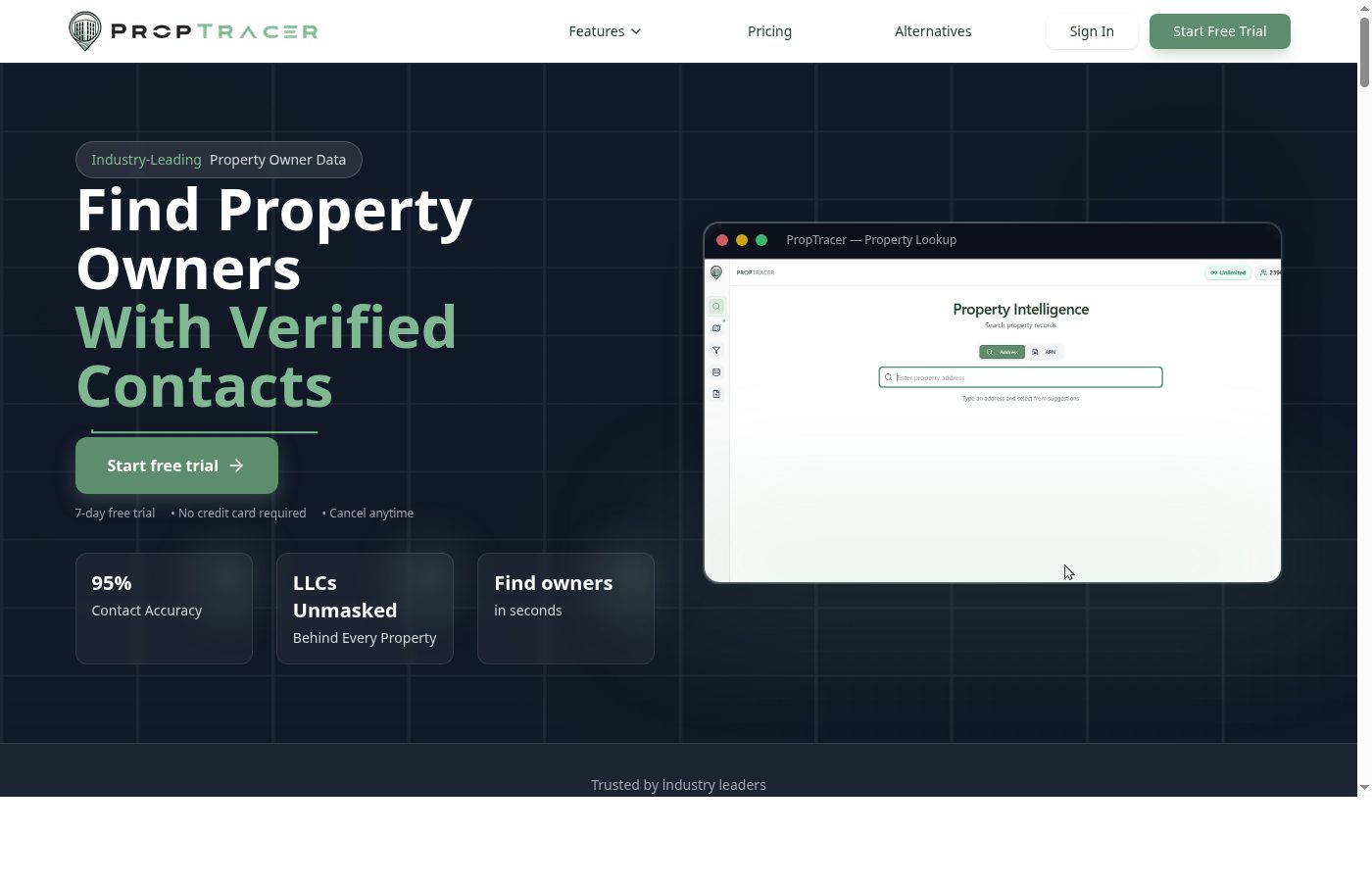
    PropTracer: Transparency Through Confidence Scoring

    PropTracer differentiates on transparency rather than raw accuracy claims. The platform’s proprietary AI algorithm provides confidence scores for all results, with published figures of 97 percent accuracy for mailing addresses and 94 percent for phone numbers. Six search modes including reverse lookups give investors flexibility in how they approach owner identification. The related contact identification feature is useful for reaching owners through multiple channels when primary contacts fail.

    The confidence scoring model is genuinely useful for investors who want to prioritize outreach based on data quality rather than treating all leads as equivalent. The primary limitation is market presence: PropTracer has less brand recognition in major investor communities than REISkip or BatchData, and independent verification of its accuracy claims is limited. Pricing varies by volume and requires direct inquiry. For detail-oriented operators willing to evaluate a less prominent platform, PropTracer warrants testing against their specific use case.

    Likely.AI: Predictive Intelligence Before the Listing

    Likely.AI occupies a distinct category: it is less a skip tracing service and more a predictive property intelligence platform that includes skip tracing as one component of an ownership monitoring workflow. Machine learning tracks ownership changes and pre-foreclosure signals, identifying property owners likely to sell weeks before traditional market indicators appear. The Skip Tracing AI for absentee owners and landlords operates within this predictive framework.

    For investors with sophisticated acquisition strategies oriented toward identifying motivated sellers before competition, Likely.AI’s predictive layer justifies its higher price point — starting at $149 per month for 2,500 property lookups. The platform is not the right tool for investors seeking bulk skip tracing at minimal cost per record. It is the right tool for operators who want to be in conversation with a property owner before that owner has decided to sell. The entry cost and the sophistication required to deploy the predictive capabilities effectively mean this platform is best suited for experienced operators with established outreach systems.

    What Investor Communities Actually Report

    Aggregating discussions from real estate investing communities across multiple forums reveals patterns that vendor marketing does not fully represent. On accuracy, REISkip and BatchData receive consistently positive mentions for hit rates. PropStream skip tracing generates frequent complaints about disconnected numbers. TLOxp is acknowledged as highly accurate — and it is, as an institutional-grade data service — but access is effectively restricted to licensed private investigators and large enterprises, making it a non-option for most investors reading this analysis.

    On pricing, pay-per-match models preferred by investors with irregular deal flow consistently outperform subscription models in satisfaction scores among smaller operators. The math is simple: a $200 per month subscription at $0.15 per match requires 1,333 successful traces per month to break even. Operators running fewer contacts than that are paying a premium for capacity they do not use. Subscription models justify themselves only when volume is consistent and monthly minimums are routinely exceeded.

    On workflow, the most experienced investors consistently report using multiple services rather than a single platform. Property data comes from one source. Contact information comes from another. Dialing and outreach management live in a third system. The convergence products that promise to handle all three in one platform have not yet delivered accuracy at each layer that matches the best-in-class specialized tools. Terrakotta AI is the notable exception — its integration specifically for commercial outreach workflows has earned genuine credibility rather than the marketing-driven enthusiasm that surrounds many all-in-one platforms.

    Recommendations by Investment Profile

    Platform selection is not a question of which tool is best in the abstract. It is a question of which tool fits the specific investor’s volume, asset class, and workflow requirements.

    For new investors running one to ten deals per year, Skipify.ai or REISkip are the logical starting points. The low cost of entry, pay-per-use pricing that aligns with irregular volume, and accuracy levels sufficient for learning the business make both defensible first choices. Skipify.ai’s free trial tier in particular removes the risk from initial evaluation.

    For active wholesalers processing 10 or more deals per quarter, the REISkip and PropStream combination emerges consistently from community recommendations. PropStream handles property research and list building at around $99 per month. REISkip delivers accurate contact data at $0.15 per successful match. The total cost scales with activity rather than demanding a fixed monthly commitment against uncertain volume.

    For commercial brokers, Terrakotta AI is the recommendation without close competition. The integrated prospecting workflow — combining owner identification, real-time verification, power dialing, and voicemail automation — is purpose-built for the commercial brokerage use case in a way that no other platform reviewed here matches. The premium is real. So is the efficiency gain for operators running consistent outbound campaigns.

    For high-volume operations processing 100 or more contacts per week, BatchData’s subscription model becomes economically rational. The team management features, speed advantages at scale, and advanced LLC and trust mapping justify the minimum monthly commitment when volume is consistent. Operators in this tier should run a parallel test against REISkip for a representative list sample before committing to any single platform, since data freshness variability affects different property types differently.

    The Bottom Line: Platform Matters as Much as Methodology

    AI has materially improved skip tracing accuracy and efficiency, but the variance across platforms is large enough that platform selection is itself a competitive variable. An investor using a purpose-built tool with 90 percent match rates and real-time verification is not just more efficient than one using a legacy service at 50 percent accuracy — they are operating in a fundamentally different acquisition environment. More connected conversations per dollar of outreach cost compounds across every campaign run through that system.

    The practical takeaway is to match platform selection to actual volume and asset class rather than defaulting to the most visible brand or the lowest per-record cost. REISkip performs well for residential and mixed-use investors who need accuracy without subscription commitments. Terrakotta AI is the choice for commercial operators who want an integrated prospecting workflow. BatchData earns its premium when volume is consistently high. PropStream belongs in the stack for property research, not as a skip tracing solution. The era of hoping for valid phone numbers from a static database is ending. The question for 2026 is which AI-native platform fits your specific acquisition model.

    For brokers, syndicators, sponsors, and investment teams evaluating tools in this category, 9AI.co partners with CRE firms to design and deploy teams of AI agents, automated workflows, and custom automations built around how your business actually operates, not how a vendor’s demo assumes it does.

    BestCRE is the practitioner-built authority on commercial real estate AI, covering 400+ tools across the 20 sectors of CRE AI. Every review is conducted independently using the 9AI Framework, nine standardized dimensions ensuring consistent, unbiased comparison across the entire CRE technology landscape. Whether you are a broker, syndicator, developer, property manager, underwriter, or investor, BestCRE is built for the professionals deploying capital and making decisions in commercial real estate.

    Frequently Asked Questions

    What is AI skip tracing and how does it differ from traditional skip tracing?

    Traditional skip tracing matches property owner names to contact information stored in static databases refreshed quarterly or less frequently. AI-powered skip tracing applies machine learning to cross-reference multiple data sources in real time, weight results by recency and source reliability, and verify contact information before delivering it to the investor. The practical difference is accuracy: legacy services typically return usable contact data for 40 to 60 percent of records, while AI-native platforms report match rates of 85 to 97 percent. The verification layer — filtering disconnected numbers before delivery — is equally important. Investors using AI skip tracing spend substantially less time dialing numbers that never connect, which means more qualified conversations per hour of outreach effort. For commercial real estate specifically, AI platforms have also developed the ability to pierce LLC ownership structures and identify beneficial owners, a capability legacy services were not designed to provide.

    How does predictive skip tracing work for identifying motivated sellers?

    Predictive skip tracing platforms like Likely.AI go beyond locating current owner contact information. They analyze ownership patterns, property distress signals, financial data, and public records to identify owners who are likely to sell weeks or months before traditional market signals appear. The machine learning model might flag a long-term absentee owner with delinquent property taxes, a recent change in the LLC’s registered agent, and no apparent recent investment in the property as a high-probability motivated seller — all before that owner has listed the property or contacted a broker. For investors with sophisticated acquisition strategies, this predictive layer means entering conversations before competition is aware the opportunity exists. The practical limitation is that predictive platforms carry higher price points and require more operational sophistication to deploy effectively than pure skip tracing services.

    Which skip tracing platform has the highest accuracy for commercial real estate?

    For commercial real estate specifically, Terrakotta AI leads in purpose-built accuracy because its platform is designed from the ground up for commercial prospecting rather than adapted from residential skip tracing workflows. It integrates real-time phone verification with confidence scoring before numbers enter the dialing queue. For investors who need a standalone accurate skip tracing service applicable across asset classes, REISkip consistently draws the strongest community validation for hit rates, claiming 85 to 90 percent match rates with a pay-per-result model that aligns incentives with accuracy. BatchData claims a 76 percent right-party contact rate — a meaningful benchmark because right-party contact is stricter than a simple match rate. The industry caveat applies across all platforms: published accuracy figures represent platform-controlled test conditions, and real-world performance varies by list quality, property type, and geographic market. Testing any platform against a representative sample of your own list before full commitment is standard practice among experienced operators.

    Will AI skip tracing platforms improve as property data becomes more fragmented?

    Yes, and the improvement trajectory is tied directly to the growing complexity of property ownership structures. As more properties transfer into LLC, trust, and fund structures — a trend accelerating in both commercial and residential real estate — the technical challenge of tracing from a property record to a contactable human being increases. AI platforms are specifically suited to this challenge because they can process signals across more data sources simultaneously than any manual or rule-based system. The platforms investing in beneficial ownership identification, corporate data mapping, and cross-database triangulation are building capabilities with increasing market relevance as ownership complexity grows. The platforms that do not evolve in this direction will see their accuracy advantage over legacy services erode as the data environment becomes more complex. The competitive differentiation will increasingly live not in raw match rates for straightforward owner identification but in the ability to resolve ownership through multi-layer entity structures.

    How should a new real estate investor choose between pay-per-use and subscription skip tracing models?

    The decision framework is simple: if your monthly skip tracing volume is consistent and exceeds roughly 1,000 to 1,500 records per month, a subscription model at a competitive per-record rate will likely cost less than pay-per-use. Below that threshold, pay-per-use aligns your costs with your actual activity and avoids paying for capacity you do not use. For new investors, pay-per-use is almost always the right starting point. It allows platform testing without financial commitment, scales with deal flow rather than demanding a fixed monthly cost regardless of activity, and preserves capital for marketing and acquisition. Skipify.ai at $0.15 per trace after a free tier and REISkip at comparable per-match pricing are designed precisely for this investor profile. Subscription platforms like BatchData make economic sense once volume justifies the monthly minimum — typically when an investor is consistently processing 100 or more contacts per week as part of a systematic outbound program.

    For more on AI tools shaping commercial real estate acquisition workflows, read Dan AI: The Retail Broker Copilot, explore CRE AI Lease Abstract Workflow, and browse the full BestCRE 20 Sectors hub.

  • Dan AI Review: The Retail Broker Copilot That Automates the Research No One Wants to Do

    Dan AI Review: The Retail Broker Copilot That Automates the Research No One Wants to Do

    A retail broker assembling a leasing pitch for a 5,000-square-foot availability spends, on average, between four and eight hours on research before the first conversation with a prospective tenant. That work involves manually pulling tenant expansion news across trade publications, checking Department of Buildings permit activity in the submarket, cross-referencing availability data from CoStar or Costar competitors, building a contact list for national retailer decision-makers, and generating a marketing package that looks professional enough to compete with what a CBRE or JLL team would produce. None of that work requires judgment. All of it requires time. The broker who bills at $250 per hour in implicit opportunity cost is spending up to $2,000 in research time on a deal that may or may not result in a commission. In competitive retail markets where three brokers are often pitching the same tenant simultaneously, the team that completes research faster and produces better materials wins the meeting.

    Dan AI is an AI copilot built specifically for retail and commercial real estate brokers. Available at meetdan.ai, the platform combines local market intelligence, real-time tenant expansion tracking, Department of Buildings data, marketing material generation, direct tenant contact data, and email workflow into a single broker workstation. A broker inputs a property address and assignment type, and Dan surfaces tenant matchmaking recommendations, current availability data synced from the broker’s existing subscriptions, tenant decision-maker contact information, and drafts professional marketing deliverables. The platform is designed to compress the research-to-pitch timeline from days to hours and the marketing material production timeline from hours to minutes.

    9AI Score: 87/100. Dan AI’s top dimension is CRE relevance: this platform was built from the ground up for retail and commercial real estate brokerage with no generic call center or horizontal SaaS heritage. The 30-day free trial and self-serve onboarding make it accessible without a sales cycle. The gap is integration depth — the platform syncs with the broker’s personal subscriptions and email but does not yet offer native connectors to the major CRE broker platforms such as Buildout, Apto, or ClientLook, which limits how tightly Dan fits into an established brokerage’s operational stack.

    Dan AI belongs to BestCRE’s CRE Brokerage and Transactions sector and is reviewed alongside the full landscape of tools in the 20 CRE sectors. For context on how AI is redefining what brokerage firms are worth to the capital markets, see BestCRE’s analysis of how AI erased $12 billion from CRE brokerage stocks — a signal that the market is already pricing in the productivity shift tools like Dan represent.

    What Dan AI Actually Does

    Dan AI is structured as a broker copilot, not a data platform. The distinction matters. A data platform sells access to information. A copilot uses information to produce something actionable. The workflow in Dan begins when a broker enters a new assignment, typically a retail space or commercial availability that needs to be leased. The system immediately draws on its integrated data environment to surface the intelligence relevant to that specific assignment.

    The tenant matchmaking engine is the platform’s primary differentiator. A broker representing a 5,000-square-foot inline retail space at a specific address can ask Dan which tenants would be a good fit, and the system analyzes the property’s location, submarket characteristics, co-tenancy, and the current tenant expansion activity tracked in real time across the platform’s data feeds to generate a ranked list of tenant candidates. This is not a static database query. It is an active analysis that weighs expansion signals, format compatibility, and market positioning to produce recommendations a broker can act on immediately.

    The tenant expansion tracking feature addresses one of the most time-consuming research tasks in retail brokerage: monitoring when national and regional retailers announce or signal new store openings. Brokers who are following expansion plans manually are reading trade publications, setting up Google Alerts, and noting regional announcements from earnings calls. Dan aggregates this activity and surfaces it in real time, with the system tracking tenant movements and expansion plans across the market. When a national retailer signals an expansion into a broker’s target market, the broker finds out through Dan before it becomes general market knowledge.

    Department of Buildings data integration is a feature that is specifically New York-centric in its current form, providing direct access to DOB permit activity, filings, and building data at a level of granularity that brokers working in New York City’s commercial and retail market use daily. The practical application is mapping where construction and buildout activity is happening, which correlates with where tenant movement and new space absorption is occurring. The DOB data layer gives a New York retail broker a competitive intelligence advantage that is not replicated in most broker research workflows without significant manual effort.

    The platform’s availability integration syncs a broker’s existing CoStar, Costar alternatives, or other subscription data into the Dan interface so all relevant market data is accessible through a single query environment. Rather than switching between platforms to cross-reference availability, the broker pulls everything through Dan. The email connectivity feature connects the broker’s business email to manage prospect communications directly within the platform, keeping deal context attached to contact records rather than scattered across an inbox.

    Marketing material generation is where the platform’s practical time savings are most measurable. A broker who needs to produce a property flyer, a tenant overview deck, or a leasing proposal can generate professional-grade deliverables through Dan’s marketing template engine. The system uses the property data, tenant information, and availability details already in the platform to populate these materials automatically. The output is described as simplified professional-grade deliverables — serviceable marketing materials that can be sent to prospects or used as the starting point for more detailed custom work.

    The direct tenant contact data feature provides access to decision-maker contact information for national retailers and beyond, which addresses one of the most persistent friction points in retail brokerage: finding the real estate decision-maker at a retailer rather than the general inquiry inbox. For a broker pitching a space directly to a national tenant without the benefit of a pre-existing relationship, Dan’s contact database is the difference between a cold outreach that lands in front of the right person and one that disappears into a corporate mailroom.

    What CRE Practitioners Gain. The most concrete time recovery is in tenant matchmaking research. An experienced retail broker currently spends between two and four hours building a targeted tenant list for a new leasing assignment from scratch, cross-referencing expansion news, format requirements, and co-tenancy preferences manually. Dan compresses that work to minutes. On a broker handling 20 active assignments simultaneously, that recovered time compounds to 40 to 80 hours per month. At the deal velocity that matters, the broker who can prepare a more complete and current tenant analysis in a fraction of the time wins more meetings. The risk reduction is in missed expansion signals: a broker who is not systematically monitoring tenant expansion activity will periodically lose a commission to a competing broker who moved faster on the same tenant. The competitive edge is contact access: direct decision-maker contact data for national retailers is a meaningful advantage in retail brokerage where the difference between a warm outreach and a cold one is often the difference between a response and silence.

    9AI Score Card Dan AI
    87
    87 / 100
    Recommended
    CRE Brokerage and Transactions
    Dan AI
    Purpose-built retail and CRE broker copilot with real-time tenant expansion tracking, DOB data, and automated marketing generation. Strong CRE relevance and transparent pricing. Integration with major brokerage CRM platforms is the primary gap to close.
    9 Dimensions — Scored 1 to 10
    1. CRE Relevance
    9/10
    2. Data Quality & Sources
    6/10
    3. Ease of Adoption
    7/10
    4. Output Accuracy
    6/10
    5. Integration & Workflow Fit
    6/10
    6. Pricing Transparency
    7/10
    7. Support & Reliability
    5/10
    8. Innovation & Roadmap
    6/10
    9. Market Reputation
    4/10
    BestCRE.com — 9AI Framework v2 Reviewed March 2026

    The 9AI Assessment: 87/100

    CRE Relevance: 9/10

    Dan AI was built for retail and commercial real estate brokerage from the first line of product code. The feature set — tenant matchmaking, DOB data, shopping center analysis, tenant expansion tracking, and marketing material generation — maps directly onto the daily workflow of an active retail leasing broker. There is no adaptation from a general sales intelligence platform or a generic AI assistant. The platform’s framing as a broker copilot rather than a data product is consistent with a genuine understanding of how retail brokers operate: they need recommendations and deliverables, not raw data dashboards. The 9 reflects a genuinely CRE-native architecture with a slight deduction for the current concentration on retail and New York City-specific features such as DOB data, which limits the addressable user base compared to a fully multi-market commercial platform. In practice: a retail leasing broker in New York City working 20 or more active assignments simultaneously gets the maximum value from this platform today. A suburban office broker in the Midwest gets the tenant matchmaking and marketing generation features but misses the DOB-specific intelligence layer.

    Data Quality and Sources: 6/10

    Dan AI’s data environment combines the broker’s existing subscription data — synced through the availability integration feature — with real-time tenant expansion tracking and DOB records. The platform does not publish its methodology for identifying tenant expansion signals, the sources feeding its tenant movement data, or the refresh cadence for its contact database. The tenant matchmaking recommendations are generated from a combination of this data, but the weighting and validation approach is not disclosed. For a broker evaluating whether a tenant recommendation is current and accurate, the lack of source transparency is a practical limitation. In practice: the broker who cross-references Dan’s tenant matchmaking output with their own market knowledge and current CoStar availability data will get more reliable results than the broker who accepts the recommendations without verification. The platform is most trustworthy as a research accelerator that generates candidates for further validation, not as a definitive source.

    Ease of Adoption: 7/10

    The 30-day free trial with self-serve signup is the platform’s clearest signal of an accessible, low-friction onboarding path. A broker can create an account, connect their email, and begin running tenant analyses on active assignments within a single session without talking to a sales representative. The interface is query-driven and natural — brokers enter assignments in conversational terms, as evidenced by the example prompt on the homepage: “I have a new 5,000SF retail assignment located at 33 East 33rd Street NYC, what tenants would be good here?” That interaction model requires no training manual. In practice: a retail broker who signs up for the free trial on Monday should be running meaningful tenant analyses on their actual active assignments by Wednesday. The adoption friction sits primarily in the subscription sync setup, where brokers who use multiple data platforms need to connect their accounts before getting full availability data integration.

    Output Accuracy: 6/10

    Dan AI does not publish accuracy benchmarks, case studies with specific outcome metrics, or third-party validation of its tenant matchmaking recommendations. The platform describes itself as providing access to “the most reliable data in your target markets” but does not define reliability relative to a benchmark. The marketing material generation output is the most immediately verifiable accuracy dimension: a broker can inspect a generated flyer or proposal and determine whether the information is correct and the format is professional. The tenant contact data accuracy is the dimension most sensitive to freshness — retail real estate decision-maker contact information changes frequently as organizational structures shift. In practice: brokers should treat Dan’s tenant contact data as a starting point for verification rather than a send-ready contact list, particularly for national retailers with complex internal real estate department structures.

    Integration and Workflow Fit: 6/10

    Dan AI integrates with the broker’s email client and syncs existing subscription data from platforms the broker already pays for. These integrations are practical and reduce the data fragmentation problem meaningfully. The gap is native connectivity with the CRE brokerage platforms that serve as the system of record for most brokerage teams: Buildout, Apto, ClientLook, and the CRM layers built on top of Salesforce or HubSpot that larger brokerages use. A broker who generates a tenant list and drafts a marketing flyer in Dan then needs to manually transfer that work into their CRM deal record. Until Dan connects to these downstream systems, it operates as a research and production layer that sits alongside the operational system rather than inside it. In practice: the integration gap is manageable for an independent broker who does not use a brokerage CRM and manageable with extra steps for a team broker whose firm mandates Buildout or a similar platform for transaction tracking.

    Pricing Transparency: 7/10

    Dan AI has a pricing page and a 30-day free trial prominently visible on the homepage. This is a meaningful commitment to transparency relative to the custom-only pricing that most early-stage CRE platforms default to. The specific tier pricing was not accessible for independent verification at the time of this review, but the existence of a published pricing structure and a free trial path means a broker can evaluate cost-benefit fit before engaging a sales conversation. In practice: the free trial removes the most significant barrier to evaluation for an independent retail broker. Try it for 30 days on actual assignments and determine whether the tenant matchmaking output, contact data, and marketing generation save enough research time to justify the subscription cost.

    Support and Reliability: 5/10

    Dan AI has a FAQ page and a contact page. There is no published SLA, no documented support tier structure, no help center beyond basic FAQ content, and no status page for platform availability monitoring. The company is an early-stage startup operating in 2025. The support infrastructure reflects that stage. For an independent broker whose primary risk from platform downtime is losing research time on a single assignment, the support gap is manageable. For a brokerage team that has built Dan into its standard workflow across 15 or 20 brokers, the absence of enterprise support commitments is a legitimate procurement concern. In practice: the support question matters most when a broker is preparing for a significant pitch deadline and the platform is unavailable. There is currently no documented escalation path for that scenario.

    Innovation and Roadmap: 6/10

    Dan AI is clearly an AI-native product rather than a legacy platform with AI features bolted on, which is a meaningful quality signal. The platform architecture — a conversational broker copilot that synthesizes multiple data sources into actionable recommendations — reflects a genuine product vision for where retail brokerage technology is going. No public funding information is available, which limits the innovation signal. The 2025 founding date and the product maturity visible in the available features suggest an active development team. No public changelog or roadmap is accessible without a login, which reduces visibility into the velocity of product iteration. In practice: the absence of public funding news means operators evaluating Dan for team-wide deployment should ask the company directly about runway, development velocity, and planned feature additions before committing to a multi-seat subscription.

    Market Reputation: 4/10

    Dan AI does not yet have a presence on G2 or Capterra. There is no trade media coverage in GlobeSt, Bisnow, or The Real Deal at the time of this review. The platform describes itself as serving “top brokers and teams” but does not name clients. The LinkedIn company page is active. This is an accurate description of a platform that has built a real product and found early adopters but has not yet developed the third-party validation ecosystem that establishes category presence. In practice: a broker evaluating Dan for personal use can make that decision based on the 30-day free trial without needing third-party validation. A brokerage principal evaluating Dan for team-wide deployment should ask for client references before committing at scale.

    Who Should Use This (and Who Should Not)

    Dan AI belongs in the workflow of retail leasing brokers who are individually managing 10 or more active assignments in markets where tenant expansion tracking, shopping center analysis, and direct tenant contact access create a meaningful competitive advantage. The platform is most powerful for brokers operating in dense urban retail markets, particularly New York City where the DOB data integration adds a layer of intelligence that is genuinely valuable and not easily replicated manually. Boutique retail brokerage shops that do not have the research infrastructure of a CBRE or JLL team — and therefore rely on individual brokers to run their own research — are the highest-value users. The 30-day free trial means the evaluation cost is time rather than money, which makes this a no-risk assessment for any active retail broker.

    Brokers who should hold off are teams whose firms mandate a specific CRM or brokerage platform for all deal activity and who need native integration before any new tool goes into production. Office, industrial, and multifamily brokers will find limited applicability in the current feature set, which is built around retail tenant dynamics. Brokerage principals evaluating Dan for firm-wide deployment should request client references and a product roadmap conversation before committing, given the limited third-party validation currently available.

    Pricing Reality Check

    Dan AI has a pricing page and a 30-day free trial. For a retail broker billing at $200 to $400 per hour of implied opportunity cost, the platform pays for itself if it recovers two or three hours of research time per month. At the deal economics of a typical retail leasing transaction, one additional tenant meeting generated through a Dan-assisted research process that produces a commission represents a 10x or greater return on annual subscription cost at almost any price point below $500 per month per seat. The economics are straightforward for active retail brokers. The question is not whether the math works in principle but whether the tenant matchmaking quality and contact data freshness are reliable enough in practice to generate meetings that would not have happened through the broker’s existing research workflow.

    Integration and Stack Fit

    Dan AI connects to the broker’s email for communications management and syncs availability data from existing subscriptions. The practical workflow is: run tenant analysis and build contact list in Dan, execute outreach through the connected email interface, then transfer finalized prospect records into the brokerage CRM manually. This two-step process is a friction point for high-volume brokers but workable given the time savings generated earlier in the research phase.

    The Competitive Landscape

    Dan AI’s closest competitors in the retail broker intelligence category are Buildout Prospect, GrowthFactor, and the general-purpose AI assistants brokers have assembled from ChatGPT and CoStar’s own AI features. None replicate Dan’s specific combination of tenant matchmaking, DOB data, contact enrichment, and marketing material generation in a single broker-facing interface. DealGround addresses a similar fragmentation problem for broader CRE prospecting but is not specifically oriented around retail tenant dynamics and shopping center analysis the way Dan is. The competitive moat Dan is building is the retail-specific data layer and a natural-language query interface that makes it accessible to brokers who are not data platform power users.

    The Bottom Line

    Dan AI earns its 87/100 score through a genuinely CRE-native architecture, a 30-day free trial that removes the evaluation barrier, and a feature set that maps directly onto the research and production work consuming the most non-billable time in an active retail leasing practice. The gaps are real: CRE CRM integration is missing, third-party validation is thin, and the DOB data advantage is currently concentrated in New York City. But for the retail broker evaluating whether AI can materially improve their research and pitch preparation workflow, Dan is one of the most purpose-fit tools in the current market. The brokers who get the most from it are the ones who have rebuilt their new-assignment intake workflow around the platform so that every research question that used to take hours now takes minutes.

    For brokers, syndicators, and investment teams looking to design AI-native workflows across the full CRE stack, 9AI.co partners with firms to build custom AI agent systems and automated pipelines built around how their business actually operates.

    BestCRE delivers data-driven CRE analysis anchored in research from CBRE, JLL, Cushman & Wakefield, and CoStar. We go deep on AI and agentic workflows across all 20 sectors, so everyone from institutional fund managers to individual brokers and investors can find an edge in a market that's changing fast.

    Frequently Asked Questions

    What is Dan AI and what does it do for commercial real estate brokers?

    Dan AI is an AI-powered broker copilot built specifically for retail and commercial real estate leasing teams, available at meetdan.ai. The platform combines real-time tenant expansion tracking, intelligent tenant matchmaking, Department of Buildings data, direct decision-maker contact information for national retailers, marketing material generation, and email connectivity into a single workstation. A broker inputs a new assignment and Dan surfaces a ranked list of tenant candidates, current expansion signals, decision-maker contacts, and automatically generated marketing deliverables. The platform compresses the tenant research and pitch preparation workflow from multiple days of manual work to a single session.

    How does Dan AI help retail brokers find and close more tenants?

    Dan AI improves tenant conversion through three compounding advantages. The tenant matchmaking engine identifies candidates based on active expansion signals rather than static demographic data. The direct contact enrichment feature provides decision-maker contact information for national retailers, eliminating the cold-outreach identification barrier. The marketing material generation feature allows a broker to produce a professional leasing package within the same session as the research. A broker who used to spend a full day preparing for a new assignment can be outreach-ready within two to three hours of entering the assignment into Dan. On a broker handling 20 active assignments simultaneously, that recovered time compounds to 40 to 80 hours per month — time that returns to relationship management, site tours, and negotiation rather than data aggregation.

    What markets and property types does Dan AI cover?

    Dan AI is built primarily for retail leasing and commercial real estate brokerage. The tenant matchmaking, expansion tracking, and shopping center analysis features are most directly applicable to inline retail, anchor spaces, strip centers, mixed-use ground floor retail, and regional mall vacancies. The Department of Buildings data integration is currently strongest for New York City, making the platform particularly valuable for brokers working in the five boroughs. Brokers in other major markets get the tenant matchmaking, contact data, and marketing generation features without the DOB intelligence depth. Office, industrial, and multifamily brokers will find limited native applicability in the current product architecture.

    How does Dan AI compare to other CRE broker AI tools like Buildout or DealGround?

    Dan AI occupies a distinct position relative to other broker AI tools on the market. Buildout Prospect focuses on ownership research and outbound prospecting with strong CRM integration but limited retail-specific tenant intelligence. DealGround positions itself as an AI-native intelligence command center for ownership research, OM processing, and deal sourcing across asset classes, with particularly strong data infrastructure at 160 million title records and 7 million tenant records. Neither platform is built around the specific workflow of retail tenant matchmaking and shopping center leasing the way Dan is. The right comparison framework is not which platform has more data but which fits most directly into the specific leasing workflow being automated. For a retail broker in New York City managing 15 active assignments, Dan is the more purpose-fit tool. For a capital markets broker tracking ownership across multiple asset classes nationally, DealGround is the stronger fit.

    How do you get started with Dan AI and what does it cost?

    Dan AI offers a 30-day free trial with self-serve signup at meetdan.ai. No sales conversation is required to begin the evaluation. A broker can create an account, connect their email, sync their existing CoStar or equivalent subscription, and begin running tenant analyses on active assignments immediately. The platform has a pricing page with published tiers. The evaluation approach most likely to produce a useful signal is to select three to five active assignments where tenant research has already been completed manually, run those same assignments through Dan, and compare the quality and completeness of the tenant candidate lists. If Dan’s output is comparably useful and required a fraction of the time, the subscription economics are straightforward for any broker closing one or more retail leases per year.

    For related BestCRE coverage, see the LandScout AI review for an early-stage CRE AI platform in the entitlement intelligence space, and the full 20 CRE sectors hub for the complete landscape of AI tools across commercial real estate.