BestCRE 9AI Score
69/100 · Niche
TreasuryView ranks #293 of 425 commercial real estate AI tools scored on the 9AI Framework. Nine dimensions, each scored out of 10: CRE relevance, data quality, ease of adoption, output accuracy, integration fit, pricing transparency, support, innovation and market reputation.
TreasuryView is debt and treasury management software for finance teams, fund managers and property owners that have outgrown spreadsheet based loan administration. Its practical CRE use is straightforward: consolidate bank debt, intercompany loans, deposits and cash pools, then calculate interest, accruals, repayments and balances from one controlled system. The product targets the recurring work between loan closing and accounting, when finance staff must monitor changing rates, upcoming payments, facility availability and reporting dates across multiple entities.
For a CRE owner, that workflow can become difficult well before the portfolio is institutionally large. A workbook may contain loan terms, another file may hold rate resets, and separate schedules may support monthly close, lender reporting and cash forecasts. TreasuryView replaces much of that repeated assembly. Users can enter loans directly, upload a structured Excel template, create records through an API or use an AI assisted import process that is identified as beta.
The strongest part of the proposition is specialization. TreasuryView is not presenting itself as a broad property management platform or a loan origination marketplace. It concentrates on borrower side debt administration, including fixed and floating rates, several repayment structures, commitment fees, undrawn amounts and loans with multiple legs. That focus makes the product more relevant to CRE finance than a generic treasury application, although its broader positioning still includes other industries and intercompany finance teams.
BestCRE analysis: TreasuryView looks most credible as a controlled calculation and reporting layer for an owner that needs more discipline than Excel but does not need a large enterprise treasury management system. Published entry pricing and a self service trial reduce procurement friction. The main reservations are its limited public market footprint, thin published evidence about implementation support and an AI capability that should be evaluated as an assisted data entry feature, not autonomous treasury management.
What TreasuryView Does and How It Works
TreasuryView stores the contractual inputs needed to model each borrowing arrangement. Supported structures include fixed and floating rate loans, bullet, linear and annuity repayments, deposits, cash pools, refinancings and construction to term facilities. A record can contain multiple legs with separate currencies and terms. The system then produces schedules showing rates, interest, accrual days, repayments and outstanding balances. Users can adjust payment rows to reconcile the modeled schedule with a bank statement, an important control when actual cash movements differ from the original agreement.
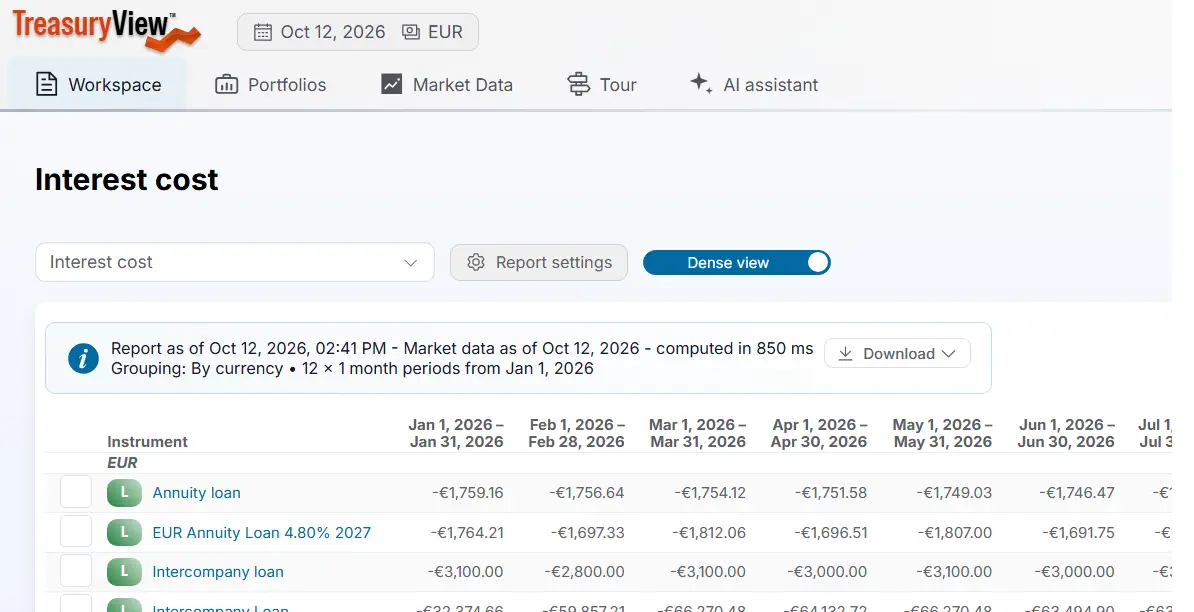
Reporting is organized around a selected date rather than a static spreadsheet tab. A finance team can calculate balances, accrued interest, cash flows, next payments, reset dates and maturities for the relevant period, then filter or group the results. Floating rate instruments use market rates available through the product’s Market Data Hub. Reports can be exported to Excel, preserving a familiar downstream format for controllers, auditors and investment teams. TreasuryView also advertises derivative valuation and interest rate risk functions, but buyers should verify instrument coverage, valuation methods and governance against their actual hedge portfolio.
Loan creation can begin with a form, an Excel template, an API or AI assisted import. In the beta import workflow, the system analyzes an uploaded spreadsheet, extracts instrument details, presents the populated record for verification and imports it after review. That human checkpoint matters because debt documents contain amendments, definitions and conditional terms that may not appear cleanly in a source table. BestCRE analysis: the useful automation is not merely extracting fields. It is converting approved terms into repeatable calculations for every reporting date. Buyers should test day count conventions, rate floors, lookback rules, fees, irregular periods and amendment histories before relying on the resulting schedules.
9AI Framework: Dimension by Dimension Analysis
CRE Relevance: 8/10
TreasuryView earns an 8 for CRE relevance because its central problem is familiar to borrowers and fund managers: controlling debt terms, interest calculations, facility capacity and payment schedules across entities and properties. Construction to term structures, multiple loan legs, commitment fees and undrawn amounts are particularly pertinent to real estate ownership. The platform is CRE native in its use case, even though it also serves general finance teams and public sector users. It does not appear to extend into underwriting, property operations, rent rolls, valuations or lender origination. BestCRE analysis: this is a strong fit for the treasury layer of a CRE stack, not a complete financing platform. The score stops short of the top range because buyers will still need other systems for asset data, covenant source documents, accounting and investment performance.
Data Quality and Sources: 7/10
TreasuryView earns a 7 for data quality. It can centralize loan terms, apply market rates and maintain calculation inputs in a more controlled form than loosely governed workbooks. Structured templates, direct entry and API creation offer sensible ways to establish records. The AI assisted import includes a verification step, which is appropriate because extracted data should not enter a debt register without review. However, the quality of the output remains dependent on complete source terms, correct amendments and accurate user approval. The vendor does not publish independent error studies, extraction benchmarks or detailed data lineage standards. BestCRE analysis: the underlying model appears fit for conventional debt administration, but buyers should run a parallel validation against loan agreements and existing schedules. Complex definitions and document exceptions are where otherwise clean debt data tends to fail.
Ease of Adoption: 8/10
TreasuryView earns an 8 for ease of adoption. It offers direct entry, spreadsheet upload, an Excel template, an API and assisted import, so teams can choose a migration route that matches the condition of their current debt register. A free trial, no required credit card and published monthly plans create a relatively low friction buying path. The interface is positioned around recognizable finance tasks rather than a long enterprise implementation. BestCRE analysis: adoption should be easiest for a finance team with a clean workbook and clearly assigned loan ownership. It will be harder when terms are scattered through PDFs, amendments, emails and bank statements. The vendor states that teams can begin quickly, but buyers should treat migration, reconciliation and approval design as real implementation work. Ease of signup is not the same as readiness for financial reporting.
Output Accuracy: 7/10
TreasuryView earns a 7 for output accuracy. Its calculated schedules reduce risks associated with broken spreadsheet references, copied formulas and manually entered reference rates. Reporting by a chosen date should also improve consistency between monthly close periods. Still, output accuracy cannot be assumed merely because calculations are automated. Loan agreements may contain nonstandard day counts, floors, margins, business day adjustments, delayed draw mechanics, capitalization provisions and amendments. Derivative valuation creates an additional standard of scrutiny. The vendor does not publish an independent assurance report on calculation accuracy or public benchmark results for modeled instruments. BestCRE analysis: TreasuryView can become a dependable calculation source after configuration and testing, but each material instrument should be reconciled before production use. Buyers should also establish review controls for rate sources, schedule overrides and changes to contractual terms.
Integration and Workflow Fit: 6/10
TreasuryView earns a 6 for integration. The published REST API can pass data to accounting software, while Excel export supports familiar reporting and reconciliation workflows. API based loan creation also creates options for connecting an internal data warehouse or transaction system. These are useful foundations, but the publicly described integration story is not yet broad enough to assume direct connectivity with the major CRE accounting, property management and investment management platforms. The vendor does not publish a comprehensive catalog of certified CRE integrations. BestCRE analysis: technical teams can probably connect TreasuryView where a capable API and controlled exports are sufficient. Buyers seeking packaged connections to Yardi, MRI, fund accounting systems or lender portals should ask for exact references and data flow diagrams. The score reflects workable openness, not a proven plug and play ecosystem.
Pricing Transparency: 8/10
TreasuryView earns an 8 for pricing transparency because it publishes a starting point of €250 per month, offers a 30 day trial and states that plans can be canceled monthly. That is materially clearer than the quote only approach common in financial software. The published starting price does not reveal every cost driver, however. Buyers still need to confirm user limits, instrument limits, entity limits, market data charges, derivative functionality, FX features, API access, onboarding and support tiers. The vendor also needs to explain whether pricing changes with portfolio complexity or enterprise requirements. BestCRE analysis: the entry point is transparent enough for initial budgeting and comparison, but it is not a complete total cost schedule. A serious evaluation should request a written configuration and renewal quote based on expected loans, entities, currencies and integrations.
Support and Reliability: 6/10
TreasuryView earns a 6 for support. The company publishes support, knowledge base and learning center destinations, indicating that users have self service resources available. The relatively direct product model may also reduce dependence on consultants for a basic deployment. What is not publicly established is equally important: the vendor does not publish detailed response commitments, escalation procedures, implementation staffing, support hours or named customer success coverage for each plan. BestCRE analysis: this is probably adequate for a capable finance team managing conventional instruments, but support quality should be tested during the trial rather than inferred from website resources. Buyers should submit a realistic modeling question, ask for help reconciling a schedule and observe the speed and precision of the response. Enterprises should also request contractual service levels, incident communication practices and business continuity procedures.
Innovation and Roadmap: 7/10
TreasuryView earns a 7 for innovation. Its best idea is not replacing treasury judgment with AI. It is combining assisted loan import, market rate application, repeatable calculations and date specific reporting in a focused borrower workflow. The AI import can reduce initial data entry when the source spreadsheet is reasonably structured, while the verification stage preserves human responsibility. The company also signals an upcoming AI based treasury assistant, but a future label is not evidence of a production capability. BestCRE analysis: TreasuryView is applying current automation methods to a neglected middle market process with good practical judgment. It does not yet demonstrate an AI advantage that competitors could not reproduce. The score recognizes useful workflow design and controlled assistance, while withholding credit for announced functions until their accuracy, permissions, audit history and customer value can be evaluated.
Market Reputation: 5/10
TreasuryView earns a 5 for market reputation. The product addresses a credible problem and presents specific capabilities, but the vendor has a limited public profile compared with established CRE software and treasury management providers. It does not publish a substantial CRE customer roster, audited adoption figures or a broad set of detailed case studies. Public information about company scale and long term operating history is also limited. One attributed user comment is not enough to establish market standing across institutional real estate. BestCRE analysis: buyers should view TreasuryView as a promising specialist that still requires vendor diligence. Ask for references from organizations with similar debt structures, reporting obligations and accounting environments. The score is intentionally restrained because product fit can be strong even when market validation remains early. A larger body of verifiable CRE deployments would support a higher rating.
Who Should Use TreasuryView
TreasuryView best suits a CRE owner, operator or fund manager whose finance team maintains a growing debt register in Excel and repeatedly rebuilds interest, accrual and cash flow schedules. The strongest buyer profile has multiple bank facilities or intercompany loans, floating rates, several legal entities and recurring reporting dates, but lacks the need or budget for a broad enterprise treasury platform. A controller, finance director or treasury manager should own the system, with documented review responsibility for imported terms and schedule changes.
It also suits lean investment managers that need clearer visibility into balances, maturities, rate resets, undrawn capacity and commitment fees without buying a full property management suite. The system may be especially useful when construction financing converts into permanent debt or one facility contains multiple legs. BestCRE analysis: buyers will obtain the most value when debt administration is a visible monthly burden, source data is reasonably organized and Excel remains an accepted reporting destination. A successful customer will treat TreasuryView as a controlled debt subledger and calculation layer, while maintaining contractual documents and accounting records in their proper systems.
Who Should Not Use TreasuryView
TreasuryView is not the best fit for a lender seeking origination, borrower intake, underwriting, servicing workflows or collateral inspections. It is designed around the borrower’s debt and treasury view. A CRE firm primarily looking for property accounting, lease administration, asset management, waterfall calculations or portfolio valuation should also begin elsewhere. Those functions sit outside the product’s stated center of gravity.
Large institutions requiring extensive bank connectivity, payment execution, global cash positioning, complex hedge accounting and a mature catalog of packaged integrations may need a broader treasury management system. Very small owners with only one or two simple fixed rate loans may not save enough time to justify another system. BestCRE analysis: firms with heavily negotiated instruments should avoid committing until they have modeled their hardest examples. If the system cannot represent the agreement’s actual rate mechanics, amendments and fees, attractive reporting will not compensate for an incomplete debt record.
Pricing and ROI Analysis
TreasuryView publishes monthly SaaS plans starting at €250 and offers a full functionality free trial. It states that the trial ends automatically, requires no credit card and can be started without consultants. That provides an unusually testable entry path for this category. The starting figure should not be mistaken for a final enterprise quote. The vendor does not publish complete pricing for every plan, feature, integration, support level or portfolio configuration. Buyers should confirm whether market data, API access, derivatives, FX functions, onboarding and additional users or instruments create separate charges.
BestCRE analysis: simple ROI math should use fully loaded staff cost and verified time saved, not vendor averages. If a finance professional costs the organization €60 per working hour and TreasuryView removes five hours of recurring work each month, the gross labor benefit is €300 per month. At the published entry price, that hypothetical case roughly covers the subscription before considering implementation, review time or error reduction. A team should measure its current monthly process during the trial, include reconciliation and approval effort, then compare the result with a written annual cost. The purchase case is strongest when it removes repeated schedule construction rather than merely moving the same manual work into another interface.
Integration and CRE Tech Stack Fit
TreasuryView can export results to Excel and pass information to accounting software through a REST API. Those two routes cover common CRE requirements: spreadsheet based review for asset and finance teams, plus structured exchange with accounting or internal reporting systems. The API also supports creating loan records, which can reduce duplicate entry when a firm has an established data platform. Buyers should define which system owns contractual terms, calculated interest, actual cash payments and journal entries before connecting anything.
The vendor does not publish a comprehensive list of direct integrations with major CRE platforms. BestCRE analysis: assume that connections to Yardi, MRI, investment management tools, data warehouses or lender systems will require validation and possibly internal development. Ask for authentication methods, field documentation, update behavior, error handling and audit logs. A practical architecture is to keep TreasuryView as the debt calculation layer, send approved outputs to accounting and analytics, and retain signed loan documents in the firm’s document repository. Avoid creating competing master records across all three.
Competitive Landscape
LoanBoss is the closest specialist comparison for a CRE borrower that wants loan administration, covenant awareness and portfolio level debt visibility. TreasuryView appears more broadly treasury oriented, with intercompany loans, market rates, cash pools, FX options and derivative functions in its scope. The choice should turn on instrument modeling, reporting controls and accounting fit, not feature count. A buyer should load the same complex facility into both products and compare setup effort, schedule results and amendment handling.
Pereview Software is a broader real estate investment management alternative. It can be more appropriate when debt data must sit beside assets, funds, valuations and investment reporting. Yardi, including its Virtuoso capabilities and wider product ecosystem, is relevant for firms already centered on Yardi accounting and operations. Those platforms may reduce system fragmentation, but they also represent a larger operational commitment than a focused debt tool.
Trepp, CRED iQ and Blooma serve different parts of the CRE credit information and underwriting market, while Rabbet and Land Gorilla concentrate more heavily on construction finance workflows. Snapdocs, Maxwell and CommLoan address transaction, mortgage or lending processes rather than borrower treasury administration. BestCRE analysis: TreasuryView should win when the requirement is controlled borrower side debt calculation without adopting a full enterprise suite. It should lose when proprietary market intelligence, lender origination, construction draw administration or native property accounting is the primary job.
The Bottom Line
TreasuryView is worth a trial for a CRE finance team that spends meaningful time maintaining loan schedules, looking up floating rates and rebuilding period reports in spreadsheets. Its domain fit, published entry price and multiple import paths make evaluation unusually practical. Treat the product as a debt calculation and reporting system, not as a substitute for source agreements, accounting controls or treasury judgment.
BestCRE analysis: proceed if the platform can reproduce your most complicated loans and produce reconcilable outputs with an acceptable approval trail. Require written answers on security, support, integrations, rate sources and total pricing before committing. Pass if you need a full lender workflow, comprehensive property software or institutional treasury infrastructure. TreasuryView’s current limitation is not the clarity of its use case. It is the amount of independent market evidence available to confirm performance at scale.
About BestCRE
BestCRE.com is the definitive authority on commercial real estate AI, analysis, and investment intelligence. Every article advances the platform’s mission to help CRE professionals identify, evaluate, and adopt the best tools and strategies in the industry. We benchmark platforms using the 9AI Framework so CRE leaders can compare tools with clear evidence. Explore the category map at 20 CRE sectors for deeper coverage across the CRE stack.
Frequently Asked Questions
What is TreasuryView?
TreasuryView is cloud based debt and treasury management software for finance teams that want to replace spreadsheet based loan tracking. For commercial real estate owners and fund managers, it centralizes bank facilities, intercompany loans, deposits and cash pools. Users record contractual terms, and the system calculates interest, accruals, repayment schedules and balances for a selected reporting date. It also tracks items such as upcoming payments, rate resets, maturities, undrawn amounts and commitment fees. Results can be exported to Excel or exchanged with other software through an API. BestCRE analysis: its strongest role is as a borrower side debt subledger and calculation layer. It is not a property management system, lender origination platform or replacement for signed credit agreements.
How does TreasuryView compare with LoanBoss and Yardi?
TreasuryView and LoanBoss are the most direct comparisons when a CRE borrower wants better control of a debt portfolio. TreasuryView emphasizes bank and intercompany loan calculations, market rates, treasury reporting and broader functions such as FX and derivative analysis. Buyers should compare how each product handles their actual facility structures, amendments, fees, covenants and reporting controls. Yardi is a broader ecosystem spanning property operations and accounting, making it more attractive when debt information must remain inside an established Yardi environment. Pereview is another option when investment and asset data need to share a wider platform. BestCRE analysis: choose TreasuryView for focused borrower treasury work, and choose a broader suite when integrated property or fund operations matter more than rapid debt system adoption.
How much does TreasuryView cost?
TreasuryView publishes SaaS plans starting at €250 per month. It also offers a free trial that does not require a credit card and ends automatically. The vendor does not publish a complete price matrix covering all users, instruments, entities, support tiers, market data, integrations or enterprise features. Prospective customers should request a written quote based on their actual debt portfolio and confirm whether API access, derivative valuation, FX functions, onboarding or added capacity cost extra. BestCRE analysis: the visible starting price makes TreasuryView easier to budget than quote only products, but total cost still requires diligence. Use the evaluation period to measure actual labor reduction and reconciliation effort, then compare those results against the full subscription and implementation cost.
Who should use TreasuryView for commercial real estate?
TreasuryView is best suited to CRE owners, operators and fund managers whose finance teams administer several loans, entities or rate structures in spreadsheets. It becomes more useful when the portfolio includes floating rates, intercompany debt, construction to term facilities, commitment fees, undrawn capacity or recurring lender and management reports. Controllers, treasury managers and finance directors are the most natural system owners. Firms with one simple loan may find the platform unnecessary, while institutions needing payment execution, extensive bank connectivity or global hedge accounting may require a larger treasury suite. BestCRE analysis: the ideal customer has enough debt complexity to make manual schedules risky and repetitive, but wants a focused system that can be adopted without a major enterprise software program.
Will TreasuryView’s AI replace manual loan setup?
TreasuryView’s AI assisted import is designed to read an existing spreadsheet, extract instrument details and populate a loan record for verification. It is identified as beta, so buyers should expect human review rather than autonomous setup. The company also promotes an upcoming AI treasury assistant, but production scope, accuracy and release details are not published. BestCRE analysis: the near term value of AI is reducing transcription, not interpreting every provision in a credit agreement. Amendments, rate floors, irregular periods, fee definitions and conditional clauses still require finance or legal review. Buyers should test the import on representative files, record every correction and confirm that the approved terms produce accurate schedules. Future AI functions deserve credit only after permissions, audit trails and measurable performance are demonstrated.
Related Reviews
Compare TreasuryView with other tools BestCRE has scored in the same category: Snapdocs, Maxwell, Trepp. Explore more CRE AI tool reviews in our Best CRE AI Tools directory. For sector-specific analysis and market intelligence, visit our 20 CRE Sectors hub.