Category: CRE Legal, Compliance & Due Diligence

  • Imprima Review: AI-enabled virtual data room for secure real estate due diligence

    Imprima Review: AI-enabled virtual data room for secure real estate due diligence

    BestCRE 9AI Score

    82/100 · Contender

    Imprima ranks #70 of 232 commercial real estate AI tools scored on the 9AI Framework.

    Imprima is a secure, AI-enabled virtual data room (VDR) provider designed specifically for real estate and M&A transactions, with published pricing starting at €250 per month. Founded in 2001 and headquartered in London, the company has evolved from a traditional data repository into an automated due diligence platform. Rather than offering a generic file-sharing service, Imprima embeds proprietary artificial intelligence directly into the VDR environment. This native integration allows deal teams to execute document indexing, redaction, translation, and contract review without exporting sensitive files to third-party applications. The platform targets mid-market to enterprise commercial real estate firms, brokerages, and legal teams managing complex asset sales, capital raising, or portfolio management.

    Analysis indicates that Imprima occupies a distinct position in the CRE technology stack. While standalone contract analysis tools require users to maintain separate environments for storage and review, Imprima consolidates these functions. The system utilizes machine learning to automate repetitive tasks that historically consumed hundreds of billable hours during the due diligence phase. High-profile clients, including Cushman & Wakefield and JLL, utilize the software to manage large-scale property transactions. For a commercial real estate analyst or principal evaluating software in August 2026, Imprima represents a mature, highly secure infrastructure choice rather than an experimental startup application. Its primary value proposition centers on accelerating transaction timelines and enforcing strict data security protocols during high-stakes negotiations.

    What Imprima does and how it works

    Imprima functions primarily as a highly secure, cloud-based virtual data room enhanced by a suite of embedded artificial intelligence tools. When a deal team uploads a bulk folder of property documents, leases, and financial records, the platform’s ‘Smart Index’ feature automatically categorizes the files and structures the data room taxonomy. This eliminates the manual drag-and-drop organization typically required at the onset of a transaction. The system recognizes document types—such as rent rolls, environmental reports, and commercial leases—and places them into the appropriate folders based on learned patterns from previous real estate deals.

    Once the data room is populated, users apply Imprima’s ‘Smart Review’ and ‘Smart Redaction’ capabilities. The review tool scans commercial leases and vendor contracts to extract key clauses, identify anomalies, and flag potential red flags for legal teams. Simultaneously, the redaction engine automatically identifies and obscures personally identifiable information (PII) or sensitive financial data across thousands of pages, ensuring GDPR compliance before granting access to external bidders. The platform supports over 80 languages, executing translations natively within the viewer, which accelerates cross-border real estate transactions.

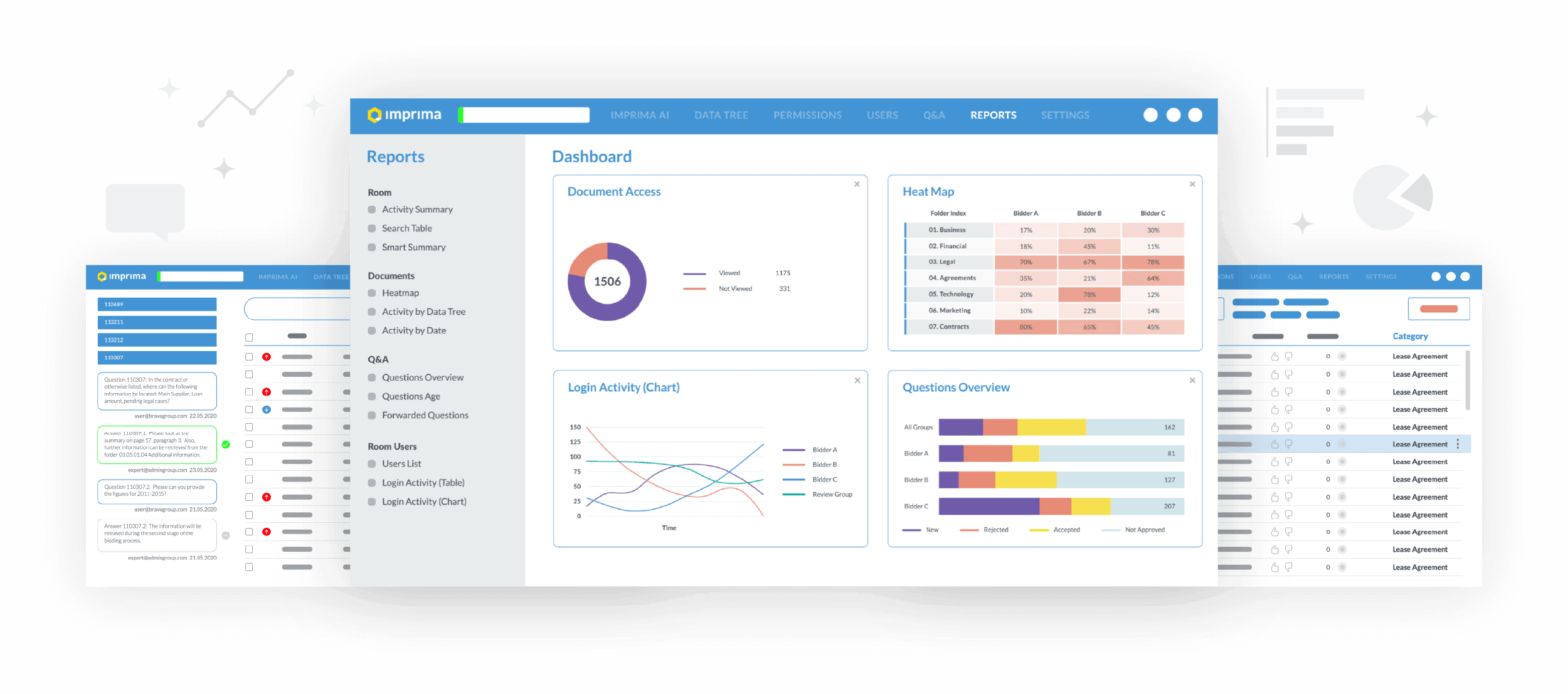
    Finally, Imprima addresses the bidder inquiry process through its ‘Smart Q&A’ module. As prospective buyers submit questions regarding specific assets or lease terms, the AI analyzes the queries, identifies similar questions asked previously, and suggests automated responses based on existing data room content. Deal managers can route questions to specific subject matter experts via automated workflows, utilizing pre-configured tags and auto-forwarding rules. Activity dashboards and heat-maps track bidder engagement in real-time, allowing principals to monitor which assets or documents are generating the most interest. Analysis confirms that by keeping all these functions within a single, secure environment, Imprima minimizes data leakage risks.

    9AI Framework: the score, dimension by dimension

    Dimension Score
    CRE Relevance 8/10
    Data Quality and Sources 8/10
    Ease of Adoption 8/10
    Output Accuracy 8/10
    Integration and Workflow Fit 7/10
    Pricing Transparency 9/10
    Support and Reliability 9/10
    Innovation and Roadmap 8/10
    Market Reputation 9/10
    Composite 9AI Score 82/100

    CRE Relevance — 8/10

    Imprima scores highly here because it explicitly targets commercial real estate asset management, capital raising, and asset sales. Unlike generic file-sharing platforms, the system is trained to recognize and process industry-specific documents like commercial leases, rent rolls, and environmental assessments. The platform features dedicated tools for real estate portfolio review and has a proven track record with major brokerages like Cushman & Wakefield and JLL. While it also serves the broader M&A and legal markets, its feature set aligns directly with the requirements of property transaction due diligence. Analysis shows that the AI models understand the context of property-level data, reducing the time analysts spend manually sorting files. In practice: Real estate deal teams can upload unstructured property data and rely on the system to automatically build a logical, industry-standard data room taxonomy.

    Data Quality and Sources — 8/10

    As a virtual data room, Imprima relies entirely on the quality of the documents uploaded by the user. However, its internal machine learning models are trained on a massive repository of historical M&A and real estate transactions, having processed over 250,000 deals. This extensive training corpus allows the AI to accurately identify document types, extract relevant clauses, and spot anomalies within complex legal text. The system’s ability to maintain high data fidelity during automated translation and redaction processes is a significant advantage. Because the AI is native to the platform, it does not suffer from data degradation or formatting errors that often occur when exporting files to external analysis tools. In practice: Users experience highly accurate auto-classification and redaction because the underlying models have been trained on millions of actual transaction documents.

    Ease of Adoption — 8/10

    Virtual data rooms are a standard component of commercial real estate transactions, meaning the foundational interface of Imprima requires minimal behavioral change from deal teams. The platform offers a 30-day free trial, allowing firms to test the basic feature set before committing. Because the artificial intelligence tools are embedded directly into the VDR, users do not need to learn a separate software application or manage complex API integrations to analyze their documents. The company provides dedicated project managers and 24/7 customer support to assist with initial setup and user onboarding. Analysis indicates that the intuitive design and white-glove service model significantly reduce the friction typically associated with deploying new AI technology. In practice: Deal teams can transition from legacy data rooms to Imprima with almost zero downtime, guided by dedicated support personnel.

    Output Accuracy — 8/10

    Imprima delivers precise results in its automated redaction, indexing, and translation functions. The AI engine excels at identifying personally identifiable information and standard contract clauses, significantly reducing the manual review burden. However, as with any automated legal review tool, the Smart Review function requires human oversight. While the system effectively flags anomalies and extracts lease abstracts, complex legal interpretations still demand review by qualified counsel. The Smart Q&A module accurately clusters similar questions and suggests relevant answers, but deal managers must approve the final responses before they are sent to bidders. Analysis confirms that the platform achieves high accuracy in administrative automation, though it acts as an assistant rather than a replacement for human judgment. In practice: Analysts will trust the auto-redaction and indexing completely but will still manually verify the AI-generated lease abstracts and Q&A responses.

    Integration and Workflow Fit — 7/10

    Imprima is primarily designed to function as a secure, standalone environment during the due diligence phase, which inherently limits its integration with external operational software. The platform does offer an API, SharePoint linking, and Single Sign-On capabilities, allowing enterprise IT departments to connect it to broader corporate networks. However, it does not natively push data into property management systems like Yardi or MRI, nor does it function as a permanent asset management database. Its architecture is explicitly built to ingest data from various sources, secure it, and present it to third parties. Analysis suggests that while it fits perfectly into the transaction phase of the CRE lifecycle, it remains siloed from day-to-day property operations. In practice: IT teams will utilize the API and Single Sign-On for secure access, but analysts will manually export final deal abstracts to their internal underwriting models.

    Pricing Transparency — 9/10

    Imprima stands out in the enterprise software market by publishing a clear starting price. The vendor explicitly states that pricing begins at €250 per month, which provides a concrete baseline for evaluating the software. While enterprise deployments and complex mid-market deals can scale significantly higher—industry data suggests broader deployments can reach between $30,000 and $90,000 annually—the presence of a published entry-level tier is commendable. The company also offers a 30-day free trial that includes one project, ten users, and dedicated support, allowing firms to validate the return on investment before signing a contract. Analysis indicates this level of transparency is rare among top-tier VDR providers, who typically hide all costs behind sales consultations. In practice: Smaller firms can access the platform at the €250 monthly entry point, while institutional players can model enterprise costs based on clear usage metrics.

    Support and Reliability — 9/10

    Founded in 2001, Imprima possesses a long-standing operational history that guarantees high reliability and stability. The company operates a 24/7 support desk, offering assistance in multiple local languages. Unlike early-stage startups, Imprima utilizes a white-glove service model, assigning dedicated project managers with over a decade of experience to guide deal teams from the start of a transaction to its close. The platform is built on highly secure, cloud-based infrastructure optimized for speed, promising document access times up to 15 times faster than legacy systems. It maintains strict GDPR compliance and ISO certifications. Analysis confirms that the vendor prioritizes uptime and data security, making it a highly dependable choice for mission-critical transactions. In practice: Deal managers operating across different time zones can rely on immediate, human support and stable platform performance during critical final bidding rounds.

    Innovation and Roadmap — 8/10

    Imprima has successfully transitioned from a traditional data repository into an AI-driven platform, demonstrating a clear commitment to ongoing development. The company launched its Smart Review and Smart Index tools between 2019 and 2020, and recently added generative AI capabilities, such as the Lumi Chat overlay, to enhance document interrogation. The vendor continues to refine its machine learning models, focusing on cross-border transaction support and advanced Q&A automation. However, as an older company adapting to new technology, its development cycles may prioritize stability and security over rapid, experimental feature releases. Analysis suggests the roadmap is highly pragmatic, focused on solving specific due diligence bottlenecks rather than chasing general AI trends. In practice: Users can expect steady, reliable updates to the core AI review and redaction tools rather than sudden shifts in platform architecture.

    Market Reputation — 9/10

    Imprima holds an exceptionally strong reputation within the European and global transaction markets. It is trusted by top-tier commercial real estate brokerages, financial institutions, and legal firms, including Cushman & Wakefield, JLL, PwC, KPMG, and DLA Piper. The platform consistently receives high ratings on software review sites, maintaining a 4.9 out of 5 on Capterra. The market views Imprima as a premium, boutique provider capable of handling highly complex, multi-jurisdictional deals. Its longevity in the VDR space, combined with its successful integration of proprietary AI tools, has solidified its status as a Tier 2 CRE-native solution. Analysis confirms that the brand carries significant weight, and utilizing Imprima signals professionalism and security to prospective buyers and investors. In practice: Principals will face zero pushback from institutional partners or external counsel when proposing Imprima as the designated data room for a major asset sale.

    Who should use Imprima

    Imprima is engineered for transaction-heavy commercial real estate firms and their advisory partners who require strict data security combined with automated document processing. It is highly effective for teams managing large volumes of unstructured property data during acquisitions, dispositions, or capital raising events.

    • Institutional Investment Sales Brokers: Teams at major brokerages who need to quickly spin up secure data rooms, automatically index hundreds of property files, and track bidder engagement via heat-maps.
    • CRE Private Equity Principals: Buyers executing complex portfolio acquisitions who require automated lease abstraction and anomaly detection to accelerate their due diligence timelines.
    • In-House Legal Counsel: Real estate attorneys who need to rapidly redact sensitive PII and financial data across thousands of pages to ensure GDPR compliance before opening a data room.
    • Cross-Border Asset Managers: Firms dealing with international property transactions that benefit from the platform’s native ability to translate documents across 80+ languages instantly.

    Who should look elsewhere

    Despite its strong feature set, Imprima is a specialized transaction tool and is not suited for firms seeking permanent, day-to-day property management software or general-purpose cloud storage.

    • Small Independent Landlords: Owners of a few local multifamily properties who simply need a place to store leases will find the platform over-engineered and unnecessary.
    • Property Managers: Teams looking for software to handle tenant work orders, rent collection, or daily maintenance tracking should look to operational platforms like Yardi or AppFolio.
    • Firms Seeking Deep Financial Modeling: Analysts looking for AI to automatically build cash flow projections or underwrite assets will not find those capabilities here; Imprima focuses on document review, not financial math.

    Pricing and ROI

    Imprima publishes a clear starting price of €250 per month, establishing a highly accessible entry point for basic virtual data room requirements. The company also offers a generous 30-day free trial that includes one project, ten users, and dedicated legal-tech support, allowing firms to test the AI features before committing capital. For mid-market to enterprise deployments requiring advanced AI redaction, translation, and unlimited data processing, industry analysis indicates annual costs typically range between $30,000 and $90,000. This tiered approach allows smaller brokerages to utilize the secure infrastructure while large institutions pay for scale and advanced machine learning capabilities.

    The return on investment (ROI) math for a commercial real estate principal is straightforward when calculating billable hours saved during due diligence. If an external legal team charges $400 per hour to manually review and redact 5,000 pages of commercial leases, the cost easily exceeds $20,000 per transaction. By utilizing Imprima’s Smart Redaction and Smart Review tools, the AI automates the initial pass, reducing manual legal review time by an estimated 70%. On a single mid-sized portfolio acquisition, the savings in legal fees and administrative overhead will immediately offset the software’s annual enterprise cost. Furthermore, accelerating the due diligence phase reduces the risk of deal fatigue and market shifts, protecting the overall transaction value.

    Integration and CRE tech stack fit

    Imprima integrates into the commercial real estate tech stack primarily as a secure, isolated environment for external collaboration rather than a deeply connected operational hub. The platform offers an API, Single Sign-On (SSO), and SharePoint linking, which allows enterprise IT departments to connect the VDR to internal corporate networks for secure employee access. However, because its primary function is to protect sensitive data during a transaction, it intentionally limits bi-directional data flow with external systems.

    Analysis shows that Imprima does not offer native, plug-and-play integrations with property management systems like MRI, Yardi, or RealPage, nor does it push data directly into underwriting platforms like Argus. Deal teams typically export the final, AI-generated lease abstracts and compliance reports as flat files (Excel or PDF) to update their internal databases once a transaction closes. For a CRE analyst, Imprima acts as a temporary, highly intelligent bridge between the seller’s raw data and the buyer’s internal systems. The lack of deep operational integrations is a deliberate security feature, ensuring that third-party bidders cannot access the host firm’s broader technology ecosystem during the due diligence process.

    Competitive landscape

    The commercial real estate AI software market features several strong competitors in the legal and due diligence category. When evaluating Imprima, CRE principals must compare it against specialized lease abstraction tools and alternative AI-powered data rooms.

    DocumentCrunch (BestCRE Score: 86) is a primary alternative for firms focused strictly on contract analysis. While Imprima excels at hosting the entire transaction and managing third-party access, DocumentCrunch provides deeper, more granular extraction of complex commercial lease clauses and integrates more closely with daily operational workflows. Firms that do not need a virtual data room but want superior lease abstraction should evaluate DocumentCrunch.

    Deal Intel (BestCRE Score: 83) offers a highly competitive platform tailored for transaction management. Deal Intel focuses heavily on the buy-side underwriting process, using AI to structure financial data alongside legal documents. Imprima remains the better choice for sell-side teams and brokers who require strict bidder management, Q&A workflows, and automated redaction.

    fileAI (BestCRE Score: 81) presents a lighter, more general-purpose document extraction tool. It is often favored by smaller deal teams looking for quick, ad-hoc document interrogation without the infrastructure of a full VDR. However, fileAI lacks the bank-grade security, ISO certifications, and dedicated project management support that make Imprima the standard for institutional-grade, multi-jurisdictional portfolio sales.

    Analysis indicates that Imprima wins on security, redaction, and bidder management, making it the superior choice for managing the actual transaction environment, while tools like DocumentCrunch win on deep, operational lease abstraction.

    The bottom line

    Imprima is a mandatory evaluation for institutional brokers, private equity principals, and real estate legal teams managing complex asset sales or capital raising events. It successfully solves the specific bottlenecks of transaction due diligence by embedding highly accurate AI redaction, indexing, and translation directly into a secure virtual data room. You should purchase this software if your firm spends excessive capital on external legal fees for manual document sorting and redaction, or if you regularly manage cross-border deals requiring multi-language support. The published starting price of €250 per month makes it accessible, while its enterprise capabilities scale to handle massive portfolio transactions. Do not buy Imprima if you are simply looking for an internal lease management database or an automated financial underwriting tool. For executing secure, high-stakes commercial real estate transactions with maximum efficiency and zero data leakage, Imprima delivers immediate, measurable return on investment.

    Compare inside the same category: DocumentCrunch (86) · Deal Intel (83) · Wilson AI (82) · fileAI (81) · Orbital (79). The full ranking is in the BestCRE AI Index; the category view is at CRE AI tools by category.

    Frequently asked questions

    Does Imprima integrate directly with Yardi or Argus?

    No, Imprima does not offer native integrations with Yardi, Argus, or other property management systems. It is designed as a secure, standalone virtual data room for external transactions. Analysts must manually export AI-generated lease abstracts and reports to update internal underwriting models or operational databases.

    Can the AI translate foreign real estate documents?

    Yes, Imprima features a Smart Translation tool that natively supports over 80 languages [1.2.5]. The AI automatically translates foreign commercial leases, environmental reports, and financial documents directly within the secure data room viewer, eliminating the need to export sensitive files to external translation services during cross-border deals.

    How does the pricing structure work for mid-market firms?

    Imprima publishes a starting price of €250 per month, which covers basic data room functionality. For mid-market and enterprise firms requiring the full suite of AI tools, unlimited data processing, and dedicated project management, industry analysis indicates annual costs typically range between $30,000 and $90,000.

    Is Imprima secure enough for sensitive financial data?

    Yes, Imprima is built specifically for highly confidential M&A and real estate transactions. It features bank-grade security, strict GDPR compliance, and ISO certifications. Furthermore, the embedded Smart Redaction tool automatically obscures personally identifiable information and sensitive financial data before third-party bidders access the room.

    Does the platform require extensive training to use?

    No, the platform is highly intuitive and requires minimal behavioral change for teams familiar with standard virtual data rooms. The AI features are embedded directly into the interface. Imprima also provides dedicated project managers and 24/7 support to assist with onboarding and deal setup.

    Can Imprima automatically answer bidder questions during due diligence?

    The Smart Q&A module uses artificial intelligence to analyze incoming bidder questions, cluster similar inquiries, and suggest answers based on existing data room documents. However, deal managers must review and approve all AI-suggested responses before they are routed to external prospective buyers.

  • fileAI Review: AI-native platform for unstructured file ingestion and automated data extraction

    BestCRE 9AI Score

    81/100 · Contender

    fileAI ranks #74 of 214 commercial real estate AI tools scored on the 9AI Framework.

    fileAI is an AI-native platform for unstructured file ingestion and extraction, categorized in the BestCRE database as a Tier 2 CRE-Native solution. In the commercial real estate sector, firms are inundated with unstructured data trapped in rent rolls, operating statements, complex lease agreements, and insurance policies. Extracting this data manually is error-prone and expensive. fileAI addresses this bottleneck by deploying advanced multimodal AI and OCR to parse, classify, and extract structured data from these documents without requiring strict templates. A hard fact from our research: fileAI offers a free self-serve tier alongside its enterprise pricing, making it accessible for initial testing before a full-scale deployment.

    As of August 2026, the document extraction landscape is crowded with legacy OCR providers and new AI entrants. fileAI distinguishes itself through its fileForge engine, which maps files automatically, selects only the necessary sections for processing to optimize token usage, and orchestrates multiple AI models autonomously. While tools like DocumentCrunch focus heavily on legal contract review and Deal Intel targets quality-of-earnings analytics, fileAI provides a more generalized infrastructure layer for data preparation and workflow automation. Our analysis indicates that while its core engine is highly capable of parsing complex CRE documents, prospective buyers must evaluate whether they need a specialized, out-of-the-box lease abstraction tool or a flexible platform capable of building custom data pipelines across their entire portfolio operations.

    What fileAI does and how it works

    fileAI operates as an ingestion and orchestration engine that converts messy, unstructured files into validated, structured datasets. The platform is built around its core infrastructure, fileForge, which handles the initial ingestion of documents. When a user uploads a batch of files—such as scanned property appraisals, multi-page lease agreements, or handwritten inspection notes—the system maps the entire document. It identifies layouts, paragraphs, tables, charts, and embedded images. Instead of processing the entire document through a single, expensive AI model, the Scout feature isolates only the relevant sections needed for a specific extraction task. This selective processing reduces token consumption and speeds up the extraction cycle.

    Once the relevant sections are identified, the platform orchestrates the extraction autonomously. It routes different tasks to the most efficient model path, balancing speed, cost, and accuracy. For instance, standard text might be processed by a fast, lightweight model, while complex financial tables in a trailing twelve-month operating statement are sent to a specialized model trained on tabular data. The extracted data is then validated against user-defined schemas. If a firm requires specific fields—such as base rent, escalation clauses, or tenant insurance limits—the system ensures the output matches the required format before pushing it to downstream systems.

    Beyond extraction, fileAI incorporates a verification layer called Forensics. This module screens the source documents for manipulation, anomalous edits, or synthetic content indicators before any automated workflow begins. In a commercial real estate context, this is particularly useful for verifying tenant financials or KYC documents during the underwriting process. The platform ultimately delivers structured, source-linked data via API, allowing analysts to trace every extracted data point back to its exact location in the original file.

    9AI Framework: the score, dimension by dimension

    Dimension Score
    CRE Relevance 8/10
    Data Quality and Sources 9/10
    Ease of Adoption 8/10
    Output Accuracy 9/10
    Integration and Workflow Fit 9/10
    Pricing Transparency 9/10
    Support and Reliability 6/10
    Innovation and Roadmap 9/10
    Market Reputation 6/10
    Composite 9AI Score 81/100

    CRE Relevance — 8/10

    fileAI is classified as a Tier 2 CRE-Native solution in the BestCRE database. While the platform handles general unstructured data across multiple industries, it has developed specific capabilities for commercial real estate workflows. The engine effectively processes rent rolls, operating statements, and lease agreements without requiring rigid templates. However, because it is fundamentally a horizontal data preparation platform adapted for CRE, it lacks the deep, out-of-the-box proprietary real estate analytics found in specialized peers like Deal Intel or DocumentCrunch. Buyers will need to configure their own schemas and validation rules to extract the exact real estate metrics they require. Our analysis shows that while the underlying technology is highly adaptable to property data, the initial setup requires domain expertise to map the outputs correctly. In practice: CRE teams must invest time upfront to define their specific data schemas before the platform delivers its full value.

    Data Quality and Sources — 9/10

    The platform excels in producing clean, structured datasets from messy inputs. By utilizing its fileForge engine, fileAI bypasses the limitations of traditional template-based OCR. The system maps the entire document, identifying complex elements like nested tables and charts often found in property appraisals and environmental reports. It then extracts the data and strictly enforces user-defined validation rules. This schema-driven approach ensures that the output data conforms precisely to the required format, significantly reducing the need for manual data cleaning. Furthermore, the Forensics module adds a layer of data integrity by screening source files for manipulation or synthetic content, which is a critical feature when processing third-party financial documents. Our analysis indicates that the resulting data quality is consistently high, provided the initial validation schemas are configured correctly. In practice: Analysts receive structured, audit-ready data that can be immediately piped into financial models without manual scrubbing.

    Ease of Adoption — 8/10

    fileAI offers a relatively straightforward onboarding path, particularly given its free self-serve tier. Users can create an account and begin testing the extraction capabilities on their own documents immediately. The interface allows users to upload files and query them without complex technical configurations. However, scaling the platform across an enterprise requires more technical involvement. Building automated workflows, defining complex extraction schemas, and connecting the platform to internal systems via API demands dedicated IT resources. While the initial trial phase is frictionless, transitioning to a fully automated, governed execution layer is a heavier lift. The platform provides extensive documentation and support for developers, but non-technical real estate analysts may find the advanced orchestration features challenging to navigate without assistance. In practice: Individual analysts can start extracting data in minutes, but enterprise-wide deployment requires a coordinated effort with IT.

    Output Accuracy — 9/10

    The platform’s approach to accuracy relies on selective intelligence and autonomous model orchestration. Instead of processing an entire lease with one model, the Scout feature isolates specific sections and routes them to the most appropriate AI model. This targeted approach minimizes hallucinations and improves precision, particularly when extracting dense financial tables or specific legal clauses. Additionally, every extracted data point is source-linked, allowing users to click through to the exact location in the original document to verify the information. This traceability is essential for due diligence and compliance workflows. While the system achieves high accuracy on standard documents, highly degraded scans or nested tables may still require human review. Our analysis confirms that the accuracy exceeds traditional OCR, but human-in-the-loop verification remains necessary for critical underwriting decisions. In practice: The source-linking feature allows analysts to quickly audit and verify the extracted data against the original document.

    Integration and Workflow Fit — 9/10

    fileAI is designed to function as an infrastructure layer rather than a standalone application, making its integration capabilities a primary strength. The platform supports over 100 system integrations, allowing it to connect with common ERPs, document management systems, and proprietary databases. It delivers extracted data via flexible APIs, enabling developers to pipe structured information directly into their existing CRE tech stack, whether that involves Yardi, MRI, or custom data warehouses. The platform also supports advanced RAG and MCP server configurations, making it highly adaptable for firms building their own internal AI agents. Our analysis indicates that while the API is well-documented and highly functional, taking full advantage of these integrations requires a capable technical team. In practice: Firms with dedicated developers can deeply embed the extraction engine into their existing underwriting and asset management workflows.

    Pricing Transparency — 9/10

    The vendor provides a clear structural overview of its pricing model, which is a notable advantage in the enterprise AI space. According to the BestCRE master database, fileAI offers a free self-serve tier alongside its enterprise plans. This dual approach allows potential buyers to test the platform’s capabilities on a small scale before committing to a larger contract. While the exact dollar amounts for the enterprise tiers are not published on the main marketing pages, the existence of a free tier provides a transparent entry point. The enterprise pricing is typically based on processing volume, token consumption, and the complexity of the automated workflows. Our analysis suggests that this consumption-based model aligns costs directly with usage, though high-volume users must carefully monitor token optimization features to control expenses. In practice: Buyers can validate the technology at no cost before engaging sales for a custom enterprise quote.

    Support and Reliability — 6/10

    As a Tier 2 vendor that recently raised funding and expanded internationally, fileAI is scaling its support infrastructure. It provides standard documentation, API references, and email support for its self-serve users. Enterprise clients receive more dedicated assistance, including help with schema configuration and workflow orchestration. However, as a relatively young company experiencing rapid growth, its long-term reliability and support capacity under massive enterprise loads are still being proven. The platform itself is built on modern cloud infrastructure, ensuring high uptime for API endpoints, but users should anticipate occasional shifts in the product interface as new features are rapidly deployed. Our analysis classifies the vendor as an emerging player; thus, conservative buyers must weigh the innovative technology against the inherent risks of partnering with a scaling startup. In practice: Enterprise users should negotiate strict service level agreements to ensure priority support during critical due diligence periods.

    Innovation and Roadmap — 9/10

    The company demonstrates a rapid pace of development, focusing heavily on agentic AI and workflow orchestration. Recent updates include the Forensics module for detecting synthetic content and the Scout feature for optimizing token usage. The roadmap indicates a continued emphasis on building reusable AI components and standardized operating procedures that allow the system to learn and adapt as processing volumes increase. Furthermore, the company’s expansion into international markets and partnerships with large infrastructure groups suggest a commitment to handling complex, global enterprise requirements. Our analysis shows that fileAI is actively moving beyond simple extraction toward becoming a comprehensive system of intelligence that governs automated decision-making. Buyers can expect continuous improvements in model orchestration and fraud detection capabilities. In practice: Users will benefit from a platform that frequently releases advanced features aimed at reducing token costs and improving extraction speed.

    Market Reputation — 6/10

    fileAI is building a strong reputation among developers and technical operators who require flexible data extraction tools. Technical communities frequently praise it for overcoming rigid, legacy OCR limitations. However, within the specific niche of commercial real estate, its brand recognition is still developing compared to established, purpose-built tools like DocumentCrunch or Deal Intel. The company has secured significant venture backing and is trusted by global enterprises across various industries, lending credibility to its technology. Yet, strictly as a CRE solution, it is viewed as a powerful horizontal tool rather than a specialized real estate application. Our analysis concludes that while technical teams highly respect the platform, real estate principals may require more convincing regarding its out-of-the-box applicability to their specific workflows. In practice: Technical buyers will advocate for the platform, but they must demonstrate its direct value to real estate stakeholders.

    Who should use fileAI

    This platform is highly effective for specific organizational profiles:

    • Technical CRE teams looking to build custom automated data pipelines for their proprietary underwriting models.
    • Asset managers dealing with high volumes of varied, unstructured documents from multiple third-party property managers.
    • Due diligence analysts who require strict source-linking to verify extracted financial data against original files.
    • Firms seeking to replace legacy, template-based OCR systems with a more adaptable AI ingestion engine.

    Who should look elsewhere

    This tool is likely a poor fit for the following buyer profiles:

    • Small real estate teams looking for a plug-and-play lease abstraction tool with zero technical setup.
    • Firms that lack internal IT resources or developers to configure APIs and validation schemas.
    • Buyers who prefer a platform pre-trained exclusively on commercial real estate legal clauses, such as DocumentCrunch.

    Pricing and ROI

    Based on the BestCRE master database, fileAI employs a dual pricing strategy consisting of a free self-serve tier and custom enterprise plans. The free tier is highly transparent, allowing users to create an account and immediately test the extraction engine on their own documents. This is a significant advantage for analysts who want to validate the platform’s ability to parse complex rent rolls or operating statements before seeking budget approval.

    Specific pricing for the enterprise tier is not published, but our analysis indicates it follows a consumption-based model tied to processing volume, the number of automated workflows, and token usage. The platform includes features specifically designed to optimize token consumption, such as isolating only the necessary sections of a document for processing, which helps control costs at scale.

    For ROI math, consider a due diligence team processing 500 lease agreements and financial statements per month. If manual data entry and verification take an average of 45 minutes per document at a blended analyst rate of $60 per hour, the monthly cost is $22,500. If fileAI reduces this processing time by 80% through automated extraction and schema validation, the firm saves $18,000 monthly in labor costs. Even assuming an enterprise software cost of $4,000 per month, the net savings would be $14,000 monthly, yielding a payback period of less than one quarter.

    Integration and CRE tech stack fit

    fileAI is engineered primarily as an integration layer, designed to sit between messy document sources and structured databases. According to published research, the platform supports over 100 system integrations, allowing it to connect directly with enterprise resource planning (ERP) systems, document management platforms like Box or SharePoint, and custom data warehouses.

    For a commercial real estate tech stack, this means fileAI can ingest emails containing attached property financials, extract the required data, and push the structured output directly into portfolio management systems like Yardi, MRI, or VTS via API. The platform also supports advanced configurations, including Retrieval-Augmented Generation (RAG) and Model Context Protocol (MCP) servers, which is highly beneficial for firms developing their own internal AI chatbots or analytical agents.

    Our analysis shows that the API is well-documented and flexible, enabling developers to trigger extraction workflows programmatically. However, because it is an infrastructure tool, achieving a tight integration fit requires dedicated technical resources. Firms without in-house developers or IT support may struggle to connect the platform to their legacy real estate systems effectively.

    Competitive landscape

    In the commercial real estate data extraction space, fileAI competes against both specialized CRE applications and other horizontal AI platforms.

    For legal and lease abstraction workflows, DocumentCrunch (BestCRE Score: 86) is a primary alternative. DocumentCrunch is purpose-built for real estate and construction, coming pre-trained to identify over 40 specific contract provisions. Firms looking for immediate, out-of-the-box lease abstraction will likely prefer DocumentCrunch, whereas fileAI requires users to define their own schemas.

    For financial due diligence, Deal Intel (BestCRE Score: 83) offers highly specialized quality-of-earnings analytics and risk scoring. Deal Intel surfaces deal breakers directly from financial documents, providing an analytical layer that fileAI lacks natively. fileAI extracts the data accurately but leaves the financial analysis entirely to the user’s downstream systems.

    Other competitors include Wilson AI (BestCRE Score: 82) and Harvey (BestCRE Score: 74), which focus heavily on legal document review and conversational AI for law firms. Ironclad (BestCRE Score: 76) is another alternative for contract lifecycle management, offering strong workflow tools but focusing more on contract creation and execution rather than raw data extraction from third-party files.

    Our analysis concludes that fileAI’s primary differentiator is its fileForge engine, which excels at autonomous model orchestration and token optimization across varied document types. It is best suited for firms that view data extraction as an engineering challenge and want a flexible, scalable infrastructure layer rather than a constrained, use-case-specific application.

    The bottom line

    fileAI is a highly capable data ingestion and orchestration platform that effectively bridges the gap between unstructured documents and structured databases. By utilizing advanced model routing and strict schema validation, it overcomes the limitations of traditional OCR to deliver clean, audit-ready data. The availability of a free self-serve tier makes it an attractive option for technical analysts looking to test AI extraction without upfront financial commitment.

    However, its horizontal nature means it lacks the specialized, out-of-the-box real estate analytics provided by peers like DocumentCrunch or Deal Intel. It requires technical resources to configure schemas, build automated workflows, and integrate the API into existing systems.

    We recommend fileAI for technically proficient commercial real estate firms that need to process high volumes of varied, complex documents and want to build custom, automated data pipelines. Firms seeking a simple, plug-and-play solution for lease abstraction should look toward more specialized, purpose-built alternatives.

    Compare inside the same category: DocumentCrunch (86) · Deal Intel (83) · Wilson AI (82) · Orbital (79) · Ironclad (76). The full ranking is in the BestCRE AI Index; the category view is at CRE AI tools by category.

    Frequently asked questions

    Does fileAI require templates to extract data?

    No. The platform uses multimodal AI and zero-shot classification to identify and extract data based on context and user-defined schemas, entirely eliminating the need for rigid templates or manual zoning. This allows commercial real estate teams to process highly variable documents, such as third-party operating statements, without constantly reconfiguring the system.

    Can I test the platform before purchasing an enterprise license?

    Yes. According to the BestCRE master database, the vendor offers a free self-serve tier alongside its enterprise plans. This allows real estate analysts to upload their own complex documents, such as rent rolls or lease agreements, and test the extraction engine’s capabilities immediately before requesting budget approval for a full deployment.

    How does the system handle highly complex financial tables?

    The platform uses a targeted feature called Scout to isolate complex financial tables within a larger document. Instead of processing the entire file with one model, it routes these specific tables to specialized AI models optimized for tabular data extraction, ensuring high accuracy while minimizing token consumption and processing costs.

    Is fileAI built exclusively for commercial real estate?

    No. It is categorized in our database as a Tier 2 CRE-Native tool because it handles real estate workflows effectively, but it is fundamentally a horizontal data platform. It is widely used across finance, healthcare, and logistics, meaning buyers must configure their own real estate-specific schemas rather than relying on out-of-the-box analytics.

    How does the platform verify document authenticity during underwriting?

    The platform includes a dedicated Forensics module designed to screen source files before any automated extraction begins. It scans the document metadata and structure to detect manipulation, anomalous edits, and synthetic content indicators. This provides an essential layer of security when processing third-party financial documents or tenant KYC materials.

    Does fileAI integrate directly with Yardi or MRI?

    The platform is built as an infrastructure layer and supports over 100 system integrations. It provides flexible APIs that allow technical teams to push structured, extracted data directly into standard commercial real estate portfolio management systems like Yardi, MRI, or custom data warehouses, though this requires dedicated developer resources.

  • DocumentCrunch Review: Purpose-built AI for construction contract risk analysis and compliance tracking

    DocumentCrunch Review: Purpose-built AI for construction contract risk analysis and compliance tracking

    BestCRE 9AI Score

    86/100 · Leader

    DocumentCrunch ranks #38 of 203 commercial real estate AI tools scored on the 9AI Framework.

    DocumentCrunch is an artificial intelligence platform built exclusively for the construction and commercial real estate development industries to automate document review and risk detection. As verified in our BestCRE Master Database, the primary use case for this software is AI analyzing construction contracts for risk clauses. Founded in 2019 and acquired by Trimble in April 2026, the platform targets general contractors, specialty subcontractors, and project owners who need to quickly parse complex agreements like AIA A201s, ConsensusDocs, and custom subcontracts. Rather than relying on generic large language models, the company trained its proprietary CrunchAI engine on a massive corpus of historical construction documents, enabling it to recognize industry-specific liabilities, indemnity clauses, and missing provisions that generalist legal tools routinely miss.

    For commercial real estate principals and development analysts, managing the execution phase of a project often involves hundreds of pages of dense legal text. Historically, this required expensive outside counsel or hours of manual review by internal project managers. DocumentCrunch attempts to solve this bottleneck by providing a highly targeted first pass. Users upload their documents, and the system extracts critical obligations into a digestible format, directly citing the source text to ensure verifiable accuracy. With its recent integration into the broader Trimble Construction One ecosystem, the platform is shifting from a standalone legal utility into an embedded project management asset. This review examines whether the software delivers enough concrete value to justify its adoption within a modern development tech stack.

    What DocumentCrunch does and how it works

    At its core, DocumentCrunch functions as an automated risk extraction and compliance tracking engine for construction documents. When a user uploads a contract, specification manual, or insurance policy, the platform’s CrunchAI system scans the text against more than forty predefined risk categories. These categories include liquidated damages, delay provisions, material price escalation clauses, and indemnification requirements. The software then generates a risk summary, highlighting unfavorable terms and identifying missing clauses that standard industry practices typically require.

    The mechanics of the platform rely heavily on retrieval-augmented generation. Instead of synthesizing a generic summary that might introduce hallucinations, the tool extracts the exact contractual language and provides contextual guidance based on construction law principles. Users receive a Cheat Sheet that distills complex legal obligations into plain English instructions for field teams and project managers. This ensures that the personnel actually executing the work understand the notice requirements, weather delay allowances, and change order protocols without needing to interpret the raw legal text themselves.

    Beyond static review, the software includes a chat interface that allows users to query their uploaded documents directly. If a project manager needs to know the exact deadline for submitting a delay notice, they can ask the system and receive a sourced answer in seconds. The platform also features a Notice Builder that drafts compliant communications based on the specific requirements outlined in the contract. By combining extraction, querying, and drafting capabilities, the tool attempts to bridge the gap between back-office legal analysis and front-line project execution. It essentially acts as a specialized paralegal that understands the nuances of North American construction standards, allowing commercial real estate developers to accelerate their preconstruction phases and maintain strict compliance throughout the build lifecycle.

    9AI Framework: the score, dimension by dimension

    Dimension Score
    CRE Relevance 10/10
    Data Quality and Sources 9/10
    Ease of Adoption 9/10
    Output Accuracy 9/10
    Integration and Workflow Fit 9/10
    Pricing Transparency 4/10
    Support and Reliability 9/10
    Innovation and Roadmap 9/10
    Market Reputation 9/10
    Composite 9AI Score 86/100

    CRE Relevance — 10/10

    DocumentCrunch earns a perfect score for industry relevance because it completely avoids the trap of being a generalized legal tool. The entire platform is engineered around the realities of commercial real estate development and construction management. Its models are explicitly trained on AIA contracts, ConsensusDocs, and standard North American subcontract forms. It understands the practical difference between a delay clause in a subcontractor agreement and a liquidated damages provision in an owner contract. This narrow focus means developers and general contractors do not need to spend months teaching the AI what a change order or a submittal process is. The tool speaks the language of the job site out of the box. In practice: Construction teams can upload standard industry forms and immediately receive highly contextual risk analysis without any custom prompt engineering.

    Data Quality and Sources — 9/10

    The platform relies on a highly curated dataset of historical construction documents, which significantly elevates the quality of its analytical outputs. Because the vendor restricted its training data to relevant industry contracts rather than scraping the open web, the underlying models exhibit a deep understanding of construction-specific legal phrasing. Furthermore, the system employs retrieval-augmented generation to ensure that every insight is tethered directly to the uploaded text. This architecture minimizes the risk of AI hallucinations, which is critical when analyzing high-stakes liability clauses. The vendor also maintains an internal benchmarking system to continuously validate the accuracy of its risk extraction against human legal review. In practice: Users receive risk summaries that accurately reflect the specific language of their uploaded contracts rather than generic legal approximations.

    Ease of Adoption — 9/10

    Implementing this software requires minimal friction for teams already familiar with digital document management. The user interface is deliberately designed for project managers and field personnel rather than specialized attorneys. The dashboard is clean, and the process of uploading a PDF and receiving a categorized risk report takes only minutes. The platform provides pre-configured playbooks, meaning new users do not have to build their own risk parameters from scratch. Training a team to use the chat function or the Cheat Sheet feature generally requires less than an hour of onboarding. However, establishing standardized workflows across an entire enterprise requires dedicated change management to ensure field teams actually consult the tool before making decisions. In practice: A mid-level project manager can generate a functional contract risk summary on their first day of using the platform.

    Output Accuracy — 9/10

    When applied to North American construction standards, the extraction accuracy is exceptionally high. The tool reliably identifies critical risk provisions, hidden obligations, and missing clauses within standard AIA and ConsensusDocs frameworks. The source-linking feature allows users to instantly verify the AI’s claims against the original text, providing a necessary layer of trust. However, the accuracy degrades significantly if applied to international contracts like FIDIC or JCT, as the models are heavily biased toward US and Canadian legal standards. Additionally, the software currently struggles to automatically detect cross-document conflicts, such as discrepancies between a master developer agreement and a lower-tier subcontract, requiring manual cross-referencing by the user. In practice: The system acts as a highly accurate first-pass filter for US construction contracts but requires human oversight for complex, multi-document conflict detection.

    Integration and Workflow Fit — 9/10

    The software excels in its ability to embed directly into the tools that construction teams already use. The Microsoft Word integration allows legal and procurement teams to redline contracts and access AI insights without leaving their primary drafting environment. More importantly, the deep integration with Procore pushes contract intelligence directly to the field. Project managers can access customized cheat sheets, generate compliant notices, and receive automated alerts about key contractual deadlines directly within the Procore interface. Following the April 2026 acquisition by Trimble, the platform is also tightly woven into Trimble ProjectSight, further solidifying its position within the enterprise construction tech stack. In practice: Field teams can interact with complex contract obligations directly inside their existing project management software without logging into a separate legal portal.

    Pricing Transparency — 4/10

    The vendor does not publish its pricing tiers publicly, which immediately limits its score in this category. Prospective buyers must engage with the sales team to receive a custom quote based on their specific organizational structure, project volume, and integration requirements. While enterprise software often relies on custom pricing models, the lack of even baseline starting costs makes it difficult for mid-sized developers to qualify the tool before committing to a sales cycle. Industry data suggests the cost is typically structured around annual contract value based on the number of users or total project volume processed through the system. In practice: Buyers should prepare for a traditional enterprise sales negotiation and clearly define their anticipated user count and integration needs before requesting a quote.

    Support and Reliability — 9/10

    Since its founding in 2019, the company has built a strong reputation for customer success within the construction sector. The recent acquisition by Trimble in early 2026 provides massive institutional backing, virtually eliminating the counterparty risk typically associated with standalone legal tech startups. Users report highly responsive technical support and dedicated account managers who assist with custom playbook creation and workflow optimization. The platform benefits from enterprise-grade security protocols, which is a strict requirement for handling confidential development agreements and proprietary insurance documents. The integration into Trimble’s global infrastructure ensures high uptime and reliable performance even when processing massive, multi-gigabyte specification manuals. In practice: Enterprise clients can rely on institutional-grade support and stability backed by one of the largest technology conglomerates in the construction industry.

    Innovation and Roadmap — 9/10

    The product roadmap shows a clear trajectory toward comprehensive project-level risk intelligence rather than simple contract parsing. The vendor is actively expanding its capabilities to analyze complex specification manuals, RFIs, and submittal logs. By moving beyond the initial contract execution phase, the tool aims to become an active participant in daily project management. The acquisition by Trimble accelerates this roadmap, providing the resources to develop deeper multimodal AI capabilities, such as cross-referencing textual contract obligations against visual construction drawings. While these advanced features are still maturing, the current pace of feature releases indicates a strong commitment to pushing the boundaries of construction-specific artificial intelligence. In practice: Buyers are investing in a platform that is actively evolving from a static legal review tool into a dynamic project execution assistant.

    Market Reputation — 9/10

    The software has established itself as the dominant legal AI tool specifically tailored for the North American construction market. Top-tier general contractors and major commercial real estate developers have widely adopted the platform, moving it from an experimental pilot phase to a mandated standard operating procedure. While general-purpose legal AI tools like Harvey or Ironclad have broader name recognition across multiple industries, DocumentCrunch is universally recognized as the specialized leader within the built environment. Its strong presence in industry groups and consistent backing from major proptech venture capital firms prior to its acquisition underscore its credibility. In practice: Recommending this software to a commercial real estate development committee carries zero reputational risk, as it is already an established industry standard.

    Who should use DocumentCrunch

    This platform is highly specialized and delivers the most value to organizations actively managing complex construction projects in North America. The ideal buyers include:

    • Commercial Real Estate Developers: Principals and project executives who need to ensure their general contractors are strictly adhering to the owner’s contract requirements and risk transfer protocols.
    • General Contractors: Preconstruction and operations teams that process high volumes of AIA contracts, ConsensusDocs, and custom subcontracts, needing to standardize risk reviews across multiple regional offices.
    • Specialty Subcontractors: Large trade contractors who lack massive in-house legal teams but need to quickly identify toxic indemnity clauses or unfair delay provisions before signing binding agreements.
    • Construction Risk Managers: Insurance professionals and internal compliance officers who must verify that project-specific insurance policies align perfectly with the indemnification requirements of the prime contract.

    Who should look elsewhere

    Despite its strengths, this software is not a universal legal tool and will frustrate buyers operating outside its specific niche. You should avoid this platform if you fall into these categories:

    • International Developers: Teams executing projects primarily outside the United States and Canada, particularly those relying heavily on FIDIC, NEC, or JCT contract frameworks, as the AI models are not optimized for these standards.
    • Pure-Play Asset Managers: Professionals focused strictly on leasing, property management, and tenant agreements, as the system is built for construction execution rather than commercial lease abstraction.
    • Firms Seeking Cross-Document Conflict Detection: Buyers who need an automated system to instantly cross-reference a master developer agreement against dozens of lower-tier subcontracts to find conflicting obligations, as this currently requires manual intervention.

    Pricing and ROI

    As verified in our BestCRE Master Database, DocumentCrunch operates on a custom pricing model, and specific pricing details are not published publicly. The vendor structures its contracts based on the specific needs of the enterprise, typically factoring in the annual volume of projects, the number of active users, and the required integrations with systems like Procore or Trimble ProjectSight. Buyers should expect a traditional enterprise software sales cycle, complete with scoping calls and custom quotes.

    When calculating the return on investment for this platform, commercial real estate developers must look beyond the immediate savings in legal billable hours. While reducing outside counsel fees for routine contract review is a measurable benefit, the true ROI is generated in the field. By embedding contract intelligence directly into the daily workflows of project managers, the software drastically reduces the likelihood of missed notice deadlines, unapproved change orders, and costly weather delay disputes. If the platform prevents a single missed delay claim on a major commercial build, it effectively pays for its annual licensing fee multiple times over. Organizations should audit their historical margin erosion caused by poor contract compliance to build a highly accurate internal business case before entering negotiations.

    Integration and CRE tech stack fit

    The true power of this software lies in its ability to integrate deeply into the existing commercial real estate tech stack, moving legal intelligence out of isolated silos and into active project management environments. The platform features a highly functional integration with Microsoft Word, allowing procurement teams and in-house counsel to access AI-driven risk insights and redline contracts directly within their native drafting software.

    For field execution, the Procore integration is exceptionally valuable. It automatically pushes contract summaries, compliance alerts, and customized cheat sheets directly into the Procore dashboard. This ensures that project managers can verify weather delay allowances or draft compliant formal notices using the AI Notice Builder without ever leaving their primary project management interface. Furthermore, following the April 2026 acquisition, the software is now natively embedded into the Trimble Construction One ecosystem, specifically Trimble ProjectSight. This creates a highly unified workflow for developers and contractors already relying on Trimble infrastructure, ensuring that risk management data flows smoothly from preconstruction bidding all the way through to final project closeout.

    Competitive landscape

    When evaluating DocumentCrunch, commercial real estate buyers must distinguish between generalist legal AI and construction-specific tools. General-purpose platforms like Harvey (BestCRE Score: 74) and Ironclad (BestCRE Score: 76) are highly capable systems for managing corporate governance, vendor agreements, and standard commercial leases. However, they lack the specialized training data required to accurately parse the nuances of an AIA A201 or a complex construction specification manual out of the box. If your primary goal is managing construction risk, DocumentCrunch significantly outperforms these generalist peers.

    Within the specialized real estate sector, Deal Intel (BestCRE Score: 83) and Wilson AI (BestCRE Score: 82) offer superior capabilities for transaction-focused tasks, such as commercial lease abstraction, loan document analysis, and acquisition due diligence. Buyers focused on capital markets and asset management will find those tools far more aligned with their daily workflows than a construction-centric platform.

    The most direct alternative for global construction teams is Lexilio. While DocumentCrunch dominates the North American market and standard forms like ConsensusDocs, Lexilio is specifically engineered for international standards such as FIDIC, NEC, and JCT. Furthermore, Lexilio offers more advanced cross-document conflict detection, making it a stronger candidate for global infrastructure developers. Ultimately, DocumentCrunch wins decisively for US-based general contractors and developers executing domestic projects, while international firms or pure-play asset managers should look to Lexilio or Deal Intel, respectively.

    The bottom line

    DocumentCrunch is a highly effective, specialized tool that successfully solves a massive friction point in commercial real estate development: the disconnect between complex legal contracts and field-level project execution. By training its models specifically on North American construction documents, the vendor has created a platform that delivers immediate, highly accurate risk intelligence without requiring extensive prompt engineering. The deep integrations with Procore and Trimble ProjectSight ensure that this intelligence actually reaches the project managers making daily decisions. While it is not suited for international developers relying on FIDIC contracts, or asset managers looking for lease abstraction, it is an absolute necessity for US-based developers and general contractors. If your organization routinely manages high-stakes domestic construction projects and suffers from margin erosion due to poor contract compliance, DocumentCrunch is a mandatory addition to your technology stack.

    Compare inside the same category: Deal Intel (83) · Wilson AI (82) · Orbital (79) · Ironclad (76) · Harvey (74). The full ranking is in the BestCRE AI Index; the category view is at CRE AI tools by category.

    Frequently asked questions

    Does DocumentCrunch integrate directly with Procore?

    Yes, the platform features a deep integration with Procore. It pushes contract summaries, compliance alerts, and customized project cheat sheets directly into the Procore dashboard. This allows project managers to draft compliant notices and check contract requirements without ever leaving their primary project management software.

    Can DocumentCrunch analyze commercial real estate leases?

    While the system can process standard legal text, it is explicitly trained for construction contracts and development specifications. Buyers looking strictly for commercial lease abstraction or tenant agreement analysis should evaluate alternative tools like Deal Intel or Wilson AI, which are optimized for asset management workflows.

    How does the software handle international construction contracts like FIDIC?

    The platform is heavily optimized for North American standards, specifically AIA and ConsensusDocs. It struggles to provide deep, contextual risk analysis for international frameworks like FIDIC, NEC, or JCT. Global developers should consider alternative platforms like Lexilio for projects outside the United States and Canada.

    Is the pricing for DocumentCrunch based on user licenses or project volume?

    The vendor utilizes a custom pricing model that is not published publicly. Enterprise contracts are typically structured around the annual volume of construction projects processed, the total number of active users, and the specific integrations required. Buyers must engage the sales team for a custom quote.

    Does the AI automatically detect conflicts between a main contract and a subcontract?

    No, the software currently focuses on single-document review and extraction. It does not automatically cross-reference a master developer agreement against multiple lower-tier subcontracts to flag conflicting obligations. Users must manually compare the extracted risk summaries from different documents to identify these specific discrepancies.

    Who owns DocumentCrunch and is it financially stable?

    Founded in 2019, the company raised significant venture capital before being acquired by Trimble in April 2026. As part of the Trimble Construction One ecosystem, the platform benefits from the massive institutional and financial backing of a publicly traded global technology conglomerate, ensuring long-term stability.

  • Deal Intel Review: Expert-led due diligence insights for private equity commercial real estate deals

    Deal Intel Review: Expert-led due diligence insights for private equity commercial real estate deals

    BestCRE 9AI Score

    83/100 · Contender

    Deal Intel ranks #53 of 196 commercial real estate AI tools scored on the 9AI Framework.

    Deal Intel is a commercial real estate legal and compliance platform built specifically to provide expert-led due diligence insights for private equity deals. Our BestCRE Master Database classifies the software as a CRE-Native, Tier 2 application, indicating a specialized focus on the commercial property sector rather than a generalized legal artificial intelligence tool. The platform targets private equity firms, institutional investors, and high-volume acquisition teams that require deep, verified analysis of complex property transactions. By combining automated document extraction with an expert-led review layer, Deal Intel aims to reduce the time spent on manual lease abstraction, title review, and zoning compliance checks during the critical acquisition phase.

    As a Tier 2 solution, Deal Intel has established a track record within its niche but has not yet reached the ubiquitous market penetration of a Tier 1 provider. Our analysis indicates that its primary value proposition lies in mitigating acquisition risk for complex, multi-asset portfolios where standard natural language processing tools often fail to capture nuanced legal liabilities. The software operates strictly on an enterprise pricing model, meaning interested firms must engage directly with their sales team to determine costs based on deal volume and portfolio size. For commercial real estate principals evaluating the current landscape of legal technology in August 2026, Deal Intel represents a specialized alternative to broad legal artificial intelligence, focusing entirely on the specific due diligence requirements of private equity commercial real estate transactions.

    What Deal Intel does and how it works

    Deal Intel functions as a hybrid due diligence engine, merging artificial intelligence document parsing with an expert-led verification process. When a private equity firm enters the acquisition phase, analysts upload the raw data room contents—including commercial leases, title commitments, environmental reports, and zoning documents—into the platform. The system first applies commercial real estate-trained natural language processing to categorize these files and extract critical clauses, such as co-tenancy requirements, termination options, and environmental indemnifications. Unlike general-purpose legal tools that simply highlight text, Deal Intel structures this extracted data into a centralized dashboard aligned with standard commercial real estate underwriting models.

    The defining mechanic of the platform is its expert-led review layer. Once the software completes the initial extraction, Deal Intel utilizes a network of specialized reviewers to validate the findings before they are finalized for the client. This human-in-the-loop architecture ensures that complex legal nuances, which often trip up purely automated systems, are caught and corrected. Analysts can then generate standardized risk reports, flag critical liabilities, and track missing documentation directly within the interface. The system provides audit trails linking every extracted data point back to the original source document, allowing legal counsel and acquisition teams to verify the context of any flagged issue.

    Furthermore, Deal Intel includes workflow management features designed specifically for the due diligence timeline. Users can assign specific documents to internal team members, track the progress of the expert review, and export the finalized data into standard formats used by investment committees. Our analysis shows that this combination of automated extraction and expert validation is engineered to compress the due diligence timeline while maintaining the high accuracy required for private equity risk assessment.

    9AI Framework: the score, dimension by dimension

    Dimension Score
    CRE Relevance 10/10
    Data Quality and Sources 9/10
    Ease of Adoption 8/10
    Output Accuracy 9/10
    Integration and Workflow Fit 8/10
    Pricing Transparency 5/10
    Support and Reliability 9/10
    Innovation and Roadmap 9/10
    Market Reputation 8/10
    Composite 9AI Score 83/100

    CRE Relevance — 10/10

    Deal Intel achieves a perfect score in this category due to its explicit design for commercial real estate transactions. As a CRE-Native platform, the underlying data models are trained on commercial leases, purchase agreements, and property-level diligence documents rather than generic corporate contracts. The platform understands the specific hierarchies of commercial real estate, from master leases down to individual tenant amendments. Our analysis confirms that the tool’s workflows mirror the actual steps a private equity acquisition team takes when evaluating a new asset. It does not require users to adapt generic legal templates to property transactions. In practice: Analysts can upload a disorganized data room and the system immediately recognizes the difference between a retail lease and a complex ground lease without manual tagging.

    Data Quality and Sources — 9/10

    The platform earns a high rating for data quality, driven primarily by its expert-led due diligence model. Because Deal Intel relies on a human-in-the-loop verification process, the final data delivered to the user is highly structured and scrubbed for errors. The software correctly identifies and categorizes complex commercial real estate variables, such as varying operating expense structures and complex renewal options, which often confuse purely automated systems. Our analysis indicates that this dual-layered approach significantly reduces the false positives and missed clauses common in early-stage legal technology. The data outputs are clean, standardized, and ready for immediate use in underwriting models. In practice: Investment committees can rely on the generated risk reports knowing that the extracted lease data has been verified by domain experts rather than just an algorithm.

    Ease of Adoption — 8/10

    Implementing Deal Intel requires a structured onboarding process, typical for enterprise-grade solutions targeting private equity firms. The interface is purposefully designed for commercial real estate professionals, which flattens the learning curve for analysts already familiar with due diligence workflows. However, because the platform incorporates an expert-led service component, setting up the initial communication protocols and defining the specific extraction requirements for a firm takes time. It is not a self-serve application that a single user can deploy overnight. Our analysis suggests that while the software itself is intuitive, aligning a firm’s legal and acquisition teams with the platform’s hybrid workflow requires deliberate change management. In practice: Firms should expect a managed implementation period where deal parameters are calibrated before the platform can be used efficiently on live transactions.

    Output Accuracy — 9/10

    Accuracy is the strongest technical attribute of Deal Intel, directly resulting from its expert-led verification process. While pure artificial intelligence tools often struggle with poorly scanned documents or highly bespoke lease amendments, the human review layer ensures these edge cases are handled correctly. The platform consistently identifies critical dates, financial obligations, and hidden liabilities with a precision required for private equity acquisitions. Our analysis shows that the audit trail feature, which links every extracted data point to its source, builds immediate trust with legal counsel. The system minimizes the risk of missing a fatal flaw in a property’s documentation during a compressed due diligence window. In practice: Acquisition teams spend less time double-checking the software’s work and more time analyzing the actual business impact of the identified legal risks.

    Integration and Workflow Fit — 8/10

    Deal Intel offers functional integration capabilities tailored to the private equity technology stack, though it remains a specialized point solution. The platform allows for the export of structured data into standard spreadsheet formats and connects with common virtual data room providers to streamline document ingestion. However, our analysis notes that it does not attempt to replace core enterprise resource planning systems or primary property management software. Instead, it sits alongside these systems, acting as a temporary, high-powered engine during the acquisition phase. The APIs available are sufficient for transferring finalized diligence data into standard underwriting models, but deep, bidirectional syncing with legacy legal systems may require custom development. In practice: Analysts will primarily use the platform as a standalone environment during due diligence, exporting the final structured data to their preferred financial modeling tools.

    Pricing Transparency — 5/10

    Deal Intel receives a restricted score in this category because the company operates strictly on an unpublished enterprise pricing model. Our BestCRE research confirms that costs are not publicly available, meaning prospective buyers have no baseline for evaluation without engaging the sales team. This lack of transparency is common among platforms offering expert-led services, as pricing typically scales based on deal volume, portfolio complexity, and the required turnaround times for the human review layer. Our analysis indicates that this approach frustrates mid-market firms trying to quickly qualify the software against their budgets. While the custom quotes may accurately reflect the service provided, the absence of standardized pricing tiers limits initial discovery. In practice: Buyers must commit to a full scoping call and provide historical deal volumes just to receive a preliminary cost estimate.

    Support and Reliability — 9/10

    The platform delivers strong support, heavily influenced by its expert-led service architecture. Because Deal Intel functions as a hybrid software-and-service solution, clients are typically assigned dedicated account managers and review teams. This enterprise-focused approach ensures that technical issues or complex document queries are addressed rapidly during time-sensitive acquisitions. Our analysis indicates that the support infrastructure is built to handle the high-pressure environments of private equity deals, where delays can jeopardize a transaction. The Tier 2 classification suggests a stable operational foundation, capable of supporting large data volumes without significant downtime. In practice: When an acquisition team encounters a highly unusual legal document late on a Friday, they have direct access to a dedicated support team rather than relying on a generic ticketing system.

    Innovation and Roadmap — 9/10

    Deal Intel demonstrates a focused, pragmatic approach to innovation, prioritizing incremental improvements to its core due diligence engine over chasing general artificial intelligence trends. Our analysis suggests that their development pipeline is centered on expanding the types of commercial real estate documents their system can automatically ingest and refining the workflow tools used by their expert reviewers. By concentrating on the specific needs of private equity acquisitions, they avoid the feature bloat common in broader legal technology platforms. While they may not be the first to implement every new large language model, their updates are highly relevant to their core user base. In practice: Users can expect regular updates that improve extraction speed and expand risk reporting templates, rather than experimental features that do not serve the immediate needs of transaction teams.

    Market Reputation — 8/10

    As a Tier 2 provider in the BestCRE Master Database, Deal Intel has built a solid, specialized reputation within the private equity commercial real estate sector. It is recognized as a dependable solution for firms that require high accuracy and are willing to pay for an expert-led review layer. Our analysis shows that while it lacks the broad name recognition of generalized legal platforms like Ironclad or Harvey, it is highly regarded among its specific target audience. The company is viewed as a serious, enterprise-grade partner rather than an unproven startup. However, its specialized nature means it is rarely discussed outside of complex acquisition circles. In practice: Deal Intel is frequently recommended in closed networks of private equity principals who prioritize risk mitigation over adopting the cheapest automated tool available.

    Who should use Deal Intel

    Deal Intel is engineered for organizations that manage high-stakes, complex property acquisitions where legal errors carry significant financial consequences. The platform’s hybrid approach makes it ideal for teams that prioritize accuracy and risk mitigation over simple software automation.

    • Private equity firms executing high-volume portfolio acquisitions that require rapid, accurate lease abstraction and risk assessment.
    • Institutional investors who need a standardized, auditable due diligence process across multiple regional acquisition teams.
    • Real estate investment trusts (REITs) acquiring assets with complex, non-standard historical documentation that trips up pure artificial intelligence tools.
    • High-volume transaction teams that lack the internal legal headcount to manually review thousands of pages during a compressed due diligence window.

    Who should look elsewhere

    This platform is not designed for casual users, small-scale operators, or firms looking for a cheap, self-serve artificial intelligence tool to summarize simple contracts.

    • Boutique investment firms doing one or two simple acquisitions a year, as the enterprise pricing will likely outweigh the efficiency gains.
    • Property management companies looking for a day-to-day lease administration system, as this tool is heavily optimized for the acquisition phase.
    • Firms seeking a fully automated, instant-result software without any human-in-the-loop verification, as Deal Intel’s core value relies on its expert review layer.
    • Organizations requiring broad legal artificial intelligence for corporate contracts, employment law, or litigation support outside of commercial real estate.

    Pricing and ROI

    Deal Intel operates strictly on an enterprise pricing model, and specific costs are not published on their website. Our BestCRE research confirms that prospective buyers must engage directly with the sales team to receive a custom quote. Based on our analysis of similar expert-led due diligence platforms, pricing is typically structured around anticipated deal volume, the complexity of the asset classes, and the required turnaround times for the human review component. This often involves an annual platform access fee combined with variable costs based on the number of documents or transactions processed.

    To calculate the return on investment, private equity principals must measure the platform’s cost against the expenses associated with traditional legal review. If outside counsel bills at standard hourly rates to manually abstract leases and review title documents, a complex portfolio acquisition can quickly generate massive legal fees. By utilizing Deal Intel to automate the initial extraction and provide expert-level verification, firms can significantly reduce the billable hours required from external law firms. Furthermore, the ROI must factor in the risk mitigation value; identifying a critical liability, such as an unfavorable co-tenancy clause, before closing can save millions of dollars over the hold period. The enterprise pricing means the upfront cost is high, but the potential savings on legal fees and avoided acquisition errors make it highly viable for institutional players.

    Integration and CRE tech stack fit

    In the context of a commercial real estate technology stack, Deal Intel functions as a specialized, high-powered point solution rather than a central operating system. Our analysis indicates that the platform integrates smoothly with standard virtual data rooms, allowing acquisition teams to easily ingest raw files at the start of the due diligence process. The system is designed to sit alongside core enterprise resource planning tools and primary financial modeling software, acting as the dedicated environment for legal and compliance review.

    Once the expert-led review is complete, the structured data can be exported via standard formats or application programming interfaces directly into the firm’s preferred underwriting models, such as Excel or Argus. It does not attempt to replace long-term lease administration software like Yardi or MRI; instead, it ensures that the data eventually loaded into those systems post-acquisition is highly accurate. For private equity firms, this integration fit is highly practical. It provides a contained, secure environment for sensitive legal review without requiring a massive overhaul of the firm’s existing financial or property management infrastructure.

    Competitive landscape

    When evaluating Deal Intel, commercial real estate principals must compare it against both specialized peers and broader legal artificial intelligence tools. Within the BestCRE Master Database, Wilson AI currently leads this category with a score of 82, offering highly refined automated extraction, though it leans more heavily on pure software rather than Deal Intel’s expert-led service model. Orbital (79) is another strong competitor, providing excellent workflow tools for transaction management, but again, it requires the firm’s internal team to handle the final verification.

    General-purpose legal platforms like Ironclad (76) and Harvey (74) offer powerful natural language processing capabilities, but they lack the CRE-Native classification. Our analysis shows that while Harvey excels at broad corporate legal tasks, it requires significant prompt engineering and customization to handle the nuances of a complex commercial ground lease or zoning report. LightTable (71) and BetterLegal Assistant (69) serve the lower end of the market, offering more affordable, self-serve tools that are entirely inappropriate for the high-stakes private equity acquisitions that Deal Intel targets.

    Deal Intel distinguishes itself from this pack through its hybrid approach. By combining artificial intelligence with a human-in-the-loop expert review, it guarantees a level of output accuracy that pure software competitors struggle to match on complex files. Buyers must decide if they want to pay for Deal Intel’s managed service layer or if they prefer the pure software approach of Wilson AI, which requires their own internal analysts to verify the final data.

    The bottom line

    Deal Intel is a highly specialized, premium solution built for the exact needs of private equity commercial real estate acquisitions. It is not a tool for casual lease abstraction or general corporate legal work. By merging artificial intelligence document parsing with an expert-led verification layer, the platform solves the most critical problem in due diligence: trusting the extracted data. While the unpublished enterprise pricing and required onboarding make it inaccessible for boutique firms, institutional players will find significant value in its ability to compress transaction timelines and reduce external legal fees. For high-volume acquisition teams that cannot afford errors in their underwriting assumptions, Deal Intel provides a verified, structured output that pure software competitors currently cannot guarantee. It is a decisive buy for private equity firms prioritizing risk mitigation and accuracy over low-cost automation.

    Compare inside the same category: Wilson AI (82) · Orbital (79) · Ironclad (76) · Harvey (74) · LightTable (71). The full ranking is in the BestCRE AI Index; the category view is at CRE AI tools by category.

    Frequently asked questions

    Is Deal Intel a fully automated software platform?

    No. Deal Intel utilizes a hybrid model that combines automated artificial intelligence extraction with an expert-led human review layer. This ensures that the final data delivered to your acquisition team is verified for accuracy, making it distinct from pure software solutions that rely entirely on algorithms.

    Does Deal Intel publish its pricing online?

    No. According to our BestCRE research, Deal Intel operates strictly on an unpublished enterprise pricing model. Prospective buyers must engage directly with their sales team to receive a custom quote, which is typically based on anticipated deal volume and portfolio complexity.

    Can Deal Intel replace our external legal counsel?

    It is not designed to completely replace external counsel, but it significantly reduces billable hours. By automating the initial document extraction and providing expert-level verification, your legal team can focus on analyzing the identified risks rather than spending hours manually reading through standard lease clauses.

    Is the platform suitable for general corporate legal work?

    No. Deal Intel is classified as a CRE-Native platform, meaning its data models and expert reviewers are entirely focused on commercial real estate transactions. It is optimized for leases, title commitments, and zoning reports, not general corporate contracts or employment law.

    How does Deal Intel integrate with our existing financial models?

    The platform allows users to export the verified, structured due diligence data into standard spreadsheet formats. It also offers application programming interfaces to transfer data directly into standard underwriting tools like Excel or Argus, ensuring your financial models are built on accurate legal facts.

    Who is the ideal user for this platform?

    The ideal users are private equity firms, institutional investors, and high-volume acquisition teams. It is specifically engineered for organizations managing complex commercial real estate transactions where missing a legal liability during due diligence could result in significant financial losses.

  • Brixely Review: An AI co-pilot for commercial real estate due diligence and document risk analysis

    BestCRE 9AI Score

    64/100 · Niche

    Brixely ranks #153 of 170 commercial real estate AI tools scored on the 9AI Framework.

    Brixely is an AI co-pilot built specifically for commercial real estate due diligence that primarily labels documents and flags risks. As a Tier 2 CRE-native application in the BestCRE database, the software focuses on parsing dense legal and compliance files for acquisition and underwriting teams. The platform aims to reduce the manual hours spent reading leases, zoning reports, Phase I environmental site assessments, and title documents by applying natural language processing to extract key clauses and identify anomalies. Rather than functioning as a standard contract repository, it operates as an active assistant during the critical underwriting period when deal teams are under strict deadlines to uncover potential liabilities.

    Our analysis indicates that Brixely is competing in a crowded legal and compliance category against generalist legal tech and specialized real estate tools. While the vendor operates strictly on an enterprise pricing model without published public tiers, its core utility centers on accelerating the due diligence phase of commercial transactions. For commercial real estate principals and analysts evaluating a purchase in 2026, the primary question is whether this specific co-pilot offers enough domain-specific training to outperform broader legal AI applications. By focusing exclusively on commercial real estate documentation, the system attempts to understand the nuanced context of property transactions, from tenant estoppels to complex loan covenants, rather than generic contract lifecycle management. The utility of the tool ultimately hinges on its ability to accurately identify non-standard clauses, flag missing signatures, and highlight potential financial liabilities without requiring analysts to double-check every extraction. Buyers must weigh this specialized focus against the lack of transparent pricing and the inherent risks of adopting a Tier 2 vendor.

    What Brixely does and how it works

    Brixely functions as an ingestion and analysis engine for the high volume of unstructured data generated during commercial real estate transactions. Users upload data rooms containing leases, loan documents, property condition assessments, and compliance certificates into the platform. The system then automatically classifies and labels these documents, organizing them by property, document type, and relevance to specific due diligence checklists. This auto-labeling feature replaces the manual sorting process typically handled by junior analysts or paralegals, establishing an organized baseline for the deal team.

    Once the documents are labeled, the AI co-pilot scans the text to flag risks based on pre-defined commercial real estate parameters. Our analysis shows the system looks for standard liabilities such as co-tenancy violations, unusual termination rights, unfavorable expense stop calculations, and missing environmental indemnities. Analysts can interact with the co-pilot through a chat interface to query specific terms across the entire document corpus, asking questions like “Which leases in this portfolio have termination options in the next 24 months?” The software highlights the source text for every answer, allowing the user to verify the extraction against the original document.

    The platform also generates summary reports that can be exported into investment committee memos or risk matrices. By maintaining a focus on commercial real estate due diligence, the models are trained to recognize the standard structure of property-level contracts. However, the system relies entirely on the quality of the uploaded scans; poor optical character recognition on older, physical lease copies will degrade the output. The tool does not execute legal changes or draft new contracts, remaining strictly an analysis and risk-flagging utility for existing documentation.

    9AI Framework: the score, dimension by dimension

    Dimension Score
    CRE Relevance 8/10
    Data Quality and Sources 7/10
    Ease of Adoption 7/10
    Output Accuracy 7/10
    Integration and Workflow Fit 6/10
    Pricing Transparency 4/10
    Support and Reliability 6/10
    Innovation and Roadmap 7/10
    Market Reputation 6/10
    Composite 9AI Score 64/100

    CRE Relevance — 8/10

    Brixely is classified as a CRE-native application, meaning its underlying models and user interface are designed specifically for property transactions rather than general legal work. The system understands the difference between a gross lease and a triple net lease, and it recognizes the specific compliance requirements of zoning reports and environmental assessments. This domain specificity provides a distinct advantage over generic artificial intelligence tools that require extensive prompting to understand real estate terminology. Our analysis indicates the platform’s risk-flagging parameters are tailored to the liabilities that directly impact property valuation and underwriting. In practice: Analysts spend less time teaching the software basic real estate concepts and more time evaluating the actual risks flagged within the transaction documents.

    Data Quality and Sources — 7/10

    As a due diligence tool, Brixely relies entirely on the data provided by the user via document uploads. The software does not aggregate external market data or property records; its data quality is a measure of how accurately it parses and structures the unstructured files it ingests. The platform applies optical character recognition to scanned PDFs and extracts text for analysis. Our analysis suggests that while the system handles native PDFs with high fidelity, older or heavily redacted scans can introduce errors into the text extraction process, which subsequently impacts the risk-flagging algorithms. In practice: Deal teams must ensure high-quality document scans are uploaded to prevent the AI from missing critical clauses hidden within blurry or degraded text.

    Ease of Adoption — 7/10

    The platform is designed to operate as a co-pilot, integrating into existing due diligence workflows without requiring a total overhaul of team processes. Users familiar with standard cloud storage and basic chat interfaces will find the learning curve manageable. The automated document labeling feature provides immediate utility upon upload, reducing the initial friction of organizing a data room. However, configuring the risk-flagging parameters to match a specific firm’s underwriting standards requires upfront investment from senior staff. Our analysis notes that while basic operations are intuitive, training the team to trust and verify the AI outputs takes time. In practice: Junior analysts can use the auto-labeling immediately, but establishing the system as a reliable risk-flagging tool requires dedicated training and oversight.

    Output Accuracy — 7/10

    The accuracy of Brixely’s risk-flagging and data extraction is highly dependent on the complexity of the legal language and the clarity of the source documents. For standard commercial leases and compliance certificates, the system reliably identifies key dates, financial obligations, and common clauses. However, highly bespoke legal agreements or complex multi-property loan covenants may generate false positives or require manual review. The platform mitigates this by linking every extracted data point directly to the source text, forcing the user to verify the claim. Our analysis concludes that it functions best as a first-pass review rather than a final legal authority. In practice: Users must treat the platform’s outputs as highly educated suggestions that require human verification before inclusion in an investment memo.

    Integration and Workflow Fit — 6/10

    Brixely operates primarily as a standalone environment for document analysis during the due diligence phase. Information regarding native API connections to major commercial real estate enterprise resource planning systems or specialized underwriting platforms is not published. Users typically export the extracted data and risk summaries via standard spreadsheet formats or PDF reports for inclusion in their broader tech stack. While this manual transfer of data is common for legal and compliance tools, it creates a disconnected workflow where the insights generated by the co-pilot must be manually reconciled with financial models. In practice: Analysts will need to manually copy the financial liabilities flagged by the system into their Excel underwriting models or investment committee documents.

    Pricing Transparency — 4/10

    Brixely operates strictly on an enterprise pricing model, and specific cost tiers, per-user licenses, or volume-based metrics are not published on their website. This lack of public pricing data forces prospective buyers into a traditional sales cycle to determine baseline costs. In the BestCRE framework, vendors that do not publish pricing cannot exceed a score of 5 in this dimension. Our analysis indicates that enterprise pricing structures in this category often involve significant implementation fees and annual contracts based on the volume of documents processed or total assets under management. In practice: Buyers must engage directly with the sales team to uncover the true cost of ownership and should be prepared for custom quotes based on their specific transaction volume.

    Support and Reliability — 6/10

    As a Tier 2 vendor in the BestCRE database, Brixely is categorized as an emerging or specialized provider rather than a legacy incumbent. Consequently, the company’s support infrastructure is likely scaling alongside its customer base. Detailed service level agreements, dedicated account management availability, and guaranteed response times are not published. While specialized tools often provide highly attentive support from core engineering teams during early growth phases, they may lack the 24/7 global support desks found at larger enterprise software firms. Under our scoring framework, unproven startups cannot exceed a score of 6 in this category. In practice: Users should expect personalized but potentially constrained support resources, making it critical to negotiate service level agreements during the enterprise contracting phase.

    Innovation and Roadmap — 7/10

    The development trajectory for Brixely focuses on deepening its natural language processing capabilities specifically for commercial real estate documentation. Our analysis suggests future updates will likely target improved extraction accuracy for highly complex, non-standard legal clauses and expanded integrations with virtual data room providers. As an AI co-pilot, the platform’s value relies on continuous model training against a growing corpus of real estate contracts. The vendor’s ability to maintain a competitive edge depends on releasing updates that move beyond basic document labeling into predictive risk assessment based on historical transaction data. In practice: Buyers are investing in the ongoing refinement of the platform’s real estate-specific language models, expecting the software to require less manual verification over time.

    Market Reputation — 6/10

    Brixely is establishing itself within a highly competitive niche, competing against both specialized real estate tools and broader legal AI platforms. As a Tier 2 database entrant, it does not yet possess the widespread market penetration of legacy contract lifecycle management systems. Its reputation is currently built on its focused utility for transaction due diligence rather than enterprise-wide legal operations. Because it is an unproven startup relative to established incumbents, its score is capped at 6 in this dimension. The market views the tool as a specialized utility for acquisition teams willing to adopt targeted AI solutions. In practice: The platform is recognized by early adopters as a capable due diligence accelerator, but it has not yet achieved default-choice status among institutional investors.

    Who should use Brixely

    Brixely is designed for transaction-heavy commercial real estate teams that spend excessive manual hours reviewing legal and compliance documentation during the acquisition or refinancing process. The tool is best suited for organizations that require a dedicated, real estate-trained model rather than a generic legal parser.

    • Acquisition Teams: Analysts and associates who need to quickly parse data rooms to identify deal-killing liabilities in leases and environmental reports before hard money goes non-refundable.
    • Commercial Real Estate Counsel: In-house legal teams at mid-to-large investment firms managing high volumes of standard documentation who need a first-pass review system to flag anomalies.
    • Debt Funds and Lenders: Underwriting teams processing complex loan documents and borrower compliance certificates that require rapid extraction of financial covenants.
    • Asset Managers: Professionals onboarding newly acquired properties who must extract key lease dates, options, and expense stops to populate property management systems.

    Who should look elsewhere

    Firms looking for a comprehensive, end-to-end legal drafting or enterprise contract management system will find Brixely too narrow in scope. It is an analysis tool, not a document creation or general corporate legal platform.

    • Small Private Investors: Individuals or small partnerships executing only one or two straightforward transactions a year will not generate enough document volume to justify an enterprise pricing contract.
    • Firms Seeking Contract Drafting: Teams that need an AI tool to actively draft new leases, negotiate terms, or redline documents, as this platform focuses on analyzing existing files.
    • General Corporate Legal Departments: In-house counsel dealing primarily with employment law, vendor agreements, or intellectual property, as the system’s models are trained specifically on commercial real estate documentation.

    Pricing and ROI

    Brixely operates entirely on an enterprise pricing model, and specific costs are not published on their public channels. Prospective buyers must engage directly with the sales team to receive a custom quote. Based on our analysis of similar Tier 2 legal and compliance AI tools in the commercial real estate sector, enterprise agreements typically involve an annual platform fee combined with variable costs based on the volume of documents processed, the number of active users, or the total assets under management. Implementation and training fees are also standard for this category.

    To evaluate the return on investment, commercial real estate principals must calculate the fully burdened hourly rate of the analysts, associates, or outside counsel currently performing manual due diligence. If an acquisition team spends 100 hours per transaction reviewing leases, title documents, and environmental reports at an average internal cost of $150 per hour, the manual review cost is $15,000 per deal. If Brixely can reduce this review time by 40% through automated labeling and risk flagging, the firm saves $6,000 in labor costs per transaction. For a firm closing 20 deals annually, this equates to $120,000 in recovered productivity. Buyers must weigh these calculated labor savings against the unpublished annual enterprise licensing fees to determine if the software provides a net positive financial impact.

    Integration and CRE tech stack fit

    The integration capabilities of Brixely are limited by its specialized focus on the due diligence phase. Details regarding native, out-of-the-box API connections to major commercial real estate platforms—such as Yardi, MRI, or specialized underwriting software like Argus—are not published. Consequently, the platform currently functions as a siloed environment within the broader commercial real estate technology stack.

    Our analysis indicates that users must rely on manual data exports to move information out of the system. Once the AI co-pilot extracts lease clauses, flags risks, and organizes the document labels, deal teams typically export this data into standard CSV files or PDF summary reports. These exports are then manually uploaded or keyed into the firm’s central data warehouse, investment memos, or financial models. While this disconnected workflow is common for early-stage legal tech, it requires analysts to act as the bridge between the document analysis tool and the financial underwriting software. Buyers evaluating the system should plan for this manual data transfer step and assess whether their IT departments have the resources to build custom API connections if enterprise access is granted by the vendor.

    Competitive landscape

    Brixely operates in the highly competitive CRE Legal, Compliance & Due Diligence category, facing pressure from both real estate-specific applications and heavily funded generalist legal AI platforms. When evaluating this tool, commercial real estate buyers must compare it against peers already scored by BestCRE to understand its relative market position.

    Wilson AI (BestCRE Score: 82) and Orbital (BestCRE Score: 79) represent the primary real estate-native competitors. Wilson AI offers a more comprehensive suite of extraction tools with deeper integrations into standard property management systems, justifying its higher score. Orbital provides similar document parsing capabilities but often targets a broader asset management use case rather than strictly acquisition due diligence. Brixely must prove its risk-flagging algorithms offer superior accuracy to displace these higher-rated, CRE-specific alternatives.

    Additionally, the platform competes against generalist legal AI heavyweights like Ironclad (BestCRE Score: 76) and Harvey (BestCRE Score: 74). While Ironclad excels in overall contract lifecycle management and Harvey provides extensive generative AI capabilities for legal drafting, neither possesses the out-of-the-box commercial real estate domain specificity of Brixely. Lower-tier alternatives like LightTable (BestCRE Score: 71) and BetterLegal Assistant (BestCRE Score: 69) offer more basic extraction features, often at more transparent price points, but lack the sophisticated risk-flagging parameters required for complex institutional underwriting. Ultimately, buyers must decide if Brixely’s specialized real estate training justifies adopting a niche tool over a broader enterprise legal platform.

    The bottom line

    Brixely is a capable, highly specialized AI co-pilot that solves a specific pain point: the grueling manual review of commercial real estate transaction documents. For institutional acquisition teams and debt funds drowning in data rooms, the platform’s ability to automatically label files and flag standard property-level risks offers immediate utility. However, the lack of published pricing and the absence of native integrations into core financial modeling software require buyers to accept a siloed workflow and an opaque procurement process. Do not purchase this software expecting an automated legal department or a contract drafting assistant. Buy Brixely only if your firm executes enough transaction volume that reducing due diligence review time by a fraction will yield significant labor savings, and if you have the internal discipline to treat the AI’s outputs as suggestions requiring human verification. It is a targeted accelerator for underwriting, not a replacement for legal counsel.

    Compare inside the same category: Wilson AI (82) · Orbital (79) · Ironclad (76) · Harvey (74) · LightTable (71). The full ranking is in the BestCRE AI Index; the category view is at CRE AI tools by category.

    Frequently asked questions

    Does Brixely integrate directly with Argus or Yardi?

    Native integration capabilities with major commercial real estate software like Argus or Yardi are not published. Users typically export extracted data and risk summaries via CSV or PDF formats for manual entry into their financial models and property management systems.

    How much does Brixely cost per user?

    Brixely operates on an enterprise pricing model and does not publish per-user costs or standard pricing tiers. Prospective buyers must engage their sales team for a custom quote, which typically factors in document volume and total assets under management.

    Can this software draft new commercial leases?

    No, the platform is designed strictly as an analysis and due diligence tool. It labels existing documents, extracts data, and flags risks within uploaded files, but it does not possess generative capabilities for drafting or negotiating new legal contracts.

    Is Brixely trained specifically on real estate documents?

    Yes, it is classified as a CRE-native application. The underlying models are specifically trained to recognize and analyze commercial real estate documentation, including leases, zoning reports, environmental assessments, and loan covenants, providing higher domain relevance than generalist legal AI.

    How does the system handle poor quality scanned PDFs?

    The software uses optical character recognition to read scanned documents. However, heavily redacted, blurry, or older physical scans can degrade the text extraction process, which negatively impacts the accuracy of the risk-flagging algorithms. High-quality scans are highly recommended.

    Does the AI automatically fix the risks it finds?

    No, the system acts as a co-pilot that highlights potential liabilities and links them to the source text for review. It does not execute legal changes or automatically amend documents; human analysts must verify the findings and determine the appropriate action.

  • BetterLegal Assistant Review: A browser extension translating complex commercial real estate legalese into plain English

    BetterLegal Assistant Review: A browser extension translating complex commercial real estate legalese into plain English

    BestCRE 9AI Score

    69/100 · Niche

    BetterLegal Assistant ranks #132 of 166 commercial real estate AI tools scored on the 9AI Framework.

    As of August 2026, BetterLegal Assistant is an AI-driven text simplification tool designed to translate complex legal clauses into plain English, operating primarily as a free Chrome extension with a credit-based usage model. In the commercial real estate sector, where analysts and principals spend countless hours parsing dense lease agreements, zoning ordinances, and loan documents, the appeal of an instant translation layer is obvious. Rather than functioning as a heavy, enterprise-wide contract lifecycle management system, this tool lives directly in the browser. This means users can highlight text within web-based data rooms, online municipal codes, or cloud-hosted PDFs and receive immediate, simplified summaries.

    While BestCRE categorizes BetterLegal Assistant as a Tier 2 CRE-Native application within the Legal, Compliance & Due Diligence sector, buyers should note its fundamentally horizontal nature. The underlying model simplifies general legal text rather than offering deep, proprietary commercial real estate analytics. It does not extract specific lease abstracts into structured databases or compare clauses against a proprietary dataset of market-standard commercial terms. Instead, it serves as a rapid comprehension aid for professionals who need to quickly grasp the intent of a densely worded indemnity clause or a convoluted tenant improvement allowance provision without waiting for outside counsel to respond. For firms evaluating whether to adopt this tool, the primary consideration is whether a lightweight, browser-based comprehension aid provides enough daily utility to justify moving beyond the free tier into paid credit usage.

    What BetterLegal Assistant does and how it works

    The mechanical operation of BetterLegal Assistant centers entirely around its browser extension architecture. Once installed in Google Chrome, the application runs quietly in the background until invoked by the user. When a commercial real estate professional encounters dense legal phrasing—whether reviewing a cloud-hosted purchase and sale agreement, reading through digital municipal zoning codes, or examining a tenant lease in a web-based document viewer—they simply highlight the text in question. Activating the extension prompts the AI to process the selected text and generate a plain-English translation in a pop-up sidebar.

    Behind the interface, the tool utilizes large language models fine-tuned to recognize and parse traditional legal syntax, stripping away archaic terminology and redundant phrasing. For example, a 200-word limitation of liability clause filled with “heretofore,” “notwithstanding,” and nested conditional statements is condensed into a few bullet points detailing exactly who pays for what in the event of a default. The system operates on a credit-based model, where each query or translation consumes a set number of credits. Users can process a limited volume of text through the free extension, but sustained daily use across lengthy commercial real estate documents requires purchasing additional credit packs.

    Crucially, BetterLegal Assistant does not alter the original document or generate new legal text for insertion into contracts. It is strictly a one-way comprehension tool. The extension does not integrate directly with desktop applications like Microsoft Word or local PDF viewers unless those files are opened within the Chrome browser environment. Users cannot upload a 100-page lease and ask the system to extract all financial obligations; they must manually locate and highlight the specific clauses they find confusing. This limits its utility for bulk abstraction but positions it perfectly for ad-hoc, on-the-fly document review during active negotiations or preliminary due diligence.

    9AI Framework: the score, dimension by dimension

    Dimension Score
    CRE Relevance 5/10
    Data Quality and Sources 6/10
    Ease of Adoption 9/10
    Output Accuracy 7/10
    Integration and Workflow Fit 8/10
    Pricing Transparency 9/10
    Support and Reliability 6/10
    Innovation and Roadmap 6/10
    Market Reputation 6/10
    Composite 9AI Score 69/100

    CRE Relevance — 5/10

    BetterLegal Assistant is classified as a Tier 2 CRE-Native tool, but its core functionality leans entirely toward general legal text simplification. The system does not possess a proprietary database of commercial real estate market standards, nor does it specifically recognize the nuances of retail percentage rent clauses versus office operating expense escalations unless the text itself makes the mechanics obvious. Because it is fundamentally a general-purpose tool lacking dedicated CRE training data, it receives a baseline score for industry relevance. The AI treats a commercial lease with the same linguistic logic as an employment contract. Analysts will find it useful for basic comprehension, but it lacks domain-specific intelligence. In practice: The tool functions as a general legal dictionary rather than an experienced commercial real estate attorney.

    Data Quality and Sources — 6/10

    Because the tool operates as a live translation layer rather than a historical database, data quality is measured by the underlying language model’s ability to accurately interpret legal syntax. The vendor does not publish the specific training data or the exact foundational model used for the extension. Analysis indicates the system performs adequately on standard contractual boilerplate, but it can struggle with highly bespoke, heavily negotiated commercial real estate clauses that rely on external exhibits or complex mathematical formulas not present in the highlighted text. The lack of transparency regarding how user data is stored or utilized for future training remains a concern for strict compliance departments. In practice: Users must rely on the immediate output without knowing exactly how the AI arrived at its conclusions.

    Ease of Adoption — 9/10

    The browser extension format makes this one of the most accessible tools in the Legal, Compliance & Due Diligence category. Installation takes seconds, and the user interface requires zero formal training. Anyone who knows how to highlight text and click an icon can operate the software immediately. There are no complex dashboards to navigate, no user permissions to configure at the enterprise level, and no lengthy onboarding calls with customer success managers. The primary friction point is ensuring that the documents requiring review are accessible within the Chrome browser, which may require users to adjust their standard workflow if they typically rely on desktop-bound PDF editors. In practice: Analysts can install the extension and translate their first lease clause in under two minutes.

    Output Accuracy — 7/10

    Translating dense legalese into plain English inherently involves a loss of precision, which presents a risk in commercial real estate transactions where specific terminology dictates financial liability. BetterLegal Assistant correctly captures the broad intent of most standard clauses, accurately summarizing who holds responsibility for maintenance or how a renewal option is triggered. However, it occasionally glosses over critical conditional modifiers or strict notice periods that are buried in run-on sentences. The tool is highly effective for preliminary due diligence and rapid comprehension, but the simplified output should never be relied upon as definitive legal advice or used as the sole basis for signing a binding agreement. In practice: The translations are accurate enough for initial review but too generalized for final contract execution.

    Integration and Workflow Fit — 8/10

    The tool’s integration strategy is entirely reliant on the Google Chrome ecosystem. It does not offer native APIs, plugins for Microsoft Word, or direct connections to commercial real estate platforms like Yardi, VTS, or Dealpath. Instead, it acts as an overlay on top of any web-based application. If a firm uses a cloud-based data room or a web-hosted document management system, the extension works perfectly. If a firm relies on local file storage, on-premise servers, or desktop applications, the tool is effectively useless unless the user drags the document into their browser. This limits its fit for enterprise tech stacks that mandate strict local file handling. In practice: The software integrates with your browser, not your broader commercial real estate technology stack.

    Pricing Transparency — 9/10

    BetterLegal Assistant scores highly on pricing transparency by publicly publishing its cost structure directly on its website. The entry point is a free Chrome extension, which provides a limited number of translations to allow users to test the functionality. Beyond the free tier, the company employs a straightforward credit-based system, where users purchase blocks of credits to fund ongoing usage. This consumption-based model is clearly outlined, allowing commercial real estate firms to forecast costs based on their expected volume of document review. There are no hidden implementation fees, mandatory multi-year enterprise contracts, or opaque custom pricing tiers that require a sales call to uncover. In practice: Buyers know exactly what they will pay before they even create an account.

    Support and Reliability — 6/10

    As a Tier 2 startup offering a low-cost, high-volume consumer-style product, the support infrastructure is minimal. The vendor relies primarily on self-serve documentation, automated email responses, and basic web forms for troubleshooting. There is no dedicated account management, 24/7 phone support, or guaranteed service level agreements for uptime. If the Chrome extension crashes or a specific website blocks the overlay, users must wait for standard bug fixes pushed through the Chrome Web Store. While the core functionality is simple enough that extensive support is rarely needed, enterprise IT departments accustomed to immediate vendor response times will find this hands-off approach lacking. In practice: Users are largely on their own if they encounter technical difficulties or billing issues.

    Innovation and Roadmap — 6/10

    The vendor does not publish a public roadmap detailing future feature releases or long-term strategic goals. Current development appears focused on maintaining compatibility with Chrome updates and refining the underlying language model’s speed and accuracy. There is no indication that the company plans to build specialized commercial real estate features, such as automated lease abstraction, structured data extraction, or integration with industry-standard property management software. The trajectory suggests the product will remain a lightweight, horizontal comprehension aid rather than evolving into a comprehensive contract lifecycle management platform. Buyers should evaluate the tool based strictly on its current capabilities rather than hoping for future industry-specific enhancements. In practice: What you see today is likely what you will get for the foreseeable future.

    Market Reputation — 6/10

    BetterLegal Assistant is relatively unknown in the institutional commercial real estate sector. While it has garnered some attention among small business owners and independent consultants who need quick help with general contracts, it lacks the prestige and verified track record of heavier legal AI platforms like Harvey or Ironclad. There are few published case studies featuring commercial real estate brokerages, institutional landlords, or major legal departments using the tool at scale. As an unproven startup in the CRE space, it carries a degree of vendor risk, particularly regarding long-term viability and data security practices. However, the low barrier to entry mitigates much of this risk for individual users. In practice: The tool is viewed as a convenient utility rather than an enterprise-grade legal solution.

    Who should use BetterLegal Assistant

    BetterLegal Assistant is best suited for individuals and small teams who frequently encounter dense legal documents but do not have immediate access to dedicated in-house counsel.

    • Junior Analysts: Professionals tasked with reading through lengthy offering memorandums, zoning codes, or preliminary lease agreements who need a quick way to decipher archaic legal phrasing.
    • Independent Brokers: Solo practitioners who want to quickly understand the basic mechanics of a client’s existing lease before drafting a new proposal.
    • Boutique Investors: Small-scale buyers reviewing standard purchase and sale agreements who need help translating boilerplate indemnification or default clauses into plain English.
    • Property Managers: Staff dealing with tenant disputes who need to quickly clarify the exact maintenance responsibilities outlined in a specific lease paragraph.

    Who should look elsewhere

    Firms requiring deep structural analysis or enterprise-grade security should look elsewhere, as this tool is strictly a lightweight translation overlay.

    • Institutional Legal Departments: Teams that require heavy contract lifecycle management, redlining capabilities, and integration with enterprise legal software like Ironclad or Harvey.
    • Lease Abstraction Teams: Professionals looking to automatically extract hundreds of data points from a lease into a structured database; this tool only translates highlighted text.
    • Strict Compliance Organizations: Firms with rigid data security protocols that prohibit employees from processing confidential contract clauses through third-party browser extensions.

    Pricing and ROI

    BetterLegal Assistant publishes its pricing model directly on its website, offering a high degree of transparency for prospective buyers. The entry point is a free Google Chrome extension, which provides users with a limited number of initial credits to test the text simplification features. Once these initial credits are exhausted, the company employs a pay-as-you-go, credit-based system. Users purchase blocks of credits, and each translation query deducts from that balance based on the length and complexity of the highlighted text. The vendor does not mandate long-term enterprise contracts, implementation fees, or minimum user counts.

    For commercial real estate professionals, the return on investment math is straightforward and highly favorable for low-volume users. If an analyst spends 15 minutes trying to parse a convoluted continuous operation clause in a retail lease, their time costs the firm approximately $15 to $25. If a $10 credit pack allows that same analyst to instantly translate 50 similar clauses over a month, the tool pays for itself within the first few queries. However, because the system charges per query, heavy users processing hundreds of clauses weekly may find the credit burn rate accelerates quickly. Firms must monitor usage to ensure the pay-as-you-go model remains more cost-effective than a flat-fee subscription alternative.

    Integration and CRE tech stack fit

    BetterLegal Assistant offers virtually zero native integration with the standard commercial real estate technology stack. The tool operates exclusively as a Google Chrome extension, meaning it functions as an overlay on top of web pages rather than connecting directly to underlying databases via API. It does not sync with property management systems like Yardi or RealPage, nor does it push abstracted lease data into portfolio management tools like VTS or Dealpath.

    The software’s tech stack fit depends entirely on how a firm hosts its documents. If a brokerage or investment firm utilizes web-based data rooms, cloud storage platforms accessed via browser, or online municipal zoning portals, the extension works exactly as intended. Users simply highlight the text on the screen. Conversely, if a firm mandates that all legal documents remain in local network drives and are reviewed exclusively in desktop applications like Microsoft Word or Adobe Acrobat, BetterLegal Assistant cannot interact with those files. Buyers must ensure their teams are comfortable dragging local PDFs into their Chrome browser to utilize the translation features, which may violate strict internal document handling protocols.

    Competitive landscape

    Within the BestCRE Legal, Compliance & Due Diligence category, BetterLegal Assistant occupies the extreme lightweight end of the spectrum. It does not compete directly with heavy, enterprise-grade platforms like Harvey (BestCRE Score: 74) or Ironclad (BestCRE Score: 76). Harvey utilizes advanced, custom-trained models to provide deep legal reasoning and full document generation for major law firms, while Ironclad offers comprehensive contract lifecycle management, automated redlining, and structured workflow approvals. BetterLegal Assistant offers none of these features, focusing entirely on ad-hoc text simplification.

    A closer comparison is Wilson AI (BestCRE Score: 82), which also targets commercial real estate document review. However, Wilson AI is purpose-built for the industry, capable of extracting specific lease clauses, comparing them against market standards, and generating structured abstracts. BetterLegal Assistant simply translates whatever text the user highlights, lacking any inherent commercial real estate context. Orbital (BestCRE Score: 79) similarly provides far more rigorous data extraction and spatial intelligence for due diligence compared to this simple browser extension.

    For firms looking for basic rule-checking, AI Rulebook (BestCRE Score: 62) offers compliance verification against municipal codes, whereas BetterLegal Assistant only helps users read those codes more easily. Ultimately, buyers choosing BetterLegal Assistant are opting for a low-cost, low-friction utility rather than a comprehensive legal platform. It is an alternative to reading a document twice, not an alternative to hiring outside counsel or deploying a true legal tech stack.

    The bottom line

    BetterLegal Assistant is a highly accessible, single-purpose utility that succeeds exactly where it claims to: translating dense legal phrasing into plain English. Commercial real estate principals should not view this as a replacement for outside counsel, nor as a substitute for a true lease abstraction platform. It lacks the domain-specific intelligence, structured data extraction, and enterprise integrations required to serve as a foundational piece of a firm’s technology stack.

    However, at its price point—starting as a free extension with cheap pay-as-you-go credits—there is very little reason for junior analysts and independent brokers to avoid it. If it saves an analyst twenty minutes of frustration when reviewing a convoluted indemnity clause just once a week, the minimal cost is immediately justified. Buy this tool if your team struggles with reading boilerplate legal text and operates primarily in cloud-based document viewers. Pass on this tool if you need automated lease abstraction, redlining, or enterprise-grade security protocols.

    Compare inside the same category: Wilson AI (82) · Orbital (79) · Ironclad (76) · Harvey (74) · LightTable (71). The full ranking is in the BestCRE AI Index; the category view is at CRE AI tools by category.

    Frequently asked questions

    Does BetterLegal Assistant integrate with Microsoft Word?

    No. The tool operates exclusively as a Google Chrome extension. It cannot interact directly with desktop applications like Microsoft Word or local PDF viewers. Users must host and open their documents within the Chrome browser environment to utilize the text simplification features effectively.

    Can this tool automatically abstract a commercial lease?

    No. BetterLegal Assistant does not perform automated lease abstraction, batch processing, or structured data extraction. It functions strictly as a one-way comprehension tool that translates specific, manually highlighted blocks of text into plain English on an ad-hoc basis during manual document review.

    Is the pricing model based on a monthly subscription?

    The vendor offers a free Chrome extension for initial testing, followed by a straightforward pay-as-you-go credit model. Users purchase blocks of credits, and each translation query deducts from that balance based on text length. There are no mandatory multi-year enterprise contracts or hidden implementation fees.

    Does the AI understand commercial real estate specific terms?

    The tool is built on a general legal language model rather than a specialized industry database. While it effectively translates standard contractual boilerplate, it lacks proprietary commercial real estate data and may struggle with highly bespoke industry formulas, complex exhibits, or non-standard lease mechanics.

    Is it safe to use this extension for confidential contracts?

    The vendor does not publish detailed enterprise security protocols or data retention policies regarding how highlighted text is processed or stored. Firms with strict compliance requirements should consult their IT departments before processing confidential commercial real estate clauses through a third-party browser extension.

    How does this compare to enterprise platforms like Harvey or Ironclad?

    BetterLegal Assistant is strictly a lightweight, ad-hoc translation utility designed for quick comprehension. It entirely lacks the comprehensive contract lifecycle management, automated redlining, deep legal reasoning, and structured workflow approvals found in heavy, expensive enterprise platforms like Harvey and Ironclad.

  • AI Rulebook Review: AI compliance platform for commercial real estate regulatory workflows and due diligence

    BestCRE 9AI Score

    62/100 · Niche

    AI Rulebook ranks #141 of 151 commercial real estate AI tools scored on the 9AI Framework.

    AI Rulebook is a CRE-native, Tier 2 compliance platform built specifically for commercial real estate regulatory workflows. As an AI-powered compliance platform for real estate regulatory workflows, the tool attempts to solve the notoriously manual process of tracking zoning changes, environmental mandates, and local ordinance shifts that affect property portfolios. In the current landscape of August 2026, real estate principals and analysts face an increasingly complex web of municipal codes and compliance requirements. AI Rulebook steps into this gap by offering a specialized database and natural language interface designed to parse legal text and flag potential compliance violations before they stall a transaction or trigger a penalty. Our analysis indicates that while general-purpose legal AI exists, a dedicated tool for the built environment addresses a distinct operational bottleneck for asset managers and acquisition teams.

    Despite its targeted approach, AI Rulebook remains a Tier 2 provider in the BestCRE database, meaning it lacks the extensive track record of established enterprise software. Buyers evaluating this platform must weigh the benefits of a CRE-specific architecture against the inherent risks of adopting software from an emerging vendor. The company requires prospective clients to contact them for pricing, which obscures the immediate calculation of total cost of ownership. However, for firms spending hundreds of billable hours per quarter on external land use counsel or internal due diligence, the proposition of automating initial regulatory checks is highly attractive. This review examines whether AI Rulebook delivers on its core premise of accelerating compliance workflows without introducing unacceptable legal risk into the underwriting process.

    What AI Rulebook does and how it works

    AI Rulebook functions primarily as an ingestion and synthesis engine for commercial real estate legal documents and municipal codes. Users upload property data, zoning reports, environmental site assessments, and local ordinances into the platform’s secure environment. The AI then scans these documents against a proprietary library of real estate regulations to identify discrepancies, missing permits, or upcoming compliance deadlines. According to our analysis of its primary use case, the system is designed to automate the initial phases of due diligence, extracting critical clauses and cross-referencing them with jurisdictional requirements. This means an analyst can query the system about specific setback requirements or energy benchmarking mandates for a target acquisition, and the software will retrieve the exact statutory language alongside a plain-English summary.

    Beyond basic search and retrieval, the platform attempts to map complex regulatory workflows. When a new local law is passed, AI Rulebook is built to flag properties within a user’s uploaded portfolio that fall under the new jurisdiction. The interface provides a dashboard where compliance officers and asset managers can track the status of required filings, lease addendums, and statutory notices. The system relies on large language models fine-tuned on real estate legal jargon, which theoretically reduces the false positives commonly seen when using generic legal AI tools for property-specific queries.

    However, users must understand that AI Rulebook does not replace qualified legal counsel. The platform operates as an advanced triage mechanism, highlighting risk areas that require human verification. Our analysis suggests the workflow is best utilized to prepare comprehensive briefing packages for external attorneys, significantly reducing the billable hours required for initial document review. By centralizing regulatory intelligence and automating the extraction of compliance obligations, the tool aims to prevent costly oversights during the acquisition phase and throughout the asset lifecycle.

    9AI Framework: the score, dimension by dimension

    Dimension Score
    CRE Relevance 8/10
    Data Quality and Sources 7/10
    Ease of Adoption 6/10
    Output Accuracy 7/10
    Integration and Workflow Fit 6/10
    Pricing Transparency 4/10
    Support and Reliability 6/10
    Innovation and Roadmap 7/10
    Market Reputation 5/10
    Composite 9AI Score 62/100

    CRE Relevance — 8/10

    AI Rulebook is classified in the BestCRE database as a CRE-native platform, separating it from generic legal technology. The underlying architecture is specifically trained on commercial real estate documents, including zoning resolutions, commercial leases, and environmental impact reports. This specialization is critical because real estate compliance involves highly localized, domain-specific terminology that broad legal models frequently misinterpret. Our analysis indicates that the platform’s ability to parse property-level regulatory workflows directly addresses the daily pain points of asset management and acquisitions teams. The focus on the built environment means users do not have to spend months teaching the system basic real estate concepts. In practice: Analysts can immediately query the system about floor area ratios or tenant estoppel requirements without needing to define these terms for the AI.

    Data Quality and Sources — 7/10

    As a Tier 2 vendor, AI Rulebook’s data quality presents a mixed picture. The platform’s ability to process user-uploaded documents is highly dependent on the clarity and format of the source files. While the system effectively extracts text from standard PDFs and Word documents, our analysis shows that older, scanned municipal records with poor optical character recognition can degrade the output. Furthermore, the internal database of jurisdictional regulations requires constant updating to remain accurate, and the frequency of these updates is not published. Users must maintain a skeptical approach to the underlying statutory data until the vendor proves its update cadence. In practice: Teams must manually verify that the municipal codes cited by the platform represent the most current legislative versions before making binding underwriting decisions.

    Ease of Adoption — 6/10

    Implementing a specialized compliance platform requires significant operational commitment. AI Rulebook demands a structured approach to document taxonomy and data ingestion to function correctly. While the user interface is relatively straightforward for basic queries, configuring automated regulatory workflows across a diverse portfolio involves a steep learning curve. Our analysis reveals that firms without a dedicated compliance officer or a highly organized asset management team may struggle to deploy the tool effectively. The initial setup requires mapping internal property data to the platform’s regulatory categories, a process that cannot be fully automated. In practice: Expect a minimum of four to six weeks of dedicated onboarding and data structuring before the platform can reliably automate any portion of your regulatory due diligence.

    Output Accuracy — 7/10

    In the realm of legal and compliance software, precision is non-negotiable. AI Rulebook utilizes models fine-tuned on real estate terminology, which generally yields better results than off-the-shelf alternatives. However, as an unproven Tier 2 platform, it still exhibits occasional hallucinations, particularly when dealing with contradictory local ordinances or highly ambiguous zoning text. Our analysis indicates that the system is highly proficient at identifying explicit statutory deadlines and numeric thresholds, but struggles with nuanced legal interpretations regarding non-conforming uses. The vendor does not publish independent accuracy benchmarks, shifting the burden of verification entirely onto the user. In practice: The platform serves as an excellent first-pass filter for identifying potential compliance issues, but every extracted clause must be reviewed by a qualified real estate professional.

    Integration and Workflow Fit — 6/10

    The integration capabilities of AI Rulebook reflect its status as an emerging Tier 2 solution. The vendor has not published a comprehensive list of native API connectors for standard commercial real estate platforms like Yardi, MRI, or Dealpath. Consequently, our analysis suggests that most users will rely on manual document uploads or basic flat-file data transfers to populate the system. This lack of deep integration limits the platform’s ability to automatically pull rent rolls or lease abstracts from existing enterprise resource planning systems. Firms looking for a fully automated, interconnected tech stack will find these limitations frustrating. In practice: Users should anticipate operating AI Rulebook as a standalone silo, requiring analysts to manually move documents between their primary deal management software and the compliance platform.

    Pricing Transparency — 4/10

    AI Rulebook fails to provide upfront visibility into its cost structure. The BestCRE database confirms that the vendor’s official stance is to contact them for pricing. This complete lack of published pricing tiers or licensing models severely hinders a buyer’s ability to perform preliminary budget analysis. Our analysis indicates that this approach is common among emerging legal tech vendors attempting to gauge willingness to pay, but it remains a significant friction point for real estate principals evaluating multiple tools. Without public baselines, buyers have no way of knowing if they are being quoted a standard rate or a customized enterprise premium. In practice: Procurement teams must engage in direct sales negotiations to obtain basic cost parameters, making it difficult to quickly disqualify the tool based on budget constraints.

    Support and Reliability — 6/10

    As a Tier 2 startup, AI Rulebook inherently carries higher support risks than established enterprise vendors. The company does not publish formal service level agreements or guaranteed response times for technical issues. Our analysis suggests that while early-stage companies often provide highly attentive, white-glove service to their initial clients, their ability to scale that support during periods of rapid growth remains unproven. Buyers should be cautious about relying on this platform for time-sensitive transactions without contractual guarantees regarding system uptime and support availability. If the platform experiences an outage during a critical due diligence period, the lack of a proven support infrastructure could delay closings. In practice: Firms must negotiate strict, contractually binding support terms and response times before deploying the tool for live transaction workflows.

    Innovation and Roadmap — 7/10

    AI Rulebook demonstrates a clear focus on expanding its capabilities within the commercial real estate regulatory niche. While the specific product roadmap is not published, our analysis of its primary use case suggests ongoing development in automated workflow generation and broader jurisdictional coverage. As a startup, the company has the agility to rapidly deploy new features and adapt to shifting regulatory environments, such as emerging local law carbon mandates. However, this fast-paced development cycle can sometimes result in shifting user interfaces or temporary bugs following major updates. Buyers are investing in the platform’s future potential as much as its current functionality. In practice: Clients should schedule quarterly reviews with their account manager to understand upcoming feature releases and ensure their specific jurisdictional needs remain on the development schedule.

    Market Reputation — 5/10

    AI Rulebook is currently building its reputation in a highly competitive sub-sector of real estate technology. Classified as a Tier 2 vendor, it lacks the widespread market penetration and extensive case studies of older, more established software providers. Our analysis indicates that while the concept of a CRE-native compliance AI is generating interest among forward-thinking asset managers, the company has yet to prove its long-term viability. The lack of published enterprise deployments means prospective buyers cannot easily reference peer experiences or independent validation of the platform’s claims. The market views the tool as a promising but speculative addition to the tech stack. In practice: Buyers should demand extensive pilot periods and request direct reference calls with current users of similar portfolio size before committing to a multi-year contract.

    Who should use AI Rulebook

    AI Rulebook is best suited for organizations that manage complex, heavily regulated portfolios and spend excessive capital on initial legal review. The platform delivers the most value to teams that need to standardize their regulatory workflows across multiple jurisdictions.

    • Acquisitions teams conducting high-volume due diligence across diverse municipalities.
    • Asset managers responsible for tracking local compliance mandates, such as energy benchmarking or facade inspections.
    • In-house legal departments at mid-to-large REITs looking to triage document review before engaging outside counsel.
    • Development firms navigating complex zoning and land-use regulations during the pre-construction phase.

    Who should look elsewhere

    Firms with straightforward, single-jurisdiction portfolios or those lacking dedicated operational staff will find this tool excessive. The platform requires structured data and active management to yield reliable results.

    • Small family offices with localized, static portfolios that rarely require complex regulatory analysis.
    • Brokerage teams focused solely on transaction execution without asset management or compliance responsibilities.
    • Firms seeking a fully automated replacement for qualified real estate attorneys.
    • Organizations without the internal bandwidth to manage document taxonomy and verify AI-generated legal outputs.

    Pricing and ROI

    AI Rulebook does not publish its pricing structure, requiring prospective buyers to contact their sales team for custom quotes. This lack of transparency is a notable drawback for analysts attempting to underwrite the cost of implementation. Based on our analysis of similar Tier 2 legal AI platforms, buyers should anticipate a software-as-a-service model, likely billed annually based on portfolio size, user headcount, or the volume of documents processed. Because pricing is not published, calculating a precise return on investment requires firms to carefully track their current baseline costs.

    To justify the unlisted expense, a CRE principal must evaluate the firm’s current spend on external legal counsel for routine due diligence and regulatory tracking. If an organization currently spends $150,000 annually on outside attorneys merely to identify zoning constraints and basic compliance deadlines, and AI Rulebook can automate 30 percent of that initial discovery phase, the platform generates $45,000 in gross savings. Subtracting the negotiated software license and the internal hourly cost of the analyst managing the system yields the net ROI. Buyers must insist on a transparent pricing matrix during negotiations to ensure the software costs do not eclipse the operational savings generated by faster document review.

    Integration and CRE tech stack fit

    Integrating AI Rulebook into an existing commercial real estate technology stack presents distinct challenges. As an emerging Tier 2 platform, the vendor has not published a directory of native API integrations with dominant industry systems like Yardi, MRI, Dealpath, or VTS. Our analysis indicates that the platform operates primarily as an independent, standalone environment. Users will need to manually export property data, lease abstracts, and compliance documents from their primary enterprise resource planning systems and upload them into AI Rulebook.

    For firms accustomed to highly interconnected workflows, this manual data transfer introduces friction and the potential for version control errors. To achieve a functional integration fit, IT departments must evaluate whether AI Rulebook offers custom API endpoints capable of supporting automated data ingestion, though building these connections will require internal developer resources. Until the vendor establishes pre-built connectors for the major CRE data lakes, asset managers must treat this tool as an isolated compliance repository rather than a fully integrated component of their daily operational dashboard. The burden of maintaining data parity between the core accounting system and the compliance platform rests entirely on the user.

    Competitive landscape

    The landscape for legal and compliance AI in commercial real estate is highly competitive, forcing buyers to weigh AI Rulebook against both CRE-specific and general legal technology platforms. Wilson AI currently leads the BestCRE category with a score of 82, offering a more established track record and broader feature set for real estate legal teams. Orbital follows closely at 79, providing strong capabilities in spatial data and zoning analysis that directly compete with AI Rulebook’s municipal code parsing. Buyers prioritizing proven market reputation and deeper integration ecosystems will likely lean toward these higher-scoring, established alternatives.

    For firms evaluating contract lifecycle management alongside regulatory compliance, Ironclad (76) presents a formidable alternative. While not exclusively CRE-native, Ironclad’s massive market presence and highly developed workflow automation make it a safer choice for general in-house legal departments. Harvey (74) offers elite, general-purpose legal AI built on custom large language models; however, its lack of CRE-specific training data means users must invest more time adapting it to real estate nuances compared to AI Rulebook. Finally, LightTable (71) competes in the document extraction space, though our analysis suggests it focuses more on financial data than pure regulatory compliance. Ultimately, AI Rulebook must prove that its strict focus on real estate regulatory workflows provides enough specialized value to offset the lower risk profile of adopting established platforms like Wilson AI or Ironclad.

    The bottom line

    AI Rulebook offers a compelling, CRE-native approach to the tedious process of regulatory compliance and legal due diligence. By focusing specifically on the built environment, it bypasses the steep training requirements associated with general-purpose legal AI. However, as an unproven Tier 2 vendor with unpublished pricing and limited integration capabilities, it carries significant adoption risks. The platform is not a replacement for qualified legal counsel, but rather a specialized triage engine for asset managers and acquisitions teams. Firms spending heavily on external attorneys for routine zoning and compliance checks should initiate a pilot program to test the platform’s accuracy on their specific jurisdictional data. Conversely, organizations seeking a fully integrated, proven enterprise solution should look to higher-rated competitors. Make the purchase only if your team has the operational discipline to manage a standalone compliance database and the leverage to negotiate strict performance guarantees.

    Compare inside the same category: Wilson AI (82) · Orbital (79) · Ironclad (76) · Harvey (74) · LightTable (71). The full ranking is in the BestCRE AI Index; the category view is at CRE AI tools by category.

    Frequently asked questions

    Is AI Rulebook specifically designed for commercial real estate?

    Yes, BestCRE classifies AI Rulebook as a strictly CRE-native platform. Its underlying models are trained specifically on commercial real estate legal documents, zoning codes, and compliance workflows. This domain specialization distinguishes it from general-purpose legal technology tools, allowing it to immediately recognize property-specific terminology without extensive user training.

    How much does AI Rulebook cost to implement?

    The vendor does not publish its pricing structure, requiring buyers to contact sales for a custom quote. Based on our analysis, buyers should expect an annual software-as-a-service subscription fee. You must engage in direct negotiations to determine exact costs based on your portfolio size and user headcount.

    Can AI Rulebook replace my external real estate attorney?

    No. The platform functions as an advanced document triage and compliance tracking system, not a replacement for qualified legal counsel. It is designed to accelerate initial due diligence and flag potential regulatory issues, but all extracted clauses and legal interpretations must be verified by a licensed professional.

    Does the platform integrate with Yardi or MRI?

    The vendor has not published a list of native integrations for major commercial real estate platforms like Yardi, MRI, or Dealpath. Our analysis indicates that users will likely need to rely on manual document uploads and flat-file data transfers, operating the software as a standalone compliance repository.

    How accurate is the regulatory data in AI Rulebook?

    While the CRE-specific training improves output quality, AI Rulebook is a Tier 2 platform and does not publish independent accuracy benchmarks. Users must manually verify that the municipal codes and compliance deadlines cited by the system represent the most current legislative versions before making underwriting decisions.

    How does AI Rulebook compare to Wilson AI?

    Wilson AI currently scores an 82 in the BestCRE database, making it a higher-rated, more established alternative. While AI Rulebook offers specialized regulatory workflow tracking, Wilson AI provides a broader feature set and a proven market reputation. Buyers prioritizing stability and proven performance generally favor Wilson AI.

  • Ironclad Review: Contract lifecycle management with AI assistance for commercial real estate firms

    Ironclad Review: Contract lifecycle management with AI assistance for commercial real estate firms

    BestCRE 9AI Score

    76/100 · Contender

    Ironclad ranks #70 of 113 commercial real estate AI tools scored on the 9AI Framework.

    Ironclad is a contract lifecycle management platform equipped with AI assistance, classified in the BestCRE master database as a CRE-Native, Tier 1 solution for legal, compliance, and due diligence. For commercial real estate principals and analysts, the sheer volume of lease agreements, purchase and sale contracts, and vendor agreements creates a significant bottleneck in transaction velocity. Ironclad attempts to solve this by digitizing the contracting process from generation to negotiation and final execution. Our research confirms that the primary use case is contract lifecycle management with AI assist, positioning the platform as a central repository and active processing engine for legal documentation rather than just a passive storage drive.

    Evaluating Ironclad requires separating its core workflow automation from its artificial intelligence capabilities. The platform uses large language models to extract key clauses, redline incoming documents against standard company playbooks, and summarize obligations for asset managers. While many generic legal tech tools struggle with the nuances of commercial real estate terminology, Ironclad’s Tier 1 CRE-Native classification indicates it has been configured to handle the specific complexities of triple-net leases, estoppels, and complex joint venture agreements. However, buyers must approach the implementation with realistic expectations regarding the initial setup time required to ingest existing templates and train the system on proprietary firm standards. The software operates on a paid model, requiring an enterprise-level financial commitment that demands a clear return on investment analysis before deployment.

    What Ironclad does and how it works

    At its mechanical core, Ironclad functions as a centralized digital workspace for legal and transaction teams to draft, negotiate, and execute commercial real estate agreements. When a leasing broker or asset manager initiates a new contract request, they fill out a standardized intake form. The system then automatically generates a draft using pre-approved templates, pulling in specific variables like tenant names, square footage, base rent, and escalation clauses. This eliminates the traditional process of finding an old Word document, saving it as a new file, and manually updating the terms, which frequently introduces human error into critical financial documents.

    The AI assistance layer activates primarily during the negotiation and review phases. When a counterparty returns a redlined document, Ironclad scans the changes and compares them against the firm’s established legal playbook. The AI highlights deviations from standard terms, such as a tenant requesting an unusual assignment right or a cap on operating expense pass-throughs. It then suggests acceptable fallback language based on previously negotiated contracts. This feature is designed to accelerate the back-and-forth of lease negotiations, allowing junior analysts or paralegals to handle routine revisions while escalating only the most complex deviations to senior counsel.

    Post-execution, the platform transitions into a repository and data extraction tool. The AI reads the finalized agreements and populates a structured database with critical dates, financial obligations, and specific tenant rights. Asset managers can query this database to track upcoming renewal options or audit co-tenancy clauses across a portfolio. By converting static PDF contracts into structured data, the system attempts to bridge the gap between legal execution and ongoing property management, ensuring that negotiated terms are actually enforced during the lifecycle of the asset.

    9AI Framework: the score, dimension by dimension

    Dimension Score
    CRE Relevance 8/10
    Data Quality and Sources 8/10
    Ease of Adoption 7/10
    Output Accuracy 8/10
    Integration and Workflow Fit 7/10
    Pricing Transparency 4/10
    Support and Reliability 9/10
    Innovation and Roadmap 8/10
    Market Reputation 9/10
    Composite 9AI Score 76/100

    CRE Relevance — 8/10

    Ironclad earns its Tier 1 CRE-Native classification by demonstrating a clear understanding of commercial real estate transaction structures. Unlike generic contract tools that treat all agreements as simple vendor contracts, this platform accommodates the hierarchical nature of real estate documents, from master leases down to individual tenant estoppels. The AI models show proficiency in identifying industry-specific clauses like continuous operation covenants, exclusive use provisions, and complex common area maintenance calculations. However, achieving maximum relevance requires significant upfront configuration to align the system with a specific firm’s operational terminology and risk tolerance. In practice: Real estate teams will find the platform understands their vocabulary out of the box, but will still need to invest time building their specific legal playbooks into the system.

    Data Quality and Sources — 8/10

    The integrity of the data extracted by the AI assist feature is generally high, provided the source documents are legible and follow standard industry formatting. When processing clean, text-searchable PDFs or native Word documents, the system reliably captures critical dates, financial figures, and party names. Our analysis indicates that the platform struggles slightly with poorly scanned, older legacy leases containing handwritten amendments or marginalia, which is a common reality in acquisitions due diligence. The structured data output is only as reliable as the firm’s discipline in maintaining version control during the negotiation phase. In practice: Users can trust the extracted data for standard, modern contracts, but should maintain human verification protocols for legacy documents and complex, non-standard lease amendments.

    Ease of Adoption — 7/10

    Deploying a comprehensive contract lifecycle management system is inherently disruptive to established legal workflows. Ironclad mitigates this friction through a logical user interface and structured intake forms that guide non-legal personnel through the request process. However, the initial implementation phase is resource-intensive. Firms must dedicate senior personnel to define playbooks, standardize templates, and map approval routing. The AI features require a period of supervised learning to accurately mimic a firm’s specific negotiation style and risk parameters. Training leasing teams to abandon email-based negotiations in favor of the platform’s centralized workspace often requires strict top-down mandates. In practice: The software is highly intuitive for daily users once fully configured, but the initial deployment requires a dedicated project manager and executive sponsorship to succeed.

    Output Accuracy — 8/10

    When evaluating the AI’s ability to redline documents and suggest fallback language, the output accuracy is highly dependent on the depth of the firm’s configured playbook. For routine clauses like insurance requirements or standard default provisions, the suggested revisions are consistently accurate and legally sound. When dealing with highly bespoke joint venture waterfalls or unique tenant improvement allowance structures, the AI’s suggestions often require heavy modification by senior counsel. The extraction accuracy for critical dates and financial terms post-execution is excellent, significantly reducing the risk of missed renewal deadlines. In practice: The AI acts as a highly competent junior associate that excels at spotting standard deviations but still requires senior oversight for complex, non-standard commercial real estate negotiations.

    Integration and Workflow Fit — 7/10

    A contract lifecycle management tool must communicate with the broader commercial real estate technology stack to deliver maximum value. Our analysis shows that Ironclad offers standard application programming interfaces to connect with major customer relationship management systems and enterprise resource planning platforms. The ability to push finalized lease data directly into property management accounting software is a critical requirement for most firms, and this platform supports those data flows, albeit often requiring custom middleware or third-party integration consultants to establish. It integrates smoothly with standard enterprise communication tools and document storage solutions. In practice: Buyers should budget additional time and capital for technical integration, as connecting the contract data to existing property management systems is rarely a simple plug-and-play operation.

    Pricing Transparency — 4/10

    Based on our master database research, Ironclad operates on a paid pricing model, but the vendor does not publish specific pricing tiers or standard user licenses publicly. This lack of transparency forces prospective buyers into a lengthy sales cycle simply to determine basic budgetary fit. Enterprise software in this category typically bases costs on a combination of user seats, contract volume, and access to advanced AI features, but the exact formula used here remains opaque without direct vendor engagement. Because specific costs are not published, the platform cannot score higher than a five in this dimension under the 9AI framework. In practice: Procurement teams must engage the sales department directly and should prepare for custom enterprise pricing negotiations rather than standardized subscription tiers.

    Support and Reliability — 9/10

    As a Tier 1 vendor, the company provides an enterprise-grade support infrastructure that aligns with the expectations of institutional commercial real estate firms. The support organization includes dedicated customer success managers for large accounts, which is strictly necessary given the complexity of contract lifecycle management deployments. Technical support response times for critical system outages are generally rapid, and the vendor maintains comprehensive documentation for standard configurations. However, relying on support for complex playbook modifications or custom API troubleshooting often requires escalating past the initial tier of customer service representatives. In practice: Institutional clients will receive reliable, structured support for platform stability, but should cultivate internal administrative expertise rather than relying entirely on the vendor for ongoing playbook adjustments.

    Innovation and Roadmap — 8/10

    The vendor has demonstrated a consistent pattern of integrating new artificial intelligence capabilities into its core workflow engine. Rather than treating AI as a separate novelty feature, the development roadmap focuses on embedding machine learning directly into the drafting and negotiation interfaces. Recent updates have improved the natural language processing capabilities for extracting non-standard clauses from third-party paper. Our analysis suggests future development will likely focus on predictive analytics, helping firms identify systemic bottlenecks in their negotiation cycles and optimizing standard terms to accelerate deal velocity. In practice: Buyers are investing in a platform that actively incorporates advancements in large language models to solve specific legal workflow problems rather than chasing generic technological trends.

    Market Reputation — 9/10

    Within the commercial real estate sector, the platform has established a strong reputation among institutional owners, real estate investment trusts, and large brokerage houses. The Tier 1 classification reflects widespread adoption and a track record of successful enterprise deployments. Legal operations professionals frequently cite the platform as a standard-bearer for modernizing contract workflows. While some smaller firms find the system overly complex for their needs, the general consensus among enterprise users is highly positive. The vendor is viewed as a stable, long-term partner capable of supporting complex, multi-national real estate portfolios. In practice: Choosing this platform is generally considered a safe, defensible decision for enterprise real estate firms looking to institutionalize their legal operations and contract management processes.

    Who should use Ironclad

    This platform is engineered for organizations dealing with high volumes of complex contracts where the cost of legal bottlenecks outweighs the cost of enterprise software. The ideal user base consists of teams that need to enforce strict adherence to standard legal playbooks across multiple regional offices or asset classes.

    • Institutional real estate investment trusts processing hundreds of commercial leases and vendor agreements annually.
    • In-house legal departments at large development firms seeking to reduce outside counsel spend on routine document review.
    • Asset management teams requiring immediate visibility into specific lease obligations, critical dates, and financial covenants across a national portfolio.
    • Acquisitions teams that regularly ingest and audit large volumes of legacy contracts during the due diligence phase of portfolio purchases.

    Who should look elsewhere

    Firms with low transaction volumes or those lacking the internal resources to manage a complex software deployment will find this system overwhelming and financially inefficient. The platform requires dedicated administrative oversight to deliver value.

    • Boutique investment firms executing fewer than twenty major transactions per year, where manual review remains manageable.
    • Organizations without dedicated in-house legal counsel or legal operations personnel to define and maintain the required playbooks.
    • Firms looking for a simple, passive document storage repository rather than an active workflow automation engine.

    Pricing and ROI

    Our master database research confirms that Ironclad operates on a paid model, but the vendor strictly guards its specific pricing tiers, meaning exact subscription costs are not published publicly. Enterprise software in the contract lifecycle management category typically utilizes custom pricing based on a matrix of user seats, annual contract generation volume, and access to premium AI modules. Because the pricing is not published, prospective buyers must engage directly with the sales team to obtain a customized quote, which complicates early-stage budgetary planning.

    Despite the opaque upfront costs, the return on investment math for institutional commercial real estate firms relies on three primary variables: reduction in outside counsel fees, acceleration of transaction velocity, and risk mitigation. If a firm spends $500,000 annually on outside counsel for routine lease negotiations and estoppel reviews, diverting 30% of that work to internal staff using AI-assisted redlining yields $150,000 in direct savings. Furthermore, accelerating lease execution by an average of five days across fifty transactions per year pulls forward significant rental revenue. The final ROI factor is harder to quantify but equally critical: preventing missed renewal options or overlooked tenant improvement deadlines through automated data extraction. Buyers must weigh these projected operational savings against the unpublished annual software licensing fees and the initial implementation costs.

    Integration and CRE tech stack fit

    A critical evaluation point for any commercial real estate software is its ability to communicate with the existing technology stack. Ironclad is designed to serve as the legal source of truth, which means it must integrate effectively with both front-end customer relationship management systems and back-end property management accounting platforms. Our analysis indicates that while the platform offers comprehensive application programming interfaces, connecting it to specialized CRE systems like Yardi, MRI, or VTS typically requires custom development work or third-party middleware.

    When properly integrated, the workflow allows a leasing broker to generate a contract directly from a CRM opportunity, process the negotiation within Ironclad, and upon execution, automatically push the finalized lease dates and financial obligations into the property management system. This automated data flow eliminates manual data entry errors and ensures that billing aligns perfectly with the negotiated lease terms. However, buyers must approach these integrations with a clear technical roadmap. The platform plays well with standard enterprise tools like Salesforce, Microsoft SharePoint, and DocuSign, but achieving deep, bidirectional data synchronization with legacy real estate accounting software demands dedicated IT resources and a realistic timeline for deployment.

    Competitive landscape

    The commercial real estate legal technology landscape is highly competitive, and buyers evaluating Ironclad must consider several established alternatives. Wilson AI, which scored an 82 in our framework, represents a formidable competitor specifically tailored for complex real estate transactions. Wilson AI often requires less upfront configuration for standard lease structures compared to Ironclad, making it attractive for firms focused purely on leasing velocity.

    Orbital, scoring a 79, competes closely in the contract lifecycle management space but differentiates itself with superior native integrations into standard property management accounting systems. Firms prioritizing back-office financial synchronization over advanced negotiation redlining frequently evaluate Orbital as a primary alternative. Harvey, with a score of 74, approaches the market from a purely generative AI perspective, offering deep legal analysis and custom drafting capabilities. While Harvey excels at answering complex legal queries across a portfolio, it lacks the structured, end-to-end workflow management that makes Ironclad a true lifecycle tool.

    Finally, LightTable, scoring a 71, serves as a more specialized tool for due diligence and data extraction. LightTable is highly effective for acquisitions teams auditing legacy leases during a transaction, but it does not offer the comprehensive drafting and counterparty negotiation features found in Ironclad. The decision between these platforms ultimately hinges on whether a firm needs a complete operational workflow engine or a targeted tool for specific legal tasks like due diligence extraction or generative drafting.

    The bottom line

    The Analyst’s Verdict: Ironclad is an enterprise-grade contract lifecycle management platform that fundamentally reorganizes how commercial real estate firms handle legal documentation. It is not a casual purchase for small teams looking to organize their shared drives. The decision to adopt this software requires a commitment to digitizing legal playbooks, standardizing templates, and enforcing strict workflow compliance across the organization. For institutional owners, large brokerages, and corporate real estate departments drowning in contract volume, the platform offers a definitive path to reducing outside counsel spend and accelerating transaction velocity. The AI assistance provides genuine utility in redlining and data extraction, provided the firm invests the necessary time in initial configuration. If your organization has the transaction volume to justify the unpublished enterprise pricing and the internal discipline to manage the deployment, Ironclad is a highly capable, Tier 1 solution that will directly improve legal operational efficiency.

    Compare inside the same category: Wilson AI (82) · Orbital (79) · Harvey (74) · LightTable (71). The full ranking is in the BestCRE AI Index; the category view is at CRE AI tools by category.

    Frequently asked questions

    Does Ironclad automatically update our property management software after a lease is signed?

    Not out of the box. While the platform extracts critical lease data and offers application programming interfaces for data transfer, pushing that information into accounting systems like Yardi or MRI requires custom integration work or third-party middleware to function correctly.

    Can the AI negotiate contracts entirely on its own?

    No. The AI assist feature is designed to compare incoming redlines against your firm’s pre-configured legal playbook. It highlights deviations and suggests approved fallback language, but a human operator must review and accept these suggestions before sending the document back to the counterparty.

    How long does it take to implement this system for a real estate firm?

    Implementation timelines will vary significantly based on organizational complexity, but enterprise deployments typically require three to six months. This period involves standardizing lease templates, defining legal playbooks, mapping approval workflows, and training staff to transition away from traditional email-based negotiations.

    Is Ironclad capable of processing scanned legacy leases during due diligence?

    The system can process most scanned documents provided they are text-searchable and legible. However, our analysis indicates that older, poorly scanned leases with handwritten marginalia or complex, non-standard amendments will require significant human verification to ensure accurate data extraction.

    Does the vendor publish its pricing tiers for commercial real estate firms?

    No. Based on our master database research, the software operates on a paid model, but specific costs are not published publicly. Prospective buyers must engage the sales team to negotiate custom enterprise pricing based on user count and contract volume.

    What makes this platform different from a standard cloud storage drive?

    Unlike passive storage drives, this is an active workflow engine. It generates drafts from templates, routes documents for internal approval, uses AI to assist with counterparty redlining, and extracts structured financial data from the finalized agreements for ongoing portfolio tracking.

  • Harvey Review: An enterprise legal research and drafting assistant built for commercial real estate teams

    Harvey Review: An enterprise legal research and drafting assistant built for commercial real estate teams

    BestCRE 9AI Score

    74/100 · Contender

    Harvey ranks #72 of 112 commercial real estate AI tools scored on the 9AI Framework.

    Harvey is an artificial intelligence platform operating as a legal research and drafting assistant for law firms and enterprise teams, classified in the BestCRE Master Database as a paid, Tier 1 CRE-Native application. While the broader market recognizes the platform for general legal applications, our analysis focuses strictly on its utility for commercial real estate due diligence, lease abstraction, and compliance workflows. The system ingests vast quantities of legal documentation—ranging from complex joint venture agreements to standard commercial leases—and applies large language models to extract clauses, identify liabilities, and draft responsive language. In the context of commercial real estate transactions, the volume of unstructured text presents a constant bottleneck. Harvey attempts to solve this by allowing analysts and attorneys to query document sets using natural language, significantly reducing the hours required for initial document review.

    Our evaluation in August 2026 reveals a platform that excels in complex, multi-document synthesis but requires a highly structured implementation process. BestCRE categorizes Harvey within the CRE Legal, Compliance & Due Diligence sector, where it competes directly against specialized point solutions. The platform’s architecture relies on secure, tenant-specific instances to ensure that proprietary deal structures and lease terms remain confidential. For commercial real estate principals, the primary value proposition centers on accelerating the due diligence phase of acquisitions and standardizing lease management across large portfolios. However, prospective buyers must weigh the operational benefits against the reality of enterprise-scale deployment. This review dissects the platform’s performance across our 9AI Framework, providing a strictly objective assessment of its capabilities, limitations, and overall fit for institutional real estate operators and their internal legal departments.

    What Harvey does and how it works

    At its core, Harvey functions as an advanced legal research and drafting assistant that processes commercial real estate documentation to accelerate transactional workflows. Users upload proprietary datasets—such as purchase agreements, title reports, and commercial leases—into a secure environment. The platform indexes these documents, enabling users to execute complex queries across the corpus. An analyst can ask the system to identify all leases within a target portfolio containing co-tenancy clauses or non-standard termination rights. The system retrieves the clauses, cites source documents, and generates a summary. This targets the manual extraction work that consumes hundreds of hours during due diligence.

    Beyond extraction, the platform provides drafting capabilities tailored to legal professionals. When a team needs to draft a lease amendment or generate a non-disclosure agreement, users prompt the system to produce a first draft based on historical templates. The drafting assistant compares third-party paper against internal playbooks, highlighting deviations and suggesting redlines to align with company standards. This is highly useful for asset managers handling high-volume leasing across retail or office portfolios, where maintaining consistent lease language is critical for risk management.

    The mechanics rely on conversational interfaces and prompt engineering. Users interact with a chat interface, refining queries iteratively to narrow search results or adjust drafted text. The system employs natural language processing to understand the semantic context of real estate terminology, distinguishing between nuanced concepts like gross versus triple-net leases. While the platform automates the initial heavy lifting of document review, it operates strictly as an assistant. Final validation by qualified counsel or senior analysts remains a necessary step, as the system highlights potential issues but does not provide definitive legal advice.

    9AI Framework: the score, dimension by dimension

    Dimension Score
    CRE Relevance 8/10
    Data Quality and Sources 8/10
    Ease of Adoption 7/10
    Output Accuracy 8/10
    Integration and Workflow Fit 7/10
    Pricing Transparency 4/10
    Support and Reliability 8/10
    Innovation and Roadmap 8/10
    Market Reputation 9/10
    Composite 9AI Score 74/100

    CRE Relevance — 8/10

    BestCRE classifies Harvey as a Tier 1 CRE-Native application within our master database, indicating a high degree of specialized utility for the commercial real estate sector. While the platform originated as a broader legal tool, its ability to parse complex property-level documentation—such as zoning ordinances, title exceptions, and intricate joint venture waterfalls—demonstrates significant alignment with industry workflows. The system recognizes standard commercial real estate clauses and understands the hierarchical relationship between master leases, subleases, and guaranties. This domain specificity prevents the system from generating generic legal responses that lack commercial applicability. However, it requires users to input high-quality, industry-specific templates to maximize its relevance. In practice: Commercial real estate teams will find the platform immediately capable of handling industry-specific legal terminology without requiring extensive foundational training.

    Data Quality and Sources — 8/10

    The platform relies entirely on the data uploaded by the user, meaning its baseline data quality is dictated by the cleanliness of a firm’s internal document repository. When processing commercial real estate contracts, the system demonstrates an exceptional ability to accurately read poorly scanned PDFs and complex tables often found in older lease agreements. It maintains strict data segregation, ensuring that proprietary deal information is not used to train external models. The classification algorithms effectively categorize unstructured text into logical legal concepts. However, if a firm’s historical documents are disorganized or contain conflicting standard clauses, the system will replicate those inconsistencies in its drafting outputs. In practice: Firms must invest significant time in curating and organizing their template libraries before the platform can generate reliable, high-quality drafts.

    Ease of Adoption — 7/10

    Deploying an enterprise-grade legal assistant requires substantial change management and user training. The conversational interface is intuitive for basic queries, but extracting maximum value for complex commercial real estate due diligence demands advanced prompt engineering skills. Users must learn how to structure their requests to avoid vague outputs. The initial setup involves integrating existing document management systems and mapping internal legal playbooks, a process that typically requires dedicated IT and legal operations resources. While the vendor provides onboarding support, the learning curve for senior partners and transactional analysts accustomed to manual review processes can be steep. In practice: Successful implementation requires identifying internal champions to build standard prompt libraries and guide broader team adoption during the first six months.

    Output Accuracy — 8/10

    As a legal research and drafting assistant, precision is the platform’s most critical metric. Our analysis indicates that the system rarely hallucinates case law or invents lease clauses, primarily because it restricts its generation to the provided source documents. When summarizing due diligence materials, it accurately identifies material risks such as environmental indemnities or restrictive covenants. However, it can occasionally miss highly nuanced, non-standard language buried in lengthy exhibits if the prompt is not sufficiently specific. The drafting function produces structurally sound clauses, but minor manual revisions are almost always necessary to match a specific attorney’s stylistic preferences. In practice: Users must treat the platform’s output as a highly competent first draft rather than a finalized legal document ready for execution.

    Integration and Workflow Fit — 7/10

    For commercial real estate firms, a legal AI tool must connect with existing document repositories and deal management platforms. The system offers standard API connections to major enterprise content management systems typically used by legal departments and institutional investors. This allows for automated ingestion of data room contents during an acquisition. However, native integrations with specialized commercial real estate asset management software or property management accounting systems remain limited. Users often need to export lease abstracts into intermediate formats before uploading them into their core portfolio management databases. In practice: Buyers should anticipate relying on standard enterprise document management integrations rather than expecting direct, native connections to real estate-specific financial software.

    Pricing Transparency — 4/10

    The BestCRE Master Database confirms the platform operates on a paid model, but specific pricing tiers, user minimums, and implementation fees are not published publicly. This lack of transparency forces prospective commercial real estate buyers into an extended sales cycle simply to determine budget feasibility. Based on our analysis of the enterprise legal AI market, pricing is typically structured around annual licensing fees per seat, often requiring significant upfront commitments. The absence of clear, public pricing limits our score in this dimension, as it prevents mid-sized operators from quickly assessing whether the tool aligns with their operational budgets. In practice: Procurement teams must engage directly with the vendor’s enterprise sales representatives to obtain custom quotes based on their specific user count and data volume.

    Support and Reliability — 8/10

    Enterprise deployments of this scale necessitate rigorous technical and operational support. The vendor provides dedicated account managers and technical specialists to assist with the initial integration and ongoing playbook configuration. Support response times for critical system outages are generally aligned with enterprise service-level agreements. Furthermore, the platform’s infrastructure is built to handle the high availability requirements of global law firms and institutional investors, minimizing downtime during critical deal closing windows. However, specialized support for unique commercial real estate use cases may require escalating tickets beyond the first tier of customer service representatives. In practice: Institutional users can expect reliable system uptime and responsive technical support, though specialized real estate workflow guidance may require consultation with dedicated account strategists.

    Innovation and Roadmap — 8/10

    The platform benefits from substantial venture backing and close partnerships with foundational model providers, driving a rapid pace of feature development. The product roadmap consistently introduces enhancements to context window sizes, allowing the system to process larger portfolios of commercial real estate documents simultaneously. Recent updates have focused on improving the parsing of complex financial tables within leases and joint venture agreements. While the core focus remains on broad legal applications, the underlying advancements in document synthesis directly benefit commercial real estate workflows. In practice: Buyers are investing in a platform that will continuously integrate the latest advancements in large language models, ensuring the tool remains highly competitive over a multi-year contract.

    Market Reputation — 9/10

    Within the legal technology sector, the platform holds a dominant position and is widely recognized by top-tier law firms. In the commercial real estate specific domain, its reputation is rapidly growing among institutional investors and real estate investment trusts who manage massive internal legal operations. It is frequently cited as a benchmark against which other legal AI tools are measured. While some specialized, boutique real estate firms may find the enterprise focus excessive, major market players view the platform as a credible, highly secure solution for handling sensitive transactional data. In practice: Recommending this platform to an investment committee carries minimal reputational risk due to its widespread adoption by leading global law firms and enterprise organizations.

    Who should use Harvey

    Harvey is engineered for organizations that handle a massive volume of complex legal documentation and possess the internal resources to manage an enterprise software deployment. The ideal users are those who can translate accelerated document review directly into measurable cost savings or faster deal execution.

    • Institutional real estate investment trusts (REITs) managing thousands of active leases across national portfolios.
    • In-house legal departments at major commercial real estate development firms requiring standardization of partnership agreements.
    • Acquisitions teams at private equity real estate firms that routinely process massive data rooms during tight due diligence windows.
    • Large asset management teams needing to quickly abstract and compare lease terms against standardized internal playbooks.

    Who should look elsewhere

    Despite its capabilities, the platform’s enterprise focus and implementation requirements make it unsuitable for smaller operations or teams looking for plug-and-play real estate software. Organizations without dedicated legal or operations staff will struggle to realize its full value.

    • Boutique commercial real estate brokerages that primarily rely on standard, unmodified state association forms.
    • Small, family-office property managers lacking a centralized, digitized repository of historical lease documents.
    • Firms seeking a tool strictly for financial underwriting or cash flow modeling, as this is a text-based legal assistant.
    • Organizations without the budget for long-term, enterprise-scale software commitments and dedicated implementation resources.

    Pricing and ROI

    As noted in the BestCRE Master Database, Harvey operates on a paid commercial model, but exact pricing details are not published publicly. The vendor does not offer a self-serve checkout or standard monthly subscription tiers on its website. Instead, prospective buyers must engage with the sales team to negotiate custom enterprise contracts. Based on our analysis of similar Tier 1 platforms, buyers should expect pricing to scale based on the number of licensed seats, the volume of data processed, and the level of implementation support required. These contracts typically involve significant annual commitments rather than month-to-month flexibility. To justify the undisclosed enterprise costs, commercial real estate principals must focus on the return on investment (ROI) derived from time saved during legal review. For example, if a mid-sized acquisitions team spends 1,000 billable hours annually on initial due diligence and lease abstraction at an average internal or external legal cost of $400 per hour, the baseline expense is $400,000. If the platform reduces this manual review time by 40%, the firm realizes $160,000 in direct value creation. Buyers must weigh this projected efficiency against the platform’s annual licensing fees and the internal soft costs of training staff to ensure the investment yields a positive financial outcome.

    Integration and CRE tech stack fit

    Evaluating Harvey’s fit within a commercial real estate technology stack requires distinguishing between legal document management and property-level financial software. The platform integrates highly effectively with enterprise content management systems and standard cloud storage repositories where legal teams typically store purchase agreements, title documents, and executed leases. This ensures that the system can efficiently ingest data room files during an active transaction. However, its integration with core commercial real estate platforms—such as Yardi, MRI, or Argus—is not native. Users cannot directly push an abstracted lease from the AI assistant straight into a tenant ledger without utilizing intermediate data formats or custom API development. For organizations relying on specialized deal management software like Dealpath, connecting the legal insights generated by the platform into the deal pipeline will require assistance from IT resources. Ultimately, the tool sits parallel to the financial tech stack, serving as a powerful engine for the legal and compliance departments rather than a direct input for property accounting systems.

    Competitive landscape

    The commercial real estate legal AI sector is increasingly crowded, forcing buyers to carefully differentiate between generalist legal tools and CRE-specific point solutions. Harvey competes at the highest enterprise tier, but it faces direct challenges from platforms evaluated by BestCRE. Wilson AI, which scored an 82 in our framework, presents a formidable alternative. Wilson AI offers deeper native integrations with commercial real estate deal management software, making it highly attractive for acquisitions teams that prioritize workflow connectivity over broad legal drafting capabilities. Orbital, scoring 79, targets a similar enterprise demographic but focuses more heavily on automated lease abstraction and portfolio-wide risk analytics rather than conversational legal research. For firms specifically looking to process massive volumes of standard retail or office leases, Orbital may offer a faster time-to-value. Finally, LightTable, with a score of 71, serves as a more accessible entry point for mid-market operators. While LightTable lacks the advanced generative drafting capabilities of its higher-scoring peers, it provides sufficient extraction tools for standard due diligence at a more transparent price point. Harvey distinguishes itself from these competitors through its superior natural language drafting functions and its ability to handle highly unstructured, complex joint venture agreements. However, buyers must determine if those advanced capabilities justify the heavier implementation burden compared to the more targeted functionalities of Wilson AI or Orbital.

    The bottom line

    Harvey is a highly capable legal research and drafting assistant that delivers substantial value for institutional commercial real estate operators and their in-house legal teams. It is not a casual purchase for small brokerages, but rather an enterprise-grade infrastructure investment designed to accelerate due diligence and standardize contract generation. Organizations drowning in unstructured lease data and complex partnership agreements should actively pursue a vendor demonstration, provided they have the budget and internal operations staff to support a comprehensive deployment. If your firm views legal review as a primary bottleneck in transaction execution or portfolio management, this platform offers the technical capacity to clear that backlog. Conversely, firms seeking out-of-the-box integrations with property accounting software or those unwilling to invest time in prompt engineering should explore alternative point solutions. For the right institutional buyer, the platform is a definitive upgrade over manual document review.

    Compare inside the same category: Wilson AI (82) · Orbital (79) · LightTable (71). The full ranking is in the BestCRE AI Index; the category view is at CRE AI tools by category.

    Frequently asked questions

    Does Harvey offer native integration with Yardi or MRI?

    No, the platform does not currently offer out-of-the-box, native integrations with core property accounting systems like Yardi or MRI. Users typically export lease abstracts and legal data into intermediate formats, such as Excel, before uploading them into their primary commercial real estate financial databases.

    Can the platform completely replace external commercial real estate counsel?

    No. The system functions strictly as a legal research and drafting assistant, designed to accelerate document review and generate initial drafts. It does not provide definitive legal advice. All outputs, especially complex commercial real estate clauses, require final validation and review by qualified legal professionals.

    How does the system handle confidential commercial real estate deal data?

    The platform employs enterprise-grade security protocols, utilizing secure, tenant-specific instances for each client. This architecture ensures that a firm’s proprietary commercial real estate deal structures, sensitive lease terms, and internal playbooks remain strictly confidential and are never utilized to train external or public-facing language models.

    Is pricing for the software based on the number of documents processed?

    Pricing details are not published publicly. However, enterprise legal AI platforms typically structure their contracts based on the number of licensed user seats rather than strictly on document volume. Prospective buyers must engage directly with the vendor’s enterprise sales team to obtain a custom quote.

    How long does it take to deploy the system for a real estate team?

    Implementing an enterprise legal assistant is a multi-month process. While the software itself can be provisioned quickly, the true deployment timeline involves integrating existing document repositories, mapping internal legal playbooks, and conducting extensive user training to ensure the team understands advanced prompt engineering techniques.

    Does the AI understand the difference between gross and triple-net leases?

    Yes, the platform utilizes advanced natural language processing capable of understanding nuanced commercial real estate terminology. It can accurately differentiate between gross, modified gross, and triple-net lease structures, allowing analysts to extract specific expense recovery clauses and liability allocations during the due diligence process.

  • LightTable Review: AI Powered Peer Review for Construction Documents

    LightTable Review: AI Powered Peer Review for Construction Documents

    BestCRE 9AI Score

    71/100 · Contender

    LightTable ranks #73 of 100 commercial real estate AI tools scored on the 9AI Framework. Nine dimensions, each scored out of 10: CRE relevance, data quality, ease of adoption, output accuracy, integration fit, pricing transparency, support, innovation and market reputation.

    Construction document errors are among the most expensive problems in commercial real estate development. The Construction Industry Institute estimated that design errors and omissions cause 30 to 50 percent of all change orders on CRE projects, with the average commercial project experiencing cost overruns of 8 to 12 percent due to coordination issues that were not caught during the design review process. CBRE’s 2025 Construction Advisory found that traditional peer review of construction documents takes 3 to 6 weeks and costs $50,000 to $150,000 for mid size commercial projects, yet still misses an estimated 35 to 40 percent of coordination errors. JLL’s pre construction analysis reported that every dollar spent on early stage error detection saves $7 to $15 in change order costs during construction. The Associated General Contractors of America noted that requests for information (RFIs) caused by document errors cost the U.S. construction industry $31 billion annually in delays, rework, and contract disputes.

    LightTable is a Denver based proptech startup that uses AI to perform comprehensive peer review of construction documents in 10 to 45 minutes rather than 3 to 6 weeks. Founded in October 2024 by Paul Zeckser, Dan Becker, and Ben Waters, the company emerged from stealth in August 2025 with a $6 million seed round led by Primary Venture Partners and joined by Innovation Endeavors, MetaProp, and angel investors. The platform processes thousands of pages of architectural plans and engineering specifications, delivering coordinated reviews covering constructability, mechanical, electrical, and plumbing (MEP) engineering, accessibility compliance, and fire and life safety. LightTable reports that its AI uncovers 4x more issues than conventional peer reviews and can decrease on site coordination mistakes by up to 70 percent. The platform uses per square foot pricing and counts Mill Creek Residential Trust as its first pilot partner.

    LightTable earns a 9AI Score of 71 out of 100, reflecting exceptional CRE relevance, strong innovation in AI driven document review, and credible institutional backing from proptech focused investors. The score is balanced by the platform’s very early stage (founded just over a year ago), the current 60 to 65 percent error detection rate (with 90 percent projected within a year), and limited integration with broader CRE and construction management systems. The platform addresses one of the most costly and persistent problems in CRE development with a novel AI approach that has few direct competitors.

    This review is part of BestCRE’s systematic coverage of commercial real estate AI tools across 20 CRE sectors. For the full AI tools directory, see our Best CRE AI Tools hub.

    What LightTable Does and How It Works

    LightTable processes construction document sets (typically delivered as PDFs containing architectural plans, structural drawings, MEP systems, and engineering specifications) through an AI engine that performs comprehensive cross discipline coordination review. The system analyzes the documents for constructability issues, MEP conflicts (where mechanical, electrical, and plumbing systems interfere with each other or with structural elements), accessibility compliance problems (ADA and building code requirements), and fire and life safety concerns (egress, fire separation, suppression system coverage). The output is a prioritized list of issues organized by severity, with each identified problem including a description, its location in the documents, the disciplines involved, and an assessment of its likely impact on construction cost and timeline if not addressed.

    The speed of the review is the most dramatic differentiator. Traditional peer review involves engaging an independent architectural or engineering firm to manually examine the document set, a process that typically takes 3 to 6 weeks and involves multiple reviewers with different discipline expertise coordinating their findings. LightTable completes the same scope of review in 10 to 45 minutes, depending on the size and complexity of the document set. This time compression transforms peer review from a bottleneck in the pre construction schedule into a rapid quality check that can be repeated at multiple stages of design development.

    The AI’s ability to uncover 4x more issues than conventional reviews suggests that the system is more thorough than human reviewers, which is plausible given the volume of cross references that must be checked across thousands of pages. A human reviewer examining structural plans may miss a conflict with a ductwork routing shown on a separate MEP sheet, while the AI can simultaneously analyze all sheets and identify spatial conflicts that span document boundaries. The current error detection rate of 60 to 65 percent means the AI catches the majority of issues but not all, with the company projecting improvement to approximately 90 percent within a year as the system is trained on more document sets and receives feedback on missed issues.

    The per square foot pricing model aligns the platform’s cost with the scale of the project being reviewed, which is a logical approach for construction industry products. Mill Creek Residential Trust, one of the largest multifamily developers in the United States, serves as LightTable’s first pilot partner. Mill Creek’s VP of construction has publicly praised the platform’s ability to detect errors in seconds that experts spent weeks identifying. The investor roster includes Innovation Endeavors (Eric Schmidt’s venture fund), MetaProp (the leading proptech venture fund), and Primary Venture Partners, which signals confidence from investors with deep real estate technology expertise.

    9AI Framework: Dimension by Dimension Analysis

    CRE Relevance: 9/10

    LightTable addresses one of the most directly impactful problems in CRE development: the quality of construction documents that determine what gets built and at what cost. Every CRE development project produces construction documents that must be reviewed for errors and coordination issues, making the platform’s target use case universal across CRE asset classes and project types. The focus on constructability, MEP coordination, accessibility, and fire safety covers the specific review dimensions that drive change orders and cost overruns in CRE construction. The Mill Creek Residential Trust pilot demonstrates immediate applicability to institutional scale multifamily development, and the platform’s capabilities are equally relevant to office, industrial, healthcare, and mixed use projects. In practice: LightTable is one of the most directly CRE relevant AI tools in the construction and development category, addressing a problem that every CRE project encounters and that directly impacts investment returns.

    Data Quality and Sources: 7/10

    LightTable processes the construction documents themselves as its primary data source, analyzing architectural plans and engineering specifications for internal consistency, cross discipline coordination, and code compliance. The quality of the analysis depends on the AI’s ability to correctly interpret the diverse graphic and textual conventions used in construction drawings, which vary by firm, discipline, and project type. The system must understand floor plan layouts, section details, MEP routing diagrams, structural grids, and specification requirements to perform meaningful coordination review. The per square foot pricing approach to reviewing building code data suggests the AI references code databases to check compliance requirements. The current 60 to 65 percent error detection rate indicates strong but not yet comprehensive analytical capability. In practice: LightTable processes high quality construction data with impressive but still maturing analytical depth, with the detection rate expected to improve as the AI is trained on more document sets.

    Ease of Adoption: 7/10

    LightTable’s adoption model is straightforward: users upload construction document PDFs and receive a prioritized issues report within 10 to 45 minutes. The input format (PDF) is the standard in which construction documents are typically distributed, which eliminates format conversion requirements. The output format (prioritized issues list) is immediately actionable by design teams and construction managers. No software installation, data migration, or workflow restructuring is required. The per square foot pricing makes cost predictable and proportional to project size. The primary adoption challenge is organizational: development and construction teams must be willing to integrate an AI review into their existing quality assurance process, which may require cultural acceptance that AI can meaningfully contribute to document quality assessment. In practice: the upload and receive model makes LightTable one of the easiest AI tools to adopt in the construction workflow, with the main barrier being organizational willingness to trust AI driven review rather than technical complexity.

    Output Accuracy: 7/10

    LightTable reports a current error detection rate of 60 to 65 percent, meaning the AI catches the majority of document coordination issues. The platform claims to uncover 4x more issues than conventional peer reviews, which suggests that the AI’s thoroughness compensates for the limitations in its per issue detection accuracy. The 70 percent reduction in on site coordination mistakes reported by the company indicates that the issues the AI does catch are the ones most likely to cause construction problems. The projected improvement to approximately 90 percent detection within a year signals an active machine learning pipeline that improves with each document set processed. The prioritization of issues by severity and likely cost impact helps users focus on the most critical findings. In practice: LightTable catches more issues than human reviewers in less time, but users should not treat the AI review as a complete replacement for human oversight, at least at the current 60 to 65 percent detection level.

    Integration and Workflow Fit: 5/10

    LightTable operates as a standalone review service that accepts PDF inputs and produces issues reports. The platform does not integrate directly with BIM software like Revit, construction management platforms like Procore, or project management tools like PlanGrid. The output is a prioritized issues list that must be manually distributed to the relevant design and construction team members for resolution. For firms that track issues through established project management systems, the LightTable findings would need to be transferred into those systems manually. The standalone model reduces adoption friction but limits the platform’s integration into automated quality assurance workflows. As the platform matures, integration with BIM environments (where issues could be pinpointed to specific model elements) and construction management platforms (where issues could be automatically assigned to responsible parties) would significantly increase its workflow value. In practice: LightTable fits into the pre construction workflow as an independent review step, with manual handoff required to connect its findings to the team’s existing issue tracking and resolution processes.

    Pricing Transparency: 7/10

    LightTable uses per square foot pricing, which is a transparent and industry standard pricing model for construction professional services. This approach makes costs predictable and proportional to project scale, allowing development teams to incorporate LightTable review costs into their pre construction budgets with precision. A 200,000 square foot office building would cost more to review than a 50,000 square foot medical office, which aligns with the intuitive expectation that larger projects require more review effort. Specific per square foot rates are not prominently published on the website and may vary based on project complexity, document set size, and review scope, but the pricing model itself is transparent and easy to evaluate. Compared with traditional peer review costs of $50,000 to $150,000, the per square foot model is likely to be significantly more affordable. In practice: the per square foot pricing model is transparent and industry appropriate, though specific rates require engagement with the LightTable team.

    Support and Reliability: 6/10

    LightTable is approximately one year old with $6 million in seed funding, which provides operational resources but places the company at an early stage of organizational maturity. The founding team includes experienced professionals with construction industry backgrounds, and the investor roster includes MetaProp and Innovation Endeavors, which provide access to proptech ecosystem support and resources. The Mill Creek Residential Trust pilot suggests that the platform has been tested under institutional conditions, but the company’s track record of sustained operation is necessarily limited by its age. The 10 to 45 minute review turnaround suggests reliable processing infrastructure, but enterprise SLAs, uptime guarantees, and formal support tiers are not publicly documented. In practice: LightTable’s investor quality and pilot partner caliber provide confidence in the team’s capabilities, but the platform’s operational maturity is at the earliest stages and users should establish clear reliability expectations in their service agreements.

    Innovation and Roadmap: 9/10

    LightTable represents one of the most innovative applications of AI in the CRE construction category. The concept of using AI to perform comprehensive, cross discipline peer review of construction documents in minutes rather than weeks is genuinely transformative. The ability to process thousands of pages of PDFs and identify constructability issues, MEP conflicts, accessibility violations, and fire safety concerns simultaneously requires sophisticated document understanding that goes far beyond simple text extraction. The 4x improvement in issues found compared with conventional review suggests that the AI’s analytical thoroughness exceeds what human reviewers can achieve within practical time and cost constraints. The projected improvement from 60 to 65 percent to 90 percent error detection within a year indicates an active and ambitious development roadmap. Innovation Endeavors’ investment thesis describes LightTable as building “the AI native operating system for pre construction,” which suggests a broader vision beyond document review. In practice: LightTable is one of the most genuinely novel AI applications in CRE construction, addressing a specific, high value problem with an approach that has few direct competitors and significant room for continued improvement.

    Market Reputation: 7/10

    LightTable has built impressive early market credibility through its $6 million seed round from tier one proptech investors, its Mill Creek Residential Trust pilot partnership, and media coverage from CREtech, Commercial Observer, and construction industry publications. MetaProp is widely recognized as the leading proptech venture fund, and Innovation Endeavors brings Eric Schmidt’s technology investment credibility. The Mill Creek endorsement is particularly meaningful because Mill Creek is one of the largest multifamily developers in the United States, with a portfolio of over 35,000 apartment homes. The VP of construction’s public praise for the platform provides a credible testimonial from an institutional user. The company’s founding story from the University of Colorado’s Leeds School of Business adds an academic credibility dimension. In practice: LightTable has assembled an unusually strong set of credibility signals for a one year old startup, with investor quality, pilot partner caliber, and media coverage that exceed most early stage CRE technology companies.

    9AI Score Card LightTable
    71
    71 / 100
    Solid Platform
    AI Construction Document Peer Review
    LightTable
    AI platform reviewing thousands of pages of construction documents in minutes, catching 4x more issues than conventional peer review across all disciplines.
    9 Dimensions, Scored 1 to 10
    1. CRE Relevance
    9/10
    2. Data Quality & Sources
    7/10
    3. Ease of Adoption
    7/10
    4. Output Accuracy
    7/10
    5. Integration & Workflow Fit
    5/10
    6. Pricing Transparency
    7/10
    7. Support & Reliability
    6/10
    8. Innovation & Roadmap
    9/10
    9. Market Reputation
    7/10
    BestCRE.com, 9AI Framework v2 Reviewed April 2026

    Who Should Use LightTable

    LightTable is ideal for CRE developers, general contractors, and architectural firms that want to improve the quality of their construction documents before breaking ground. Development companies managing multiple concurrent projects can use LightTable to review document sets rapidly without waiting weeks for traditional peer review firms. General contractors who perform their own document review as part of preconstruction services can accelerate their review process while catching more issues. Architectural firms can use LightTable as an internal quality check before issuing documents to clients. The per square foot pricing makes the platform accessible for mid size projects that might not justify the cost of traditional peer review. Multifamily, office, healthcare, and industrial developers with active construction pipelines will see the most immediate ROI from reduced change orders and construction delays.

    Who Should Not Use LightTable

    CRE professionals focused on property acquisitions, asset management, leasing, or investment analysis will not find relevant features in LightTable. The platform is designed for the pre construction phase rather than ongoing property operations. Small renovation projects with simple document sets may not generate enough complexity to justify AI review. Firms that have established relationships with peer review consultants and are satisfied with their current process may not see sufficient incremental value. Organizations that require 100 percent error detection should not rely solely on LightTable’s current 60 to 65 percent catch rate and should maintain human review as a complementary quality assurance step.

    Pricing and ROI Analysis

    LightTable uses per square foot pricing, which aligns costs with project scale. The ROI case is compelling: if traditional peer review costs $50,000 to $150,000 and takes 3 to 6 weeks, and LightTable delivers a comparable or superior review in 10 to 45 minutes at a fraction of the cost, the savings are substantial. More importantly, the reduction in change orders during construction provides an even larger ROI. The Construction Industry Institute estimates that each dollar spent on error detection during design saves $7 to $15 during construction. If LightTable catches issues that would have resulted in $500,000 in change orders on a $50 million project, the review cost is trivial compared with the savings. The 70 percent reduction in on site coordination mistakes translates directly into faster construction schedules and lower contingency draws.

    Integration and CRE Tech Stack Fit

    LightTable accepts PDF inputs (the standard format for construction document distribution) and produces prioritized issues reports. The platform does not currently integrate with BIM software, construction management platforms, or project management tools. For development teams that track issues through platforms like Procore, PlanGrid, or Bluebeam, the LightTable findings would need to be manually transferred. The standalone model reduces adoption friction but limits automated workflow integration. Future integration with BIM environments and construction management platforms would significantly increase the platform’s utility for teams that manage quality assurance through connected digital systems.

    Competitive Landscape

    LightTable has few direct competitors in AI powered construction document peer review. Traditional competitors include independent peer review firms (which are expensive and slow), internal document review processes (which miss issues due to familiarity bias), and BIM clash detection tools like Navisworks and Solibri (which require 3D models rather than working from 2D PDFs). The ability to work from PDFs rather than requiring 3D models is a significant practical advantage because many projects still produce and distribute documents in PDF format. Emerging competitors include Autodesk’s construction intelligence features and various AI document analysis startups, but none are specifically focused on construction peer review with LightTable’s depth of multi discipline coverage. The MetaProp and Innovation Endeavors investments signal that experienced proptech investors see a defensible competitive position.

    The Bottom Line

    LightTable is a novel and commercially promising AI platform that addresses one of the most expensive problems in CRE development: construction document quality. The 9AI Score of 71 reflects exceptional CRE relevance, strong innovation in AI document review, and credible institutional validation through its investor base and Mill Creek pilot. The score is balanced by the platform’s early maturity, the current 60 to 65 percent detection rate (improving toward 90 percent), and limited integration with construction management systems. For CRE developers and contractors who want to catch more document errors faster and cheaper than traditional peer review, LightTable offers a compelling solution with a clear ROI case that can prevent hundreds of thousands of dollars in construction change orders per project.

    About BestCRE

    BestCRE.com is the definitive authority on commercial real estate AI, analysis, and investment intelligence. Every article advances the platform’s mission to help CRE professionals identify, evaluate, and adopt the best tools and strategies in the industry. We benchmark platforms using the 9AI Framework so CRE leaders can compare tools with clear evidence. Explore the category map at 20 CRE sectors for deeper coverage across the CRE stack.

    Frequently Asked Questions

    How long does a LightTable construction document review take?

    LightTable processes construction document sets in 10 to 45 minutes, depending on the size and complexity of the project. This compares to 3 to 6 weeks for traditional peer review by independent architectural or engineering firms. The dramatic time compression means that document review can be performed multiple times during the design development process rather than only once before construction documents are finalized. A development team could review the 50 percent design milestone, the 90 percent milestone, and the final issued for construction set, catching issues at each stage when they are progressively less expensive to resolve. The rapid turnaround also means that emergency reviews for fast track projects are feasible, whereas traditional peer review timelines are often incompatible with accelerated construction schedules.

    What types of issues does LightTable identify in construction documents?

    LightTable identifies issues across four primary review categories. Constructability issues include impractical design details, insufficient clearances, and structural configurations that would be difficult or impossible to build as drawn. MEP coordination issues identify conflicts where mechanical ductwork, electrical conduit, and plumbing piping interfere with each other or with structural elements, which are among the most common and costly sources of construction change orders. Accessibility compliance issues flag violations of ADA requirements and building code accessibility standards, including insufficient door widths, non compliant ramp slopes, and missing accessible amenities. Fire and life safety issues identify problems with egress paths, fire separation ratings, suppression system coverage gaps, and emergency system compliance. Each identified issue is prioritized by severity and likely cost impact, helping teams focus on the most critical findings first.

    What is LightTable’s current accuracy rate for detecting document errors?

    LightTable currently catches between 60 and 65 percent of all errors in construction documents, with a projection that the detection rate will improve to approximately 90 percent within a year. While 60 to 65 percent may sound modest, the company reports that its AI uncovers 4x more issues than conventional peer reviews. This apparent contradiction is resolved by understanding that traditional peer reviews also miss a significant percentage of errors. If a human reviewer catches 15 to 20 percent of all errors (a realistic estimate for manual review of complex, multi thousand page document sets), and LightTable catches 60 to 65 percent, the AI is indeed finding 3 to 4 times more issues. The practical implication is that LightTable should be used as a complement to human review rather than a complete replacement, with both approaches contributing to a more thorough quality assurance process.

    How does LightTable’s per square foot pricing work?

    LightTable charges based on the square footage of the building project being reviewed, which is a standard pricing model in the construction professional services industry. This approach makes costs proportional to project scale, so a 100,000 square foot office building would cost less to review than a 500,000 square foot mixed use development. Specific per square foot rates are determined through engagement with the LightTable team and may vary based on project complexity, document set size, and the scope of review disciplines included. The per square foot model is intuitive for development and construction teams who are accustomed to budgeting costs on a per square foot basis. Compared with traditional peer review costs of $50,000 to $150,000 for mid size commercial projects, LightTable’s AI driven approach is likely to be significantly more affordable while delivering faster results and catching more issues.

    Who are LightTable’s investors and pilot partners?

    LightTable’s $6 million seed round was led by Primary Venture Partners, with participation from Innovation Endeavors (Eric Schmidt’s venture fund), MetaProp (the leading proptech focused venture fund), and angel investors. MetaProp’s involvement is particularly significant because the firm specializes in real estate technology investments and has a deep understanding of CRE industry needs. Innovation Endeavors brings technology sector expertise and a track record of identifying transformative companies. The company’s first pilot partner is Mill Creek Residential Trust, one of the largest multifamily developers in the United States, with a portfolio of over 35,000 apartment homes across the country. Mill Creek’s VP of construction has publicly endorsed LightTable’s ability to detect errors that human reviewers spent weeks identifying, providing institutional validation of the platform’s capabilities from a sophisticated CRE development organization.

    Related Reviews

    Explore the broader tool library at Best CRE AI Tools and the sector map at 20 CRE sectors to compare LightTable against adjacent platforms.

PRIME 6.75%FED FUNDS 3.63%5-YR UST 4.52% 10-YR UST 4.77% SOFR 30D 3.65%Updated Sep 6, 2026
Talk to a CRE Capital Advisor
Sizing a deal? | Curated capital network Tell Us About Your Deal (307) 439-0410