BestCRE 9AI Score
76/100 · Contender
Measurabl Navigate ranks #60 of 100 commercial real estate AI tools scored on the 9AI Framework. Nine dimensions, each scored out of 10: CRE relevance, data quality, ease of adoption, output accuracy, integration fit, pricing transparency, support, innovation and market reputation.
Environmental, social, and governance compliance has transitioned from a voluntary differentiator to a regulatory requirement across major commercial real estate markets. The European Union’s Sustainable Finance Disclosure Regulation (SFDR) now mandates ESG reporting for real estate funds marketed to EU investors, affecting approximately $4.2 trillion in global real estate assets under management according to MSCI’s 2025 ESG trends report. GRESB participation, the industry’s primary ESG benchmarking framework, grew to cover more than 2,000 property portfolios in 2025, representing over $8.6 trillion in assets. JLL’s sustainability survey found that 74% of institutional CRE investors now require ESG performance data as a condition of investment, up from 48% in 2022. The Urban Land Institute’s 2025 Emerging Trends report identified decarbonization pathway planning as the highest-priority sustainability initiative for commercial real estate owners, with 68% of respondents actively developing or implementing net-zero strategies. Managing the data infrastructure required to support these compliance, benchmarking, and strategic planning obligations has emerged as one of the most complex operational challenges facing CRE portfolio managers.
Measurabl Navigate is a next-generation ESG platform designed specifically for real estate owners, operators, and investors to quantify value from sustainability. The platform is deployed across more than 18 billion square feet of real estate valued in excess of $3 trillion, adopted by 37% of the world’s top asset managers operating across 93 countries. Navigate’s product suite includes Data Manager for streamlined data acquisition with AI-driven quality checks, Insights for customizable analytics and reporting, Disclosure for automated submission to frameworks including GRESB, SFDR, and CDP, and Decarb for evaluating decarbonization scenarios against science-based pathways. At the platform’s core is Quantum Cloud, described as the world’s most authoritative repository of aggregated real estate ESG data, powered by Connect, an AI-enabled utility data automation tool that ingests data four times faster and more accurately than competing sustainability software.
Under BestCRE’s 9AI evaluation framework, Measurabl Navigate earns a score of 76 out of 100, placing it in the “Solid Platform” category. The platform’s dominant market position in CRE ESG data management, AI-powered data ingestion capabilities, and comprehensive regulatory reporting coverage make it the industry’s leading sustainability intelligence platform.
This review is part of BestCRE’s systematic coverage of commercial real estate AI tools across 20 CRE sectors. For the full AI tools directory, see our Best CRE AI Tools hub.
What Measurabl Navigate Does and How It Works
Measurabl Navigate addresses the full lifecycle of ESG data management for commercial real estate portfolios, from raw data collection through analysis, reporting, and strategic planning. The platform recognizes that ESG compliance in CRE is fundamentally a data problem: the challenge is not whether to pursue sustainability but how to collect, validate, organize, and report the energy consumption, water usage, waste generation, emissions, and social impact data that compliance frameworks demand across portfolios spanning hundreds or thousands of properties.
Data Manager handles the most labor-intensive aspect of ESG compliance: collecting and validating utility and resource consumption data across a portfolio. The module’s Connect feature uses AI to automate utility data ingestion from hundreds of utility providers, reducing the manual effort of gathering monthly bills, entering meter readings, and reconciling account numbers across properties. Measurabl claims this AI-enabled approach is four times faster and more accurate than competing software, which if validated represents a meaningful productivity improvement for sustainability teams managing large portfolios. The ML-driven quality checks automatically flag data anomalies such as unexplained consumption spikes, missing months, unit conversion errors, and readings that fall outside expected ranges for a property’s size and type.
Insights provides customizable analytics and reporting capabilities that transform raw ESG data into actionable intelligence. Portfolio managers can track energy intensity, carbon emissions, water consumption, and waste diversion rates across properties, benchmark performance against peers, identify underperforming assets, and monitor progress toward sustainability targets. The analytics engine supports both internal reporting (board presentations, investment committee materials, asset management reviews) and external reporting (investor communications, tenant engagement, regulatory submissions).
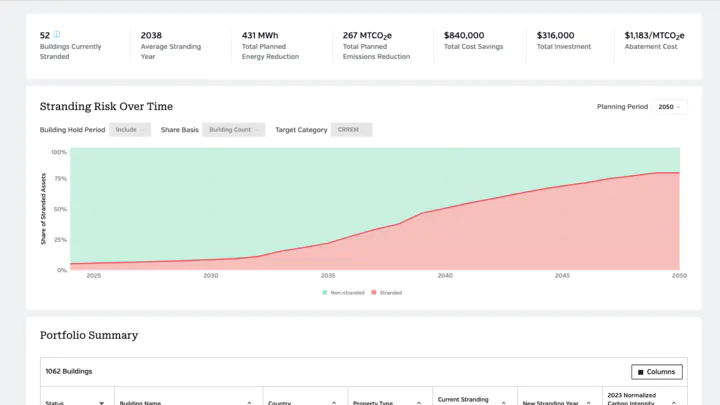
Disclosure automates the preparation and submission of ESG reports to major frameworks. GRESB submission, which traditionally requires weeks of data compilation and formatting, can be streamlined through Measurabl’s pre-mapped data templates. The platform also supports SFDR Article 8 and Article 9 fund reporting, CDP climate disclosure, ENERGY STAR benchmarking, and various local regulatory requirements. Decarb provides scenario planning tools for decarbonization strategy, allowing portfolio managers to evaluate different intervention pathways (building envelope improvements, mechanical system upgrades, renewable energy procurement, operational changes) against science-based targets and assess the capital expenditure implications of each approach.
9AI Framework: Dimension-by-Dimension Analysis
CRE Relevance: 9/10
Measurabl Navigate is built exclusively for commercial real estate ESG management, with every feature designed around the specific data structures, compliance requirements, and operational patterns of property portfolios. The platform understands that CRE ESG data is organized by property, measured in building-specific units (kWh per square foot, gallons per occupant), and reported through industry-specific frameworks (GRESB, ENERGY STAR). The company’s entire product strategy, client base, and domain expertise are focused on real estate sustainability, with no general-purpose or cross-industry capabilities that might dilute the CRE focus. The deployment across 18 billion square feet demonstrates relevance at a scale that touches a meaningful portion of the global institutional CRE market. The only reason this dimension does not score a perfect 10 is that ESG represents one dimension of CRE operations rather than a core transactional or property management workflow. In practice: Measurabl is the most CRE-relevant ESG platform available, with domain depth that generic sustainability software cannot replicate.
Data Quality and Sources: 9/10
Measurabl’s Quantum Cloud represents the largest aggregation of real estate ESG data in the world, covering more than 18 billion square feet across 93 countries. This data scale enables the benchmarking, peer comparison, and trend analysis capabilities that make the platform valuable beyond simple data collection. The Connect AI tool automates utility data ingestion from hundreds of utility providers, reducing the manual errors and gaps that plague traditional data collection approaches. ML-driven quality checks provide automated validation that catches anomalies human reviewers might miss: consumption patterns that deviate from historical norms, meter readings that are inconsistent with building size, or data gaps that would undermine reporting accuracy. The platform’s data normalization capabilities ensure consistency across properties with different utility providers, meter configurations, and reporting periods. In practice: Measurabl’s data quality infrastructure is the most sophisticated in CRE ESG, with the Quantum Cloud dataset providing benchmarking context that no other platform can match at comparable scale.
Ease of Adoption: 7/10
Measurabl Navigate operates as a cloud-based SaaS platform accessible through a web interface, eliminating infrastructure requirements. The Connect AI tool significantly reduces the onboarding burden by automating utility data ingestion rather than requiring manual entry of historical consumption data. However, ESG data management is inherently complex, and even with automation tools, onboarding a large portfolio requires mapping properties to utility accounts, establishing data connections with utility providers, validating historical data, and configuring reporting frameworks. Implementation timelines for institutional portfolios typically range from 4 to 12 weeks depending on portfolio size and data complexity. The platform’s interface is designed for sustainability professionals and requires familiarity with ESG concepts, reporting frameworks, and building performance metrics. Property managers without ESG expertise will face a steeper learning curve than sustainability team members who understand the domain. In practice: Navigate streamlines adoption relative to manual ESG data management, but the inherent complexity of utility data collection and framework compliance means onboarding is not instantaneous.
Output Accuracy: 8/10
Measurabl’s output accuracy benefits from its ML-driven quality validation pipeline, which catches data anomalies before they propagate into reports and disclosures. The automated utility data ingestion through Connect reduces the transcription errors that commonly occur during manual bill entry, and the platform’s normalization engine ensures that consumption data is consistently calculated regardless of billing period variations, unit differences between utility providers, or meter configuration changes. For GRESB submissions specifically, Measurabl’s pre-mapped templates reduce the formatting and calculation errors that have historically caused portfolio managers to submit inaccurate disclosures. The Quantum Cloud benchmarking dataset provides additional accuracy validation: when a property’s reported energy intensity falls significantly outside the range observed for comparable buildings, the system flags the anomaly for review. The primary accuracy limitation is that the platform’s outputs are only as good as the underlying utility data, and in markets where utility providers deliver inconsistent or delayed billing data, even automated ingestion cannot fully compensate. In practice: Navigate’s accuracy is strong for well-instrumented properties with reliable utility data, with the ML quality checks providing a meaningful safety net against common data errors.
Integration and Workflow Fit: 7/10
Measurabl integrates with the CRE technology ecosystem through utility provider connections, property management system data exchanges, and reporting framework submissions. The Connect AI tool interfaces directly with hundreds of utility providers to automate data collection, eliminating the most tedious integration challenge in ESG data management. The platform supports data exchange with property management systems (Yardi, MRI) for property attribute synchronization and with building management systems for more granular operational data. GRESB, CDP, ENERGY STAR, and regulatory framework integrations automate the submission process, reducing the manual effort required for compliance reporting. The platform provides API access for firms that want to integrate ESG data into proprietary analytics platforms or investor reporting dashboards. The primary integration gap is that Measurabl operates as a specialized ESG data layer rather than an integrated component of the core property management workflow, meaning that ESG data management remains somewhat siloed from daily operational systems. In practice: Measurabl connects well to the external systems that matter most for ESG compliance (utility providers, reporting frameworks) while maintaining productive connections to core CRE technology platforms.
Pricing Transparency: 4/10
Measurabl does not publish pricing on its website, and subscription costs are determined through direct sales engagement based on portfolio size, number of properties, and feature modules required. The platform’s institutional positioning and the complexity of ESG data management create a pricing dynamic similar to other enterprise CRE platforms: custom quotes, annual contracts, and limited visibility into cost structures before engaging with the sales process. Industry feedback suggests that Measurabl’s pricing scales with portfolio size, which makes economic sense (larger portfolios derive more value from automated data management) but creates uncertainty for firms evaluating the platform’s cost-effectiveness. The absence of a self-service trial or entry-level pricing tier means that smaller CRE firms or those with limited ESG requirements must commit to the evaluation process before understanding whether the platform fits their budget. In practice: pricing is fully opaque, consistent with enterprise CRE software norms but frustrating for buyers seeking transparent cost comparison against alternatives.
Support and Reliability: 7/10
Measurabl provides enterprise support including implementation assistance, training resources, and dedicated account management for institutional clients. The company’s team includes sustainability professionals who understand both the platform and the ESG compliance landscape, which means support interactions address both technical platform questions and domain-specific advisory needs. The platform’s cloud infrastructure supports mission-critical ESG reporting workflows, with particular reliability demands during GRESB submission periods when hundreds of firms prepare and upload disclosures simultaneously. Documentation covers platform functionality, framework-specific reporting guidance, and best practices for data collection and quality management. The company hosts educational webinars and industry events that provide additional learning opportunities. The primary support consideration is that the sustainability and ESG advisory aspect of the service varies by subscription tier: larger clients receive more strategic advisory support, while smaller subscribers may rely more heavily on self-service resources. In practice: Measurabl’s support combines platform expertise with ESG domain knowledge, a combination that generic technology support organizations cannot provide.
Innovation and Roadmap: 8/10
Measurabl demonstrates strong innovation in applying AI to the specific challenges of real estate ESG data management. The Quantum Cloud architecture represents a significant data infrastructure investment that creates network effects: as more properties contribute data, the benchmarking and analytics capabilities become more valuable for all participants. The Connect AI tool’s ability to automate utility data ingestion from hundreds of providers at four times the speed of manual processes addresses the industry’s most persistent operational bottleneck. The Decarb module brings scenario planning and science-based target analysis to portfolio-level decarbonization strategy, a capability that most CRE firms currently approach through custom consulting engagements or spreadsheet-based models. The platform’s evolution from a data collection tool to a comprehensive sustainability intelligence platform reflects a strategic vision that anticipates the increasing centrality of ESG to CRE investment and operations decisions. In practice: Measurabl’s innovation is well-targeted at the highest-value problems in CRE sustainability, with the Quantum Cloud data platform providing a durable competitive advantage that compounds with scale.
Market Reputation: 9/10
Measurabl has established itself as the dominant ESG data platform in commercial real estate, with market penetration metrics that are exceptional for a specialized technology provider. Deployment across 18 billion square feet, adoption by 37% of the world’s top asset managers, and presence in 93 countries represent a level of institutional validation that few CRE technology companies achieve. The company’s leadership is regularly featured in sustainability and real estate publications, and Measurabl is referenced as a standard tool in institutional investor ESG evaluation frameworks. The platform’s partnership with GRESB and its position as a recommended technology solution for GRESB reporting further cement its market standing. Industry analysts and ESG consultants routinely recommend Measurabl as the leading purpose-built CRE sustainability platform. In practice: Measurabl’s market reputation in CRE ESG is comparable to CoStar’s position in CRE data, representing the clear category leader that competitors are measured against.
Who Should Use Measurabl Navigate
Measurabl Navigate is essential for institutional CRE investors, REITs, and operators that participate in GRESB benchmarking, report under SFDR requirements, or manage decarbonization commitments. Firms managing portfolios of 50 or more properties with active ESG reporting obligations represent the core user profile, as the platform’s automation capabilities deliver the most value at scale. Asset managers under pressure from institutional investors (pension funds, sovereign wealth funds, endowments) to demonstrate ESG performance will find Navigate’s reporting and benchmarking tools directly responsive to investor demands. Corporate real estate teams managing large occupancy portfolios subject to energy disclosure requirements (Local Law 97 in New York, BERDO in Boston) will benefit from the automated utility data management and compliance reporting capabilities. Sustainability teams seeking to move beyond basic data collection into strategic decarbonization planning will find the Decarb module’s scenario analysis capabilities relevant to their strategic needs.
Who Should Not Use Measurabl Navigate
Small CRE firms managing fewer than 20 properties with limited ESG reporting requirements may find Navigate’s enterprise capabilities and pricing disproportionate to their needs. Firms not subject to GRESB, SFDR, or local energy disclosure requirements may not need the compliance automation features that justify Navigate’s subscription cost. Property managers whose sustainability efforts are limited to basic ENERGY STAR benchmarking can accomplish that through the free ENERGY STAR Portfolio Manager tool without investing in a comprehensive ESG platform. Firms seeking a combined property management and sustainability solution may prefer the ESG modules available within Yardi or MRI Software rather than adding a standalone ESG platform.
Pricing and ROI Analysis
Measurabl does not publish pricing, and subscription costs are determined by portfolio size and feature requirements. The ROI case for Measurabl centers on three value streams. First, labor efficiency: automated utility data collection and GRESB submission can save a sustainability team 200 to 500 hours annually compared to manual processes, valued at $15,000 to $40,000 at typical sustainability analyst compensation. Second, compliance risk reduction: accurate, automated ESG reporting reduces the risk of regulatory penalties (Local Law 97 fines can reach $268 per ton of CO2 above limits) and audit findings. Third, investment access: institutional investors increasingly require GRESB participation and ESG performance documentation as conditions of capital allocation, making Measurabl’s reporting capabilities a gateway to capital that might otherwise be unavailable. For large institutional portfolios, the capital access value alone can dwarf the subscription cost.
Integration and CRE Tech Stack Fit
Measurabl integrates with the CRE technology ecosystem through utility provider connections (via the Connect AI tool), property management system data exchanges (Yardi, MRI), building management system interfaces for real-time operational data, and reporting framework submissions (GRESB, CDP, ENERGY STAR). The platform provides API access for firms integrating ESG data into proprietary analytics and investor reporting systems. The utility provider integration network covers hundreds of providers across the platform’s 93-country footprint, enabling automated data collection that would be impractical to replicate manually. The platform’s position as a specialized ESG data layer means it complements rather than replaces core property management technology, adding sustainability intelligence to the existing technology stack.
Competitive Landscape
Measurabl competes in the CRE ESG platform market against several established and emerging alternatives. Deepki provides a European-focused ESG platform with strong regulatory reporting capabilities. Envizi (acquired by IBM) offers environmental data management for enterprise portfolios. Yardi and MRI Software both offer ESG modules within their broader property management platforms, providing integration advantages for firms already on those ecosystems. Smaller specialized tools like Turntide, Aquicore, and Facilio focus on building-level energy management rather than portfolio-wide ESG reporting. Measurabl’s primary competitive advantages are its CRE-specific focus, the scale of its Quantum Cloud dataset (which enables unmatched peer benchmarking), and its GRESB reporting workflow integration. The platform’s dominance among top-tier asset managers creates a network effect that reinforces data quality and benchmarking relevance.
The Bottom Line
Measurabl Navigate earns a 9AI score of 76 out of 100, reflecting its position as the commercial real estate industry’s leading ESG data management platform. The deployment across 18 billion square feet, adoption by 37% of the world’s top asset managers, and the Quantum Cloud dataset’s unmatched scale provide a foundation that competitors cannot easily replicate. The score is moderated by pricing opacity, the inherent complexity of ESG data management adoption, and the specialized nature of the platform’s value proposition (ESG is critical but represents one dimension of CRE operations). For institutional CRE firms navigating the expanding landscape of sustainability regulation, investor ESG requirements, and decarbonization commitments, Measurabl Navigate represents the most comprehensive and credible platform available for converting environmental compliance from an operational burden into a strategic advantage.
About BestCRE
BestCRE.com is the definitive authority on commercial real estate AI, analysis, and investment intelligence. Our coverage spans 20 CRE sectors with institutional-quality research designed for practitioners, investors, and operators navigating the intersection of technology and commercial real estate. Every review, analysis, and market report is built on primary data, independent evaluation, and a commitment to advancing the CRE industry’s understanding of where AI creates genuine value and where it falls short.
Frequently Asked Questions
How does Measurabl’s Connect AI tool automate utility data collection?
Measurabl’s Connect AI tool automates utility data collection by establishing direct connections with hundreds of utility providers across the platform’s 93-country operational footprint. Once a property’s utility accounts are linked to Connect, the system automatically retrieves billing data, meter readings, and consumption information on a recurring basis without manual intervention. The AI component of Connect handles the normalization challenges that make utility data collection complex: different billing periods, varying unit measurements, estimated versus actual readings, and account structure changes. The tool also applies machine learning quality checks to ingested data, flagging anomalies such as consumption spikes that might indicate meter errors, billing period overlaps that could cause double-counting, or readings that fall outside expected ranges for a property’s type and size. Measurabl claims this automated approach is four times faster and more accurate than manual utility bill entry, which for a portfolio of 500 properties could translate to hundreds of hours saved annually during the data collection phase of ESG reporting cycles.
What ESG reporting frameworks does Measurabl Navigate support?
Measurabl Navigate supports automated reporting for the major ESG frameworks relevant to commercial real estate. GRESB (Global Real Estate Sustainability Benchmark) is the primary framework, with Navigate providing pre-mapped data templates that streamline the annual submission process. The platform also supports SFDR (Sustainable Finance Disclosure Regulation) Article 8 and Article 9 fund reporting for firms marketing to EU investors, CDP (formerly Carbon Disclosure Project) climate disclosure, ENERGY STAR benchmarking and certification through automated data exchange with EPA’s Portfolio Manager, and various local regulatory requirements including building performance standards in cities like New York (Local Law 97), Boston (BERDO), Washington D.C. (BEPS), and others. The platform’s framework coverage continues to expand as new regulatory requirements emerge across global markets. For firms subject to multiple reporting obligations, Navigate’s ability to map a single dataset to multiple frameworks reduces the duplicative effort that would otherwise be required.
How large does a CRE portfolio need to be to justify Measurabl?
The economic justification for Measurabl Navigate generally becomes clear for portfolios of 50 or more properties with active ESG reporting obligations. At this scale, the manual effort required for utility data collection, data quality validation, and framework-specific reporting preparation typically consumes 400 to 800 hours of sustainability team time annually, a labor cost that often exceeds $30,000 per year. Measurabl’s automation can reduce this effort by 50% to 70%, with the time savings increasing as portfolio size grows. For portfolios of 200 or more properties, the ROI case is straightforward: the labor savings alone justify the subscription, and the added value of benchmarking, analytics, and compliance automation makes the investment compelling. Smaller portfolios of 20 to 50 properties may find the platform valuable if they face stringent reporting requirements (GRESB participation, SFDR compliance) that would be impractical to manage manually, or if institutional investors require ESG performance documentation as a condition of capital allocation.
Can Measurabl help with building decarbonization planning?
Yes, Measurabl’s Decarb module provides scenario planning tools for portfolio-level decarbonization strategy. The module allows portfolio managers to evaluate multiple intervention pathways against science-based decarbonization targets, comparing the emissions impact, capital expenditure requirements, and implementation timelines of different approaches. Users can model scenarios including building envelope improvements (insulation, window upgrades), mechanical system replacements (electrification of heating systems, high-efficiency HVAC), operational changes (setpoint optimization, scheduling adjustments), renewable energy procurement (on-site solar, green power purchase agreements), and combinations of these interventions. The Decarb module draws on the Quantum Cloud dataset to provide benchmark data on the effectiveness of similar interventions across comparable buildings, helping portfolio managers make investment decisions informed by real-world performance data rather than theoretical estimates. This capability is increasingly important as building performance standards with escalating carbon limits create financial penalties for properties that fail to meet reduction targets.
How does Measurabl compare to using Yardi or MRI’s built-in ESG modules?
Measurabl Navigate and the ESG modules offered by Yardi and MRI Software represent different strategic approaches to CRE sustainability data management. Yardi and MRI’s ESG modules provide integration advantages for firms already on those platforms, accessing property data directly from the property management system without additional connections. However, these modules are components of broader property management suites rather than purpose-built ESG platforms, which typically means less depth in sustainability-specific analytics, benchmarking, and framework reporting. Measurabl’s advantages include the Quantum Cloud dataset (enabling peer benchmarking across 18 billion square feet), dedicated framework reporting workflows (particularly for GRESB, which Measurabl has optimized extensively), the Connect AI tool for automated utility data collection from hundreds of providers, and the Decarb scenario planning module. For firms with straightforward ESG reporting needs on Yardi or MRI, the built-in modules may suffice. For firms with complex multi-framework reporting obligations, ambitious decarbonization targets, or a need for institutional-grade benchmarking, Measurabl provides capabilities that platform-native ESG modules do not match.
Related Reviews
Explore more CRE AI tool reviews in our Best CRE AI Tools directory. For sector-specific analysis and market intelligence, visit our 20 CRE Sectors hub.