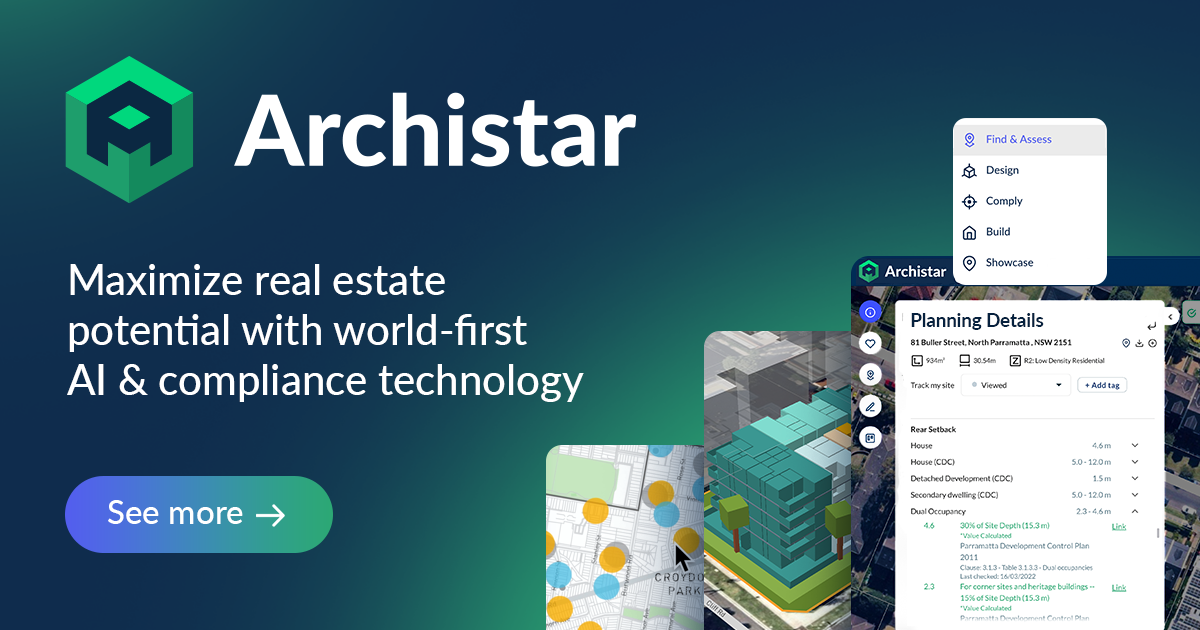
Archistar AI is a CRE-native permitting and zoning platform that automates building permit assessments and compliance checks for developers, architects, and municipalities. Originating in Australia and having raised over $22 million in funding, the company has expanded its footprint into the North American market. In August 2026, Archistar AI operates as a Tier 2 database provider within the BestCRE framework, primarily focusing on accelerating the notoriously slow pre-construction and municipal review phases. The core offering, known as AI PreCheck, evaluates architectural plans against local zoning ordinances and building codes to identify compliance failures before formal submission.
The platform relies on deterministic, rule-based logic combined with computer vision to parse complex design files, including PDFs, CAD drawings, and BIM models. By partnering directly with the International Code Council (ICC) as a Premier Platinum Reseller, Archistar AI accesses digitized building codes via API, grounding its assessments in verified regulatory frameworks. While competitors like PermitFlow and LandScout AI focus heavily on workflow routing or site selection, Archistar AI attempts to bridge the gap between municipal intake systems and developer design processes. The system generates pass/fail reports with specific code citations, allowing applicants to correct deficiencies early. However, this dual-sided market approach, selling to both city governments like Los Angeles County and private CRE developers, means the platform’s utility is highly dependent on how well a specific jurisdiction’s rules have been digitized and maintained within the Archistar environment.
What Archistar AI does and how it works
Archistar AI functions primarily as an automated compliance engine for building designs and site plans. Users upload their architectural files, accepting standard formats such as PDF, CAD, and BIM, directly into the platform. The system then runs these files through its AI PreCheck module, which consists of two distinct phases: Completeness Check and Compliance Analysis. The Completeness Check acts as an automated intake gate, scanning the submission to ensure all required documents, annotations, and formatting standards are present based on the specific permit type. If elements are missing, the system immediately flags the application, preventing an incomplete package from entering a prolonged municipal review queue.
Once an application passes the initial gate, the Compliance Analysis module evaluates the actual design against digitized zoning bylaws and building codes. Archistar AI extracts measured values from the submitted plans and compares them against local regulations, such as setback requirements, height limits, and floor area ratios. The platform utilizes a deterministic rules engine rather than generative guessing, ensuring that every flagged issue includes an explicit code citation and visual evidence linked directly to the specific plan sheet. This produces a structured pass/fail report that highlights exactly where a design violates local ordinances, allowing architects and developers to revise their plans prior to formal municipal submission.
For municipal users, Archistar AI integrates into existing permit workflow solutions to act as a first line of defense. City planners receive a dashboard view of incoming applications, complete with analytics on common failure points and pass rates. When a municipality updates a zoning ordinance, the rule configuration within Archistar AI must be updated accordingly to maintain accuracy. The platform does not replace human review or grant final approvals; rather, it augments the process by clearing out routine compliance checks, leaving complex discretionary decisions to human examiners.
9AI Framework: the score, dimension by dimension
CRE Relevance: 10/10
Archistar AI is purpose-built for the commercial real estate and property development sector. Unlike generic document-reading algorithms, its entire architecture is designed around spatial data, zoning ordinances, and building codes. The platform specifically targets the bottleneck of permit approvals, a critical pain point for CRE developers aiming to reduce holding costs. By evaluating actual CAD and BIM files against municipal rules, it addresses the exact technical requirements of property development. The dual focus on both the developer and the municipal reviewer ensures the tool is deeply embedded in the CRE lifecycle. In practice: CRE professionals use it to validate site feasibility and ensure architectural designs meet local zoning laws before spending months in the permit queue.
Data Quality and Sources: 9/10
The platform’s data integrity relies heavily on its integration with authoritative sources, most notably its partnership with the International Code Council (ICC). By accessing the ICC Code Connect API, Archistar AI ensures that its baseline building code data is accurate and up-to-date. For local zoning bylaws, the company digitizes municipal ordinances into deterministic rules. The quality of this local data is generally high, though it remains dependent on the frequency of updates from partner cities. Because the system uses rule-based logic rather than probabilistic text generation, the extracted measurements and code citations are highly reliable. In practice: Users receive compliance reports grounded in exact municipal code text, minimizing the risk of AI hallucinations during the review process.
Ease of Adoption: 7/10
Implementing Archistar AI requires a moderate to high level of initial effort, particularly for enterprise developers or municipalities requiring custom rule configurations. While the user interface for uploading a PDF or BIM file is straightforward, the backend alignment with specific local zoning rules takes time. If a developer is operating in a jurisdiction where Archistar AI has already mapped the local codes, adoption is relatively quick. However, expanding into unmapped territories requires digitizing new regulations. The platform’s ability to ingest standard architectural file formats reduces friction for design teams. In practice: Firms operating in pre-mapped municipalities will experience rapid time-to-value, while those in new markets must account for a configuration period.
Output Accuracy: 9/10
Archistar AI excels in output accuracy by strictly avoiding generative AI for its core compliance decisions. Instead, it relies on computer vision to extract measurements and applies deterministic logic to evaluate them against digitized codes. When a design fails a compliance check, the platform provides exact citations and links the failure to the specific location on the plan sheet. This auditable trail ensures that developers and city planners can trust the system’s conclusions. The primary limitation is the quality of the uploaded file; poorly rendered 2D PDFs may yield less accurate extractions than native BIM files. In practice: Developers can confidently rely on the pass/fail reports to identify setback or height violations before submitting plans to the city.
Integration and Workflow Fit: 8/10
The platform is designed to sit between the design phase and the municipal review phase, making its integration capabilities critical. Archistar AI successfully handles industry-standard file types, including CAD and BIM, fitting naturally into the workflow of architects and engineers. On the municipal side, it integrates with existing government permit workflow solutions, acting as an automated intake layer. The direct API connection with the ICC further strengthens its position within the regulatory tech stack. However, developers looking for deep, native integrations with niche CRE project management software may find the options limited compared to broader workflow tools. In practice: The tool functions as a highly specialized bridge between architectural design software and municipal permitting portals.
Pricing Transparency: 5/10
Archistar AI operates with a tiered subscription model, typically categorized into Basic, Professional, and National plans, but exact pricing figures are not published on their website. Prospective buyers must contact the sales team to request a demo and receive a custom quote based on their specific needs, geographic scope, and user count. This lack of public pricing data forces CRE analysts to engage in the sales process simply to determine baseline budget feasibility. While enterprise software often obscures pricing, this approach limits upfront financial modeling for smaller development firms evaluating multiple proptech tools. In practice: Buyers should prepare for a traditional enterprise sales cycle and negotiate terms based on the number of jurisdictions they need to access.
Support and Reliability: 8/10
Backed by over $22 million in funding and established partnerships with major municipalities and the ICC, Archistar AI demonstrates strong organizational stability. The company has a proven track record in Australia and has successfully expanded into North America, indicating a reliable support infrastructure. Municipal deployments require high service level agreements, which typically translates to better support standards for private CRE clients as well. The firm provides dedicated onboarding and custom configuration services to ensure local zoning rules are accurately digitized and maintained over time. In practice: Users can expect enterprise-grade support and a stable platform, mitigating the risks typically associated with early-stage proptech startups.
Innovation and Roadmap: 8/10
Archistar AI continues to expand its capabilities beyond basic 2D plan review. The acquisition of Snaploader indicates a strategic push into interactive 3D visualizations, enhancing the platform’s utility for complex site assessments. The company is actively moving from low-density residential applications into mid-rise and commercial development checks, broadening its total addressable market. Furthermore, the ongoing integration of more sophisticated computer vision techniques to parse complex BIM models shows a commitment to staying ahead of architectural technology trends. In practice: Buyers are investing in a platform that is actively expanding its ability to handle high-density commercial projects and advanced 3D modeling formats.
Market Reputation: 9/10
Within the niche of automated permit review, Archistar AI has built a formidable reputation. Securing contracts with major jurisdictions like Los Angeles County and the City of Austin provides significant market validation. The official collaboration with the International Code Council serves as a major endorsement of the platform’s technical legitimacy. Among CRE developers, the tool is increasingly recognized as a standard for pre-submission compliance checking. While competitors have strong momentum in workflow automation, Archistar AI is widely regarded as the leader in actual code compliance analysis. In practice: The platform is highly respected by both municipal planners and private developers for its technical rigor and regulatory alignment.
Who should use Archistar AI
Archistar AI is best suited for development teams and architectural firms that operate in high-volume or highly regulated jurisdictions where permit delays severely impact project ROI.
High-volume developers seeking to minimize holding costs by ensuring first-pass permit approvals.
Architectural firms wanting an automated quality assurance check before submitting plans to municipal clients.
CRE analysts conducting rapid site feasibility studies across multiple zoned parcels.
Municipal planning departments looking to clear backlog by automating initial intake and compliance checks.
Who should look elsewhere
This platform is not a fit for firms engaged in highly bespoke, one-off developments in obscure jurisdictions where the effort to digitize local codes outweighs the benefits.
Small-scale developers operating in rural or unmapped municipalities where local codes are not yet digitized.
Firms looking for an end-to-end project management tool rather than a specialized compliance engine.
Investors seeking basic market data or rent rolls, as this is strictly a zoning and permitting tool.
Pricing and ROI
Archistar AI does not publish its pricing publicly, requiring prospective buyers to contact their sales team for a custom quote. The company utilizes a tiered subscription structure, typically categorized into Basic, Professional, and National plans, which scales based on the geographic scope of the data required, the complexity of the features, and the number of user seats. Because the vendor does not publish pricing, it cannot exceed a score of 5 on pricing transparency within the BestCRE framework.
For a mid-sized CRE developer, the ROI math is heavily dependent on the reduction of holding costs. If a developer is carrying a $10 million land acquisition at an 8% interest rate, the holding cost is approximately $66,000 per month. If Archistar AI’s PreCheck system identifies compliance failures early and prevents a single resubmission cycle, which typically delays a project by four to eight weeks, the platform effectively saves the developer between $66,000 and $132,000 on a single project. When evaluated against these potential savings, even a premium enterprise subscription easily justifies its cost. However, buyers must factor in the time and potential implementation fees required to configure the system for specific, unmapped municipal codes. Firms should negotiate price-locked contracts, as the company has historically offered extended terms up to 60 months for early adopters.
Integration and CRE tech stack fit
Archistar AI fits into the CRE tech stack as a specialized bridge between architectural design software and municipal permitting portals. The platform’s ability to ingest standard design files, including PDF, CAD, and BIM formats, ensures that architects do not need to alter their native drafting workflows in tools like AutoCAD or Revit to utilize the compliance engine. The system extracts the necessary spatial data directly from these files.
On the regulatory side, Archistar AI’s most significant integration is its API connection with the International Code Council (ICC). This ensures that the baseline building codes used for compliance checks are authoritative and automatically updated. For municipal clients, the software integrates directly into existing government permit workflow solutions, allowing city planners to view pass/fail reports within their native dashboards. However, private developers should note that Archistar AI is a point solution for zoning and permitting; it does not natively integrate with broader CRE financial modeling tools like Argus or general construction management platforms like Procore. The tool is best deployed as a standalone quality assurance layer immediately preceding formal permit submission.
Competitive landscape
The CRE permitting and zoning software landscape has matured significantly, with Archistar AI competing against several distinct types of platforms. When compared to GatherGov and ReZone, Archistar AI offers a much deeper technical evaluation of architectural plans. While ReZone excels at summarizing zoning text for quick feasibility checks, Archistar AI actually parses CAD and BIM files to measure setbacks and heights against those rules.
PermitFlow is a primary alternative, but the two platforms solve different problems. PermitFlow operates essentially as a workflow automation engine, focusing heavily on form auto-filling and routing applications to the correct municipal departments. Archistar AI, conversely, focuses on the structural and zoning compliance of the design itself. Developers struggling with administrative paperwork should look to PermitFlow, while those failing municipal plan reviews due to code violations need Archistar AI.
LandScout AI remains the highest-rated tool in the broader site selection category, offering superior predictive analytics for finding off-market parcels based on zoning potential. However, once a site is acquired and designs are drafted, LandScout AI cannot perform the deterministic code compliance checks that Archistar AI handles. Shovels.ai provides excellent historical permit data and contractor intelligence, which is highly useful for market research, but it lacks the active plan review capabilities of Archistar AI. Ultimately, Archistar AI stands alone in its ability to bridge the gap between complex architectural files and municipal rule engines, making it the premier choice for technical compliance verification.
The bottom line
Archistar AI is a highly effective, specialized tool that attacks one of the most expensive bottlenecks in commercial real estate: the municipal permit review cycle. By utilizing deterministic logic and computer vision to evaluate architectural designs against digitized building codes, it provides a level of technical rigor that generic workflow tools cannot match. The platform is not a casual investment; it requires a commitment to integrating architectural files and verifying local municipal rules. However, for high-volume developers and architectural firms operating in complex regulatory environments, the ability to catch code violations before formal submission is invaluable. If your firm routinely loses months to permit resubmission cycles due to avoidable zoning or building code errors, Archistar AI is a mandatory evaluation. Buyers must be prepared to navigate an opaque enterprise sales process, but the potential reduction in project holding costs makes the platform a financially sound operational upgrade.
Frequently asked questions
Does Archistar AI support BIM files?
Yes, the platform is built to accept standard architectural file formats, including 2D PDFs, CAD drawings, and complex 3D BIM models. This flexibility allows the system to extract spatial data and measurements directly from native designs without forcing architects to alter their existing drafting workflows before running compliance checks.
How much does Archistar AI cost?
Pricing is not published publicly on their website. The company uses a tiered subscription model, typically divided into Basic, Professional, and National plans, based on geographic coverage, feature complexity, and user count. Prospective buyers must contact the sales team directly to request a custom quote and negotiate contract terms.
Does Archistar AI replace municipal plan reviewers?
No, the platform acts as an automated intake and compliance check rather than a final authority. It flags clear code violations and prevents incomplete applications from entering the queue, but final discretionary approvals and complex interpretations remain strictly in the hands of human municipal examiners and city planners.
Is Archistar AI available for use in the United States?
Yes, while the company was originally founded in Australia, it has expanded heavily into the North American market. It has successfully secured partnerships and deployed its AI PreCheck software with major United States jurisdictions, including Los Angeles County and the City of Austin, adapting to local zoning codes.
How does the platform get its building code data?
Archistar AI operates as a Premier Platinum Reseller for the International Code Council (ICC). Through a direct API integration, the platform accesses authoritative, digitized, and up-to-date building codes, ensuring that its automated compliance checks are grounded in verified regulatory frameworks rather than generative guesses.
Can Archistar AI find off-market commercial development sites?
While the platform offers basic site feasibility features and zoning data, its primary strength lies in architectural plan review and compliance analysis. Firms strictly looking for predictive analytics to identify off-market development parcels based on zoning potential may prefer dedicated site selection tools like LandScout AI.
Related Reviews
Compare Archistar AI with other Permitting & Zoning tools BestCRE has scored: Symbium (78/100), Zoneomics (78/100), PermitPortal (71/100) and Gridics (69/100). Browse every review in CRE Permitting & Zoning, the full Best CRE AI Tools directory, or the 20 CRE Sectors hub.