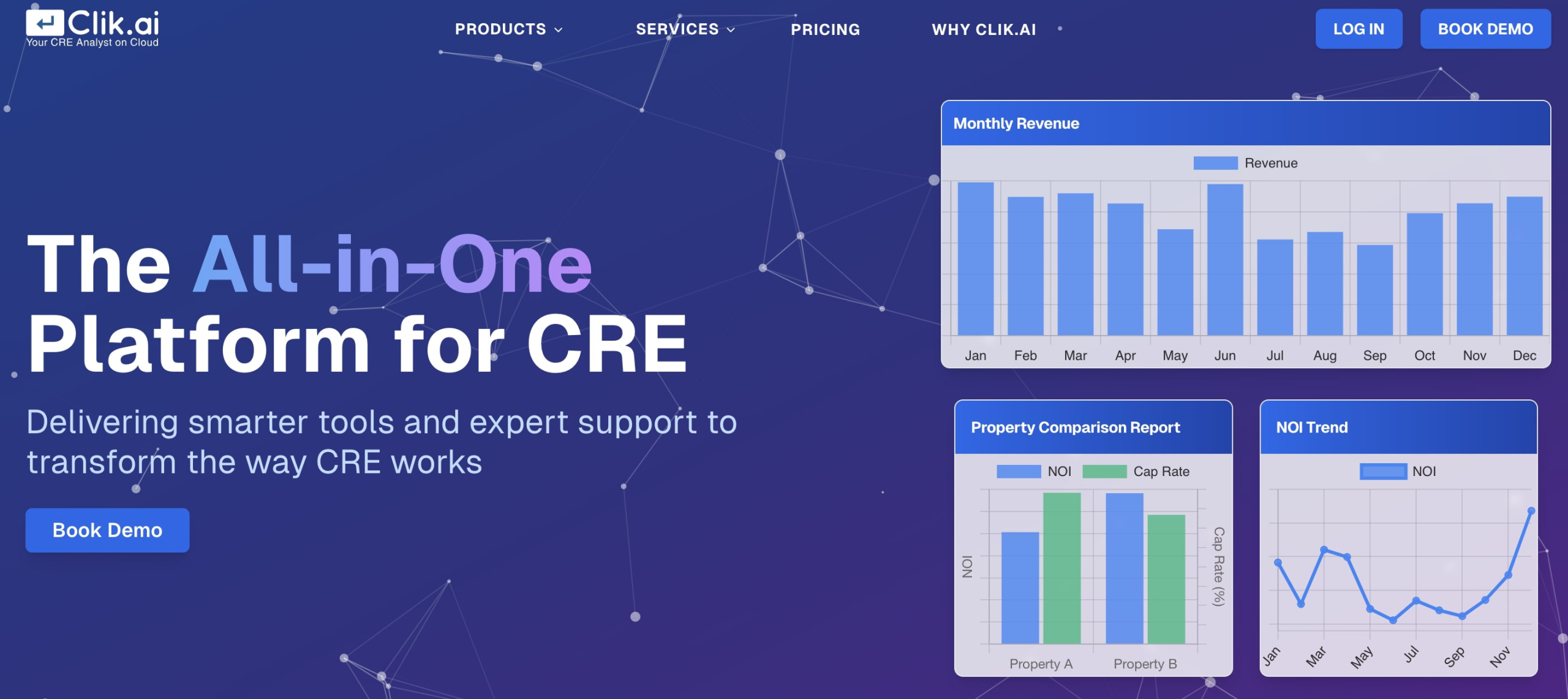
Clik.ai is a commercial real estate technology company that provides artificial intelligence software specifically designed for underwriting, document extraction, and lease abstraction. For acquisitions teams and commercial lenders, the bottleneck in deal analysis has always been the manual entry of unstructured data from rent rolls, trailing twelve-month (T12) operating statements, and offering memorandums. Clik.ai targets this exact friction point by replacing the manual rekeying process with machine learning models trained exclusively on commercial real estate financials. According to the BestCRE Master Database, the platform’s primary use case centers entirely on AI for CRE underwriting and financial document extraction, categorizing it as a Tier 2 CRE-Native solution.
The platform operates primarily through its AutoUW product, which ingests messy, varied formats, ranging from scanned PDFs to broker-formatted Excel files, and normalizes them into structured, standardized underwriting models. Rather than operating as a generic optical character recognition (OCR) tool, Clik.ai understands the context of multifamily and commercial property financials, recognizing complex utility billing allocations, concession schedules, and non-standard line items. By automating the financial spreading process, the software allows analysts to spend their time actually analyzing deal viability and market risk rather than simply digitizing data. As the commercial real estate market moves through August 2026, the demand for operational efficiency in lending and acquisitions makes purpose-built extraction tools a critical component of the modern technology stack.
What Clik.ai does and how it works
At its core, Clik.ai functions as an automated financial spreading and document digitization engine. Users begin by uploading property documents, typically rent rolls, T12 operating statements, offering memorandums, or appraisals, into the platform via a drag-and-drop interface. The system accepts various file types, including PDFs, scanned images, and Excel spreadsheets. Once uploaded, the proprietary machine learning algorithms scan the documents to identify and extract key financial metrics, property details, and tenant information. The software is trained to recognize standard commercial real estate accounting categories, automatically mapping raw line items from a seller’s messy income statement to a standardized chart of accounts used by institutional lenders and investors.
After the initial extraction, Clik.ai provides a side-by-side document viewer for validation. This interface displays the original source document next to the extracted, normalized data. Analysts can quickly trace any extracted number back to its exact location on the original PDF, allowing for rapid auditing and inline editing if the machine learning model misclassified a niche line item. This human-in-the-loop workflow ensures that the final underwriting model maintains high fidelity before any capital decisions are made. The platform supports multiple asset classes, including multifamily, retail, office, and industrial properties, adjusting its extraction logic based on the specific nuances of each property type.
The final step in the Clik.ai workflow is exporting the structured data into production-ready formats. The platform can populate custom Excel underwriting models, allowing deal teams to maintain their proprietary calculation logic while automating the data entry phase. For lenders, the software also supports direct integration into agency workbooks, such as those required by Fannie Mae and Freddie Mac. By handling the heavy lifting of document parsing and data normalization, Clik.ai transforms static, unstructured files into dynamic financial inputs ready for immediate analysis and loan sizing.
9AI Framework: the score, dimension by dimension
CRE Relevance: 10/10
Generic document parsers often fail when confronted with the idiosyncratic nature of commercial real estate financials. Clik.ai avoids this pitfall by being entirely CRE-native, built specifically to understand the nuances of rent rolls, T12s, and offering memorandums. The machine learning models are trained to differentiate between loss to lease, gross potential rent, and specific utility reimbursements, rather than just reading text on a page. This domain-specific training means the software understands the context of property-level accounting across multifamily, industrial, and office assets. It maps unstructured broker data directly into standard institutional charts of accounts without requiring users to build custom extraction templates for every new deal. In practice: Analysts can upload a poorly formatted seller rent roll and trust the system to recognize tenant names, lease dates, and rent amounts accurately.
Data Quality and Sources: 8/10
The integrity of any underwriting model depends entirely on the accuracy of its inputs. Clik.ai delivers high-quality structured data by combining advanced machine learning extraction with a mandatory validation interface. While the software boasts high automated extraction accuracy, the real quality control comes from the side-by-side viewer that forces analysts to verify the mapped data against the source document. This ensures that any anomalies, such as handwritten notes on a scanned PDF or unusual concession structures, are caught and corrected before the data enters the financial model. The output is clean, standardized, and auditable. In practice: Deal teams receive normalized financial data that retains a clear digital paper trail back to the original source documents.
Ease of Adoption: 8/10
Implementing new underwriting software often faces resistance from analysts accustomed to their own Excel workflows. Clik.ai mitigates this by functioning as an ingestion layer rather than forcing teams to abandon their proprietary models. The user interface is straightforward, relying on a simple drag-and-drop upload process and an intuitive validation screen. Because it exports directly into Excel and standard agency workbooks, the learning curve is minimal. Teams do not need to learn a new complex financial modeling language; they simply learn a faster way to get data into their existing spreadsheets. Training a new analyst to use the platform typically takes hours rather than weeks. In practice: Acquisitions teams can start processing live deal documents through the platform on their first day of deployment.
Output Accuracy: 8/10
Automated extraction tools are historically prone to errors when dealing with low-resolution scans or highly non-standard broker packages. Clik.ai addresses this by utilizing models trained specifically on millions of commercial real estate data points. The platform accurately captures complex tabular data, recognizing multi-tier utility billing and non-standard line-item descriptions that confuse generic OCR tools. However, complete autonomy is not the goal; the system highlights low-confidence extractions to prompt human review. This hybrid approach ensures that the final exported numbers are highly accurate, provided the analyst properly utilizes the validation tools. In practice: The software significantly reduces manual data entry errors, though a final human review remains a necessary step for institutional-grade accuracy.
Integration and Workflow Fit: 8/10
A tool that creates a data silo is a liability in modern commercial real estate operations. Clik.ai integrates well into existing technology stacks primarily through its flexible export capabilities and API offerings. The platform’s ability to populate custom Excel models means it fits naturally into the standard analyst workflow. For enterprise clients, the SmartExtract API allows institutions to embed the extraction engine directly into their own proprietary loan origination systems or asset management dashboards. Furthermore, the software supports agency workbook population for Fannie Mae and Freddie Mac, making it highly relevant for multifamily lenders. In practice: Firms can connect the extraction engine directly to their upstream lending systems to automate the flow of data from borrower submission to final credit memo.
Pricing Transparency: 4/10
Evaluating the financial commitment required for Clik.ai is difficult prior to engaging with their sales team. The vendor operates with custom pricing models, and specific tier costs or baseline subscription fees are not published publicly. This lack of transparency requires prospective buyers to invest time in discovery calls to determine if the software fits their technology budget. While enterprise solutions frequently obscure pricing to tailor packages based on volume and feature requirements, it makes initial vendor screening challenging for mid-sized brokerages or boutique investment firms. Buyers must negotiate based on their specific document processing volume and required integrations. In practice: Prospective users must complete a full sales cycle to understand the exact cost implications for their specific deal volume.
Support and Reliability: 8/10
As a Tier 2 CRE-native platform, Clik.ai has established a solid operational footprint among commercial lenders and brokerages. The company provides dedicated support for enterprise clients, particularly those utilizing the platform for high-volume agency underwriting where turnaround times are critical. The inclusion of human-assisted AI services indicates a commitment to ensuring clients are not left stranded if the software encounters an edge-case document it cannot parse. System uptime and processing speeds are generally reliable, supporting the demands of active deal teams during peak transaction periods. In practice: Users can rely on the platform to maintain consistent performance and receive adequate technical support when processing urgent deal packages.
Innovation and Roadmap: 8/10
The trajectory of Clik.ai shows a clear focus on expanding its utility across the entire commercial real estate lifecycle. Beyond basic extraction, the company is actively developing features for loan servicing analytics, lease abstraction, and portfolio reporting. By positioning itself as an infrastructure layer rather than a point solution, the platform is moving toward comprehensive data digitization for asset management. The ongoing refinement of its machine learning models to handle an increasing variety of asset classes, including niche sectors like student housing and healthcare, demonstrates a commitment to continuous improvement. In practice: Clients can expect the platform to steadily increase its automated recognition capabilities and expand its integration options over the coming years.
Market Reputation: 8/10
Within the commercial real estate lending and acquisitions space, Clik.ai has built a strong reputation as a practical, time-saving utility. It is frequently cited as a preferred alternative to generic document processing tools because of its specialized focus on T12s and rent rolls. The platform has secured adoption among notable institutional players, which lends credibility to its claims of high accuracy and efficiency gains. While it may not have the universal name recognition of broader data platforms like CompStak or Cherre, it is highly respected within its specific niche of automated financial spreading. In practice: Industry peers generally view the software as a reliable, specialized tool that delivers on its core promise of reducing manual underwriting hours.
Who should use Clik.ai
Clik.ai is engineered for commercial real estate professionals who spend a disproportionate amount of their week manually digitizing financial documents. The platform delivers the highest return on investment for teams that process a high volume of messy, unstructured data from external brokers or sponsors.
Commercial Lenders: Origination teams that need to rapidly spread T12s and rent rolls to issue term sheets faster than the competition.
Multifamily Acquisitions Teams: Analysts who must reconcile complex unit-level rent rolls against operating statements during tight due diligence windows.
Agency Underwriters: Firms working with Fannie Mae and Freddie Mac that require automated population of standardized agency workbooks.
CRE Brokerages: Investment sales teams looking to accelerate the creation of offering memorandums by automating the initial financial analysis of seller documents.
Who should look elsewhere
While highly effective at document extraction, Clik.ai is not a general-purpose data provider or a full-suite property management system. Firms looking for external market data or those with very low transaction volumes will not realize the full value of the platform.
Boutique Investors with Low Deal Flow: Teams underwriting fewer than a handful of deals per month may find that the cost and setup of an enterprise extraction tool outweigh the manual labor savings.
Market Researchers: Professionals seeking aggregated market rent comps or sales histories, as this tool extracts data from your own documents rather than providing external market intelligence.
Single-Family Residential Investors: Buyers focused on individual homes or small duplexes, as the software is optimized for complex commercial and large-scale multifamily financials.
Pricing and ROI
Clik.ai operates on a custom pricing model, and exact subscription tiers or baseline costs are not published on their website. Pricing is typically structured based on the volume of documents processed, the number of user licenses required, and the specific modules or integrations a firm needs. Because it is an enterprise-grade solution, prospective buyers must engage directly with the sales team to scope their requirements and receive a tailored quote.
When evaluating the return on investment, the math centers entirely on labor arbitrage and speed to execution. Consider a mid-sized acquisitions team where analysts spend an average of four hours manually rekeying and formatting a complex 300-unit multifamily rent roll and T12 operating statement. If an analyst’s fully loaded cost is $75 per hour, each manual spread costs the firm $300 in direct labor, not accounting for the opportunity cost of delayed analysis. If Clik.ai reduces that processing time by 90%, the direct labor cost drops to $30 per deal. For a firm underwriting 50 deals per month, this translates to over $13,500 in monthly labor savings, or roughly $162,000 annually. Beyond the hard cost savings, the ability to return a preliminary underwrite to a broker in hours rather than days significantly increases the probability of winning competitive deals, providing a less quantifiable but highly impactful boost to the firm’s overall pipeline velocity.
Integration and CRE tech stack fit
In the modern commercial real estate technology stack, an extraction tool is only as valuable as its ability to push data into downstream systems. Clik.ai fits neatly into existing workflows by prioritizing flexible export options rather than forcing users into a closed ecosystem. For most acquisitions teams, the primary integration is simply the ability to export normalized data directly into custom Excel underwriting models, preserving the firm’s proprietary calculation logic.
For institutional lenders and enterprise asset managers, the integration capabilities are far more advanced. The platform offers a SmartExtract API, allowing development teams to embed the document parsing engine directly into custom loan origination systems (LOS) or Salesforce environments. This ensures that data flows directly from a borrower’s uploaded PDF into the lender’s database without manual intervention. Additionally, the software’s native ability to populate Fannie Mae and Freddie Mac agency workbooks makes it a plug-and-play solution for specialized multifamily lenders. By acting as the translation layer between unstructured broker documents and structured financial databases, Clik.ai effectively bridges the gap between document intake and final credit analysis.
Competitive landscape
The landscape of commercial real estate data extraction and automated underwriting has expanded significantly, giving buyers several specialized alternatives to evaluate alongside Clik.ai. When comparing options, the primary distinction lies between generic intelligent document processing tools and CRE-native platforms.
HelloData (BestCRE Score: 91) is a formidable competitor, particularly for multifamily investors. While Clik.ai focuses heavily on the mechanical extraction of rent rolls and T12s, HelloData incorporates broader market intelligence, automating rent and expense comps alongside document extraction. Buyers focused purely on internal document spreading may prefer Clik.ai, while those wanting integrated market analytics often lean toward HelloData.
Cotality (BestCRE Score: 91) offers another high-end alternative, frequently utilized by institutional asset managers who require complex data aggregation and financial modeling automation. Cotality tends to serve broader portfolio management needs, whereas Clik.ai is highly optimized for the initial intake and underwriting phase of the transaction lifecycle.
Generic AI document parsers like Docsumo or Akkio (BestCRE Score: 86) are also frequently evaluated. While these platforms can be trained to read financial documents, they lack the out-of-the-box CRE accounting logic that Clik.ai provides. An analyst using a generic tool will spend significant time building custom templates to recognize loss to lease or common area maintenance (CAM) reconciliations, whereas Clik.ai understands these concepts natively.
Finally, for firms focused more on aggregating external market data rather than processing their own documents, platforms like CompStak (BestCRE Score: 88) or Cherre (BestCRE Score: 86) are more appropriate, though they serve entirely different use cases than Clik.ai’s document digitization engine.
The bottom line
Clik.ai is a highly effective, purpose-built utility that solves one of the most frustrating bottlenecks in commercial real estate: the manual digitization of messy financial documents. If your analysts are spending hours rekeying PDFs into Excel before they can actually begin analyzing a deal’s viability, this platform is a necessary acquisition. It is not a magical oracle that will underwrite a deal for you, nor is it a source of external market intelligence. It is a specialized extraction engine that turns static documents into structured data with high accuracy and speed. The custom pricing model requires a dedicated sales process, which may deter smaller shops, but for active lenders, brokerages, and acquisitions teams, the labor arbitrage alone justifies the investment. Stop paying highly educated analysts to do basic data entry; implement Clik.ai to automate the spreading process and refocus your team on actual risk assessment and deal structuring.
Frequently asked questions
Does Clik.ai provide commercial real estate market data or rent comps?
No, Clik.ai does not provide external market data, sales comps, or market rent estimates. It is strictly a document extraction and financial spreading tool designed to digitize and normalize the data contained within your own uploaded property documents, such as T12s and rent rolls.
What types of documents can Clik.ai process?
The platform is built to process standard commercial real estate financial documents. This includes trailing twelve-month (T12) operating statements, rent rolls, offering memorandums, and appraisals. It can ingest these documents in various formats, including standard PDFs, scanned images, and messy Excel spreadsheets.
Can Clik.ai export data directly into my firm’s custom Excel model?
Yes, one of the platform’s core features is its ability to map extracted data directly into custom Excel underwriting models. This allows deal teams to automate the data entry process without having to abandon their proprietary calculation logic or formatting preferences.
How accurate is the automated data extraction?
The vendor claims extremely high accuracy rates, but all automated extraction requires oversight. Clik.ai facilitates this through a side-by-side validation interface that highlights low-confidence extractions, allowing analysts to quickly verify and edit the data against the original source document before exporting.
Is Clik.ai suitable for single-family residential investors?
The software is not optimized for single-family residential properties. It is specifically trained on the complex accounting structures, multi-tenant rent rolls, and commercial lease terms found in multifamily, retail, office, and industrial asset classes. Single-family investors would not realize the full value of the platform.
How much does Clik.ai cost for a small acquisitions team?
Pricing is not published publicly and operates on a custom quoting model based on document volume, user count, and required integrations. Prospective buyers must engage with the sales team to receive a specific price. Smaller teams with low deal volume should weigh the cost against their current manual labor expenses.
Related Reviews
Compare Clik.ai with other Underwriting & Deal Analysis tools BestCRE has scored: Crexi (84/100), redIQ (83/100), Capitalize.io (71/100) and Archer (70/100). Browse every review in CRE Underwriting & Deal Analysis, the full Best CRE AI Tools directory, or the 20 CRE Sectors hub.