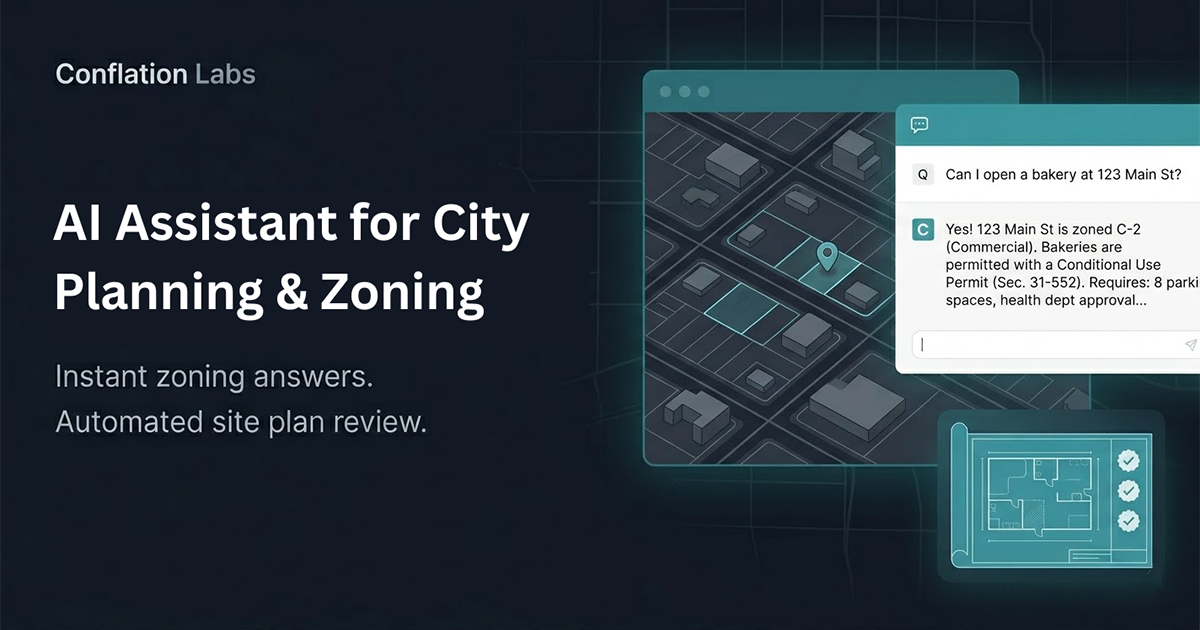
Conflation Labs is a CRE-Native, Tier 2 software provider that uses artificial intelligence to read municipal zoning codes and answer user questions in plain English.
As of August 2026, the commercial real estate industry continues to struggle with the fragmented, highly localized nature of zoning ordinances. Analysts and developers spend hundreds of hours parsing PDF documents and municipal websites to determine site viability, setbacks, and allowable uses. Conflation Labs enters this specific niche by offering a natural language interface for zoning queries, aiming to replace manual document review. Our analysis indicates that while the premise addresses a genuine pain point for acquisition teams, the execution relies heavily on the underlying language model’s ability to interpret dense legal text without hallucinating. BestCRE evaluates this tool through the lens of a principal or analyst who requires high-stakes accuracy. A missed overlay district or misinterpreted parking ratio can kill a deal or result in severe financial penalties. The platform is currently positioned in the market with a paid subscription model following a free trial, though exact enterprise pricing tiers are not published. As a Tier 2 vendor, Conflation Labs competes against more established permitting platforms but differentiates itself by focusing strictly on the code-reading and interpretation phase rather than workflow management or permit expediting. This review breaks down its capabilities, limitations, and overall utility for institutional and mid-market commercial real estate operators seeking to accelerate their site selection and due diligence processes.
What Conflation Labs does and how it works
Conflation Labs functions as a specialized search and synthesis engine for municipal zoning codes. Users input a specific property address or jurisdiction, and the platform retrieves the relevant zoning ordinances, overlay maps, and municipal guidelines. Instead of forcing the user to read through hundreds of pages of municipal PDFs, the software provides a chat-like interface where analysts can ask direct questions. For example, a user can type, “What is the maximum floor area ratio for a mixed-use development on this parcel?” or “Are there any setback requirements for a drive-thru restaurant in this specific zone?” The AI processes the query against the ingested municipal data and returns an answer in plain English.
Our analysis shows that the core mechanic relies on natural language processing to map the user’s intent to the specific legal definitions within the local code. The system highlights the source text it used to generate the answer, which is a critical feature for commercial real estate professionals who must verify every claim before presenting it to an investment committee. If the tool states that a parcel allows for a 50-foot building height, it provides a direct citation to the exact section and paragraph of the municipal code. This traceability is intended to mitigate the risk of AI hallucinations, though users must still manually check the cited text to ensure the model did not misinterpret exemptions or conditional use clauses.
Beyond single-parcel queries, the platform allows users to run comparative analyses across multiple jurisdictions. An acquisition team looking for light industrial sites can theoretically use the tool to compare warehouse parking requirements across five different suburban municipalities simultaneously. However, because Conflation Labs focuses entirely on reading and answering questions about existing codes, it does not generate architectural massing models, nor does it track the status of live permit applications. It is strictly a text-based research assistant designed to compress the time spent in the initial zoning feasibility phase of a project.
9AI Framework: the score, dimension by dimension
CRE Relevance: 8/10
Conflation Labs is entirely dedicated to commercial real estate, specifically targeting the zoning and feasibility stages of development and acquisition. Unlike generic language models, this tool is classified as a CRE-Native platform, meaning its architecture is built around the specific terminology and structure of municipal land use codes. It directly addresses the tedious process of zoning research, which is a universal bottleneck for developers, brokers, and site selection consultants. However, because it is a Tier 2 application focused solely on text interpretation rather than full-cycle development management, its relevance is highly concentrated on front-end due diligence rather than asset management or operations. In practice: Acquisition analysts will use this daily during site selection, but property managers and leasing brokers will find little utility in the platform.
Data Quality and Sources: 7/10
The platform’s effectiveness is entirely dependent on the recency and completeness of the municipal codes it ingests. Zoning ordinances change frequently through city council amendments, variances, and updated comprehensive plans. Our analysis indicates that while Conflation Labs pulls directly from published municipal databases, the latency between a city passing an ordinance and the tool updating its corpus is an unknown variable. The data is inherently unstructured and varies wildly in format from one county to the next, making standardized data extraction difficult. The tool attempts to normalize this data, but users must remain vigilant about the “as of” date for any code it references. In practice: Users must independently verify that the AI is referencing the most recently amended version of the local zoning code before finalizing any site feasibility studies.
Ease of Adoption: 8/10
By utilizing a plain English question-and-answer interface, Conflation Labs removes the steep learning curve typically associated with specialized commercial real estate software. There are no complex dashboards to configure or extensive onboarding modules required to start querying zoning codes. Analysts who are already familiar with consumer-grade AI chatbots will immediately understand how to interact with the platform. The primary adoption hurdle is not technical, but rather behavioral: training senior partners and investment committees to trust the outputs generated by an AI assistant. The inclusion of a free trial allows teams to test the interface with zero financial commitment, further lowering the barrier to entry. In practice: A junior analyst can begin pulling zoning summaries within ten minutes of creating an account, requiring almost no formal software training.
Output Accuracy: 6/10
Translating dense, legally binding zoning text into plain English introduces significant risk. Municipal codes are filled with cross-references, conditional exceptions, and grandfather clauses that can easily confuse natural language processing models. While Conflation Labs provides citations to the original text, our analysis suggests that the AI may occasionally miss nuanced overlay districts or misinterpret the hierarchy of conflicting ordinances. The accuracy is sufficient for initial site screening, but it is not infallible enough to replace a formal zoning report from a qualified land use attorney. Users must treat the outputs as a highly educated starting point rather than a definitive legal conclusion. In practice: Analysts must click through every single citation provided by the AI to manually confirm that the plain English summary accurately reflects the legal text.
Integration and Workflow Fit: 4/10
As a specialized zoning research tool, Conflation Labs operates primarily as a standalone web application. There is no published evidence in our research that it offers native API integrations with major commercial real estate platforms like Argus, Yardi, or Salesforce. Users interact with the tool in an isolated environment, meaning that any data or summaries generated must be manually copied and pasted into external investment memos or underwriting spreadsheets. For enterprise teams looking to build automated, end-to-end data pipelines for site selection, this lack of connectivity presents a structural limitation. It functions as an isolated research terminal rather than a connected node in a broader tech stack. In practice: Analysts will run queries in a separate browser tab and manually export the findings into their firm’s standardized Word or Excel templates.
Pricing Transparency: 4/10
The vendor’s website indicates a model consisting of a paid subscription following a free trial. However, exact pricing tiers, seat licenses, and enterprise contract minimums are not published publicly. According to the 9AI Framework rules, a vendor that does not publish pricing cannot exceed a score of 5 in this category. This lack of transparency forces prospective buyers into a sales funnel simply to determine if the software fits their operating budget. While the free trial offers a risk-free evaluation period, the opaque nature of the subsequent paid tiers makes it difficult for procurement teams to forecast long-term software expenditures or calculate immediate return on investment prior to engagement. In practice: Buyers must complete the free trial and engage directly with a sales representative to uncover the actual cost of deployment.
Support and Reliability: 5/10
Conflation Labs is classified as a Tier 2, unproven startup in the commercial real estate technology space. Per the 9AI Framework, an unproven startup cannot exceed a score of 6 in this dimension. Information regarding dedicated customer success managers, service level agreements, or guaranteed response times is not published. Early-stage companies often struggle to scale their support infrastructure as their user base grows, leading to potential bottlenecks when users encounter bugs or require assistance with complex queries. While the simplicity of the tool may reduce the overall volume of support tickets, enterprise clients typically demand rigorous support guarantees that are currently unverified for this vendor. In practice: Users should expect standard email-based support and should not rely on the vendor for immediate, mission-critical technical assistance during active deal negotiations.
Innovation and Roadmap: 6/10
The core proposition of using AI to read zoning codes is highly relevant today, but the underlying technology is rapidly becoming commoditized. As foundational language models improve, the moat for specialized text-reading applications shrinks. Conflation Labs will need to innovate beyond simple question-and-answer mechanics to maintain its market position. Our analysis suggests that future iterations must incorporate geospatial mapping, automated massing generation, or integration with live municipal permit tracking to remain competitive. Currently, the roadmap is not published, leaving buyers to guess whether the platform will evolve into a comprehensive feasibility suite or remain a narrow, single-function research utility. In practice: Buyers are purchasing the tool for its current text-parsing capabilities, with no clear guarantee of future feature expansions or advanced geospatial integrations.
Market Reputation: 5/10
As a Tier 2 startup, Conflation Labs lacks the extensive track record and widespread industry adoption of older, more established software providers. Under the 9AI Framework rules, an unproven startup is capped at a score of 6 for market reputation. The company is currently building its brand within the niche of AI zoning analysis, but it has not yet accumulated a critical mass of published case studies or institutional endorsements. It competes in a crowded field alongside vendors like LandScout AI and Archistar AI, which have already secured higher visibility in the market. Trust is paramount when dealing with legal zoning codes, and Conflation Labs is still in the process of earning that trust from major developers. In practice: Institutional buyers will likely require a prolonged pilot program to independently validate the tool’s reputation for accuracy before committing to a firm-wide rollout.
Who should use Conflation Labs
Conflation Labs is purpose-built for professionals who spend a disproportionate amount of their week reading municipal codes. The tool is highly effective for teams that need to rapidly filter out unviable sites before committing capital to formal legal review.
Acquisition analysts at mid-sized development firms who need to quickly verify allowable uses and setbacks across multiple municipalities.
Site selection consultants working on behalf of retail or industrial tenants to identify parcels that meet specific zoning criteria.
Land brokers who want to provide prospective buyers with immediate, plain-English summaries of a parcel’s development potential to accelerate transactions.
Urban planners and architects conducting preliminary feasibility studies before drafting initial site plans or massing models.
Who should look elsewhere
Organizations that require full-service permit expediting, architectural design generation, or guaranteed legal opinions will find this tool insufficient for their needs. It is a research assistant, not a replacement for specialized legal or engineering professionals.
Property managers and leasing agents, as zoning feasibility has minimal impact on the daily operations of stabilized assets.
Institutional investment committees seeking legally binding zoning reports or formal land use opinions for final underwriting approval.
Firms looking for an all-in-one platform that generates 3D architectural massing models or tracks live construction permits.
Pricing and ROI
Pricing for Conflation Labs is not published on their public-facing website. The research confirms that the vendor operates on a paid subscription model following a free trial, allowing users to test the platform before committing. Because exact enterprise tiers, per-seat costs, and minimum contract lengths are hidden behind a sales wall, procurement teams cannot accurately benchmark the software against competitors like Shovels.ai or PermitFlow without direct engagement.
Our analysis indicates that the return on investment math for a tool of this nature is straightforward, despite the opaque pricing structure. If an acquisition analyst earns $100,000 annually, which equates to roughly $50 per hour, and currently spends ten hours per week manually reading municipal zoning PDFs, the firm is spending $500 weekly on basic zoning research. If Conflation Labs can reduce that research time by 80 percent through its plain English question-and-answer interface, it saves the firm $400 per week, or over $20,000 annually per analyst. To achieve a positive return on investment, the undisclosed annual subscription cost must simply fall below the value of the analyst hours saved. Buyers must also factor in the administrative time still required to manually verify the AI’s citations, ensuring that the efficiency gains are not offset by the cost of correcting inaccurate legal interpretations.
Integration and CRE tech stack fit
Conflation Labs functions as an isolated application within the commercial real estate tech stack. There is no published documentation suggesting that it offers native APIs or pre-built connectors to industry-standard platforms such as Yardi, MRI, Argus, or Salesforce. For teams focused on building highly integrated, automated data pipelines, this lack of connectivity is a notable drawback. Users must conduct their zoning research within the Conflation Labs interface and then manually export or copy the plain English summaries into their firm’s underwriting models, investment memos, or relationship management records. While this siloed approach is common among early-stage, Tier 2 research utilities, it limits the tool’s ability to automatically pass data downstream to architectural or financial forecasting software. The platform is best viewed as a standalone research terminal, similar to a specialized search engine, rather than a foundational layer of a firm’s enterprise architecture. Firms adopting this tool will need to establish strict internal protocols for how the AI-generated zoning data is formatted, verified, and manually entered into their primary systems of record to maintain data integrity across the organization.
Competitive landscape
The market for artificial intelligence in zoning and permitting software is becoming increasingly crowded, and Conflation Labs faces stiff competition from vendors that offer broader feature sets. LandScout AI, which holds a BestCRE Score of 87, and Archistar AI, with a BestCRE Score of 81, represent the upper echelon of this category. Both competitors go beyond simply reading text; they incorporate geospatial data and automated 3D massing models, allowing users to visualize the zoning code on a specific parcel. For teams that need visual outputs, these higher-scoring platforms present a more comprehensive solution.
In the permitting and contractor intelligence space, Shovels.ai, scoring 80, and PermitFlow, scoring 76, offer workflow management and historical permit data tracking, which Conflation Labs does not attempt to provide. GreenLite, scoring 71, and ReZone, scoring 70, are closer direct competitors in terms of zoning analysis, but they also offer more established track records. Conflation Labs differentiates itself strictly through its focused, plain English question-and-answer interface, prioritizing simplicity over complex feature bloat. However, because it lacks the visual and workflow capabilities of its peers, buyers must decide if a pure text-analysis tool justifies a dedicated subscription, or if they are better served by a platform like LandScout AI that handles both the reading of the code and the visual application of its rules.
The bottom line
Conflation Labs offers a sharp, highly focused solution to one of commercial real estate’s most tedious problems: reading and interpreting municipal zoning codes. Its plain English interface makes it incredibly easy to use, and the citation feature provides necessary transparency for high-stakes due diligence. However, as an unproven Tier 2 startup with unpublished pricing and no integration capabilities, it carries inherent adoption risks. The tool is not a replacement for land use attorneys or comprehensive platforms like LandScout AI that offer geospatial visualizations. Decision makers should utilize the free trial to test the AI’s accuracy against known zoning codes in their target markets. If the tool consistently saves your analysts hours of manual reading without hallucinating legal nuances, it is worth the investment as a standalone research utility. If your firm requires automated massing models or integrated workflow management, pass on Conflation Labs and look to higher-scoring alternatives.
Frequently asked questions
Does Conflation Labs generate 3D architectural massing models?
No. Conflation Labs is strictly a text-based research tool that uses AI to read zoning codes and answer questions in plain English. It does not provide geospatial mapping, visual site plans, or automated 3D massing models like some of its higher-rated competitors in the market.
How much does a Conflation Labs subscription cost?
Pricing is not published on the vendor’s website. The company offers a paid subscription model that requires users to transition from a free trial. Prospective buyers must engage directly with the sales team to determine enterprise pricing tiers, seat licenses, and contract minimums.
Can this software replace my land use attorney?
Absolutely not. While the AI provides plain English summaries and citations to specific municipal codes, it is not infallible. Users must manually verify the outputs, as AI can misinterpret complex legal nuances, grandfather clauses, or overlay districts. It is a research assistant, not a legal authority.
Does Conflation Labs integrate with Argus or Yardi?
There is no published evidence that the platform offers native integrations or APIs for major commercial real estate software like Argus, Yardi, or Salesforce. It operates as a standalone web application, requiring users to manually export and transfer data into their existing underwriting models.
Is a free trial available for new users?
Yes, the research confirms that Conflation Labs offers a free trial. This allows acquisition teams and analysts to test the natural language interface and verify the accuracy of the AI’s zoning citations before committing to a paid enterprise subscription.
How does it compare to LandScout AI?
LandScout AI scored an 87 on the BestCRE framework, significantly higher than Conflation Labs. While Conflation Labs focuses purely on text-based question-and-answer mechanics, LandScout AI offers a more comprehensive suite that includes geospatial data and visual massing models, making it better suited for complex site planning.
Related Reviews
Compare Conflation Labs with other Permitting & Zoning tools BestCRE has scored: Symbium (78/100), Zoneomics (78/100), TurboPermit (76/100) and Camino (68/100). Browse every review in CRE Permitting & Zoning, the full Best CRE AI Tools directory, or the 20 CRE Sectors hub.