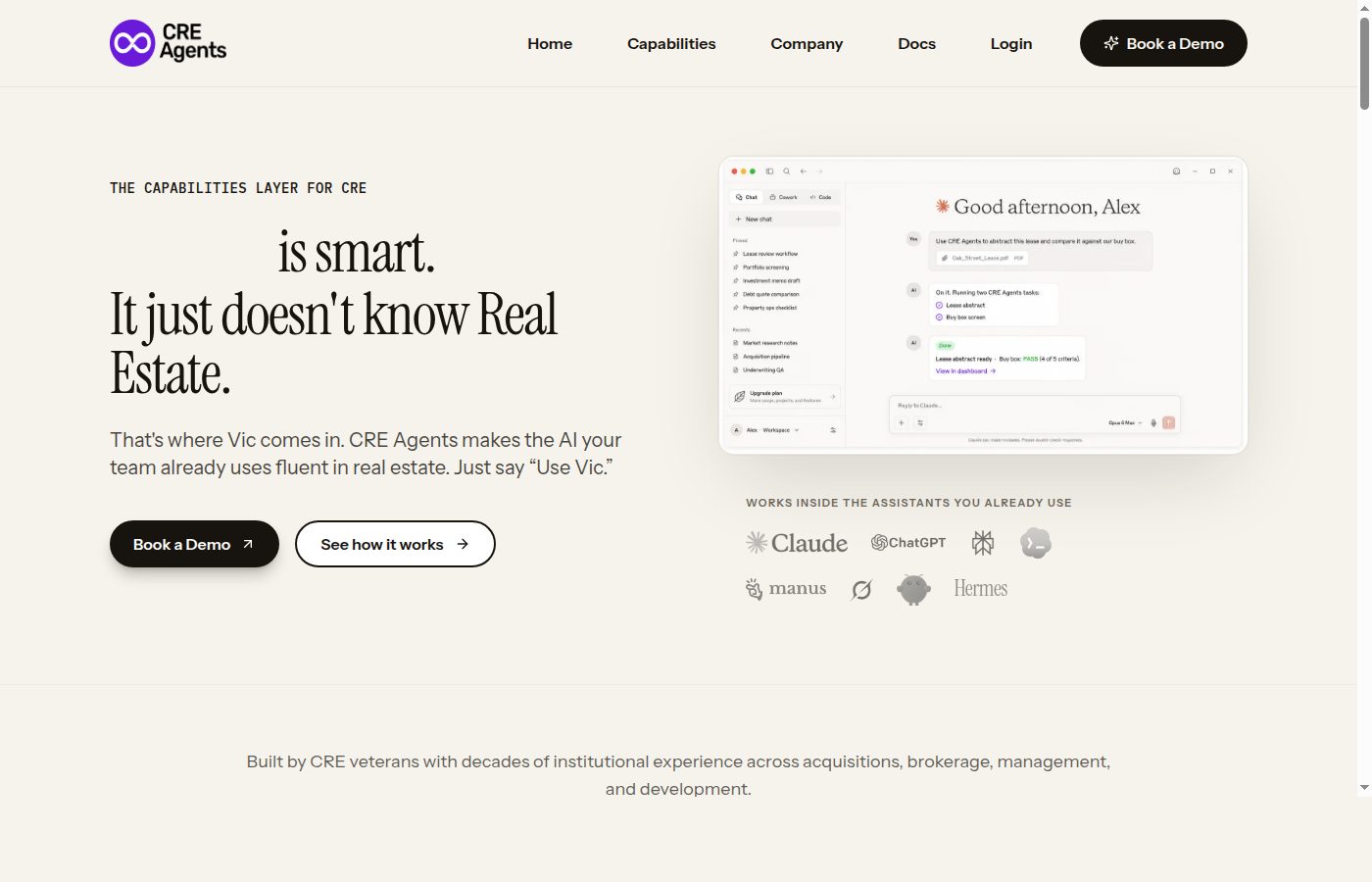
CRE Agents is a specialized software provider delivering AI agents tailored for CRE asset management, acquisitions, and brokerage. Operating as a Tier 2 CRE-native platform, the company focuses on automating repetitive analytical tasks that typically consume associate-level hours. While categorized primarily under CRE Valuation & Appraisal, the tool functions more as a workflow automation layer than a traditional automated valuation model. By deploying specialized agents, the platform attempts to bridge the gap between static property data and active deal execution. The commercial real estate industry has seen a flood of general-purpose generative AI wrappers, but CRE Agents differentiates itself by constraining its models to specific industry use cases.
Evaluating this platform requires separating the vendor’s technical ambition from its current operational reality. As of March 2026, the market for autonomous AI agents in commercial real estate remains highly speculative. Buyers must understand that these agents do not replace the fiduciary judgment required in acquisitions or asset management. Instead, they act as high-speed data compilers. The software parses rent rolls, extracts lease clauses, and structures financial data for preliminary underwriting. However, because the vendor operates as an unproven startup in a sector where trust is paramount, prospective buyers must approach implementation with strict oversight protocols. The platform shows promise for mid-sized brokerages and agile acquisition teams, provided they have the internal discipline to verify the machine-generated outputs before utilizing them in investment committee memorandums.
What CRE Agents does and how it works
CRE Agents operates by deploying specialized, task-specific AI routines that interact with a firm’s internal documents and external data feeds. When an analyst uploads a raw offering memorandum, a rent roll, and historical operating statements, the acquisition agent extracts the relevant financial metrics and populates a standardized underwriting template. The system uses natural language processing to identify anomalies in lease structures, such as unusual co-tenancy clauses or non-standard expense stops, flagging these for human review. This extraction process aims to reduce the initial screening time for new deals from several hours to a matter of minutes.
For asset management, the platform deploys a different set of agents designed to monitor portfolio performance against initial business plans. These agents ingest monthly property management reports, cross-reference them with budget projections, and generate variance summaries. If a property experiences a sudden spike in utility costs or a drop in physical occupancy, the asset management agent drafts an alert detailing the discrepancy. The brokerage-focused agents concentrate on market research and comp aggregation, pulling recent lease and sale comparables to generate preliminary broker opinion of value reports.
Mechanically, the software relies on large language models fine-tuned on commercial real estate terminology. Users interact with the agents through a chat interface or by setting up automated triggers tied to a shared inbox or cloud storage folder. When a new deal hits the inbox, the agent automatically begins processing the attachments. The output is typically delivered as a structured data file or a drafted narrative summary. Crucially, the system requires users to maintain strict document organization, as the agents struggle to parse highly unstructured or poorly scanned historical records.
9AI Framework: the score, dimension by dimension
CRE Relevance: 9/10
The platform is entirely dedicated to commercial real estate, avoiding the pitfalls of general-purpose AI tools that fail to understand industry-specific nuances like triple net leases or capitalization rate spreads. By focusing specifically on asset management, acquisitions, and brokerage, the vendor has trained its models to recognize the standard document formats and financial structures unique to institutional real estate. This specialized focus means users do not need to spend time teaching the AI basic industry concepts. The agents understand the difference between gross and net rentable area out of the box. In practice: Analysts can deploy the tool immediately on standard deal documents without writing complex, explanatory prompts.
Data Quality and Sources: 7/10
As a Tier 2 database, CRE Agents relies heavily on the quality of the internal data provided by the user. The platform does not natively supply a proprietary database of national property comparables like some top-tier data providers. Instead, it structures and synthesizes the data found in the user’s uploaded rent rolls, operating statements, and third-party appraisals. The AI is highly effective at extracting text and numbers from clean PDFs, but performance degrades when processing older, handwritten, or heavily skewed scans. In practice: Firms must ensure their source documents are legible and reasonably organized to prevent the agents from hallucinating financial figures.
Ease of Adoption: 6/10
Implementing AI agents requires a significant shift in daily workflows. While the user interface is relatively straightforward, training acquisition and asset management teams to trust and verify the automated outputs takes time. Users must learn how to configure the agents, set up email triggers, and map the extracted data to their specific internal underwriting models. The vendor provides onboarding documentation, but the burden of change management falls entirely on the buyer’s leadership team. Resistance from senior staff who prefer manual data entry is a common hurdle. In practice: Successful deployment requires an internal champion to mandate usage and audit the early results.
Output Accuracy: 7/10
The accuracy of the extracted financial data and lease abstractions is generally high when dealing with standardized institutional documents. The models correctly identify key lease dates, base rent escalations, and tenant improvement allowances most of the time. However, the system occasionally struggles with complex, multi-tiered waterfall structures or highly bespoke joint venture agreements. Buyers cannot blindly trust the aggregated numbers for final investment decisions. The software is a screening tool, not a replacement for a final human audit. In practice: Analysts must spot-check the generated underwriting assumptions against the source documents before presenting the data to the investment committee.
Integration and Workflow Fit: 6/10
The platform offers basic API connectivity to common cloud storage providers and email clients, allowing for automated document ingestion. However, direct, two-way integrations with heavy enterprise resource planning systems or complex valuation software like Argus Enterprise are limited. Users typically have to export the agent’s findings as a CSV or Excel file and manually upload them into their primary financial models. This disjointed data transfer limits the platform’s utility for large institutions demanding fully automated data pipelines. In practice: Buyers should expect to rely on Excel as the intermediary bridge between the AI agents and their core accounting systems.
Pricing Transparency: 4/10
The vendor operates on a paid model but does not publish specific pricing tiers, implementation fees, or seat license costs on its website. This opacity forces prospective buyers into a lengthy sales cycle just to determine basic budget feasibility. It remains unclear whether the company charges based on the number of users, the volume of documents processed, or the number of active agents deployed. This lack of public information complicates the evaluation process for mid-market firms with strict technology budgets. In practice: Buyers must demand a detailed, itemized pricing proposal early in the sales conversation to avoid unexpected overage charges.
Support and Reliability: 5/10
As an unproven startup, the vendor’s support infrastructure is still developing. Users report that while the founding engineering team is highly responsive to critical bugs, standard technical support queries often face delayed response times. The company lacks a comprehensive, 24/7 global support desk, which may pose challenges for international firms or teams working late on deal deadlines. Documentation is adequate for basic setup but lacks deep troubleshooting guides for complex API integration errors. In practice: Early adopters should negotiate guaranteed service level agreements and dedicated account management to ensure they receive timely assistance during the critical onboarding phase.
Innovation and Roadmap: 8/10
The company demonstrates a clear understanding of where autonomous workflows are heading in commercial real estate. Their development pipeline includes planned features for predictive market analytics and more sophisticated multi-document cross-referencing. The vendor frequently updates its underlying language models to improve reasoning capabilities and reduce extraction errors. This aggressive development pace indicates a strong commitment to pushing the boundaries of what AI can achieve in property valuation and deal screening. In practice: Buyers are investing in the company’s future capabilities as much as the current feature set, requiring a tolerance for frequent interface updates and evolving functionalities.
Market Reputation: 5/10
The platform is relatively new to the commercial real estate technology landscape and lacks the extensive track record of established valuation providers. While early pilot programs have generated cautious optimism among boutique brokerages, the tool has yet to be stress-tested by major institutional asset managers at scale. The company has not accumulated a critical mass of verified, independent case studies detailing long-term return on investment. Trust in the brand is still being built. In practice: Prospective buyers should ask the vendor for reference calls with current clients of a similar size and asset class focus before signing a contract.
Who should use CRE Agents
CRE Agents is best suited for agile teams looking to accelerate their initial deal screening and portfolio monitoring processes. The ideal user has a high volume of standardized documents and a mandate to increase operational efficiency without adding headcount.
Boutique and mid-sized investment sales brokerages needing faster preliminary valuations.
Acquisition teams at private equity real estate firms processing dozens of offering memorandums weekly.
Asset managers overseeing stabilized portfolios who need automated variance reporting.
Tech-forward analysts comfortable auditing machine-generated financial models.
Who should look elsewhere
Firms requiring highly customized, enterprise-grade data pipelines or those dealing exclusively in niche, non-standard asset classes will find the platform lacking. Organizations without the internal discipline to verify AI outputs face significant risk.
Institutional core funds requiring direct, two-way integration with Argus Enterprise.
Firms dealing primarily in complex, highly unstructured distressed debt workouts.
Organizations with strict on-premise data security mandates prohibiting cloud-based AI processing.
Teams looking for a fully automated valuation model that requires zero human oversight.
Pricing and ROI
The vendor operates on a paid commercial model, but specific pricing details are strictly not published on their public channels. Prospective buyers must engage directly with the sales team to receive a custom quote. Based on typical structures for similar AI agent platforms, buyers should anticipate a combination of base platform access fees and variable costs tied to usage metrics, such as the number of documents processed or active agents deployed. This lack of transparency requires firms to carefully define their expected usage volume during contract negotiations to avoid unexpected overage fees.
When calculating the return on investment, buyers must weigh the software cost against the fully loaded hourly rate of junior analysts. If an acquisition team reviews 100 offering memorandums per month, and the software reduces the initial data extraction and formatting time from two hours to twenty minutes per deal, the firm saves approximately 166 hours monthly. At an analyst cost of $50 per hour, this yields a gross savings of $8,300 per month. To achieve a positive ROI, the platform’s monthly licensing and implementation amortization must fall well below this threshold, factoring in the time still required for senior staff to audit the AI’s output.
Integration and CRE tech stack fit
Fitting CRE Agents into an existing commercial real estate technology stack requires realistic expectations regarding data flow. The platform excels at ingesting unstructured data from email attachments and standard cloud storage repositories like SharePoint or Google Drive. However, its ability to push structured data directly into complex, industry-standard systems is currently constrained.
Firms utilizing heavy enterprise resource planning software such as Yardi or MRI will not find native, plug-and-play synchronization. Instead, the AI agents generate structured outputs, typically CSV or Excel files, that must be manually imported into these core accounting systems. Similarly, while the tool is categorized under valuation and appraisal, it does not currently offer a direct API link to Argus Enterprise for automated cash flow modeling. Users must map the extracted rent roll data into an Excel upload template first. For brokerages, integrating the agent’s findings into customer relationship management platforms like Salesforce requires utilizing third-party middleware or custom API development. Buyers must allocate internal IT resources or hire external consultants to build these data bridges if they desire a highly automated pipeline.
Competitive landscape
The commercial real estate valuation and AI landscape is increasingly crowded, forcing buyers to carefully distinguish between automated valuation models and workflow automation tools. CRE Agents competes in a specialized niche, but buyers must evaluate it against established players in the broader category.
Attentive.ai (scored 88) remains a formidable alternative for firms focused on automated site measurements and exterior property data extraction, offering a more proven track record in visual data processing. Clear Capital (Scored 78) and HouseCanary (Scored 74) dominate the residential and light commercial valuation space, providing vast proprietary databases of historical transactions that CRE Agents lacks. If a firm requires instant access to verified sales comparables rather than document extraction, these established data providers are superior choices.
For construction and development-focused valuation, Togal.AI (Scored 76) offers highly specialized automated takeoff capabilities that far exceed the general document processing scope of CRE Agents. Meanwhile, C3 AI Property Appraisal (Scored 76) provides a more enterprise-ready infrastructure for large municipal and institutional valuation tasks, backed by a mature corporate support network. Finally, PriceHubble (Scored 73) offers strong predictive valuation analytics, particularly in the European market, which may appeal to cross-border investors looking for integrated market forecasting. CRE Agents differentiates itself by focusing specifically on the analyst workflow, reading documents and drafting summaries, rather than providing a proprietary database of property values.
The bottom line
CRE Agents offers a compelling, albeit early-stage, solution for commercial real estate firms desperate to reduce the administrative burden of deal screening and portfolio monitoring. By focusing specifically on asset management, acquisitions, and brokerage workflows, the platform avoids the generic pitfalls of broader AI tools. However, its status as an unproven startup requires buyers to proceed with caution. The software is a powerful data extraction and synthesis engine, not a replacement for experienced underwriting judgment. Firms that implement strict auditing protocols and possess the technical agility to manage manual data transfers will extract significant value. Conversely, large institutions demanding native enterprise integrations and published, transparent pricing should wait for the platform to mature. Purchase this tool if your primary bottleneck is junior analyst capacity, but do not expect it to operate entirely unsupervised.
Frequently asked questions
Does CRE Agents provide a proprietary database of sales comparables?
No. The platform operates strictly as a workflow automation tool, extracting and structuring data from the specific documents you upload. It does not supply an internal database of national property comparables, historical sales data, or proprietary market analytics. Users must bring their own market data to the platform.
Can the software automatically update Argus Enterprise models?
Direct, two-way API integration with Argus Enterprise is not natively supported out of the box. Users must export the extracted rent roll and operating statement data into an Excel format. From there, analysts can format the spreadsheet to match the standard Argus import templates for cash flow modeling.
Is the pricing for CRE Agents publicly available?
Pricing is strictly not published on the vendor’s website. The company utilizes a custom, paid commercial model, requiring prospective buyers to engage directly with their sales team. You will receive a specific quote based on your anticipated document processing volume and the number of active agents deployed.
How does the platform handle scanned, handwritten documents?
While the artificial intelligence models excel at processing clean, digital PDFs, their accuracy significantly degrades when analyzing older, handwritten, or heavily skewed scanned documents. Users must allocate additional time to manually verify and correct the financial outputs generated from poor-quality source files to avoid underwriting errors.
Does the tool work for all commercial asset classes?
The underlying language models are trained on standard commercial real estate structures and perform reliably on traditional multifamily, office, industrial, and retail assets. However, highly bespoke or niche asset classes, such as specialized cold storage or complex hospitality joint ventures, will require significant manual oversight and verification.
What level of technical support is provided during onboarding?
The vendor provides basic onboarding documentation and direct access to the engineering team for resolving critical software bugs. However, because they operate as an unproven startup, they currently lack a dedicated 24/7 global support desk, which may delay immediate troubleshooting for complex API integration or workflow errors.
Related Reviews
Compare CRE Agents with other Valuation & Appraisal tools BestCRE has scored: Hover (86/100), V7 Go (73/100), ZipSmart.ai (63/100) and Placepoint (62/100). Browse every review in CRE Valuation & Appraisal, the full Best CRE AI Tools directory, or the 20 CRE Sectors hub.