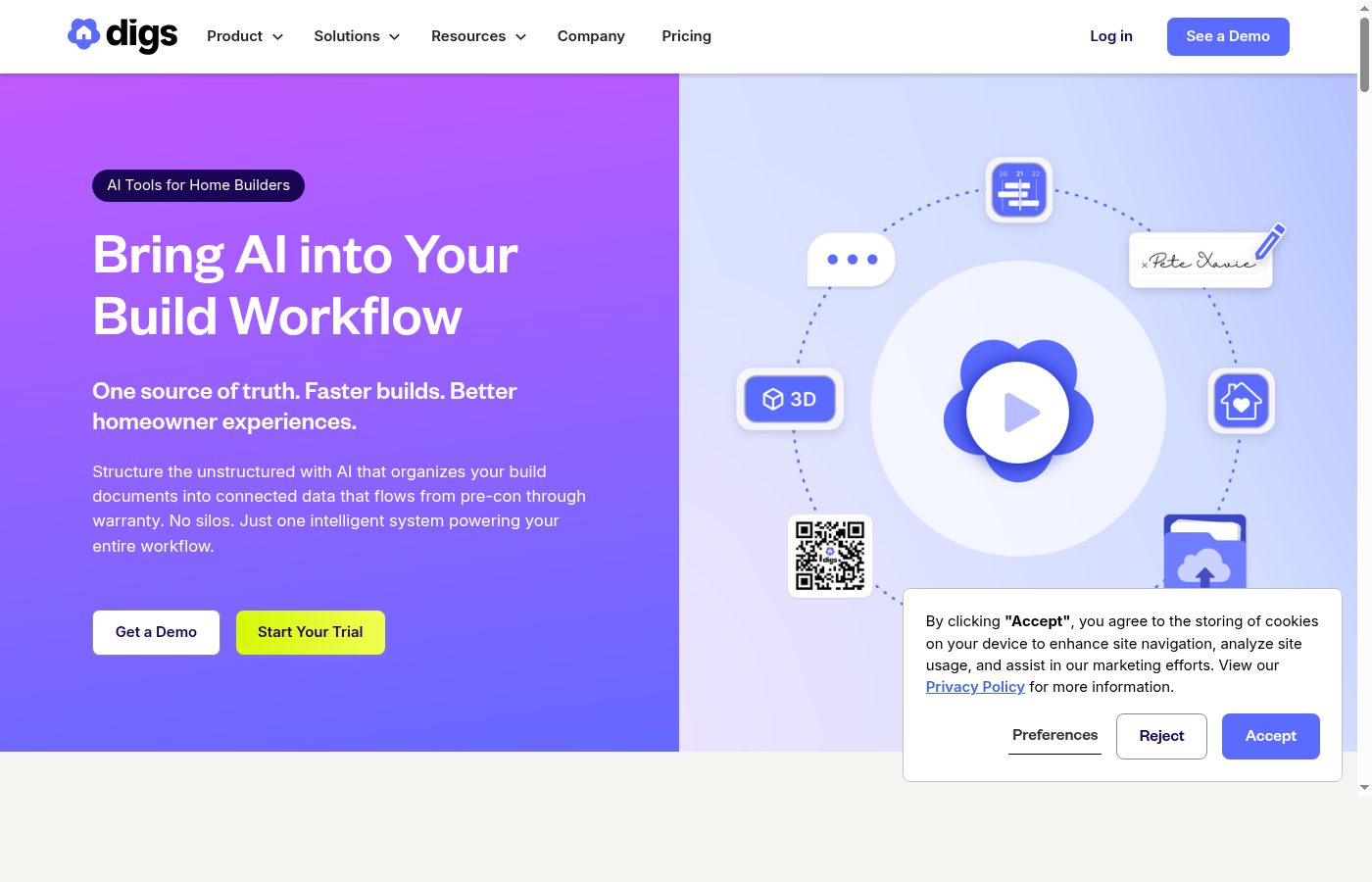
Digs is a cloud-based AI collaboration platform specifically engineered for residential homebuilders, remodelers, and their supply chain partners. Founded to solve the persistent communication gaps between the field, the back office, and the ultimate buyer, the platform centralizes project data into a highly visual, interactive environment. According to the BestCRE Master Database, Digs offers a free trial and operates on a published pricing model of $39 per member per month, making it an accessible entry point for mid-sized production builders. The software attempts to replace the fragmented mix of email threads, static PDF blueprints, and disjointed text messages that typically characterize residential construction management. By anchoring all communication to specific locations within a digital floorplan, the system creates a single source of truth for every stakeholder involved in the build.
While classified within the commercial real estate construction and development category as a Tier 2 CRE-native application, its primary utility remains strictly within residential and build-to-rent asset classes. The platform utilizes proprietary tools like DigsCloud for document storage and DigsCanvas for visual markup, allowing users to interact directly with 2D and 3D models. As of August 2026, the company has expanded its feature set to include automated takeoffs and an AI-assisted chat function called AskDigs, which queries project documents to instantly answer questions about specifications or warranties. For commercial developers evaluating the tool, the critical question is whether a system optimized for single-family homebuilders can scale to the complexities of large multifamily or mixed-use developments. Our analysis indicates that while the user interface excels in simplicity, enterprise-level commercial projects may stretch the platform beyond its intended architectural framework.
What Digs does and how it works
At its core, Digs functions as a spatial document management and collaboration hub. The mechanics begin when a user uploads standard architectural blueprints, typically in PDF format, into the DigsCloud environment. The software processes these static files and translates them into DigsCanvas, an interactive, web-based workspace where the 2D floorplan becomes the literal foundation for project communication. Users can drop pins onto specific rooms or structural elements within the plan to attach comments, photos, specification sheets, or change orders. This spatial anchoring ensures that a question about kitchen cabinetry is physically linked to the kitchen on the digital blueprint, eliminating the ambiguity of text-based descriptions. The platform also supports 3D visualization, allowing stakeholders to navigate a basic digital twin of the property to better understand spatial relationships and design intent.
Beyond visual markup, the platform integrates artificial intelligence to accelerate pre-construction and administrative workflows. The AskDigs AI chat interface acts as a project-specific search engine. Instead of manually parsing through hundreds of pages of building codes, supplier catalogs, or contract addendums, a project manager can ask the AI a natural language question—such as identifying the approved paint finish for the primary bathroom—and receive an immediate answer extracted directly from the uploaded project documentation. Additionally, the software features automated takeoff capabilities, utilizing machine learning to recognize structural elements and generate trade-specific material quantities with a single click.
The final mechanical component of the software is the homeowner handoff process, branded as DigsCare. Upon project completion, the builder transfers a digital package to the buyer containing all warranties, appliance manuals, maintenance schedules, and the interactive floorplan. This creates a persistent digital record of the home, reducing post-construction warranty calls to the builder while providing the end-user with an interactive manual for their property. The entire ecosystem is designed to operate via standard web browsers and mobile devices, requiring minimal technical training for field crews and subcontractors.
9AI Framework: the score, dimension by dimension
CRE Relevance: 7/10
While the BestCRE database categorizes Digs as a Tier 2 CRE-native application, its fundamental architecture targets residential homebuilders rather than commercial developers. The workflows, terminology, and feature sets—particularly the DigsCare homeowner handoff module—are optimized for single-family custom homes and mid-sized production builds. Commercial real estate principals managing large-scale multifamily, retail, or industrial projects will find the platform lacks the complex critical path scheduling and heavy commercial compliance tracking required for institutional-grade development. However, for firms operating in the build-to-rent (BTR) sector or managing sprawling portfolios of single-family rental units, the platform offers significant utility. The spatial communication tools translate well to repetitive residential floorplans, even if they fall short of full commercial BIM requirements. In practice: Commercial developers should only consider this tool if their portfolio heavily indexes toward single-family build-to-rent communities.
Data Quality and Sources: 8/10
The integrity of the data within the platform is highly dependent on the quality of the initial user uploads. Because the system relies on parsing architectural PDFs and specification documents to feed its AI chat and takeoff features, low-resolution scans or inconsistently formatted files will degrade the output. However, when fed clean, standardized vector PDFs, the extraction algorithms perform reliably. The DigsCloud infrastructure ensures that all uploaded documents are centralized and version-controlled, preventing field crews from building off outdated blueprints. The platform does not natively aggregate external market data or proprietary CRE datasets, functioning strictly as a localized repository for your specific project files. The closed-loop nature of the data environment ensures privacy but limits macro-level portfolio analytics. In practice: Users must enforce strict document formatting standards across their architectural partners to maximize the AI extraction capabilities.
Ease of Adoption: 9/10
Digs excels in usability, intentionally stripping away the dense, intimidating interfaces typical of legacy construction management software. The web-based DigsCanvas environment mimics consumer-grade applications, allowing subcontractors and clients to navigate 2D and 3D floorplans with intuitive pan-and-zoom controls. Onboarding a new project requires little more than uploading a PDF, and the platform’s spatial pinning system requires virtually no training to master. The mobile experience is highly responsive, ensuring that field workers can access plans and answer queries directly from the job site without navigating complex folder structures. This frictionless entry is critical for residential builders who rely on a fragmented network of independent tradespeople who may resist adopting heavy enterprise software. In practice: Project managers can expect external stakeholders and subcontractors to begin using the core markup features within minutes of receiving an invitation link.
Output Accuracy: 8/10
The automated takeoff generation and the AskDigs AI chat are the primary outputs evaluated here. The AI-powered takeoffs provide a rapid baseline for material estimation, successfully identifying standard residential components like linear footage of walls or square footage of flooring. However, our analysis shows these automated counts require manual verification, particularly when dealing with custom architectural features or non-standard elevations. The AskDigs chat function demonstrates high accuracy when retrieving factual data from well-structured specification sheets, but it occasionally struggles to synthesize conflicting information across multiple addendums. The spatial markup outputs—pins, annotations, and attached photos—are highly accurate simply because they rely on direct human placement rather than algorithmic interpretation. In practice: Estimators should treat the AI-generated takeoffs as a high-speed first draft rather than a final, bid-ready material order.
Integration and Workflow Fit: 7/10
The platform operates primarily as a standalone ecosystem for mid-market builders, which limits its immediate integration into a mature commercial real estate technology stack. While the enterprise tier advertises custom connections to standard ERPs and single sign-on (SSO) providers, the base platform lacks out-of-the-box API connectors for industry heavyweights like Yardi, MRI, or advanced commercial scheduling tools. The software handles file management well within its own DigsCloud environment but does not natively sync with external repositories like SharePoint or Google Drive in real-time. For residential builders, this isolation is rarely a dealbreaker, but commercial analysts will view the lack of native financial and accounting integrations as a significant workflow bottleneck. In practice: IT directors should anticipate using this software as an isolated collaboration silo rather than a fully integrated node in their broader data architecture.
Pricing Transparency: 9/10
Digs provides clear, publicly accessible pricing tiers, a refreshing departure from the opaque quoting practices common in construction technology. The BestCRE Master Database verifies that the platform offers a free trial and a standard published rate of $39 per member per month. This per-user model allows builders to scale their licensing costs predictably as their internal teams grow. The company also clearly delineates what features are included in the standard tier versus the enterprise tier, which requires contacting sales for custom integration pricing. By publishing exact monthly figures and offering a self-service trial, the vendor allows financial analysts to accurately model software expenditures without enduring aggressive sales funnels. In practice: Financial teams can calculate exact annual licensing costs for their internal staff before ever initiating contact with a vendor representative.
Support and Reliability: 6/10
As a relatively unproven startup in the highly competitive construction technology sector, Digs carries inherent operational risks. While user feedback indicates that the current customer success team is highly responsive and eager to assist with onboarding, the company lacks the massive global support infrastructure of legacy competitors. The enterprise tier promises dedicated product experts and bulk document insertion assistance, but standard users must rely primarily on web-based help centers and basic ticketing systems. The platform’s uptime has remained stable through August 2026, but prospective buyers must weigh the risk of adopting software from an early-stage company that is still building out its long-term support protocols and engineering depth. In practice: Buyers should maintain localized backups of all critical project files in the event of unexpected platform downtime or startup volatility.
Innovation and Roadmap: 8/10
The development velocity at Digs is impressive, demonstrating a clear commitment to integrating practical artificial intelligence into everyday building workflows. The recent rollout of the AskDigs AI chat and one-click automated takeoffs highlights a roadmap focused on reducing administrative friction. Furthermore, the DigsCare module represents a forward-thinking approach to the post-construction lifecycle, turning a static homeowner handoff into an interactive, long-term digital asset. The company appears focused on deepening its machine learning capabilities to better parse complex architectural documents and automate warranty routing. While they are not currently building toward heavy commercial BIM integration, their trajectory within the residential and build-to-rent space shows a strong understanding of their core user base’s evolving needs. In practice: Users can expect frequent feature updates centered around AI document parsing and automated client communication over the next twelve months.
Market Reputation: 6/10
Operating under the constraints of an unproven startup, Digs is still working to establish a dominant brand presence against entrenched construction management platforms. Within the niche of custom homebuilders and mid-sized production firms, early adopters praise the platform for its visual simplicity and effective client portal capabilities. However, in the broader commercial real estate and institutional development markets, the brand remains largely unknown. They do not yet possess the extensive case studies or enterprise-level testimonials required to win over skeptical commercial general contractors. The company is currently viewed as a promising, agile disruptor in the residential space rather than a safe, established enterprise standard. In practice: Procurement officers will need to champion this software internally, as the brand name alone will not provide immediate credibility with cautious executive boards.
Who should use Digs
The platform is engineered for teams managing high-volume, repeatable builds or highly customized residential projects where visual communication is paramount. It excels in environments where stakeholders lack formal architectural training but need to interact deeply with building plans.
- Build-to-Rent (BTR) Developers: Firms constructing sprawling single-family rental communities will benefit from the spatial pinning and repetitive floorplan management.
- Custom Residential Builders: Teams that require constant, clear communication with emotional homebuyers will find the visual interface and DigsCare handoff invaluable.
- Mid-Sized Production Builders: Regional operators looking to replace chaotic email threads with a centralized, map-based communication hub.
- Residential Remodelers: Contractors managing complex renovations who need to anchor specific change orders to physical locations on a blueprint.
Who should look elsewhere
Commercial developers managing complex, multi-tiered institutional assets will find the platform’s architecture fundamentally misaligned with their operational requirements. The system lacks the heavy compliance and financial tracking necessary for large-scale commercial real estate.
- Institutional Multifamily Developers: Firms building high-rise apartments require advanced BIM integration and critical path scheduling that this software does not support.
- Commercial General Contractors: Teams managing retail, industrial, or office build-outs need deep ERP integrations and heavy RFI management tools absent here.
- Real Estate Investment Trusts (REITs): Portfolio managers seeking macro-level construction analytics and financial forecasting will find the isolated project data insufficient.
Pricing and ROI
Digs operates on a highly transparent, per-user pricing model, which is a significant advantage for firms tired of opaque, percentage-of-construction-volume licensing fees. According to the BestCRE Master Database, the platform offers a free trial and a standard published rate of $39 per member per month. This straightforward SaaS pricing allows mid-sized builders to scale their software expenses linearly with their internal headcount. The company also offers an enterprise tier for larger operations requiring custom ERP integrations, single sign-on (SSO), and dedicated support, though pricing for this tier requires direct negotiation with their sales team.
From an ROI perspective, the math for a build-to-rent developer or custom homebuilder is highly compelling. At $468 annually per internal user, the software only needs to prevent a single minor communication error to pay for itself. If the spatial pinning feature and AskDigs AI chat save a project manager just two hours per week of hunting through email threads or driving to a site to clarify a blueprint detail, the labor savings alone exceed $4,000 annually per employee. Furthermore, the DigsCare digital handoff reduces post-construction warranty calls by empowering homeowners to find their own answers, protecting the builder’s profit margins long after the final certificate of occupancy is issued.
Integration and CRE tech stack fit
When evaluating Digs for a commercial real estate technology stack, analysts must recognize that the platform is designed primarily as an independent ecosystem rather than a deeply connected node. For the standard $39 per month user, the software functions as a standalone silo for file management and collaboration. It does not offer out-of-the-box, native API connectors to the heavy enterprise resource planning (ERP) systems dominant in commercial real estate, such as Yardi, MRI Software, or JD Edwards.
The enterprise tier does advertise custom integration capabilities, allowing larger builders to connect the platform to their specific accounting software or project management tools, but these are bespoke development efforts rather than plug-and-play modules. Furthermore, the platform lacks native synchronization with universal document repositories like Microsoft SharePoint or Procore’s document management suite. Consequently, commercial developers attempting to force this tool into a mature tech stack will likely face redundant data entry, as financial data and formal RFI logs will need to be maintained in separate systems. The software is best deployed as a specialized, visual collaboration layer for the field, completely decoupled from the back-office financial stack.
Competitive landscape
The construction technology landscape is densely populated, and Digs faces competition from both legacy behemoths and specialized AI startups. For commercial real estate developers, the most immediate comparison is Procore. Procore is the undisputed heavyweight of construction management, offering deep financial integrations, rigorous RFI tracking, and enterprise-grade compliance tools. However, Procore is notoriously expensive and complex, making Digs a far more agile and cost-effective alternative for residential or build-to-rent operators who do not need institutional-grade features.
Within the residential and mid-market sector, Buildertrend and CoConstruct are the primary legacy alternatives. Both offer comprehensive project management, including estimating and scheduling, but they rely on traditional, folder-based file management. Digs differentiates itself by anchoring all communication spatially to the 2D floorplan via DigsCanvas, providing a much more intuitive visual interface than the text-heavy dashboards of Buildertrend.
Looking at the AI-specific peers evaluated by BestCRE, tools like ALICE Technologies (Score: 87) and OpenSpace (Score: 86) serve entirely different commercial needs. ALICE focuses on generative scheduling for massive infrastructure projects, while OpenSpace utilizes 360-degree cameras for automated site tracking. Digs does not compete in the advanced scheduling or reality capture arenas. Instead, it competes directly with lightweight markup tools like Fieldwire or PlanGrid (now part of Autodesk Build), winning on residential-specific workflows like the DigsCare homeowner handoff, but losing on heavy commercial blueprint management and advanced punch list routing.
The bottom line
Digs is a highly effective, visually intuitive collaboration platform that successfully solves the communication breakdown between residential builders, subcontractors, and buyers. By anchoring project data directly to digital floorplans and utilizing AI to accelerate document parsing, it eliminates the friction of traditional folder-based management. However, commercial real estate principals must be realistic about its architectural limitations. This is not a commercial-grade project management system capable of handling complex institutional developments, advanced financial routing, or heavy BIM integration. The decision to purchase should be dictated entirely by your asset class. If your firm specializes in single-family custom homes or sprawling build-to-rent communities, the $39 per user monthly fee is a high-yield investment that will immediately streamline field communication. If you are developing high-rise multifamily or commercial mixed-use properties, this software will fail to meet your enterprise requirements.
Frequently asked questions
Does Digs integrate with commercial ERP systems like Yardi or MRI?
No. The standard platform operates as a standalone collaboration tool without native API connectors for commercial real estate ERPs. While the enterprise tier offers custom integration development, buyers should expect the software to function independently from their back-office financial and accounting stacks.
How much does a Digs subscription cost per user?
According to the BestCRE Master Database, the platform offers a published rate of $39 per member per month. A free trial is available for testing. Enterprise licensing, which includes custom integrations and dedicated support, requires custom pricing negotiated directly with their sales team.
Can I use this software for large multifamily commercial developments?
It is not recommended. The platform is optimized for residential homebuilders and single-family build-to-rent projects. It lacks the critical path scheduling, advanced RFI routing, and heavy commercial compliance tracking required to successfully manage complex, institutional-grade multifamily or mixed-use construction.
What is the DigsCare homeowner handoff feature?
DigsCare is a digital turnover module that transfers the interactive floorplan, appliance manuals, and warranty documents to the buyer upon project completion. This provides the homeowner with a persistent digital record of their property, significantly reducing post-construction warranty calls and administrative friction for the builder.
Do the AI-powered takeoffs provide final, bid-ready material counts?
No. While the machine learning algorithms rapidly identify structural elements and generate baseline material quantities, our analysis indicates these automated counts require manual verification. Estimators should utilize the AI takeoffs as a high-speed first draft rather than a definitive material order.
How does the AskDigs AI chat function work?
The AI chat acts as a project-specific search engine. Users ask natural language questions, and the system scans the uploaded architectural PDFs and specification documents to extract the answer. It requires clean, well-formatted initial document uploads to ensure high accuracy and reliable data retrieval.