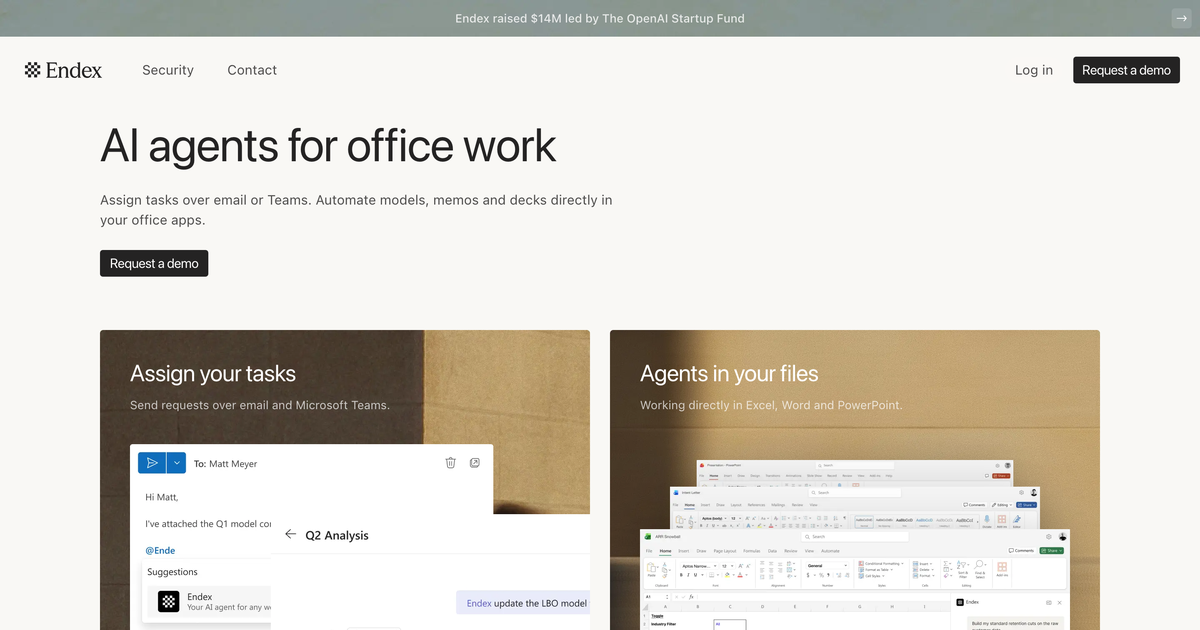
Endex is an Excel-native artificial intelligence agent designed to automate financial modeling and underwriting directly within Microsoft Excel workbooks. Backed by a $14 million investment from the OpenAI Startup Fund, the platform operates as a dedicated sidebar add-in that reads, audits, and generates complex financial models. For commercial real estate principals and acquisitions analysts, the primary appeal lies in keeping the analytical workflow entirely within the industry’s default software rather than migrating sensitive deal data to a proprietary web dashboard. The company is currently operating on a restricted waitlist model with custom enterprise pricing, positioning itself as a highly specialized tool for private equity firms, investment banks, and institutional real estate developers who require strict data governance.
In the current landscape of August 2026, many artificial intelligence tools require users to abandon their established spreadsheets in favor of closed ecosystems. Endex takes the exact opposite approach. Founded by Tarun Amasa, the startup focuses on augmenting the financial analyst rather than replacing the workbook entirely. By interacting directly with cells, formulas, and formatting, the tool attempts to compress hours of manual data entry and model building into minutes. It claims to accurately translate unstructured offering memorandums and messy rent rolls into dynamic Discounted Cash Flow models, complete with traceable formulas. However, because the software is still in an early deployment phase with restricted access, independent verification of its capabilities at scale remains somewhat limited. Buyers must carefully weigh the promise of accelerated underwriting against the realities of adopting an early-stage product. For firms tired of generic chatbots that cannot write functional spreadsheet formulas, this targeted approach warrants close attention.
What Endex does and how it works
Endex functions as an advanced copilot embedded directly into Microsoft Excel. Users install the software as a standard add-in, which opens a conversational sidebar interface alongside their active workbook. The primary mechanical function is translating natural language prompts and unstructured documents, such as PDF offering memorandums or messy rent rolls, into structured, mathematically functional spreadsheet models. When an analyst uploads a 50-page broker package, the agent extracts the core assumptions, including minimum internal rate of return, preferred returns, and equity multiples, and uses these variables to populate a fresh underwriting template.
Crucially, the tool does not simply paste static text values into cells. It writes actual, dynamic Excel formulas that link across multiple tabs, such as Assumptions, Income Statement, and Cash Flow. If a user asks the agent to build a Discounted Cash Flow model, it will generate the necessary tabs, format the headers, and construct the mathematical logic in real time. Analysts can watch the cells populate and verify the formula syntax exactly as if a junior team member had built the file. The software also includes an auditing feature designed to scan inherited or overly complex workbooks. It highlights broken links, circular references, and hardcoded numbers hidden within formula strings, providing a critical diagnostic layer for risk management.
Beyond generation and auditing, the software assists with initial deal screening. Users can feed an investment criteria matrix into the prompt, and the agent will evaluate the extracted deal metrics against those benchmarks. It can generate an executive summary, flag potential issues like rent control exposure or tenant concentration, and output a preliminary recommendation. The entire process remains confined to the local Excel environment, which addresses data privacy concerns common in institutional real estate. By keeping the logic transparent and editable, the software allows principals to retain full control over the final underwriting model without relying on a black-box algorithm.
9AI Framework: the score, dimension by dimension
CRE Relevance: 8/10
Endex is classified in the BestCRE master database as a Tier 2 CRE-Native tool. While it serves the broader finance sector, including private equity and investment banking, its mechanics are deeply aligned with commercial real estate underwriting workflows. The ability to parse offering memorandums, abstract lease data, and generate multi-tier waterfall return models directly addresses the daily pain points of acquisitions teams. It lacks a proprietary property database, meaning it relies entirely on the data the user provides or integrates from third-party sources. However, because commercial real estate remains fundamentally tethered to Excel for financial analysis, a tool built natively for this environment holds significant structural relevance for the industry. In practice: Acquisitions teams will find the tool highly applicable for initial deal screening and translating unstructured broker packages into functional baseline models.
Data Quality and Sources: 7/10
As an application layer rather than a data provider, Endex does not supply its own market comparables, demographic statistics, or rent trends. Its data quality score reflects its ability to accurately extract and process the information fed into it by the user. The software utilizes advanced optical character recognition and natural language processing to pull figures from PDFs and unstructured text. A critical feature is its AI-labeled tracing, which provides integrated citations linking the generated spreadsheet assumptions back to the source document. This prevents the black box problem common in early artificial intelligence tools, allowing analysts to verify every extracted rent figure or expense ratio. In practice: Users must supply high-quality input documents, but the integrated citation system ensures that the extracted data can be audited against the original source.
Ease of Adoption: 8/10
The decision to build natively within Microsoft Excel significantly reduces the friction typically associated with deploying new enterprise software. Analysts do not need to learn a new user interface, migrate historical data to a web dashboard, or abandon their proprietary underwriting templates. The installation is a standard add-in process, and the interaction occurs via a familiar conversational sidebar. However, maximizing the utility of the agent requires training in effective prompt engineering. Users must learn how to structure their requests logically to generate accurate multi-sheet models rather than fragmented data dumps. The transition from manual entry to algorithmic generation requires a shift in workflow habits. In practice: Junior analysts will adapt quickly to the interface, but teams will need to establish standardized prompting frameworks to ensure consistent model generation across the firm.
Output Accuracy: 8/10
The software differentiates itself by writing functional Excel formulas rather than outputting static text. When it constructs a Discounted Cash Flow model or a rent roll summary, the math is transparent and editable. Early demonstrations indicate a high degree of accuracy in standard financial logic, but complex, bespoke partnership waterfalls may still require manual intervention. The inclusion of an auditing function that scans for hidden hardcodes and broken links actively improves the accuracy of existing workbooks. Because the agent relies on large language models, the risk of hallucination remains, making the integrated citation feature essential for verifying extracted assumptions. In practice: Principals should treat the generated models as highly advanced first drafts that still require a trained professional to review the formula logic and final outputs.
Integration and Workflow Fit: 9/10
Endex excels in this category by existing entirely within the most ubiquitous software in commercial real estate: Microsoft Excel. This native integration means it inherently plays well with any other tool that exports data to CSV or Excel formats. Users can pull rent comps from platforms like CompStak or property data from Cherre, drop them into a spreadsheet, and immediately instruct the agent to analyze the data. It does not require complex API configurations or custom middleware to function within a standard tech stack. The primary limitation is its confinement to the Microsoft ecosystem, though this is rarely an issue for institutional finance teams. In practice: The software will immediately slot into any existing acquisitions workflow without requiring IT to build custom data pipelines or API connections.
Pricing Transparency: 5/10
The vendor operates entirely on a custom pricing and waitlist model. There are no published tiers, baseline costs, or user license fees available on the company website. This approach is common for early-stage enterprise software companies managing deployment capacity, but it prevents prospective buyers from conducting preliminary budget analysis. Because pricing details are not published, the tool receives a maximum score of 5 in this dimension according to the 9AI framework rules. Buyers must engage directly with the sales team to determine if the cost aligns with their operational budget and expected return on investment. In practice: Firms evaluating this software must commit to a discovery process and waitlist period before obtaining actionable financial figures for procurement.
Support and Reliability: 6/10
As an early-stage startup backed by the OpenAI Startup Fund, the company has significant financial backing but lacks the established support infrastructure of legacy software providers. The waitlist model suggests that engineering and customer success resources are currently focused on a limited number of enterprise design partners. While this often results in high-touch support for early adopters, it raises questions about reliability and response times as the user base scales. Under the 9AI framework rules, an unproven startup cannot exceed a score of 6 in this category. Buyers should expect rapid product iteration but must prepare for potential bugs inherent in early software versions. In practice: Early adopters should negotiate strict service level agreements and expect a highly collaborative, though potentially volatile, support relationship.
Innovation and Roadmap: 9/10
The company is positioned at the forefront of financial artificial intelligence. Securing $14 million from the OpenAI Startup Fund and being led by a Thiel Fellow indicates a strong mandate to push technical boundaries. The roadmap heavily emphasizes complex orchestration, moving beyond simple formula generation toward autonomous agents capable of managing entire portfolio monitoring workflows. The focus on privacy-centric, institutional-grade architecture suggests upcoming features tailored specifically for enterprise compliance and security. The pace of feature shipping appears rapid, reflecting the agility of a well-funded startup attacking a specific, high-value problem. In practice: Buyers are investing in the trajectory of the engineering team and the expectation that the tool will rapidly evolve to handle increasingly complex private equity tasks.
Market Reputation: 6/10
Endex is generating significant interest within specialized commercial real estate and private equity circles, frequently appearing in industry podcasts and AI tool directories. However, its restricted access model means that broad market consensus has not yet formed. It does not possess the extensive track record of established peers like CompStak or Cherre. While the pedigree of the founder and the backing of OpenAI lend immediate credibility, the software must still prove its long-term viability and return on investment across a diverse range of institutional clients. Per the 9AI framework rules, an unproven startup is capped at a score of 6 for market reputation. In practice: The tool is highly regarded by technology-forward early adopters, but conservative institutions will likely wait for broader market validation.
Who should use Endex
Endex is built for heavy spreadsheet users who spend hours manually extracting data from PDFs and structuring financial models. It is best suited for firms that want to accelerate their underwriting velocity without abandoning their proprietary Excel templates.
Acquisitions Analysts: Professionals who need to quickly screen offering memorandums, abstract rent rolls, and build baseline DCF models to determine if a deal warrants deeper review.
Private Equity Principals: Leaders looking to standardize the underwriting process and utilize the auditing features to catch errors in complex partnership waterfalls before investment committee meetings.
Real Estate Developers: Teams that frequently inherit messy workbooks from partners or lenders and need a tool to map and clean the logic automatically.
Portfolio Managers: Professionals tasked with consolidating disparate property data into unified Excel dashboards for quarterly reporting.
Who should look elsewhere
Because the software operates strictly as an Excel add-in and relies on user-provided data, it is not a standalone research terminal or a cloud-based portfolio management system. Firms looking for an all-in-one web platform will find it misaligned with their needs.
Small Independent Investors: Buyers who underwrite only a few deals per year and cannot justify the enterprise-level engagement required by a waitlisted, custom-priced tool.
Firms Seeking Proprietary Market Data: Teams expecting the software to provide built-in rent comparables, sales histories, or demographic data, as it does not include a native property database.
Non-Excel Users: Organizations that have fully migrated their financial modeling to cloud-native platforms like Argus or proprietary web applications and no longer rely on spreadsheets.
Pricing and ROI
Endex does not publish its pricing on its website. The company currently operates on a custom pricing and waitlist model, requiring prospective buyers to engage directly with their sales team to receive a quote. Because pricing is not published, it is impossible to provide exact software licensing costs. This enterprise-focused approach typically indicates that the software is priced based on the size of the firm, the number of active users, or the volume of data processed, rather than a simple monthly subscription.
To calculate the return on investment, firms must measure the cost of the software against the time saved in the underwriting and auditing phases. If an acquisitions analyst earning $120,000 annually spends twenty hours per week manually extracting data from offering memorandums and building baseline models, their time costs approximately $60 per hour. If the artificial intelligence agent can reduce that manual workload by fifty percent, it saves the firm $600 per week, or roughly $30,000 annually per analyst in recaptured productivity. This time can be reallocated to sourcing new deals or conducting deeper risk analysis. Furthermore, the auditing feature provides unquantifiable return on investment by mitigating the risk of executing a multi-million dollar transaction based on a broken formula or a hidden hardcoded assumption in the final underwriting model.
Integration and CRE tech stack fit
The integration profile of Endex is unique because it bypasses traditional API connections and middleware entirely. By existing as a native add-in within Microsoft Excel, it automatically integrates with the central hub of the commercial real estate technology stack. Analysts can export data from property databases like Cherre or CompStak, drop the CSV files into a workbook, and immediately use the artificial intelligence agent to format, analyze, and chart the information.
This structural design means the software does not require IT intervention to connect with existing systems. If a platform can export to Excel, it is compatible. However, this also means the tool does not push data back into cloud-based CRMs or portfolio management systems autonomously. Users must still manually upload the finished Excel models into their centralized document repositories or data lakes. For firms utilizing Microsoft 365, the software fits perfectly into the established security and compliance infrastructure, keeping sensitive deal data localized to the spreadsheet rather than transmitting it to third-party web applications. This localized approach is highly favorable for institutional investors with strict data governance policies.
Competitive landscape
The landscape of artificial intelligence in commercial real estate is expanding rapidly, but Endex occupies a specific niche by focusing strictly on the Excel environment. Buyers evaluating this software should consider how it compares to both general-purpose tools and CRE-specific platforms.
Cotality (91) and HelloData (91) offer highly specialized, CRE-native data extraction and underwriting capabilities. HelloData, in particular, excels at extracting data from offering memorandums and appraisals, but it operates through its own web interface rather than living natively inside the user’s spreadsheet. Firms that want to keep their workflow strictly within Excel may prefer Endex, while those looking for a dedicated cloud application might lean toward HelloData.
CompStak (88) and Cherre (86) provide massive, proprietary databases of lease comps and property metrics. Endex does not compete with these platforms; rather, it acts as a companion tool that can process and model the data exported from them.
General-purpose artificial intelligence tools like Microsoft Copilot are the most direct structural competitors. Copilot is also embedded natively within Excel. However, standard Copilot often struggles with the complex, multi-sheet financial modeling required in private equity and commercial real estate. Endex differentiates itself by being purpose-built for institutional finance, possessing the specific context required to build Discounted Cash Flow models and audit complex partnership waterfalls. Finally, tools like Akkio (86) offer predictive analytics and machine learning, but they are designed for broader business intelligence rather than the specific mechanics of real estate underwriting.
The bottom line
Endex is a highly specialized, technically impressive tool for commercial real estate firms that refuse to abandon Microsoft Excel. If your acquisitions team loses days to manual data entry, lease abstraction, and building baseline models from unstructured broker packages, this software offers a direct, native solution. The ability to generate functional, traceable formulas rather than static text separates it from generic artificial intelligence chatbots. However, the waitlist model, unpublished pricing, and early-stage nature of the company introduce procurement friction and adoption risk. Conservative institutions should wait for the product to mature and pricing to become transparent. But for technology-forward private equity firms and developers looking to drastically increase their underwriting velocity, Endex is worth the effort of navigating the waitlist. It is a buy for firms ready to treat artificial intelligence as a true financial modeling copilot.
Frequently asked questions
Does Endex provide its own commercial real estate market data or rent comps?
No. It is an application layer, not a data provider. It relies entirely on the data you provide, such as uploaded offering memorandums, rent rolls, or data exported from third-party platforms like CompStak or Cherre. You must bring your own market comparables and demographic statistics to the analysis.
How much does Endex cost for a commercial real estate firm?
Pricing is not published. The company currently operates on a custom pricing and waitlist model. Prospective buyers must engage directly with the sales team to receive a quote based on their specific enterprise requirements, user count, and overall data processing volume.
Can Endex build a Discounted Cash Flow model from scratch?
Yes. Users can prompt the agent to build a complete Discounted Cash Flow model. It will generate the necessary tabs, format the headers, and write dynamic, functional Excel formulas that link across the entire workbook, saving hours of manual setup time.
Does the software work with Google Sheets or other spreadsheet programs?
No. The tool is built specifically as a native add-in for Microsoft Excel. It is designed to integrate deeply with Excel’s proprietary formula architecture and is not currently compatible with Google Sheets, Apple Numbers, or other cloud-based spreadsheet alternatives.
How does the tool handle data privacy for sensitive real estate transactions?
The software is built with enterprise finance in mind, keeping the modeling logic confined to the local Excel environment. While it is backed by OpenAI, it utilizes a privacy-centric architecture to ensure proprietary deal data is not used to train public language models.
Can Endex find errors in an existing real estate underwriting model?
Yes. It includes a dedicated auditing feature that scans existing workbooks. It acts like a senior analyst, identifying broken links, circular references, and hardcoded numbers hidden within formula strings to reduce financial risk before you present to an investment committee.
Related Reviews
Compare Endex with other Underwriting & Deal Analysis tools BestCRE has scored: Crexi (84/100), redIQ (83/100), Exo AI / ExoFinance (63/100) and REHQ (63/100). Browse every review in CRE Underwriting & Deal Analysis, the full Best CRE AI Tools directory, or the 20 CRE Sectors hub.