Imprima is a secure, AI-enabled virtual data room (VDR) provider designed specifically for real estate and M&A transactions, with published pricing starting at €250 per month. Founded in 2001 and headquartered in London, the company has evolved from a traditional data repository into an automated due diligence platform. Rather than offering a generic file-sharing service, Imprima embeds proprietary artificial intelligence directly into the VDR environment. This native integration allows deal teams to execute document indexing, redaction, translation, and contract review without exporting sensitive files to third-party applications. The platform targets mid-market to enterprise commercial real estate firms, brokerages, and legal teams managing complex asset sales, capital raising, or portfolio management.
Analysis indicates that Imprima occupies a distinct position in the CRE technology stack. While standalone contract analysis tools require users to maintain separate environments for storage and review, Imprima consolidates these functions. The system utilizes machine learning to automate repetitive tasks that historically consumed hundreds of billable hours during the due diligence phase. High-profile clients, including Cushman & Wakefield and JLL, utilize the software to manage large-scale property transactions. For a commercial real estate analyst or principal evaluating software in August 2026, Imprima represents a mature, highly secure infrastructure choice rather than an experimental startup application. Its primary value proposition centers on accelerating transaction timelines and enforcing strict data security protocols during high-stakes negotiations.
What Imprima does and how it works
Imprima functions primarily as a highly secure, cloud-based virtual data room enhanced by a suite of embedded artificial intelligence tools. When a deal team uploads a bulk folder of property documents, leases, and financial records, the platform’s ‘Smart Index’ feature automatically categorizes the files and structures the data room taxonomy. This eliminates the manual drag-and-drop organization typically required at the onset of a transaction. The system recognizes document types, such as rent rolls, environmental reports, and commercial leases, and places them into the appropriate folders based on learned patterns from previous real estate deals.
Once the data room is populated, users apply Imprima’s ‘Smart Review’ and ‘Smart Redaction’ capabilities. The review tool scans commercial leases and vendor contracts to extract key clauses, identify anomalies, and flag potential red flags for legal teams. Simultaneously, the redaction engine automatically identifies and obscures personally identifiable information (PII) or sensitive financial data across thousands of pages, ensuring GDPR compliance before granting access to external bidders. The platform supports over 80 languages, executing translations natively within the viewer, which accelerates cross-border real estate transactions.
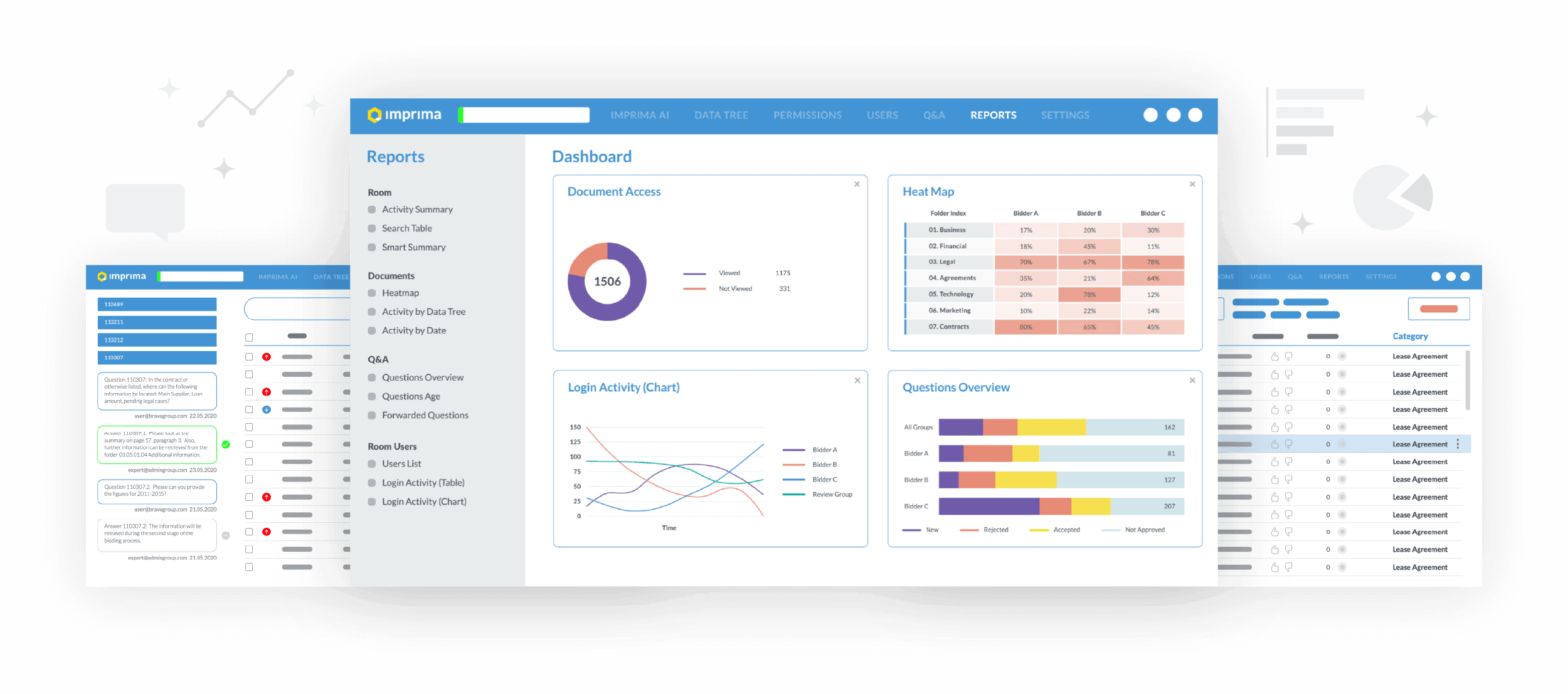
Finally, Imprima addresses the bidder inquiry process through its ‘Smart Q&A’ module. As prospective buyers submit questions regarding specific assets or lease terms, the AI analyzes the queries, identifies similar questions asked previously, and suggests automated responses based on existing data room content. Deal managers can route questions to specific subject matter experts via automated workflows, utilizing pre-configured tags and auto-forwarding rules. Activity dashboards and heat-maps track bidder engagement in real-time, allowing principals to monitor which assets or documents are generating the most interest. Analysis confirms that by keeping all these functions within a single, secure environment, Imprima minimizes data leakage risks.
9AI Framework: the score, dimension by dimension
CRE Relevance: 8/10
Imprima scores highly here because it explicitly targets commercial real estate asset management, capital raising, and asset sales. Unlike generic file-sharing platforms, the system is trained to recognize and process industry-specific documents like commercial leases, rent rolls, and environmental assessments. The platform features dedicated tools for real estate portfolio review and has a proven track record with major brokerages like Cushman & Wakefield and JLL. While it also serves the broader M&A and legal markets, its feature set aligns directly with the requirements of property transaction due diligence. Analysis shows that the AI models understand the context of property-level data, reducing the time analysts spend manually sorting files. In practice: Real estate deal teams can upload unstructured property data and rely on the system to automatically build a logical, industry-standard data room taxonomy.
Data Quality and Sources: 8/10
As a virtual data room, Imprima relies entirely on the quality of the documents uploaded by the user. However, its internal machine learning models are trained on a massive repository of historical M&A and real estate transactions, having processed over 250,000 deals. This extensive training corpus allows the AI to accurately identify document types, extract relevant clauses, and spot anomalies within complex legal text. The system’s ability to maintain high data fidelity during automated translation and redaction processes is a significant advantage. Because the AI is native to the platform, it does not suffer from data degradation or formatting errors that often occur when exporting files to external analysis tools. In practice: Users experience highly accurate auto-classification and redaction because the underlying models have been trained on millions of actual transaction documents.
Ease of Adoption: 8/10
Virtual data rooms are a standard component of commercial real estate transactions, meaning the foundational interface of Imprima requires minimal behavioral change from deal teams. The platform offers a 30-day free trial, allowing firms to test the basic feature set before committing. Because the artificial intelligence tools are embedded directly into the VDR, users do not need to learn a separate software application or manage complex API integrations to analyze their documents. The company provides dedicated project managers and 24/7 customer support to assist with initial setup and user onboarding. Analysis indicates that the intuitive design and white-glove service model significantly reduce the friction typically associated with deploying new AI technology. In practice: Deal teams can transition from legacy data rooms to Imprima with almost zero downtime, guided by dedicated support personnel.
Output Accuracy: 8/10
Imprima delivers precise results in its automated redaction, indexing, and translation functions. The AI engine excels at identifying personally identifiable information and standard contract clauses, significantly reducing the manual review burden. However, as with any automated legal review tool, the Smart Review function requires human oversight. While the system effectively flags anomalies and extracts lease abstracts, complex legal interpretations still demand review by qualified counsel. The Smart Q&A module accurately clusters similar questions and suggests relevant answers, but deal managers must approve the final responses before they are sent to bidders. Analysis confirms that the platform achieves high accuracy in administrative automation, though it acts as an assistant rather than a replacement for human judgment. In practice: Analysts will trust the auto-redaction and indexing completely but will still manually verify the AI-generated lease abstracts and Q&A responses.
Integration and Workflow Fit: 7/10
Imprima is primarily designed to function as a secure, standalone environment during the due diligence phase, which inherently limits its integration with external operational software. The platform does offer an API, SharePoint linking, and Single Sign-On capabilities, allowing enterprise IT departments to connect it to broader corporate networks. However, it does not natively push data into property management systems like Yardi or MRI, nor does it function as a permanent asset management database. Its architecture is explicitly built to ingest data from various sources, secure it, and present it to third parties. Analysis suggests that while it fits perfectly into the transaction phase of the CRE lifecycle, it remains siloed from day-to-day property operations. In practice: IT teams will utilize the API and Single Sign-On for secure access, but analysts will manually export final deal abstracts to their internal underwriting models.
Pricing Transparency: 9/10
Imprima stands out in the enterprise software market by publishing a clear starting price. The vendor explicitly states that pricing begins at €250 per month, which provides a concrete baseline for evaluating the software. While enterprise deployments and complex mid-market deals can scale significantly higher, industry data suggests broader deployments can reach between $30,000 and $90,000 annually, the presence of a published entry-level tier is commendable. The company also offers a 30-day free trial that includes one project, ten users, and dedicated support, allowing firms to validate the return on investment before signing a contract. Analysis indicates this level of transparency is rare among top-tier VDR providers, who typically hide all costs behind sales consultations. In practice: Smaller firms can access the platform at the €250 monthly entry point, while institutional players can model enterprise costs based on clear usage metrics.
Support and Reliability: 9/10
Founded in 2001, Imprima possesses a long-standing operational history that guarantees high reliability and stability. The company operates a 24/7 support desk, offering assistance in multiple local languages. Unlike early-stage startups, Imprima utilizes a white-glove service model, assigning dedicated project managers with over a decade of experience to guide deal teams from the start of a transaction to its close. The platform is built on highly secure, cloud-based infrastructure optimized for speed, promising document access times up to 15 times faster than legacy systems. It maintains strict GDPR compliance and ISO certifications. Analysis confirms that the vendor prioritizes uptime and data security, making it a highly dependable choice for mission-critical transactions. In practice: Deal managers operating across different time zones can rely on immediate, human support and stable platform performance during critical final bidding rounds.
Innovation and Roadmap: 8/10
Imprima has successfully transitioned from a traditional data repository into an AI-driven platform, demonstrating a clear commitment to ongoing development. The company launched its Smart Review and Smart Index tools between 2019 and 2020, and recently added generative AI capabilities, such as the Lumi Chat overlay, to enhance document interrogation. The vendor continues to refine its machine learning models, focusing on cross-border transaction support and advanced Q&A automation. However, as an older company adapting to new technology, its development cycles may prioritize stability and security over rapid, experimental feature releases. Analysis suggests the roadmap is highly pragmatic, focused on solving specific due diligence bottlenecks rather than chasing general AI trends. In practice: Users can expect steady, reliable updates to the core AI review and redaction tools rather than sudden shifts in platform architecture.
Market Reputation: 9/10
Imprima holds an exceptionally strong reputation within the European and global transaction markets. It is trusted by top-tier commercial real estate brokerages, financial institutions, and legal firms, including Cushman & Wakefield, JLL, PwC, KPMG, and DLA Piper. The platform consistently receives high ratings on software review sites, maintaining a 4.9 out of 5 on Capterra. The market views Imprima as a premium, boutique provider capable of handling highly complex, multi-jurisdictional deals. Its longevity in the VDR space, combined with its successful integration of proprietary AI tools, has solidified its status as a Tier 2 CRE-native solution. Analysis confirms that the brand carries significant weight, and utilizing Imprima signals professionalism and security to prospective buyers and investors. In practice: Principals will face zero pushback from institutional partners or external counsel when proposing Imprima as the designated data room for a major asset sale.
Who should use Imprima
Imprima is engineered for transaction-heavy commercial real estate firms and their advisory partners who require strict data security combined with automated document processing. It is highly effective for teams managing large volumes of unstructured property data during acquisitions, dispositions, or capital raising events.
Institutional Investment Sales Brokers: Teams at major brokerages who need to quickly spin up secure data rooms, automatically index hundreds of property files, and track bidder engagement via heat-maps.
CRE Private Equity Principals: Buyers executing complex portfolio acquisitions who require automated lease abstraction and anomaly detection to accelerate their due diligence timelines.
In-House Legal Counsel: Real estate attorneys who need to rapidly redact sensitive PII and financial data across thousands of pages to ensure GDPR compliance before opening a data room.
Cross-Border Asset Managers: Firms dealing with international property transactions that benefit from the platform’s native ability to translate documents across 80+ languages instantly.
Who should look elsewhere
Despite its strong feature set, Imprima is a specialized transaction tool and is not suited for firms seeking permanent, day-to-day property management software or general-purpose cloud storage.
Small Independent Landlords: Owners of a few local multifamily properties who simply need a place to store leases will find the platform over-engineered and unnecessary.
Property Managers: Teams looking for software to handle tenant work orders, rent collection, or daily maintenance tracking should look to operational platforms like Yardi or AppFolio.
Firms Seeking Deep Financial Modeling: Analysts looking for AI to automatically build cash flow projections or underwrite assets will not find those capabilities here; Imprima focuses on document review, not financial math.
Pricing and ROI
Imprima publishes a clear starting price of €250 per month, establishing a highly accessible entry point for basic virtual data room requirements. The company also offers a generous 30-day free trial that includes one project, ten users, and dedicated legal-tech support, allowing firms to test the AI features before committing capital. For mid-market to enterprise deployments requiring advanced AI redaction, translation, and unlimited data processing, industry analysis indicates annual costs typically range between $30,000 and $90,000. This tiered approach allows smaller brokerages to utilize the secure infrastructure while large institutions pay for scale and advanced machine learning capabilities.
The return on investment (ROI) math for a commercial real estate principal is straightforward when calculating billable hours saved during due diligence. If an external legal team charges $400 per hour to manually review and redact 5,000 pages of commercial leases, the cost easily exceeds $20,000 per transaction. By utilizing Imprima’s Smart Redaction and Smart Review tools, the AI automates the initial pass, reducing manual legal review time by an estimated 70%. On a single mid-sized portfolio acquisition, the savings in legal fees and administrative overhead will immediately offset the software’s annual enterprise cost. Furthermore, accelerating the due diligence phase reduces the risk of deal fatigue and market shifts, protecting the overall transaction value.
Integration and CRE tech stack fit
Imprima integrates into the commercial real estate tech stack primarily as a secure, isolated environment for external collaboration rather than a deeply connected operational hub. The platform offers an API, Single Sign-On (SSO), and SharePoint linking, which allows enterprise IT departments to connect the VDR to internal corporate networks for secure employee access. However, because its primary function is to protect sensitive data during a transaction, it intentionally limits bi-directional data flow with external systems.
Analysis shows that Imprima does not offer native, plug-and-play integrations with property management systems like MRI, Yardi, or RealPage, nor does it push data directly into underwriting platforms like Argus. Deal teams typically export the final, AI-generated lease abstracts and compliance reports as flat files (Excel or PDF) to update their internal databases once a transaction closes. For a CRE analyst, Imprima acts as a temporary, highly intelligent bridge between the seller’s raw data and the buyer’s internal systems. The lack of deep operational integrations is a deliberate security feature, ensuring that third-party bidders cannot access the host firm’s broader technology ecosystem during the due diligence process.
Competitive landscape
The commercial real estate AI software market features several strong competitors in the legal and due diligence category. When evaluating Imprima, CRE principals must compare it against specialized lease abstraction tools and alternative AI-powered data rooms.
DocumentCrunch (BestCRE Score: 86) is a primary alternative for firms focused strictly on contract analysis. While Imprima excels at hosting the entire transaction and managing third-party access, DocumentCrunch provides deeper, more granular extraction of complex commercial lease clauses and integrates more closely with daily operational workflows. Firms that do not need a virtual data room but want superior lease abstraction should evaluate DocumentCrunch.
Deal Intel (BestCRE Score: 83) offers a highly competitive platform tailored for transaction management. Deal Intel focuses heavily on the buy-side underwriting process, using AI to structure financial data alongside legal documents. Imprima remains the better choice for sell-side teams and brokers who require strict bidder management, Q&A workflows, and automated redaction.
fileAI (BestCRE Score: 81) presents a lighter, more general-purpose document extraction tool. It is often favored by smaller deal teams looking for quick, ad-hoc document interrogation without the infrastructure of a full VDR. However, fileAI lacks the bank-grade security, ISO certifications, and dedicated project management support that make Imprima the standard for institutional-grade, multi-jurisdictional portfolio sales.
Analysis indicates that Imprima wins on security, redaction, and bidder management, making it the superior choice for managing the actual transaction environment, while tools like DocumentCrunch win on deep, operational lease abstraction.
The bottom line
Imprima is a mandatory evaluation for institutional brokers, private equity principals, and real estate legal teams managing complex asset sales or capital raising events. It successfully solves the specific bottlenecks of transaction due diligence by embedding highly accurate AI redaction, indexing, and translation directly into a secure virtual data room. You should purchase this software if your firm spends excessive capital on external legal fees for manual document sorting and redaction, or if you regularly manage cross-border deals requiring multi-language support. The published starting price of €250 per month makes it accessible, while its enterprise capabilities scale to handle massive portfolio transactions. Do not buy Imprima if you are simply looking for an internal lease management database or an automated financial underwriting tool. For executing secure, high-stakes commercial real estate transactions with maximum efficiency and zero data leakage, Imprima delivers immediate, measurable return on investment.
Frequently asked questions
Does Imprima integrate directly with Yardi or Argus?
No, Imprima does not offer native integrations with Yardi, Argus, or other property management systems. It is designed as a secure, standalone virtual data room for external transactions. Analysts must manually export AI-generated lease abstracts and reports to update internal underwriting models or operational databases.
Can the AI translate foreign real estate documents?
Yes, Imprima features a Smart Translation tool that natively supports over 80 languages [1.2.5]. The AI automatically translates foreign commercial leases, environmental reports, and financial documents directly within the secure data room viewer, eliminating the need to export sensitive files to external translation services during cross-border deals.
How does the pricing structure work for mid-market firms?
Imprima publishes a starting price of €250 per month, which covers basic data room functionality. For mid-market and enterprise firms requiring the full suite of AI tools, unlimited data processing, and dedicated project management, industry analysis indicates annual costs typically range between $30,000 and $90,000.
Is Imprima secure enough for sensitive financial data?
Yes, Imprima is built specifically for highly confidential M&A and real estate transactions. It features bank-grade security, strict GDPR compliance, and ISO certifications. Furthermore, the embedded Smart Redaction tool automatically obscures personally identifiable information and sensitive financial data before third-party bidders access the room.
Does the platform require extensive training to use?
No, the platform is highly intuitive and requires minimal behavioral change for teams familiar with standard virtual data rooms. The AI features are embedded directly into the interface. Imprima also provides dedicated project managers and 24/7 support to assist with onboarding and deal setup.
Can Imprima automatically answer bidder questions during due diligence?
The Smart Q&A module uses artificial intelligence to analyze incoming bidder questions, cluster similar inquiries, and suggest answers based on existing data room documents. However, deal managers must review and approve all AI-suggested responses before they are routed to external prospective buyers.
Related Reviews
Compare Imprima with other Legal, Compliance & Due Diligence tools BestCRE has scored: InvestNext (90/100), Jones (84/100), StrataReports (72/100) and SiteCompli (71/100). Browse every review in CRE Legal, Compliance & Due Diligence, the full Best CRE AI Tools directory, or the 20 CRE Sectors hub.