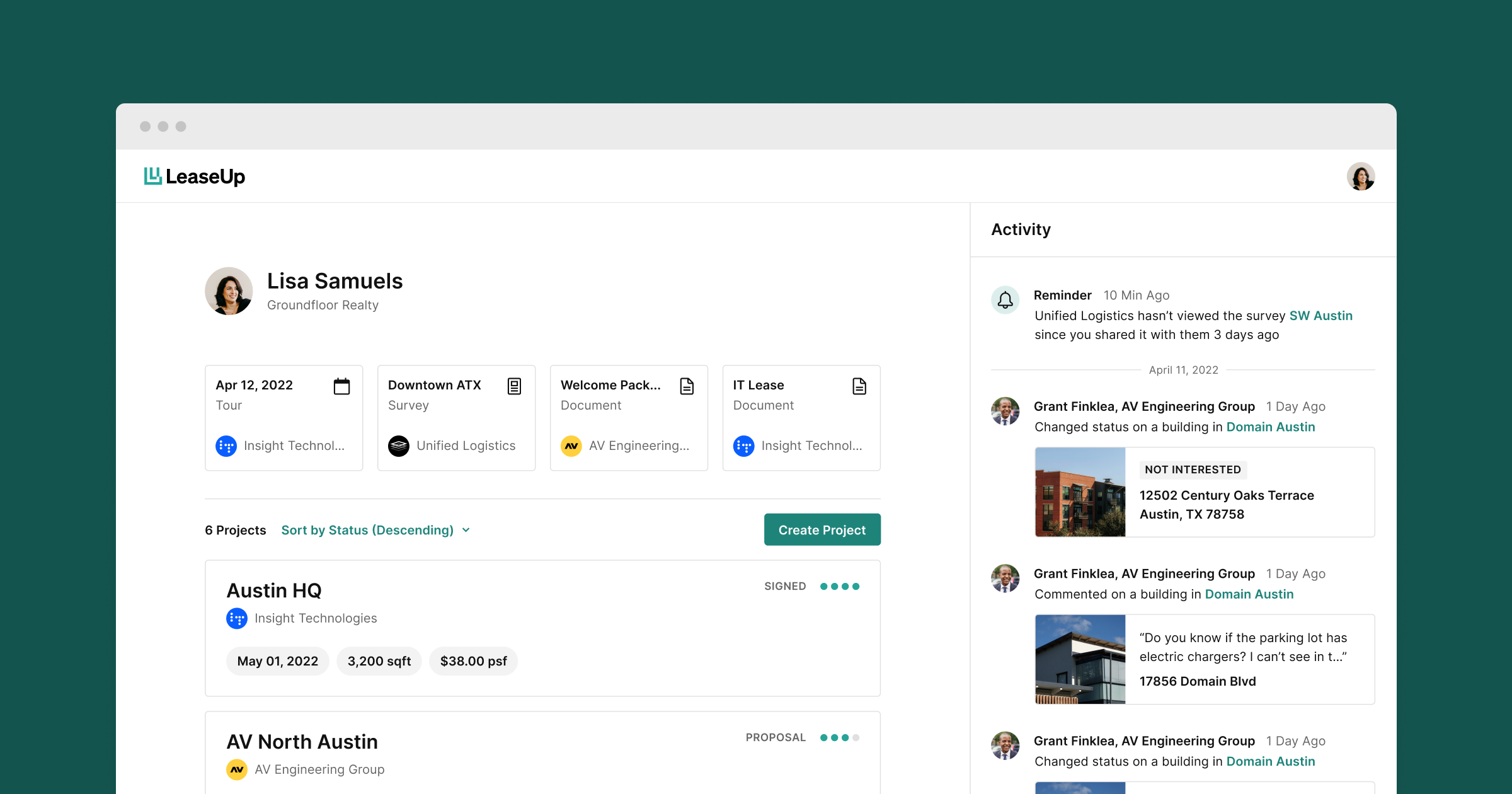
LeaseUp is an AI-enabled deal and transaction platform built specifically for commercial real estate brokers, focusing on tenant representation. In an industry historically burdened by static PDFs and fragmented email chains, this software centralizes market data, client feedback, and marketing deliverables into a single digital workspace. As a Tier 2 CRE-Native platform, it targets the core inefficiencies of the site selection process. According to BestCRE research, LeaseUp starts at approximately $100 per user per month, making it an accessible addition to the modern brokerage tech stack. By replacing manual spreadsheet comparisons and cumbersome document creation, the platform allows brokerage teams to present building data through interactive, mobile-friendly interfaces.
For commercial real estate principals and analysts evaluating new software in August 2026, the primary appeal of LeaseUp lies in its ability to accelerate the transaction cycle. The platform acts as a bridge between internal data management and external client presentation. Instead of spending hours compiling property details into static reports, brokers can use the system to instantly generate branded surveys and interactive tour books. This transition from static documents to collaborative digital environments directly impacts how clients interact with property data, ultimately speeding up their decision-making process. While the commercial real estate technology landscape is crowded, LeaseUp differentiates itself by focusing specifically on the workflow of tenant rep brokers, offering a specialized environment rather than a generic project management tool.
What LeaseUp does and how it works
At its core, LeaseUp functions as a centralized hub for commercial real estate deal data and marketing asset generation. Brokers input or import property data, which the system then organizes into a standardized format. From this central repository, users can instantly generate branded client deliverables, such as site surveys and tour books. The software eliminates the need to manually copy and paste building specifications, floor plans, and financial details into presentation templates. Instead, the AI-enabled platform pulls the necessary data points and formats them into professional, client-ready documents or digital portals.
The platform goes beyond static document creation by offering an interactive, mobile-first experience for clients. When a broker shares a survey or tour itinerary, the client receives a digital link rather than a heavy PDF attachment. Within this digital environment, clients can review property details, view layered geographic data, and leave direct feedback on specific spaces. This interactive feedback loop is captured within the platform, allowing the brokerage team to track client preferences and adjust their site selection strategy accordingly. The system acts as a shared workspace where both the broker and the client can collaborate on the transaction in real time.
Furthermore, LeaseUp addresses the internal project management needs of brokerage teams. It provides a unified dashboard where team members can track the status of various deals, monitor client engagement with shared materials, and coordinate tasks. By consolidating client communications, document storage, and property data into one platform, the software reduces reliance on disjointed third-party applications. The platform aims to replace traditional methods like shared spreadsheets for property comparisons and generic mapping tools for tour routing, offering a specialized toolkit designed specifically for the nuances of commercial real estate transactions.
9AI Framework: the score, dimension by dimension
CRE Relevance: 9/10
As a Tier 2 CRE-Native database, LeaseUp is explicitly designed for the commercial real estate sector, with a laser focus on tenant representation workflows. Unlike generic presentation or project management tools, the platform understands the specific data points required for commercial transactions, such as lease rates, floor plans, and tenant improvement allowances. The interface is tailored to the site selection process, mapping out properties and organizing data in a way that aligns with how brokers and clients actually evaluate space. This specialized approach ensures that the software immediately resonates with brokerage teams without requiring extensive customization to fit their operational model. In practice: Brokers can adopt the platform quickly because the data structures and output formats already match industry-standard site surveys and tour books.
Data Quality and Sources: 7/10
The quality of the data within LeaseUp is inherently tied to the inputs provided by the brokerage team and any integrated market data sources. As a transaction platform rather than a primary data provider, it relies on users to populate the system with accurate property details and financial metrics. However, the software enforces a standardized data structure, which significantly reduces the risk of formatting errors and inconsistencies that often plague manual spreadsheets. By centralizing the data, it ensures that all team members are working from the most current information, mitigating the issue of version control. In practice: The platform improves data consistency across deliverables, but users must remain diligent about the accuracy of the initial property information they enter into the system.
Ease of Adoption: 8/10
LeaseUp is engineered to be highly intuitive, minimizing the learning curve for brokers who may not be highly technical. The process of moving from account creation to generating a shared client deliverable is streamlined into a few straightforward steps. The mobile-first design ensures that brokers can access deal information and manage client interactions while on the go, which is critical for professionals who spend significant time touring properties. The intuitive nature of the digital surveys and tour books also extends to the client side, requiring no training for clients to navigate and provide feedback. In practice: Brokerage teams can transition away from their legacy PDF and spreadsheet workflows within days rather than months.
Output Accuracy: 8/10
The platform excels in producing accurate, professional marketing assets by pulling directly from the centralized deal database. Because the surveys and tour books are generated automatically from the source data, the risk of transcription errors during the document creation process is virtually eliminated. The AI-enabled formatting ensures that the deliverables are visually appealing and consistently branded, regardless of which team member generates them. The accuracy of the geographic data layers and mapping features further enhances the reliability of the site selection materials presented to clients. In practice: Brokers can trust that the digital deliverables match the underlying property data exactly, preventing embarrassing discrepancies during client presentations.
Integration and Workflow Fit: 7/10
LeaseUp is designed to fit into the modern commercial real estate tech stack, complementing existing CRM systems and lead generation tools. By centralizing the transaction workflow, it actively replaces the need for multiple disjointed applications, such as generic mapping software, disparate document storage, and shared spreadsheets. The platform’s architecture suggests a focus on interoperability, allowing it to act as the primary interface for deal execution while drawing on data from other specialized tools. The company is also developing API access, which will further enhance its ability to connect with enterprise-level brokerage systems. In practice: The software centralizes the deal execution phase, acting as the connective tissue between initial lead generation and final document execution.
Pricing Transparency: 8/10
The vendor maintains a clear and accessible pricing structure, which is a significant advantage for principals evaluating the software. According to BestCRE research, pricing starts at approximately $100 per user per month. This published baseline allows firms to accurately model the financial impact of deploying the platform across their brokerage teams. The subscription model is straightforward, avoiding the hidden fees or complex tiered structures that often complicate software procurement in the commercial real estate sector. This level of transparency facilitates faster decision-making for firms looking to upgrade their technology stack. In practice: Analysts can easily calculate the total cost of ownership and project the required return on investment based on the published per-user pricing.
Support and Reliability: 6/10
As a relatively young PropTech startup, LeaseUp is still establishing its long-term support infrastructure and reliability track record. While the platform is currently utilized by innovative brokerage firms, it does not yet have the decades of proven stability associated with legacy enterprise software providers. Users should anticipate the typical growing pains associated with early-stage technology companies, including potential shifts in support protocols and feature updates. However, the company’s dedicated focus on the commercial real estate niche suggests a highly specialized support team that understands broker workflows. In practice: Firms should assign an internal champion to manage the relationship with the vendor and navigate any early-stage support dynamics.
Innovation and Roadmap: 7/10
The company demonstrates a strong commitment to evolving its product offering, particularly in the realm of artificial intelligence and data accessibility. The integration of AI-enabled features indicates a forward-looking approach to automating the more tedious aspects of transaction management. Furthermore, the development of API access shows an understanding of the broader commercial real estate ecosystem and the need for data portability. The vendor actively engages with the industry through webinars and content, suggesting that customer feedback directly influences their product development cycle. In practice: Users can expect regular feature releases that continuously refine the digital presentation and data management capabilities.
Market Reputation: 6/10
LeaseUp is building a solid reputation among forward-thinking tenant representation brokers, though it remains an emerging player in the broader commercial real estate technology landscape. Its recent seed funding round indicates growing investor confidence and market validation for its specific approach to deal management. While it may not yet possess the universal name recognition of industry giants, it is highly regarded by its current user base for solving a very specific and painful workflow problem. The platform is increasingly viewed as a necessary tool for modernizing the client experience. In practice: The software is respected by early adopters, but conservative firms may still view it as an unproven challenger.
Who should use LeaseUp
LeaseUp is highly specialized, making it an excellent fit for specific types of commercial real estate professionals who manage complex site selection processes. The platform delivers the most value to teams that handle a high volume of property data and require frequent, polished client communication.
- Tenant Representation Brokers: Professionals who need to compile and present multiple property options to clients quickly and efficiently.
- Boutique Brokerage Firms: Smaller agencies looking to punch above their weight by delivering highly professional, interactive digital experiences that rival larger competitors.
- Brokerage Team Leads: Managers seeking to standardize the quality of marketing deliverables across their team and track client engagement metrics.
- Commercial Real Estate Analysts: Staff members tasked with compiling market surveys who want to eliminate the manual formatting of static presentation documents.
Who should look elsewhere
While powerful for its intended use case, the software is not a universal solution for all commercial real estate disciplines. Firms operating outside of traditional leasing or those requiring heavy financial modeling will find the platform lacking in necessary functionality.
- Investment Sales Brokers: Professionals focused on capital markets transactions who require complex financial underwriting tools rather than tenant tour books.
- Property Managers: Teams needing operational software for rent collection, maintenance tracking, and tenant communication post-lease execution.
- Firms Requiring Primary Market Data: Users looking for a database of off-market properties or historical lease comps, as this tool is a management platform rather than a data provider.
Pricing and ROI
According to BestCRE research, LeaseUp operates on a subscription model with pricing starting at approximately $100 per user per month. This published pricing provides a clear baseline for commercial real estate principals to evaluate the financial feasibility of the platform. For a mid-sized brokerage team of ten professionals, the annual software expenditure would total roughly $12,000.
To justify this investment, analysts must calculate the return on investment based on time saved and deal velocity. The traditional process of compiling a market survey and formatting a PDF tour book often consumes five to ten hours of an analyst’s or junior broker’s time per client. Assuming a conservative estimate of ten hours saved per user per month, and valuing that time at a standard internal rate of $50 per hour, the software generates $500 in productivity value per user monthly. This yields a 5x return on the initial subscription cost purely through operational efficiency.
Furthermore, the interactive nature of the digital deliverables can accelerate the client decision-making process. If the platform helps a broker close just one additional lease transaction per year by preventing deal fatigue and keeping the client engaged, the commission earned will exponentially cover the annual cost of the software for the entire team.
Integration and CRE tech stack fit
LeaseUp is positioned to serve as the central hub for the deal execution phase, fitting neatly between top-of-funnel lead generation tools and bottom-of-funnel legal execution software. In a standard commercial real estate tech stack, a broker might use a CRM to track a prospect and a data provider to source initial property options. LeaseUp takes over once the active site selection process begins, replacing the ad-hoc combination of shared spreadsheets, generic mapping applications, and PDF editors.
The platform is designed to consolidate these disparate functions into a single workspace. By standardizing property data and client feedback within its system, it ensures that information is not lost in fragmented email chains. While the software currently acts as a standalone environment for deal management, the company is actively developing API access. This future connectivity will allow firms to push and pull data directly between LeaseUp and their enterprise CRM or proprietary databases, further solidifying its role as a specialized presentation and collaboration layer within the broader technology ecosystem.
Competitive landscape
When evaluating LeaseUp, commercial real estate principals must consider how it stacks up against both generic productivity tools and specialized industry software. Historically, the primary competitors have been the Microsoft Office suite and Adobe Acrobat, which brokers use to manually construct spreadsheets and static PDFs. While these legacy tools are universally understood, they lack the automation, interactive client interface, and CRE-specific formatting that LeaseUp provides.
Within the realm of specialized presentation and marketing software, tools like Beautiful.ai (BestCRE Score: 89) offer faster document creation but lack the CRE-native data structures and mapping capabilities essential for site selection. Similarly, AI writing assistants like Jasper AI (BestCRE Score: 89) or Copy.ai (BestCRE Score: 87) can help draft property descriptions but cannot manage the actual transaction workflow or generate interactive tour books.
In the proptech sector, brokers might compare LeaseUp to broader deal management platforms like VTS or Dealpath. However, those platforms are primarily geared toward landlords and investment teams, respectively, whereas LeaseUp is explicitly built for the tenant representation workflow. Another alternative is Buildout, which excels in creating marketing memorandums for investment sales but is less focused on the interactive, mobile-first client collaboration required during a tenant’s site selection process. Ultimately, LeaseUp carves out a distinct niche by focusing heavily on the broker-client interaction during the active touring and evaluation phase.
The bottom line
LeaseUp is a mandatory evaluation for any tenant representation team looking to modernize their client deliverables and accelerate the site selection process. The platform successfully identifies and eliminates the specific friction points associated with manual market surveys and static tour books. By transitioning these assets into an interactive, digital environment, brokers can provide a superior client experience that directly impacts deal velocity. While conservative firms may hesitate to adopt software from an early-stage startup, the published pricing of roughly $100 per user per month makes the financial risk negligible compared to the potential productivity gains. Principals should mandate a trial of the software for their most active leasing teams. If your brokers are still spending hours formatting PDFs and managing client feedback via messy email chains, LeaseUp offers a highly specialized, immediately deployable solution to upgrade your operational efficiency.
Frequently asked questions
What is the primary function of LeaseUp?
LeaseUp is an AI-enabled transaction platform designed specifically for commercial real estate brokers. It centralizes deal data to automatically generate branded marketing assets, such as interactive market surveys and digital tour books, effectively replacing manual spreadsheets and static PDF documents within the tenant representation workflow.
How much does LeaseUp cost per user?
According to BestCRE research, LeaseUp utilizes a straightforward subscription pricing model that starts at approximately $100 per user per month. This transparent pricing structure allows commercial real estate brokerage firms to easily calculate their total cost of ownership and project potential return on investment.
Is LeaseUp suitable for investment sales brokers?
No, the platform is explicitly designed for the tenant representation workflow and the site selection process. Investment sales brokers require complex financial underwriting capabilities and capital markets distribution tools, which are not the primary focus of this specific transaction management software.
Does LeaseUp provide primary market data or property listings?
No, LeaseUp functions as a deal management and presentation platform, not a primary data provider. Brokers must input their own property data or import it from their existing commercial real estate market research tools to populate the digital surveys and tour books.
Can clients interact with the deliverables generated by LeaseUp?
Yes, the software generates mobile-first, digital deliverables. Clients receive a secure link where they can review property details, view geographic data layers, and leave direct feedback on specific spaces, facilitating a highly collaborative and efficient site selection process for the brokerage team.
Does LeaseUp integrate with existing commercial real estate CRMs?
The platform is designed to complement existing tech stacks by handling the active deal execution phase. While it currently operates as a centralized workspace, the vendor is actively developing API access to enable deeper integrations with enterprise commercial real estate CRMs and proprietary databases.