Plaace is a CRE-native, Tier 2 data-driven platform designed specifically for tenant mix optimization and market monitoring. According to BestCRE’s master database record, the primary use case centers entirely on helping commercial real estate professionals evaluate optimal tenant placements and track surrounding market dynamics. In a sector where valuation often hinges on the specific retail or commercial tenants occupying a property, relying on gut instinct for tenant placement introduces unnecessary risk. Plaace attempts to quantify this process by analyzing locational data to recommend which types of occupiers will perform best in a given space. Our analysis indicates that the platform serves as a bridge between traditional appraisal methods and modern data science, focusing strictly on the income-generation potential of specific tenant combinations.
As of August 2026, the commercial real estate market demands strict underwriting and precise income forecasting. Plaace enters this environment offering tools that move beyond basic demographic rings. Instead of simply reporting population density, the software evaluates foot traffic patterns, complementary business clusters, and local consumer behavior to project tenant viability. The system functions within the CRE Valuation & Appraisal category by directly influencing the inputs used in discounted cash flow models, specifically the probability of tenant retention and optimal lease rates. While the company does not publish its pricing publicly, its positioning as a Tier 2 database tool suggests it targets mid-market to enterprise-level asset managers and retail landlords who need empirical data to justify their leasing strategies.
What Plaace does and how it works
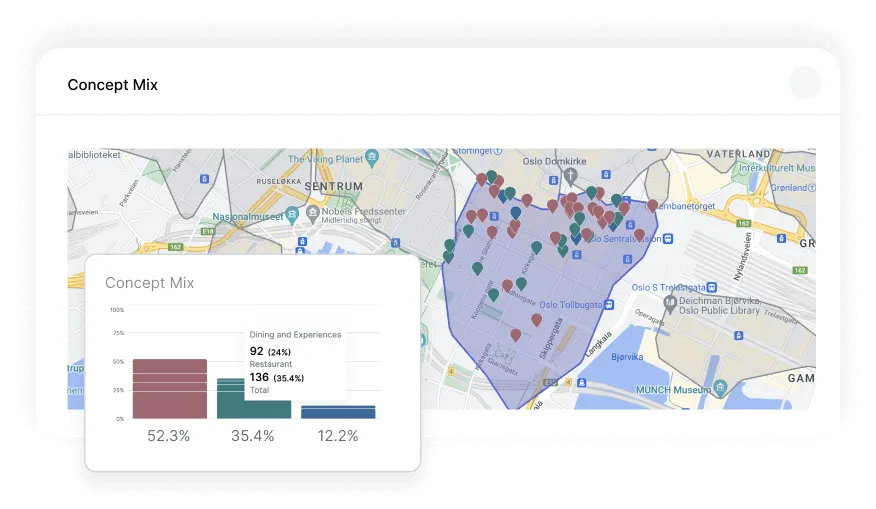
Plaace operates by aggregating multiple data streams to evaluate commercial locations and suggest the most viable tenant categories. The core mechanics involve users inputting a specific property address or drawing a polygon around a target retail corridor. The platform then queries its internal database, which integrates mobility data, demographic shifts, and existing retail supply. By analyzing these layers, the software identifies gaps in the local market, such as an oversupply of quick-service restaurants but a deficit of boutique fitness operators.
For valuation and appraisal professionals, the platform provides a quantitative foundation for highest and best use analysis. When an appraiser or asset manager is evaluating a vacant big-box retail space, Plaace generates a probability matrix of successful tenant types based on the surrounding ecosystem. This output directly informs the lease-up assumptions in an Argus model. If the data indicates a high probability of success for a grocery anchor, the analyst can confidently model lower vacancy periods and higher tenant retention rates. Conversely, if the software flags a location as highly saturated for a proposed use, the analyst must adjust their risk premium accordingly.
The user interface relies heavily on map-based visualizations and dashboard reporting. Users can monitor specific market areas over time, setting alerts for when new competing businesses open or when foot traffic patterns shift significantly. This market monitoring feature transitions the tool from a point-in-time appraisal utility to an ongoing asset management asset. Analysis of the platform’s workflow reveals that while it does not automatically generate a final property value, it provides the critical micro-economic inputs required to defend a valuation. Users export these tenant mix recommendations and market reports into PDF or CSV formats to include as exhibits in formal appraisal reports.
9AI Framework: the score, dimension by dimension
CRE Relevance: 9/10
Plaace is built entirely for commercial real estate, earning its CRE-native classification. Unlike generic geospatial tools or basic demographic aggregators, the platform’s architecture is specifically designed around the concept of tenant mix optimization and commercial market monitoring. The data models are trained to answer questions unique to retail and mixed-use asset management, such as how a specific anchor tenant impacts the foot traffic of adjacent inline spaces. This strict focus ensures that the metrics provided are directly applicable to commercial property valuation and leasing strategies. Our analysis confirms that the tool does not waste interface space on irrelevant residential or industrial metrics when evaluating retail sites. In practice: Asset managers can directly apply the platform’s retail gap analysis to their leasing strategy without needing to translate generic data into CRE-specific insights.
Data Quality and Sources: 7/10
As a Tier 2 CRE database, the platform relies on aggregating third-party data streams, including mobility metrics, census data, and business registries. The quality of the output is inherently tied to the accuracy and recency of these underlying sources. Analysis suggests that while the data is generally reliable for major metropolitan statistical areas, users in secondary or tertiary markets may encounter thinner data sets that require manual verification. The platform attempts to clean and normalize this data to present a unified view of market dynamics, but appraisers must still apply professional judgment when anomalies appear in foot traffic estimates. In practice: Analysts should cross-reference the platform’s business registry data with street-level verification before finalizing the highest and best use section of an appraisal.
Ease of Adoption: 7/10
The software utilizes a standard map-based interface that will feel familiar to anyone who has used basic geographic information systems or modern CRE listing platforms. The learning curve is relatively shallow for the core features, allowing analysts to begin pulling market monitoring reports within the first few days of deployment. However, interpreting the tenant mix optimization algorithms requires a deeper understanding of retail dynamics and data science principles. The vendor provides onboarding support, but teams will need to invest time in establishing internal protocols for how the tool’s recommendations are weighted against traditional broker feedback. In practice: A junior analyst can learn to pull site reports in an hour, but a senior principal must dictate how those reports influence the firm’s underwriting models.
Output Accuracy: 7/10
The platform’s primary deliverable is a recommendation for tenant mix and an assessment of market conditions. Because these are forward-looking projections based on historical data, absolute accuracy is difficult to measure until a lease is signed and the tenant operates for a cycle. Analysis indicates that the tool is highly accurate at identifying existing market gaps and mapping current competitor locations. However, the predictive accuracy regarding tenant success rates is subject to macroeconomic variables that the software cannot foresee, such as abrupt changes in interest rates or localized supply chain disruptions. In practice: Users should treat the tenant mix recommendations as a highly educated starting point for leasing strategy, rather than a guaranteed formula for zero vacancy.
Integration and Workflow Fit: 6/10
Plaace operates primarily as a standalone web application, requiring users to log into its specific portal to conduct market monitoring and tenant analysis. While the platform allows users to export data via CSV or PDF for use in external models, native API integrations with primary CRE software like Argus Enterprise or standard CRM systems are not heavily emphasized in the baseline product. This means analysts must manually transfer the insights gained from the tenant mix optimization tools into their cash flow models or leasing pipelines. The lack of direct database-to-database connectivity limits its utility for enterprise firms seeking fully automated underwriting workflows. In practice: Analysts will need to maintain a dual-screen workflow, viewing Plaace on one monitor while manually updating their primary financial models on the other.
Pricing Transparency: 3/10
The vendor strictly adheres to a Contact for pricing model, completely obscuring its cost structure from public view. There are no published tiers, baseline entry costs, or indications of whether the software is billed per user, per asset, or per market. This lack of transparency forces prospective buyers into a sales funnel before they can determine if the platform aligns with their technology budget. For a Tier 2 database tool, this approach creates friction during the initial procurement phase, especially for independent appraisers or boutique investment firms that require predictable software expenses. In practice: Procurement teams must allocate time for direct vendor negotiations and should demand a clear explanation of future scaling costs before signing an initial contract.
Support and Reliability: 6/10
As an unproven startup in the highly competitive CRE tech landscape, the company’s long-term support infrastructure remains a variable. While early-stage platforms typically offer highly responsive, white-glove support to their initial client base, scaling that support as the user base grows often presents challenges. The platform lacks the extensive, decades-old documentation libraries and certified training programs found with legacy CRE software providers. Users must rely on direct communication with the vendor’s team to resolve technical issues or clarify data anomalies within the market monitoring modules. In practice: Buyers should negotiate strict service level agreements regarding response times and data update frequencies to mitigate the risks associated with early-stage vendors.
Innovation and Roadmap: 7/10
The platform’s focus on tenant mix optimization positions it well to incorporate future advancements in predictive analytics and machine learning. Analysis of the product’s trajectory suggests a focus on refining the algorithms that predict consumer behavior and cross-shopping patterns. As mobility data becomes more granular, the software is expected to offer increasingly precise micro-market monitoring capabilities. However, the roadmap must balance adding complex predictive features with maintaining the usability required by traditional CRE professionals. The challenge will be evolving beyond a data aggregator into a prescriptive engine without alienating users who demand transparent methodologies. In practice: Clients should schedule quarterly reviews with the vendor to ensure upcoming features align with their specific retail asset management strategies.
Market Reputation: 6/10
Within the CRE Valuation & Appraisal software category, Plaace is currently building its brand identity. It does not yet hold the widespread industry recognition of established peers like Clear Capital or the specific valuation buzz of Deepblocks. As an unproven startup, its reputation is primarily confined to early adopters focusing specifically on retail and mixed-use tenant optimization. Market feedback is limited, meaning prospective buyers cannot rely on a deep well of peer reviews or standardized case studies to validate the vendor’s claims. The company must prove its algorithms can consistently deliver ROI across multiple market cycles to secure a stronger foothold. In practice: Firms adopting the tool should view themselves as early adopters and conduct rigorous parallel testing against their existing market research methods.
Who should use Plaace
This tool is highly recommended for professionals focused on retail and mixed-use income generation.
Retail asset managers looking to justify capital expenditures for property repositioning based on empirical tenant demand data.
Leasing brokers specializing in mixed-use developments who need data-backed presentations to attract specific anchor tenants.
Commercial appraisers requiring quantitative support for highest and best use determinations in complex retail corridors.
Acquisition analysts at private equity firms evaluating the upside potential of underperforming strip centers through tenant mix optimization.
Who should look elsewhere
Firms operating outside of retail or those requiring fully automated valuation models should look elsewhere.
Industrial or multifamily investors, as the platform’s primary mechanics are tailored toward retail consumer behavior and commercial tenant mixes.
Independent residential appraisers who do not require complex commercial market monitoring or tenant optimization data.
Firms requiring fully transparent, low-cost SaaS tools with published pricing tiers for immediate, frictionless deployment.
Enterprise organizations demanding native, bi-directional API integrations with legacy valuation software like Argus Enterprise.
Pricing and ROI
Plaace does not publish its pricing publicly, relying entirely on a Contact for pricing model. BestCRE’s master database record confirms that prospective buyers must engage directly with the sales team to receive a custom quote. This opaque approach means there is no public visibility into whether the platform charges based on a per-user license, per-asset under management, or geographic market access. For CRE principals evaluating the tool, this requires dedicating time to discovery calls simply to establish baseline budget feasibility.
To calculate the return on investment (ROI), analysts must construct a framework based on risk mitigation and lease-up velocity. If the custom pricing for a mid-sized asset management firm is estimated at $15,000 annually, the ROI is realized through the avoidance of a single bad lease. In retail commercial real estate, a failed tenant results in lost rent, unrecovered tenant improvement (TI) allowances, and extended vacancy periods, easily costing upwards of $100,000 for a standard inline space. If the platform’s tenant mix optimization data prevents one incompatible tenant from being signed, or identifies a high-performing tenant that signs a lease three months faster than the market average, the software pays for itself multiple times over. However, without published pricing, buyers must demand a clear, fixed-fee structure during negotiations to prevent unexpected cost escalations as their portfolio grows.
Integration and CRE tech stack fit
Integrating Plaace into an existing commercial real estate technology stack requires manual processes rather than automated data flows. The platform functions primarily as a standalone, cloud-based market monitoring environment. Analysis indicates that it lacks the deep, out-of-the-box API connections necessary to push tenant mix optimization data directly into enterprise valuation systems like Argus Enterprise or standard property management software like Yardi or MRI.
For the CRE analyst, this means the tool sits at the top of the research funnel. Users will generate insights, export the data via CSV or PDF, and then manually input those assumptions, such as projected lease rates, downtime, and tenant probability, into their discounted cash flow models. While this disconnected workflow prevents data corruption in the primary financial models, it does introduce the risk of human error during data entry. Firms utilizing modern data lakes may find it challenging to ingest the platform’s proprietary scoring metrics without custom development work. Buyers should evaluate whether their teams have the capacity to manage a disconnected application that serves strictly as a specialized research terminal rather than an integrated operational system.
Competitive landscape
In the CRE Valuation & Appraisal category, Plaace occupies a specialized niche focused on tenant mix, which sets it apart from broader automated valuation models and construction-focused AI tools. When compared to peers already scored by BestCRE, the distinctions become clear. Attentive.ai (Scored 88) and Togal.AI (Scored 76) focus heavily on automating site measurements and construction takeoffs, serving a completely different phase of the asset lifecycle than Plaace’s market monitoring.
A closer comparison is Deepblocks (Scored 81), which also utilizes map-based interfaces and demographic data. However, Deepblocks is primarily engineered for zoning analysis and development feasibility, whereas Plaace is strictly focused on the operational phase of optimizing the tenant mix for existing or planned retail spaces. Clear Capital (Scored 78) operates in the valuation space but leans heavily into residential and standard commercial appraisals through traditional data aggregation, lacking the specific retail tenant optimization algorithms that define Plaace.
C3 AI Property Appraisal (scored 76) provides enterprise-grade property valuation tools primarily for tax assessors and large institutions, offering a much broader, statistically driven valuation approach compared to Plaace’s micro-level focus on foot traffic and retail gaps. Another peer, Hover (Scored 86), is entirely focused on 3D property modeling from smartphone photos, offering no competitive overlap with tenant analytics. Ultimately, buyers must recognize that Plaace is not a direct replacement for traditional valuation software; rather, it is a supplementary data provider that competes against traditional retail brokerage reports, demographic data providers, and manual market research.
The bottom line
Plaace offers a highly specialized, data-driven approach to a problem that has historically relied on broker intuition: tenant mix optimization. For retail asset managers and commercial landlords, the platform provides empirical backing for leasing strategies and continuous market monitoring. However, its opaque pricing model and lack of native integrations require a deliberate commitment from the buying firm to manually incorporate its insights into existing underwriting workflows. Because it is an unproven startup in the Tier 2 database classification, buyers must exercise caution and demand clear service level agreements. The decision to purchase should not be based on replacing an existing valuation tool, but rather on the need to inject quantitative rigor into retail leasing and highest and best use analyses. If your portfolio’s performance dictates precise retail tenant placement, Plaace is a necessary evaluation; if you operate strictly in industrial or multifamily sectors, look elsewhere.
Frequently asked questions
Does Plaace provide automated property valuations?
No. The platform provides market monitoring and tenant mix optimization data, which analysts use as inputs to justify their own valuation models, rather than generating a final automated property value.
Is the pricing for the platform publicly available?
No. According to BestCRE research, the vendor uses a Contact for pricing model, requiring prospective buyers to engage directly with their sales team to receive a custom quote.
Can the software integrate directly with Argus Enterprise?
The platform operates primarily as a standalone web application. Users must export data via CSV or PDF and manually input the resulting assumptions into Argus or other financial models.
What property types benefit most from this tool?
Retail properties, shopping centers, and mixed-use developments benefit most, as the algorithms are specifically designed to analyze consumer foot traffic, retail gaps, and complementary business clusters.
How does the tool assist with commercial appraisals?
It provides quantitative data for the highest and best use analysis section of an appraisal, offering empirical evidence to support assumptions about tenant viability and market demand.
Is this tool suitable for residential real estate investors?
No. The platform is a CRE-native tool focused on commercial tenant optimization and business market monitoring, making it irrelevant for standard single-family residential investments.
Related Reviews
Compare Plaace with other Valuation & Appraisal tools BestCRE has scored: ZestyAI (82/100), V7 Go (73/100), Adema AI (66/100) and CRE Agents (63/100). Browse every review in CRE Valuation & Appraisal, the full Best CRE AI Tools directory, or the 20 CRE Sectors hub.