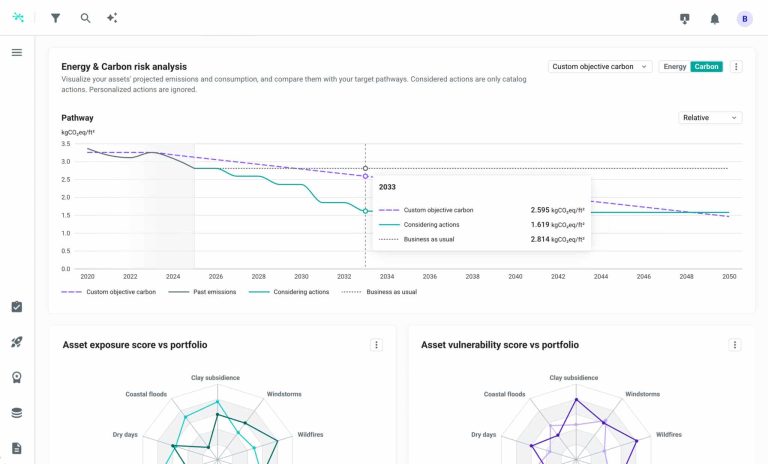
Deepki is a CRE specific sustainability data and decarbonization platform for institutional property owners, investors, asset managers and large occupiers. It changes a workflow that often depends on utility portals, spreadsheets, consultants and repeated requests to property managers. The platform collects building and meter information, checks it, calculates sustainability indicators and presents performance from individual meters through entire portfolios. Buyers can then use the same governed dataset for reporting, climate risk analysis, energy management and capital planning.
The practical proposition is consolidation. Deepki says its platform covers utility and property data, operational energy, carbon emissions, physical climate risk, regulatory reporting, due diligence, embodied carbon and retrofit planning. Its capital planning tools can model potential interventions against CRREM pathways or custom targets. That scope matters because many landlords still treat disclosure, engineering and investment planning as separate exercises, creating conflicting asset records and expensive reconciliation work.
Deepki is headquartered in Paris and has established a credible enterprise presence. The company reports more than $4 trillion of real estate assets under monitoring, operations across more than 100 countries and use by major investment and property organizations. It also reports more than 600 customers and 85,000 platform users. Its acquisitions of EVORA Global and Metry broaden the proposition through sustainability advisory expertise and meter data infrastructure. Deepki previously raised a €150 million Series C round.
BestCRE analysis: Deepki belongs near the top of a specialist CRE sustainability shortlist, particularly for multinational portfolios facing complicated data collection and disclosure obligations. It is not conventional property management software and will not replace accounting, leasing, work order or tenant systems. Its value depends on the quality of source access, ownership of remediation tasks and whether investment teams actually use the resulting analysis. Buyers should test data coverage, calculation governance, local reporting requirements and export rights using a representative group of difficult assets before committing portfolio wide.
What Deepki Does and How It Works
Deepki starts by assembling sustainability information that is normally scattered across utility companies, property managers, invoices, meters and internal systems. The company advertises more than 7,300 automated connectors, alongside integrations with data partners and workflows for collecting property attributes and financial information. The platform checks and versions incoming records, preserves audit trails and flags incomplete or questionable data. Where readings are unavailable, AI based estimates can fill gaps across more than 60 asset types. Estimated values still require governance because modeled consumption is not equivalent to a verified bill or meter reading.
Once data is organized, users can examine energy, emissions and other sustainability indicators at meter, building, fund and portfolio levels. Benchmarking helps identify unusually intensive assets, while physical climate risk and carbon assessments add a longer term risk view. Teams can coordinate reporting campaigns, reuse collected indicators and monitor completion against deadlines. Deepki positions the resulting records as audit ready, but that does not remove the buyer’s responsibility to define boundaries, review estimation methods, reconcile ownership periods and approve final disclosures.
The action layer connects measurement with investment planning. Users can create virtual retrofit scenarios, compare measures, estimate their effects and monitor implementation against carbon pathways or internal targets. Energy management views can support operational investigation, while due diligence tools can bring sustainability factors into acquisition or financing decisions. BestCRE analysis: the most valuable mechanic is not another emissions dashboard. It is the ability to carry a consistent asset record from collection through compliance and into capital allocation. The main implementation risk is organizational. A platform can expose gaps and recommend priorities, but engineering teams, asset managers and finance committees must validate assumptions, fund projects and document realized results.
9AI Framework: Dimension by Dimension Analysis
CRE Relevance: 10/10
Deepki earns 10 for CRE relevance because its data model, workflows and outputs are designed around buildings, meters, assets, funds and property portfolios. The product addresses tasks performed by sustainability teams, asset managers, property managers, investment committees and real estate lenders. Its coverage of CRREM alignment, retrofit scenarios, utility consumption, climate exposure, due diligence and real estate reporting is materially different from a general carbon accounting platform. BestCRE analysis: the strongest evidence is the connection between environmental measurements and asset level decisions. Users can move from a questionable utility record to portfolio comparison and then to a proposed capital intervention without translating everything into an unrelated corporate accounting structure. The qualification is category scope. Deepki is deeply relevant to property sustainability and operations, but it is not a full property management system for leasing, rent collection, maintenance and general ledger functions.
Data Quality and Sources: 8/10
Deepki earns 8 for data quality. Its proposition rests on centralized utility, building, financial and climate information, supported by automated connectors, partner feeds, validation processes, audit trails and data versioning. Meter specialist Metry should strengthen collection capabilities, while the platform’s estimation models can help make incomplete portfolios usable. BestCRE analysis: those controls are appropriate for institutional reporting, but no vendor can manufacture verified source data when utilities, managers or tenants do not provide it. Estimated readings may improve continuity while also creating false confidence if they are not visibly separated from observed values. Buyers should inspect lineage at the individual meter level, rules for weather and occupancy adjustments, treatment of acquisitions and disposals, duplicate detection, and procedures for correcting closed reporting periods. A score above 8 would require more publicly accessible technical evidence about validation performance, error rates and independent testing across jurisdictions.
Ease of Adoption: 7/10
Deepki earns 7 for ease of adoption. The interface consolidates several sustainability workflows, and automated collection can reduce recurring requests once connections are established. Centralized campaigns, role based workflows and reusable indicators should be easier than maintaining parallel spreadsheets for every disclosure. Deepki also combines software with a substantial sustainability expert team, which can help buyers define processes and interpret requirements. BestCRE analysis: implementation will still be demanding for a large owner. Utility authorizations, meter hierarchies, landlord and tenant boundaries, joint venture permissions, historical gaps and inconsistent asset identifiers take real work. Users outside the sustainability function may also need training before they trust modeled scenarios or enter data consistently. Prospective customers should request a phased plan that identifies responsibilities, acceptance tests and remediation queues. Adoption should be judged by time to a reconciled portfolio, not by the speed of an initial dashboard demonstration.
Output Accuracy: 7/10
Deepki earns 7 for output accuracy. Audit trails, version control, structured checks and consistent calculation workflows can produce more defensible reporting than uncontrolled spreadsheets. The platform can also compare assets, calculate carbon indicators and simulate retrofit effects using a shared dataset. BestCRE analysis: accuracy remains conditional on source completeness, organizational boundaries, emissions factors, estimation choices and the assumptions placed inside investment scenarios. A decarbonization model is decision support, not a guaranteed forecast of energy savings, project cost or valuation impact. Physical climate outputs similarly depend on external hazard models, asset coordinates and the interpretation of exposure. Deepki does not publish enough standardized accuracy evidence to justify a higher score across all modules. Buyers should require sample calculations, factor libraries, methodology documentation, change controls and exports that allow an adviser or auditor to reproduce important figures independently before relying on the platform for formal disclosures or underwriting.
Integration and Workflow Fit: 9/10
Deepki earns 9 for integration because data connectivity is central to the product rather than an optional accessory. It supports thousands of automated utility connections and presents integrated partner data alongside property, meter and financial records. The acquisition of Metry adds specialization in energy data collection, while enterprise positioning suggests that identity, governance and portfolio scale are core design concerns. BestCRE analysis: this is a strong fit for owners that need to connect many providers and jurisdictions into a common sustainability layer. The remaining diligence is specific to each buyer. A large connector count does not prove that the exact utility, property manager, accounting system or data field required by a portfolio is supported in the needed country. Buyers should obtain a source by source coverage matrix, clarify API and bulk export terms, test asset identifier mapping, and document how failed connections are monitored. Integration quality should be measured through sustained data delivery, not connector availability alone.
Pricing Transparency: 3/10
Deepki earns 3 for pricing transparency because the vendor does not publish subscription prices, package rates, implementation fees or standard contract terms. Prospective customers are directed to request a demonstration and enter a sales process. That approach is common in enterprise CRE software, where portfolio size, geography, modules, data sources and advisory requirements can materially affect scope. It still prevents buyers from estimating total cost before engaging the vendor. BestCRE analysis: procurement teams should ask for separate prices for platform access, implementation, connector setup, historical data work, advisory services, additional modules, support tiers and future portfolio growth. They should also clarify minimum terms, annual increases, user limits, data export rights and exit assistance. The score is below the framework ceiling for unpublished pricing because opacity adds time and makes comparisons harder, even when a configured enterprise quote may ultimately be reasonable.
Support and Reliability: 8/10
Deepki earns 8 for support. The company positions software, sustainability expertise and process assistance as a combined offering, and reports a team of more than 150 sustainability experts. Its purchase of EVORA Global adds an established real estate sustainability advisory capability, which is particularly relevant for buyers that need methodology, reporting and portfolio strategy help alongside technology. BestCRE analysis: this structure can reduce the gap between software configuration and CRE decision making. It may be especially useful during onboarding, regulatory changes and capital planning exercises. Buyers should not assume every expert service is included in the software fee or available equally in every market. Contract diligence should identify the named support model, service hours, escalation path, response commitments, training allocation and boundaries between customer success and billable consulting. References should be matched by geography and portfolio complexity, since enterprise support performance can vary substantially by team and implementation scope.
Innovation and Roadmap: 8/10
Deepki earns 8 for innovation. The platform connects sustainability data management with climate risk, regulatory reporting, energy operations, due diligence and capital expenditure planning. AI is used for data estimation and retrofit support, while virtual scenarios can compare investments against recognized or custom decarbonization targets. The broader combination of software, advisory capability and energy data infrastructure gives Deepki more operational depth than a narrow disclosure tool. BestCRE analysis: the innovation is useful because it attempts to join measurement with investment decisions, not because the product applies an AI label. The restraint is evidence. Automated estimates and suggested interventions must be explainable, reviewable and tied to known inputs before an investment committee should rely on them. Buyers should test whether AI functions materially improve data remediation or option analysis, and whether users can see assumptions and override results. Public information does not establish independently measured gains for every module, asset class or geography.
Market Reputation: 9/10
Deepki earns 9 for market reputation. The company has an established profile in European real estate sustainability and publicly identifies recognized investment managers, property companies and service firms in customer stories. Reported portfolio scale, international coverage and enterprise adoption indicate that the platform has progressed well beyond an early market trial. The acquisitions of EVORA Global and Metry also signal an effort to broaden delivery and data capabilities around the core product. BestCRE analysis: this reputation should earn Deepki a place in serious institutional evaluations, but brand scale is not a substitute for reference checks. Buyers should speak with customers that share their asset types, utility markets, ownership structures and reporting obligations. They should ask about implementation delays, data exceptions, renewal economics and actual use by investment teams. A perfect score would require broader independently verifiable performance evidence and consistently detailed public documentation of customer outcomes, rather than primarily vendor selected case studies.
Who Should Use Deepki
Deepki is best suited to institutional owners, investment managers, listed property companies, large occupiers and real estate finance organizations with portfolios spread across managers, utilities or countries. The ideal buyer already has material sustainability reporting duties and needs one governed record for asset performance, emissions, climate exposure and planned interventions. It is particularly relevant when sustainability staff spend too much time chasing bills, reconciling spreadsheets and rebuilding the same indicators for investors, regulators and internal committees.
It also suits organizations trying to connect sustainability targets with capital planning. An asset management team can use portfolio comparisons to prioritize investigations, then evaluate retrofit scenarios with engineers and finance colleagues. BestCRE analysis: the economic case is strongest where data collection repeats frequently, reporting carries meaningful risk and capital committees need comparable asset level evidence. Buyers should have an executive sponsor, named data owners and a process for resolving exceptions. Without those elements, Deepki may become an expensive reporting repository rather than an operating system for portfolio improvement.
Who Should Not Use Deepki
Deepki is unlikely to suit a small landlord with a limited local portfolio, simple utility access and no complex disclosure burden. Such an owner may obtain adequate results from utility portals, an energy consultant and a controlled workbook. Companies seeking rent collection, lease administration, maintenance dispatch or tenant communications should buy property management software instead. Deepki may complement those systems, but it does not replace their core transactional functions.
The platform is also a poor fit for buyers unwilling to fund data cleanup or assign accountability across sustainability, property management, engineering and finance. BestCRE analysis: organizations looking for automatic, unquestionable savings forecasts should be cautious. Estimated data, climate models and retrofit scenarios all require review. Teams that only need corporate emissions accounting outside real estate should compare broader carbon platforms, while buyers that need advisory work without an enterprise data platform may be better served by a specialist consultant.
Pricing and ROI Analysis
Deepki does not publish subscription prices, implementation charges or standard packages. Pricing is therefore likely configured through a sales process, but the vendor does not publicly specify its formula. Buyers should request a written total cost model covering platform modules, assets, meters, users, countries, data connectors, onboarding, historical imports, advisory work and premium support. They should also ask how acquisitions, disposals and portfolio growth affect fees, and whether access to raw data and calculation histories continues after termination.
BestCRE analysis: a simple ROI test should start with avoidable labor and credible operating improvement, then subtract all recurring and one time costs. If a portfolio spends 4,000 staff and consultant hours each year collecting, checking and reporting sustainability data, and Deepki removes 1,000 hours, multiply those saved hours by the buyer’s fully loaded hourly cost. Add only energy savings that have a documented baseline, approved measure and accountable owner. Do not count modeled savings as cash until they appear in verified consumption or invoices. Compare the resulting annual benefit with subscription, implementation, internal administration and integration costs over the proposed contract term.
Integration and CRE Tech Stack Fit
Deepki should sit beside the property management, accounting, data warehouse and investment systems in an institutional CRE stack. It can act as the sustainability system of record while source applications continue handling leases, invoices, work orders and financial books. Utility connectors and partner feeds reduce manual collection, and structured exports or interfaces can pass approved indicators into reporting and analytics environments. The platform’s asset identifiers must be mapped carefully to the owner’s existing property hierarchy.
BestCRE analysis: buyers should build an integration inventory before procurement. For every material source, document the system owner, geography, refresh frequency, authorization method, required history and fallback when automated collection fails. Test API access and bulk exports rather than relying on presentation slides. Confirm whether financial and property attributes are synchronized or manually uploaded, and determine how corrections flow back into downstream reports. A pilot should include tenant controlled meters, missing bills, ownership changes and at least one difficult utility market, because straightforward assets reveal little about integration resilience.
Competitive Landscape
Measurabl is the most direct enterprise alternative. It also focuses on real estate sustainability data, reporting and portfolio performance, with substantial visibility among institutional owners. A buyer should compare source coverage in its actual markets, treatment of estimates, disclosure workflows, calculation traceability and the usability of asset level action planning. Measurabl Navigate may be relevant where climate and transition risk analysis is central to the decision. Deepki’s case is strongest when the buyer values an integrated combination of platform, advisory expertise and energy data connections.
Cambio is another credible option, particularly for teams comparing carbon intelligence, data automation and decarbonization planning. It may appeal to buyers seeking a focused product experience or a different approach to AI assisted data work. The correct comparison depends less on the feature checklist than on successful ingestion of the buyer’s own portfolio data. Each finalist should process the same sample, expose assumptions and reproduce selected calculations.
BestCRE analysis: Deepki competes on institutional scope rather than general property management breadth. DoorLoop, Entrata and AppFolio address core property operations and accounting, so they are complements or alternatives only when the buying problem has been defined incorrectly. Conduit, Banner, Venn, Moved and Relevance AI likewise solve different workflow categories. A sustainability platform should be evaluated against specialist products first, then tested for fit with the existing operational stack.
The Bottom Line
Deepki should make the shortlist for a large owner, investor or occupier that needs defensible sustainability data across a complicated property portfolio. Its CRE specific model, wide connector strategy, capital planning functions and combined software and advisory capabilities form a credible enterprise proposition. BestCRE analysis: the platform appears strongest when one governed dataset must support reporting, risk review and investment planning across multiple markets.
Proceed only after a paid or contractually defined pilot proves source coverage, lineage, calculation reproducibility and user adoption on difficult assets. Require a complete cost schedule and clear separation between measured, estimated and modeled results. Smaller portfolios and buyers seeking ordinary property management functions should look elsewhere. For the right institutional buyer, Deepki is a serious operating platform, but the purchase case should rest on verified data improvement and decisions changed, not the breadth of the product presentation.
About BestCRE
BestCRE.com is the definitive authority on commercial real estate AI, analysis, and investment intelligence. Every article advances the platform’s mission to help CRE professionals identify, evaluate, and adopt the best tools and strategies in the industry. We benchmark platforms using the 9AI Framework so CRE leaders can compare tools with clear evidence. Explore the category map at 20 CRE sectors for deeper coverage across the CRE stack.
Frequently Asked Questions
What is Deepki?
Deepki is a sustainability data intelligence and decarbonization platform built for commercial real estate. Institutional owners, investment managers, occupiers and finance organizations use it to collect utility and building data, calculate environmental indicators, manage reporting campaigns, assess climate and transition risks, and plan property improvements. It organizes information from meters, bills, property teams and connected systems into asset and portfolio views. The product also supports energy management, due diligence, embodied carbon work and capital expenditure scenarios. Deepki is not a general property management platform. It does not replace rent accounting, lease administration, maintenance dispatch or tenant management systems. BestCRE analysis: its primary value is giving sustainability, asset management and investment teams a common dataset for disclosure and property decisions.
How does Deepki compare with Measurabl?
Deepki and Measurabl are direct competitors for institutional real estate sustainability management. Both centralize property data, support disclosure workflows and help teams examine portfolio performance. Deepki emphasizes broad utility connectivity, decarbonization planning, energy operations and access to sustainability advisers following its expansion through EVORA Global and Metry. Measurabl has its own established real estate data platform, while Measurabl Navigate extends its climate and transition risk proposition. BestCRE analysis: neither should win from a generic feature demonstration. Ask both vendors to ingest the same sample of difficult assets, identify missing data, show the lineage of calculated indicators and export a reproducible report. The better choice is the one that covers the buyer’s utilities and jurisdictions with fewer manual exceptions and clearer methodology.
How much does Deepki cost?
Deepki does not publish standard subscription prices or implementation fees. Buyers need to request a proposal based on their portfolio and selected scope. A useful quotation should separate software modules, asset or meter charges, connector work, initial data cleanup, historical imports, advisory services, training and premium support. It should also state user limits, contract length, annual price changes and charges for adding properties or countries. BestCRE analysis: compare vendors using total cost over the full contract term, including internal staff time and integration work. Treat estimated energy reductions as potential benefits rather than guaranteed returns. A credible business case should identify current reporting labor, consultant spending, compliance exposure and specific operating measures that the organization can actually implement and verify.
Who should use Deepki?
Deepki is most appropriate for institutional property owners, investment managers, listed real estate companies, large occupiers and lenders with complex portfolios. It fits organizations collecting data from many utilities, property managers, joint ventures or jurisdictions, especially when the same information must support regulation, investor reporting, asset plans and investment committees. Teams should already have an executive sponsor and named owners for data quality, engineering review and project delivery. BestCRE analysis: the platform is less compelling for a small landlord with a few buildings and straightforward reporting, or for a company mainly seeking rent collection and maintenance software. It also will not fix weak governance by itself. Buyers need staff who can investigate exceptions, approve assumptions and turn portfolio findings into funded property actions.
Will Deepki become an AI platform for real estate investment decisions?
Deepki is moving toward a broader real estate intelligence role by applying AI to data estimation and capital planning while connecting sustainability records with risk and financial decisions. That direction is plausible because the platform already spans collection, benchmarking, climate analysis and retrofit scenarios. BestCRE analysis: buyers should expect AI to improve exception detection, data completion and option comparison before it can independently support high consequence investment decisions. The important future test is explainability. Users need to see source records, assumptions, confidence levels and model changes, then override results when property evidence disagrees. Deepki could become more influential in underwriting and capital allocation, but adoption will depend on reproducible calculations, integration with financial systems and proof that recommendations translate into verified property outcomes.
Related Reviews
Compare Deepki with other tools BestCRE has scored in the same category: DoorLoop, Entrata, Moved. Explore more CRE AI tool reviews in our Best CRE AI Tools directory. For sector-specific analysis and market intelligence, visit our 20 CRE Sectors hub.