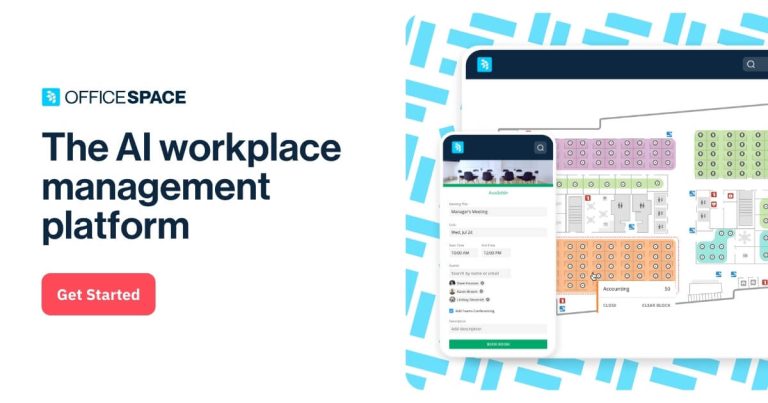
OfficeSpace Software is a workplace management platform for corporate real estate, facilities, space planning, and workplace experience teams. Its core value is operational: it connects floor plans, employee locations, workplace reservations, utilization information, moves, facilities requests, and asset records. The platform is most relevant to occupiers managing active office portfolios, especially organizations that regularly restack departments, operate hybrid-work programs, or need defensible evidence for renovation and footprint decisions.
The product changes a workflow that is often divided among CAD drawings, spreadsheets, ticketing systems, reservation applications, and institutional knowledge. OfficeSpace gives teams a visual system for maintaining floor plans, comparing planning scenarios, assigning people and departments, and executing moves. Its AI Canvas and Space Planning Agent extend that foundation by helping users create stacking options and obtain portfolio insights more quickly. The practical attraction is not autonomous design. It is reducing the manual coordination around workplace planning.
OfficeSpace also reaches beyond the narrow architecture and space-planning category. Desk and room booking, wayfinding, visitor management, work orders, preventive maintenance, workplace communications, and asset tracking make it closer to an integrated workplace management platform. That breadth can consolidate vendors for a large occupier, but it may be excessive for a design firm or owner seeking only test fits. The strongest buying case appears when planning data must remain useful after a scenario becomes an operating plan.
BestCRE analysis: OfficeSpace belongs below design-first products such as Autodesk Forma and TestFit for early feasibility and generative building studies, but it is more operationally complete than many point solutions. Its differentiator is AI-assisted stacking and move planning inside an established workplace system. Buyers should still verify how much of the advertised agent functionality is available in production, which modules carry separate fees, and whether generated recommendations respect their own adjacency, capacity, accessibility, and policy constraints.
What OfficeSpace Software Does and How It Works
OfficeSpace organizes workplace information around digital floor plans. Administrators can map seats, offices, rooms, departments, neighborhoods, equipment, and other assets, then use that spatial record for planning and daily operations. Block and stack planning supports departmental allocation across floors or buildings, while scenario planning lets teams compare possible layouts or assignments before committing to a move. Moves, adds, and changes can then be managed within the same environment, reducing the need to reconstruct an approved scenario in a separate move spreadsheet.
The AI layer is positioned as a set of specialized agents. The Space Planning Agent is intended to automate planning cycles and produce stacking options, while the Insights Agent answers questions or surfaces patterns from workplace information. OfficeSpace also presents agents for workplace experience and facilities workflows. AI Canvas focuses on interactive space planning and scenario creation. BestCRE analysis: the useful capability is likely constraint-assisted iteration, not a substitute for architectural judgment. Buyers should test whether the system can encode departmental adjacencies, growth assumptions, sharing ratios, special-use rooms, circulation limits, and immovable conditions without repeated manual correction.
Outside planning, the platform supports desk and room reservations, employee wayfinding, workplace neighborhoods, announcements, visitors, service requests, work orders, assets, preventive maintenance, and capital tracking. Reporting covers utilization and portfolio performance, with integrations connecting common collaboration and identity systems. Mobile access supports employees and field updates. These mechanics matter because a stack plan has limited value if assignments, reservations, moves, and asset records immediately diverge afterward. OfficeSpace can maintain a common operational picture, provided the buyer establishes data ownership and reliable update processes.
9AI Framework: Dimension by Dimension Analysis
CRE Relevance: 8/10
OfficeSpace earns an 8 for CRE relevance because its planning functions address recognizable occupier workflows: floor-plan administration, departmental stacking, scenario comparison, utilization analysis, move execution, and portfolio reporting. These are direct concerns for corporate real estate and facilities teams deciding how much office space to retain and how to allocate it. The product is CRE-adjacent rather than a complete real estate system because it does not primarily handle acquisitions, leasing, valuations, development underwriting, or brokerage. It also is not an architectural authoring platform. BestCRE analysis: its relevance is strongest after an organization controls or occupies space and needs to plan and operate that workplace. It is weaker during site selection, building design, and transaction management. That distinction keeps the score below the category’s broadest design and feasibility platforms.
Data Quality and Sources: 7/10
OfficeSpace earns a 7 for data quality. The platform can bring floor plans, seat assignments, reservations, employee information, assets, requests, and utilization records into a connected workplace model. This is more useful than an isolated planning tool because live operational activity can inform future scenarios. Data quality, however, depends heavily on implementation discipline and connected source systems. An inaccurate floor plan, stale roster, inconsistent check-in behavior, or incomplete sensor feed will undermine both dashboards and AI recommendations. The vendor describes integrations and workplace intelligence, but it does not publicly publish enough technical validation to establish universal completeness, refresh performance, or error rates across deployments. BestCRE analysis: buyers should treat the data model as capable infrastructure, not a guarantee of trustworthy information. A pilot should reconcile capacity, occupancy, assignments, and reservations against independently verified records.
Ease of Adoption: 8/10
OfficeSpace earns an 8 for ease of adoption because visual floor plans, employee-facing booking, wayfinding, and connected move workflows are understandable to both administrators and workplace users. The platform states that implementations can be completed in 35 days, although buyers should treat that as a vendor claim whose applicability depends on portfolio complexity, integrations, drawing quality, and governance. Adoption is likely easier when the company replaces several fragmented workplace tools and gives employees one interface for common office tasks. It becomes harder when business units use inconsistent space standards or resist centralized data ownership. BestCRE analysis: implementation risk resides less in interface training than in preparing drawings, cleaning workforce records, defining reservation policies, and assigning ongoing administrative responsibility. Buyers should ask for a project plan tied to their actual building count, identity environment, sensor sources, and migration requirements.
Output Accuracy: 7/10
OfficeSpace earns a 7 for output accuracy. Its plans and reports can be dependable when the underlying floor geometry, capacity rules, employee records, and utilization sources are current. Scenario comparison and move coordination also create a traceable process that is preferable to disconnected spreadsheet versions. The unresolved issue is the accuracy of AI-generated stack plans and agent responses under real operational constraints. The vendor does not publish independent benchmark results for planning accuracy, constraint satisfaction, or recommendation quality. BestCRE analysis: users should regard generated scenarios as decision support requiring professional review. Test cases should include fixed rooms, accessibility requirements, departmental adjacencies, confidential teams, specialized equipment, future headcount, and limits on usable capacity. Accuracy should be measured by constraint violations and required corrections, not by how quickly an attractive diagram appears. Final life-safety and code decisions remain outside this platform’s proper authority.
Integration and Workflow Fit: 8/10
OfficeSpace earns an 8 for integration. It publicly identifies connections with Microsoft, Google, Slack, Zoom, Microsoft Azure, and related workplace tools, supporting identity, calendars, communications, and employee workflows. That coverage is important because reservation and occupancy information becomes more credible when booking behavior fits tools employees already use. The platform’s broad modules also reduce handoffs among planning, booking, move, facilities, and asset applications. Still, an integration logo does not establish field-level completeness, bidirectional synchronization, latency, or inclusion in the base contract. The vendor does not publish a universal mapping for every enterprise system. BestCRE analysis: buyers should build an integration matrix covering the human resources source, identity provider, calendars, sensors, access control, service management, lease administration, business intelligence, and drawing formats. Contract exhibits should identify each connector, data owner, refresh interval, failure alert, and implementation responsibility.
Pricing Transparency: 3/10
OfficeSpace earns a 3 for pricing transparency because the vendor does not publish standard subscription prices, module prices, implementation fees, or a public cost calculator. Prospects are directed toward a sales process and demonstration. This is common among enterprise workplace platforms, but it makes early comparison difficult and prevents buyers from establishing a credible total cost before discovery. Packaging also matters because space planning, booking, facilities, assets, analytics, professional services, and AI functions may not share one entitlement. BestCRE analysis: procurement teams should request a multiyear quote that separates platform access, modules, users or employees, locations, floor-plan conversion, integrations, support, training, data migration, professional services, and renewal increases. They should also ask whether agent usage has limits or separate charges. The low score reflects limited public visibility, not necessarily poor value.
Support and Reliability: 8/10
OfficeSpace earns an 8 for support. The company advertises live phone and email assistance during extended hours, client success services, training, implementation help, office hours, and professional services. It also states that floor-plan changes and integration services are available, which can be material for teams without dedicated workplace technology staff. Public product tours, a help center, and educational resources add useful paths for evaluation and onboarding. The principal limitation is verification. Service-level terms, escalation procedures, response targets, support boundaries, and the meaning of unlimited floor-plan changes are not fully published for every contract. BestCRE analysis: the support model appears stronger than that of a narrow planning startup, but buyers should convert sales assurances into contractual commitments. References should be asked about drawing turnaround, integration troubleshooting, administrator continuity, response during urgent booking failures, and support quality after initial deployment.
Innovation and Roadmap: 8/10
OfficeSpace earns an 8 for innovation because it is applying AI agents to established workplace data and workflows rather than offering a detached chatbot. AI-assisted stacking, scenario generation, workplace guidance, facilities activity, and natural-language insight retrieval could shorten planning cycles and make portfolio information accessible to more decision makers. The connection between proposed plans and downstream moves is particularly relevant. The score stops short of the top tier because public descriptions do not establish how agents reason, which constraints they guarantee, how recommendations are evaluated, or when human approval is mandatory. BestCRE analysis: the architecture is directionally compelling, but buyers should separate production capabilities from roadmap language. A controlled demonstration should begin with the buyer’s own floor plan, policies, and roster, then document configuration effort, invalid outputs, user corrections, explanation quality, and the time saved against the existing process.
Market Reputation: 8/10
OfficeSpace earns an 8 for market reputation. The company has operated since 2006 and presents itself as an established workplace platform rather than a newly launched planning tool. It says the product supports more than 2,000 teams globally and identifies recognizable customers through case studies, including Medtronic, Quantum Health, and HUB International. The vendor also publishes user-rating, managed-area, retention, and satisfaction claims, although those figures should be verified in current third-party sources and customer references during procurement. BestCRE analysis: longevity, visible enterprise deployments, and a broad service organization reduce vendor maturity risk relative to younger category entrants. They do not prove that every module or newer AI agent is equally mature. Buyers should request references matching their portfolio scale, geographic complexity, integration stack, and intended modules, with particular attention to renewals, support responsiveness, and realized planning outcomes.
Who Should Use OfficeSpace Software
OfficeSpace best suits corporate real estate, facilities, and workplace teams responsible for occupied offices rather than one-time design engagements. The strongest buyer manages multiple floors or locations, performs regular departmental restacks, and needs planning decisions to flow into employee assignments, bookings, moves, assets, and service operations. Organizations operating hybrid policies can also benefit when reservation behavior and utilization evidence must inform footprint or renovation decisions. A centralized workplace team with authority over data standards is the most favorable operating model.
It is also appropriate for enterprises trying to consolidate separate tools for space plans, reservations, move lists, workplace communications, facilities requests, and selected asset workflows. BestCRE analysis: the product becomes easier to justify when several departments will use the same spatial record and when management expects recurring scenarios, not a single test fit. Buyers should have an internal product owner, reliable employee and location data, defined space standards, and the capacity to govern integrations. Companies evaluating the AI functions should nominate experienced planners to test and approve the resulting scenarios.
Who Should Not Use OfficeSpace Software
OfficeSpace is not the natural first choice for architects, developers, or brokers whose principal requirement is rapid test fitting during acquisition, leasing, or early building design. TestFit, Autodesk Forma, qbiq, or conventional design software may align more directly with those stages. Small occupiers with one stable office may also find the platform’s breadth difficult to justify, especially if calendar booking and a maintained floor plan already cover their needs.
Buyers should hesitate when they lack clean drawings, a dependable employee source, or ownership of workplace data. AI planning will not repair inconsistent capacity definitions or unresolved policy decisions. Organizations seeking transparent self-service pricing, a lightweight month-to-month purchase, or independently published accuracy benchmarks will encounter gaps. BestCRE analysis: if the only requirement is occupancy sensing, dedicated providers such as Density, VergeSense, or Occuspace deserve closer consideration before adopting a broader workplace suite.
Pricing and ROI Analysis
OfficeSpace does not publish standard pricing for subscriptions, modules, implementation, integrations, or AI features. Buyers must request a demonstration and commercial proposal. That limits direct comparison and creates uncertainty about whether planning, booking, facilities, analytics, assets, and agents are bundled or priced separately. A serious request for proposal should demand line items for recurring software, initial configuration, drawing preparation, migration, connectors, training, premium support, professional services, and renewal adjustments. It should also define the pricing unit, such as employee, seat, floor, building, or module.
BestCRE analysis: use simple ROI math based on avoidable labor and space cost, not vendor-wide case studies. If planners and coordinators collectively save 40 hours per month, multiply 480 annual hours by the organization’s fully loaded hourly cost. Add any documented savings from retiring overlapping software. Then compare that annual benefit with the complete annualized cost, including implementation. Treat avoided construction or lease expense separately and count it only when an approved baseline shows that the spending would otherwise occur. A purchase is persuasive when recurring, auditable savings exceed the subscription and administration burden under conservative assumptions.
Integration and CRE Tech Stack Fit
OfficeSpace fits most naturally between workplace source systems and employee collaboration tools. Microsoft and Google connections can support calendars and identity-related workflows, while Slack and Teams can bring booking or workplace actions into familiar channels. Zoom support is also advertised. The platform can then connect planning decisions with reservations, assignments, move execution, facilities activity, assets, and reporting. For a large occupier, that continuity is more important than simply having a long connector catalog.
BestCRE analysis: buyers should test the exact stack, not accept category-level compatibility. Confirm the authoritative source for employees, organizational hierarchy, floor geometry, room resources, badges, sensors, work orders, leases, and financial data. Determine which exchanges are native, bidirectional, scheduled, or custom. OfficeSpace may complement lease administration and transaction platforms, but it should not be assumed to replace them. Likewise, plans should be checked for exportability to the drawing and business-intelligence tools used by architects, analysts, and external partners.
Competitive Landscape
Against Autodesk Forma and TestFit, OfficeSpace is less focused on early building feasibility, site studies, or generative architectural options. Its advantage begins later, when an occupier needs to allocate departments, compare workplace scenarios, execute moves, and keep operational information current. qbiq is a closer alternative for rapid AI-assisted office planning and visualization, particularly in leasing and design contexts. OfficeSpace is the stronger candidate when the output must remain connected to booking, employee experience, facilities, and asset workflows.
VergeSense, Density, and Occuspace approach the category from occupancy measurement. Their value is evidence about how space is actually used, while OfficeSpace offers a wider management environment that can consume or contextualize utilization information. A buyer primarily trying to improve presence measurement should evaluate those dedicated providers. A buyer trying to turn utilization evidence into repeatable planning and operational action may prefer OfficeSpace, subject to integration quality.
Eptura is the broadest suite-level comparison because it also addresses workplace and real estate operations across multiple functions. Occupier is more directly associated with lease administration, transactions, and portfolio management, making it complementary or competitive depending on scope. BestCRE analysis: OfficeSpace should make the shortlist for occupier-side workplace operations, but selection should follow a scripted test using the same floor, roster, constraints, and reporting questions across vendors.
The Bottom Line
OfficeSpace is a credible shortlist product for enterprise occupiers that want space planning tied to daily workplace operations. Its combination of stacking, scenarios, moves, reservations, facilities, assets, and analytics provides more continuity than a stand-alone planning application. The newer AI layer could materially reduce iteration time, but buyers should require proof using their own constraints and data before assigning value to it.
BestCRE analysis: buy when the organization needs a governed workplace platform and can support the implementation with clean data and accountable owners. Do not buy solely for an impressive generated stack plan or an unverified savings story. Run a paid or controlled pilot, document correction rates and administrative effort, and negotiate module-level pricing plus integration obligations. If early design, sensing, or lease administration is the primary problem, choose a specialist instead.
About BestCRE
BestCRE.com is the definitive authority on commercial real estate AI, analysis, and investment intelligence. Every article advances the platform’s mission to help CRE professionals identify, evaluate, and adopt the best tools and strategies in the industry. We benchmark platforms using the 9AI Framework so CRE leaders can compare tools with clear evidence. Explore the category map at 20 CRE sectors for deeper coverage across the CRE stack.
Frequently Asked Questions
What is OfficeSpace Software?
OfficeSpace Software is a workplace management platform used by corporate real estate, facilities, workplace experience, and space-planning teams. It combines digital floor plans with block and stack planning, scenario comparison, moves, desk and room booking, wayfinding, visitor workflows, facilities requests, assets, preventive maintenance, and reporting. Its newer AI capabilities are designed to help teams generate planning options and retrieve workplace insights more quickly. It is not a building design application, brokerage platform, or full lease administration system. BestCRE analysis: OfficeSpace is best understood as an operational workplace system with meaningful space-planning capabilities. Its value comes from keeping a plan connected to assignments and workplace activity after the planning exercise is complete.
How does OfficeSpace compare with qbiq and TestFit?
OfficeSpace, qbiq, and TestFit overlap around faster space planning, but they enter the workflow at different points. TestFit is oriented toward rapid feasibility and building configuration during development or site evaluation. qbiq focuses on automated office layouts and visual material useful in leasing and design discussions. OfficeSpace is oriented toward occupiers that must manage existing workplaces, create stack scenarios, coordinate moves, support bookings, and maintain operational records. BestCRE analysis: choose OfficeSpace when ongoing workplace administration is central to the purchase. Choose a design-first alternative when the main deliverable is an early test fit or architectural concept. Buyers should compare all candidates with the same constraints and count manual corrections, not merely generation speed.
How much does OfficeSpace Software cost?
OfficeSpace does not publish standard subscription prices, module fees, implementation charges, or AI usage prices. Prospective customers must contact the vendor for a tailored proposal. The total can depend on the contracted modules, organizational scale, locations, implementation scope, integrations, drawing preparation, migration, training, support, and professional services. Buyers should request a detailed multiyear quote and identify which capabilities are included in the base platform. BestCRE analysis: compare the complete annualized cost with conservative savings from reduced planning labor, retired applications, and demonstrably avoidable space expense. Do not use a large renovation claim as the baseline unless internal plans and approvals show that expenditure would otherwise occur.
Who is OfficeSpace Software best for?
OfficeSpace is best for midsized and large occupiers with active workplace portfolios, recurring moves, hybrid attendance patterns, and multiple teams that need a common floor-plan record. It is particularly relevant to corporate real estate, facilities, workplace experience, and space-planning leaders who want scenarios to connect with assignments, reservations, moves, assets, and service requests. The organization should have dependable floor plans and workforce data, plus an internal owner who can govern standards and integrations. BestCRE analysis: the platform is less compelling for a small company with one stable office or for an architecture team seeking only rapid design concepts. Value increases as operational complexity and cross-functional use grow.
Will OfficeSpace AI replace manual space planning?
OfficeSpace AI is more likely to compress planning work than eliminate professional review. Agents can help create stacking options, surface information, and automate parts of recurring workplace workflows, but valid plans still depend on accurate geometry, organizational data, business rules, accessibility requirements, specialist spaces, and human priorities. The vendor does not publish independent benchmarks showing that its agents can satisfy every planning constraint without correction. BestCRE analysis for October 2026: buyers should expect assisted planning, with experienced staff defining constraints and approving results. Future value will depend on whether OfficeSpace can make recommendations explainable, measure constraint compliance, preserve audit trails, and keep agent outputs synchronized with live workplace changes.
Related Reviews
Compare OfficeSpace Software with other tools BestCRE has scored in the same category: Autodesk Forma, TestFit, Density. Explore more CRE AI tool reviews in our Best CRE AI Tools directory. For sector-specific analysis and market intelligence, visit our 20 CRE Sectors hub.