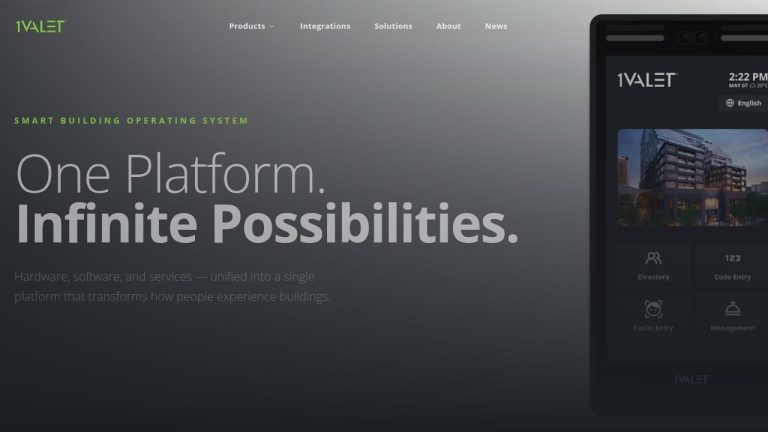
1VALET is a smart building operating platform for multifamily owners and property managers. It connects property access, intercom communications, package handling, amenity interactions, resident services, and building administration through a management portal and resident app. The CRE workflow it changes is the daily coordination of building entry and resident operations. Instead of treating those functions as isolated hardware purchases, 1VALET presents them as components of one property system.
That proposition is most credible in apartment communities where access events, visitor entry, deliveries, amenity reservations, and resident requests create meaningful work for onsite teams. A resident can interact with building services through the app, while management receives a centralized operational interface. The intended benefit is fewer disconnected credentials, interfaces, and vendor handoffs. Whether that benefit materializes depends on the installed configuration, the condition of existing building systems, and the integrations contracted for each property.
BestCRE’s analysis is that 1VALET should be evaluated primarily as property infrastructure, not as a conventional AI application. Its value comes from coordinating physical devices and operational software across a building. Buyers should therefore apply a higher diligence standard than they would to a standalone software subscription. Network design, door hardware, installation responsibility, failover behavior, cybersecurity, resident enrollment, and long term service obligations all affect the result.
The platform is CRE native and focused on a clear multifamily problem, which supports a strong relevance score. Its Rogers Smart Community relationship also gives it a meaningful Canadian distribution and connectivity context. However, public pricing, detailed service benchmarks, broad integration documentation, and independently comparable performance data are limited. The company has disclosed a C$15 million Roynat credit facility in 2026, indicating growth capacity, but financing does not establish product performance. The buying decision should rest on a building specific technical proposal, reference checks, and a measured implementation plan.
What 1VALET Does and How It Works
1VALET provides a shared software layer for smart building functions. Its smart intercom supports visitor communication and entry workflows, while access controls govern how residents, staff, guests, and service providers enter designated areas. The resident app serves as the occupant interface for enabled services. The management portal gives property personnel an administrative view of users, permissions, and building activity. Exact capabilities can vary by installed hardware and contracted modules, so buyers should require a written feature matrix that distinguishes standard functions, optional components, third party dependencies, and planned features.
The operating model combines physical equipment, cloud software, and implementation services. That combination can reduce the fragmentation created when an intercom, door access system, package process, and resident application come from unrelated vendors. It also creates implementation dependencies. Door conditions, wiring, cellular or internet connectivity, life safety boundaries, device placement, mobile operating systems, and staff permissions need to be mapped before deployment. Buyers should test common failure cases, including lost phones, resident turnover, connectivity loss, power interruption, credential revocation, guest access, emergency entry, and support escalation.
For property management, the practical output is not an AI generated recommendation. It is an operating environment that records events, administers access, and gives residents digital controls for configured building services. The quality of those outputs depends on correct identity records, permission rules, device health, and integrations. BestCRE’s analysis is that portfolio operators should insist on property level reporting, audit trails, role based administration, retention policies, export options, and documented recovery procedures. A pilot should measure staff time, resident enrollment, intercom completion, package handling, access exceptions, support tickets, and system availability before any portfolio commitment.
9AI Framework: Dimension by Dimension Analysis
CRE Relevance: 9/10
A score of 9 reflects direct alignment with multifamily property operations. 1VALET addresses building entry, visitors, residents, packages, amenities, and administrative control, all of which sit inside recurring CRE workflows. This is not a general consumer application adapted loosely to real estate. The system is intended for owners and managers responsible for physical properties and resident experience. Its combination of devices and software can influence operating workload, asset positioning, and resident satisfaction. BestCRE’s analysis is that the remaining gap from a perfect score comes from specialization. The product is highly relevant within multifamily, but less applicable to office, retail, industrial, hospitality, or mixed portfolios that need broader property management functions. It also does not replace accounting, leasing, maintenance, or asset management systems.
Data Quality and Sources: 7/10
A score of 7 recognizes that access and building systems can produce valuable first party operational records when devices, identities, and permissions are configured correctly. Event histories can support investigations, access administration, staffing decisions, and service monitoring. The limitation is that data quality depends heavily on implementation discipline. Duplicate resident records, delayed move out updates, shared credentials, offline devices, and inconsistent staff practices can weaken the record. The vendor does not publish enough standardized information for BestCRE to compare data completeness, device availability, retention periods, or error rates across deployments. BestCRE’s analysis is that buyers should define required fields, system ownership, retention rules, exports, exception reports, and reconciliation procedures before launch. Data should be sampled during the pilot rather than assumed accurate because it originates from connected hardware.
Ease of Adoption: 6/10
A score of 6 reflects a product that may simplify daily use after installation but requires meaningful operational change upfront. Residents must enroll, install or access the app, understand entry procedures, and know what to do when a phone or connection is unavailable. Staff must administer identities, permissions, guests, turnover, and exceptions. Installation can involve doors, intercom locations, networks, power, and existing systems, making adoption more demanding than ordinary cloud software. BestCRE’s analysis is that success will depend on site readiness, clear responsibility between the vendor and installers, resident communications, staff training, and fallback procedures. Buyers should not extrapolate from a polished demonstration to an occupied building. A phased deployment with onsite testing, accessible resident instructions, and a documented support path is the appropriate adoption model.
Output Accuracy: 7/10
A score of 7 reflects the deterministic nature of most core functions. Access permissions, directory records, visitor calls, and event logs should produce consistent results when identities, devices, and rules are correct. These are operational transactions rather than probabilistic AI responses, which makes accuracy easier to test. However, a correct software instruction does not guarantee a correct physical outcome. Door hardware, connectivity, device status, resident records, and integration timing can all introduce discrepancies. The vendor does not publish broad comparative statistics for successful entry events, intercom completion, false denials, or synchronization latency. BestCRE’s analysis is that buyers should establish acceptance tests for every entry type and user role, then verify event records against observed outcomes. Contractual service levels should define measurement methods, exclusions, incident classification, response expectations, and remedies.
Integration and Workflow Fit: 6/10
A score of 6 recognizes the value of a unified building platform and the strategic relevance of the Rogers Smart Community relationship in Canada. The platform is designed to coordinate multiple property functions rather than operate as a single isolated device. Still, public documentation does not establish the breadth and depth of connections that every owner may require across property management, identity, maintenance, package, accounting, and building systems. Integration claims should be evaluated at the workflow and field level. BestCRE’s analysis is that buyers need to confirm whether each connection is native, partner delivered, custom, or based on file exchange. They should also examine synchronization frequency, source of truth, error handling, API access, fees, and responsibility for support. A logo or partnership announcement is not sufficient evidence that a specific portfolio workflow will function correctly.
Pricing Transparency: 3/10
A score of 3 reflects the absence of public, standardized pricing. 1VALET does not publish a simple subscription schedule or an installed cost that permits an owner to compare properties without engaging sales. Some customization is understandable because building size, door count, wiring, devices, modules, connectivity, and installation conditions affect cost. Even so, limited pricing visibility shifts more diligence onto the buyer and makes early underwriting difficult. BestCRE’s analysis is that proposals should separate hardware, installation, software, connectivity, implementation, training, support, replacements, optional modules, taxes, and future escalation. Owners should also request contract length, renewal mechanics, minimum commitments, termination rights, data export terms, and costs associated with property sale or management transition. A decision should be based on total cost over the expected holding period, not an introductory monthly figure.
Support and Reliability: 6/10
A score of 6 reflects the importance of service within 1VALET’s combined hardware and software model, while acknowledging limited public evidence for comparing support performance. Access and intercom failures can affect residents immediately, so support quality is not a secondary consideration. Buyers need clarity on monitoring, triage, remote diagnostics, dispatch, parts replacement, installer coordination, and after hours escalation. The vendor does not publish enough standardized support metrics for BestCRE to validate response or resolution performance across its customer base. BestCRE’s analysis is that operators should interview comparable references and contract for named severity levels, contact methods, operating hours, response targets, restoration expectations, and escalation ownership. The agreement should also distinguish vendor responsibilities from those of telecom providers, installers, property staff, and other technology vendors when an incident crosses system boundaries.
Innovation and Roadmap: 7/10
A score of 7 reflects a thoughtful combination of resident software, administrative controls, connected access, intercom, and other building functions. The innovation is architectural rather than dependent on an unverified AI claim. Bringing multiple resident touchpoints into one operating environment can improve usability and make building events more actionable. The approach is particularly relevant where owners are replacing aging entry systems or developing connected communities. The score stops short of the highest band because unified smart building platforms are an established category, with credible competitors offering overlapping capabilities. BestCRE’s analysis is that innovation should be judged through practical details such as permission flexibility, device interoperability, deployment options, auditability, failure recovery, and portfolio administration. Buyers should favor demonstrated workflow improvement over feature volume or future product promises.
Market Reputation: 6/10
A score of 6 reflects credible category positioning and a significant Canadian partnership context, balanced against limited public evidence that supports a higher rating. The Rogers Smart Community relationship can help 1VALET reach multifamily projects where connectivity and building technology are planned together. The disclosed growth financing also indicates institutional support for expansion. Neither fact, on its own, proves customer satisfaction, deployment quality, or long term reliability. The vendor does not publish enough independently verifiable customer, retention, service, or performance information for BestCRE to place it alongside the category’s most established property software companies. BestCRE’s analysis is that prospective buyers should request references matching their building age, unit count, geography, ownership model, and installed modules. Reference calls should cover implementation delays, adoption, outages, support escalation, renewal experience, and unexpected costs.
Who Should Use 1VALET
1VALET best suits multifamily owners and operators planning a coordinated modernization of building access and resident services. The strongest candidate has enough operational complexity to justify centralized administration, such as multiple entrances, frequent visitors and deliveries, shared amenities, or a portfolio seeking consistent resident workflows. New developments and substantial renovations may be especially suitable because connectivity, power, device locations, and door hardware can be designed into the project rather than retrofitted around legacy constraints.
It also suits Canadian owners interested in evaluating a smart community package connected to Rogers. Institutional and regional operators should consider the platform when they can assign an internal owner across property operations, information technology, construction, and resident communications. BestCRE’s analysis is that the buyer should have a measurable operational problem, not merely a desire to advertise smart apartments. Good selection criteria include excessive intercom issues, fragmented credential management, manual guest procedures, package congestion, or inconsistent amenity access. The organization should also be prepared to run a pilot, maintain accurate resident records, train staff, and monitor performance after installation.
Who Should Not Use 1VALET
1VALET is a weaker fit for owners seeking a complete property management, leasing, accounting, maintenance, or asset management system. It addresses the building experience and access layer, not the entire operating stack. Small properties with simple entry requirements may struggle to justify the implementation effort unless replacement hardware is already required. Operators without reliable connectivity, internal technology ownership, or the capacity to manage resident onboarding should resolve those issues before purchasing.
The platform may also be unsuitable for buyers requiring transparent online pricing, a broad publicly documented integration catalog, or extensive independent performance benchmarks before speaking with sales. Portfolios dominated by office, retail, or industrial assets should look for systems designed around those property types. BestCRE’s analysis is that an owner should defer adoption if the proposal lacks a site survey, responsibility matrix, failure plan, data terms, and total installed cost. A smart building platform becomes operational infrastructure, so an ambiguous deployment scope creates more risk than a missing convenience feature.
Pricing and ROI Analysis
1VALET does not publish standardized pricing. Buyers should expect a property specific proposal because cost can vary with unit count, entrances, intercom requirements, door hardware, network conditions, installed modules, implementation services, and ongoing connectivity or support. A useful bid should itemize equipment, installation, commissioning, software, training, service, replacements, optional functions, and renewal increases. Owners should ask whether pricing is per unit, per door, per building, per device, or based on a combination. They should also identify which costs are paid once and which recur.
BestCRE analysis: calculate ROI using verified savings and avoided costs rather than a projected rent premium alone. For example, add annual reductions in staff time, credential replacement, call box service, package handling, and separate software contracts. Then subtract annual platform, connectivity, support, maintenance, and replacement costs. Divide the initial installation expense by the resulting annual net benefit to estimate a simple payback period. Buyers should run conservative, expected, and favorable cases, while excluding benefits that cannot be measured during a pilot. If the proposal depends mainly on higher rents, test that assumption against comparable leasing data and ask whether residents must pay a technology fee. The analysis should also account for the owner’s expected holding period.
Integration and CRE Tech Stack Fit
1VALET belongs between the physical building layer and the broader property management stack. Its resident identities, unit assignments, permissions, access events, visitor workflows, and amenity functions can intersect with leasing and property records. The platform’s relationship with Rogers is relevant for Canadian connectivity and smart community deployments, but buyers still need to verify the exact architecture proposed for each site. Public information does not establish every supported system, data field, or synchronization pattern.
BestCRE’s analysis is that the property management system should normally remain the source of truth for residents, units, and occupancy, with 1VALET receiving only the information required to administer building services. Buyers should map move ins, transfers, roommates, staff access, vendors, and move outs from start to finish. They should confirm authentication, API or file methods, update frequency, error alerts, audit logs, export rights, privacy controls, and support ownership. A controlled test should prove that a record change propagates correctly and that revoked access cannot persist because of a failed synchronization.
Competitive Landscape
SmartRent is the clearest alternative for owners seeking a broad enterprise smart apartment and property operations platform. It may appeal to larger portfolios prioritizing device management, unit automation, access, and centralized administration. Venn approaches the market through resident experience and community engagement, making it relevant when an owner places more weight on neighborhood services and resident programming. Visitt is worth considering when maintenance operations and work management are closer to the central buying problem.
Within BestCRE’s broader property management and operations category, Entrata and AppFolio offer wider property management coverage, including core operational workflows beyond smart building access. They are not direct replacements for every 1VALET component, but they may reduce the need for another resident interface or become the system that a smart building product must complement. DoorLoop is another broader property management option for buyers whose priority is administration rather than connected building infrastructure.
BestCRE’s analysis is that 1VALET is most differentiated when an owner wants building wide smart access, an intercom, and a resident app under one operating model, particularly in a Canadian Rogers context. Competitive evaluation should use the same building plan and workflow script for every vendor. Compare installed scope, supported hardware, resident experience, integrations, outage procedures, service coverage, contract terms, and total holding period cost. Feature checklists alone will conceal the implementation differences that determine value.
The Bottom Line
1VALET merits a shortlist for multifamily owners replacing access or intercom infrastructure and seeking one resident facing layer for connected building services. Its CRE focus is clear, and the combined hardware, portal, and app model addresses real operating friction. The product should not be purchased on positioning alone. Require a building survey, detailed architecture, itemized commercial proposal, security documentation, integration proof, service commitments, and references from comparable properties.
BestCRE’s decision is to pilot before standardizing. Select a representative occupied building, define baseline measures, and test resident enrollment, access exceptions, intercom completion, staff workload, device availability, and support resolution. Proceed to a portfolio rollout only if the pilot produces measurable improvement and the contract assigns responsibility clearly. Buyers needing a complete property management platform should choose a broader system first, then determine whether 1VALET fills a remaining building operations gap.
About BestCRE
BestCRE.com is the definitive authority on commercial real estate AI, analysis, and investment intelligence. Every article advances the platform’s mission to help CRE professionals identify, evaluate, and adopt the best tools and strategies in the industry. We benchmark platforms using the 9AI Framework so CRE leaders can compare tools with clear evidence. Explore the category map at 20 CRE sectors for deeper coverage across the CRE stack.
Frequently Asked Questions
What is 1VALET?
1VALET is a smart building operating platform designed primarily for multifamily properties. It combines connected building hardware with a management portal and resident app. Depending on the selected configuration, the platform can support functions such as smart access, intercom communications, visitor entry, package workflows, amenity interactions, and resident services. Property staff use administrative tools to manage users and permissions, while residents use the app to interact with enabled building functions. It is not a complete substitute for property management, accounting, leasing, maintenance, or asset management software. BestCRE’s analysis is that 1VALET should be evaluated as operational infrastructure because its results depend on physical installation, connectivity, identity data, staff procedures, and ongoing service.
How does 1VALET compare with SmartRent?
Both 1VALET and SmartRent address connected multifamily operations, including access and resident facing technology. SmartRent has a broad enterprise smart apartment proposition that can include unit automation, device management, and portfolio controls. 1VALET emphasizes a unified building operating model spanning smart access, intercom, management tools, and a resident app, with a notable Rogers Smart Community relationship in Canada. The better choice depends on the required hardware, geography, property systems, service coverage, and implementation model. BestCRE’s analysis is that buyers should provide both vendors with the same door schedule, building conditions, workflow requirements, integration map, and service expectations. A controlled pilot will reveal more than a general feature comparison.
How much does 1VALET cost?
1VALET does not publish standardized prices. The commercial proposal is likely to depend on property size, entrances, doors, intercom requirements, existing wiring and hardware, connectivity, selected modules, installation work, support, and contract structure. Buyers should request an itemized quote separating equipment, installation, commissioning, software, training, connectivity, maintenance, replacements, optional features, and renewal increases. BestCRE’s analysis is that total cost should be modeled across the expected ownership period. Compare that cost with measurable reductions in staff time, credential administration, intercom repairs, package work, and overlapping software. Do not rely on an assumed rent premium unless comparable leasing evidence supports it. The contract should also explain termination, transfer, data export, equipment ownership, and costs following a property sale.
Who should use 1VALET?
1VALET is best suited to multifamily owners and property managers seeking coordinated access, intercom, resident, package, or amenity workflows across an apartment building. It is particularly relevant when an owner is developing a new property, renovating common areas, replacing aging entry equipment, or trying to standardize resident technology across multiple assets. Canadian operators evaluating Rogers Smart Community offerings have an additional reason to consider it. BestCRE’s analysis is that the strongest buyer has a defined operational problem, reliable property data, internal ownership across operations and technology, and the ability to support resident onboarding. Small properties with simple access requirements, nonresidential portfolios, and owners seeking a complete accounting or leasing system should consider other products or establish their core property management platform first.
Is 1VALET a good long term smart building platform?
1VALET could serve as a long term platform if its architecture, service model, and contracts meet the owner’s portfolio requirements. The important questions concern hardware interoperability, device replacement, software support, cybersecurity, privacy, data export, integration maintenance, connectivity failure, and transfer rights when a property is sold or changes managers. Buyers should ask which components are proprietary, how long installed devices are supported, what happens when mobile operating systems change, and how the platform operates during outages. BestCRE’s analysis is that long term suitability should be proven through a representative pilot and contractual protections, not a product roadmap. Owners should review performance regularly and retain access to operational data in a usable format so future technology choices remain possible.
Related Reviews
Compare 1VALET with other tools BestCRE has scored in the same category: DoorLoop, Entrata, Moved. Explore more CRE AI tool reviews in our Best CRE AI Tools directory. For sector-specific analysis and market intelligence, visit our 20 CRE Sectors hub.