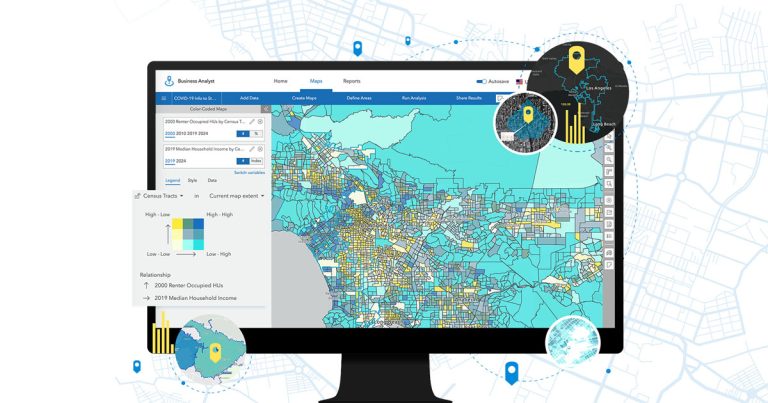
Esri ArcGIS Business Analyst is location intelligence software used by site selection, market planning, retail real estate and GIS teams. Its central job is to turn geographic, demographic and commercial data into evidence for decisions about stores, facilities, territories and customer coverage. For a CRE analyst, the changed workflow is straightforward: candidate locations can be mapped, assigned realistic trade areas and compared against the people, spending patterns, businesses and competitors surrounding them.
The product belongs to Esri, the privately held geographic information systems company headquartered in Redlands, California. Business Analyst is available through web, desktop and mobile applications and can also fit into a broader ArcGIS environment. This matters because it is not merely a dashboard placed over a fixed location database. It is part of a substantial mapping platform with spatial analysis, data management, visualization and publishing capabilities.
Its strongest CRE application is location strategy rather than property underwriting. Analysts can create drive time areas, rings and other trade areas, profile consumers, assess market potential, examine network coverage and produce reports for proposed or existing locations. Those capabilities are particularly relevant to retail, restaurants, health care, hospitality and service businesses. The product is less directly useful for investors whose central questions concern rent rolls, lease comparables, debt, ownership, valuation or transaction probability.
BestCRE analysis: Business Analyst is one of the most capable choices when geographic context is the core of the decision and the buyer either has GIS talent or intends to build it. Its breadth also creates friction. Teams seeking a ready made answer about visits, tenant demand or acquisition pricing may find that a more specialized CRE product reaches the conclusion faster. The buying case is strongest when the organization will reuse Esri data, maps and analytical workflows across many markets and decisions.
What Esri ArcGIS Business Analyst Does and How It Works
Business Analyst begins with a location or an area of interest. A user can place candidate sites on a map, import organizational data and define the geographic areas that each site is expected to serve. Those areas may be simple distance rings, travel time boundaries or more sophisticated trade areas. The software then summarizes the characteristics inside each boundary, allowing an analyst to compare candidates on population, household attributes, consumer behavior, business presence and spending potential rather than relying on municipal boundaries that may not reflect actual customer access.
The data layer is a major part of the product. Esri says Business Analyst combines demographic, census, lifestyle, spending and business information, with global coverage spanning more than 170 countries and over 15,000 variables. Users can combine those sources with proprietary information such as customer locations, sales, facilities and property costs. Workflows include customer segmentation, market potential, territory design, location allocation, market penetration and sales forecasting. The quality of the result still depends on selecting appropriate variables, geographic units, travel assumptions and internal inputs.
Outputs include thematic maps, comparative reports, infographics and presentations that can be shared with decision makers. Teams can use the web application for accessible analysis, desktop software for more advanced GIS work and mobile access for field use. Integration with ArcGIS also permits analysts to publish map content and connect Business Analyst findings to wider spatial workflows. BestCRE analysis: the product produces decision infrastructure, not an automatic site verdict. Its value lies in letting a qualified analyst test assumptions consistently, document the geographic evidence and communicate why one market or location compares favorably with another.
9AI Framework: Dimension by Dimension Analysis
CRE Relevance: 8/10
BestCRE analysis: 8 out of 10. Business Analyst addresses genuine CRE workflows, especially retail site selection, market planning, network optimization and trade area analysis. Drive time boundaries, customer profiling, spending estimates and location comparison can materially improve how occupiers, brokers and consultants evaluate a market. The limitation is that it is CRE adjacent rather than a complete property intelligence system. It does not center its experience on leases, rent rolls, ownership, debt, sale comparables or asset valuation. A retail location team may use it every week, while an acquisitions analyst focused on office investments may use it only occasionally. The score reflects excellent relevance to location driven real estate decisions, offset by limited coverage of the financial, transactional and operational work that defines much of commercial property analysis.
Data Quality and Sources: 9/10
BestCRE analysis: 9 out of 10. Esri provides a broad combination of demographic, census, consumer spending, lifestyle and business data, supported by the geographic framework required to interpret those variables correctly. The ability to add customer, sales, facility and cost information makes the product more useful than a closed data portal. Its geographic reach also supports organizations that operate across multiple countries. Buyers should still evaluate source dates, estimate methods, update schedules and geographic consistency for every market they intend to study. Modeled consumer variables are estimates, not direct observations of every household, and small area analysis can create false precision. The high score recognizes the scope and spatial structure of the data, while preserving the distinction between a credible analytical input and verified property, transaction or customer facts.
Ease of Adoption: 7/10
BestCRE analysis: 7 out of 10. The web application, guided workflows and prepared reports make basic demographic mapping accessible to analysts who are not full time GIS specialists. A user can define an area, select variables and create a presentable market profile without building a mapping system from scratch. Adoption becomes harder when the organization wants advanced trade areas, custom data, territory optimization or desktop GIS analysis. Those tasks require geographic judgment, careful data preparation and familiarity with ArcGIS concepts. Large variable libraries can also encourage unfocused analysis unless the team establishes standard metrics and templates. Business Analyst is approachable relative to traditional GIS, but it is not as immediately prescriptive as a specialized location dashboard. Buyers should budget for workflow design and training, not only software access.
Output Accuracy: 8/10
BestCRE analysis: 8 out of 10. Business Analyst can produce accurate and reproducible maps, calculations and area summaries when the underlying data, boundaries and analytical assumptions are suitable. Esri’s spatial tools give analysts more control over geography than products that summarize only fixed administrative areas. That control is valuable, but it also transfers responsibility to the user. A drive time setting, customer file, forecast assumption or trade area method can materially change the result. Demographic and spending estimates should not be treated as observed sales, visits or lease economics. The product therefore supports rigorous analysis without guaranteeing a correct investment or site decision. The score rewards transparent spatial mechanics and repeatable outputs, while recognizing that analytical accuracy depends heavily on methodology, input quality and professional review.
Integration and Workflow Fit: 9/10
BestCRE analysis: 9 out of 10. Business Analyst fits naturally within the ArcGIS ecosystem and can be used through web, desktop and mobile experiences. Organizations already storing facilities, customers, territories or planning layers in ArcGIS have a strong foundation for incorporating its data and analysis. Maps and findings can be shared across the organization, while proprietary datasets can be combined with Esri content. The main constraint is that integration depth varies by deployment, licensing and the technical resources available to the buyer. Connecting a CRM, data warehouse or property system may require ArcGIS administration, data engineering or custom configuration rather than a simple toggle. Even with that caveat, few competing market analysis products offer an equivalent geographic platform around the application. This score reflects platform fit and extensibility, not a claim that every CRE system has a packaged connector.
Pricing Transparency: 5/10
BestCRE analysis: 5 out of 10. Esri provides a route to pricing and purchase options, but the vendor does not publish one simple universal cost that captures every Business Analyst deployment. The relevant total can depend on the application, user structure, ArcGIS environment, data access, credits, services and organizational agreement. That makes it difficult for a buyer to determine a complete operating cost from the product description alone. A sales conversation may be reasonable for a configurable enterprise GIS product, but it reduces comparability for smaller CRE teams evaluating several tools. Buyers should request an itemized proposal that separates recurring licenses, data entitlements, consumption charges, implementation, training and optional services. Under the BestCRE methodology, limited upfront visibility caps this dimension at 5 even when the eventual proposal may be commercially competitive.
Support and Reliability: 8/10
BestCRE analysis: 8 out of 10. Esri offers the institutional support expected from a mature software provider, including product documentation, training resources, community knowledge and direct sales contact. The wider ArcGIS user and partner ecosystem can also help organizations find GIS expertise. That is materially different from relying on a small vendor with limited implementation capacity. Support quality can nevertheless vary by contract, geography, deployment and the complexity of the workflow. A standard product question is easier to resolve than a problem involving proprietary data, custom models or several connected ArcGIS services. Buyers should confirm response expectations, onboarding scope and named administrative responsibilities before purchase. The score reflects the depth of the Esri ecosystem and available learning resources, while avoiding the assumption that every subscription includes intensive consulting or dedicated analyst support.
Innovation and Roadmap: 7/10
BestCRE analysis: 7 out of 10. Business Analyst applies sophisticated spatial analysis to practical decisions about customers, territories and facilities, but its core proposition is established rather than newly created. Trade areas, demographic profiling, location allocation and thematic mapping have long been central GIS methods. Esri’s advantage is the breadth and maturity with which these capabilities are assembled, distributed and connected to a larger geographic platform. That is meaningful product development, even if it does not make every workflow novel. Compared with newer competitors, Business Analyst may feel less centered on automated recommendations or a narrowly designed CRE interface. BestCRE analysis favors useful advancement over novelty for its own sake. The score recognizes a deep analytical toolkit and ongoing platform evolution, tempered by the fact that much of the value comes from well developed GIS methods rather than a fundamentally new decision model.
Market Reputation: 9/10
BestCRE analysis: 9 out of 10. Esri is an established name in geographic information systems, and Business Analyst benefits from that institutional credibility, technical ecosystem and familiarity among GIS professionals. Public examples identify use by organizations including Mid America Real Estate Group, Chick fil A, Horwath HTL Canada, Moffitt Cancer Center, the Food and Drug Administration and Trust for Public Land. These references demonstrate applicability across commercial, consulting, health and public sector settings, although they should not substitute for references matching a buyer’s exact workflow. Esri is privately held and does not publish a verified Business Analyst customer count. The score reflects strong recognition and documented enterprise use. It stops short of a perfect rating because reputation at the ArcGIS platform level does not prove equal satisfaction with every license, dataset, implementation partner or market specific use case.
Who Should Use Esri ArcGIS Business Analyst
Business Analyst is best suited to retail real estate, restaurant, health care, hospitality and service network teams that repeatedly compare sites or markets. It is especially compelling when analysts need defensible trade areas, demographic profiles, consumer spending indicators and territory planning in one geographic workflow. Brokers and location consultants can also use its maps and infographics to explain recommendations to clients, provided they disclose the assumptions behind the analysis. Existing ArcGIS users receive the clearest adoption advantage because governance, skills and spatial data may already be in place.
Enterprise strategy and research teams should consider it when they need to combine internal sales, customer or facility data with external market information. It also suits organizations that want analysts to move beyond static radius reports into travel time, location allocation and network coverage analysis. BestCRE analysis: the ideal buyer has recurring location decisions, an accountable analytical owner and enough volume to justify standard templates and training. A buyer should define the decisions Business Analyst will support before purchase, then test the product with real candidate sites and known store outcomes.
Who Should Not Use Esri ArcGIS Business Analyst
Business Analyst is a weaker fit for CRE investors seeking a primary source for lease comparables, sale transactions, ownership, loan exposure, rent rolls or property valuation. Those requirements call for property and capital markets platforms rather than demographic GIS. It is also excessive for a small team that needs only an occasional population report and has no plan to maintain geographic data or analytical standards.
Teams wanting direct foot traffic observations, automated tenant recommendations or a finished acquisition conclusion may prefer a more specialized product. Business Analyst requires the user to frame the question and interpret the evidence. BestCRE analysis: buyers without GIS capacity should not assume the web interface eliminates methodological work. If no one owns data quality, trade area design and model validation, the organization may produce attractive maps without improving decisions. A limited pilot is preferable when expected usage is uncertain.
Pricing and ROI Analysis
Esri does not publish one universal all inclusive price for ArcGIS Business Analyst. Its site directs buyers toward pricing and purchase options, while the complete cost can vary with deployment, user access, ArcGIS licensing, data, service credits, implementation and support requirements. Prospective customers should obtain a written configuration and identify which capabilities require Business Analyst Web App, desktop access or other ArcGIS components. The proposal should also state renewal terms, usage limits, geographic data coverage, training costs and the price of adding users.
BestCRE analysis: ROI should be calculated from avoided location errors and analyst time, using the buyer’s own verified inputs. For example, a team can multiply annual site studies by the hours currently spent gathering, mapping and formatting market data, then multiply the saved hours by its loaded labor cost. It can add the expected value of better site screening, but only if that estimate is supported by historical approval and performance data. The resulting annual benefit should exceed the complete annual software and administration cost by the buyer’s required return threshold. Esri does not publish a universal customer ROI figure, and BestCRE would not treat a vendor case study as a substitute for this calculation.
Integration and CRE Tech Stack Fit
Business Analyst has its strongest technology fit inside an ArcGIS environment. A CRE organization can combine market data with its own sites, customers, sales, territories, parcels or planning layers, then distribute maps and reports through Esri applications. Web, desktop and mobile availability supports analysts, decision makers and field teams with different levels of geographic expertise. Organizations using enterprise GIS can also apply existing identity, data governance and publishing practices.
Outside that ecosystem, buyers should map every required connection before signing. CRM records, property databases, financial models and warehouse tables may need preparation, geocoding and scheduled data movement. Esri does not claim a packaged connector for every CRE platform. BestCRE analysis: Business Analyst should serve as the spatial analysis layer, while systems of record retain leases, properties, customers and financial assumptions. This division keeps demographic intelligence useful without forcing GIS software to perform jobs for which it was not designed.
Competitive Landscape
Placer.ai is the most obvious alternative when a buyer prioritizes observed visitation patterns, venue performance and movement based location intelligence. Business Analyst is stronger when the assignment requires broad demographic variables, custom geographic analysis and integration with enterprise GIS. Buxton also targets customer analytics and site selection, often with a more consultative and brand oriented approach. The choice depends on whether the buyer wants a configurable spatial platform or a more packaged location strategy service.
Targomo is relevant for travel time, accessibility and location planning, particularly where mobility based catchments are central. LocateAI is positioned around retail real estate decision support and may appeal to teams seeking a narrower interface for site strategy. CoStar remains a different kind of alternative, centered more heavily on commercial property and market information than consumer trade area analysis. Green Street is more appropriate for investors focused on property markets, valuation and public real estate securities.
BestCRE analysis: Esri wins when geographic flexibility, internal data combination and ArcGIS compatibility matter most. Placer.ai may reach a traffic based answer faster, while CoStar or Green Street better addresses property and investment questions. Buyers should run the same locations through finalists and compare data lineage, boundary logic, workflow time and the clarity of the resulting recommendation. Feature volume alone is not a useful selection test.
The Bottom Line
Choose ArcGIS Business Analyst when location is the organizing principle of the decision and the team needs repeatable trade area, demographic and territory analysis. It is particularly defensible for multi market occupiers, consultants and enterprises already committed to ArcGIS. Require a pilot using internal customer or site data, and have business users review the conclusions rather than judging only the maps.
Do not buy it as a substitute for property comparables, lease intelligence or investment underwriting. BestCRE analysis: Business Analyst deserves a shortlist for serious site selection programs, but its value depends on analytical ownership and disciplined implementation. Obtain a complete price, confirm the required licenses and test whether routine users can reproduce an approved workflow. If the organization cannot support that operating model, a narrower location platform may deliver a faster return.
About BestCRE
BestCRE.com is the definitive authority on commercial real estate AI, analysis, and investment intelligence. Every article advances the platform’s mission to help CRE professionals identify, evaluate, and adopt the best tools and strategies in the industry. We benchmark platforms using the 9AI Framework so CRE leaders can compare tools with clear evidence. Explore the category map at 20 CRE sectors for deeper coverage across the CRE stack.
Frequently Asked Questions
What is Esri ArcGIS Business Analyst?
Esri ArcGIS Business Analyst is location based market intelligence software for demographic mapping, site selection, market planning, customer analysis and territory design. It combines Esri maps and spatial analysis with demographic, census, lifestyle, consumer spending and business information. Users can define a trade area around a proposed or existing location, examine the characteristics within it and compare that location with alternatives. They can also add internal information such as customers, sales, facilities and property costs. The product is available through web, desktop and mobile applications and connects with the broader ArcGIS ecosystem. For CRE teams, it is most relevant to occupier and advisory decisions about where to locate, expand, consolidate or adjust coverage. It is not a complete property, lease or transaction database.
How does ArcGIS Business Analyst compare with Placer.ai?
ArcGIS Business Analyst and Placer.ai answer related but different location questions. Business Analyst emphasizes GIS, demographics, consumer characteristics, spending indicators, trade areas, territory planning and the combination of internal data with geographic layers. Placer.ai is generally considered when observed visitation patterns, venue traffic and movement based insights are the main requirement. BestCRE analysis: Business Analyst is the stronger choice for configurable spatial analysis and organizations already using ArcGIS. Placer.ai may be easier for teams seeking a focused view of location visitation without developing a broader GIS workflow. Neither product should be selected from a feature checklist alone. A useful trial should compare identical sites, inspect the lineage and timing of each input, and test whether the output improves a real approval decision.
How much does ArcGIS Business Analyst cost?
Esri does not publish one universal all inclusive price for every ArcGIS Business Analyst configuration. Buyers are directed to pricing and purchase options, but the complete amount may depend on deployment, number and type of users, ArcGIS products, geographic data, service credits, implementation and support. Request a written proposal that identifies every required license and separates recurring software costs from onboarding, training and optional consulting. Confirm whether adding users, running analyses or accessing additional geographic markets creates further charges. BestCRE analysis: compare the complete annual cost with labor saved across recurring studies and with any measurable improvement in site screening. Do not base the business case on an unverified claim that one avoided bad location will automatically pay for the software.
Who should use ArcGIS Business Analyst for commercial real estate?
ArcGIS Business Analyst suits retail real estate directors, location strategists, market researchers, brokers, consultants and GIS analysts who repeatedly evaluate sites, trade areas or network coverage. It is particularly relevant to restaurants, retailers, health care providers, hospitality groups and service businesses whose performance depends on customer access and local demand. Organizations already using ArcGIS are well positioned because they may have compatible skills, data governance and mapping infrastructure. BestCRE analysis: the product is most valuable when a named analyst owns the methodology and internal sales or customer data can be incorporated. It is less suitable as the primary tool for acquisition teams focused on rents, leases, ownership, debt, sale comparables or valuation. Those buyers need a property intelligence or underwriting platform.
Will ArcGIS Business Analyst remain useful as site selection becomes more automated?
Yes, provided Esri continues pairing automation with transparent geographic methods and current data. Site selection can automate data assembly, screening and presentation, but buyers still need to understand why a trade area was drawn, which variables influenced a result and how internal performance data was treated. Business Analyst has an advantage because it sits within a larger GIS platform and supports custom data, maps and analytical workflows. BestCRE analysis: its future value will depend less on producing another demographic report and more on helping teams test scenarios, validate models and distribute governed location intelligence. Buyers in October 2026 should assess product direction, data update practices and automation controls during procurement. Esri does not publish a guaranteed roadmap covering every future Business Analyst capability.
Related Reviews
Compare Esri ArcGIS Business Analyst with other tools BestCRE has scored in the same category: CompStak, Google Gemini, Cherre. Explore more CRE AI tool reviews in our Best CRE AI Tools directory. For sector-specific analysis and market intelligence, visit our 20 CRE Sectors hub.