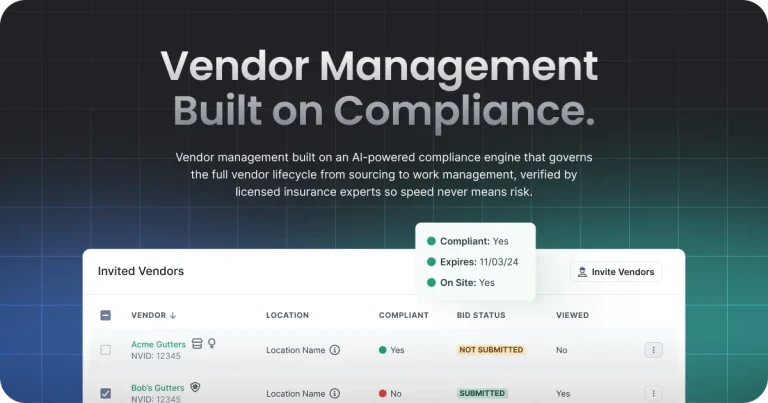
NetVendor is a vendor compliance and management platform built primarily for property managers and multifamily operators. It changes a fragmented workflow in which site teams, risk staff, procurement leaders, and accounts payable personnel separately track insurance, credentials, contracts, bids, and maintenance activity. The platform brings those functions into one governed vendor lifecycle, with compliance rules applied according to ownership requirements. Its broader coverage includes commercial, student, senior, affordable, military, and storage portfolios, although multifamily remains the clearest center of gravity.
The central buying case is control. Property operators often maintain different insurance and approval requirements for different owners, while individual properties hire vendors under time pressure. NetVendor is designed to verify vendors, monitor continuing compliance, govern contracts, document competitive bids, and coordinate work without leaving each property to devise its own process. The company says its ecosystem includes more than 275,000 vendors and its customers manage more than five million units. Those figures are company claims, not independently audited measures disclosed to BestCRE.
NetVendor now presents artificial intelligence as an acceleration layer rather than an autonomous compliance authority. Its stated applications include vendor matching, credentialing automation, search, bid leveling, and bid management. Human review remains part of the compliance process. Analysis: that combination is sensible for insurance documents and vendor qualifications, where automation can reduce repetitive work but exceptions, ambiguous endorsements, and ownership rules still require accountable review.
The product is more operational than many tools in the CRE Legal, Compliance & Due Diligence category. It does not primarily analyze leases, construction documents, zoning rules, or transaction data. Instead, it manages recurring third party risk after properties are operating. Buyers should therefore judge it against the cost of compliance administration, uninsured vendor exposure, missed contract dates, weak bid documentation, and disconnected maintenance execution. NetVendor appears strongest when a portfolio has enough properties, owners, and vendors to make decentralized tracking materially inefficient.
What NetVendor Does and How It Works
The workflow begins with the vendor network. A property manager can invite an existing vendor or search NetVendor’s vendor ecosystem for a provider. The selected vendor enters a credentialing process based on the operator’s requirements, which may vary by owner or property. NetVendor monitors items such as insurance and other required credentials, supports outreach to vendors, and gives management teams a centralized compliance view. The company describes the review process as AI accelerated and expert verified, an important distinction because the final value depends on resolving document exceptions rather than merely extracting fields.
Once vendors are eligible, the platform extends into sourcing and project bidding. Operators can identify candidates from the credentialed network, distribute bid opportunities, compare responses, and maintain an auditable record of approvals and award decisions. AI assisted matching is intended to suggest suitable vendors, while automated bid leveling can organize submissions for comparison. Analysis: this connection between compliance status and procurement is more useful than a stand-alone vendor directory because an attractive bid should not advance if the vendor fails the applicable ownership requirements. Buyers should still test how the system treats incomplete scopes, exclusions, alternates, and nonstandard proposals.
Contract management adds internal routing, renewal tracking, and rebid discipline. Work management then connects approved vendors to property maintenance and unit turn execution, giving portfolio leaders visibility beyond initial onboarding. The product therefore covers a longer operating cycle than a credential repository: source, verify, bid, contract, assign, and monitor. That breadth also creates implementation work. Owner rules, approval paths, vendor records, and property structures must be configured correctly before automation becomes dependable. NetVendor publishes connections with multiple property management systems and specifically identifies Entrata as an integration partner, but buyers should confirm the exact data objects and workflow depth available for their chosen system.
9AI Framework: Dimension by Dimension Analysis
CRE Relevance: 8/10
NetVendor earns an 8 for CRE relevance because its workflows map directly to property operations: vendor credentialing, owner specific compliance, competitive bidding, contract governance, and maintenance execution. The system addresses recurring risk across portfolios rather than offering a generic supplier database. Its positioning covers several property types, and its property management system connections strengthen the fit for operating portfolios. The deduction reflects its CRE-adjacent character. NetVendor is not a core underwriting, leasing, valuation, asset management, or transaction due diligence platform, and its strongest use case remains vendor administration for multifamily property managers. A commercial owner with limited outsourced work may find the product less central than a large third party manager would. Analysis: relevance is high for operational risk teams, but uneven across the full CRE investment lifecycle.
Data Quality and Sources: 8/10
NetVendor earns an 8 for data quality. Vendor credentials are gathered within a structured compliance process, and the combination of automated handling, human review, and continuing monitoring should produce better records than email folders or property level spreadsheets. Configurable requirements also help preserve the context behind a compliance decision, particularly when different owners impose different standards. The vendor ecosystem can improve discovery, but network size alone does not establish that every profile is current, complete, or suitable for a particular assignment. Buyers should test update frequency, duplicate handling, insurance certificate validation, endorsement review, and the treatment of disputed information. Analysis: the platform’s operating model supports strong data quality, yet accuracy still depends on source documents, vendor responsiveness, configuration discipline, and the scope of expert verification. NetVendor does not publish an independent accuracy audit.
Ease of Adoption: 7/10
NetVendor earns a 7 for ease of adoption. For operators already managing vendor compliance, the product replaces familiar tasks rather than introducing an entirely new business process. Vendor invitations, credential collection, approval workflows, bid distribution, and renewal monitoring should be understandable to risk, procurement, and property teams. Bilingual vendor support may reduce friction for participating businesses. Adoption becomes harder when portfolios contain inconsistent owner requirements, duplicate vendor records, decentralized buying authority, or several property management systems. Vendors must also submit and maintain information, so success depends partly on parties outside the buyer’s organization. Analysis: the interface may be straightforward, but enterprise rollout is a policy and data project as much as a software deployment. NetVendor does not publish a standard implementation duration, so buyers should request a property migration plan and adoption milestones.
Output Accuracy: 7/10
NetVendor earns a 7 for output accuracy. Its most consequential outputs include compliance status, credential exceptions, vendor matches, bid comparisons, renewal alerts, and workflow approvals. Human verification provides a useful control where insurance documents or ownership requirements are ambiguous. Even so, compliance is not a binary data extraction problem. Policies can contain exclusions, endorsements can alter coverage, and contractual requirements may differ by jurisdiction or scope of work. AI assisted matching and bid leveling also depend on complete profiles and comparable proposals. Analysis: NetVendor appears designed to reduce clerical errors and expose missing information, but buyers should not treat every system status as legal advice or an unconditional authorization to hire. The company does not publish audited error rates, model performance measures, or service level results for these outputs. Material exceptions still warrant review by qualified risk or legal personnel.
Integration and Workflow Fit: 8/10
NetVendor earns an 8 for integration because property management system connectivity is a visible part of its operating model. Entrata is a named partner, and NetVendor states that it supports more than seven property management system integrations. That matters because vendor eligibility has greater practical value when it reaches the systems where properties assign work, process records, or manage operations. The platform’s coverage from compliance through work management may also reduce handoffs between separate point solutions. The deduction reflects limited public technical detail. Buyers need to confirm whether their connection is native, API based, file based, or dependent on custom services, as well as which records move in each direction. Analysis: integration appears stronger than that of a stand-alone credentialing portal, but procurement teams should validate field mappings, synchronization timing, error handling, identity matching, and administrative ownership before signing.
Pricing Transparency: 3/10
NetVendor earns a 3 for pricing transparency because the vendor does not publish standard subscription prices, implementation fees, vendor charges, contract minimums, or packaging details. Prospective customers are directed to schedule a demonstration, which prevents an operator from estimating total cost before entering a sales process. The breadth of modules also makes the missing information consequential. A buyer may need compliance, sourcing, bidding, contracts, maintenance, or some combination, and the commercial structure could materially affect value. Buyers should request a written schedule covering platform fees, portfolio or unit based charges, onboarding, integrations, data migration, support, renewals, and any fees imposed on participating vendors. Analysis: negotiated enterprise pricing is common in property technology, but that does not remove the need for comparability. The score reflects disclosure, not an assertion that NetVendor is expensive.
Support and Reliability: 8/10
NetVendor earns an 8 for support. The company promotes live assistance and bilingual support for vendors, including direct insurance outreach. That service component matters because vendor compliance programs frequently stall when small contractors struggle with portals, terminology, or insurance documentation. Human review also suggests that customers are not relying solely on automated extraction for consequential decisions. The remaining uncertainty concerns the contractual service model. NetVendor does not publicly disclose standard response times, escalation paths, customer success staffing, after hours coverage, or service level commitments. Buyers should distinguish support for vendors from support for property management administrators, then test both during diligence. Analysis: the visible operating model indicates above average assistance for a workflow involving many external users, but a strong sales demonstration is not a substitute for written response targets, escalation rules, and named accountability after implementation.
Innovation and Roadmap: 8/10
NetVendor earns an 8 for innovation because it applies artificial intelligence across several connected stages rather than limiting it to a chatbot or document summary. Vendor matching, credentialing automation, search, and bid leveling can reduce repetitive review while the platform preserves expert verification and approval controls. More importantly, these functions sit within an end to end operating process, allowing compliance requirements to affect sourcing, contracting, bidding, and work execution. That is a more meaningful design choice than adding isolated generative features. The deduction reflects limited public evidence about the underlying models, measurable gains, explainability, or customer controls over AI generated recommendations. Analysis: the architecture is directionally strong because it keeps people accountable for exceptions and awards. Buyers should require demonstrations using their own vendor documents and bid formats, then examine how suggestions are sourced, reviewed, corrected, and logged.
Market Reputation: 8/10
NetVendor earns an 8 for market reputation. Its visible focus on property operations, established vendor ecosystem, customer case studies, and property management system relationships indicate meaningful market presence. The company cites recognizable operators, including Princeton Management and NSA Storage, now part of Public Storage. Its reported portfolio and vendor scale also suggest that the product has moved beyond an early pilot stage. These are positive signals, but they should not be mistaken for independent proof of retention, service quality, or financial stability. NetVendor does not publish audited customer counts, renewal rates, net retention, profitability, or detailed customer satisfaction measures. Analysis: the company appears credible and established within multifamily vendor compliance, while its reputation across institutional commercial property types is less clearly documented. Reference calls should match the buyer’s portfolio size, ownership complexity, property management system, and vendor volume.
Who Should Use NetVendor
NetVendor is best suited to third party property managers, multifamily operators, and diversified residential platforms that coordinate large numbers of outside contractors across multiple owners. These organizations face a structural problem: each owner may impose different insurance, credential, approval, contracting, and bidding rules, while work is initiated locally. Central risk, procurement, and operations teams should consider NetVendor when spreadsheets and shared inboxes no longer provide reliable portfolio visibility. The case becomes stronger when the organization also wants vendor sourcing, competitive bids, contract renewals, and maintenance activity connected to the same compliance record.
The product also fits operators using Entrata that want vendor controls closer to their property management workflow, subject to confirmation of the exact integration scope. Storage, student housing, senior living, affordable housing, military housing, and commercial managers may benefit when they have recurring outsourced work and enough scale to justify formal governance. Analysis: the ideal buyer has centralized standards, decentralized execution, a material vendor population, and executive sponsorship across risk and operations. A disciplined implementation team should own rule configuration, vendor cleanup, exception policy, and property adoption rather than treating the purchase as a simple portal replacement.
Who Should Not Use NetVendor
NetVendor is less compelling for a small owner with a handful of properties, few recurring vendors, and simple insurance requirements. Such an organization may not generate enough compliance volume or procurement complexity to justify an enterprise platform and implementation effort. It is also a poor match for buyers seeking transaction underwriting, lease abstraction, zoning research, title review, construction drawing analysis, or general document due diligence. Those workflows require different data, expertise, and outputs.
Operators that want a stand-alone maintenance application without formal vendor governance should compare narrower work order products. Likewise, companies unwilling to standardize ownership rules or require vendor participation may struggle to obtain value. Analysis: software cannot correct an undefined exception policy or fragmented authority on its own. Buyers that require public self-service pricing, independently published AI accuracy measures, or detailed public API documentation will find the available disclosure insufficient. A legal or risk team should also avoid treating NetVendor’s status indicators as a substitute for professional review of unusual coverage, contract, or regulatory questions.
Pricing and ROI Analysis
NetVendor does not publish subscription prices, implementation charges, module pricing, contract minimums, or a standard fee schedule. The company uses a demonstration led sales process. Buyers should request separate pricing for compliance, sourcing, bidding, contract management, and work management, plus clear terms for integrations, migration, training, support, renewals, and vendor paid fees. The quote should identify its charging unit, such as properties, units, users, vendors, or transactions, and state how portfolio growth changes the bill. Without those details, public comparison of total ownership cost is not possible.
Analysis: a simple ROI model should use the buyer’s own labor and loss data. If a team spends 160 staff hours each month collecting certificates, chasing vendors, updating records, and preparing audit evidence, and NetVendor reduces that work by 40 percent, the monthly saving is 64 hours. Multiply those hours by the fully loaded hourly cost, then add avoided spending from better bidding and the expected value of fewer compliance failures. Subtract annual software, onboarding, integration, and internal administration costs. Buyers should not assign savings to avoided claims without credible historical evidence. The purchase is financially persuasive only when documented labor, procurement, and risk benefits exceed the complete contracted cost.
Integration and CRE Tech Stack Fit
NetVendor’s clearest stack fit is beside a property management system, where it can serve as the governance layer for vendor eligibility, sourcing, contracts, bids, and work. Entrata is a named integration partner, and the company reports connections with additional property management systems. This orientation should appeal to operators that want compliance decisions tied to property and ownership structures rather than stored in a disconnected document repository. The platform may also consolidate functions otherwise divided among credentialing portals, sourcing databases, contract trackers, and maintenance tools.
Buyers should verify each connection at the record and event level. Important questions include whether vendor identities synchronize in both directions, where ownership requirements reside, how blocked vendors are handled, whether compliance changes affect work assignment, and how errors reach administrators. Accounting and procurement teams should also confirm support for purchase orders, invoices, payment controls, and audit exports if those functions are required. Analysis: the integration proposition is credible, especially for Entrata users, but the public information does not establish identical depth across every supported system. Contractual documentation and a test environment should settle that issue.
Competitive Landscape
Jones is the closest BestCRE scored alternative for buyers prioritizing insurance compliance and vendor risk in commercial real estate. It may be preferable when certificate management and insurance workflows are the central requirement. NetVendor differentiates itself through a broader operating path that includes sourcing, bidding, contracts, and maintenance, with a pronounced multifamily orientation. Buyers should compare exception handling, vendor support, ownership rule configuration, property management system depth, and the party responsible for final compliance decisions.
DocumentCrunch and fileAI address adjacent document intensive problems but are not direct substitutes for a full vendor lifecycle platform. DocumentCrunch is stronger when the core need is reviewing and understanding construction contracts. fileAI is relevant when teams need generalized document extraction and structured data workflows. Imprima and Deal Intel focus more heavily on transaction due diligence and deal information, while Rexera serves real estate transaction operations. UpCodes concentrates on building code research. InvestNext targets investment management rather than vendor compliance.
Analysis: NetVendor should make the shortlist when the buying problem spans vendor qualification through work execution. A point solution may be better when the scope is limited to insurance review, contract analysis, or document extraction. The decisive comparison is not the length of each feature menu. It is whether the selected platform can enforce the buyer’s actual ownership rules, exchange reliable data with its property system, support vendors effectively, and create defensible records when an auditor, owner, or risk officer questions a decision.
The Bottom Line
NetVendor is a strong candidate for scaled property operators that need vendor compliance to govern sourcing, bidding, contracts, and maintenance rather than remain an isolated insurance task. Its property specific workflows, human verified compliance model, vendor network, and property management system orientation justify a serious evaluation. Entrata users and multifamily managers with multiple ownership structures have the clearest reason to engage.
The decision should remain conditional on a configured proof using the buyer’s documents, rules, vendors, and bid formats. Require written pricing, integration specifications, implementation responsibilities, support commitments, and clarity about how AI recommendations are reviewed. Analysis: buy when administrative savings and stronger procurement control can be measured across a sizable portfolio. Choose a narrower competitor when insurance tracking alone is the problem, and choose a different category when the requirement is transaction, lease, zoning, or construction due diligence.
About BestCRE
BestCRE.com is the definitive authority on commercial real estate AI, analysis, and investment intelligence. Every article advances the platform’s mission to help CRE professionals identify, evaluate, and adopt the best tools and strategies in the industry. We benchmark platforms using the 9AI Framework so CRE leaders can compare tools with clear evidence. Explore the category map at 20 CRE sectors for deeper coverage across the CRE stack.
Frequently Asked Questions
What is NetVendor?
NetVendor is a vendor compliance and management platform for property operators, particularly multifamily and third party property management organizations. It combines vendor credentialing, compliance monitoring, sourcing, project bidding, contract management, and property maintenance workflows. Operators can configure requirements around ownership structures, invite existing vendors, search a broader vendor ecosystem, monitor credentials, route approvals, and keep records of bid and contract decisions. The product is intended to replace fragmented spreadsheets, inboxes, and disconnected vendor portals with one governed process. It is CRE-adjacent rather than a general transaction due diligence product. NetVendor does not perform the core functions of underwriting, valuation, lease abstraction, title review, or zoning analysis.
How does NetVendor compare with Jones?
Both NetVendor and Jones address vendor compliance and insurance related risk for real estate organizations. Jones is a close alternative when certificate management and insurance compliance are the primary buying requirements. NetVendor presents a broader workflow spanning credentialing, vendor discovery, project bidding, contracts, and maintenance execution. Its positioning is especially aligned with multifamily property managers and portfolios that apply different rules by owner or property. Analysis: NetVendor is likely the better shortlist candidate when procurement and operating workflows must remain connected to compliance status. Jones may deserve preference when the buyer wants a more focused insurance compliance solution. A valid comparison requires both vendors to process the same sample certificates, exceptions, ownership rules, vendor records, and property system scenarios.
How much does NetVendor cost?
NetVendor does not publish standard prices, implementation fees, package limits, or contract minimums. Buyers must request a demonstration and commercial proposal. The proposal should separate platform subscriptions from onboarding, data migration, integrations, training, support, and any charges paid by vendors. It should also identify whether pricing depends on units, properties, users, vendors, transactions, or selected modules. Analysis: calculate value using documented staff time spent collecting credentials, pursuing corrections, updating records, administering bids, and preparing audits. Add defensible procurement savings, then subtract every recurring and one time cost. Do not count hypothetical avoided claims as guaranteed savings. Because public pricing is unavailable, buyers should obtain comparable multiyear quotes and negotiate renewal limits before making a selection.
Who should use NetVendor?
NetVendor is best suited to property managers and multifamily operators with many vendors, multiple properties, and ownership specific compliance requirements. It is particularly relevant when central risk or procurement teams set standards but local teams initiate work. Operators in student housing, senior living, affordable housing, military housing, storage, and commercial portfolios may also fit if vendor activity is frequent and formal governance is needed. Entrata users have an additional reason to evaluate it because Entrata is a named integration partner. Analysis: the strongest buyer has sufficient scale to offset implementation and subscription costs, an executive owner for the program, and a willingness to standardize rules. Small owners with few vendors and simple requirements may find spreadsheets or a narrower service more economical.
Will NetVendor AI replace human compliance review?
NetVendor describes its artificial intelligence as accelerating vendor matching, credentialing, search, bid leveling, and bid management, while experts verify compliance. That design indicates augmentation rather than fully autonomous approval. Human oversight remains important because insurance endorsements, exclusions, contract language, scope classifications, and ownership requirements can create exceptions that extracted fields do not resolve. Analysis: buyers should expect AI to reduce repetitive sorting and comparison work, not to remove accountability from risk, legal, procurement, or property personnel. During evaluation, ask NetVendor to demonstrate difficult documents, incomplete bids, conflicting vendor records, and rule changes. The vendor does not publish independent model accuracy measures, so customers should establish review thresholds, escalation procedures, audit logs, and periodic quality testing before expanding automated decisions.
Related Reviews
Compare NetVendor with other tools BestCRE has scored in the same category: InvestNext, DocumentCrunch, Jones. Explore more CRE AI tool reviews in our Best CRE AI Tools directory. For sector-specific analysis and market intelligence, visit our 20 CRE Sectors hub.