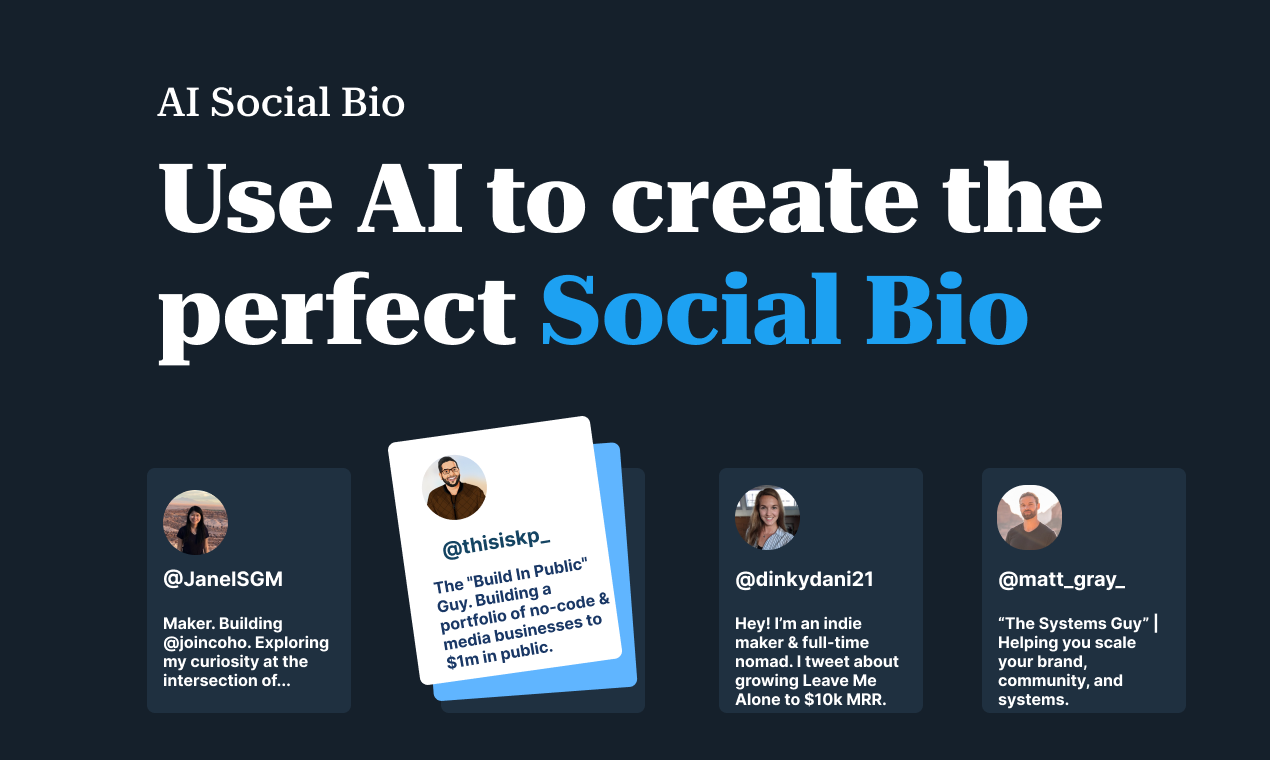
AI Social Bio is a single-purpose text generation application designed to create customized social media biographies for platforms like Twitter, LinkedIn, and Instagram. Developed by independent filmmakers Michael Novotny and Marc Fletcher, the application operates as a straightforward interface built on top of standard large language models. The tool requires users to input up to three descriptive keywords and select a recognized public figure or influencer—such as Elon Musk or Serena Williams—to serve as the stylistic inspiration for the output. According to our BestCRE Master Database research, the primary use case is to generate on-brand social bios. For commercial real estate professionals, this represents a highly narrow utility compared to the comprehensive enterprise marketing platforms typically deployed by top-tier brokerages and asset managers.
As of August 2026, the commercial real estate technology landscape is saturated with broad generative artificial intelligence suites like Jasper AI (which scored 89) and Copy.ai (which scored 87). By comparison, AI Social Bio occupies a much smaller footprint within our CRE-Adjacent, Tier 2 category. It does not connect to proprietary property databases, nor does it offer native integrations with industry-standard customer relationship management systems. Instead, it functions strictly as a standalone web utility for individuals needing immediate copy for their digital profiles. Our analysis indicates that while the application performs its stated function adequately for casual users, it lacks the depth, security infrastructure, and operational scalability required by institutional brokerages or asset management firms evaluating enterprise-grade software deployments.
What AI Social Bio does and how it works
AI Social Bio functions as a prompt-engineering interface tailored exclusively for short-form biographical text. Users begin the process by entering a maximum of three keywords that define their professional identity, target audience, or current market focus—for example, “commercial real estate,” “investment sales,” or “retail leasing.” Next, the user selects a specific tone by choosing an existing public figure or influencer from a predefined drop-down list. The underlying artificial intelligence analyzes the writing style, typical phrasing, and structural cadence associated with that selected influencer, and then applies those exact characteristics to the user’s provided keywords.
The output generation is instantaneous, providing a selection of short text blocks optimized specifically for the strict character limits of major social networks. The application categorizes these various outputs under different stylistic headings, such as credibility, entrepreneur, or growth. Users can review the generated options, copy their preferred text to their system clipboard, and manually paste it into their respective social media profiles. There is no automated publishing mechanism, nor is there a direct application programming interface connection to platforms like LinkedIn, Twitter, or Instagram.
Our analysis shows that this mechanical simplicity is both the primary feature and the main limitation of the application. It successfully bypasses the need for users to write complex, multi-layered prompts in general-purpose chat interfaces, thereby standardizing the bio-creation process for novices. However, the system does not retain user context across different sessions, nor does it allow for the upload of existing corporate brand guidelines or strict compliance parameters. The tool focuses entirely on individual, consumer-grade profile optimization rather than facilitating enterprise-wide brand management for large commercial real estate teams.
9AI Framework: the score, dimension by dimension
CRE Relevance: 2/10
As a general-purpose consumer utility, AI Social Bio contains no commercial real estate data, terminology, or industry-specific templates. The application does not understand the nuances between a tenant representation broker, a capital markets analyst, or a property manager beyond what standard language models infer from basic keywords. Because it is a general-purpose tool with no CRE data, our framework caps its score in this dimension. Brokers attempting to create highly technical or compliance-approved biographies will find the outputs require significant manual editing to meet industry standards. The tool is designed for mass-market social media users rather than specialized financial or real estate professionals. In practice: Commercial real estate analysts will need to rewrite the generated text to ensure industry accuracy and regulatory compliance.
Data Quality and Sources: 5/10
The application relies entirely on third-party foundational language models to generate its text, meaning the data quality is identical to what a user would experience using standard consumer artificial intelligence chatbots. There is no proprietary dataset, nor is there a mechanism to fact-check the generated claims against verified professional histories. The stylistic data—derived from the selected influencers—is generally accurate in mimicking tone, but it lacks the depth required for complex professional branding. Furthermore, the platform does not ingest or analyze a user’s actual transaction history, deal volume, or professional credentials, which limits the factual density of the resulting biographies. In practice: The text quality is grammatically correct but lacks the specialized vocabulary and factual precision expected in institutional real estate marketing.
Ease of Adoption: 9/10
The user interface is exceptionally straightforward, requiring almost zero technical proficiency to operate. Users are not required to navigate complex dashboards, configure API keys, or complete lengthy onboarding tutorials. The process of entering three keywords and selecting an influencer takes less than a minute, and the results are delivered immediately. This frictionless experience is the application’s strongest attribute, lowering the barrier to entry for professionals who may be intimidated by more complex generative artificial intelligence platforms. There is no software to download, and the web-based interface is responsive across desktop and mobile devices. In practice: Any real estate professional can generate a new profile biography within seconds without needing assistance from an IT department.
Output Accuracy: 6/10
When evaluated strictly on its ability to produce social media biographies based on user inputs, the application performs its intended function reliably. The character counts generally align with the constraints of major platforms like Twitter and Instagram. However, our analysis reveals that the stylistic mimicry can sometimes produce results that feel unnatural or overly dramatic for a conservative commercial real estate audience. Because the tool relies on brief keyword inputs rather than comprehensive resumes, the outputs are broad and occasionally hallucinate minor connective details to make the sentences flow. In practice: Users must carefully proofread the outputs to remove overly casual phrasing or exaggerated claims before publishing to professional networks like LinkedIn.
Integration and Workflow Fit: 2/10
AI Social Bio operates entirely in a silo. It offers no native integrations with commercial real estate customer relationship management systems, marketing automation platforms, or enterprise identity management tools. Users cannot connect the application to Salesforce, Hubspot, or specialized industry software like Buildout. The workflow relies entirely on manual copy-and-paste actions. For an independent broker, this lack of connectivity is a minor inconvenience; for a marketing director managing profiles for a fifty-person brokerage, it renders the tool entirely unscalable. There are no webhooks, API endpoints, or browser extensions available to streamline the transfer of generated text into existing corporate systems. In practice: The complete absence of software integrations restricts this application to isolated, single-user scenarios.
Pricing Transparency: 5/10
According to our BestCRE Master Database research, the pricing details are classified as Free/Paid. However, specific tier structures, enterprise licensing costs, and usage limits are not published clearly on a centralized pricing page. Because the vendor does not publish comprehensive pricing, our framework caps this score at 5. Users can access basic generation features without immediate payment, but the threshold for premium features or high-volume usage remains opaque. This lack of clarity prevents procurement departments from accurately forecasting the total cost of ownership for team-wide deployments. In practice: Buyers must approach this tool as a free consumer utility rather than a predictable line item in a corporate software budget.
Support and Reliability: 4/10
The application is maintained by independent creators rather than a scaled software engineering organization. As an unproven startup, our framework caps its support reliability score at 6, and our analysis places it even lower due to the absence of enterprise service level agreements. There is no dedicated customer success team, no 24/7 technical support hotline, and no published documentation regarding uptime guarantees or data redundancy. Users encountering errors or bugs must rely on basic email contact forms with unpredictable response times. This infrastructure is insufficient for institutional brokerages that require immediate remediation for software failures. In practice: Users should expect community-level or ad-hoc technical support rather than enterprise-grade reliability.
Innovation and Roadmap: 3/10
The product functions as a static wrapper around existing language models, with no published timeline for future feature development. Our analysis indicates that the creators are not actively building toward a comprehensive marketing suite. There are no announced plans to incorporate property data, team collaboration features, or advanced analytics regarding bio performance. The tool solves a single, highly specific problem and appears to be in a maintenance phase rather than an active growth cycle. Compared to platforms like Jasper AI or Copy.ai, which regularly release new enterprise features, this application’s trajectory is flat. In practice: Buyers should evaluate the tool based entirely on its current capabilities, as future updates are highly unlikely.
Market Reputation: 4/10
Within the commercial real estate sector, AI Social Bio has virtually no brand recognition. As an unproven startup, its market reputation score is capped by our framework. The tool has gained modest traction among general social media users and creators, but it is not discussed in institutional real estate technology circles. It lacks case studies, testimonials from recognized brokerage firms, and validation from industry associations. While it does not have a negative reputation, its complete absence from the enterprise software conversation makes it a non-factor for corporate procurement teams. In practice: Real estate professionals will not find peer validation or industry-specific use cases to justify adopting this application at scale.
Who should use AI Social Bio
AI Social Bio serves a very specific, narrow demographic within the professional landscape. It is best suited for individuals who need immediate, low-stakes copy and do not require enterprise software infrastructure.
- Independent commercial real estate agents launching their first social media profiles and struggling with writer’s block.
- Solo practitioners who want to experiment with different personal branding tones without hiring a specialized marketing consultant.
- Junior analysts looking to quickly populate a new Twitter or Instagram account with industry-adjacent keywords.
- Marketing assistants who need a rapid brainstorming utility to generate baseline text for further manual editing.
Who should look elsewhere
Institutional organizations and professionals requiring strict brand compliance will find this application entirely inadequate for their operational needs.
- Enterprise marketing directors managing consistent brand identities across dozens of corporate brokerage profiles.
- Compliance officers at publicly traded real estate investment trusts who require audit trails for all external communications.
- Senior principals seeking comprehensive generative artificial intelligence platforms with native CRM integrations.
- Teams looking for software with guaranteed service level agreements and dedicated account management.
Pricing and ROI
Based on our BestCRE Master Database research, the pricing structure for AI Social Bio is categorized as Free/Paid. However, specific subscription tiers, monthly costs, and enterprise licensing fees are not published by the vendor. Users can typically access the core generation features at no cost, which significantly lowers the barrier to entry for independent professionals. Because exact premium costs are not published, calculating a traditional software return on investment is challenging.
For a solo commercial real estate broker, the ROI math is calculated strictly in time saved. If an agent values their time at $150 per hour and typically spends 45 minutes drafting, editing, and formatting biographies for three different social platforms, the manual cost is roughly $112. By using this free utility to generate the baseline text in under two minutes, the professional reclaims that time for active prospecting or client management. However, for a corporate marketing department, the lack of published enterprise pricing and the absence of team management features mean the tool offers zero scalable ROI. The hidden costs of manually editing the outputs to meet corporate compliance standards will quickly negate any initial time savings gained from the automated generation.
Integration and CRE tech stack fit
AI Social Bio offers zero integration capabilities with the standard commercial real estate technology stack. The application operates entirely as a standalone web destination, lacking application programming interfaces, webhooks, or browser extensions. Our analysis confirms that it cannot connect to industry-standard customer relationship management platforms like Salesforce, HubSpot, or specialized real estate databases such as CoStar or Buildout.
For commercial real estate professionals, this means the workflow is entirely manual. Users must generate the text within the AI Social Bio interface, copy it to their system clipboard, and manually paste it into the settings pages of their respective social media accounts. There is no ability to push approved biographies directly to a corporate directory, nor can the tool pull in verified transaction histories or active listings to enrich the generated text. In an era where platforms like Glide Apps (which scored 87) offer extensive connectivity to internal databases, the isolated nature of this tool severely limits its utility for modern, tech-enabled brokerages. It is a disconnected utility rather than a component of a cohesive digital marketing strategy.
Competitive landscape
When evaluating AI Social Bio, commercial real estate professionals must consider the broader landscape of generative artificial intelligence tools. Within the BestCRE database, comprehensive writing platforms like Jasper AI (which scored 89) and Copy.ai (which scored 87) offer significantly more value for marketing teams. Unlike AI Social Bio, Jasper AI and Copy.ai allow users to establish consistent brand voices, save custom templates, and generate long-form content such as property descriptions and market reports alongside short-form social media biographies.
For users specifically focused on presentation and visual branding, tools like Beautiful.ai (which scored 89) provide superior structural frameworks for professional identity, albeit in a different format. Furthermore, general-purpose chat interfaces like OpenAI’s ChatGPT or Anthropic’s Claude can easily replicate the exact functionality of AI Social Bio if the user simply types a prompt such as, “Write a Twitter bio for a commercial real estate broker in the style of Elon Musk.”
Our analysis indicates that AI Social Bio is competing against the free tiers of these massive foundational models. While it offers a slightly more convenient interface by removing the need to write the prompt, it lacks the flexibility, memory, and enterprise features of its higher-scoring peers. Brokers seeking a dedicated marketing solution should invest their time in learning to use comprehensive platforms like Jasper AI rather than relying on a single-feature wrapper that offers no pathway for operational scaling.
The bottom line
AI Social Bio is a consumer-grade novelty rather than a professional commercial real estate marketing solution. While it successfully performs its single stated function—generating brief social media text based on influencer tones—it lacks the depth, security, and integration capabilities required by serious industry professionals. The inability to connect with existing property databases or customer relationship management systems renders it useless for enterprise deployment. Independent brokers may find minor value in using the free version to overcome writer’s block when setting up a new Twitter or Instagram account. However, institutional teams, marketing directors, and active agents should bypass this application entirely. Instead, professionals should allocate their resources toward comprehensive, high-scoring platforms like Jasper AI or Copy.ai, which offer the scalability, brand control, and diverse content generation capabilities necessary to support a modern commercial real estate practice.
Frequently asked questions
Does AI Social Bio integrate with Salesforce or Buildout?
No. The application does not offer any native integrations, application programming interfaces, or webhooks for commercial real estate software. Users must manually copy and paste the generated text from the web interface into their desired platforms, which creates a disconnected workflow for busy marketing teams.
Can I use this tool to write property descriptions or market reports?
No. The tool is strictly designed to generate short-form social media biographies based on brief keyword inputs. It does not possess the formatting capabilities, memory, or character limits required to produce long-form commercial real estate marketing materials, market reports, or detailed property brochures.
Is my personal data and professional information kept secure?
The vendor does not publish detailed security protocols, compliance certifications, or enterprise service level agreements. As an unproven startup, institutional users should assume that inputted data is not protected by enterprise-grade security standards and avoid entering sensitive financial information.
How much does the premium version of the software cost?
According to our research, the pricing is classified as Free/Paid, but specific premium tier costs are not published on the vendor’s site. Users must contact the creators directly to determine the exact pricing for high-volume or commercial usage across larger brokerage teams.
Does the application verify my commercial real estate credentials?
No. The system relies entirely on the keywords you manually input and does not connect to any state licensing boards, transaction databases, or professional registries to verify the accuracy of the generated claims. Users are strictly responsible for their own regulatory compliance.
How does this compare to general tools like ChatGPT?
It utilizes similar underlying technology but restricts the interface to a single function. While ChatGPT requires you to write a specific prompt, this application simplifies the process by only asking for keywords and an influencer selection, though it lacks ChatGPT’s broader conversational versatility.

