Author: Best CRE Research

  • Imprima Review: AI-enabled virtual data room for secure real estate due diligence

    BestCRE 9AI Score

    82/100 · Contender

    Imprima ranks #70 of 232 commercial real estate AI tools scored on the 9AI Framework.

    Imprima is a secure, AI-enabled virtual data room (VDR) provider designed specifically for real estate and M&A transactions, with published pricing starting at €250 per month. Founded in 2001 and headquartered in London, the company has evolved from a traditional data repository into an automated due diligence platform. Rather than offering a generic file-sharing service, Imprima embeds proprietary artificial intelligence directly into the VDR environment. This native integration allows deal teams to execute document indexing, redaction, translation, and contract review without exporting sensitive files to third-party applications. The platform targets mid-market to enterprise commercial real estate firms, brokerages, and legal teams managing complex asset sales, capital raising, or portfolio management.

    Analysis indicates that Imprima occupies a distinct position in the CRE technology stack. While standalone contract analysis tools require users to maintain separate environments for storage and review, Imprima consolidates these functions. The system utilizes machine learning to automate repetitive tasks that historically consumed hundreds of billable hours during the due diligence phase. High-profile clients, including Cushman & Wakefield and JLL, utilize the software to manage large-scale property transactions. For a commercial real estate analyst or principal evaluating software in August 2026, Imprima represents a mature, highly secure infrastructure choice rather than an experimental startup application. Its primary value proposition centers on accelerating transaction timelines and enforcing strict data security protocols during high-stakes negotiations.

    What Imprima does and how it works

    Imprima functions primarily as a highly secure, cloud-based virtual data room enhanced by a suite of embedded artificial intelligence tools. When a deal team uploads a bulk folder of property documents, leases, and financial records, the platform’s ‘Smart Index’ feature automatically categorizes the files and structures the data room taxonomy. This eliminates the manual drag-and-drop organization typically required at the onset of a transaction. The system recognizes document types—such as rent rolls, environmental reports, and commercial leases—and places them into the appropriate folders based on learned patterns from previous real estate deals.

    Once the data room is populated, users apply Imprima’s ‘Smart Review’ and ‘Smart Redaction’ capabilities. The review tool scans commercial leases and vendor contracts to extract key clauses, identify anomalies, and flag potential red flags for legal teams. Simultaneously, the redaction engine automatically identifies and obscures personally identifiable information (PII) or sensitive financial data across thousands of pages, ensuring GDPR compliance before granting access to external bidders. The platform supports over 80 languages, executing translations natively within the viewer, which accelerates cross-border real estate transactions.

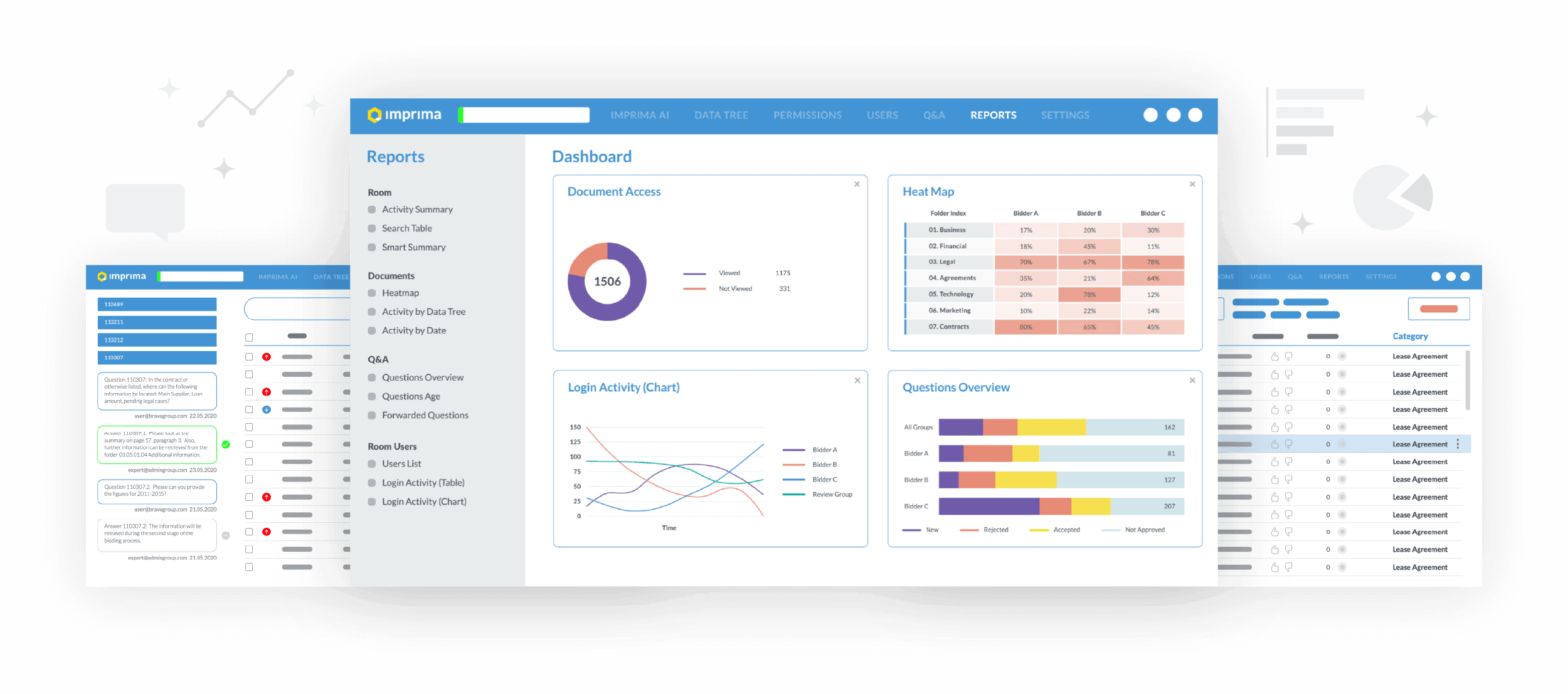
    Finally, Imprima addresses the bidder inquiry process through its ‘Smart Q&A’ module. As prospective buyers submit questions regarding specific assets or lease terms, the AI analyzes the queries, identifies similar questions asked previously, and suggests automated responses based on existing data room content. Deal managers can route questions to specific subject matter experts via automated workflows, utilizing pre-configured tags and auto-forwarding rules. Activity dashboards and heat-maps track bidder engagement in real-time, allowing principals to monitor which assets or documents are generating the most interest. Analysis confirms that by keeping all these functions within a single, secure environment, Imprima minimizes data leakage risks.

    9AI Framework: the score, dimension by dimension

    Dimension Score
    CRE Relevance 8/10
    Data Quality and Sources 8/10
    Ease of Adoption 8/10
    Output Accuracy 8/10
    Integration and Workflow Fit 7/10
    Pricing Transparency 9/10
    Support and Reliability 9/10
    Innovation and Roadmap 8/10
    Market Reputation 9/10
    Composite 9AI Score 82/100

    CRE Relevance — 8/10

    Imprima scores highly here because it explicitly targets commercial real estate asset management, capital raising, and asset sales. Unlike generic file-sharing platforms, the system is trained to recognize and process industry-specific documents like commercial leases, rent rolls, and environmental assessments. The platform features dedicated tools for real estate portfolio review and has a proven track record with major brokerages like Cushman & Wakefield and JLL. While it also serves the broader M&A and legal markets, its feature set aligns directly with the requirements of property transaction due diligence. Analysis shows that the AI models understand the context of property-level data, reducing the time analysts spend manually sorting files. In practice: Real estate deal teams can upload unstructured property data and rely on the system to automatically build a logical, industry-standard data room taxonomy.

    Data Quality and Sources — 8/10

    As a virtual data room, Imprima relies entirely on the quality of the documents uploaded by the user. However, its internal machine learning models are trained on a massive repository of historical M&A and real estate transactions, having processed over 250,000 deals. This extensive training corpus allows the AI to accurately identify document types, extract relevant clauses, and spot anomalies within complex legal text. The system’s ability to maintain high data fidelity during automated translation and redaction processes is a significant advantage. Because the AI is native to the platform, it does not suffer from data degradation or formatting errors that often occur when exporting files to external analysis tools. In practice: Users experience highly accurate auto-classification and redaction because the underlying models have been trained on millions of actual transaction documents.

    Ease of Adoption — 8/10

    Virtual data rooms are a standard component of commercial real estate transactions, meaning the foundational interface of Imprima requires minimal behavioral change from deal teams. The platform offers a 30-day free trial, allowing firms to test the basic feature set before committing. Because the artificial intelligence tools are embedded directly into the VDR, users do not need to learn a separate software application or manage complex API integrations to analyze their documents. The company provides dedicated project managers and 24/7 customer support to assist with initial setup and user onboarding. Analysis indicates that the intuitive design and white-glove service model significantly reduce the friction typically associated with deploying new AI technology. In practice: Deal teams can transition from legacy data rooms to Imprima with almost zero downtime, guided by dedicated support personnel.

    Output Accuracy — 8/10

    Imprima delivers precise results in its automated redaction, indexing, and translation functions. The AI engine excels at identifying personally identifiable information and standard contract clauses, significantly reducing the manual review burden. However, as with any automated legal review tool, the Smart Review function requires human oversight. While the system effectively flags anomalies and extracts lease abstracts, complex legal interpretations still demand review by qualified counsel. The Smart Q&A module accurately clusters similar questions and suggests relevant answers, but deal managers must approve the final responses before they are sent to bidders. Analysis confirms that the platform achieves high accuracy in administrative automation, though it acts as an assistant rather than a replacement for human judgment. In practice: Analysts will trust the auto-redaction and indexing completely but will still manually verify the AI-generated lease abstracts and Q&A responses.

    Integration and Workflow Fit — 7/10

    Imprima is primarily designed to function as a secure, standalone environment during the due diligence phase, which inherently limits its integration with external operational software. The platform does offer an API, SharePoint linking, and Single Sign-On capabilities, allowing enterprise IT departments to connect it to broader corporate networks. However, it does not natively push data into property management systems like Yardi or MRI, nor does it function as a permanent asset management database. Its architecture is explicitly built to ingest data from various sources, secure it, and present it to third parties. Analysis suggests that while it fits perfectly into the transaction phase of the CRE lifecycle, it remains siloed from day-to-day property operations. In practice: IT teams will utilize the API and Single Sign-On for secure access, but analysts will manually export final deal abstracts to their internal underwriting models.

    Pricing Transparency — 9/10

    Imprima stands out in the enterprise software market by publishing a clear starting price. The vendor explicitly states that pricing begins at €250 per month, which provides a concrete baseline for evaluating the software. While enterprise deployments and complex mid-market deals can scale significantly higher—industry data suggests broader deployments can reach between $30,000 and $90,000 annually—the presence of a published entry-level tier is commendable. The company also offers a 30-day free trial that includes one project, ten users, and dedicated support, allowing firms to validate the return on investment before signing a contract. Analysis indicates this level of transparency is rare among top-tier VDR providers, who typically hide all costs behind sales consultations. In practice: Smaller firms can access the platform at the €250 monthly entry point, while institutional players can model enterprise costs based on clear usage metrics.

    Support and Reliability — 9/10

    Founded in 2001, Imprima possesses a long-standing operational history that guarantees high reliability and stability. The company operates a 24/7 support desk, offering assistance in multiple local languages. Unlike early-stage startups, Imprima utilizes a white-glove service model, assigning dedicated project managers with over a decade of experience to guide deal teams from the start of a transaction to its close. The platform is built on highly secure, cloud-based infrastructure optimized for speed, promising document access times up to 15 times faster than legacy systems. It maintains strict GDPR compliance and ISO certifications. Analysis confirms that the vendor prioritizes uptime and data security, making it a highly dependable choice for mission-critical transactions. In practice: Deal managers operating across different time zones can rely on immediate, human support and stable platform performance during critical final bidding rounds.

    Innovation and Roadmap — 8/10

    Imprima has successfully transitioned from a traditional data repository into an AI-driven platform, demonstrating a clear commitment to ongoing development. The company launched its Smart Review and Smart Index tools between 2019 and 2020, and recently added generative AI capabilities, such as the Lumi Chat overlay, to enhance document interrogation. The vendor continues to refine its machine learning models, focusing on cross-border transaction support and advanced Q&A automation. However, as an older company adapting to new technology, its development cycles may prioritize stability and security over rapid, experimental feature releases. Analysis suggests the roadmap is highly pragmatic, focused on solving specific due diligence bottlenecks rather than chasing general AI trends. In practice: Users can expect steady, reliable updates to the core AI review and redaction tools rather than sudden shifts in platform architecture.

    Market Reputation — 9/10

    Imprima holds an exceptionally strong reputation within the European and global transaction markets. It is trusted by top-tier commercial real estate brokerages, financial institutions, and legal firms, including Cushman & Wakefield, JLL, PwC, KPMG, and DLA Piper. The platform consistently receives high ratings on software review sites, maintaining a 4.9 out of 5 on Capterra. The market views Imprima as a premium, boutique provider capable of handling highly complex, multi-jurisdictional deals. Its longevity in the VDR space, combined with its successful integration of proprietary AI tools, has solidified its status as a Tier 2 CRE-native solution. Analysis confirms that the brand carries significant weight, and utilizing Imprima signals professionalism and security to prospective buyers and investors. In practice: Principals will face zero pushback from institutional partners or external counsel when proposing Imprima as the designated data room for a major asset sale.

    Who should use Imprima

    Imprima is engineered for transaction-heavy commercial real estate firms and their advisory partners who require strict data security combined with automated document processing. It is highly effective for teams managing large volumes of unstructured property data during acquisitions, dispositions, or capital raising events.

    • Institutional Investment Sales Brokers: Teams at major brokerages who need to quickly spin up secure data rooms, automatically index hundreds of property files, and track bidder engagement via heat-maps.
    • CRE Private Equity Principals: Buyers executing complex portfolio acquisitions who require automated lease abstraction and anomaly detection to accelerate their due diligence timelines.
    • In-House Legal Counsel: Real estate attorneys who need to rapidly redact sensitive PII and financial data across thousands of pages to ensure GDPR compliance before opening a data room.
    • Cross-Border Asset Managers: Firms dealing with international property transactions that benefit from the platform’s native ability to translate documents across 80+ languages instantly.

    Who should look elsewhere

    Despite its strong feature set, Imprima is a specialized transaction tool and is not suited for firms seeking permanent, day-to-day property management software or general-purpose cloud storage.

    • Small Independent Landlords: Owners of a few local multifamily properties who simply need a place to store leases will find the platform over-engineered and unnecessary.
    • Property Managers: Teams looking for software to handle tenant work orders, rent collection, or daily maintenance tracking should look to operational platforms like Yardi or AppFolio.
    • Firms Seeking Deep Financial Modeling: Analysts looking for AI to automatically build cash flow projections or underwrite assets will not find those capabilities here; Imprima focuses on document review, not financial math.

    Pricing and ROI

    Imprima publishes a clear starting price of €250 per month, establishing a highly accessible entry point for basic virtual data room requirements. The company also offers a generous 30-day free trial that includes one project, ten users, and dedicated legal-tech support, allowing firms to test the AI features before committing capital. For mid-market to enterprise deployments requiring advanced AI redaction, translation, and unlimited data processing, industry analysis indicates annual costs typically range between $30,000 and $90,000. This tiered approach allows smaller brokerages to utilize the secure infrastructure while large institutions pay for scale and advanced machine learning capabilities.

    The return on investment (ROI) math for a commercial real estate principal is straightforward when calculating billable hours saved during due diligence. If an external legal team charges $400 per hour to manually review and redact 5,000 pages of commercial leases, the cost easily exceeds $20,000 per transaction. By utilizing Imprima’s Smart Redaction and Smart Review tools, the AI automates the initial pass, reducing manual legal review time by an estimated 70%. On a single mid-sized portfolio acquisition, the savings in legal fees and administrative overhead will immediately offset the software’s annual enterprise cost. Furthermore, accelerating the due diligence phase reduces the risk of deal fatigue and market shifts, protecting the overall transaction value.

    Integration and CRE tech stack fit

    Imprima integrates into the commercial real estate tech stack primarily as a secure, isolated environment for external collaboration rather than a deeply connected operational hub. The platform offers an API, Single Sign-On (SSO), and SharePoint linking, which allows enterprise IT departments to connect the VDR to internal corporate networks for secure employee access. However, because its primary function is to protect sensitive data during a transaction, it intentionally limits bi-directional data flow with external systems.

    Analysis shows that Imprima does not offer native, plug-and-play integrations with property management systems like MRI, Yardi, or RealPage, nor does it push data directly into underwriting platforms like Argus. Deal teams typically export the final, AI-generated lease abstracts and compliance reports as flat files (Excel or PDF) to update their internal databases once a transaction closes. For a CRE analyst, Imprima acts as a temporary, highly intelligent bridge between the seller’s raw data and the buyer’s internal systems. The lack of deep operational integrations is a deliberate security feature, ensuring that third-party bidders cannot access the host firm’s broader technology ecosystem during the due diligence process.

    Competitive landscape

    The commercial real estate AI software market features several strong competitors in the legal and due diligence category. When evaluating Imprima, CRE principals must compare it against specialized lease abstraction tools and alternative AI-powered data rooms.

    DocumentCrunch (BestCRE Score: 86) is a primary alternative for firms focused strictly on contract analysis. While Imprima excels at hosting the entire transaction and managing third-party access, DocumentCrunch provides deeper, more granular extraction of complex commercial lease clauses and integrates more closely with daily operational workflows. Firms that do not need a virtual data room but want superior lease abstraction should evaluate DocumentCrunch.

    Deal Intel (BestCRE Score: 83) offers a highly competitive platform tailored for transaction management. Deal Intel focuses heavily on the buy-side underwriting process, using AI to structure financial data alongside legal documents. Imprima remains the better choice for sell-side teams and brokers who require strict bidder management, Q&A workflows, and automated redaction.

    fileAI (BestCRE Score: 81) presents a lighter, more general-purpose document extraction tool. It is often favored by smaller deal teams looking for quick, ad-hoc document interrogation without the infrastructure of a full VDR. However, fileAI lacks the bank-grade security, ISO certifications, and dedicated project management support that make Imprima the standard for institutional-grade, multi-jurisdictional portfolio sales.

    Analysis indicates that Imprima wins on security, redaction, and bidder management, making it the superior choice for managing the actual transaction environment, while tools like DocumentCrunch win on deep, operational lease abstraction.

    The bottom line

    Imprima is a mandatory evaluation for institutional brokers, private equity principals, and real estate legal teams managing complex asset sales or capital raising events. It successfully solves the specific bottlenecks of transaction due diligence by embedding highly accurate AI redaction, indexing, and translation directly into a secure virtual data room. You should purchase this software if your firm spends excessive capital on external legal fees for manual document sorting and redaction, or if you regularly manage cross-border deals requiring multi-language support. The published starting price of €250 per month makes it accessible, while its enterprise capabilities scale to handle massive portfolio transactions. Do not buy Imprima if you are simply looking for an internal lease management database or an automated financial underwriting tool. For executing secure, high-stakes commercial real estate transactions with maximum efficiency and zero data leakage, Imprima delivers immediate, measurable return on investment.

    Compare inside the same category: DocumentCrunch (86) · Deal Intel (83) · Wilson AI (82) · fileAI (81) · Orbital (79). The full ranking is in the BestCRE AI Index; the category view is at CRE AI tools by category.

    Frequently asked questions

    Does Imprima integrate directly with Yardi or Argus?

    No, Imprima does not offer native integrations with Yardi, Argus, or other property management systems. It is designed as a secure, standalone virtual data room for external transactions. Analysts must manually export AI-generated lease abstracts and reports to update internal underwriting models or operational databases.

    Can the AI translate foreign real estate documents?

    Yes, Imprima features a Smart Translation tool that natively supports over 80 languages [1.2.5]. The AI automatically translates foreign commercial leases, environmental reports, and financial documents directly within the secure data room viewer, eliminating the need to export sensitive files to external translation services during cross-border deals.

    How does the pricing structure work for mid-market firms?

    Imprima publishes a starting price of €250 per month, which covers basic data room functionality. For mid-market and enterprise firms requiring the full suite of AI tools, unlimited data processing, and dedicated project management, industry analysis indicates annual costs typically range between $30,000 and $90,000.

    Is Imprima secure enough for sensitive financial data?

    Yes, Imprima is built specifically for highly confidential M&A and real estate transactions. It features bank-grade security, strict GDPR compliance, and ISO certifications. Furthermore, the embedded Smart Redaction tool automatically obscures personally identifiable information and sensitive financial data before third-party bidders access the room.

    Does the platform require extensive training to use?

    No, the platform is highly intuitive and requires minimal behavioral change for teams familiar with standard virtual data rooms. The AI features are embedded directly into the interface. Imprima also provides dedicated project managers and 24/7 support to assist with onboarding and deal setup.

    Can Imprima automatically answer bidder questions during due diligence?

    The Smart Q&A module uses artificial intelligence to analyze incoming bidder questions, cluster similar inquiries, and suggest answers based on existing data room documents. However, deal managers must review and approve all AI-suggested responses before they are routed to external prospective buyers.


  • Hover Review: AI property measurement and precise 3D modeling from standard smartphone photos

    BestCRE 9AI Score

    86/100 · Leader

    Hover ranks #41 of 231 commercial real estate AI tools scored on the 9AI Framework.

    Hover is a property intelligence platform that specializes in AI-driven property measurement and visualization derived entirely from smartphone photos. Founded in 2011 and having secured over $142 million in funding by its Series D round, the company has established a significant footprint in both residential and commercial real estate valuation and appraisal. By processing a minimum of eight overlapping exterior images captured via its mobile application, the software generates interactive, scaled 3D models complete with precise measurements for roofing, siding, windows, and doors. This capability directly targets the manual, error-prone processes traditionally associated with site surveys, material takeoffs, and insurance adjustments.

    For commercial real estate principals and analysts evaluating the tool in August 2026, Hover represents a mature computer vision application that bridges the gap between physical site inspections and digital estimating workflows. The platform is classified in the BestCRE database as a CRE-Native, Tier 2 solution, reflecting its deep domain specificity but acknowledging its dual focus on both residential and light commercial assets. Rather than relying on expensive drone hardware or specialized LiDAR equipment, the system democratizes spatial data capture by utilizing the ubiquitous smartphone camera. This approach significantly lowers the barrier to entry for field teams and third-party inspectors. Our analysis indicates that while the tool is heavily entrenched in the contractor and insurance claims markets, its utility for commercial property valuation—specifically in assessing capital expenditure for exterior renovations and verifying asset dimensions—is highly credible.

    What Hover does and how it works

    Hover operates primarily as a computer vision and spatial data extraction engine. The core mechanic begins in the field, where a user opens the mobile application and follows a guided capture process. The protocol requires the user to walk the perimeter of the target structure, taking a series of overlapping photographs—typically eight for a standard building, capturing each elevation and corner. The software does not require specialized hardware, secondary attachments, or active internet connectivity during the capture phase, allowing field teams to operate in remote or low-signal environments.

    Once the images are uploaded to the cloud, Hover applies proprietary machine learning algorithms and photogrammetry techniques to reconstruct the building’s geometry. The output is a fully measured, interactive 3D model that details exterior surface areas, roof pitches, linear measurements for eaves and ridges, and exact dimensions for fenestrations. This data is compiled into a structured PDF report and an interactive digital model accessible via desktop or mobile. For commercial assets with multiple structures, such as a garden-style multifamily complex or a self-storage facility, each building is processed as an independent order.

    Beyond simple measurement, the platform functions as an estimation and visualization tool. The 3D model allows users to apply different manufacturer-specific materials—such as commercial siding or roofing membranes—to visualize proposed capital improvements. The software automatically calculates the required material quantities based on the verified dimensions, generating automated takeoffs. These material lists can then be exported directly to integrated supplier networks or internal estimating software. Our analysis notes that this transition from raw photographic data to structured, actionable procurement metrics eliminates the need for manual blueprint scaling or physical tape measurements, fundamentally accelerating the underwriting and bidding phases of property repositioning.

    9AI Framework: the score, dimension by dimension

    Dimension Score
    CRE Relevance 9/10
    Data Quality and Sources 9/10
    Ease of Adoption 10/10
    Output Accuracy 8/10
    Integration and Workflow Fit 9/10
    Pricing Transparency 5/10
    Support and Reliability 9/10
    Innovation and Roadmap 9/10
    Market Reputation 9/10
    Composite 9AI Score 86/100

    CRE Relevance — 9/10

    Hover occupies a distinct position in the commercial real estate technology stack, classified as a CRE-Native, Tier 2 application. While its origins and high-volume usage are heavily tied to residential home improvement, its application in commercial valuation, multifamily renovations, and insurance underwriting is substantial. The ability to generate accurate exterior dimensions without deploying specialized surveying teams directly serves asset managers calculating capital expenditure for facade or roof replacements. However, its relevance is slightly constrained for complex, high-rise commercial structures where ground-level smartphone photography cannot capture the necessary architectural details or flat-roof mechanical layouts. For garden-style apartments, retail strip centers, and light industrial assets, the platform provides highly applicable spatial data. In practice: Asset managers utilize the generated 3D models to verify square footage and solicit accurate contractor bids during the due diligence phase of an acquisition.

    Data Quality and Sources — 9/10

    The integrity of the spatial data generated by the platform is anchored by a proprietary database that has processed over ten million structures. By relying on actual photographic evidence rather than outdated satellite imagery or municipal tax records, the software produces a highly verifiable source of truth. The measurements extracted from the photogrammetry engine are consistently reliable for surface area calculations and linear takeoffs. The data output is highly structured, delivering exact quantities for siding, roofing, and trim in standardized formats that integrate cleanly into secondary estimation platforms. Our analysis indicates that the photographic input method prevents the data degradation typically caused by manual transcription errors during field surveys. In practice: Analysts can rely on the exported material quantities to build precise capital expenditure models rather than relying on rough contractor estimates.

    Ease of Adoption — 10/10

    The platform excels in user acquisition and field deployment due to its reliance on standard smartphone hardware. There is no requirement to purchase proprietary drones, laser scanners, or specialized 360-degree cameras. The mobile application provides a highly intuitive, guided user interface that dictates exactly where and how field personnel should stand to capture the necessary images. This low technical barrier means that property managers, junior analysts, or even third-party brokers can be tasked with site capture with virtually no formal training. The processing phase is entirely automated in the cloud, removing any need for the user to manipulate point clouds or stitch images together manually. In practice: A commercial real estate firm can deploy the application across its entire property management portfolio in a single afternoon without scheduling dedicated training sessions.

    Output Accuracy — 8/10

    While the computer vision algorithms are highly advanced, the platform is not entirely immune to measurement discrepancies. Field reports and user feedback indicate that while the software is exceptionally accurate for standard geometries, it can exhibit a 3 to 5 percent margin of error on highly complex rooflines or non-standard commercial elevations. Furthermore, the system occasionally rounds measurements to the nearest standard denominator, which can compound errors on large-scale commercial takeoffs. Despite these limitations, the accuracy is generally superior to manual tape measurements and entirely sufficient for preliminary valuation, insurance claims, and material ordering. The system provides a reliable baseline, though final fabrication orders for high-cost materials may still require physical verification. In practice: Construction managers use the automated takeoffs for budgeting and bidding, but typically conduct a final physical spot-check before ordering custom architectural elements.

    Integration and Workflow Fit — 9/10

    The software is designed to function as the spatial data foundation for a broader technology ecosystem. It offers established API connections and direct integrations with major construction estimation platforms, CRM systems, and material suppliers like QXO and ABC Supply. This interoperability ensures that the 3D models and material takeoffs do not remain isolated in a proprietary silo. For commercial real estate tech stacks, the ability to export data in standard formats such as PDF, XML, JSON, and DWG allows for smooth transitions into AutoCAD, SketchUp, or proprietary underwriting models. Our analysis confirms that the platform is built to feed downstream systems rather than force users to operate exclusively within its own interface. In practice: Development teams export the generated 3D models directly into SketchUp to accelerate the schematic design phase of a repositioning project.

    Pricing Transparency — 5/10

    According to the BestCRE database, Hover operates on a custom pricing model, and exact tier costs are not published openly on their primary marketing pages. While some secondary review sites suggest a per-project or one-time fee structure for basic users, enterprise and commercial real estate clients are required to engage with the sales team to negotiate volume-based contracts or subscription tiers. The lack of standardized, publicly visible pricing tiers introduces friction for analysts attempting to model the software’s cost-to-value ratio prior to a formal sales engagement. Due to the strict evaluation criteria of the 9AI Framework, a vendor that does not publish its pricing cannot exceed a score of 5 in this category. In practice: Procurement teams must initiate a formal discovery process and negotiate custom annual contracts based on their projected portfolio scan volume.

    Support and Reliability — 9/10

    Backed by significant venture capital, including a $60 million Series D round in late 2020, the company possesses the financial stability necessary to maintain enterprise-grade support infrastructure. The organization provides comprehensive onboarding, a detailed online help center, and dedicated account management for high-volume commercial clients. User feedback consistently highlights the responsiveness of the technical support team, particularly when field users encounter processing errors or require expedited model generation. The platform’s maturity, having been founded in 2011, ensures that its service level agreements and uptime metrics are highly reliable compared to early-stage proptech startups. Our analysis indicates that the vendor is fully equipped to support national commercial real estate portfolios. In practice: Field inspectors experiencing upload issues can rely on the in-app chat support to resolve technical bottlenecks while still on the property site.

    Innovation and Roadmap — 9/10

    The company has consistently expanded its feature set beyond basic exterior measurements. Recent developments include the rollout of interior scanning capabilities, allowing users to generate floor plans and interior takeoffs using the same smartphone camera methodology. Furthermore, the integration of generative AI for conceptual design visualization indicates a commitment to pushing the boundaries of spatial technology. The roadmap clearly prioritizes deepening integrations with material suppliers and expanding automated estimation features, moving the product from a pure measurement utility to a comprehensive procurement and design platform. Our analysis suggests the vendor is actively adapting to the demands of institutional property owners and large-scale contractors. In practice: Asset managers can anticipate future updates that will further automate the transition from a smartphone photograph to a finalized, multi-trade renovation budget.

    Market Reputation — 9/10

    Hover commands a dominant position in the property measurement sector, widely recognized and trusted by over 300,000 construction professionals and major national insurance carriers. Its reputation is built on delivering consistent, actionable data that directly impacts the bottom line of contractors and adjusters. While its brand presence is slightly more pronounced in the residential and insurance sectors, commercial real estate operators widely acknowledge its utility for light commercial and multifamily assets. The platform scores highly on aggregate review sites, with users frequently praising its ability to eliminate manual site surveys and accelerate the bidding process. It is generally viewed as a mature, dependable standard in the industry. In practice: When a commercial broker provides a Hover-generated 3D model to a prospective buyer, the data is immediately recognized as credible and authoritative by the acquiring firm.

    Who should use Hover

    The platform is highly optimized for professionals who require rapid, accurate spatial data without the overhead of deploying specialized surveying teams. It is particularly effective for teams managing high-volume, light commercial or multifamily portfolios.

    • Multifamily Asset Managers: Professionals overseeing large portfolios of garden-style apartments who need to standardize capital expenditure budgets for exterior painting, siding, or roof replacements across multiple properties.
    • Commercial Insurance Adjusters: Risk management personnel who require verifiable, photographic proof of asset dimensions and exterior conditions to process claims rapidly without physical tape measurements.
    • Value-Add Investors: Acquisition teams that need to quickly generate accurate material takeoffs and solicit reliable contractor bids during the compressed timelines of the due diligence period.
    • Architects and Planners: Design professionals who can utilize the exported DWG or SketchUp files as an accurate baseline for schematic design, bypassing the need for manual site scaling.

    Who should look elsewhere

    Despite its advanced capabilities, the software relies on ground-level smartphone photography, which presents physical limitations for certain asset classes.

    • High-Rise Office Developers: Teams managing vertical construction or skyscrapers where ground-level photography cannot capture upper-level fenestrations or complex, multi-tiered flat roof mechanical layouts.
    • Industrial Warehouse Operators: Analysts evaluating massive, featureless logistics centers where the sheer scale and lack of distinct architectural markers may confuse the photogrammetry algorithms.
    • Firms Requiring Millimeter Precision: Engineering teams executing complex structural modifications that require the absolute precision of a terrestrial LiDAR scanner rather than the 3 to 5 percent margin of error acceptable in general material takeoffs.

    Pricing and ROI

    As verified by the BestCRE master database, Hover operates on a custom pricing model, and specific enterprise tier costs are not published on their public-facing website. While individual contractors may access pay-per-scan or basic subscription tiers (historically noted by third-party reviewers as starting around $29 per scan), commercial real estate firms and institutional users must engage directly with the sales team to negotiate volume-based contracts. The vendor offers a “Pro” membership that includes volume discounts, premium design features, and a credit-back system where users earn credits toward future projects based on their total spend.

    For a commercial real estate principal, the return on investment math is highly compelling despite the lack of upfront pricing transparency. The traditional method of measuring a 20-building multifamily complex for a siding and roof replacement requires days of manual labor from a specialized surveying crew, costing thousands of dollars and introducing the risk of human error. By deploying a junior analyst or property manager to capture the site using a smartphone in a single afternoon, the firm eliminates the surveying hard costs. Furthermore, the precise material takeoffs prevent contractors from padding their bids with excessive waste margins. If the software costs $1,500 for a portfolio-wide scan package, but saves $15,000 in surveying fees and prevents a 10% over-order on a $200,000 roofing contract, the platform pays for itself immediately upon deployment.

    Integration and CRE tech stack fit

    Hover is engineered to act as a highly connected node within the broader commercial real estate and construction technology stack. Rather than forcing users to operate exclusively within its proprietary dashboard, the platform is built around data portability. It offers direct API integrations with major industry CRMs, project management systems, and specialized estimating software.

    For material procurement, the system connects directly with major distributors like QXO and ABC Supply, allowing asset managers or their general contractors to push verified material lists directly into digital ordering workflows. On the design and architectural front, the ability to export the 3D models into standard formats such as DWG, DXF, SKP, and JSON ensures that the data flows cleanly into AutoCAD or SketchUp. This interoperability is critical for commercial real estate analysts who need to bridge the gap between initial site surveys and formal architectural planning. Our analysis indicates that the platform’s open architecture prevents data silos, ensuring that the precise measurements captured in the field can be utilized by underwriting, design, and construction teams without manual transcription.

    Competitive landscape

    In the CRE Valuation & Appraisal category, Hover competes against a spectrum of AI-driven spatial data and automated valuation models. According to BestCRE scoring, Attentive.ai (88) leads the category, primarily because it specializes in automating site measurements from high-resolution aerial imagery rather than ground-level photography. For commercial asset managers evaluating massive retail footprints or sprawling industrial parks, Attentive.ai’s top-down approach is often more efficient than walking the perimeter with a smartphone.

    Deepblocks (81) and Clear Capital (78) operate in adjacent valuation spaces. Deepblocks focuses heavily on zoning, feasibility, and macroeconomic data for development underwriting, lacking the physical exterior measurement capabilities of Hover. Clear Capital is deeply entrenched in automated property valuation and appraisal management, relying on aggregated market data rather than real-time physical site capture.

    Direct competitors in the automated takeoff and measurement space include Togal.AI (76) and FoxyAI (76). Togal.AI is highly specialized in utilizing machine learning to automate blueprint takeoffs. If a commercial firm already possesses accurate architectural plans, Togal.AI is the superior choice for rapid estimation. However, if the blueprints are missing or outdated, Hover’s ability to generate new measurements from the physical environment is essential. FoxyAI utilizes computer vision to assess property condition and quality from interior and exterior photos, but it leans more toward qualitative scoring for appraisals rather than the exact geometric modeling and material takeoffs provided by Hover. Ultimately, Hover remains the dominant choice for firms that need to quickly generate accurate, physical 3D models of existing, mid-market commercial assets without relying on existing blueprints or expensive aerial surveys.

    The bottom line

    Hover is a highly effective, specialized tool that successfully solves the specific problem of physical site measurement and material estimation. It is not a comprehensive commercial real estate underwriting platform, nor is it designed to evaluate macroeconomic trends or zoning feasibility. Instead, it is a tactical application that transforms standard smartphone photos into highly accurate, actionable 3D models and material takeoffs.

    For commercial asset managers, value-add investors, and property management firms overseeing multifamily, retail, or light industrial portfolios, the platform is an essential utility. It eliminates the friction, cost, and human error associated with manual site surveys, directly accelerating the due diligence and capital expenditure bidding processes. While its custom pricing model requires a formal sales engagement, the immediate return on investment realized through reduced surveying costs and tightened contractor bids is undeniable. If your firm frequently acquires or renovates mid-market physical assets and struggles with accurate, timely site measurements, Hover is a mandatory addition to your field technology stack.

    Compare inside the same category: Attentive.ai (88) · Deepblocks (81) · Clear Capital (78) · Togal.AI (76) · C3 AI Property Appraisal (76). The full ranking is in the BestCRE AI Index; the category view is at CRE AI tools by category.

    Frequently asked questions

    Is Hover suitable for large commercial high-rise buildings?

    No. The platform relies on ground-level smartphone photography, making it difficult to capture the necessary angles and upper-level details of high-rise structures. It is best suited for garden-style multifamily, retail strip centers, and light industrial assets.

    Does the software require specialized camera equipment?

    No. The platform is designed to work entirely with standard iOS and Android smartphone cameras. There is no need to purchase drones, LiDAR scanners, or 360-degree cameras to generate the 3D models.

    Can I export the 3D models to architectural software?

    Yes. The platform allows users to export data in several industry-standard formats, including DWG, DXF, SKP, and JSON, making it easy to import the models into AutoCAD, SketchUp, and other design tools.

    How accurate are the material takeoffs?

    The computer vision algorithms are highly accurate for standard geometries, but users report a 3 to 5 percent margin of error on highly complex rooflines. It is excellent for estimation, though final fabrication orders may require physical verification.

    Does the company publish its enterprise pricing?

    No. According to the BestCRE database, the vendor utilizes a custom pricing model. Commercial real estate firms must contact the sales team to negotiate volume-based contracts or subscription tiers based on their specific portfolio needs.

    Can the platform measure interior spaces?

    Yes. While originally known for exterior modeling, the software now includes interior scanning capabilities, allowing users to generate accurate floor plans and interior material takeoffs using the same smartphone capture methodology.

  • HouseWhisper AI Review: Conversational AI assistant syncing CRM data for commercial real estate agents

    BestCRE 9AI Score

    64/100 · Niche

    HouseWhisper AI ranks #203 of 230 commercial real estate AI tools scored on the 9AI Framework.

    HouseWhisper AI operates as a conversational AI assistant designed specifically to sync with customer relationship management (CRM) platforms for real estate agents. Classified in the BestCRE master database as a Tier 2 CRE-Native application, the software attempts to bridge the gap between static property data and active client communication. The primary use case centers on allowing agents to query their databases, draft communications, and update records through natural language prompts rather than manual data entry. Priced at approximately $79 per month, the tool targets individual producers and small-to-midsize brokerage teams who struggle with CRM hygiene and rapid response times.

    As an analyst evaluating the CRE AI Assistants & Copilots category in March 2026, the core question is whether HouseWhisper AI offers enough specialized utility to justify its subscription cost over general-purpose models or enterprise-grade platforms. Unlike broader development environments such as Cursor or Replit, which score 90 and 88 respectively in our framework for their technical versatility, HouseWhisper AI maintains a narrow focus on broker workflows. It competes more directly with workflow automation tools like Agentforce (88) and Conduit (87), though it lacks their enterprise-level market presence. Our analysis indicates that while the application provides immediate utility for agents managing high volumes of client interactions, its Tier 2 status reflects limitations in handling complex, institutional-grade underwriting or portfolio-wide analytics. The evaluation below assesses how well it executes its specific mandate of CRM synchronization and conversational assistance within the commercial real estate sector.

    What HouseWhisper AI does and how it works

    At its core, HouseWhisper AI functions as a natural language interface layer sitting on top of a real estate agent’s existing CRM and communication tools. When an agent receives an inquiry about a specific commercial property or market submarket, they can ask the assistant to retrieve relevant comparables, client history, or property details. The software processes this request, queries the connected database, and returns a synthesized response. This eliminates the need for the agent to manually navigate through multiple CRM tabs or external property databases to compile basic information. The conversational engine is tuned to recognize real estate terminology, allowing it to parse requests like finding all active retail leases over 5,000 square feet in the downtown submarket and translate them into the appropriate database queries.

    Beyond data retrieval, the application handles outbound communication drafting and data entry. If an agent completes a property tour, they can dictate or type a brief summary into HouseWhisper AI. The tool then parses this input, updates the corresponding CRM record with the new activity, logs the client’s feedback, and drafts a follow-up email based on the agent’s historical writing style and the specific property details discussed. This bidirectional syncing ensures that the CRM remains current without requiring dedicated administrative time from the broker. The system also includes basic scheduling capabilities, identifying proposed meeting times within email threads and cross-referencing them with the agent’s calendar.

    From a technical standpoint, the software relies on API connections to popular real estate CRMs and email providers. It does not host the underlying property data itself, acting instead as a processing and interaction layer. This means the output quality is entirely dependent on the hygiene of the agent’s existing database. If the CRM contains outdated rent rolls or incorrect contact information, HouseWhisper AI will confidently surface that flawed data. The application is accessed primarily through a web interface or mobile application, providing on-the-go utility for brokers conducting site visits or traveling between client meetings.

    9AI Framework: the score, dimension by dimension

    Dimension Score
    CRE Relevance 7/10
    Data Quality and Sources 6/10
    Ease of Adoption 8/10
    Output Accuracy 7/10
    Integration and Workflow Fit 6/10
    Pricing Transparency 9/10
    Support and Reliability 5/10
    Innovation and Roadmap 5/10
    Market Reputation 5/10
    Composite 9AI Score 64/100

    CRE Relevance — 7/10

    HouseWhisper AI is classified as a CRE-Native Tier 2 application, meaning it was built specifically with real estate workflows in mind rather than being a generic wrapper. The conversational models are trained to understand industry-specific jargon, such as cap rates, tenant improvements, and triple-net leases, which prevents the misinterpretations common in off-the-shelf consumer AI. However, its primary focus on CRM synchronization and basic communication limits its utility for complex financial modeling or deep market analytics. It serves the brokerage side of the business effectively but offers little to asset managers or developers requiring heavy quantitative analysis. The tool understands the language of deals but does not underwrite them. In practice: Brokers will find the terminology recognition accurate, but analysts will need different software for financial modeling.

    Data Quality and Sources — 6/10

    Because HouseWhisper AI operates primarily as an interface layer rather than a proprietary data provider, its internal data quality is a reflection of the user’s connected systems. The software does not supply an independent database of property records, ownership histories, or lease comparables. Instead, it relies entirely on the information housed within the agent’s CRM. The AI excels at extracting and structuring unstructured data from emails or notes, improving the overall hygiene of the connected database over time. However, it lacks built-in verification mechanisms to cross-reference CRM data against public records or third-party commercial real estate databases, meaning it cannot flag outdated or incorrect entries inputted by the user. In practice: The system will accurately retrieve what you have saved, but it will not correct your underlying database errors.

    Ease of Adoption — 8/10

    The application is designed for individual producers and small teams, prioritizing a straightforward onboarding process. Connecting the software to standard email clients and major CRMs typically requires standard OAuth authentication rather than custom API development. The conversational interface mimics familiar chat applications, reducing the learning curve for agents who are not technically inclined. Unlike complex workflow builders such as Gumloop or Manus, which require a foundational understanding of logic steps, HouseWhisper AI operates on natural language commands. The primary friction point during adoption involves training the AI on the agent’s specific communication style and ensuring the existing CRM is organized enough to allow for accurate data retrieval. In practice: Most agents can connect their accounts and begin executing basic queries within the first hour of deployment.

    Output Accuracy — 7/10

    The system performs reliably when executing binary tasks, such as logging a call or retrieving a specific contact’s phone number. Its natural language processing accurately interprets intent, rarely confusing a request to schedule a meeting with a request to draft a proposal. However, when asked to synthesize complex information across multiple properties or generate lengthy market updates, the output can occasionally become generic or require manual editing. The risk of hallucination is mitigated by its strict reliance on the connected CRM data, but formatting errors in drafted emails or slight misinterpretations of nuanced client feedback do occur. It requires human oversight before any external communication is sent. In practice: Users must review all drafted emails and complex data summaries before hitting send or presenting to clients.

    Integration and Workflow Fit — 6/10

    As a tool whose primary value proposition is CRM synchronization, integration capabilities are central to its functionality. HouseWhisper AI connects readily with major real estate CRMs and standard productivity suites like Google Workspace and Microsoft 365. However, as a Tier 2 application, it lacks the deep, enterprise-level integrations found in platforms like Agentforce. It does not natively connect with institutional property management software, specialized underwriting platforms, or proprietary enterprise data warehouses. For the average mid-market broker using standard industry tools, the API connections are sufficient, but institutional teams with custom-built tech stacks will find the integration options limiting and potentially requiring manual workarounds. In practice: The software fits perfectly into a standard broker tech stack but struggles to connect with bespoke institutional enterprise systems.

    Pricing Transparency — 9/10

    The vendor publishes its pricing details clearly, with the primary subscription costing approximately $79 per month. This straightforward, flat-rate model is highly transparent, avoiding the complex, usage-based token pricing or opaque enterprise-tier gating common in the AI software market. Buyers know exactly what their monthly expenditure will be, allowing for easy budget allocation at the individual agent or small team level. There are no hidden fees for basic CRM synchronization or standard query volumes reported in our research. This level of clarity is commendable and allows potential users to calculate their return on investment before committing to a long-term contract. In practice: Buyers can confidently budget for the $79 monthly cost without fear of unexpected overage charges for standard daily usage.

    Support and Reliability — 5/10

    As a relatively new entrant in the CRE AI space and an unproven startup, HouseWhisper AI has not yet established a long-term track record for support reliability. While the software functions adequately for daily tasks, the support infrastructure appears geared toward self-service documentation and standard email ticketing rather than dedicated account management. Users experiencing complex API synchronization issues may face longer resolution times compared to those using established enterprise platforms. The lack of a proven, multi-year operational history means buyers must accept a degree of risk regarding the company’s long-term viability and ability to maintain uptime during periods of rapid scaling or server load. In practice: Users should expect standard email support rather than immediate, white-glove technical assistance for complex integration issues.

    Innovation and Roadmap — 5/10

    The company has demonstrated a clear focus on refining its core competency: conversational CRM interaction. However, the published roadmap lacks visibility into advanced features that would elevate it to a Tier 1 application. There is little indication of upcoming features involving predictive analytics, automated financial modeling, or deep integrations with alternative data sources. The development cycle appears heavily weighted toward adding more CRM integrations and improving the natural language processing speed rather than expanding the tool’s fundamental capabilities. While this focused approach ensures stability for existing features, it may leave the platform vulnerable to broader AI assistants that eventually incorporate real estate-specific modules. In practice: Buyers are purchasing the current CRM syncing functionality rather than investing in a rapidly expanding suite of analytical tools.

    Market Reputation — 5/10

    HouseWhisper AI operates primarily in the small-to-midsize brokerage market, where it has garnered attention for its specific utility. However, as an unproven startup, it lacks the widespread market penetration and institutional validation of heavier platforms. It is not yet a household name among national brokerage directors or enterprise technology officers. Its reputation is currently being built word-of-mouth among individual producers who appreciate the time saved on data entry. It does not carry the same industry weight as established workflow tools like Conduit or broad development environments like Cursor. The company must still prove it can scale its user base while maintaining performance. In practice: The tool is known among tech-forward individual brokers but has yet to earn validation from major institutional real estate firms.

    Who should use HouseWhisper AI

    HouseWhisper AI delivers the highest return on investment for professionals whose daily workflow is heavily dependent on client communication and CRM management. The ideal user is focused on transaction volume and relationship maintenance rather than complex quantitative analysis.

    • High-volume leasing brokers: Agents managing dozens of active tenant requirements who need to quickly log updates and draft follow-ups between tours.
    • Independent commercial agents: Solo practitioners who lack dedicated administrative support and need a tool to handle basic data entry and scheduling.
    • Small brokerage teams: Groups of 3-5 agents looking to standardize their CRM inputs and ensure all client interactions are logged without enforcing rigid manual processes.
    • Market researchers: Professionals who spend significant time compiling qualitative market feedback and need an efficient way to structure those notes into a central database.

    Who should look elsewhere

    This application is fundamentally a communication and data entry assistant, making it unsuitable for professionals requiring heavy computational power or institutional-grade data security.

    • Acquisitions analysts: Professionals needing AI to assist with complex cash flow modeling, Argus integrations, or deep financial underwriting.
    • Institutional asset managers: Teams requiring enterprise-grade security compliance, custom API builds for proprietary databases, and portfolio-wide predictive analytics.
    • Commercial developers: Users looking for generative design, zoning analysis, or construction project management automation.

    Pricing and ROI

    HouseWhisper AI operates on a highly transparent, flat-rate subscription model, with pricing set at approximately $79 per month per user. This approach is a significant advantage in the current AI landscape, where many vendors obscure their costs behind contact-sales barriers or employ unpredictable, usage-based token systems. At $79 monthly, the annual cost sits just under $1,000, making it an accessible operational expense for individual producers and small teams without requiring corporate board approval.

    To evaluate the return on investment, we analyze the time saved on administrative tasks. Industry benchmarks suggest the average commercial broker spends roughly five hours per week on CRM data entry, drafting routine follow-up emails, and logging meeting notes. If HouseWhisper AI reclaims just 50 percent of that time—2.5 hours per week, or 10 hours per month—the software pays for itself rapidly. For an agent valuing their time at a conservative $100 per hour, the tool generates $1,000 in reclaimed productivity monthly against a $79 cost. This represents a 12x return on the monthly subscription fee, assuming the saved time is redirected toward revenue-generating activities like prospecting or client meetings. The math makes this a low-risk, high-reward proposition for agents struggling with administrative overhead.

    Integration and CRE tech stack fit

    The utility of HouseWhisper AI is entirely dependent on its ability to communicate with a broker’s existing technology stack. Our analysis confirms that the platform is engineered to integrate efficiently with the most common tools used by independent agents and mid-market brokerages. It establishes direct connections with major email providers, specifically Google Workspace and Microsoft 365, allowing it to read incoming messages and draft outbound replies without disruption.

    On the CRM front, the software connects via standard APIs to popular real estate databases. However, buyers must be aware of its Tier 2 classification limitations. While it handles standard REST API connections well, it does not offer the deep, bidirectional syncing required for highly customized, enterprise-level instances of Salesforce or proprietary institutional databases. It is not designed to integrate with heavy financial platforms like Argus or property management systems like Yardi. For the independent broker using a standard CRM configuration, the integration fit is excellent and requires minimal technical expertise to deploy. For enterprise IT departments managing complex, bespoke data warehouses, implementing HouseWhisper AI will likely require custom middleware and significant security vetting.

    Competitive landscape

    When evaluating HouseWhisper AI, buyers must consider how it positions itself against both general-purpose AI tools and specialized CRE workflow automation platforms. HouseWhisper AI’s primary advantage is its out-of-the-box readiness for real estate communication, but it faces stiff competition across different vectors.

    For teams looking for comprehensive workflow automation, Agentforce (BestCRE Score: 88) and Conduit (BestCRE Score: 87) represent significant alternatives. Agentforce provides a more comprehensive, enterprise-ready environment capable of handling complex, multi-step automations beyond simple CRM syncing. Conduit similarly excels in connecting disparate data sources and automating repetitive tasks, offering a broader utility for teams that need to integrate multiple third-party real estate data providers. However, both typically require a steeper learning curve and higher financial investment than HouseWhisper AI’s straightforward $79 monthly model.

    On the technical development side, platforms like Cursor (BestCRE Score: 90), Replit (BestCRE Score: 88), and Manus (BestCRE Score: 87) serve a completely different buyer. These are advanced environments for users who want to build custom applications or scripts from scratch. A broker looking to simply dictate meeting notes into their CRM will find Cursor entirely inappropriate, whereas a CRE tech team building a proprietary data scraper would choose Cursor over HouseWhisper AI every time.

    Ultimately, HouseWhisper AI competes most directly with the built-in AI features increasingly offered by the CRM providers themselves. Its survival depends on remaining faster, more intuitive, and more accurate at natural language processing than the native copilots bundled into existing real estate databases.

    The bottom line

    HouseWhisper AI is a tactical, highly focused application that solves a specific, persistent problem for commercial real estate brokers: CRM hygiene and administrative fatigue. At approximately $79 per month, the financial risk is minimal, and the potential return on investment in reclaimed hours is substantial. Buyers should not expect a comprehensive analytical engine or an enterprise-grade automation platform. It will not underwrite your deals, analyze market trends, or connect to institutional property management software. However, if you are an independent producer or part of a small leasing team losing hours each week to manual data entry and routine email drafting, this tool warrants immediate deployment. The decision rests entirely on your daily workflow. If your primary bottleneck is managing client communications and keeping your database updated, purchase a single license, test the API connection with your specific CRM, and evaluate the time saved over a 30-day period.

    Compare inside the same category: Cursor (90) · Agentforce (88) · Replit (88) · Gumloop (87) · Manus (87). The full ranking is in the BestCRE AI Index; the category view is at CRE AI tools by category.

    Frequently asked questions

    Does HouseWhisper AI provide its own property data or ownership records?

    No. The software functions strictly as an interface layer and relies entirely on the data housed within your connected CRM and email accounts. It does not include access to third-party commercial real estate databases, public ownership records, or proprietary market analytics.

    Can this tool underwrite commercial real estate deals or build financial models?

    No. HouseWhisper AI is designed exclusively for conversational CRM synchronization, basic data entry, and communication drafting. It completely lacks the quantitative capabilities, mathematical frameworks, and specialized integrations required for complex cash flow modeling, property valuations, or institutional-grade commercial real estate investment underwriting.

    How much does HouseWhisper AI cost?

    The vendor publishes a straightforward, flat-rate pricing model of approximately $79 per month per user. There are no hidden enterprise tiers, opaque setup fees, or complex token-based usage systems for basic functionality, making it exceptionally easy to budget for individual commercial agents.

    Will it integrate with my custom-built enterprise CRM?

    The software integrates easily with standard, out-of-the-box CRMs via standard API connections. However, connecting the application to highly customized, proprietary enterprise databases or legacy institutional systems will likely require significant manual configuration, custom middleware development, and extensive internal IT security oversight.

    Is the application suitable for institutional asset managers?

    Generally, no. The tool is heavily optimized for the high-volume communication workflows, scheduling, and data entry needs of commercial leasing and sales brokers. It does not support the complex analytical, financial reporting, and portfolio management requirements typical of institutional asset management teams.

    Do I need coding experience to set up the CRM integration?

    No. The platform uses standard OAuth authentication and pre-built API connectors for major commercial CRMs and standard email clients. This user-friendly setup allows agents to connect their accounts and begin querying their databases using natural language without needing to write any custom code.

  • Houmify Review: Consumer real estate agent matching platform masquerading as commercial property management software

    BestCRE 9AI Score

    50/100 · Watch

    Houmify ranks #229 of 229 commercial real estate AI tools scored on the 9AI Framework.

    Houmify is an AI-driven real estate marketplace and agent-matching platform that monetizes through a commission model [1]. Despite its classification in commercial real estate databases, a structural analysis of the platform reveals a consumer-centric architecture built entirely around residential home buyers, sellers, and mortgage refinancing. The core engine operates as a lead-generation funnel rather than a true property management or operations system. For commercial principals evaluating operations software in August 2026, Houmify represents a fundamental category mismatch. It does not manage rent rolls, automate commercial lease abstracts, or handle complex CAM reconciliations. Instead, it deploys a generative AI chatbot to answer basic real estate questions and ultimately route users to a network of residential brokers and home service professionals.

    The platform attempts to differentiate itself by offering cashback opportunities and rebates on home purchases, which is a standard residential brokerage play rather than an enterprise commercial software feature [1]. The user interface is heavily optimized for consumer ease of use, featuring a Copilot mode that guides individuals through mortgage refinancing and home maintenance tasks. While this consumer-grade design ensures high adoption among retail users, it lacks the sophisticated data architecture required by commercial asset managers. Commercial real estate firms require rigorous financial controls, multi-entity accounting, and tenant portal integrations. Houmify provides none of these. Analysts must view this tool strictly as a residential brokerage and contractor referral network, entirely divorced from the operational realities of commercial property management.

    What Houmify does and how it works

    At its technical core, Houmify functions as an intelligent routing engine disguised as a conversational assistant. Users interact with an AI chatbot—branded as a Copilot—that ingests natural language queries regarding property valuation, mortgage rates, and general real estate transactions. The system parses these inputs to profile the user’s intent, categorizing them as a buyer, seller, or homeowner seeking maintenance. Once the intent is mapped, the platform queries its internal directory of real estate agents, mortgage brokers, and home service contractors. The matching algorithm evaluates parameters such as transaction type, service area, and price range to recommend specific professionals. This is not a system of record for property data; it is a matchmaking layer designed to capture lead data and facilitate introductions [1].

    Beyond the initial introduction, Houmify tracks the transaction lifecycle to enforce its commission model. When a user successfully closes a transaction with a matched agent, the platform captures a referral fee, a portion of which is sometimes returned to the buyer as a rebate [1]. The AI assistant remains active post-match, offering automated advice on home upkeep and refinancing options. However, the depth of this advice is limited to publicly available residential data and standard homeowner tips, rather than proprietary commercial market intelligence. The platform does not ingest rent rolls, parse commercial leases, or integrate with facility management sensors.

    From a structural perspective, the software relies entirely on consumer engagement to generate value. It lacks the administrative backend required for property operations. There are no modules for work order dispatching, vendor compliance tracking, or commercial lease administration. The platform’s mechanics are strictly confined to the top of the residential sales funnel. Users seeking to manage existing commercial assets will find the interface devoid of operational tools, as the architecture is explicitly built to facilitate single-family residential transactions and contractor introductions rather than ongoing portfolio management.

    9AI Framework: the score, dimension by dimension

    Dimension Score
    CRE Relevance 4/10
    Data Quality and Sources 5/10
    Ease of Adoption 8/10
    Output Accuracy 5/10
    Integration and Workflow Fit 3/10
    Pricing Transparency 5/10
    Support and Reliability 5/10
    Innovation and Roadmap 6/10
    Market Reputation 4/10
    Composite 9AI Score 50/100

    CRE Relevance — 4/10

    Houmify fundamentally lacks applicability to the commercial real estate sector. The platform is engineered explicitly for residential consumers, focusing on home buyer rebates, single-family mortgage refinancing, and residential contractor matching. It does not possess the structural capacity to handle commercial lease abstractions, multi-tenant building operations, or complex asset management workflows. While the database classification lists it as a commercial tool, an architectural review confirms it is a consumer lead-generation engine. Commercial operators evaluating this system will find it entirely disconnected from their operational requirements, as it processes no commercial property data. In practice: Commercial principals should bypass this platform entirely, as it offers zero utility for managing office, retail, or industrial assets.

    Data Quality and Sources — 5/10

    The platform relies on a combination of public residential data and self-reported inputs from its network of agents and contractors. Because it functions primarily as a matchmaking directory, the quality of its outputs is highly dependent on the accuracy of the profiles maintained by third-party service providers. The AI assistant trains on standard residential real estate principles, which limits its analytical depth. There is no proprietary commercial market data, nor does the system integrate with authoritative commercial listing services. The data architecture is sufficient for guiding retail consumers but falls short of the rigorous standards expected by institutional analysts. In practice: Users must independently verify all contractor credentials and agent track records, as the platform’s vetting mechanisms are opaque.

    Ease of Adoption — 8/10

    Because Houmify is designed for retail consumers, its user interface is highly intuitive and requires zero technical training. Users simply interact with a conversational chat interface to begin their property journey. The Copilot feature guides individuals step-by-step through complex residential concepts like refinancing, removing friction from the onboarding process. There are no complex enterprise deployment cycles, data migration phases, or system configuration requirements. A user can create an account and begin querying the AI assistant immediately. This consumer-grade accessibility is the platform’s strongest technical achievement, even if the underlying utility is limited. In practice: Anyone capable of using a standard web browser or chat application can fully operate the platform within minutes.

    Output Accuracy — 5/10

    The conversational AI engine is prone to the standard limitations of generative models trained on broad internet data. When tasked with answering general residential real estate questions, the chatbot provides plausible but generic advice. However, its recommendations regarding mortgage rates, property valuations, and refinancing strategies lack the precision required for binding financial decisions. The matching algorithm successfully connects users with agents based on proximity and stated specialization, but the qualitative accuracy of these matches is subjective. The system cannot guarantee the performance of the professionals it recommends, acting only as an introductory layer. In practice: The AI’s financial and property advice should be treated as a preliminary guide rather than authoritative counsel.

    Integration and Workflow Fit — 3/10

    Houmify operates as a closed consumer ecosystem with virtually no enterprise integration capabilities. It does not connect with industry-standard commercial property management systems like Yardi, MRI, or Entrata. There are no published APIs for syncing data with commercial accounting software or enterprise resource planning tools. The platform is designed to be a standalone destination for home buyers and sellers, entirely isolated from the commercial tech stack. Any data generated within the platform—such as chat transcripts or matched agent profiles—must be manually exported if a user wishes to record it elsewhere. In practice: Commercial operators cannot connect this tool to their existing infrastructure, rendering it useless for automated enterprise workflows.

    Pricing Transparency — 5/10

    The platform monetizes through a commission model, capturing referral fees when a user closes a transaction with a matched agent or contractor [1]. While the basic chat interface is accessible without upfront software licensing fees, the exact mechanics of the commission splits and buyer rebates are not published on the primary marketing pages. This lack of explicit fee schedules prevents users from accurately calculating the financial impact prior to engagement. Because it does not charge standard enterprise SaaS subscription tiers, traditional software ROI calculations do not apply. In practice: Users will only discover the true cost structure during the final stages of a real estate transaction when commission agreements are signed.

    Support and Reliability — 5/10

    As an unproven startup founded in the early 2020s, Houmify lacks the mature support infrastructure of established enterprise vendors. Customer service is primarily handled through the same automated chat interface used for real estate queries, with human escalation available via email. There are no published service level agreements (SLAs), dedicated commercial account managers, or 24/7 technical support hotlines. The company’s focus on consumer volume means that individual support tickets may experience variable response times. The platform’s operational stability is adequate for consumer web traffic but untested in mission-critical enterprise environments. In practice: Users must rely heavily on self-service troubleshooting and automated responses for day-to-day support needs.

    Innovation and Roadmap — 6/10

    The company has demonstrated a willingness to pivot its architecture, transitioning from a basic social-networking model to an AI-driven matching engine based on eligibility and specialization. The integration of a Copilot feature for mortgage refinancing indicates a focus on deepening the consumer transaction lifecycle. However, the product roadmap remains strictly confined to the residential sector. There is no evidence of planned commercial features, enterprise integrations, or advanced portfolio analytics. The development trajectory is focused entirely on capturing a larger share of the residential brokerage and home services market. In practice: Buyers should expect future updates to enhance consumer chat capabilities rather than add enterprise property management functionality.

    Market Reputation — 4/10

    Within the commercial real estate sector, Houmify is entirely unknown. It does not compete with heavyweights like AppFolio or DoorLoop, nor does it possess the enterprise credibility of Conduit or Relevance AI. Its reputation is isolated to early-adopter residential consumers and the specific agents participating in its referral network. While it has garnered some positive feedback on consumer product directories, institutional investors and commercial asset managers do not recognize it as a viable software vendor. The platform’s identity is firmly entrenched in the retail home-buying space. In practice: Commercial operators will find no peer validation or enterprise case studies to justify adopting this platform.

    Who should use Houmify

    While misclassified as a commercial tool, Houmify serves a specific retail demographic. The platform is engineered for individuals navigating the complexities of single-family homeownership and residential transactions.

    • First-time home buyers seeking automated guidance on the purchasing process and potential commission rebates.
    • Residential homeowners looking for a centralized directory to find vetted maintenance contractors and service professionals.
    • Retail consumers exploring preliminary mortgage refinancing options who prefer a conversational chat interface over traditional search engines.
    • Independent residential real estate agents willing to pay referral fees in exchange for inbound consumer leads.

    Who should look elsewhere

    Commercial operators will find absolutely no utility in this platform. It lacks the data structures, financial controls, and enterprise integrations necessary for institutional asset management.

    • Commercial property managers requiring lease abstraction, rent collection, and CAM reconciliation tools.
    • Institutional asset managers who need multi-entity accounting and portfolio-level financial reporting.
    • Enterprise IT directors looking for property technology that integrates directly with Yardi, MRI, or standard commercial stacks.
    • Multifamily operators needing tenant portals, automated work order dispatching, and compliance tracking.

    Pricing and ROI

    Pricing for Houmify is fundamentally different from standard commercial real estate software, as it does not operate on a traditional SaaS subscription model. Instead, the platform relies entirely on a commission and referral fee structure [1]. Specific percentage splits and dollar amounts are not published on the public-facing website, making upfront financial modeling difficult. When a consumer uses the platform to find an agent and successfully closes on a property, Houmify captures a portion of the broker’s commission. The platform actively markets buyer rebates, returning a fraction of this captured fee to the consumer to incentivize adoption [1].

    For commercial operators, this pricing model is entirely irrelevant. There are no per-unit, per-square-foot, or user-seat licenses to evaluate. Because the software does not manage operational workflows or automate administrative tasks, traditional ROI math—such as calculating hours saved on lease abstraction or labor reductions in accounting—cannot be applied. The financial utility of the platform is strictly limited to the residential consumer receiving a rebate at closing, or the residential agent acquiring a lead at the cost of a referral fee. Commercial analysts evaluating this tool will find no enterprise pricing tiers, no enterprise service agreements, and no measurable operational return on investment. The lack of published commission splits further complicates any attempt to quantify the exact financial benefit even for its intended retail audience.

    Integration and CRE tech stack fit

    Houmify operates completely outside the established commercial real estate technology ecosystem. An architectural review confirms that the platform is a closed consumer application with zero enterprise integration fit. It does not offer native connectors, middleware support, or published APIs to interface with industry-standard property management systems such as Yardi, MRI, Entrata, or AppFolio.

    For a commercial operator, the inability to sync data across the tech stack is a fatal flaw. The platform cannot pull rent rolls from accounting software, nor can it push maintenance requests into an enterprise work order system. All interactions occur within the isolated environment of the Houmify chat interface. If a user generates a valuable insight or matches with a contractor, that data must be manually copied and pasted into external systems of record. The software is explicitly designed to serve as a standalone destination for retail home buyers rather than a modular component of a commercial technology stack. IT directors evaluating operations software in August 2026 must immediately disqualify this platform, as it guarantees the creation of a disconnected data silo.

    Competitive landscape

    Because Houmify is misclassified in commercial databases, comparing it to true property management platforms highlights a massive capability gap. When evaluated against actual category peers like DoorLoop (93) and Entrata (88), Houmify fails to meet even the most basic enterprise requirements. DoorLoop provides dedicated accounting, tenant portals, and lease management for commercial portfolios, whereas Houmify offers none of these structural necessities. Entrata dominates the institutional multifamily space with comprehensive operational workflows, making Houmify’s consumer chatbot appear entirely inadequate for professional asset management.

    If an operator is looking for AI-driven workflow automation in the commercial sector, Relevance AI (85) and Conduit (87) are the appropriate alternatives. These platforms allow commercial firms to build custom AI agents that actually integrate with enterprise data, automating tasks like lease abstraction and financial modeling. Houmify, by contrast, restricts its AI to answering generic residential queries and routing leads to local brokers.

    For residential agents seeking lead generation—which is Houmify’s actual market—the platform competes with established consumer networks like Zillow Premier Agent or Realtor.com. However, for the commercial principal reading this analysis, the competitive landscape is clear. Any established property management system, including AppFolio (86) or Banner (85), provides infinitely more utility for managing commercial assets. Houmify does not compete in the commercial software market; it merely occupies space in the database due to a superficial real estate categorization.

    The bottom line

    Commercial real estate principals must strictly avoid Houmify for property management or operations. The platform is a residential lead-generation tool and consumer chat interface, entirely devoid of the financial controls, lease administration capabilities, and enterprise integrations required to manage commercial assets. Its presence in commercial software databases is a categorical error. While the user interface is accessible and the rebate model may appeal to retail home buyers, the underlying architecture offers zero utility for institutional operators. Do not attempt to adapt this consumer application for commercial workflows. Firms needing operational software should immediately direct their capital toward proven platforms like DoorLoop or AppFolio, which possess the rigorous data structures necessary for professional asset management. Houmify is a residential matchmaking service, and it has no place in a commercial real estate technology stack.

    Compare inside the same category: DoorLoop (93) · Entrata (88) · Conduit (87) · AppFolio (86) · Banner (85). The full ranking is in the BestCRE AI Index; the category view is at CRE AI tools by category.

    Frequently asked questions

    Does Houmify integrate with commercial property management software like Yardi or MRI?

    No. Houmify operates as a closed consumer ecosystem and offers zero enterprise integrations. It lacks APIs or native connectors for standard commercial real estate platforms, meaning it cannot sync rent rolls, accounting data, or work orders with your existing technology stack.

    Can Houmify automate commercial lease abstraction or CAM reconciliations?

    The platform cannot handle any commercial lease data. It is engineered exclusively for residential consumers, focusing on home buyer rebates, single-family mortgage refinancing, and contractor matching. It possesses no structural capacity for commercial financial operations or lease management.

    How does Houmify charge for its software?

    Houmify does not charge traditional SaaS subscription fees. Instead, it monetizes through a commission model, capturing referral fees when users close residential transactions with matched agents. Specific commission splits and buyer rebate percentages are not published on their public website [1].

    Is Houmify suitable for managing multifamily apartment portfolios?

    No. The platform is designed for individual retail home buyers and sellers, not institutional multifamily operators. It lacks essential portfolio management features such as tenant portals, automated rent collection, multi-entity accounting, and enterprise-grade maintenance dispatching.

    What kind of AI capabilities does Houmify provide?

    Houmify deploys a generative AI chatbot, branded as Copilot, to answer basic residential real estate questions and guide consumers through mortgage refinancing. The AI primarily functions as an intelligent routing engine to connect users with local residential brokers and contractors [1].

    Why is Houmify listed in commercial real estate databases?

    Its inclusion is a categorical error based on a broad definition of property technology. Despite its classification, structural analysis confirms it is entirely a consumer-facing residential application with no viable use cases for commercial asset managers or institutional investors.

  • Homesage.ai Review: AI-powered property analysis and real estate data APIs for investors and developers

    BestCRE 9AI Score

    79/100 · Contender

    Homesage.ai ranks #90 of 228 commercial real estate AI tools scored on the 9AI Framework.

    Homesage.ai is an AI-powered real estate platform that provides advanced investment property search capabilities and comprehensive real estate data APIs for investors, agents, and proptech developers. According to BestCRE master database records, the platform’s primary use case centers on AI-powered investment property search and real estate data APIs, supported by a highly flexible pricing model that includes a free sandbox and multiple paid tiers. Unlike general-purpose AI assistants, Homesage.ai is a CRE-native, Tier 2 application that explicitly targets the residential and commercial investment lifecycle with specialized financial metrics. The platform aggregates data across 155 million United States property records, applying machine learning models to calculate critical metrics like after-repair value (ARV), detailed renovation costs, and long-term rental cash flow projections.

    Evaluated in March 2026, Homesage.ai represents a clear shift from legacy data warehouses to AI-native property intelligence. The system operates across multiple form factors, including a responsive web application, a Chrome extension that overlays data on listing sites, and a developer suite featuring 30 REST API endpoints. Our analysis indicates that while the tool significantly accelerates the initial underwriting phase for fix-and-flip or rental properties, it remains an early-stage startup. Buyers must carefully weigh the utility of instant computer-vision property assessments against the inherent risks of adopting a Tier 2 vendor for critical financial workflows. The recent inclusion of a Model Context Protocol (MCP) server allows users to query this proprietary database directly through mainstream large language models, presenting a highly adaptable architecture for modern real estate professionals.

    What Homesage.ai does and how it works

    Homesage.ai functions as a centralized intelligence layer for property evaluation, operating primarily through its web interface, browser extension, and API infrastructure. When a user inputs a property address or activates the Chrome extension on a listing site, the system instantly cross-references the address against its database of 155 million records. It then generates a comprehensive property report that includes automated valuation models (AVMs), historical pricing trends, and comparable sales. The platform differentiates itself by calculating specific investment metrics, such as flip return on investment (ROI), long-term and short-term rental cap rates, and a proprietary price flexibility score designed to gauge seller motivation.

    Beyond basic data aggregation, the platform employs computer vision to analyze property photos uploaded by the user or scraped from public listings. This image analysis attempts to assess property condition and automatically generate localized renovation cost estimates to assist with capital planning. For developers and technical teams, Homesage.ai provides a suite of 30 REST API endpoints, allowing proptech companies to embed these AI-driven calculations directly into their own applications or customer relationship management (CRM) systems. The API handles authentication via JSON Web Tokens (JWT) and delivers responses in under 100 milliseconds, according to the vendor’s documentation.

    Most notably, the recent introduction of a Model Context Protocol (MCP) server fundamentally alters how users interact with the data. Instead of navigating a proprietary dashboard, analysts can connect Homesage.ai to conversational interfaces like Claude or ChatGPT. In this setup, a user can type a natural language prompt asking for a cash flow analysis on a specific address, and the LLM will retrieve the structured data from Homesage.ai to formulate the response. Our analysis confirms this multi-modal approach allows the tool to serve both non-technical investors needing quick browser overlays and engineering teams building automated underwriting pipelines.

    9AI Framework: the score, dimension by dimension

    Dimension Score
    CRE Relevance 9/10
    Data Quality and Sources 8/10
    Ease of Adoption 9/10
    Output Accuracy 7/10
    Integration and Workflow Fit 9/10
    Pricing Transparency 8/10
    Support and Reliability 6/10
    Innovation and Roadmap 9/10
    Market Reputation 6/10
    Composite 9AI Score 79/100

    CRE Relevance — 9/10

    Homesage.ai is entirely dedicated to the real estate sector, avoiding the generalized approach of broader AI assistants. The platform’s architecture is built around a proprietary database of 155 million United States property records, explicitly structured for investment analysis. Every feature, from the after-repair value (ARV) calculators to the rental cash flow projections, targets the specific underwriting workflows of real estate principals, agents, and lenders. While it heavily emphasizes residential and small multi-family investments over large-scale institutional commercial assets, the depth of industry-specific metrics like renovation cost estimates and cap rates ensures high relevance for its target demographic. In practice: Real estate professionals will find a tool that natively understands the difference between a fix-and-flip scenario and a long-term hold without requiring extensive prompt engineering.

    Data Quality and Sources — 8/10

    The platform aggregates public records, multiple listing service (MLS) data, and historical pricing information to feed its machine learning models. Homesage.ai claims its automated valuation models achieve a 3.8 to 5.5 percent error rate in data-rich urban markets, though accuracy naturally degrades in rural areas with fewer comparable sales. The inclusion of computer vision to assess property condition from photos adds a layer of qualitative data rarely found in legacy databases. However, our analysis notes that users must still manually verify tax records and zoning ordinances, as algorithmic estimates cannot replace localized due diligence. In practice: The data provides an excellent starting point for initial deal screening, but analysts must independently verify the automated comps before finalizing client-ready reports or committing capital.

    Ease of Adoption — 9/10

    Deploying Homesage.ai requires minimal technical friction for end-users. The Chrome extension overlays investment metrics directly onto popular listing sites, meaning investors do not have to abandon their existing search habits to access the data. For mobile users, the DealFinder application allows on-site photo uploads for instant condition reports. On the enterprise side, the developer platform offers comprehensive documentation, interactive API explorers, and ready-to-use code snippets in multiple programming languages. The Model Context Protocol integration further lowers the barrier to entry, allowing users to query the database using plain English via their preferred large language model. In practice: Non-technical analysts can generate value immediately via the browser extension, while engineering teams can complete API integrations within a standard two-week sprint.

    Output Accuracy — 7/10

    Algorithmic property valuation is inherently challenging, and Homesage.ai faces the same limitations as any automated valuation model. While the math behind the cap rate and cash-on-cash return calculators is precise, the inputs rely on estimated renovation costs and projected rental incomes that may not perfectly reflect real-time local labor rates or hyper-local market shifts. User feedback indicates that while the tool saves hours of preliminary research, the generated renovation budgets and after-repair values require a professional review. The price flexibility score, which predicts seller motivation, is an intriguing analytical metric but remains a statistical probability rather than a guaranteed outcome. In practice: Users should treat the outputs as high-confidence estimates for filtering prospects, rather than definitive appraisals for final underwriting decisions.

    Integration and Workflow Fit — 9/10

    The platform excels in its ability to embed itself into existing real estate technology stacks. Unlike closed ecosystems, Homesage.ai provides 30 distinct REST API endpoints covering everything from property condition to skip tracing, complete with JSON Web Token authentication and SOC 2 compliance. This allows proptech companies to pipe the data directly into proprietary customer relationship management systems or custom dashboards. Furthermore, the launch of the Real Estate Model Context Protocol server in Q1 2026 bridges the gap between structured property data and unstructured AI workflows, enabling direct integration with tools like Claude, ChatGPT, and Cursor. In practice: Technology officers will appreciate the flexibility to consume the data either via traditional API endpoints or through modern conversational AI interfaces.

    Pricing Transparency — 8/10

    According to the BestCRE master database and verified vendor documentation, Homesage.ai operates on a model that includes a free sandbox environment and paid tiers. Published materials indicate that paid API access starts at $100 per month, which the company positions as a more accessible alternative to legacy providers like ATTOM Data. The platform utilizes a credit-based system for its API endpoints, allowing developers to scale usage predictably. However, specific enterprise pricing limits and custom AI solution costs are not fully published on the public-facing marketing pages, requiring a sales consultation for high-volume deployments. In practice: Small teams and developers can calculate their initial costs accurately, but enterprise buyers will need to negotiate custom contracts based on their specific endpoint consumption.

    Support and Reliability — 6/10

    As a Tier 2 startup evaluated in Q1 2026, Homesage.ai cannot demonstrate the decades-long uptime history of legacy data warehouses. The company claims 99.9 percent uptime and sub-100 millisecond response times for its API infrastructure. While early user reviews on platforms like Trustpilot are generally positive, the support infrastructure appears geared toward self-service documentation, code recipes, and community forums rather than dedicated, 24/7 enterprise account management. Relying on a newer vendor for mission-critical underwriting data carries inherent counterparty risk, particularly if the platform experiences scaling issues during periods of high market volatility. In practice: Buyers should implement fallback data sources for critical applications, as the vendor’s long-term reliability and enterprise support capabilities remain unproven at scale.

    Innovation and Roadmap — 9/10

    Homesage.ai demonstrates a rapid product development cycle, frequently shipping features that align with broader technology trends. The integration of computer vision to evaluate property condition from standard smartphone photos represents a significant step forward from traditional text-based public records. Additionally, the company was early to adopt the Model Context Protocol standard, explicitly building a bridge between real estate APIs and general-purpose AI assistants. This indicates a strategic focus on making complex data accessible through natural language. Our analysis suggests the roadmap will likely focus on refining these computer vision models and expanding the predictive capabilities of their seller motivation algorithms. In practice: Subscribers are investing in a platform that actively adopts emerging AI frameworks, ensuring their analytical toolkit will evolve alongside the broader artificial intelligence landscape.

    Market Reputation — 6/10

    Operating as an emerging player in the crowded proptech data space, Homesage.ai has built a strong initial following among independent investors, realtors, and small development teams. It is frequently discussed in industry forums as a time-saving alternative to manual spreadsheet analysis. However, as an unproven startup, it lacks the institutional credibility and widespread enterprise adoption of incumbent providers like CoreLogic or CoStar. The market views the tool as highly innovative but generally treats it as a supplementary intelligence layer rather than the sole system of record for institutional capital deployment. In practice: The vendor is respected by tech-forward early adopters, but institutional investment committees will likely require traditional appraisals to validate the platform’s automated findings.

    Who should use Homesage.ai

    Homesage.ai is optimized for professionals who require rapid, scalable property analysis and those building custom real estate software. The platform’s structure heavily favors users who value speed and API accessibility over institutional-grade manual appraisals.

    • Real estate investors and flippers who need to screen dozens of properties daily using automated ARV and renovation estimates.
    • Proptech software developers seeking well-documented REST APIs to embed property data into custom applications.
    • Independent real estate agents looking to provide clients with detailed, data-driven investment reports to compete with larger brokerages.
    • Tech-forward analysts utilizing AI assistants like Claude or ChatGPT who want to query live property data via the Model Context Protocol.

    Who should look elsewhere

    The platform’s reliance on automated valuation models and its status as a Tier 2 startup make it unsuitable for certain institutional workflows. Organizations requiring guaranteed accuracy for regulatory compliance should look elsewhere.

    • Institutional commercial real estate funds focused on large-scale office or industrial assets, as the data skews heavily residential and small multi-family.
    • Underwriters and appraisers who require legally binding, manual property valuations for final loan approvals.
    • Enterprise data scientists who need decades of raw, unformatted historical data for custom algorithmic training, as opposed to pre-calculated API endpoints.
    • Teams strictly requiring 24/7 dedicated enterprise support and guaranteed indemnification from a legacy vendor.

    Pricing and ROI

    According to BestCRE research and vendor documentation, Homesage.ai employs a transparent, usage-based pricing model that begins with a free sandbox environment for developers. For live production data, paid plans start at $100 per month, which grants access to the API endpoints and the platform’s core analytical tools. The system utilizes a credit-based architecture, meaning users pay proportionally for the specific data endpoints they query, such as basic property details versus complex computer-vision condition reports. While the entry-level pricing is published, the exact cost ceilings for high-volume enterprise deployments or custom AI solutions are not published and require direct sales engagement.

    To calculate the return on investment (ROI), consider a mid-sized real estate investment firm analyzing 50 potential acquisitions monthly. Traditionally, an analyst might spend one hour per property manually pulling public records, estimating renovation costs, and building rental comparables, costing approximately $2,500 monthly in labor (50 hours at $50 per hour). By deploying Homesage.ai at a base cost of $100 to $300 per month, the firm can automate this initial screening phase, reducing the manual review time to 15 minutes per property. This yields a labor savings of over $1,800 monthly, generating a positive ROI within the first week of deployment, provided the automated data meets the firm’s accuracy thresholds.

    Integration and CRE tech stack fit

    Homesage.ai is engineered specifically for interoperability within a modern real estate technology stack. The foundation of its integration capability is a suite of 30 REST API endpoints, secured via JSON Web Tokens (JWT) and OAuth 2.0, allowing proptech developers to pipe property data, automated comps, and investment metrics directly into custom applications or enterprise CRMs like Salesforce. For end-users, the DealFinder Chrome extension acts as a lightweight integration, overlaying proprietary analytics directly onto consumer portals such as Zillow and Redfin without requiring backend configuration.

    Crucially, in Q1 2026, the company expanded its stack fit by launching a Real Estate Model Context Protocol (MCP) server. This allows the platform to function as a direct data layer for AI development environments like Cursor, Replit, or general assistants like Claude and ChatGPT. Instead of building complex API pipelines, developers and analysts can connect the MCP and query the 155-million-record database using natural language. Our analysis confirms this dual approach—traditional REST APIs for structured software and MCP for conversational AI—makes Homesage.ai highly adaptable for both legacy proptech environments and next-generation AI agent workflows.

    Competitive landscape

    When evaluating Homesage.ai, buyers must segment competitors into legacy data providers and emerging AI development tools. In the realm of traditional property data, CoreLogic and ATTOM Data serve as the primary alternatives. CoreLogic offers unparalleled historical depth and institutional trust, making it the default choice for enterprise risk management and regulatory compliance. However, CoreLogic’s legacy architecture often involves complex procurement cycles and lacks the native computer-vision condition analysis that Homesage.ai provides out of the box. ATTOM Data provides comprehensive APIs but typically starts at a significantly higher price point—often around $500 per month—making Homesage.ai’s $100 entry tier highly competitive for startups and independent investors.

    Within the BestCRE peer group of AI tools, Homesage.ai occupies a distinct niche. General-purpose AI coding assistants like Cursor (Score: 90) and Replit (Score: 88) excel at writing software but possess zero proprietary real estate data. Conversely, automation platforms like Agentforce (Score: 88), Gumloop (Score: 87), Manus (Score: 87), and Conduit (Score: 87) allow users to build complex workflows and connect various APIs, but they require the user to supply the underlying data source. Homesage.ai bridges this gap. By utilizing its Model Context Protocol (MCP) server, developers can feed Homesage’s proprietary CRE data directly into Cursor or Agentforce. Therefore, rather than viewing these AI peers as direct replacements, analysts should view Homesage.ai as the specialized data engine that powers real estate-specific tasks within broader automation frameworks.

    The bottom line

    Homesage.ai is a highly effective, specialized intelligence layer that successfully bridges the gap between raw property data and modern AI workflows. For proptech developers, independent investors, and real estate agents, the platform’s $100 entry point, comprehensive REST APIs, and innovative Model Context Protocol integration offer exceptional value. It eliminates the friction of manual spreadsheet underwriting by instantly calculating after-repair values, renovation costs, and rental yields. However, institutional buyers requiring guaranteed accuracy, regulatory compliance, or decades of proven uptime should maintain their subscriptions to legacy providers like CoreLogic. Ultimately, if your workflow prioritizes speed, developer-friendly API access, and the ability to query property data through conversational AI, Homesage.ai is a strictly necessary addition to your technology stack. Buy it to accelerate deal screening and software development, but retain traditional appraisal methods for final capital deployment.

    Compare inside the same category: Cursor (90) · Agentforce (88) · Replit (88) · Gumloop (87) · Manus (87). The full ranking is in the BestCRE AI Index; the category view is at CRE AI tools by category.

    Frequently asked questions

    Does Homesage.ai provide commercial real estate data?

    The platform primarily focuses on 155 million United States residential and small multi-family properties. While it calculates investment metrics like cap rates and rental yields, it is not designed for large-scale institutional commercial assets like office towers or industrial parks.

    How much does the API access cost?

    According to published documentation, paid plans start at $100 per month. The platform uses a credit-based system for its 30+ endpoints, and a free sandbox environment is available for initial testing and development. Enterprise pricing requires a custom quote.

    Can I use Homesage.ai with ChatGPT or Claude?

    Yes. The company recently launched a Real Estate Model Context Protocol (MCP) server. This powerful integration allows users to connect the database directly to AI assistants like Claude, ChatGPT, and Gemini to run property intelligence queries using natural language.

    How accurate are the renovation cost estimates?

    The platform uses proprietary computer vision models to analyze uploaded property photos and estimate localized renovation costs. While these automated reports are highly useful for initial budgeting and deal screening, these algorithmic estimates cannot replace formal bids from licensed local contractors during final underwriting.

    Does the platform integrate with Zillow or Redfin?

    Yes, Homesage.ai offers a dedicated DealFinder Chrome extension that overlays proprietary investment metrics, such as flip ROI and rental cash flow projections, directly onto individual property listings and search results on popular consumer real estate portals like Zillow and Redfin.

    Is Homesage.ai a replacement for CoreLogic or ATTOM Data?

    For startups and independent investors prioritizing speed, AI integration, and lower entry costs, Homesage.ai is a highly viable alternative. However, enterprise institutions requiring legacy data warehousing, guaranteed uptime, and regulatory-grade manual appraisals will still require established, institutional providers like CoreLogic or ATTOM Data.

  • Higharc Review: Generative BIM automation for high-volume residential developers earning an 86 9AI Score

    BestCRE 9AI Score

    86/100 · Leader

    Higharc ranks #40 of 227 commercial real estate AI tools scored on the 9AI Framework.

    Higharc is a cloud-based generative design platform specifically engineered for the residential construction and development sector. As of March 2026, the company operates as a centralized intelligence layer for homebuilders, automating the complex transition from 2D architectural concepts to fully realized 3D Building Information Modeling (BIM) environments. Unlike traditional CAD software that requires manual updates for every design change, this platform uses a web-based engine to manage architectural data, sales configurations, and construction documents in a single environment. The software is currently utilized by national and regional homebuilders to manage thousands of active homesites, providing a level of automation previously unavailable in the residential space. As a Tier 2 CRE-native platform, it represents a specialized vertical solution for the production housing market.

    The platform addresses a critical inefficiency in the commercial residential development cycle: the disconnection between what is sold to a buyer and what is actually built on the lot. By serving as a single source of truth, the tool ensures that every stakeholder—from the sales agent to the site supervisor—is working from the same data set. This reduces the administrative overhead associated with manual drafting and the financial risk of field errors. For a CRE principal, the value proposition lies in the compression of the pre-construction timeline and the mitigation of costly structural discrepancies that often emerge during the transition from design to delivery. The platform represents a shift from static architectural files to dynamic, rule-based design systems that prioritize buildability and data integrity over simple drafting.

    What Higharc does and how it works

    The core mechanic of Higharc is its generative design engine, which treats architectural plans as a series of interconnected rules rather than static lines on a page. When a user modifies a specific parameter—such as increasing the depth of a living room or adding a structural option like a finished basement—the system automatically recalculates all affected components. This includes the roof geometry, structural load paths, electrical layouts, and window placements. The software generates these updates in real-time, ensuring that every configuration remains buildable and compliant with the underlying architectural logic. This automation extends to the production of construction documents, which are generated directly from the 3D model without manual drafting intervention.

    Beyond architectural design, the platform automates the creation of sales and marketing collateral. As configurations are updated, the tool generates high-fidelity 3D renderings and interactive site maps that reflect the exact specifications of the chosen home model. This ensures that the marketing materials are always accurate to the final product. Simultaneously, the system performs a real-time takeoff, calculating the precise quantity of materials required for the build. This bill of materials is linked directly to the design, meaning that any change in the floor plan is immediately reflected in the procurement list. By integrating these disparate functions—design, sales, and estimating—into one cloud-based environment, the tool eliminates the data silos that typically lead to budget overruns and construction delays. The result is a connected workflow where the digital model serves as the literal blueprint for every stage of the development lifecycle.

    9AI Framework: the score, dimension by dimension

    Dimension Score
    CRE Relevance 9/10
    Data Quality and Sources 9/10
    Ease of Adoption 8/10
    Output Accuracy 10/10
    Integration and Workflow Fit 9/10
    Pricing Transparency 5/10
    Support and Reliability 9/10
    Innovation and Roadmap 9/10
    Market Reputation 9/10
    Composite 9AI Score 86/100

    CRE Relevance — 9/10

    Higharc addresses the residential development sector of CRE. It is not a tool for office leasing or industrial asset management, but for tract housing and multifamily developers, it provides a specialized vertical solution. It automates the complex relationship between architectural design and site-specific constraints, ensuring that developers can manage high volumes of inventory with minimal manual intervention. The platform is built to handle the unique data structures of residential construction, including lot-specific setbacks and regional building code variations. This makes it a primary asset for developers focused on the production housing lifecycle. In practice: A developer uses the platform to ensure that a specific floor plan variant fits the setbacks and topography of a specific lot without manual drafting.

    Data Quality and Sources — 9/10

    The platform centralizes data from architectural plans, structural engineering, and procurement into a single cloud environment. Because the system is generative, data consistency is maintained across all outputs, meaning the marketing brochure and the lumber takeoff are derived from the same mathematical model. This eliminates the data fragmentation that typically occurs when different teams use disconnected software for design and estimating. The quality of the output is directly tied to the rules established during the initial configuration phase, ensuring a high level of reliability in the resulting documentation. In practice: When a wall is moved in the design phase, the data reflects an immediate update in the material quantities required for the site supervisor.

    Ease of Adoption — 8/10

    Transitioning from legacy CAD workflows to a generative cloud environment requires significant change management within an organization. Staff must move from drawing lines to setting rules, which involves a learning curve for traditional architectural teams and estimators. Higharc provides implementation support, but the initial setup involves digitizing existing plan libraries into the generative engine, which is a labor-intensive process. However, once the rules are established, the ease of generating new configurations significantly outweighs the initial effort. The user interface is designed for modern web browsers, making it accessible to non-technical stakeholders in sales and management. In practice: A mid-sized homebuilder will likely require several months of configuration and training before the platform replaces their existing drafting software.

    Output Accuracy — 10/10

    The generative engine eliminates the manual errors common in traditional 2D drafting, such as mismatched elevations or incorrect roof intersections. By enforcing structural and geometric rules, the tool ensures that every configuration of a home is buildable before it reaches the field. This high level of accuracy reduces the volume of Requests for Information (RFIs) from the job site and minimizes the need for expensive field corrections. The software acts as a gatekeeper, preventing the creation of designs that violate the predefined structural logic of the home model. In practice: The system prevents a sales agent from selling a configuration that is structurally impossible or violates local building codes.

    Integration and Workflow Fit — 9/10

    Higharc provides APIs to connect with common ERP and CRM systems used in the construction industry. It aims to bridge the gap between the sales office and the job site, though integration with legacy accounting software can still present technical hurdles depending on the age of the existing stack. The platform is designed to be the hub of architectural and material data, pushing information to project management tools like Procore. Its cloud-native architecture allows for real-time data sharing across geographically dispersed teams. In practice: A buyer’s selection in the sales center automatically generates a purchase order in the back-office ERP system without manual data entry.

    Pricing Transparency — 5/10

    Higharc does not publish its pricing tiers or per-user costs, adhering to a custom enterprise model. This lack of transparency makes it difficult for analysts to perform a quick cost-benefit comparison without engaging in a formal sales cycle. Potential clients must go through a discovery process to receive a quote based on their specific volume and community count. While this is common for enterprise-grade construction software, it remains a barrier for firms in the early stages of technology evaluation. In practice: A principal must request a custom quote based on their annual home closing volume and the number of active communities.

    Support and Reliability — 9/10

    As an established player in the residential construction technology space, the company provides dedicated implementation teams to assist with the transition. However, as a Tier 2 native platform, its support infrastructure is still maturing compared to legacy architectural software giants. Users generally report high satisfaction with the responsiveness of the technical team, although complex custom rule configurations may require several days of consultation. The company has shown a commitment to long-term stability through significant venture funding and a growing client base of top-tier builders. In practice: Users report that while technical support is responsive, complex custom rule configurations may require several days of consultation with the vendor.

    Innovation and Roadmap — 9/10

    The roadmap focuses on expanding generative capabilities to larger multifamily structures and deeper integration with supply chain logistics. They are moving toward a fully automated digital twin for every home built on the platform, which is a significant step for the industry. Future updates are expected to include more advanced environmental impact analysis and real-time carbon footprint calculations based on material selections. The company consistently releases updates that refine the generative engine and expand the library of automated architectural features. In practice: Future updates are expected to include real-time carbon footprint calculations based on material selections during the design phase.

    Market Reputation — 9/10

    Higharc is recognized as a leader in the residential construction technology space, specifically for production builders. It has secured significant venture backing and has a growing list of top-tier homebuilders as clients, though it remains a niche player in the broader CRE market. The company is frequently cited in industry reports as the primary alternative to traditional, disconnected CAD and BIM workflows. Its reputation is built on the technical sophistication of its generative engine and its ability to solve the specific pain points of high-volume residential developers. In practice: The tool is frequently cited in industry reports as the primary alternative to traditional, disconnected CAD and BIM workflows for production builders.

    Who should use Higharc

    This platform is designed for specific profiles within the residential development sector:

    • Large-scale residential developers managing multiple active communities with high plan variety.
    • Production homebuilders looking to automate the transition from 2D architectural concepts to 3D BIM.
    • Development firms seeking to reduce field errors and administrative overhead through generative design.
    • Sales and marketing teams that require accurate, real-time 3D renderings of custom-configured homes.
    • Analysts looking to centralize architectural and procurement data into a single source of truth.

    Who should look elsewhere

    The tool is not suitable for all commercial real estate stakeholders:

    • Commercial office, industrial, or retail asset managers with no residential development portfolio.
    • Small-scale custom builders producing fewer than ten unique, non-repeating homes per year.
    • Firms with no internal capacity or desire to manage a transition from traditional drafting to rule-based design.

    Pricing and ROI

    Higharc does not publish its pricing on its website, opting instead for a custom enterprise model tailored to the specific volume and needs of each homebuilder. This lack of transparency is a standard practice for Tier 2 CRE-native software but presents a barrier for initial cost-benefit analysis. Pricing is typically structured as an annual subscription fee, which can be influenced by the number of active communities, the volume of home closings, or the total number of users within the organization. While the upfront investment is significant, the ROI is calculated through the reduction of soft costs and field errors.

    For a developer closing 500 homes annually, the ROI math is compelling. Traditional drafting and estimating for such a volume might require a large internal team or expensive outsourced services. If the platform reduces the time spent on plan revisions by 60% and eliminates just one $2,500 structural error per 10 homes, the annual savings can exceed $250,000 in direct costs alone. Furthermore, the ability to bring products to market faster allows for quicker capital recycling. Analysts should evaluate the cost not as a software expense, but as a replacement for multiple disconnected legacy systems and manual labor hours. However, without a public price list, firms must undergo a discovery process to determine the exact impact on their margins.

    Integration and CRE tech stack fit

    Higharc is built as a cloud-native platform with an API-first architecture, designed to fit into a modern construction technology stack. It primarily targets the gap between front-end Sales/CRM systems and back-end ERP/Accounting software. For residential developers, this means the platform can ingest buyer data from tools like Salesforce or HubSpot and push finalized material takeoffs and purchase orders into construction management software like Procore or specialized homebuilder ERPs like MarkSystems.

    The integration logic focuses on maintaining data integrity across the project lifecycle. Because the platform holds the master architectural and material data, it acts as the hub for other applications. However, the success of these integrations often depends on the quality of the developer’s existing data and the flexibility of their legacy systems. For firms still relying on local server-based CAD files and manual spreadsheets, the move to this platform requires a significant overhaul of their data management practices. While the tool provides the necessary hooks for a connected ecosystem, the implementation phase usually involves custom mapping to ensure that the generative outputs translate correctly into the firm’s specific accounting codes and procurement workflows.

    Competitive landscape

    In the specialized field of residential construction and development AI, Higharc competes with both legacy architectural suites and newer, niche-specific automation tools. Its most direct competitors are traditional BIM providers like Autodesk Revit, though Revit lacks the generative automation and integrated sales-to-site workflow that Higharc provides. While Revit is the industry standard for complex architectural design, it requires high-level technical expertise and manual effort to manage home configurations at scale.

    Within the BestCRE database, ALICE Technologies (87) is a notable peer, though it focuses more on the optimization of construction schedules and resource allocation rather than the architectural design itself. Civils.ai is another high-scoring alternative (94), but it specializes in geotechnical and site engineering data, making it a complementary tool rather than a direct substitute. For developers focused on the procurement side, Field Materials (91) offers deep automation for material ordering, which overlaps with Higharc’s takeoff capabilities but lacks the design engine. Other players like Datagrid (88) and LandScout AI (87) focus on the earlier stages of land acquisition and site feasibility. Higharc occupies a unique middle ground, focusing on the production phase of residential development. Its primary competitive advantage is the consolidation of design, sales, and estimating into a single generative model, a feat that most competitors only address through fragmented, third-party integrations.

    The bottom line

    Higharc is a high-performance solution for residential developers who are struggling with the inefficiencies of traditional CAD-based workflows. It is not a general-purpose CRE tool; its value is strictly confined to the homebuilding and tract-development vertical. For firms in this sector, the decision to adopt the platform should be driven by a desire to scale production without a linear increase in architectural and administrative headcount. The 86 9AI Score reflects its technical excellence and the high accuracy of its generative engine, tempered by the lack of pricing transparency and the significant organizational change required for adoption. If your firm manages high-volume residential projects with numerous plan variations, this tool is the current market leader for BIM automation. However, for office, industrial, or retail developers, the platform’s features will not translate to your asset classes. It is a specialized instrument for a specific, high-stakes industry.

    Compare inside the same category: Civils.ai (94) · Field Materials (91) · Attentive.ai (88) · Datagrid (88) · LandScout AI (87). The full ranking is in the BestCRE AI Index; the category view is at CRE AI tools by category.

    Frequently asked questions

    Does Higharc replace my existing architects?

    No, it changes their role. Instead of drafting every line, architects use the platform to set the rules and constraints for home designs. This allows them to focus on design quality and configuration logic rather than repetitive manual updates across hundreds of individual files.

    Can this tool handle multifamily developments?

    While primarily focused on single-family production homebuilding, the platform is expanding its capabilities to include multi-unit residential structures that share similar modular and rule-based design characteristics. It is not currently optimized for high-rise commercial structures.

    How does the platform improve sales?

    It generates real-time 3D renderings of the exact home a buyer is configuring. This eliminates the imagination gap and ensures the buyer sees precisely what will be built, reducing post-sale change orders and increasing buyer confidence.

    Is it compatible with Procore?

    Yes, the platform is designed to integrate with major construction management software like Procore to ensure that the data generated during design flows into the project management and field execution phases without manual data entry.

    What is the typical implementation time?

    Implementation usually takes several months. It involves digitizing your existing plans into the generative engine and training your design and sales teams on the new rule-based workflow. This timeline depends on the complexity of your plan library.

    Does it work for custom one-off homes?

    It is most effective for production builders who have a set of base plans with many options. It is not optimized for architects doing unique, one-of-a-kind custom luxury homes that do not share a common structural logic.

  • Henry Review: AI-powered deal decks and underwriting for commercial real estate brokers

    BestCRE 9AI Score

    83/100 · Contender

    Henry ranks #57 of 226 commercial real estate AI tools scored on the 9AI Framework.

    Henry is an artificial intelligence copilot built specifically for commercial real estate brokers, designed to automate the creation of offering memorandums, deal decks, and underwriting materials. According to the BestCRE master database, the platform’s primary use case is automating deal decks for CRE brokers, addressing a bottleneck that traditionally consumes dozens of analyst hours per transaction. Founded by Sammy Greenwall and Adam Pratt, the Y Combinator-backed company recently secured a $16.5 million Series A funding round in July 2026 to expand its capabilities beyond basic marketing materials into deeper financial analysis and buyer list generation.

    Unlike general-purpose design tools like Beautiful.ai or horizontal AI writers such as Jasper AI, Henry is trained on the specific vernacular and visual requirements of institutional real estate. The platform ingests a firm’s proprietary underwriting models, comparable sales data, and brand guidelines to generate custom presentations. By focusing exclusively on the commercial real estate sector, Henry attempts to solve the persistent challenge of maintaining high-quality output while increasing deal velocity. For brokerage principals and originations teams evaluating the software, the core proposition is time savings: reducing the typical fifteen-hour design and formatting process down to a few hours of automated generation followed by human review. The system is SOC 2 compliant and encrypts data by default, which is a necessary baseline for handling sensitive deal flow at enterprise brokerages.

    What Henry does and how it works

    Henry operates as a specialized workflow engine that bridges the gap between raw financial data and client-ready marketing materials. The core mechanic begins when an analyst or broker uploads their completed underwriting model and market comparables into the platform. Users then provide a brief input—typically three bullet points outlining the core investment thesis or deal narrative. Instead of requiring the user to manually populate templates, Henry’s artificial intelligence processes these inputs, extracts the relevant financial metrics, and drafts the accompanying narrative text.

    The system applies the brokerage’s specific brand guidelines, including fonts, color palettes, and layout preferences, which are established during the initial onboarding phase by training the AI on the firm’s historical decks. The output is a fully formatted offering memorandum or pitch deck. While the machine handles the heavy lifting of data extraction and initial layout, the workflow is designed to include a human-in-the-loop phase. Analysts must review the generated materials, adjust the narrative tone if necessary, and verify the financial figures before finalizing the document. The median turnaround time for this process is under four hours, with the actual human review portion taking approximately thirty minutes.

    With the recent introduction of the Henry Deal product line in Q3 2026, the platform has expanded its mechanical capabilities deeper into the originations process. The software now assists with generating targeted buyer lists and drafting internal investment memos. By combining external market data with the firm’s proprietary CRM and historical transaction records, Henry attempts to automate the entire top-of-funnel marketing motion. The platform supports multiple asset classes, including multifamily, retail, and specialty commercial properties, adjusting its output structure to match the specific reporting standards of each category.

    9AI Framework: the score, dimension by dimension

    Dimension Score
    CRE Relevance 10/10
    Data Quality and Sources 9/10
    Ease of Adoption 9/10
    Output Accuracy 9/10
    Integration and Workflow Fit 8/10
    Pricing Transparency 5/10
    Support and Reliability 7/10
    Innovation and Roadmap 9/10
    Market Reputation 9/10
    Composite 9AI Score 83/100

    CRE Relevance — 10/10

    Henry is entirely purpose-built for the commercial real estate industry, directly addressing the specific workflow bottlenecks of investment sales and capital markets teams. Unlike horizontal presentation software, the platform understands the structural requirements of an offering memorandum, the standard metrics of a multifamily underwriting model, and the visual hierarchy expected by institutional investors. The system is trained to handle specialized asset classes and recognizes the difference between a retail strip center pitch and an industrial portfolio disposition. This deep vertical focus ensures the generated narrative aligns with industry standards rather than reading like generic AI-generated text. The platform’s recent expansion into buyer list generation further cements its alignment with the broker’s daily operational needs. In practice: Brokers can upload a standard rent roll and operating statement, and the system will correctly interpret the net operating income without requiring manual mapping.

    Data Quality and Sources — 9/10

    The platform’s data quality relies heavily on a hybrid approach, merging a firm’s proprietary internal data with external market sources. Because Henry ingests the user’s specific underwriting models and comparable sales, the accuracy of the financial narrative is directly tied to the quality of the uploaded spreadsheets. The AI excels at extracting and formatting this data without introducing transcription errors, which is a common issue in manual deck creation. Furthermore, Henry maintains strict data isolation protocols; it is SOC 2 compliant and encrypts information by default, ensuring that a brokerage’s proprietary deal metrics are not leaked into public training models. This architecture protects the integrity of the firm’s historical data while allowing the AI to learn formatting preferences. In practice: Analysts must ensure their initial underwriting models are flawless, as the AI will faithfully reproduce whatever financial assumptions are provided.

    Ease of Adoption — 9/10

    Implementing Henry requires an initial setup phase where the platform is trained on a firm’s historical marketing materials to establish brand guidelines, fonts, and stylistic preferences. Once this baseline is configured, the daily user experience is highly streamlined. Analysts simply upload their existing Excel models and provide a few bullet points of context, bypassing the steep learning curves associated with complex design software like Adobe InDesign. The interface is designed for real estate professionals rather than graphic designers, focusing on speed and simplicity. However, teams must adapt their internal workflows to trust the automated generation process, shifting their time from document creation to document review. The cloud-based nature of the platform ensures no local installation is required. In practice: A junior analyst can generate an on-brand, institutional-quality draft on their first day without needing a tutorial on corporate formatting standards.

    Output Accuracy — 9/10

    Henry produces highly polished visual documents that strictly adhere to established corporate brand guidelines. The text generation is specifically tuned for commercial real estate, avoiding the generic or overly enthusiastic tone often produced by consumer-grade AI writers. However, because the system translates complex financial models into narrative text, the output requires mandatory human verification. The platform is designed to condense hours of manual formatting, but it is not infallible when interpreting highly nuanced or non-standard deal structures. Users report that while the visual layout and data extraction are highly precise, the qualitative investment thesis sometimes requires manual refinement to capture the exact strategic angle of the lead broker. The system provides an editing interface to make these final adjustments. In practice: Deal teams should allocate approximately thirty minutes per deck for a senior analyst to verify financial figures and refine the strategic narrative.

    Integration and Workflow Fit — 8/10

    Henry is designed to sit directly in the middle of a brokerage’s existing technology stack, acting as a bridge between financial modeling tools and client communication. The platform accepts standard file formats, primarily Excel, which means it integrates naturally with the way most commercial real estate analysts already work. While it does not boast an extensive marketplace of native API connections to every CRM or property management system, its ability to ingest standard underwriting files makes it highly adaptable. The recent addition of the Henry Deal product indicates a move toward deeper integrations with internal buyer databases and contact management systems. The platform’s enterprise-grade security ensures it meets the strict IT compliance requirements of major global brokerages. In practice: Teams do not need to change their underlying underwriting software; they simply export their final models and upload them into the Henry interface.

    Pricing Transparency — 5/10

    Henry operates with a custom pricing model and does not publish standard subscription tiers on its public website. Based on industry analysis and the BestCRE master database, the platform targets enterprise and mid-market brokerages rather than individual independent agents. Pricing is typically structured around usage volume and the scale of the deployment, with entry points starting in the thousands of dollars per month and scaling significantly for national firms. This opaque approach is common for enterprise software but makes it difficult for smaller teams to evaluate the financial viability of the tool prior to engaging with the sales team. Because the vendor does not publish pricing, it receives a penalized score in this dimension under the 9AI Framework. In practice: Prospective buyers must commit to a discovery call and scoping process to receive a customized quote based on their specific deal volume.

    Support and Reliability — 7/10

    As a Y Combinator-backed company that recently closed a $16.5 million Series A in August 2026, Henry has the financial backing to support enterprise-grade reliability. The platform is already deployed across more than 150 firms, including major national brokerages, which requires a high standard of uptime and customer support. The system is SOC 2 compliant and encrypted by default, demonstrating a mature approach to data security for a relatively young company. While it remains a startup and is subject to the operational growing pains typical of rapid scaling, the significant venture capital investment ensures they can hire dedicated customer success teams to manage onboarding and troubleshooting. Under the 9AI Framework, its score is constrained by its startup status, though its trajectory is highly positive. In practice: Enterprise clients can expect dedicated account management to assist with custom brand training and workflow integration.

    Innovation and Roadmap — 9/10

    Henry is moving aggressively to expand its footprint within the commercial real estate transaction lifecycle. Originally focused solely on automating the creation of offering memorandums and pitch decks, the company has recently launched Henry Deal. This expansion signals a strategic shift from a pure marketing utility to a comprehensive deal management copilot. The roadmap includes deeper automation of underwriting processes, automated generation of internal investment memos, and intelligent buyer list curation. Backed by significant recent venture capital funding, the engineering team has the resources to rapidly deploy new artificial intelligence models and refine their proprietary context engine. The pace of product releases over the past year indicates a strong commitment to solving complex, multi-step back-office workflows. In practice: Buyers are investing in a platform that will likely automate an increasing percentage of the analyst workload over the next twelve months.

    Market Reputation — 9/10

    Henry has rapidly established a strong reputation within the commercial real estate sector, particularly among investment sales and capital markets teams. The platform is utilized by professionals at nine of the top ten United States brokerages, including Colliers, CBRE, Marcus & Millichap, and Berkadia. This level of enterprise adoption in a notoriously relationship-driven and skeptical industry validates the product’s core value proposition. Testimonials from executive vice presidents and operations directors consistently highlight significant time savings and the ability to punch above their weight class regarding marketing quality. While the company is relatively new, having raised its seed round in early 2025, its ability to penetrate top-tier firms and secure a massive Series A round in 2026 speaks volumes. In practice: When pitching a seller, brokers can confidently present Henry-generated materials knowing the formatting meets the highest institutional standards.

    Who should use Henry

    Henry is highly specialized and delivers the most value to teams that produce a high volume of standardized, data-heavy marketing materials. The ideal users are those who currently experience bottlenecks in the design and formatting phases of the deal cycle.

    • Investment Sales Teams: Brokerages handling high transaction volumes that need to produce institutional-quality offering memorandums quickly to beat competitors to market.
    • Capital Markets Groups: Debt and equity placement teams that require polished pitch decks and internal investment memos synthesized from complex underwriting models.
    • Boutique Brokerages: Lean teams looking to produce marketing materials that rival the output of global firms without hiring dedicated in-house graphic designers.
    • Real Estate Private Equity: Acquisition teams that need to rapidly generate internal deal memos and committee presentations based on initial underwriting files.

    Who should look elsewhere

    While powerful for transaction-focused teams, Henry is not a general-purpose tool and will not provide a return on investment for every real estate professional.

    • Residential Real Estate Agents: The platform is built for complex commercial underwriting and institutional marketing, making it entirely unnecessary for single-family home sales.
    • Independent Solo Brokers: Professionals with low deal volume who only produce a few simple flyers a year will find the enterprise pricing model prohibitive.
    • Firms Seeking General AI Writers: Teams looking for a tool to write blog posts, social media captions, or general emails should look toward horizontal tools like Copy.ai or Jasper AI.
    • Property Managers: Operations-focused teams handling tenant requests and maintenance logs will not benefit from a platform designed for deal origination and marketing.

    Pricing and ROI

    According to the BestCRE master database, Henry operates with custom pricing and does not publish standard subscription tiers on its website. Industry data indicates that enterprise contracts typically start at several thousand dollars per month and scale upward based on the size of the firm and the volume of deals processed. Because pricing is not published, prospective buyers must engage in a direct scoping process with the vendor’s sales team to receive an accurate quote.

    To calculate the return on investment, a brokerage must evaluate the fully loaded cost of its analyst and design teams. If a junior analyst earns $90,000 annually and spends twenty hours a week manually extracting data from Excel to format offering memorandums, the firm is spending approximately $45,000 per year just on document formatting. If Henry reduces that twenty-hour process down to three hours of automated generation and review, the firm reclaims seventeen hours of analyst capacity per week. This allows the team to underwrite more properties and pitch more sellers without increasing headcount. For a mid-sized brokerage executing fifty transactions a year, the ability to bring a property to market a week faster than the competition can directly impact win rates and commission revenue, easily justifying a five-figure annual software contract.

    Integration and CRE tech stack fit

    Henry is engineered to fit cleanly into the standard commercial real estate technology stack, primarily by accommodating the industry’s universal reliance on Microsoft Excel. Rather than forcing firms to abandon their proprietary underwriting models, Henry ingests these existing spreadsheets directly. This approach bypasses the need for complex API integrations with specialized financial software like ARGUS Enterprise, as analysts can simply export their cash flow projections and rent rolls into Excel before uploading them to the platform.

    The platform also requires historical marketing materials, typically in PDF or presentation formats, during the onboarding phase to train the AI on the firm’s brand identity. With the recent rollout of the Henry Deal functionality, the software is beginning to interact more closely with top-of-funnel data, suggesting future alignment with industry-standard CRMs like Salesforce or Dealpath. However, the current workflow is highly modular: data is exported from the underwriting tool, processed through Henry, and the final output is delivered as a polished presentation ready for distribution via email or a virtual data room. Enterprise-grade encryption and SOC 2 compliance ensure that this data transfer meets the strict security protocols required by institutional brokerages.

    Competitive landscape

    When evaluating Henry, commercial real estate firms typically compare it against three categories of software: horizontal AI writers, general presentation builders, and traditional outsourced design services.

    Horizontal AI tools like Jasper AI (BestCRE Score: 89) and Copy.ai (BestCRE Score: 87) are excellent for drafting general marketing copy, emails, and blog posts. However, they lack the specific commercial real estate context required to interpret a multifamily rent roll or draft a credible investment thesis. They cannot ingest an Excel underwriting model and format it into a cohesive offering memorandum.

    General presentation platforms like Beautiful.ai (BestCRE Score: 89) offer superior design capabilities compared to standard PowerPoint. They enforce clean layouts and brand guidelines, making it easier for analysts to build decks. Yet, Beautiful.ai still requires the user to manually input the data and write the narrative. Henry differentiates itself by entirely automating the initial generation of both the text and the layout based on raw data uploads.

    For virtual property tours and spatial data, firms utilize Matterport (BestCRE Score: 92), which serves a completely different marketing function than Henry’s document generation. Finally, many brokerages rely on internal graphic design teams or outsourced agencies. While human designers provide ultimate creative control, they introduce significant bottlenecks, often requiring weeks to turn around a single offering memorandum. Henry competes directly against this manual process by offering a median turnaround time of a few hours, trading bespoke artistic design for extreme speed and institutional consistency.

    The bottom line

    Henry is a mandatory evaluation for any mid-market or enterprise commercial real estate brokerage experiencing bottlenecks in their marketing and origination workflows. If your analysts are spending more time formatting PowerPoint slides and copying data from Excel than they are underwriting new deals, this platform offers a direct, measurable solution. The custom pricing model means it requires a significant financial commitment, making it unsuitable for solo practitioners or residential agents. However, for high-volume investment sales and capital markets teams, the ability to compress a multi-week offering memorandum creation process into a single afternoon provides a distinct operational advantage. The recent $16.5 million Series A funding ensures the product will continue to mature. Brokerages should deploy Henry to reclaim analyst capacity, accelerate speed-to-market, and enforce strict brand consistency across all outgoing deal materials.

    Compare inside the same category: Matterport (92) · Jasper AI (89) · Beautiful.ai (89) · Dan AI (87) · Copy.ai (87). The full ranking is in the BestCRE AI Index; the category view is at CRE AI tools by category.

    Frequently asked questions

    Can Henry match our brokerage’s specific brand guidelines and deck style?

    Yes. During the initial onboarding process, users provide historical marketing materials and pitch decks. The platform trains its artificial intelligence on these documents to ensure all generated materials strictly adhere to your firm’s specific fonts, color palettes, layouts, and narrative tone.

    Does the platform support specialized commercial real estate asset classes?

    The software is built to support a wide range of commercial property types, including multifamily, retail, industrial, and specialty asset classes. The artificial intelligence adjusts its formatting and the metrics it highlights based on the specific requirements of the uploaded asset data.

    How does Henry handle my proprietary underwriting models and financial data?

    You upload your existing Excel underwriting models directly into the platform. The system extracts the relevant financial metrics, such as net operating income and internal rate of return, and automatically populates the narrative and charts within the offering memorandum. This entirely eliminates manual data entry.

    Is the data uploaded to the platform secure and kept confidential?

    Yes. The system is built with enterprise-grade security, is SOC 2 compliant, and encrypts all data by default. Your proprietary deal flow, comparable sales, and client information remain isolated and are not used to train public artificial intelligence models. This ensures strict institutional compliance.

    Can I edit the offering memorandum after the AI generates it?

    Absolutely. While the platform automates the heavy lifting of data extraction and initial layout, it includes an editing interface. Analysts are expected to review the document, verify the financial figures, and refine the strategic narrative before finalizing the presentation for client distribution.

    Does the company publish its pricing tiers online?

    No, pricing is not published on the website. The vendor operates with a custom pricing model tailored to the size of the firm and the expected deal volume. Prospective buyers must engage with the sales team to receive a specific quote based on their unique operational requirements.

  • Hedral Review: AI-powered structural engineering firm delivering stamped drawings and building models

    BestCRE 9AI Score

    70/100 · Contender

    Hedral ranks #167 of 225 commercial real estate AI tools scored on the 9AI Framework.

    Hedral operates as a tech-enabled architecture, engineering, and construction (AEC) design firm that utilizes artificial intelligence to automate structural engineering for commercial real estate developers. Backed by a $5.5 million seed round led by Khosla Ventures, the company targets the highly fragmented design market by promising to deliver stamped drawings and 3D building models five to ten times faster than legacy engineering firms. Commercial developers face massive delays and costs during the structural design phase, often waiting months for revised models when architectural plans change. Hedral steps into this gap not merely as a software vendor, but as a full-stack service provider that takes on the engineering liability while utilizing proprietary internal automation to accelerate the output.

    Traditional structural engineering relies heavily on manual data entry, annotation, and updating across platforms like Autodesk Revit. Every time a project’s geometry shifts, engineers must manually recalculate loads and update construction documents, creating a severe bottleneck in the development lifecycle. Hedral replaces this manual workflow with computational geometry, neural networks, and physics-based machine learning models. By operating as the actual engineer of record rather than selling software to existing engineering firms, Hedral bypasses the notoriously slow technology adoption curve of the AEC sector. This approach allows commercial real estate principals to interface with the company exactly as they would with a traditional structural engineering consultant, but with significantly accelerated turnaround times for critical path deliverables.

    What Hedral does and how it works

    Hedral functions as a tech-enabled structural engineering service rather than a traditional software platform that developers or engineers license. When a commercial real estate developer or architect finalizes a conceptual design, they hand the architectural models over to Hedral. Behind the scenes, the company utilizes proprietary artificial intelligence and machine learning pipelines to automate the generation of structural systems. Their technology ingests the architectural geometry and applies computational physics to instantly calculate load paths, structural member sizing, and material requirements. Instead of engineers manually drafting each beam, column, and connection, Hedral’s algorithms generate the optimized structural framework required to support the building while adhering to local building codes.

    The core mechanical advantage of Hedral lies in its automated generation of 3D building models and construction documents. The platform utilizes advanced spatial modeling, neural geometry, and 3D scene representation to translate structural calculations into detailed, fully annotated building information models. This automation eliminates the tedious manual drafting and updating process that typically consumes the majority of an engineer’s billable hours. If an architect moves a load-bearing wall or alters a floor plate, Hedral’s system can rapidly recalculate the structural implications and regenerate the associated drawings, turning a revision process that typically takes weeks into a matter of days or hours.

    Ultimately, the output delivered to the commercial real estate developer consists of fully stamped structural engineering drawings and compliant 3D models ready for coordination and construction. Because Hedral employs licensed structural engineers who review and stamp the AI-generated outputs, the firm assumes the professional liability for the design. This model ensures that the final deliverables meet all regulatory and safety standards required for permitting and construction, allowing developers to accelerate their pre-construction timelines without taking on experimental technology risk themselves.

    9AI Framework: the score, dimension by dimension

    Dimension Score
    CRE Relevance 8/10
    Data Quality and Sources 8/10
    Ease of Adoption 9/10
    Output Accuracy 9/10
    Integration and Workflow Fit 7/10
    Pricing Transparency 4/10
    Support and Reliability 5/10
    Innovation and Roadmap 8/10
    Market Reputation 5/10
    Composite 9AI Score 70/100

    CRE Relevance — 8/10

    Hedral is fundamentally built for the commercial real estate development and construction lifecycle. Unlike generic computer vision or spatial AI models, the company’s algorithms are specifically trained on structural engineering principles, building codes, and architectural geometry. The platform directly addresses one of the most significant bottlenecks in commercial development: the time and cost associated with structural design and revision. By focusing exclusively on the architecture, engineering, and construction sector, the firm ensures its outputs align with the specific physical and regulatory constraints of commercial property development. The technology is highly specialized for vertical construction and infrastructure projects.

    In practice: Developers can utilize this service to drastically compress the pre-construction timeline for new commercial builds.

    Data Quality and Sources — 8/10

    The integrity of structural engineering relies entirely on precise, physics-based data and strict adherence to building codes. Hedral trains its machine learning models on complex computational geometry, material science parameters, and historical structural performance data. Because the company operates in a domain where physical failure is catastrophic, the underlying data pipelines must prioritize exact mathematical accuracy over probabilistic generation. The firm incorporates advanced spatial modeling and 3D reconstruction datasets to ensure that its automated structural calculations map perfectly to the architectural intent. Furthermore, the reliance on licensed engineers to validate the AI outputs creates a continuous feedback loop that reinforces the quality and safety of the generated models.

    In practice: The resulting structural models are mathematically sound and compliant with local engineering standards.

    Ease of Adoption — 9/10

    Because Hedral operates as a tech-enabled service firm rather than a pure software-as-a-service vendor, the adoption friction for commercial real estate developers is virtually non-existent. Principals and project managers do not need to purchase new software licenses, train their internal teams on complex artificial intelligence platforms, or alter their existing technological infrastructure. Developers simply hire Hedral to perform the structural engineering scope of work, providing them with the same architectural inputs they would give to a legacy engineering firm. The complex machine learning and automation occur entirely behind the scenes, shielding the client from the steep learning curve typically associated with advanced construction technology.

    In practice: Development teams can integrate this solution immediately by simply awarding their next structural engineering contract to the firm.

    Output Accuracy — 9/10

    In the field of structural engineering, accuracy is a strict binary: a design either meets the safety requirements of the building code or it does not. Hedral guarantees the accuracy of its automated outputs through the traditional mechanism of professional licensure. Every structural drawing and 3D model generated by their artificial intelligence pipeline is reviewed, validated, and stamped by a licensed professional engineer. This human-in-the-loop verification ensures that the automated calculations for load distribution, wind resistance, and seismic compliance are entirely accurate before they reach the developer. The technology accelerates the drafting process, but the final accuracy is certified by human experts who hold the legal liability.

    In practice: Developers receive fully stamped, permit-ready construction documents that carry the same legal weight as those from traditional firms.

    Integration and Workflow Fit — 7/10

    While Hedral handles the complex automation internally, the firm must deliver outputs that integrate perfectly into the broader commercial real estate technology stack. The company provides standard 3D building information models and 2D construction drawings that are compatible with industry-standard platforms like Autodesk Revit and AutoCAD. This ensures that the architects, mechanical engineers, and general contractors working on the project can directly incorporate Hedral’s structural models into their existing coordination workflows. Additionally, the firm utilizes advanced 3D scene representation frameworks like Universal Scene Description (USD) and NVIDIA Omniverse, indicating a forward-looking approach to interoperability with emerging digital twin and spatial computing environments.

    In practice: The delivered files drop directly into the project team’s existing building information modeling coordination software without requiring file conversion.

    Pricing Transparency — 4/10

    As of August 2026, Hedral does not publish its pricing structure publicly on its website. Because the company operates as a tech-enabled design firm, pricing is custom-quoted based on the specific scope, scale, and complexity of each commercial development project. The firm likely prices its services competitively against legacy structural engineering firms, capturing the margin created by their internal automation efficiencies. However, without public rate cards or a software-as-a-service subscription tier, developers must engage in a direct scoping process to understand the financial commitment required for their specific building.

    In practice: Buyers must submit their architectural plans for a custom proposal to determine the exact engineering fees.

    Support and Reliability — 5/10

    As an early-stage startup founded recently and operating with a relatively small team of 11-50 employees, Hedral carries the inherent reliability risks associated with unproven vendors. While the company has secured notable seed funding and government grants, it lacks the decades of operational history that major commercial real estate developers typically look for in a structural engineering partner. If the firm experiences rapid growth or technical bottlenecks, their ability to support multiple large-scale commercial projects simultaneously remains untested. However, because they deliver static, stamped engineering documents rather than ongoing software access, the long-term reliability risk is somewhat mitigated once the final drawings are delivered to the client.

    In practice: Developers should verify the firm’s current bandwidth and professional liability insurance limits before awarding critical path contracts.

    Innovation and Roadmap — 8/10

    Hedral exhibits a highly aggressive and specialized approach to technological advancement within the architecture, engineering, and construction sector. Backed by prominent venture capital and supported by multiple Department of Defense grants for artificial intelligence in civil engineering, the firm is actively pushing the boundaries of spatial modeling. Their recruitment of researchers specializing in neural geometry, Gaussian splatting, and Fourier neural operators indicates a roadmap focused on real-time, adaptive 3D reconstruction and structural health monitoring. This deep investment in foundational computational physics suggests the company will continue to expand its automation capabilities far beyond basic structural drafting.

    In practice: Clients will benefit from increasingly faster turnaround times as the firm’s internal algorithms become more sophisticated.

    Market Reputation — 5/10

    Hedral is currently building its reputation as a specialized, high-tech entrant in a market dominated by legacy engineering conglomerates. The firm has generated significant buzz within the venture capital and property technology communities, highlighted by their oversubscribed seed funding round led by Vinod Khosla and participation in prominent industry panels. However, among traditional commercial real estate developers and general contractors, the company is still establishing its track record. They are recognized more as a promising innovator than an entrenched market leader. Winning federal contracts for Air Force civil engineering projects provides a strong layer of technical validation, but widespread commercial adoption remains in the early stages.

    In practice: The firm is highly regarded by technology investors but is still proving its execution capabilities to traditional property developers.

    Who should use Hedral

    Hedral is best suited for commercial real estate professionals who control the design and pre-construction phases of development and are highly motivated to compress their project timelines.

    • Commercial developers managing large-scale vertical construction projects who want to reduce pre-construction holding costs by accelerating the engineering phase.
    • Design-build general contractors looking for a more responsive structural engineering partner to handle rapid design iterations and value engineering.
    • Real estate private equity firms seeking to standardize and expedite the design process across a portfolio of repetitive asset classes, such as industrial warehouses or multifamily housing.
    • Architectural firms that want to partner with a highly efficient engineering consultant to deliver faster comprehensive design packages to their clients.

    Who should look elsewhere

    This tech-enabled service is not appropriate for firms looking for software to license, or those dealing with existing, already-engineered assets.

    • Structural engineering firms looking for artificial intelligence software to purchase and use internally, as Hedral competes directly with them.
    • Property managers and asset managers operating stabilized commercial buildings with no active ground-up development or major structural renovation plans.
    • Developers working on highly bespoke, avant-garde architectural designs that require intense, manual structural creativity rather than algorithmic optimization.

    Pricing and ROI

    As of August 2026, Hedral does not publish its pricing structure publicly. Because the company operates as a tech-enabled architecture, engineering, and construction firm rather than a traditional software-as-a-service provider, fees are entirely custom and scoped on a per-project basis. Commercial real estate developers must submit their architectural designs to receive a specific proposal. It is highly probable that Hedral prices its structural engineering services at or slightly below the market rate of legacy engineering firms, utilizing their internal artificial intelligence efficiencies to capture higher profit margins while winning bids on speed.

    The true return on investment for a commercial developer utilizing this service does not come from saving money on the engineering fee itself, but from the drastic reduction in the pre-construction timeline. If Hedral can deliver stamped structural drawings and 3D models five to ten times faster than a traditional firm, a developer might shave weeks or months off their schedule. For a $50 million commercial development with a 10% cost of capital, saving just two months in the pre-construction phase avoids over $800,000 in capitalized interest and holding costs. Furthermore, the ability to rapidly regenerate structural models when architectural changes occur prevents costly delays that typically derail project schedules, making the speed of delivery far more valuable than the baseline engineering fee.

    Integration and CRE tech stack fit

    Because Hedral functions as an outsourced service provider rather than a software platform that requires internal deployment, the integration burden on a commercial real estate firm’s technology stack is minimal. The primary integration requirement centers on file compatibility and data handoffs. Developers and architects must be able to export their initial architectural concepts into standard 3D formats that Hedral’s artificial intelligence pipelines can ingest.

    Once the structural engineering process is complete, Hedral delivers fully developed building information models and 2D construction documents. These outputs are designed to integrate directly into the industry-standard software ecosystems utilized by general contractors and architects, primarily the Autodesk suite, including Revit, AutoCAD, and Navisworks. Furthermore, the company’s reliance on advanced spatial frameworks like Universal Scene Description (USD) ensures that their structural models can be imported into modern digital twin platforms and advanced coordination environments like NVIDIA Omniverse. This approach guarantees that while the engineering is generated via proprietary machine learning, the final deliverables function exactly like traditional files, fitting perfectly into standard project management and clash detection workflows.

    Competitive landscape

    Hedral occupies a unique position in the commercial real estate technology landscape because it straddles the line between a software vendor and a professional services firm. When evaluating alternatives, developers must consider both traditional engineering firms and emerging artificial intelligence platforms targeting the construction sector.

    The most direct competitors to Hedral are legacy structural engineering conglomerates like WSP, Arup, and Thornton Tomasetti. These firms offer decades of proven reliability and massive workforces, but they rely on the traditional, manual drafting workflows that Hedral’s automation is designed to bypass. Developers must weigh the security of an established brand against the speed and efficiency promised by Hedral’s tech-enabled model.

    On the software side, Hedral operates in the same broad category of construction and development artificial intelligence as firms like Civils.ai, which scored a 94 in the BestCRE database, and ALICE Technologies, which scored an 87. While Civils.ai focuses heavily on automating geotechnical and civil engineering calculations, Hedral is strictly focused on the vertical structural engineering of the building itself. ALICE Technologies utilizes artificial intelligence for construction optioneering and schedule optimization, which complements rather than replaces Hedral’s structural design outputs. Another adjacent tool is Field Materials (scored 91), which automates procurement but relies on the structural models that a firm like Hedral would produce. Ultimately, Hedral is competing against the status quo of manual engineering services rather than direct software-as-a-service competitors, making it a distinct entity in the property technology ecosystem.

    The bottom line

    Hedral represents a highly compelling proposition for commercial real estate developers frustrated by the sluggish pace of traditional structural engineering. By wrapping advanced artificial intelligence and computational physics inside a traditional professional services business model, the company entirely removes the technology adoption risk for the end user. You do not have to learn their software; you simply hire them to engineer your building. While their status as an early-stage startup requires careful vetting regarding their current bandwidth and professional liability limits, the potential to compress pre-construction schedules by weeks or months is too significant to ignore. For developers managing large-scale vertical construction where holding costs are punishing, Hedral is a definitive “buy.” Engaging them for a pilot project on an upcoming development is a low-risk method to test their claims of delivering stamped drawings five to ten times faster than legacy competitors.

    Compare inside the same category: Civils.ai (94) · Field Materials (91) · Attentive.ai (88) · Datagrid (88) · LandScout AI (87). The full ranking is in the BestCRE AI Index; the category view is at CRE AI tools by category.

    Frequently asked questions

    Is Hedral a software platform I can purchase for my team?

    No, Hedral operates as a tech-enabled structural engineering firm [1.1.1]. You do not buy their software; instead, you hire them as your structural engineer of record, and they use their proprietary artificial intelligence internally to deliver your drawings faster.

    Does Hedral provide stamped engineering drawings?

    Yes, the company employs licensed professional engineers who review, validate, and stamp the structural drawings and 3D models generated by their artificial intelligence algorithms, assuming the legal liability for the design.

    What types of commercial real estate projects does Hedral handle?

    The firm focuses on vertical commercial construction and infrastructure projects, utilizing their automated systems to design the structural frameworks for large-scale developments, multifamily buildings, and industrial facilities.

    How does Hedral accelerate the pre-construction timeline?

    By automating the manual drafting and load calculation processes that typically consume an engineer’s time, the firm claims to deliver structural models and revised drawings five to ten times faster than legacy engineering companies.

    Will Hedral’s files work with my architect’s software?

    Yes, the company delivers standard 2D construction drawings and 3D building information models that are fully compatible with industry-standard coordination platforms like Autodesk Revit and AutoCAD.

    How much does it cost to use Hedral for a development project?

    Pricing is custom and scoped on a per-project basis. Developers must submit their architectural plans to receive a specific proposal, with fees likely mirroring or slightly undercutting traditional engineering market rates.

  • HappyCo Review: Enterprise maintenance platform utilizing AI to accelerate multifamily unit turns

    BestCRE 9AI Score

    79/100 · Contender

    HappyCo ranks #87 of 224 commercial real estate AI tools scored on the 9AI Framework.

    HappyCo is a commercial real estate property management and operations platform specifically built to digitize maintenance workflows, inspections, work orders, and unit turns for multifamily portfolios. According to BestCRE research, the platform operates on a paid, per-unit pricing model and targets enterprise operators. Originally launched as an inspection application, the software has evolved into a centralized maintenance hub that currently supports over 5.5 million units globally. The system connects field technicians, property managers, and asset owners through a unified database, replacing fragmented paper processes and standalone mobile apps with a single operational system of record.

    In recent years, HappyCo has expanded its capabilities by introducing Joy AI, a proprietary artificial intelligence layer trained on a decade of historical service records. This addition shifts the platform from a pure data collection tool to an analytical engine capable of identifying bottlenecks in unit turns or predicting equipment failures. By focusing strictly on the physical operations of multifamily assets rather than general accounting or leasing, the company has carved out a specialized niche. For a CRE principal or asset manager, the platform promises tighter control over maintenance expenditures and faster make-ready times, directly impacting net operating income. However, evaluating the tool requires looking past the broad claims to understand its strict deployment requirements, enterprise-focused minimums, and reliance on third-party property management systems for core financial data.

    What HappyCo does and how it works

    At its core, HappyCo functions as the operational nervous system for multifamily maintenance teams. The platform is divided into modules that handle distinct phases of property operations: mobile inspections, work order management, make-ready board tracking, and portfolio-wide analytics. Field technicians interact primarily with the native mobile application, which operates offline and syncs automatically when connectivity is restored. This allows staff to conduct move-in and move-out inspections, log preventative maintenance tasks, and capture photographic evidence of unit conditions without relying on stable cellular service in basements or remote buildings.

    The introduction of Joy AI has fundamentally changed how data enters and exits the system. Technicians can now use voice commands to dictate completion notes directly into the mobile app. The AI parses the spoken input, extracts relevant details about the repair, and structures it into standardized work order data. On the management side, Joy AI acts as an analytical assistant. Regional managers and executives can query the system using natural language to uncover operational inefficiencies. For example, a portfolio manager can ask why a specific property takes twice as long to turn units compared to the portfolio average, and the AI will analyze historical service records to identify material shortages or specific vendor delays.

    Crucially, HappyCo does not operate as a standalone property management system. It is designed to sit alongside core financial and leasing platforms. The system pulls resident data, lease dates, and property details from the PMS, executes the physical maintenance workflows within its own environment, and pushes completed work orders and inspection reports back to the primary ledger. This architecture ensures that maintenance teams have a purpose-built interface for their daily tasks while accounting teams retain a single source of truth for financial reporting.

    9AI Framework: the score, dimension by dimension

    Dimension Score
    CRE Relevance 10/10
    Data Quality and Sources 8/10
    Ease of Adoption 7/10
    Output Accuracy 8/10
    Integration and Workflow Fit 9/10
    Pricing Transparency 4/10
    Support and Reliability 8/10
    Innovation and Roadmap 8/10
    Market Reputation 9/10
    Composite 9AI Score 79/100

    CRE Relevance — 10/10

    HappyCo is fundamentally a CRE-native application, engineered exclusively for the multifamily sector. Unlike generic task management software or broad field-service applications, its data architecture is built around properties, units, residents, and make-ready workflows. The platform’s proprietary AI, Joy AI, was trained on millions of actual multifamily service records rather than generic internet data, ensuring it understands the specific context of HVAC failures, unit turns, and preventative maintenance schedules. This deep industry focus allows the software to address the exact operational bottlenecks that plague large apartment portfolios. By concentrating solely on the physical asset and the teams that maintain it, the platform avoids the feature bloat common in all-in-one property management systems. In practice: The system speaks the exact language of a multifamily maintenance supervisor, requiring zero translation from generic task management concepts to real estate operations.

    Data Quality and Sources — 8/10

    The quality of data within HappyCo is directly tied to its mobile-first design and offline capabilities. Because technicians can log information, take photos, and close work orders without an active internet connection, the system captures ground-truth data at the point of execution. The recent addition of voice-to-text AI for completion notes further improves data fidelity by removing the friction of typing on small screens, which historically led to sparse or incomplete records. Furthermore, the AI layer processes a massive historical dataset from over 5.5 million units to establish performance baselines. However, the system’s overall data integrity remains highly dependent on the initial sync with the user’s primary property management system. In practice: The platform effectively forces structured, standardized data collection in the field, eliminating the illegible handwriting and missing details that ruin operational reporting.

    Ease of Adoption — 7/10

    Deploying HappyCo across a portfolio requires a structured, enterprise-level implementation strategy. The mobile application is widely praised for its intuitive interface, meaning field technicians and maintenance staff generally face a low learning curve. Features like offline syncing and voice-assisted note-taking actively reduce the administrative burden on end-users. However, the administrative setup is complex. Creating standardized inspection templates, mapping workflows to existing property management systems, and training regional managers to utilize the AI analytics dashboard demand significant upfront investment. The company enforces a 500-unit minimum, signaling that this is not a lightweight tool for casual deployment. Smaller operators will find the onboarding process and structural requirements overwhelming. In practice: Field staff will likely embrace the mobile app immediately, but the corporate office must commit serious resources to configure the integrations and templates that make the system valuable.

    Output Accuracy — 8/10

    HappyCo delivers highly accurate operational reporting by enforcing strict data collection protocols in the field. When a technician logs a completed work order, the system requires specific fields, photos, and signatures, ensuring the resulting analytics are based on complete records. The Joy AI component, which translates voice notes and answers portfolio-level queries, relies on a constrained dataset of actual service history rather than a broad large language model. This significantly reduces the risk of AI hallucinations. If an asset manager asks the AI for the average unit turn time at a specific property, the output is a direct calculation of timestamps within the database. While the AI insights are mathematically sound, their utility depends entirely on technicians consistently using the app to log their start and stop times. In practice: The platform provides precise, verifiable metrics on maintenance performance, provided management enforces strict adherence to the mobile workflow.

    Integration and Workflow Fit — 9/10

    HappyCo is built to function as a specialized spoke connected to a central property management system hub. The platform offers established, bidirectional integrations with major enterprise systems including Yardi, RealPage, Entrata, MRI, and ResMan. These connections allow property, unit, and resident data to flow into HappyCo, while completed inspection reports and closed work orders sync back to the primary ledger. The company also maintains an open API ecosystem, branded as HappyCo Plugins, which facilitates connections with niche proptech tools for resident onboarding or smart home devices. While these integrations are generally reliable, users occasionally report sync delays or data mapping errors when dealing with highly customized PMS configurations. In practice: The software integrates neatly into the standard enterprise multifamily tech stack, functioning as the operational layer while leaving financial control in the primary PMS.

    Pricing Transparency — 4/10

    HappyCo operates on a paid, per-unit, per-month subscription model, but exact pricing tiers are not published publicly. The company explicitly states a 500-unit minimum requirement to initiate a contract, firmly positioning the software as an enterprise solution. Because the vendor does not publish its specific rates, it cannot exceed a score of 5 in this dimension according to BestCRE methodology. Prospective buyers must engage with the sales team to receive a custom quote, which fluctuates based on portfolio size, the specific modules selected, and the complexity of the required integrations. Volume discounts are reportedly available for portfolios exceeding 5,000 units. While the per-unit structure aligns with industry norms, the lack of an upfront pricing schedule complicates initial budget planning for mid-sized operators. In practice: Buyers must commit to a formal sales process and clear the 500-unit threshold just to determine if the software fits their operating budget.

    Support and Reliability — 8/10

    Since its founding in 2011, HappyCo has established a reliable support infrastructure tailored to enterprise clients. The company provides dedicated account managers for large portfolios, assisting with the initial implementation, template creation, and ongoing integration maintenance. For field technicians, the platform offers a comprehensive knowledge base and in-app troubleshooting guides. While the core application boasts high uptime and stability, independent analysis indicates that support response times can vary when dealing with complex, third-party integration failures, often requiring coordination between HappyCo and the underlying PMS vendor. Despite these occasional integration bottlenecks, the company’s long tenure in the proptech space and substantial market footprint provide confidence that the vendor is stable and capable of supporting mission-critical operations. In practice: The vendor delivers dependable, enterprise-grade support, though resolving data sync issues with legacy accounting systems may require patience.

    Innovation and Roadmap — 8/10

    HappyCo has demonstrated a consistent ability to evolve its platform beyond basic digital forms. The recent rollout of Joy AI represents a significant leap, moving the software from passive data collection to active operational intelligence. The introduction of voice-assisted completion notes directly addresses the friction of field data entry, while the AI-driven portfolio analytics provide executive-level insights previously requiring manual spreadsheet aggregation. As of August 2026, the company’s roadmap indicates a continued focus on centralized maintenance, remote technician support, and integrated capital planning. By aggressively incorporating artificial intelligence into practical, everyday workflows rather than treating it as a novelty, the vendor proves it understands the future of property operations. In practice: The company is actively pushing the boundaries of maintenance technology, delivering practical AI tools that directly improve technician efficiency and executive oversight.

    Market Reputation — 9/10

    HappyCo holds a dominant position in the multifamily maintenance and inspection sector. With over 5.5 million units on the platform, it is widely recognized as the default choice for large, institutional operators and features prominently in the tech stacks of top National Multifamily Housing Council managers. The company has successfully transitioned its brand from a simple inspection app to a comprehensive centralized maintenance platform. While smaller operators are priced out by the 500-unit minimum, enterprise clients consistently praise the software for standardizing chaotic field operations and accelerating unit turns. The vendor’s reputation is built on delivering tangible operational efficiencies rather than speculative tech promises, securing its status as a Tier 2 CRE-native database. In practice: For institutional multifamily portfolios, this platform is viewed as a safe, proven investment and a standard-bearer for maintenance operations.

    Who should use HappyCo

    HappyCo is engineered for scale and is best suited for organizations that manage significant multifamily volume and employ dedicated maintenance staff.

    • Institutional multifamily operators managing over 2,000 units who need to standardize unit turns across multiple regions.
    • Asset managers seeking granular visibility into maintenance costs, technician efficiency, and capital expenditure forecasting.
    • Property management firms utilizing enterprise systems like Yardi or Entrata that require a specialized, mobile-first interface for their field teams.
    • Portfolios transitioning to a centralized maintenance model where specialized technicians are dispatched across multiple properties from a central hub.

    Who should look elsewhere

    The platform’s strict minimums and enterprise architecture make it unsuitable for smaller operations or those seeking an all-in-one financial system.

    • Operators with fewer than 500 units, as they will not meet the vendor’s minimum contract requirements.
    • Small landlords or property managers looking for a single system to handle accounting, leasing, and maintenance simultaneously.
    • Commercial office or retail property managers, as the workflows are heavily optimized for multifamily residential unit turns.
    • Organizations without dedicated, in-house maintenance technicians, as the software’s value relies on tracking internal labor and workflows.

    Pricing and ROI

    Pricing for HappyCo is not published on their website, requiring prospective buyers to engage directly with the sales team for a custom quote. However, BestCRE research confirms the platform operates on a paid, per-unit, per-month subscription model. The most critical pricing constraint is the strict 500-unit minimum required to initiate a contract, which immediately disqualifies smaller operators. Costs scale based on the total unit count and the specific modules implemented, with volume discounts reportedly available for enterprise portfolios exceeding 5,000 units.

    Because the exact per-unit fee is not published, calculating a precise return on investment requires operators to model their own baseline metrics against the platform’s historical performance claims. The ROI math centers entirely on operational efficiency rather than direct revenue generation. Buyers should calculate their current average cost and duration of a unit turn, factoring in lost rent for vacant days. If the software can reduce a twelve-day unit turn to a six-day turn, the additional days of captured rent across a large portfolio can quickly offset the annual software subscription. Furthermore, the platform’s ability to track inventory and predict preventative maintenance needs can reduce emergency repair costs and extend the lifespan of major capital assets like HVAC systems. For portfolios clearing the 500-unit threshold, the efficiency gains typically justify the undisclosed enterprise pricing.

    Integration and CRE tech stack fit

    HappyCo is designed to integrate deeply into the established commercial real estate technology stack, specifically targeting the enterprise multifamily sector. It does not attempt to replace core accounting or leasing software; instead, it acts as the operational interface for field teams. The platform features native, bidirectional integrations with industry-standard property management systems including Yardi, RealPage, Entrata, MRI Software, and ResMan.

    In a typical deployment, the primary PMS serves as the system of record for lease dates, resident information, and financial ledgers. This data flows automatically into HappyCo, triggering necessary workflows such as move-out inspections or make-ready tasks. Once a technician completes the physical work and logs it via the mobile app, the closed work order, associated costs, and inspection reports sync back to the primary PMS. This architecture ensures that accounting teams have accurate ledger data without forcing field technicians to navigate complex financial software on their phones. Additionally, the HappyCo Plugins ecosystem provides an open API framework, allowing operators to connect the maintenance platform with third-party resident portals, smart home access systems, and specialized compliance tools.

    Competitive landscape

    The market for property management software is highly segmented by portfolio size and asset class, placing HappyCo in direct competition with both all-in-one platforms and specialized operational tools. For enterprise multifamily operators, the primary alternatives are the native maintenance modules built into legacy systems like Yardi, RealPage, and Entrata (BestCRE Score: 88). While these all-in-one systems offer the advantage of a single database without integration hurdles, their mobile interfaces for field technicians often lack the offline capabilities and intuitive design of HappyCo’s purpose-built application.

    In the mid-market segment, platforms like AppFolio (BestCRE Score: 86) and DoorLoop (BestCRE Score: 93) provide comprehensive property management solutions that include maintenance tracking alongside accounting and leasing. DoorLoop is particularly attractive for growing portfolios that cannot meet HappyCo’s 500-unit minimum, offering a unified system for a lower barrier to entry. However, these systems generally do not offer the depth of centralized maintenance analytics or the voice-to-text AI capabilities found in HappyCo.

    For pure inspection and maintenance functionality, operators might evaluate specialized point solutions. While some smaller apps offer basic digital checklists, they rarely provide the enterprise-grade API connections required by institutional owners. Ultimately, HappyCo competes by conceding the financial and leasing workflows to the major PMS vendors, focusing entirely on dominating the physical operations and unit turn processes for large-scale multifamily portfolios.

    The bottom line

    HappyCo is the definitive operational platform for enterprise multifamily portfolios that need to standardize maintenance and accelerate unit turns. By combining a highly reliable, offline-capable mobile app with sophisticated AI analytics, the software solves the fundamental disconnect between field technicians and regional asset managers. It is not a tool for small landlords, nor is it a replacement for your core accounting system. The strict 500-unit minimum and reliance on third-party integrations demand a mature corporate infrastructure to deploy effectively. However, for institutional operators managing thousands of units, the ability to track every work order, identify workflow bottlenecks in real-time, and capture accurate field data via voice AI makes this an essential investment. If your portfolio is large enough to suffer from decentralized, chaotic maintenance operations, HappyCo provides the exact structural discipline required to protect your physical assets and improve net operating income.

    Compare inside the same category: DoorLoop (93) · Entrata (88) · Conduit (87) · AppFolio (86) · Banner (85). The full ranking is in the BestCRE AI Index; the category view is at CRE AI tools by category.

    Frequently asked questions

    What is the minimum unit requirement for HappyCo?

    HappyCo requires a strict minimum of 500 units to initiate a contract. Portfolios below this threshold cannot purchase the software directly and should seek alternative mid-market property management solutions that are specifically designed to accommodate smaller scale operations and growing portfolios.

    Does HappyCo replace my property management system?

    No. HappyCo is explicitly designed to work alongside your core property management system. It handles the physical operations, inspections, and maintenance workflows, while enterprise systems like Yardi or Entrata manage the financial ledgers, rent collection, and leasing agreements for the property.

    How does Joy AI work for maintenance technicians?

    Joy AI allows technicians to dictate work order completion notes using voice commands in the mobile app. The AI automatically structures the spoken details into standardized text, reducing manual data entry, saving time in the field, and significantly improving overall record accuracy.

    Can HappyCo operate without an internet connection?

    Yes. The mobile application is designed with offline capabilities, allowing technicians to complete inspections, take photos, and log work orders in basements or remote areas. Data automatically syncs to the central database as soon as cellular or Wi-Fi connectivity is restored.

    How much does HappyCo cost?

    Pricing is not published publicly and requires a custom quote from the sales team. It operates on a paid, per-unit, per-month model, with volume discounts available for portfolios exceeding 5,000 units. Buyers must meet the 500-unit minimum to receive a quote.

    What systems does HappyCo integrate with?

    The platform features native, bidirectional integrations with major enterprise property management systems including Yardi, RealPage, Entrata, MRI Software, and ResMan. These connections ensure that resident data, lease information, and completed work orders stay perfectly synchronized between the field and the accounting office.

  • Hank AI Review: Autonomous HVAC optimization for commercial assets focusing on energy efficiency and air quality

    BestCRE 9AI Score

    73/100 · Contender

    Hank AI ranks #133 of 223 commercial real estate AI tools scored on the 9AI Framework.

    Hank AI is a technical performance layer for commercial real estate assets, specifically engineered to optimize building HVAC systems, air quality, and overall energy efficiency. Analysis of its Q3 2026 market position indicates that the platform functions as an autonomous optimization engine that sits atop existing Building Automation Systems (BAS). Unlike broad management suites such as DoorLoop or Entrata, which focus on tenant relations and accounting, Hank AI is a specialized utility designed to address the mechanical inefficiencies that drive up common area maintenance costs and carbon emissions. It targets the physical operation of the asset, aiming to turn passive hardware into an intelligent, responsive network.

    The platform is classified as a CRE-Native, Tier 2 tool, meaning it was built from the ground up to solve problems unique to the built environment rather than adapting a general-purpose AI for property use. By focusing on the intersection of machine learning and building physics, the software attempts to bridge the gap between traditional facilities management and modern sustainability requirements. For an analyst or principal, the value proposition lies in the direct reduction of utility expenses and the extension of mechanical equipment lifespans through more precise, algorithmic control. This review evaluates the tool’s ability to deliver these results within the constraints of typical commercial infrastructure.

    What Hank AI does and how it works

    The software utilizes a cloud-based machine learning architecture to interface with a building’s mechanical controllers via standard communication protocols like BACnet. It ingests high-frequency telemetry from thermostats, air handling units, chillers, and boilers to build a digital twin of the asset’s thermal behavior. Because commercial buildings have high thermal inertia, the AI can predict how a space will react to changes in external temperature or internal occupancy long before those changes occur. By processing variables such as localized weather forecasts and historical occupancy patterns, the system calculates the most efficient operation path for the mechanical plant at any given moment.

    Instead of relying on static, manual schedules or simple setpoints, Hank AI pushes real-time adjustments back to the building’s controllers. It can modulate fan speeds, adjust damper positions for optimal fresh air intake, and cycle chillers with a level of precision that manual operators cannot achieve. This closed-loop system operates autonomously, meaning it does not just suggest changes to a facilities manager but actually executes them. The system is designed to maintain indoor air quality and tenant comfort within strict parameters while minimizing the kilowatt-hour consumption of the entire HVAC stack. This transition from reactive to proactive management is the core mechanic of the platform.

    9AI Framework: the score, dimension by dimension

    Dimension Score
    CRE Relevance 10/10
    Data Quality and Sources 9/10
    Ease of Adoption 7/10
    Output Accuracy 9/10
    Integration and Workflow Fit 8/10
    Pricing Transparency 3/10
    Support and Reliability 6/10
    Innovation and Roadmap 8/10
    Market Reputation 6/10
    Composite 9AI Score 73/100

    CRE Relevance — 10/10

    Hank AI is built exclusively for the commercial real estate sector, specifically addressing the operational complexities of large-scale mechanical systems. Unlike general energy management tools that might apply to residential smart homes, this platform focuses on the high-load environments of office towers, industrial facilities, and retail centers. The software understands the nuances of commercial lease structures and how energy savings directly impact Net Operating Income. By targeting HVAC and air quality, it addresses the largest controllable expense in most commercial property budgets. The AI models are trained on commercial building physics, ensuring that the logic applied to a 40-story office building is fundamentally different from a smaller residential application. This native focus allows for a deeper understanding of thermal inertia and occupancy-driven demand. In practice: Hank AI prioritizes the specific mechanical requirements of high-occupancy commercial buildings over residential or retail-lite assets.

    Data Quality and Sources — 9/10

    The platform relies on high-frequency telemetry ingested from a variety of building sensors and controllers. Because it operates at the Building Automation System level, it accesses granular data points including supply air temperatures, chiller load percentages, and zone-level carbon dioxide concentrations. The system employs data cleaning protocols to identify and ignore faulty readings or sensor outputs that could lead to inefficient mechanical decisions. This focus on high-fidelity data is necessary for autonomous operation, as the AI must have a precise understanding of the building’s state before making real-time adjustments. The quality of the output is directly tied to the density of the sensor network within the asset. Analysis suggests that the tool performs best in environments where digital controls are already pervasive and well-maintained. In practice: The system filters noisy sensor data to ensure that HVAC adjustments are based on actual environmental conditions rather than faulty hardware readings.

    Ease of Adoption — 7/10

    Implementing Hank AI is a technical process that involves more than just a software login. It requires a thorough audit of the existing building automation infrastructure to ensure compatibility with modern communication protocols. For buildings with legacy pneumatic systems or closed proprietary controllers, the adoption curve can be steep and may require hardware upgrades. Once the physical connectivity is established, a learning phase begins where the AI monitors the building for several weeks to establish a baseline. This is not a simple solution for property managers but rather a coordinated effort between the vendor and the on-site engineering team. The time to value is longer than administrative software, but the automation reduces the long-term workload for facilities staff. In practice: Implementation requires a technical audit of the building automation system, making it a slower rollout than pure software-as-a-service tools.

    Output Accuracy — 9/10

    The accuracy of the platform is measured by its ability to maintain tight environmental setpoints while reducing energy consumption. Analysis indicates that the machine learning models are effective at predicting thermal drift and pre-cooling or pre-heating spaces before peak demand periods. This proactive approach avoids the hunting behavior common in traditional thermostats, where the system overshoots or undershoots the target temperature. By maintaining a more stable indoor climate, the software reduces the frequency of tenant hot or cold calls, which is a key performance indicator for property managers. The accuracy of the system’s energy savings projections is generally high, provided the building’s mechanical equipment is in good working order and not suffering from significant deferred maintenance or mechanical failure. In practice: The AI maintains tighter temperature bands than manual scheduling, reducing tenant complaints while lowering energy consumption.

    Integration and Workflow Fit — 8/10

    The tool is designed to sit within a modern CRE tech stack, primarily interfacing with mechanical hardware rather than administrative software. It utilizes industry-standard protocols such as BACnet and Modbus to communicate with diverse equipment from various manufacturers. While it does not offer direct native integrations with property management systems like DoorLoop or AppFolio, the data it generates is highly valuable for ESG reporting platforms and energy benchmarking tools. The ability to push and pull data from a Tridium Niagara framework is a significant advantage for assets that have already consolidated their controls. However, the lack of an open API for general property management data limits its utility for broader business intelligence without manual data exports. In practice: Success depends on the building’s existing infrastructure, as older pneumatic systems or proprietary closed loops may limit the tool’s effectiveness.

    Pricing Transparency — 3/10

    Hank AI does not publish its pricing on its website, following the standard enterprise model for technical CRE software. Costs are typically determined by the square footage of the asset, the complexity of the mechanical systems, and the number of integration points required. This lack of transparency makes it difficult for analysts to perform a quick cost-benefit comparison without engaging in a formal sales process. Prospective buyers are usually required to provide historical utility bills and mechanical drawings before receiving a customized quote. While this allows for a tailored return on investment projection, it creates a barrier for smaller owners who may be exploring several options simultaneously. The pricing structure often includes a one-time implementation fee followed by an ongoing annual subscription for the AI service. In practice: Prospective buyers must engage in a full sales cycle and site audit before receiving a clear cost-benefit analysis.

    Support and Reliability — 6/10

    Support for the platform is provided by a team of mechanical engineers and data scientists rather than general customer success agents. This is necessary given the technical nature of HVAC optimization and the potential risks associated with autonomous mechanical control. Because the tool is classified as a Tier 2 specialist provider, the support structure is more focused on technical performance and uptime of the AI engine than on broad user training. Reliability is contingent on the stability of the building’s internet connection and the health of the underlying hardware controllers. While the platform provides alerts for mechanical failures, it is not a replacement for an on-site facilities team. The specialized nature of the support ensures that when issues arise, they are handled by individuals who understand building physics. In practice: Users rely on specialized engineers rather than general customer success agents, which ensures technical accuracy during troubleshooting.

    Innovation and Roadmap — 8/10

    The development trajectory for the software is focused on the increasing demand for ESG compliance and carbon footprint reduction. Future updates are expected to include more granular reporting on Scope 2 emissions and deeper integration with renewable energy sources like on-site solar and battery storage. As local regulations become more stringent, the tool is evolving to provide the specific documentation required for regulatory filings. There is also a push toward more advanced predictive maintenance features, using vibration and sound data to predict equipment failure before it happens. This roadmap aligns with the broader CRE trend of moving from simple energy efficiency to comprehensive carbon management. The focus remains on the physical side of PropTech rather than the financial or tenant experience side. In practice: The development path favors owners facing strict local carbon mandates, such as New York’s Local Law 97.

    Market Reputation — 6/10

    Within the specialized world of building optimization, the platform is recognized as a capable Tier 2 player that delivers on its core promise of energy reduction. It does not have the broad market recognition of Tier 1 platforms like Entrata or DoorLoop, which are household names in property management. However, among sustainability officers and facilities directors, it is viewed as a credible solution for mechanical efficiency. Its reputation is built on technical performance rather than marketing volume. As a Tier 2 provider, it is often seen as a more agile and specialized alternative to the massive, multi-purpose software suites offered by global industrial conglomerates. The tool’s reputation is strongest in the office and industrial sectors where energy costs are a significant portion of the operating budget. In practice: Hank is viewed as a technical specialist tool rather than a broad property management suite like Entrata or DoorLoop.

    Who should use Hank AI

    This tool is appropriate for specific asset classes and ownership structures that prioritize operational efficiency.

    • Institutional owners of Class A office portfolios seeking to reduce common area maintenance expenses.
    • REITs with strict ESG reporting requirements and carbon reduction targets.
    • Industrial facility managers overseeing temperature-controlled environments or cold storage.
    • Owners of large-scale retail centers with centralized HVAC plants and high energy intensity.
    • Sustainability consultants looking for an autonomous solution to stabilize building temperatures.

    Who should look elsewhere

    Certain property types will find the technical requirements or the cost of the platform prohibitive.

    • Small residential or multifamily owners with decentralized, individual HVAC units.
    • Owners of older assets with manual or pneumatic control systems that lack digital connectivity.
    • Short-term holders who do not plan to own the asset long enough to see a return on the integration costs.
    • Properties with minimal energy spend where the subscription fee would outweigh the potential savings.

    Pricing and ROI

    Pricing for Hank AI is not published and is strictly enterprise-based, typically requiring a site-specific quote. Analysis suggests that for a standard 250,000 square foot Class A office building with an annual energy spend of $500,000, a typical AI optimization deployment seeks to achieve a 15% to 20% reduction in HVAC-related utility costs. This equates to a potential gross saving of $75,000 to $100,000 per year. When factoring in the software subscription and initial integration fees, most assets target a simple payback period of 12 to 18 months, depending on the age of the existing mechanical infrastructure and local utility rates. The pricing model usually involves a fixed implementation fee to cover the point-mapping and gateway installation, followed by a monthly or annual recurring fee based on building size or the number of connected points. Because the tool operates as a service, the ongoing costs must be weighed against the persistent energy savings and the reduction in manual labor required for HVAC scheduling. Without public price lists, the 9AI Score for transparency is capped at 3.

    Integration and CRE tech stack fit

    Hank AI is designed to integrate with standard commercial building protocols, primarily BACnet and Modbus, which are the industry standards for communication between controllers. It typically requires a gateway device or a direct connection to a Tridium Niagara framework or similar building management system. While it does not directly exchange data with accounting-focused platforms like AppFolio or DoorLoop, the energy savings data can be exported to ESG reporting tools. The integration process involves a point-mapping exercise where the AI identifies every sensor and actuator in the building to ensure precise control. This mechanical-first approach means the tool lives in the facilities management stack rather than the property management stack. For assets with modern digital controls, the connection is straightforward; however, assets with mixed-age hardware may require middleware to bridge the gap. The platform acts as an overlay, meaning it does not replace the existing BAS but rather optimizes the logic that the BAS executes.

    Competitive landscape

    In the specialized niche of AI-driven HVAC optimization, Hank AI competes with platforms like BrainBox AI and 75F. While DoorLoop (93) and Entrata (88) dominate the administrative and tenant-facing aspects of property management, they lack the deep mechanical control capabilities found in Hank. Compared to Enertiv, which focuses heavily on sub-metering and equipment health monitoring, Hank is more focused on active, autonomous control. The primary differentiator for Hank is its focus on the closed-loop system where the AI not only monitors but also executes changes to the building’s environment without manual intervention from facilities managers. Other competitors like Conduit (87) focus on broader data aggregation, whereas Hank remains vertically integrated into the HVAC stack. For an owner, the choice between these tools often comes down to the specific mechanical equipment in place and whether they prefer a monitoring-only solution or an autonomous control solution. Hank’s position as a Tier 2 specialist makes it a strong contender for those who already have a management suite like AppFolio (86) but need a dedicated layer for energy performance.

    The bottom line

    For institutional owners and REITs managing large-scale office or industrial portfolios, Hank AI offers a clear path to reducing operational expenses and meeting ESG targets. It is not a replacement for a general property management system but a necessary technical overlay for assets with high energy intensity. The 9AI Score of 73 reflects its high relevance and output accuracy, offset by the lack of pricing transparency and the technical barriers to adoption. The decision to implement should be based on a thorough audit of existing building controllers; if the infrastructure is modern, the autonomous nature of the tool provides a significant advantage over manual energy management. For older assets, the hardware upgrade costs may delay the return on investment. Ultimately, it is a specialist tool for owners who view energy as a controllable variable rather than a fixed cost.

    Compare inside the same category: DoorLoop (93) · Entrata (88) · Conduit (87) · AppFolio (86) · Banner (85). The full ranking is in the BestCRE AI Index; the category view is at CRE AI tools by category.

    Frequently asked questions

    What specific hardware does Hank AI require?

    Hank AI requires a digital Building Automation System (BAS) that supports standard protocols like BACnet or Modbus. If a building uses older pneumatic controls, hardware upgrades or digital-to-pneumatic transducers are necessary before the software can effectively manage the environment.

    Does Hank AI replace the need for a facilities manager?

    No, the software is a tool that automates HVAC scheduling and optimization. Facilities managers are still required for physical maintenance, repairs, and oversight, but the AI reduces their manual workload regarding temperature adjustments and energy monitoring.

    How does the software handle tenant comfort complaints?

    The AI is programmed to operate within strict temperature and air quality bands. By proactively adjusting setpoints based on occupancy and weather, it typically reduces the frequency of hot or cold calls by preventing the building from drifting outside of comfort zones.

    Is there a minimum building size for a positive ROI?

    While there is no hard limit, the 12-18 month payback period is most easily achieved in buildings over 50,000 square feet where the energy spend is high enough to justify the subscription and integration costs.

    Does the tool help with ESG and carbon reporting?

    Yes, the platform tracks energy reduction and can provide data for Scope 2 emissions reporting. This is increasingly important for assets subject to local carbon mandates or institutional investors with green building requirements.

    How does Hank AI differ from a standard programmable thermostat?

    A standard thermostat follows a fixed schedule regardless of external conditions. Hank AI uses machine learning to predict thermal needs, adjusting the entire mechanical plant dynamically based on weather, occupancy, and real-time sensor feedback.

PRIME 6.75%FED FUNDS 3.63%5-YR UST 4.39% 10-YR UST 4.69% SOFR 30D 3.64%Updated Aug 23, 2026
Talk to a CRE Capital Advisor
Sizing a deal? | Curated capital network Tell Us About Your Deal (307) 439-0410