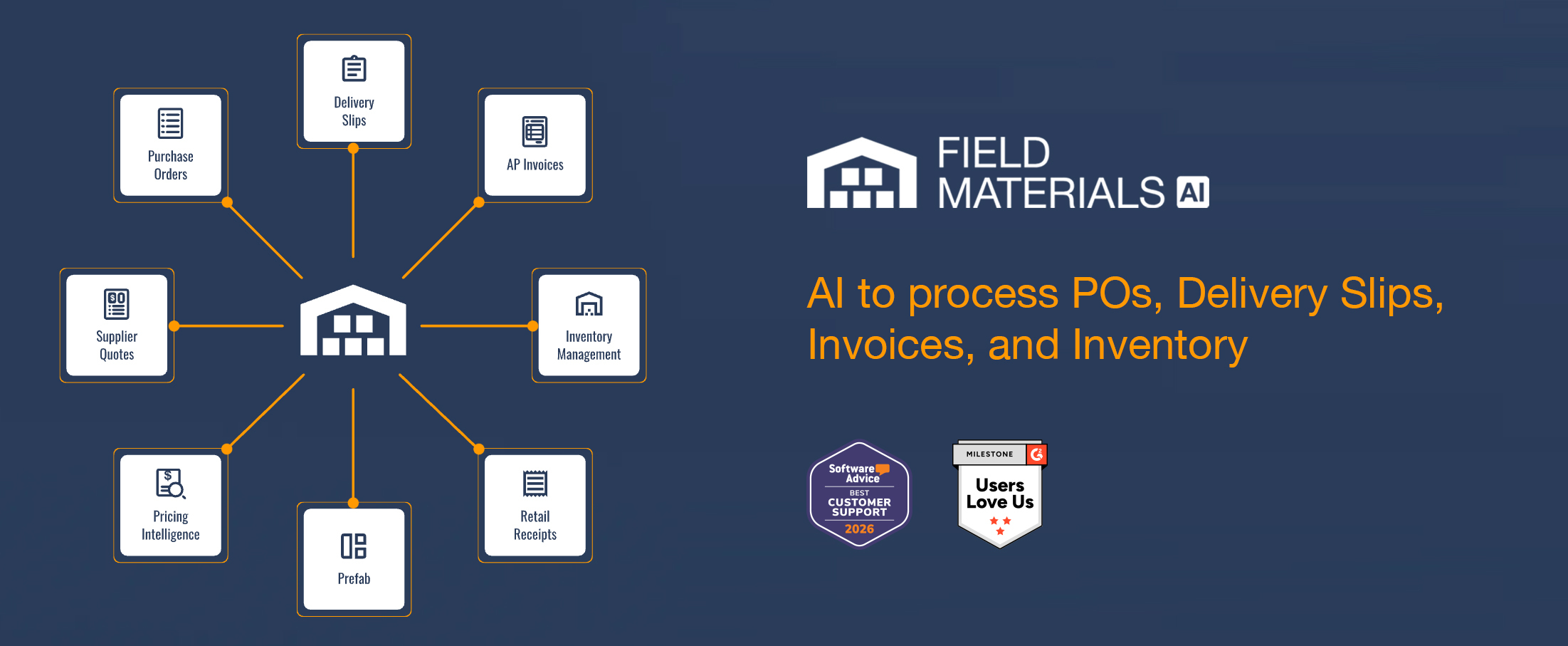
Field Materials is an AI-powered procurement and accounts payable automation platform built specifically for commercial construction contractors and developers. In an industry where material costs dictate project viability, the software targets the administrative friction of purchasing by digitizing quotes, purchase orders, delivery slips, and invoices. According to the BestCRE master database, the platform is priced at $599 per month, making it an accessible enterprise-grade solution for mid-market general contractors and specialty trades. Founded by former AI researchers with deep construction ties, the company recently secured an oversubscribed Series A funding round, signaling strong market validation. The platform is designed to replace the fragmented spreadsheets, email threads, and paper tickets that typically define construction procurement.
By deploying artificial intelligence to read and extract data from unstructured vendor documents, Field Materials automates the tedious three-way matching process required to verify that what was ordered matches what was delivered and what was ultimately billed. The software bridges the gap between the job site and the back office, offering a mobile application for field workers to request materials and log deliveries, while providing accounting teams with a centralized dashboard for invoice approvals. In a landscape populated by highly rated peers like ALICE Technologies and OpenSpace, Field Materials distinguishes itself by focusing strictly on the financial and logistical supply chain rather than physical site mapping or schedule optimization. This narrow focus allows it to deliver highly specialized tools for inventory management, prefabrication tracking, and real-time pricing intelligence.
What Field Materials does and how it works
At its core, Field Materials functions as a digital bridge between a construction firm’s field operations, purchasing department, and accounting team. The platform is divided into several interconnected modules: quote management, purchase orders, delivery records, accounts payable automation, inventory management, and prefabrication tracking. The workflow begins when a project manager or field superintendent submits a material requisition via the mobile application. The system can automatically generate requests for quotes and send them to a network of approved vendors. Once vendors reply with PDF quotes, the software’s artificial intelligence agents read the documents, extract line-item details, and present a side-by-side bid leveling comparison, allowing the purchasing team to select the most cost-effective option without manual data entry.
After vendor selection, the platform converts the winning quote into a standardized purchase order and routes it through internal approval hierarchies before dispatching it to the supplier. When materials arrive at the job site, field workers use their smartphone cameras to capture images of the delivery tickets. The artificial intelligence reads these slips, extracting received quantities and instantly cross-referencing them against the original purchase order to flag any discrepancies or backorders. This real-time receipt logging prevents the common issue of lost paperwork and ensures the office knows exactly what materials are on site.
The final phase of the product mechanics involves accounts payable automation. When the vendor submits an invoice, the system automatically performs a three-way match, comparing the invoice line items against the original purchase order and the verified delivery tickets. If all quantities and prices align, the invoice is approved and synced directly to the company’s enterprise resource planning system for payment. The platform recently added a pricing intelligence module, which aggregates historical purchasing data to provide executives with real-time insights into material price volatility, helping them time their bulk purchases to avoid market price spikes.
9AI Framework: the score, dimension by dimension
CRE Relevance: 10/10
Field Materials is entirely native to the commercial real estate and construction sectors, built specifically to address the unique supply chain challenges of general contractors and specialty trades. Unlike generic procurement software, this platform understands construction-specific units of measure, such as reconciling pricing units like thousand square feet against shipping units like individual studs or panels. It also handles complex industry workflows, including prefabrication tracking, equipment rentals, and job-specific inventory management. The system recognizes American Institute of Architects invoice formats and tracks retainage, demonstrating a deep understanding of construction finance. By focusing exclusively on the materials and equipment that physically build commercial assets, the software avoids the bloat of industry-agnostic tools and delivers immediate value to project managers and estimators. In practice: Construction firms can deploy the software without needing to translate their existing procurement terminology or adapt their workflows to fit a generic template.
Data Quality and Sources: 9/10
The platform relies heavily on optical character recognition and natural language processing to extract data from highly variable vendor documents. Construction suppliers frequently use proprietary, non-standardized formats for quotes, delivery tickets, and invoices, often featuring handwritten notes or smudged text from job sites. Field Materials excels at interpreting these messy inputs, accurately digitizing line items, quantities, and pricing data. The software also maintains high data integrity by enforcing strict validation rules during the three-way matching process, ensuring that discrepancies are flagged before they corrupt the accounting system. The newly introduced pricing intelligence module further enhances data quality by aggregating historical purchasing trends, providing users with a reliable baseline for cost estimation. In practice: Accounting teams spend significantly less time hunting down data entry errors and can trust that the figures synced to their financial systems are accurate and verified.
Ease of Adoption: 8/10
Implementing a comprehensive procurement system requires a dedicated change management effort, particularly when bridging the gap between office staff and field workers. Field Materials mitigates this friction by offering an intuitive mobile application that simplifies the requisition and receiving process for superintendents who may be resistant to new technology. However, the initial setup process demands a focused effort to map internal approval workflows, upload vendor databases, and configure integrations with existing accounting software. While the vendor provides onboarding assistance, firms must be prepared to invest time in training their purchasing and accounts payable teams to trust the automated matching system. The user interface is clean and logical, but the sheer breadth of modules means full adoption will likely occur in phases. In practice: Companies achieve the best results by rolling out the mobile receipt capture first, securing quick wins before transitioning to fully automated invoice matching.
Output Accuracy: 9/10
The core value proposition of Field Materials hinges entirely on its ability to accurately match purchase orders, delivery tickets, and invoices. The artificial intelligence agents perform this three-way match with a high degree of precision, catching unit discrepancies, unexpected price hikes, and short shipments that human reviewers often miss during end-of-month rushes. By automating the bid leveling process, the software also ensures that purchasing decisions are based on accurate, line-by-line comparisons rather than back-of-the-napkin math. While no extraction tool is completely flawless, particularly when dealing with heavily damaged field tickets, the system provides clear confidence scores and routes uncertain items for human review. This hybrid approach ensures that the final output sent to the general ledger is highly dependable. In practice: Contractors consistently recover margin by catching vendor overcharges and duplicate invoices that would have otherwise slipped through manual review processes.
Integration and Workflow Fit: 10/10
A procurement platform is only as useful as its ability to communicate with a company’s financial system of record. Field Materials excels in this dimension, offering deep, bidirectional integrations with the most prominent construction enterprise resource planning systems on the market. The platform connects directly with Sage 100, Sage 300 CRE, Sage Intacct, Viewpoint Vista, Viewpoint Spectrum, Foundation, CMiC, and Procore. These connections are not superficial data dumps; they involve direct database connections or application programming interfaces that ensure cost codes, vendor files, and project budgets remain perfectly synchronized between the field and the back office. This eliminates the need for double entry and ensures that project managers have real-time visibility into committed costs versus actual spending. In practice: Financial controllers can approve invoices within the procurement platform and watch them instantly populate in their accounting software with the correct job cost allocations.
Pricing Transparency: 9/10
The vendor strikes a reasonable balance between public disclosure and enterprise customization. According to the BestCRE master database, Field Materials offers a pricing entry point of $599 per month. While the company’s website indicates that final costs scale based on organization size and annual procurement volume, the existence of a verified baseline price allows commercial real estate analysts to model initial return on investment scenarios before engaging with a sales representative. Notably, the platform is completely free for vendors and suppliers to use, which removes a significant barrier to adoption and encourages network effects. This approach avoids the predatory toll booth models seen in some older construction networks. In practice: Mid-sized contractors can confidently budget for the software using the baseline figure, knowing that vendor participation will not incur hidden fees or require secondary licensing agreements.
Support and Reliability: 9/10
The company has built a strong reputation for customer service, consistently earning high marks from active users for its responsiveness and willingness to incorporate user feedback into the product. Support is accessible via direct phone lines and email, ensuring that critical procurement bottlenecks can be addressed immediately. As a relatively young company backed by a recent Series A funding round, Field Materials exhibits the agility of a startup, often deploying fixes and updates faster than legacy competitors. However, buyers should note that as the user base expands, maintaining this high-touch support model will require significant operational scaling. The platform itself operates on modern cloud infrastructure, providing high uptime and reliable performance even when field workers are uploading photos from areas with poor cellular connectivity. In practice: Users encountering an unrecognized vendor document format can rely on the support team to quickly train the system to read it.
Innovation and Roadmap: 9/10
Field Materials demonstrates a highly aggressive and relevant development trajectory. The company recently launched a pricing intelligence module in December 2025, which acts as a radar for material price volatility, directly addressing the margin compression contractors face from inflation and supply chain disruptions. The roadmap indicates a continued focus on expanding the capabilities of their artificial intelligence agents, allowing users to interact with the system using plain English commands for complex reporting tasks. Furthermore, the company is actively expanding its prefabrication tracking modules, aligning perfectly with the industry’s broader shift toward off-site manufacturing. This forward-looking approach ensures the platform remains a strategic asset rather than just a tactical administrative tool. In practice: Buyers are investing in a platform that actively evolves to solve emerging macroeconomic challenges, rather than a static piece of software that will require replacement in three years.
Market Reputation: 9/10
Despite being a newer entrant compared to legacy enterprise resource planning modules, Field Materials has rapidly established itself as a premier solution for self-performing general contractors and specialty trades. The platform is currently trusted by contractors across multiple construction trades, processing hundreds of millions in material purchases annually. The leadership team’s background, combining advanced artificial intelligence research with deep familial roots in the construction industry, lends significant credibility to their approach. The company’s ability to secure an oversubscribed funding round in a challenging venture capital environment speaks volumes about its customer traction and unit economics. It frequently wins head-to-head evaluations against older, workflow-driven tools by proving the tangible time savings of its document extraction capabilities. In practice: Procurement directors view the platform as a safe, highly validated choice that delivers measurable efficiency gains without disrupting established vendor relationships.
Who should use Field Materials
Field Materials is engineered for construction firms that manage high volumes of material purchases and struggle with the administrative burden of reconciling field deliveries with back-office accounting. It is highly effective for organizations looking to decentralize purchasing power to the field while maintaining strict financial controls.
- Self-performing general contractors who need to track materials across multiple active job sites and cost codes.
- Mechanical, electrical, and plumbing specialty trades dealing with complex, multi-line-item quotes and volatile commodity pricing.
- Firms utilizing prefabrication facilities that require precise coordination between warehouse inventory and job site delivery schedules.
- Financial controllers seeking to automate the accounts payable process and eliminate the manual three-way matching of invoices.
- Procurement managers wanting historical data to negotiate better bulk pricing agreements with regional suppliers.
Who should look elsewhere
While powerful for materials management, the platform is not a universal solution for all commercial real estate entities. Firms that do not directly manage construction materials will find the system entirely unnecessary for their operational needs.
- Real estate investment trusts or asset managers who outsource all construction and development to third-party general contractors.
- Pure-play property management firms looking for maintenance ticketing or tenant work order software.
- Boutique residential contractors with low transaction volumes who can effectively manage procurement through basic spreadsheet software.
- Firms unwilling to integrate their core accounting systems, as the platform’s primary value relies on bidirectional financial data syncing.
Pricing and ROI
According to the BestCRE master database, Field Materials offers a published pricing entry point of $599 per month. The vendor utilizes a tiered subscription model for contractors, where final costs scale based on the total size of the organization and the annual volume of procurement processed through the system. Importantly, the platform is completely free for vendors and suppliers to use, ensuring that supply chain partners can submit quotes and invoices without encountering paywalls that might discourage adoption. When evaluating the return on investment, commercial real estate analysts must look beyond the monthly subscription fee and calculate the hard cost savings generated by the software. Industry benchmarks suggest that automated three-way matching typically catches billing errors, duplicate invoices, and unapplied credits that amount to one to two percent of total material spend. Furthermore, the platform eliminates the need for manual data entry, allowing accounts payable clerks to process significantly more invoices per week. For a mid-sized specialty contractor purchasing five million dollars in materials annually, recovering just one percent in billing errors yields fifty thousand dollars in direct savings, paying for the baseline software subscription many times over within the first quarter of deployment.
Integration and CRE tech stack fit
Field Materials is designed to sit comfortably between a construction firm’s field management tools and its core financial systems. The platform boasts exceptional integration capabilities, featuring direct, bidirectional connections with the industry’s most widely used enterprise resource planning solutions. Verified integrations include Sage 100, Sage 300 CRE, Sage Intacct, Viewpoint Vista, Viewpoint Spectrum, Foundation, CMiC, and QuickBooks. For project management alignment, the software also integrates with Procore, ensuring that procurement data flows logically into broader project dashboards. These connections are typically established via direct cloud database connections or application programming interfaces, allowing for the real-time synchronization of vendor lists, project cost codes, and budget allocations. This architectural approach ensures that Field Materials acts as an extension of the existing tech stack rather than an isolated data silo. By automatically pushing verified, cost-coded invoices directly into the accounting system’s general ledger, the software eliminates duplicate data entry and ensures that financial controllers always have an accurate, up-to-the-minute view of committed costs and project profitability.
Competitive landscape
The construction procurement software market is highly competitive, with several distinct approaches to solving supply chain friction. Field Materials competes most directly with Kojo, a platform historically focused on the mechanical, electrical, and plumbing trades. While Kojo relies heavily on pre-built digital catalogs and direct electronic data interchange connections with specific suppliers, Field Materials differentiates itself through its artificial intelligence document extraction, allowing it to work with any vendor regardless of their technological sophistication. Remarcable is another strong alternative, specifically tailored for electrical contractors, offering deep catalog integrations but lacking the broad, multi-trade flexibility of Field Materials. For contractors heavily invested in the Trimble ecosystem, Trimble Materials offers a workflow-driven procurement solution that natively aligns with Trimble Construction One, though it may lack the advanced invoice matching automation found in specialized third-party tools. Subbase provides a lighter alternative for contractors with simpler requirements, focusing on quick ordering from custom material lists rather than comprehensive accounts payable automation. Finally, at the enterprise level, generic spend management platforms like Coupa or Stampli offer accounts payable automation, but they completely lack the construction-specific context required to handle retainage, prefabrication tracking, or complex unit-of-measure conversions. Field Materials secures its position by offering the sophisticated artificial intelligence of enterprise accounts payable tools while remaining strictly native to the physical realities of commercial construction.
The bottom line
Field Materials is a mandatory evaluation for any self-performing general contractor or specialty trade processing more than five million dollars in annual material spend. The platform successfully solves the most persistent administrative bottleneck in construction: the disconnect between what was ordered, what arrived on site, and what the vendor ultimately billed. By deploying highly accurate artificial intelligence to read unstructured documents, the software forces accountability onto the supply chain without requiring vendors to change their behavior. While the initial setup requires a dedicated effort to map internal workflows and integrate with core accounting systems, the immediate recovery of margin through automated error detection justifies the implementation cost. For firms relying on spreadsheets and manual ticket matching, Field Materials transitions procurement from a defensive administrative chore into a strategic, data-driven advantage. Buy it to protect project margins, accelerate invoice processing, and give your field teams a modern tool for material management.
Frequently asked questions
Does Field Materials integrate with Sage 300 CRE?
Yes, Field Materials offers a built-in integration with Sage 300 CRE through an on-premise desktop client. This bidirectional connection ensures that project cost codes, vendor data, and approved invoices sync perfectly between the procurement platform and your core accounting system without manual double entry.
Can vendors use the platform for free?
Yes, the platform is completely free for vendors and suppliers. They do not need to pay subscription fees to receive requests for quotes, submit bids, or process purchase orders. This zero-cost approach removes friction and ensures high adoption rates across your entire supply chain network.
How does the software handle delivery tickets from the job site?
Field workers use the mobile application to take photos of paper delivery tickets. The artificial intelligence automatically reads the document, extracts the received quantities, and instantly matches them against the original purchase order to flag missing items or backorders for the office team.
What is the Field Materials pricing intelligence module?
Launched in December 2025, the pricing intelligence module is a dashboard that tracks historical material costs and market volatility. It helps purchasing teams identify historical price trends, allowing contractors to lock in bulk orders when prices are lowest and accurately forecast future project expenses.
Does the system automate accounts payable matching?
Yes, the platform specializes in automated three-way matching. When an invoice is received, the artificial intelligence compares the billed amounts and quantities against the approved purchase order and the verified field delivery tickets. If everything matches, the invoice is routed for final payment approval.
Is Field Materials suitable for real estate developers who do not self-perform?
No, the software is built specifically for self-performing general contractors and specialty trades who directly purchase physical building materials. Developers or asset managers who outsource construction to third parties will not benefit from this highly specialized material procurement and inventory tracking platform.


