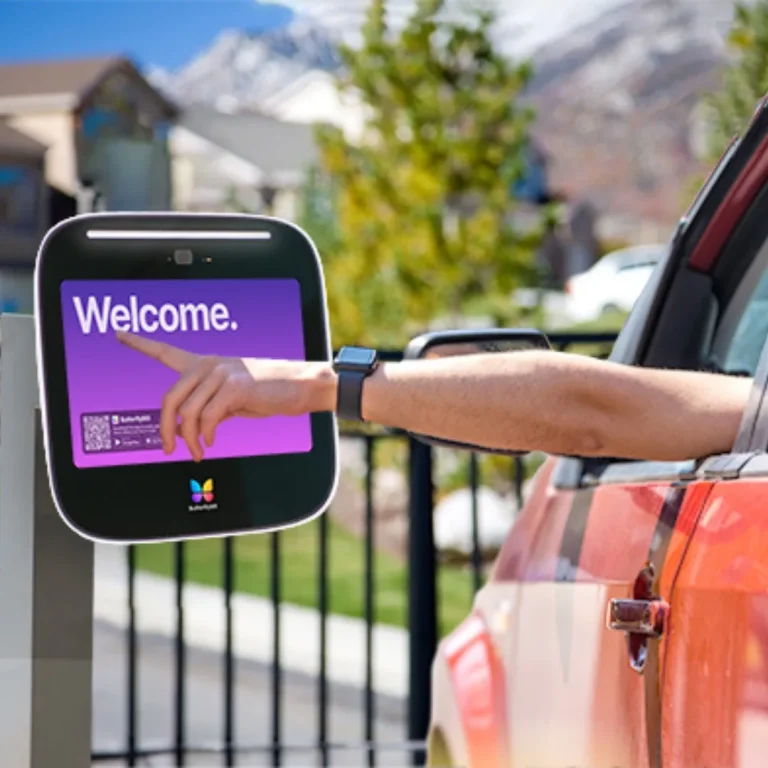
ButterflyMX is a cloud-based property access and security platform headquartered in New York City. Multifamily owners, commercial landlords, community associations, student housing operators, and other property managers use it to replace or supplement physical keys, fobs, call boxes, and separately managed entry systems. Its central workflow is straightforward: an authorized person uses a smartphone, credential, keypad, or intercom to enter, while management administers permissions and reviews activity through one system.
The platform extends beyond its best-known video intercom. Its product set includes access control, package rooms, security cameras, vehicle entry, smart locks, elevator controls, keypads, front desk tools, and self-guided tour capabilities. That breadth matters for buyers trying to coordinate entrances, gates, amenity spaces, elevators, and unit or suite access without assigning each opening to a different vendor. The practical value is operational consolidation, although the attainable scope depends on property hardware and integrations.
For residents and tenants, ButterflyMX centers the smartphone as both an access credential and a way to communicate with visitors. Guests can contact occupants through a video intercom, and authorized occupants can grant entry remotely. Property teams can manage access without routinely distributing replacement credentials or visiting the site for every permission change. Analysis: this is most valuable where visitor traffic, turnover, deliveries, lockouts, and after-hours access create recurring labor rather than occasional inconvenience.
The buying decision is more complicated than selecting an app. Door hardware, wiring, connectivity, installation quality, life-safety requirements, existing systems, and resident adoption all affect results. ButterflyMX does not publish standard pricing, so buyers need a site-specific proposal and a clear accounting of equipment, installation, subscriptions, integrations, maintenance, and replacement obligations. BestCRE views it as a credible CRE-native access platform, but not as a substitute for property management, work-order, accounting, or asset management software.
What ButterflyMX Does and How It Works
ButterflyMX creates a digital permission layer across building entry points. Administrators maintain users and access rights in its management software, then connect those permissions to supported entrances and devices. A resident or employee can use a mobile credential to open an authorized door or gate. Visitors can search a directory or contact an occupant through the intercom, communicate by video, and receive remote entry when approved. Temporary access methods, including visitor passes and QR-based entry, can reduce the need for permanent credentials when configured for the property.
The broader system connects several physical access workflows. Video intercoms handle communication at entrances, access control manages controlled openings, vehicle products address gates, and compatible locks and elevator controls can extend permissions deeper into a building. Package-room tools can restrict access to delivery areas, while cameras and event records provide context around entry activity. A front desk station supports staffed properties, and self-guided tour functionality can help leasing teams provide controlled prospect access. Exact functionality should be confirmed by device, entrance type, and building configuration.
Management occurs remotely through cloud software rather than only at an on-site panel. This enables teams to add or remove users, adjust permissions, investigate access events, and manage multiple entry workflows without being physically present at every property. Integrations can connect resident, tenant, or prospect data with access provisioning, reducing duplicate entry during move-ins, move-outs, and tours. Analysis: the platform’s strongest mechanic is the connection between identity, permission, and physical entry. Its weakest point is that software performance cannot compensate for poorly selected hardware, unreliable connectivity, weak installation, or inaccurate source data.
9AI Framework: Dimension by Dimension Analysis
CRE Relevance: 9/10
Score: 9. ButterflyMX is purpose-built around physical access workflows found in multifamily and commercial real estate. Its modules address front entrances, gates, elevators, package rooms, parking access, unit or suite doors, visitor communication, and controlled tours. These are recurring operating concerns for owners and managers, not generic business processes repackaged for property teams. The platform also accommodates several property types, including apartments, offices, associations, student housing, senior living, industrial facilities, and gated communities. Analysis: its relevance is especially high for portfolios where access administration affects staffing, resident experience, leasing, and security. It falls short of a perfect score because it handles a defined operational layer rather than the full property lifecycle. It does not replace core accounting, lease administration, maintenance management, investment analysis, or asset management systems.
Data Quality and Sources: 7/10
Score: 7. ButterflyMX depends on identity records, access permissions, directory information, device status, and event logs. These are well-defined operational data types, and a unified platform can provide a clearer record than disconnected call boxes, key logs, and stand-alone door systems. Video and access events can add useful context when teams investigate an incident. However, the quality of the record depends on correct user provisioning, synchronized move-in and move-out data, reliable devices, accurate timestamps, and disciplined administration. Public technical detail about retention rules, field-level data governance, exception handling, and completeness metrics is limited. Analysis: buyers should not assume that installing the platform automatically produces clean portfolio data. They should test how records enter the system, how quickly terminated users lose access, which events are retained, and how administrators identify failed or offline devices.
Ease of Adoption: 8/10
Score: 8. The resident proposition is familiar: use a smartphone to receive visitor calls and open authorized entrances. That can be easier to explain than a collection of keys, remotes, and building-specific panels. Remote administration can also simplify recurring tasks for property teams, particularly credential changes, visitor entry, and lockout response. Adoption is not frictionless, however. Some occupants may lack compatible phones, resist app-based access, or need an accessible alternative. Installation can involve door hardware, gates, elevators, wiring, networking, and coordination with contractors. Analysis: ButterflyMX earns a strong score because the daily interface is simpler than the physical infrastructure behind it. Buyers should evaluate adoption in two separate phases: construction and commissioning for the property, then onboarding and exception handling for users. A fallback access policy remains necessary even when mobile adoption is high.
Output Accuracy: 7/10
Score: 7. ButterflyMX does not primarily generate analytical answers or forecasts. Its critical outputs are permission decisions, door commands, visitor communications, device states, and access-event records. Accuracy therefore means that the correct person receives the correct rights, an authorized command reaches the intended opening, and the audit trail reflects what occurred. Those functions can be dependable when user data, integrations, connectivity, and hardware are correctly configured. Errors may originate upstream through stale resident records, incorrect permissions, shared credentials, integration delays, or installer mistakes. Analysis: the system should be judged through controlled operating tests, not a polished demonstration. Buyers should test revoked credentials, temporary passes, offline conditions, elevator permissions, repeated visitor calls, concurrent administrators, and emergency procedures. ButterflyMX provides useful operational evidence, but its records should not be treated as infallible proof without corroborating context.
Integration and Workflow Fit: 8/10
Score: 8. ButterflyMX positions integrations as a way to connect access with the systems that manage residents, tenants, prospects, smart-home devices, and property operations. The most valuable workflow is automated provisioning: a move-in, move-out, employee change, or scheduled tour can update access without repeated manual entry. This reduces administrative effort and lowers the chance that old credentials remain active. Its broad hardware scope also lets buyers connect more entry points within a common environment. Public availability does not guarantee that every integration supports the same objects, timing, or bidirectional behavior. Analysis: buyers should request a field-level integration map for their exact property management system and hardware. Confirm whether updates are real time or scheduled, how failures are reported, who owns troubleshooting, and whether custom work carries additional fees. The integration story is strong, but implementation detail determines its actual value.
Pricing Transparency: 3/10
Score: 3. ButterflyMX does not publish standard product prices, subscription rates, installation charges, or an online cost calculator. Prospective customers are directed to request a quote. Site-specific pricing is understandable because entrance counts, door conditions, gates, elevators, wiring, connectivity, camera requirements, and local labor can vary materially. Still, the absence of public ranges makes early comparison difficult and can obscure the division between equipment, installation, recurring software, support, and future expansion. Analysis: buyers should require an itemized total cost of ownership covering the initial term and a realistic renewal period. The proposal should identify hardware ownership, warranty coverage, replacement costs, cellular or network charges, integration fees, minimum commitments, annual increases, and cancellation terms. The low score reflects purchasing opacity, not necessarily poor value. Value cannot be judged responsibly until the complete site design and commercial terms are visible.
Support and Reliability: 7/10
Score: 7. ButterflyMX provides distinct contact paths for sales, support, and billing, and its website includes resources for residents, property managers, and installers. That separation suggests an operating model designed for several stakeholder groups. For access systems, support quality must extend beyond answering software questions because outages can affect entry, deliveries, leasing, and resident satisfaction. The vendor does not publicly present enough standardized service-level detail to compare response and restoration commitments across every plan. Analysis: owners should evaluate support as part of the access architecture. Contracts should identify coverage hours, escalation procedures, monitoring responsibility, installer obligations, remote troubleshooting scope, replacement logistics, and the process for a building-wide outage. References should come from properties with similar doors, gates, elevators, and staffing. The score recognizes the visible support structure while reserving judgment on contractual performance that is not published.
Innovation and Roadmap: 7/10
Score: 7. ButterflyMX’s innovation lies in combining smartphone visitor communication, mobile credentials, access administration, and connected building devices in one property-focused environment. QR entry, self-guided tours, package-room access, vehicle control, elevator permissions, and camera context extend the platform beyond a conventional apartment call box. None of these concepts is unique in isolation, and established access-control vendors increasingly offer mobile credentials and cloud management. The differentiation is the packaging of these capabilities around real estate workflows and user groups. Analysis: this is practical product innovation rather than evidence of a fundamentally new access model. Buyers should prioritize reliability, interoperability, and administration over feature novelty because an entry platform becomes operational infrastructure. The score also reflects limited public detail about advanced automation, independent performance benchmarks, or distinctive artificial intelligence functions. ButterflyMX is modern, but its value comes primarily from workflow design and consolidation.
Market Reputation: 8/10
Score: 8. ButterflyMX has visible adoption across multifamily, commercial, student housing, and gated communities. The company says its platform is used at more than 20,000 properties and its homepage states that it is trusted by 2 million, although the latter claim does not clearly define the measured population in the abbreviated statement. Public customer stories include owners and managers describing use in apartments, coworking properties, and gated communities. Analysis: this establishes meaningful market presence for a specialized CRE access vendor, but vendor-published testimonials are not a substitute for independent references. Buyers should speak with operators using comparable hardware, portfolio scale, resident demographics, and property staffing. They should also ask about renewal experience, outage history, support escalation, installer quality, and expansion costs. The reputation score is strong because ButterflyMX is a recognized category participant, not because every deployment will perform equally.
Who Should Use ButterflyMX
ButterflyMX best suits multifamily and mixed-use owners that experience frequent guest traffic, deliveries, resident turnover, lockouts, and credential administration. It is also relevant to commercial offices, coworking operators, student housing, gated communities, associations, senior living, and industrial properties that need centrally managed entry. Portfolio operators with lean site teams may benefit most when remote administration removes repeated trips or manual credential work. Developers planning access during design or major renovation have the best opportunity to coordinate doors, gates, elevators, cameras, networking, and resident workflows as one project.
The strongest buyer has a named operational owner, a reliable installation partner, and clean source data for occupants and staff. That buyer should want more than an attractive intercom. It should have specific workflows to improve, such as visitor entry, move-out revocation, prospect tours, package access, or after-hours gate management. Analysis: ButterflyMX is particularly compelling when several access functions can be consolidated and connected to the existing property technology stack. A controlled pilot at a representative property is preferable for a portfolio commitment because it reveals installation, connectivity, user adoption, and support behavior under actual conditions.
Who Should Not Use ButterflyMX
Properties needing only a basic stand-alone buzzer or a small number of conventional keys may find the platform broader than necessary. Buyers with unreliable building connectivity, severely constrained capital budgets, or door and elevator systems due for replacement should resolve those foundations before committing to cloud administration. Operators that cannot offer a practical alternative for residents without smartphones also need a more inclusive access design. ButterflyMX should not be treated as a cure for weak identity management or inconsistent move-out procedures.
The product is also a poor fit for buyers seeking a complete property management, accounting, maintenance, or asset management suite. It controls a specialized operational layer and must coexist with core systems. Highly regulated or security-sensitive facilities should conduct deeper reviews of architecture, permissions, retention, incident response, and fallback operations than public marketing can support. Analysis: if procurement requires public list prices, standardized installation costs, or independently published performance benchmarks before vendor engagement, ButterflyMX will create early diligence friction because those details are not comprehensively published.
Pricing and ROI Analysis
ButterflyMX does not publish standard pricing. Buyers must request a quote based on the property and desired products. That proposal may need to account for intercom equipment, controlled openings, cameras, gates, elevators, smart locks, keypads, installation labor, networking, subscriptions, integrations, warranties, and ongoing service. A responsible comparison should normalize each bid across the same doors and workflows. Ask for separate initial and recurring charges, contract length, renewal mechanics, expansion pricing, equipment ownership, replacement obligations, and any charges associated with implementation or data connections.
Analysis: simple ROI math should begin with avoidable annual operating cost, not a vendor claim. Suppose a property expects to save 12 staff hours per month and values loaded labor at $35 per hour. The estimated labor benefit is $5,040 per year, calculated as 12 times $35 times 12. Add only documented savings from eliminated credentials, reduced on-site dispatches, or other measurable changes. Then subtract annual software, connectivity, maintenance, and hardware reserve costs. Divide the remaining annual benefit into the initial installation cost to estimate payback. This example is illustrative, not ButterflyMX pricing or a guaranteed result. Buyers should replace every assumption with property records and test sensitivity when savings are lower than expected.
Integration and CRE Tech Stack Fit
ButterflyMX fits beside a property management system rather than replacing it. The core system should remain the authoritative source for leases, residents, tenants, employees, or prospects, while ButterflyMX translates eligible records into access permissions. Useful connections can automate move-ins, revoke access after move-outs, support scheduled tours, and coordinate compatible locks or building devices. This arrangement can reduce duplicate administration, but only if identity matching and exception handling are dependable.
Before contracting, request a written matrix covering the exact vendor, product edition, fields, triggers, and devices in use. Confirm whether provisioning is automatic, how quickly changes propagate, whether updates travel in both directions, and what administrators see after a failed synchronization. Buyers should also establish which party supports the connection when the property management vendor, access platform, and installer disagree. Analysis: the platform can become a valuable access layer in a CRE stack, but vague claims of compatibility are not enough for a mission-critical entrance workflow.
Competitive Landscape
SmartRent is the closest alternative when an owner wants access control inside a broader smart-apartment and property automation strategy. Its appeal may be stronger for portfolios coordinating locks, thermostats, sensors, and resident technology under a wider operating program. Brivo is a well-established cloud access-control option with relevance across commercial facilities and multifamily properties. It may suit buyers prioritizing enterprise security administration, credential management, and a broad access ecosystem. ButterflyMX is more visibly centered on the property entrance, visitor, and resident experience.
Latch is another recognizable alternative for mobile building access and connected property workflows. Buyers should assess its current product scope, support model, compatible hardware, and commercial terms for the proposed deployment rather than relying on historical category positioning. Traditional intercom and access vendors, combined with separate visitor-management software, can also compete when an owner prefers modular procurement or already has standardized security infrastructure.
Within BestCRE’s broader Property Management and Operations category, DoorLoop, Entrata, AppFolio, Venn, TurboTenant, VTS, and Yardi Virtuoso address different layers of property operations. They are not direct substitutes for every ButterflyMX device or entrance workflow. Analysis: compare ButterflyMX primarily against access platforms, then evaluate how well each candidate connects with the selected management suite. The winning choice should be based on site compatibility, administration, failure behavior, support, and total cost, not the length of a feature page.
The Bottom Line
ButterflyMX should make the shortlist for owners seeking a CRE-native platform that joins video intercoms, mobile entry, visitor access, and related building controls. Its strongest case appears at properties where fragmented systems create recurring work and an inconsistent resident or tenant experience. Proceed when the vendor can demonstrate the exact doors, gates, elevators, integrations, fallback methods, and administrator workflows required by the site.
Do not approve it from a remote demonstration alone. Require an itemized proposal, technical survey, implementation plan, support commitments, data-flow map, and references from comparable properties. Analysis: a pilot is the right decision for a portfolio buyer unless an existing standard has already been proven under similar conditions. ButterflyMX is a credible access platform with meaningful breadth, but the investment succeeds at the intersection of software, hardware, installation, source data, and operating discipline.
About BestCRE
BestCRE.com is the definitive authority on commercial real estate AI, analysis, and investment intelligence. Every article advances the platform’s mission to help CRE professionals identify, evaluate, and adopt the best tools and strategies in the industry. We benchmark platforms using the 9AI Framework so CRE leaders can compare tools with clear evidence. Explore the category map at 20 CRE sectors for deeper coverage across the CRE stack.
Frequently Asked Questions
What is ButterflyMX?
ButterflyMX is a cloud-based property access and security platform for multifamily and commercial real estate. It is best known for video intercoms that let visitors contact residents or tenants, who can then see, speak with, and admit them using a smartphone. The product portfolio also covers access control, package rooms, cameras, vehicle gates, compatible smart locks, elevator controls, keypads, front desk functions, and self-guided tours. Property managers administer users and permissions remotely. Analysis: it is an access operating layer, not a complete property management system. Owners still need separate systems for leases, accounting, work orders, and asset management. Its value is highest where visitor entry, credential changes, deliveries, lockouts, or controlled tours generate significant recurring work.
How does ButterflyMX compare with Brivo, SmartRent, and Latch?
ButterflyMX places strong emphasis on video intercoms, visitor entry, mobile credentials, and the resident or tenant experience. Brivo is often evaluated by buyers seeking cloud access control across a broader commercial security environment. SmartRent may be more attractive when access is part of a wider smart-apartment program involving locks, thermostats, sensors, and automation. Latch also competes in mobile access and connected property operations. Analysis: no comparison should stop at feature labels. Test the exact doors, gates, elevators, credentials, integrations, offline behavior, and management workflows required by the property. Installation coverage, support obligations, data synchronization, and total cost can matter more than nominal product breadth. A site-specific demonstration and comparable customer references are essential.
How much does ButterflyMX cost?
ButterflyMX does not publish standard prices for its hardware, installation, or recurring software. A buyer must request a site-specific quote, which is reasonable for a physical access project but limits early cost comparison. The proposal should separate equipment, installation, subscriptions, connectivity, integrations, maintenance, warranties, replacements, and optional modules. It should also state contract length, renewal increases, equipment ownership, and cancellation terms. Analysis: evaluate cost against measured reductions in credential handling, lockout visits, front desk work, manual provisioning, and other site tasks. Do not accept generalized savings claims as the business case. Build a property-level model using actual labor records and expected hardware life, then test whether the project still pays back if adoption is slower or savings are smaller than forecast.
Who should use ButterflyMX?
ButterflyMX is suited to multifamily owners, commercial landlords, student housing operators, associations, gated communities, coworking businesses, senior living properties, and other managers with recurring access complexity. It is particularly relevant when a property handles substantial visitor traffic, deliveries, resident or employee turnover, after-hours entry, amenity permissions, vehicle gates, or leasing tours. Portfolio teams can also benefit from remote administration and standardized workflows across sites. Analysis: the ideal buyer has clean occupant data, a capable installer, reliable connectivity, and a manager accountable for access governance. Small properties with simple key requirements may not recover the cost or operational effort. Facilities with specialized security obligations should complete a detailed technical, privacy, resilience, and incident-response review before purchase.
Is ButterflyMX prepared for the future of property access?
ButterflyMX is positioned for continued movement toward mobile credentials, remote administration, integrated building devices, temporary visitor access, and automated provisioning. Its range across intercoms, controlled doors, cameras, gates, elevators, and tours gives owners room to expand within one environment. Future readiness still depends on matters that a product catalog cannot settle: hardware longevity, open integration paths, cybersecurity practices, accessible alternatives, contractual data rights, and the vendor’s ability to support installed equipment over time. Analysis: buyers should negotiate export rights, replacement terms, integration continuity, and a workable exit plan. They should also preserve non-phone entry options and documented outage procedures. The platform appears adaptable, but future-proofing comes from architecture and contracts as much as from current features.
Related Reviews
Compare ButterflyMX with other tools BestCRE has scored in the same category: DoorLoop, Entrata, Moved. Explore more CRE AI tool reviews in our Best CRE AI Tools directory. For sector-specific analysis and market intelligence, visit our 20 CRE Sectors hub.