Category: CRE Construction & Development

  • Snaptrude Review: AI Powered Concept Design Platform for CRE Architecture

    Snaptrude Review: AI Powered Concept Design Platform for CRE Architecture

    BestCRE 9AI Score

    70/100 · Contender

    Snaptrude ranks #80 of 100 commercial real estate AI tools scored on the 9AI Framework. Nine dimensions, each scored out of 10: CRE relevance, data quality, ease of adoption, output accuracy, integration fit, pricing transparency, support, innovation and market reputation.

    The concept design phase of commercial real estate development is where the most critical decisions are made with the least analytical support. CBRE’s 2025 Development Advisory estimated that 80 percent of a building’s lifecycle cost is determined during the first 20 percent of the design process, yet architects spend an average of 4 to 8 weeks on concept design using tools originally designed for construction documentation rather than early stage exploration. JLL’s architectural efficiency study found that the gap between schematic design and BIM ready models adds an average of 6 to 10 weeks to the pre construction timeline, with firms spending $30,000 to $80,000 on the transition from concept sketches to coordinated digital models. The American Institute of Architects reported that 42 percent of design firms identified early stage design tools as their most significant technology gap, while Dodge Construction Network’s survey indicated that projects using AI assisted concept design reached permit submission 35 percent faster than those relying on traditional design workflows.

    Snaptrude is an AI powered BIM platform that enables architects to move from a text prompt or RFP to a BIM ready building model entirely within the browser. The platform deploys 10 specialized AI agents that handle distinct phases of the concept design process: site analysis, zoning compliance, architectural programming, space dimensioning based on building codes (IBC, ADA, Neufert), massing studies, floor plan generation, space stacking across stories, and AI rendered presentation outputs. Founded in 2017 and developed over seven years, Snaptrude’s technical foundation is its Universal Graph Representation, a proprietary system that treats buildings as interconnected databases of spatial relationships rather than static geometry. Customers report 60 to 70 percent reductions in concept design time, with average daily usage among core users exceeding three hours per day.

    Snaptrude earns a 9AI Score of 70 out of 100, reflecting strong innovation in AI driven architectural design, meaningful ease of adoption through browser based access, and a maturing product with seven years of development behind it. The score is balanced by moderate CRE integration depth, custom pricing that limits accessibility assessment, and a market position that is still growing relative to established BIM platforms. The platform represents one of the most technically ambitious approaches to AI assisted architecture, with a clear trajectory toward deeper capabilities in 2026.

    This review is part of BestCRE’s systematic coverage of commercial real estate AI tools across 20 CRE sectors. For the full AI tools directory, see our Best CRE AI Tools hub.

    What Snaptrude Does and How It Works

    Snaptrude covers the full early stage design process in a single browser based platform, from initial site analysis through presentation ready design outputs. The workflow begins when a user provides either a text prompt describing the project requirements or uploads an RFP document. The AI agents then execute a structured design sequence: analyzing the site’s constraints and opportunities, checking zoning regulations and building codes, generating an architectural program with departments and spaces, assigning dimensions based on applicable codes (International Building Code, ADA accessibility requirements, Neufert standards), organizing spaces vertically across stories, producing floor plan layouts, and generating AI rendered visualizations for client presentations.

    The Universal Graph Representation (UGR) is the technical foundation that distinguishes Snaptrude from traditional design software. Developed over three years of R and D, UGR treats a building not as static 3D geometry but as an interconnected database where every element has defined relationships with adjacent elements. This means that when an architect changes a room size, the system understands the cascading implications for corridor widths, structural grid alignment, egress compliance, and program area calculations. Traditional BIM tools handle these relationships through manual constraints and clash detection; Snaptrude’s graph based approach manages them algorithmically.

    The platform operates entirely in the browser, which eliminates the need for powerful local workstations and expensive desktop software licenses. This architectural choice reflects a deliberate strategy to lower the barrier to AI assisted design, making professional tools accessible to firms of all sizes, including the free student plan launched in late 2025 that gives architecture students worldwide access to the full professional platform. The browser based delivery also enables real time collaboration, where multiple team members and stakeholders can view and interact with the design simultaneously.

    For CRE professionals, Snaptrude’s value lies in the compression of the concept to schematic design timeline. A developer evaluating multiple sites can use Snaptrude to generate concept designs for each site in hours rather than weeks, enabling faster feasibility assessment and more informed land acquisition decisions. The zoning compliance AI agent is particularly relevant because it automatically checks proposed designs against local zoning requirements, reducing the risk of concept designs that are not entitleable. A major release planned for Spring 2026 aims to push the platform’s capabilities to LOD 300 to 350, the level of detail at which architects could complete schematic design within Snaptrude and only hand off to Revit for final construction documentation.

    9AI Framework: Dimension by Dimension Analysis

    CRE Relevance: 8/10

    Snaptrude directly serves the architectural design phase of CRE development, with AI agents specifically calibrated for building code compliance, zoning analysis, and space programming that are central to commercial real estate projects. The platform’s ability to generate concept designs from RFP documents aligns with how CRE developers commission architectural services, and the zoning compliance checking addresses one of the most common sources of delay and cost in CRE development. The multi story space stacking capability is particularly relevant for commercial buildings where vertical organization of uses drives lease economics and functional performance. While Snaptrude primarily serves architects rather than CRE investors or operators, its impact on the design timeline directly affects development economics and project feasibility. In practice: Snaptrude addresses the architectural design workflow that gates every CRE development project, with AI capabilities that directly reduce the time and cost of moving from concept to buildable design.

    Data Quality and Sources: 7/10

    Snaptrude incorporates building code databases (IBC, ADA, Neufert) into its AI agents, which provides a reliable foundation for code compliant design generation. The zoning analysis capability draws on regulatory data to check proposed designs against local requirements. The Universal Graph Representation creates a high fidelity data model of building relationships that supports accurate spatial calculations and constraint checking. However, the platform does not incorporate external CRE market data, construction cost databases, or real time regulatory updates. The quality of the zoning compliance checking depends on the completeness of the regulatory data for each jurisdiction, which may vary. The AI rendered outputs are presentation quality but are conceptual representations rather than photographic documentation. In practice: Snaptrude delivers high quality design data grounded in building codes and spatial intelligence, though the data scope is confined to architectural and regulatory domains rather than extending into market or financial analytics.

    Ease of Adoption: 8/10

    Snaptrude’s browser based architecture eliminates the hardware requirements and software installation that traditional BIM tools demand. Architects can begin using the platform from any computer with a web browser, which dramatically reduces the adoption barrier compared with desktop applications like Revit that require powerful workstations and expensive licenses. The text prompt to design workflow means that users can start generating concept designs within minutes of accessing the platform, without needing to master complex software interfaces. The free student plan extends accessibility to the next generation of architects, building a user base familiar with the platform before they enter professional practice. The 60 to 70 percent reduction in concept design time reported by customers suggests that the platform delivers immediate productivity benefits. In practice: Snaptrude has one of the lowest adoption barriers of any professional architectural design platform, combining browser based access with AI driven workflows that produce results quickly even for first time users.

    Output Accuracy: 7/10

    Snaptrude’s output accuracy benefits from its Universal Graph Representation, which maintains consistent spatial relationships and constraint compliance throughout the design process. The AI agents check designs against building codes and zoning requirements, which adds a layer of regulatory accuracy that manual design processes often achieve only through iterative review. The BIM ready outputs ensure dimensional precision and structural coordination that supports downstream design development. However, the AI generated designs are concept level outputs that require professional review and refinement before they can serve as construction documents. The accuracy of zoning compliance depends on the currency and completeness of the regulatory data for each jurisdiction. Customer reports of 60 to 70 percent time reductions suggest that the outputs are of sufficient quality to serve as the foundation for detailed design rather than requiring complete rework. In practice: Snaptrude produces architecturally sound concept designs that are reliable enough to serve as the starting point for schematic and detailed design phases, with built in code compliance checking adding value that manual processes may miss.

    Integration and Workflow Fit: 6/10

    Snaptrude is designed to serve the concept through schematic design phases, with handoff to Revit for detailed design and construction documentation. The platform exports to standard formats that architectural teams can import into their downstream BIM workflows. The browser based architecture enables collaboration with stakeholders who do not have architectural software, including CRE developers and project managers. However, direct integrations with CRE operational platforms, financial modeling tools, or construction management systems are not prominently documented. The Spring 2026 release targeting LOD 300 to 350 should extend the platform’s workflow coverage, reducing the need for early handoff to Revit. For firms that use Snaptrude in combination with Revit, the integration path is established but involves a file based handoff rather than a live connection. In practice: Snaptrude fits well into the early stage design workflow with a clear handoff point to established BIM tools, but does not integrate with the broader CRE operational tech stack.

    Pricing Transparency: 5/10

    Snaptrude uses custom pricing for professional subscriptions, with no publicly available rate cards on its website. The free student plan demonstrates a commitment to accessibility, but professional pricing requires engagement with the sales team. The custom pricing model is typical for BIM platforms targeting architectural firms, where the pricing often varies based on firm size, project volume, and feature requirements. For CRE developers evaluating Snaptrude as a complement to their design team’s toolkit, the lack of published pricing creates uncertainty in the evaluation process. The availability of the free student plan does provide a zero cost way to explore the platform’s capabilities, though the student version may differ from the professional offering. In practice: professional pricing requires a sales conversation, which limits rapid evaluation, but the free student plan provides an indirect way to assess the platform’s capabilities.

    Support and Reliability: 6/10

    Snaptrude has been in development since 2017, which provides a track record of sustained development and operational continuity that many newer platforms cannot demonstrate. The browser based architecture provides reliability advantages including automatic updates, server side processing, and elimination of local software conflicts. The three hours of average daily usage among core customers suggests a platform that is reliable enough for sustained professional work. However, specific SLA commitments, uptime guarantees, and formal support tier details are not prominently documented. The company’s active development roadmap and regular releases indicate an engaged product team, but the support infrastructure may be more limited than what established BIM vendors like Autodesk provide. In practice: Snaptrude appears to deliver reliable performance based on customer usage patterns, but firms should confirm support commitments and data backup policies before depending on the platform for critical design work.

    Innovation and Roadmap: 9/10

    Snaptrude represents one of the most innovative approaches to AI assisted architectural design. The concept of deploying 10 specialized AI agents that handle distinct phases of the design process, from site analysis through rendered presentations, goes significantly beyond simple AI feature additions to traditional tools. The Universal Graph Representation, developed over three years, is a technically sophisticated approach to modeling building intelligence that enables the cascading constraint management that makes AI design generation possible. The text prompt to BIM ready model workflow is transformative for the concept design phase, where speed and iteration are more important than documentation precision. The Spring 2026 release targeting LOD 300 to 350 represents an ambitious roadmap milestone that, if achieved, would significantly extend the platform’s coverage of the design process. The free student plan is also innovative from a market development perspective, building familiarity and adoption among future professionals. In practice: Snaptrude pushes the boundaries of what AI can achieve in architectural concept design, with a technical foundation and roadmap that position it as a potential disruptor in the BIM software category.

    Market Reputation: 7/10

    Snaptrude has earned meaningful recognition in the architectural technology community through coverage in AEC Magazine, Dezeen, and illustrarch, and has been featured in educational programs like PAACADEMY’s architectural intelligence course. The seven years of development demonstrate persistence and continuous improvement that build credibility among architectural practitioners who have seen many AEC startups come and go. The customer reports of 60 to 70 percent design time reductions provide tangible evidence of the platform’s value. However, Snaptrude’s market presence is still significantly smaller than established BIM platforms, and its adoption among large institutional architectural firms is not extensively documented in public materials. The free student plan should strengthen the platform’s reputation over time as students enter professional practice. In practice: Snaptrude is well regarded in the architectural technology community, with credible media coverage and customer outcomes, though its market footprint is still growing relative to established incumbents.

    9AI Score Card Snaptrude
    70
    70 / 100
    Solid Platform
    AI Concept Design and BIM Platform
    Snaptrude
    Browser based AI BIM platform with 10 specialized agents taking architects from text prompt to code compliant, presentation ready building designs.
    9 Dimensions, Scored 1 to 10
    1. CRE Relevance
    8/10
    2. Data Quality & Sources
    7/10
    3. Ease of Adoption
    8/10
    4. Output Accuracy
    7/10
    5. Integration & Workflow Fit
    6/10
    6. Pricing Transparency
    5/10
    7. Support & Reliability
    6/10
    8. Innovation & Roadmap
    9/10
    9. Market Reputation
    7/10
    BestCRE.com, 9AI Framework v2 Reviewed April 2026

    Who Should Use Snaptrude

    Snaptrude is ideal for architectural firms that want to dramatically accelerate the concept design phase of CRE projects. Firms producing high volumes of concept designs, feasibility studies, or competition entries will see the most immediate productivity gains from the AI agent workflow. CRE developers who commission concept designs and want faster iteration between project vision and architectural feasibility should encourage their architectural partners to evaluate Snaptrude. Architecture students benefit from the free student plan that provides access to professional AI design tools during their education. Small and mid size firms that cannot afford multiple Revit licenses may find Snaptrude’s browser based model a cost effective alternative for early stage design work.

    Who Should Not Use Snaptrude

    CRE professionals focused on investment analysis, property management, leasing, or portfolio analytics will not find relevant features in Snaptrude. Large architectural firms with established Revit workflows and significant training investments may be reluctant to introduce a new design platform, even for early stage work. Firms working primarily on renovation, adaptive reuse, or historic preservation projects may find the AI’s new construction orientation less applicable. Projects requiring immediate LOD 400 or 500 outputs for construction documentation are beyond Snaptrude’s current capabilities and should continue using Revit or equivalent tools. If your CRE workflow does not involve commissioning or reviewing architectural designs, Snaptrude does not address your professional needs.

    Pricing and ROI Analysis

    Snaptrude uses custom pricing for professional subscriptions, with a free plan available for architecture students. The ROI case centers on design time compression: if the platform delivers the reported 60 to 70 percent reduction in concept design time, a firm that typically spends 8 weeks on concept design could complete the same work in 2.5 to 3 weeks. For firms billing hourly, this time compression could translate into either reduced project costs or increased capacity to handle more projects per year. The browser based architecture also reduces infrastructure costs by eliminating the need for high performance workstations and desktop software licenses. For CRE developers, faster concept design means faster feasibility assessment, which accelerates land acquisition decisions and reduces pre development carrying costs.

    Integration and CRE Tech Stack Fit

    Snaptrude exports to standard BIM formats for handoff to Revit and other detailed design tools. The browser based platform enables collaboration with CRE stakeholders who do not have architectural software. The Spring 2026 release targeting LOD 300 to 350 should extend the platform’s workflow coverage and reduce the need for early handoff to legacy BIM tools. The platform does not integrate with CRE financial modeling, deal management, or property operations systems. For firms that need to connect architectural design outputs to pro forma analysis, the connection is through file export rather than live integration.

    Competitive Landscape

    Snaptrude competes with TestFit for site and building feasibility, qbiq for interior space planning, Autodesk Forma for concept design and environmental analysis, and Revit itself for the broader BIM workflow. Snaptrude differentiates through its multi agent AI approach to concept design, its browser based architecture that eliminates hardware barriers, and its Universal Graph Representation that enables intelligent constraint management. TestFit is more focused on development feasibility with financial integration, while Snaptrude covers a broader architectural design scope from concept through schematic design. The free student plan creates a competitive advantage in building the next generation user base. The Spring 2026 LOD 300 to 350 release, if successful, would position Snaptrude as a more comprehensive alternative to Revit for early and mid stage design work.

    The Bottom Line

    Snaptrude is a technically ambitious AI design platform that transforms the concept design phase of CRE architecture. The 9AI Score of 70 reflects strong innovation with its 10 AI agents and Universal Graph Representation, combined with exceptional ease of adoption through browser based delivery. The score is balanced by moderate CRE integration depth and a market position still growing relative to established BIM platforms. For architectural firms and CRE developers who need faster, more iterative concept design, Snaptrude offers a compelling alternative to traditional workflows that can reduce design timelines by 60 to 70 percent. The platform’s seven year development history and ambitious 2026 roadmap suggest sustained commitment to becoming a comprehensive AI design platform for the CRE industry.

    About BestCRE

    BestCRE.com is the definitive authority on commercial real estate AI, analysis, and investment intelligence. Every article advances the platform’s mission to help CRE professionals identify, evaluate, and adopt the best tools and strategies in the industry. We benchmark platforms using the 9AI Framework so CRE leaders can compare tools with clear evidence. Explore the category map at 20 CRE sectors for deeper coverage across the CRE stack.

    Frequently Asked Questions

    How does Snaptrude’s text prompt to design workflow work?

    Users begin by providing either a text prompt describing their project requirements or uploading an RFP document. Snaptrude’s 10 specialized AI agents then execute a structured design sequence: the site analysis agent evaluates the parcel’s constraints and opportunities, the zoning agent checks applicable regulations, the programming agent generates a structured list of departments and spaces, the dimensioning agent assigns appropriate sizes based on building codes (IBC, ADA, Neufert), and subsequent agents handle massing, floor plan generation, space stacking across stories, and presentation rendering. The entire process produces a BIM ready model in the browser without requiring the user to manually draw or model any geometry. Architects can then refine the AI generated design, adjusting room sizes, relocating spaces, or modifying the massing while the system maintains compliance with codes and spatial relationships through its Universal Graph Representation.

    Can Snaptrude replace Revit for CRE architectural projects?

    Currently, Snaptrude is designed to complement Revit rather than replace it entirely. The platform covers the concept through early schematic design phases, where its AI capabilities provide the most dramatic productivity advantages. For detailed design development and construction documentation (LOD 400 and above), architects still need to hand off to Revit or equivalent BIM tools. However, the Spring 2026 release targeting LOD 300 to 350 aims to extend Snaptrude’s coverage deeper into the schematic design phase, which would reduce the scope of work that needs to happen in Revit. For firms that spend significant time on concept design and feasibility studies, Snaptrude can eliminate weeks of work per project while producing outputs that transition smoothly into Revit based detailed design workflows. The long term trajectory suggests Snaptrude may eventually cover a larger portion of the design process.

    What building codes does Snaptrude’s AI check against?

    Snaptrude’s AI agents reference the International Building Code (IBC), Americans with Disabilities Act (ADA) accessibility requirements, and Neufert architectural data standards when generating designs. These codes govern key design parameters including minimum room sizes, corridor widths, egress requirements, accessibility clearances, and occupancy calculations. The AI automatically dimensions spaces according to these standards, which reduces the risk of code compliance issues being discovered later in the design process when changes are more expensive. The platform’s zoning compliance agent also checks proposed designs against local zoning requirements including setbacks, height limits, floor area ratio (FAR), and parking requirements, though the availability of local zoning data may vary by jurisdiction. Architects should verify AI generated code compliance against the specific version of codes adopted by their project’s jurisdiction.

    Is there a free version of Snaptrude available?

    Snaptrude launched a free student plan in late 2025 that gives architecture students worldwide full access to the professional platform and AI workflows. This plan is designed to build familiarity with Snaptrude among future architectural professionals, creating a pipeline of users who enter practice already proficient with the platform’s capabilities. The student plan requires verification of student status through an educational institution. For professional users, pricing is custom and requires engagement with the sales team. The student plan provides an indirect way for CRE professionals and architectural firms to evaluate Snaptrude’s capabilities, as firms can ask interns or recent graduates who have student access to demonstrate the platform’s features before committing to a professional subscription.

    What is the Universal Graph Representation and why does it matter?

    The Universal Graph Representation (UGR) is Snaptrude’s proprietary technical foundation, developed over three years of research and development. Unlike traditional BIM tools that represent buildings as static 3D geometry with manually defined constraints, UGR models a building as an interconnected database of spatial relationships. Every element in the building (rooms, corridors, structural elements, openings) has defined relationships with adjacent elements, and changes to one element trigger automatic adjustments to related elements. This matters because it enables the AI agents to generate designs that are internally consistent, code compliant, and spatially coherent without requiring architects to manually manage constraint relationships. When an architect resizes a room, the UGR automatically adjusts corridor widths, checks egress compliance, updates area calculations, and modifies adjacent spaces, a cascade of updates that would take manual effort in traditional tools. The graph based approach is what makes text prompt to design generation feasible at architectural quality levels.

    Related Reviews

    Explore the broader tool library at Best CRE AI Tools and the sector map at 20 CRE sectors to compare Snaptrude against adjacent platforms.

  • Motif Review: AI Powered Collaboration Platform for AEC Design Teams

    Motif Review: AI Powered Collaboration Platform for AEC Design Teams

    BestCRE 9AI Score

    70/100 · Contender

    Motif ranks #77 of 100 commercial real estate AI tools scored on the 9AI Framework. Nine dimensions, each scored out of 10: CRE relevance, data quality, ease of adoption, output accuracy, integration fit, pricing transparency, support, innovation and market reputation.

    The architecture, engineering, and construction industry has long struggled with fragmented collaboration tools that force design teams to work across disconnected platforms, converting files between formats and losing context between 2D drawings, 3D models, and design discussions. CBRE’s 2025 Development Technology Survey found that design coordination inefficiencies add an average of 12 to 18 percent to pre construction timelines, with 58 percent of developers citing design review bottlenecks as a top source of project delays. JLL’s construction advisory team estimated that the AEC software market reached $8 billion in 2025, yet most architectural firms still rely on email, PDF markups, and file sharing systems designed for general office work rather than for the specific demands of building design. The Urban Land Institute reported that AI adoption in architectural design grew from 14 percent to 38 percent between 2023 and 2025, driven by tools that can generate photorealistic renderings, optimize layouts, and streamline the design review process that gates every CRE development project.

    Motif is an intelligent workspace for architects and designers, built by former Autodesk executives Amar Hanspal and Brian Mathews. The platform provides a unified cloud environment where design teams can collaborate on 2D drawings, 3D models, sketches, specifications, and AI generated renderings in a single infinite canvas. Motif connects directly to Revit and Rhino, streaming live models into the workspace without file exports or format conversions. The AI rendering engine transforms sketches, images, and 3D models into 4K architectural visualizations in seconds, purpose built for buildings rather than adapted from general purpose image generation tools. The company has secured $46 million in seed and Series A funding led by Redpoint Ventures and CapitalG (Alphabet’s independent growth fund), and was named to the 2025 AI Disruptors 60 list.

    Motif earns a 9AI Score of 70 out of 100, reflecting exceptional innovation, strong institutional backing, and deep AEC workflow integration. The score is balanced by its indirect CRE relevance (the platform serves architects and designers rather than CRE investors or operators directly), limited pricing transparency, and the absence of CRE specific data or analytics. The platform addresses the design collaboration layer of CRE development, which is critical to project timelines but serves a specialized audience within the broader CRE ecosystem.

    This review is part of BestCRE’s systematic coverage of commercial real estate AI tools across 20 CRE sectors. For the full AI tools directory, see our Best CRE AI Tools hub.

    What Motif Does and How It Works

    Motif reimagines the design collaboration workflow by providing a single, cloud based workspace that natively handles the diverse file types and media that architectural teams work with daily. Instead of switching between Revit for 3D modeling, Bluebeam for PDF markup, Figma for presentations, and email for communication, design teams can bring all of these activities into Motif’s infinite canvas. The workspace supports 2D drawings (plans, sections, elevations), 3D models (streamed live from Revit or Rhino), sketches, photographs, specification documents, and AI generated renderings, all coexisting in a spatial layout that preserves the relationships between design elements.

    The direct integration with Revit and Rhino is a technical achievement that distinguishes Motif from general purpose collaboration tools. Rather than exporting models to intermediate formats (which introduces file size issues, loss of detail, and version management complexity), Motif streams live 3D models directly from the design software into the collaborative workspace. Changes made in Revit are reflected in Motif without manual re upload. This live connection also supports visual programming environments like Grasshopper and Dynamo, which architects use for parametric design and computational optimization. The streaming architecture means that project stakeholders, including CRE developers and asset managers, can review 3D models in the browser without installing Revit or Rhino on their machines.

    The AI rendering capability is calibrated specifically for architectural applications. General purpose AI image generators often produce buildings that look impressive but contain structural impossibilities, incorrect proportions, or materials that do not exist in construction. Motif’s AI is fine tuned for buildings, producing 4K renders that reflect constructible geometry, realistic materials, and appropriate spatial proportions. The renderings are IP protected, meaning the AI does not train on the user’s designs, which addresses a significant concern for architectural firms that need to protect their creative work. The rendering engine can transform rough sketches into photorealistic visualizations in seconds, which accelerates the design presentation process that is critical in CRE development, where visual communication often determines whether a project advances or stalls.

    The founding team’s Autodesk pedigree is directly relevant to understanding Motif’s positioning. Amar Hanspal served as CEO of Autodesk’s Design and Manufacturing group, and Brian Mathews held senior leadership positions at the company. Their deep understanding of how architectural software is used in practice, combined with the frustrations they observed in the existing tool landscape, informed Motif’s design philosophy. The $46 million in funding from Redpoint Ventures and CapitalG (Alphabet’s growth fund) provides the resources to compete with established AEC software vendors. The company’s selection for the 2025 AI Disruptors 60 list validates its technical innovation within the broader AI landscape.

    9AI Framework: Dimension by Dimension Analysis

    CRE Relevance: 7/10

    Motif serves the architectural design teams that create the buildings CRE professionals develop, lease, and manage, but it does not directly serve CRE investors, operators, or brokers. The platform’s CRE relevance comes through its impact on the design and pre construction phases of commercial development, where collaboration efficiency directly affects project timelines, costs, and design quality. CRE developers who are actively involved in design review and coordination benefit from Motif’s ability to stream 3D models to stakeholders without requiring specialized software. The AI rendering capability is relevant for marketing, leasing presentations, and investor communications where photorealistic visualizations of proposed developments are needed. However, the platform does not provide market data, financial analysis, lease management, or any CRE operational capabilities. In practice: Motif is highly relevant to the design and development segment of CRE but has limited applicability for professionals focused on investment analysis, property operations, or brokerage.

    Data Quality and Sources: 6/10

    Motif processes design data rather than market or financial data. The platform handles 3D models, 2D drawings, renderings, and specifications with high fidelity, maintaining the precision and detail that architectural work demands. The live streaming from Revit and Rhino preserves the full data integrity of the source models, which is critical for design review and coordination. The AI rendering engine produces high quality visual outputs that accurately represent architectural intent. However, the platform does not incorporate external CRE data sources, market analytics, cost databases, or property information. The data dimension is entirely confined to the design domain, which means Motif does not contribute to the data driven decision making that characterizes most CRE technology platforms. In practice: Motif delivers excellent data quality within the architectural design domain but does not extend into the market, financial, or property data that CRE professionals typically need.

    Ease of Adoption: 7/10

    Motif is designed as a cloud native platform that works in the browser, which eliminates the installation and hardware requirements that traditional AEC software demands. The direct integration with Revit and Rhino means that design teams can begin streaming their existing models into Motif without converting files or changing their design workflow. The infinite canvas interface is intuitive for design professionals who are accustomed to spatial arrangements of drawings and models. The AI rendering feature requires minimal setup and can produce results in seconds. For project stakeholders who are not architects (including CRE developers and asset managers), the browser based access provides a low friction way to review designs without installing specialized software. The main adoption challenge is that the platform is new and design teams may be reluctant to add another tool to their workflow, even if it promises to consolidate existing ones. In practice: Motif’s cloud native architecture and direct software integrations make adoption relatively straightforward for teams already using Revit or Rhino, with the browser based access lowering the barrier for non technical stakeholders.

    Output Accuracy: 7/10

    Motif’s output accuracy is strong across its core functions. The live model streaming preserves the dimensional and geometric accuracy of Revit and Rhino models without introducing conversion artifacts. The 2D drawing review maintains the precision needed for architectural sheet review, including dimensioning, annotations, and layering. The AI rendering accuracy is notable because the system is specifically trained for architectural applications, producing visualizations that reflect constructible geometry and realistic material properties rather than the fantastical interpretations that general purpose AI image generators sometimes produce. The 4K resolution ensures that renderings are suitable for professional presentations and marketing materials. The platform’s accuracy limitations are primarily in the AI rendering domain, where generated images, while architecturally grounded, are artistic interpretations rather than photographic documentation of actual conditions. In practice: Motif produces accurate outputs for design review and collaboration, with AI renderings that are realistic enough for professional use while remaining clearly identified as conceptual visualizations.

    Integration and Workflow Fit: 8/10

    Integration is one of Motif’s strongest dimensions. The direct connections to Revit, Rhino, Grasshopper, and Dynamo cover the most widely used architectural design and computational tools in the industry. The live streaming architecture eliminates the export/import cycle that creates friction and version control issues in traditional workflows. The infinite canvas workspace can accommodate all project media types, reducing the need to switch between separate tools for different activities. For CRE development teams that participate in design review, the browser based access means they can view and comment on designs without needing design software licenses or training. The platform supports multi model collaboration, which is essential for complex CRE projects where architectural, structural, and MEP models must be coordinated. In practice: Motif integrates deeply with the AEC design tool ecosystem, providing a natural extension of existing workflows rather than requiring a replacement of established tools.

    Pricing Transparency: 4/10

    Motif uses custom pricing with no publicly available tiers or rate cards on its website. The $46 million in funding suggests that the company is focused on building market share and may offer competitive pricing, but prospective users must engage with the sales team to learn about costs. This is typical for enterprise AEC software but creates friction for smaller architectural firms and individual practitioners who want to evaluate affordability before committing to a conversation. The platform’s positioning toward mid to large architectural firms and CRE development companies suggests enterprise oriented pricing that may be less accessible to boutique studios and sole practitioners. In practice: pricing information requires direct engagement with Motif’s sales team, which limits the platform’s accessibility for smaller firms and creates procurement friction in an industry where tool evaluation often happens informally before formal procurement.

    Support and Reliability: 7/10

    Motif’s $46 million in funding from tier one investors including Redpoint Ventures and CapitalG provides substantial resources for product development, customer support, and platform reliability. The founding team’s Autodesk background means they understand the enterprise support expectations of architectural firms and CRE development companies. The cloud native architecture provides reliability advantages over desktop software, including automatic updates, data redundancy, and access from any device. However, the platform is relatively new, and its track record of sustained reliability under heavy usage loads has not been extensively documented. The AEC industry demands high reliability because design review deadlines and project milestones create time sensitive collaboration requirements. In practice: the funding level and founding team experience suggest a strong support foundation, but the platform’s newness means that sustained reliability and enterprise support quality have not yet been proven over multiple years of operation.

    Innovation and Roadmap: 9/10

    Motif demonstrates exceptional innovation across multiple dimensions. The live streaming of Revit and Rhino models without file export is a technical achievement that addresses one of the most persistent friction points in AEC collaboration. The AI rendering engine calibrated specifically for buildings, with IP protection and architectural accuracy, goes beyond what general purpose AI tools offer. The infinite canvas concept that unifies 2D drawings, 3D models, sketches, and renderings in a single spatial workspace reimagines how design teams organize and communicate their work. The founding team’s decision to build a new platform rather than incrementally improving existing tools reflects a transformative ambition. The 2025 AI Disruptors 60 recognition validates the innovation from an independent perspective. The $46 million in funding from Alphabet’s growth fund signals confidence in the platform’s technical direction. In practice: Motif represents one of the most technically ambitious new platforms in the AEC software landscape, with innovations that address fundamental workflow problems rather than incremental feature improvements.

    Market Reputation: 8/10

    Motif has rapidly built market credibility through its founding team’s Autodesk pedigree, $46 million in institutional funding, and recognition in prominent media and industry channels. TechCrunch covered the company’s launch and funding, Engineering News Record profiled the platform’s capabilities, and CapitalG published an investment thesis explaining why Motif represents a revolution in building design. The 2025 AI Disruptors 60 selection further validates the company’s innovation credentials. The founding team’s established relationships in the AEC industry provide direct access to potential enterprise clients, and the Autodesk alumni network creates a natural adoption pathway. While the platform is still in its early market phase, the quality and volume of its validation signals exceed what most AEC startups achieve at this stage. In practice: Motif has achieved a level of market credibility that typically takes years to build, driven by the founding team’s industry standing, the caliber of its investors, and the quality of its media coverage.

    9AI Score Card Motif
    70
    70 / 100
    Solid Platform
    AEC Design Collaboration and AI Rendering
    Motif
    Cloud collaboration platform for architects and designers with AI rendering, live Revit/Rhino model streaming, and infinite canvas workspace.
    9 Dimensions, Scored 1 to 10
    1. CRE Relevance
    7/10
    2. Data Quality & Sources
    6/10
    3. Ease of Adoption
    7/10
    4. Output Accuracy
    7/10
    5. Integration & Workflow Fit
    8/10
    6. Pricing Transparency
    4/10
    7. Support & Reliability
    7/10
    8. Innovation & Roadmap
    9/10
    9. Market Reputation
    8/10
    BestCRE.com, 9AI Framework v2 Reviewed April 2026

    Who Should Use Motif

    Motif is ideal for architectural and design firms working on commercial real estate projects who need to streamline their design review, collaboration, and visualization workflows. Firms that use Revit or Rhino as their primary design tools will benefit most from the live model streaming capability, which eliminates file export friction. CRE development companies that actively participate in design review and need browser based access to 3D models without installing specialized software will find value in Motif’s stakeholder review features. Marketing and leasing teams that need rapid architectural renderings for presentations, investor decks, and leasing collateral can use the AI rendering engine to produce professional visualizations without waiting for traditional rendering workflows. Large firms managing multiple concurrent projects will benefit from the unified workspace that consolidates disparate design media into a single collaborative environment.

    Who Should Not Use Motif

    CRE professionals focused on investment analysis, property management, market analytics, or brokerage transactions will not find relevant features in Motif. The platform serves the design and construction phase of CRE development rather than the investment, operations, or leasing phases. Small architectural firms with simple project portfolios may not need the level of collaboration infrastructure that Motif provides. Teams that do not use Revit or Rhino as their primary design tools will see reduced benefit from the platform’s core integration capabilities. Organizations that need transparent, published pricing before evaluating new tools will find the custom pricing model a barrier. If your CRE workflow does not involve design review, coordination, or visualization, Motif does not address your professional needs.

    Pricing and ROI Analysis

    Motif uses custom pricing with no publicly available rate information. The ROI case centers on collaboration efficiency and rendering cost reduction. If Motif eliminates the need for separate collaboration, rendering, and review tools, the consolidated subscription may be cost competitive with the sum of tools it replaces. The AI rendering capability can reduce the cost and timeline of producing architectural visualizations from thousands of dollars and days of work to seconds at marginal cost. For firms that produce frequent renderings for marketing, leasing, or investor presentations, the rendering savings alone could justify the subscription. The collaboration efficiency gains, measured in reduced email volume, fewer file conversion errors, and faster design review cycles, contribute additional ROI that compounds across multiple projects.

    Integration and CRE Tech Stack Fit

    Motif integrates deeply with architectural design tools through direct connections to Revit, Rhino, Grasshopper, and Dynamo. The cloud based architecture provides browser access to 3D models and design content without requiring specialized software on the viewer’s machine. The platform does not integrate with CRE operational systems like Yardi, CoStar, Argus, or deal management platforms. For CRE development teams, Motif connects to the design layer of their project workflow but operates independently of financial, lease, and property management systems. The integration gap between design collaboration and CRE operations remains a manual bridge, though Motif’s browser access makes it easier for non technical CRE stakeholders to participate in design review without switching to specialized software.

    Competitive Landscape

    Motif competes with established AEC collaboration tools including Bluebeam Revu (PDF markup and review), Autodesk Construction Cloud (cloud based project collaboration), and Procore (construction management). In the AI rendering space, it competes with tools like Chaos V Ray AI, Lumion, and general purpose AI image generators that are being adapted for architectural use. Motif differentiates through its unified workspace approach (combining 2D, 3D, and AI rendering in one platform), its live model streaming without file export, and its founding team’s deep AEC industry expertise. The $46 million in funding from tier one investors positions Motif to compete aggressively with established vendors, and the cloud native architecture avoids the legacy constraints that older platforms carry. The competitive landscape is intensifying as AI capabilities are being integrated into multiple AEC software platforms simultaneously.

    The Bottom Line

    Motif is a technically ambitious and well funded platform that addresses fundamental collaboration challenges in the AEC industry. The 9AI Score of 70 reflects exceptional innovation, strong market credibility through institutional backing and founding team pedigree, and deep design tool integration. The score is balanced by indirect CRE relevance, limited pricing transparency, and the platform’s early market stage. For architectural firms and CRE development companies that are actively involved in design collaboration and visualization, Motif offers a compelling vision of how AI and cloud technology can transform the design review process. The platform is best evaluated by teams currently frustrated with the fragmentation of their design collaboration workflow and willing to adopt a new tool that consolidates multiple functions into a single workspace.

    About BestCRE

    BestCRE.com is the definitive authority on commercial real estate AI, analysis, and investment intelligence. Every article advances the platform’s mission to help CRE professionals identify, evaluate, and adopt the best tools and strategies in the industry. We benchmark platforms using the 9AI Framework so CRE leaders can compare tools with clear evidence. Explore the category map at 20 CRE sectors for deeper coverage across the CRE stack.

    Frequently Asked Questions

    How does Motif’s AI rendering differ from general purpose AI image generators?

    Motif’s AI rendering engine is specifically fine tuned for architectural applications, which means it understands building geometry, construction materials, spatial proportions, and lighting conditions in ways that general purpose AI tools do not. General purpose generators like Midjourney or DALL E can produce impressive building images, but they often include structural impossibilities, unrealistic material combinations, or proportions that would not work in actual construction. Motif’s architectural training produces renderings that reflect constructible geometry and realistic specifications, making them suitable for professional presentations to CRE developers, investors, and leasing prospects. The platform also provides IP protection, meaning user designs are not used to train the AI model, which addresses a significant concern for architectural firms that need to protect their creative intellectual property.

    Can CRE developers use Motif without being architects?

    Yes, CRE developers can access Motif through the browser without needing architectural software like Revit or Rhino installed on their machines. The platform streams 3D models and design content directly to the browser, allowing developers to review, comment on, and discuss designs with their architectural teams in a shared workspace. This browser based access is one of Motif’s key advantages for CRE stakeholders who participate in design review but do not create architectural drawings themselves. Developers can view the latest 3D models, see AI generated renderings of proposed designs, review 2D drawing sets, and provide feedback, all within a single platform. This eliminates the need for architects to export models to separate formats for developer review, which is a common source of delays and miscommunication in the design process.

    What architectural software does Motif integrate with?

    Motif provides direct, live integrations with Autodesk Revit and McNeel Rhino, which are the two most widely used 3D modeling platforms in the architecture industry. The integrations support live model streaming, meaning changes made in Revit or Rhino are automatically reflected in the Motif workspace without manual file export or upload. The platform also supports visual programming environments including Grasshopper (for Rhino) and Dynamo (for Revit), which architects use for parametric design, computational optimization, and design automation. These integrations cover the core tools used by the majority of architectural firms working on commercial real estate projects, ensuring that Motif fits naturally into existing design workflows rather than requiring teams to change their primary modeling software.

    Who founded Motif and why does their background matter?

    Motif was founded by Amar Hanspal and Brian Mathews, both former senior executives at Autodesk. Hanspal served as CEO of Autodesk’s Design and Manufacturing group, and Mathews held leadership positions at the company. Their background matters because Autodesk is the dominant software company in the AEC industry, and their experience gives them deep understanding of how architects and engineers actually use design software, what workflow problems persist despite decades of software development, and what enterprise clients expect from professional tools. This pedigree also provides credibility with potential clients and investors, which is reflected in the $46 million funding from tier one firms. For CRE professionals evaluating the platform, the Autodesk background provides confidence that Motif is built by people who understand the building design process at an institutional level.

    Is Motif’s design data protected from being used to train AI models?

    Yes, Motif emphasizes that its AI rendering engine is IP protected, meaning that user designs uploaded to the platform are not used to train the AI model. This is a significant differentiator for architectural firms that handle proprietary designs for CRE clients and cannot risk their creative work being incorporated into a publicly accessible AI training dataset. The IP protection policy addresses one of the primary concerns that professional design firms have about adopting AI tools, as many general purpose AI platforms use uploaded content to improve their models. For CRE development companies that commission architectural designs and own the intellectual property in those designs, Motif’s IP protection provides assurance that competitive information about proposed developments will not be exposed through AI training processes.

    Related Reviews

    Explore the broader tool library at Best CRE AI Tools and the sector map at 20 CRE sectors to compare Motif against adjacent platforms.

  • TestFit Review: Generative Design for CRE Development Feasibility

    TestFit Review: Generative Design for CRE Development Feasibility

    BestCRE 9AI Score

    78/100 · Contender

    TestFit ranks #55 of 100 commercial real estate AI tools scored on the 9AI Framework. Nine dimensions, each scored out of 10: CRE relevance, data quality, ease of adoption, output accuracy, integration fit, pricing transparency, support, innovation and market reputation.

    Development feasibility analysis is the foundation of every commercial real estate investment decision, yet the process of evaluating how a site can be optimally developed remains one of the most labor intensive and uncertain phases of the CRE lifecycle. CBRE’s 2025 Development Advisory reported that the average feasibility study for a mid size commercial project costs $75,000 to $200,000 and takes 8 to 16 weeks, with multiple design iterations required before developers can confidently validate financial assumptions. JLL’s development pipeline analysis found that 34 percent of deals that reach the feasibility stage are ultimately abandoned due to unfavorable site constraints or financial outcomes that emerge only after significant design investment. The Urban Land Institute’s 2025 Emerging Trends report identified AI driven design optimization as one of the top five technologies reshaping CRE development, with early adopters reporting 40 to 60 percent reductions in pre development timelines. Prologis, one of the world’s largest logistics real estate investors, has backed the development of generative design tools through its venture arm, signaling institutional confidence in the category’s transformative potential.

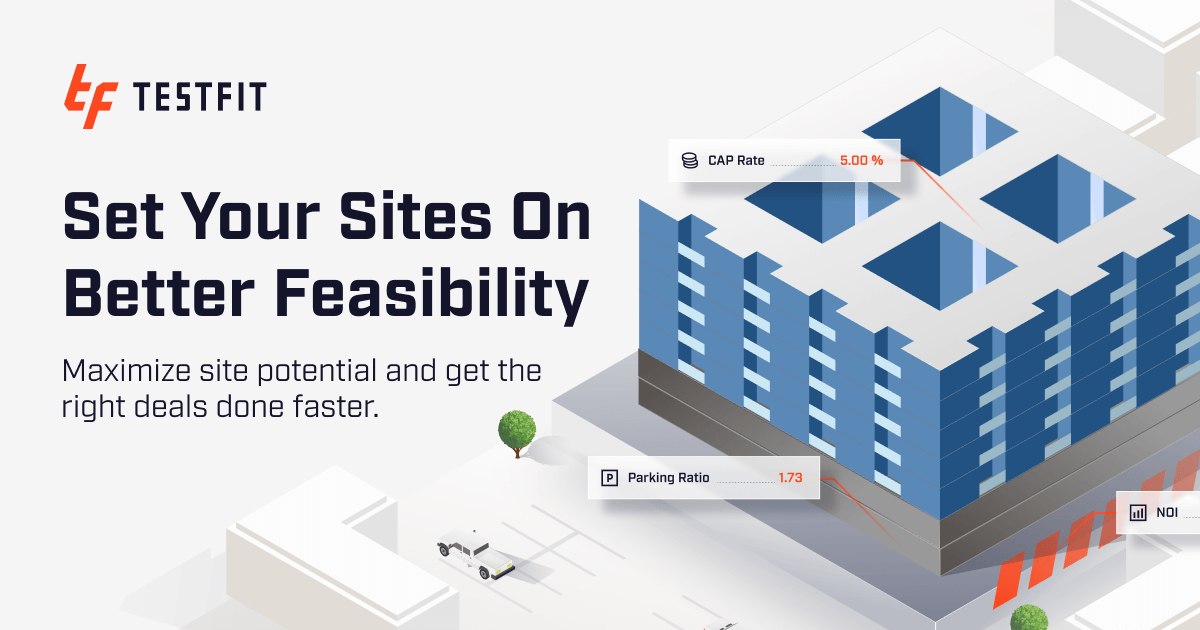
    TestFit is a real estate feasibility platform that uses generative design AI to help developers, architects, and contractors realize the full potential of land through trusted automation. Founded in 2016 and headquartered in Dallas, the company has raised $22 million in total funding, including a $20 million Series A led by Parkway Venture Capital with participation from Prologis Ventures, Moderne Ventures, Perot Jain, and Schematic Ventures. The platform tests thousands of building and site layout variations in real time, optimizing for both pro forma financial requirements and design intent simultaneously. TestFit’s automated takeoffs provide instant cost insights for parking, infrastructure, and earthwork, allowing developers to validate deals before investing in traditional architectural design. Celebrating its 10th anniversary in 2026, TestFit covers multifamily, single family, townhome, retail, and mixed use development types.

    TestFit earns a 9AI Score of 78 out of 100, reflecting exceptional CRE relevance, strong innovation in generative design, institutional investor validation, and meaningful output accuracy. The score is balanced by the learning curve associated with its analytical depth and the specialized audience of development professionals. The platform represents one of the most mature and commercially validated applications of generative AI in commercial real estate.

    This review is part of BestCRE’s systematic coverage of commercial real estate AI tools across 20 CRE sectors. For the full AI tools directory, see our Best CRE AI Tools hub.

    What TestFit Does and How It Works

    TestFit operates at the intersection of architectural design and financial analysis, where developers need to answer the fundamental question: what is the best thing to build on this site, and will it pencil? The platform’s Site Solver takes a parcel or site boundary as input and generates optimized building configurations that maximize developable area while respecting zoning constraints, setback requirements, parking ratios, access points, and topographic conditions. The generative design engine evaluates thousands of layout permutations simultaneously, testing different building orientations, massing configurations, parking arrangements, and unit mix strategies to identify solutions that satisfy both design and financial criteria.

    The financial integration is a critical differentiator. While traditional architectural tools optimize for spatial and aesthetic outcomes, TestFit connects design decisions to pro forma economics in real time. As the AI generates layout options, it simultaneously calculates construction cost estimates through automated quantity takeoffs for structural elements, parking infrastructure, earthwork, and site improvements. Developers can see how changing a building footprint or adding a parking level affects both the unit count and the estimated development cost, enabling rapid iteration between design and financial feasibility without waiting for separate cost estimation workflows.

    The platform supports multiple building types including multifamily apartment buildings, single family detached communities, townhome developments, retail centers, and mixed use projects. Each building type has specific optimization parameters: multifamily projects optimize for unit count, mix, and parking ratio; single family communities optimize for lot yield, street layout, and open space; retail projects optimize for gross leasable area and parking. The generative design feature, launched in July 2024, represents the latest advancement in the platform’s capabilities, using computational AI to explore design spaces that would be impossible for human designers to evaluate manually.

    TestFit’s investor base reflects the CRE industry’s confidence in the platform. Prologis Ventures, the venture arm of the world’s largest logistics real estate company, participated in the Series A alongside firms specializing in real estate technology and construction innovation. The company has been recognized by major industry publications including AI Magazine and Engineering.com, and its 2025 year in review indicates a growing client base across the development industry. Looking ahead to 2026 and beyond, the roadmap includes enhanced pro forma tools for deeper financial analysis, a retail building editor, improvements for low density development types, and continued generative design enhancements with more user control and processing speed.

    9AI Framework: Dimension by Dimension Analysis

    CRE Relevance: 10/100

    TestFit is built exclusively for commercial real estate development feasibility, making it one of the most CRE relevant platforms in the entire AI tools landscape. Every feature directly addresses a decision point in the development process: site optimization answers what can be built, unit mix analysis answers what should be built, cost estimation answers what it will cost, and the pro forma connection answers whether it pencils. The platform covers the most common CRE development types and integrates zoning constraints, parking requirements, and site specific conditions that are unique to real estate development. The Prologis Ventures investment validates the platform’s relevance to institutional CRE development, and the focus on real time financial feedback distinguishes TestFit from purely architectural tools. In practice: TestFit is purpose built for the most critical decision in CRE development, site feasibility, and addresses it with a depth of integration between design and finance that no competing platform matches.

    Data Quality and Sources: 7/10

    TestFit processes site data (boundaries, topography, zoning constraints), design parameters (building types, unit sizes, parking ratios), and cost data (construction unit costs, material quantities) to generate its optimized outputs. The quality of the site data depends on what the user provides or what the platform can access through integrated data sources. The cost estimation engine uses automated takeoffs to calculate quantities, which are then multiplied by user configured unit costs. The platform does not provide market data, comparable sale information, or demand analytics, which means the financial feasibility dimension relies on the developer’s own assumptions about rental rates, absorption, and operating expenses. The generative design algorithms produce spatially accurate outputs that respect physical constraints, but the financial accuracy depends on the quality of the cost and revenue assumptions the user inputs. In practice: TestFit delivers high quality spatial and structural outputs, but the financial feasibility assessment is only as good as the market assumptions the developer provides to the system.

    Ease of Adoption: 7/10

    TestFit provides a cloud based platform with published pricing and a structured onboarding process. The user interface is designed for real estate development professionals rather than trained architects, which means the conceptual learning curve is manageable for anyone familiar with site planning concepts. However, the platform’s analytical depth means that extracting maximum value requires understanding of zoning codes, parking ratios, construction cost structures, and development pro forma mechanics. The published pricing page allows prospective users to evaluate costs before engaging with sales, which reduces adoption friction. The generative design feature adds another layer of capability that may require time to master. Training resources and support from the TestFit team help bridge the learning gap, and the rapid output generation means that users can begin seeing valuable results even during the initial learning period. In practice: development professionals can start producing useful feasibility outputs within the first week, though building proficiency with advanced features like generative design and custom cost configurations takes longer.

    Output Accuracy: 8/10

    TestFit’s output accuracy is strong across its spatial optimization dimension, where the platform has been refined over nearly a decade of development and client feedback. The generative design engine tests thousands of layout variations against physical constraints and optimization criteria, producing building configurations that are architecturally feasible and spatially efficient. The automated takeoffs for parking counts, building areas, and site work quantities are deterministic calculations based on the generated geometry, which means they are mathematically accurate within the resolution of the design. The cost estimation accuracy depends on the unit costs configured by the user, which should be calibrated to local market conditions. Industry publications like Engineering.com and AEC Business have reviewed the platform favorably, noting the quality and reliability of the generated designs. In practice: TestFit produces spatially accurate, architecturally feasible layouts with reliable quantity calculations, though users should validate cost assumptions and check outputs against local code requirements before making investment commitments.

    Integration and Workflow Fit: 7/10

    TestFit fits into the CRE development workflow at the feasibility stage, producing outputs that feed into downstream architectural design, financial modeling, and permitting processes. The platform exports to standard architectural formats that can be consumed by Revit, AutoCAD, and other design tools. The pro forma data can be exported for integration with Excel based financial models or dedicated underwriting platforms. TestFit does not directly integrate with Argus, Yardi, or other CRE operational systems, but its position in the workflow is upstream of those tools. The cloud based architecture allows multiple team members to access and collaborate on projects, and the real time design feedback enables interactive sessions between developers, architects, and financial analysts. The upcoming pro forma enhancements in 2026 should deepen the financial integration layer. In practice: TestFit integrates well into the early stage development workflow through standard file exports and collaborative access, though connecting its outputs to downstream financial and operational systems requires manual or custom integration.

    Pricing Transparency: 7/10

    TestFit publishes a pricing page on its website, which provides more transparency than most enterprise CRE platforms. While the specific tier details and pricing levels require engagement with the sales team for full clarity, the existence of a public pricing page signals a commitment to accessibility and allows prospective users to understand the general cost structure before committing to a procurement conversation. The published pricing, combined with the platform’s clear ROI case (reducing feasibility study costs from $75,000 to $200,000 down to a fraction of that amount through automation), makes the value proposition relatively straightforward to evaluate. For a development firm evaluating multiple sites per year, the subscription cost is likely a small fraction of the traditional feasibility study expense. In practice: TestFit’s pricing transparency is above average for the CRE technology category, with a published pricing page that provides enough information for preliminary budgeting and ROI assessment.

    Support and Reliability: 7/10

    TestFit has been operating since 2016, making it one of the more mature platforms in the CRE generative design category. The $22 million in funding provides operational resources for product development, customer support, and platform reliability. The company’s 10 year track record suggests organizational stability and the ability to maintain consistent service over time. Published year in review content and active product roadmap communications indicate an engaged team that maintains close relationships with its user base. The platform’s adoption by institutional clients and its recognition in industry publications like AI Magazine and Engineering.com suggest enterprise grade expectations for support and reliability. Specific SLA details are not publicly documented, but the institutional investor base (including Prologis Ventures) implies that the company meets the operational standards expected by sophisticated real estate firms. In practice: TestFit’s decade of operations and institutional backing provide confidence in platform reliability and support quality.

    Innovation and Roadmap: 9/10

    TestFit is a pioneer in applying generative design to real estate development feasibility, and its 2024 launch of dedicated generative design capabilities represents a significant technical achievement. The ability to test thousands of building configurations in real time, simultaneously optimizing for spatial efficiency and financial performance, goes beyond what any traditional architectural tool can deliver. The platform’s continuous evolution over nearly a decade demonstrates sustained R and D investment, with each year bringing new building types, deeper analytical capabilities, and expanded automation. The 2026 roadmap includes pro forma tools for enhanced financial clarity, a retail building editor expanding asset class coverage, low density improvements for single family and townhome development, and generative design enhancements with more user control and processing speed. The Prologis Ventures investment signals confidence in the platform’s innovation trajectory from one of the most sophisticated CRE investors in the world. In practice: TestFit is at the leading edge of generative design for CRE development, with a demonstrated ability to innovate continuously and an ambitious roadmap that addresses expanding development types and deeper financial integration.

    Market Reputation: 8/10

    TestFit has built a strong market reputation within the CRE development and architectural community over its nearly decade long history. The $22 million in institutional funding from CRE focused investors including Prologis Ventures, Moderne Ventures, and Parkway Venture Capital validates the platform’s commercial viability and industry relevance. Coverage in publications including AI Magazine, Engineering.com, AEC Business, and Dallas Innovates demonstrates broad visibility across real estate, technology, and construction media. The platform’s participation in the Trimble 0 to 60 Challenge program in 2025 indicates recognition from major construction technology platforms. The user base includes developers, architects, and contractors across multiple market segments, and the company’s active content marketing and thought leadership position it as a knowledgeable voice in the generative design and development feasibility conversation. In practice: TestFit enjoys one of the strongest market reputations in the CRE generative design category, backed by institutional investors, industry media coverage, and a growing user base built over nearly a decade.

    9AI Score Card TestFit
    78
    78 / 100
    Solid Platform
    Generative Design for Development Feasibility
    TestFit
    Real estate feasibility platform using generative AI to optimize building and site layouts with real time cost analysis for developers and architects.
    9 Dimensions, Scored 1 to 10
    1. CRE Relevance
    10/100
    2. Data Quality & Sources
    7/10
    3. Ease of Adoption
    7/10
    4. Output Accuracy
    8/10
    5. Integration & Workflow Fit
    7/10
    6. Pricing Transparency
    7/10
    7. Support & Reliability
    7/10
    8. Innovation & Roadmap
    9/10
    9. Market Reputation
    8/10
    BestCRE.com, 9AI Framework v2 Reviewed April 2026

    Who Should Use TestFit

    TestFit is essential for CRE developers who evaluate multiple sites for potential acquisition and need to quickly determine what can be built and whether the economics work. Development firms that analyze 10 or more sites per year will see the most dramatic ROI from the platform’s ability to compress feasibility timelines from weeks to hours. Multifamily developers benefit particularly from the unit mix optimization and parking analysis capabilities. Architectural firms that provide feasibility services to developer clients can use TestFit to accelerate their deliverables and win more engagements. General contractors evaluating design build opportunities can use the platform to generate competitive proposals that demonstrate site optimization expertise. Land brokers who need to show prospective buyers what a site can yield benefit from the rapid visualization capabilities.

    Who Should Not Use TestFit

    CRE professionals focused on existing asset management, property operations, leasing, or portfolio analytics will not find relevant features in TestFit. The platform is designed for pre development and feasibility analysis rather than for managing or evaluating existing properties. Developers working exclusively on highly specialized building types like data centers, hospitals, or laboratory facilities may find that TestFit’s building type library does not adequately address their unique spatial and technical requirements. Firms that do not evaluate land or development sites as part of their business will have limited use for the platform’s capabilities. Individual investors focused on stabilized assets rather than ground up development will not find the generative design features relevant to their investment process.

    Pricing and ROI Analysis

    TestFit publishes a pricing page on its website, though specific tier details may require a sales conversation for full clarity. The ROI case is compelling for any development firm that regularly evaluates sites. If a traditional feasibility study costs $75,000 to $200,000 and takes 8 to 16 weeks, and TestFit can produce comparable analysis in hours, the time and cost savings are transformational. A development firm evaluating 20 sites per year could save $1 million or more annually in feasibility study costs while dramatically accelerating their decision making timeline. The financial insight also reduces the risk of advancing projects that ultimately fail feasibility, saving the even larger costs associated with pre development spending on unfeasible deals. The platform’s ability to test thousands of design variations means developers can find optimization opportunities that manual processes would miss, potentially adding millions in project value through better unit counts, more efficient parking, and reduced earthwork.

    Integration and CRE Tech Stack Fit

    TestFit exports to standard architectural formats including Revit and AutoCAD, which enables seamless handoff to design development teams. The pro forma data can be exported for integration with Excel based financial models, Argus, or other underwriting tools. The cloud based platform supports collaborative access for development teams, architects, and financial analysts. The platform sits at the beginning of the development workflow, producing outputs that feed into all downstream design, financial, and permitting processes. As the 2026 roadmap enhances the pro forma capabilities, the financial integration with downstream modeling tools should deepen. For firms with integrated development workflows, TestFit serves as the starting point that shapes all subsequent decisions about a site’s development potential.

    Competitive Landscape

    TestFit competes with qbiq in the AI space planning category, though the two platforms address different scales of design: qbiq focuses on interior commercial layouts while TestFit optimizes building massing and site planning. Autodesk Forma (formerly Spacemaker) offers environmental and site analysis capabilities but approaches design optimization from an architectural rather than a development feasibility perspective. Traditional feasibility consultants and architectural firms provide manual services that TestFit aims to augment or replace for initial site analysis. Smaller competitors like Snaptrude and ArchiLabs offer AI assisted architectural design but lack TestFit’s depth of financial integration and development specific optimization. TestFit’s competitive advantages are its nearly decade long development history, its institutional investor validation through Prologis Ventures, and its unique integration of generative design with real time cost analysis that directly serves the developer’s decision making process.

    The Bottom Line

    TestFit is one of the most commercially validated and technically mature generative design platforms in commercial real estate. The 9AI Score of 78 reflects exceptional CRE relevance, strong innovation backed by nearly a decade of development, institutional investor confidence, and meaningful financial integration that distinguishes it from purely architectural tools. For developers, architects, and contractors who evaluate land and building feasibility as a core business activity, TestFit provides a transformational tool that compresses weeks of work into hours while discovering optimization opportunities that manual processes cannot identify. The platform’s upcoming pro forma enhancements and retail building editor will further expand its utility across development types. TestFit represents the leading edge of how AI is reshaping the earliest and most critical phase of commercial real estate development.

    About BestCRE

    BestCRE.com is the definitive authority on commercial real estate AI, analysis, and investment intelligence. Every article advances the platform’s mission to help CRE professionals identify, evaluate, and adopt the best tools and strategies in the industry. We benchmark platforms using the 9AI Framework so CRE leaders can compare tools with clear evidence. Explore the category map at 20 CRE sectors for deeper coverage across the CRE stack.

    Frequently Asked Questions

    How does TestFit’s generative design work for real estate development?

    TestFit’s generative design engine takes a site boundary and development parameters as inputs and tests thousands of building and site layout variations in real time. The AI considers zoning constraints (setbacks, height limits, FAR), parking requirements, access points, topographic conditions, and the developer’s program requirements (unit count targets, unit mix preferences, amenity requirements) to generate optimized configurations. Unlike traditional design processes where an architect manually iterates through a handful of options, TestFit’s generative engine explores a vastly larger solution space, often finding configurations that maximize developable area or reduce construction costs in ways that would not be apparent through manual design. The generated solutions include not just building layouts but also parking arrangements, access drives, utility connections, and landscape areas, providing a comprehensive site plan that developers can evaluate against their financial criteria immediately.

    What building types does TestFit support?

    TestFit currently supports multifamily apartment buildings, single family detached residential communities, townhome developments, retail centers, and mixed use projects. Each building type has specific optimization parameters calibrated to the metrics that matter most for that development category. Multifamily projects optimize for unit count, bedroom mix, corridor efficiency, and parking ratio. Single family communities optimize for lot yield, street network efficiency, and open space allocation. The 2026 roadmap includes a dedicated retail building editor and enhanced low density development tools for single family and townhome projects, expanding the platform’s coverage of development types. Highly specialized building types like data centers, hospitals, and laboratory facilities are not currently supported, as these require domain specific technical requirements that go beyond the platform’s current building type library.

    Can TestFit replace a traditional architectural feasibility study?

    TestFit can replace or significantly supplement the initial site analysis and feasibility assessment that developers traditionally commission from architectural firms. The platform produces building configurations, unit counts, parking layouts, and cost estimates that serve the same decision making purpose as a traditional feasibility study but in a fraction of the time. However, TestFit’s outputs are optimized schematic designs rather than the fully developed architectural plans needed for permitting and construction. Most developers use TestFit to screen sites quickly and identify the most promising opportunities, then engage architectural firms for detailed design development on the sites that pass the feasibility test. This approach reduces the number of expensive architectural engagements needed by filtering out unfeasible sites early. For firms that evaluate many sites, the screening function alone can save hundreds of thousands of dollars annually in avoided architectural fees.

    What investors have backed TestFit?

    TestFit has raised $22 million in total funding, including a $20 million Series A round led by Parkway Venture Capital. Other investors include Prologis Ventures (the venture arm of Prologis, the world’s largest logistics real estate company), Moderne Ventures (a venture fund focused on real estate technology), Perot Jain (a Dallas based venture firm), and Schematic Ventures. The investor roster is notable for its concentration of CRE focused investors, which validates the platform’s relevance to the development industry from a financial and strategic perspective. The Prologis Ventures investment is particularly significant because Prologis operates one of the largest global logistics real estate portfolios, with over $200 billion in assets under management, and its venture arm invests selectively in technologies that have the potential to transform how real estate is developed and managed.

    How does TestFit compare to Autodesk Forma for CRE development?

    TestFit and Autodesk Forma (formerly Spacemaker) both apply AI to the early stages of building design, but they approach the problem from different perspectives. Autodesk Forma focuses on environmental analysis (sun, wind, noise, daylight), urban context, and concept design quality, approaching site design from an architectural and urban planning perspective. TestFit focuses on development feasibility, optimizing for unit count, construction cost, parking efficiency, and financial performance. Autodesk Forma helps architects design better buildings; TestFit helps developers determine whether a deal pencils. For CRE development professionals, the distinction matters: TestFit produces the financial and spatial metrics that drive investment decisions, while Autodesk Forma produces the environmental and design quality insights that inform architectural development. Some firms use both platforms at different stages of the design process, leveraging TestFit for initial feasibility screening and Autodesk Forma for design quality optimization on projects that pass the financial test.

    Related Reviews

    Explore the broader tool library at Best CRE AI Tools and the sector map at 20 CRE sectors to compare TestFit against adjacent platforms.

  • Mercator.ai Review: AI Powered Construction Project Intelligence for CRE Development

    Mercator.ai Review: AI Powered Construction Project Intelligence for CRE Development

    BestCRE 9AI Score

    72/100 · Contender

    Mercator.ai ranks #70 of 100 commercial real estate AI tools scored on the 9AI Framework. Nine dimensions, each scored out of 10: CRE relevance, data quality, ease of adoption, output accuracy, integration fit, pricing transparency, support, innovation and market reputation.

    Identifying commercial construction projects at their earliest stages represents one of the most significant competitive advantages in the development and construction services ecosystem. CBRE’s 2025 Construction Market Outlook estimated that the U.S. commercial construction pipeline exceeded $1.2 trillion in planned and underway projects, yet JLL’s contractor survey found that 72 percent of general contractors learn about private development projects only after they hit public bid boards, by which point the competitive field is already crowded. The Associated General Contractors of America reported that construction firms that identify projects at the land transfer or rezoning stage win contracts at three times the rate of firms that compete through traditional bid processes. Dodge Construction Network’s data indicated that the average commercial project moves through 14 to 22 months of pre construction activity before breaking ground, creating a substantial window for early intelligence to translate into competitive positioning.

    Mercator.ai is an AI powered business development platform for the construction industry that tracks the earliest signals of commercial real estate development projects, including land transactions, title transfers, rezoning applications, project registrations, and building permits. The platform’s proprietary AI continuously analyzes millions of data points across public and private sources to identify patterns that signal new project opportunities months or even years before they appear on traditional bid boards. Mercator.ai currently tracks more than 65,000 active projects across Texas and expanding markets, covering healthcare, office, data center, and high rise residential assets. The platform surfaces project owners, consultants, and development timelines, enabling general contractors, subcontractors, and construction service providers to engage with opportunities at their genesis rather than at the competitive bidding stage.

    Mercator.ai earns a 9AI Score of 72 out of 100, reflecting strong CRE relevance, high quality multi source data aggregation, meaningful innovation in early project detection, and notably transparent pricing. The score is balanced by geographic coverage that is still expanding beyond its Texas base and limited integration with enterprise CRE platforms. The platform represents a well executed approach to solving one of the construction industry’s most persistent business development challenges.

    This review is part of BestCRE’s systematic coverage of commercial real estate AI tools across 20 CRE sectors. For the full AI tools directory, see our Best CRE AI Tools hub.

    What Mercator.ai Does and How It Works

    Mercator.ai operates as a construction business development intelligence platform that detects commercial real estate projects at their earliest stages of development. The system continuously scans thousands of data sources including county clerk records for land transfers and title changes, municipal planning departments for rezoning applications, permitting authorities for building permit filings, and project registration databases for early announcements. The AI engine analyzes these disparate signals, identifies patterns that indicate a new commercial development project is forming, and compiles the information into structured project records that include the property location, estimated project scope, owner and consultant identification, development timeline estimates, and the current stage of the project.

    The platform’s competitive advantage lies in the timing of intelligence delivery. Traditional construction business development relies on networking, word of mouth, and public bid announcements that typically appear only after a project has progressed through design and is ready for contractor selection. By tracking upstream signals like land acquisitions and rezoning applications, Mercator.ai provides visibility into projects that are 6 to 24 months away from the bidding stage. This early warning allows construction firms to build relationships with project owners and consultants before competing firms are even aware of the opportunity. A general contractor who learns about a $50 million medical office development at the land transfer stage can position itself as a trusted partner through early engagement, rather than competing as one of many bidders on a public invitation.

    The platform currently tracks more than 65,000 active projects across Texas, with coverage expanding into additional states. The focus on Texas reflects the state’s outsized construction market, which consistently ranks among the largest in the nation by both volume and value. The platform covers multiple asset classes including healthcare facilities, office buildings, data centers, high rise residential towers, retail developments, and institutional projects. Each project record is enriched with information about the development team, including the project owner, architect, civil engineer, and other consultants who have been identified through permit filings and public records.

    The business development workflow is supported by features that go beyond simple project identification. Users can set up alerts for specific project types, geographic areas, or development stages, receiving notifications when new opportunities match their criteria. The platform provides competitive intelligence by showing which contractors and consultants are active in specific markets or asset classes. Published case studies demonstrate tangible results, including one client that identified a $131 million education project within two weeks of adopting the platform. Pricing starts at approximately $500 per month, which positions the platform as accessible for mid market construction firms, not just enterprise contractors.

    9AI Framework: Dimension by Dimension Analysis

    CRE Relevance: 8/10

    Mercator.ai is deeply relevant to commercial real estate because it tracks the upstream development signals that precede every CRE construction project. The platform’s focus on land transfers, rezonings, and permits maps directly to the pre development phase of the CRE lifecycle that determines what gets built, where, and when. While the platform is oriented primarily toward construction service providers rather than CRE investors or operators, the intelligence it generates is equally valuable for developers scouting competing projects, investors monitoring supply pipeline, and brokers tracking new development in their target markets. The multi asset class coverage across healthcare, office, data centers, and residential ensures broad applicability across the CRE spectrum. In practice: Mercator.ai addresses the construction and development segment of the CRE industry with purpose built intelligence that is directly relevant to anyone involved in or affected by new commercial construction activity.

    Data Quality and Sources: 8/10

    Mercator.ai aggregates data from multiple authoritative sources including county clerk offices, municipal planning departments, permitting authorities, and project registration databases. This multi source approach creates a comprehensive view of development activity that no single data source can provide. The AI engine’s ability to correlate signals across these sources, identifying when a land transfer, rezoning application, and permit filing relate to the same development project, adds significant analytical value. The platform tracks over 65,000 active projects, which represents a substantial dataset for the markets it covers. The primary data quality limitations are geographic coverage (currently concentrated in Texas with expansion underway) and the inherent lag between when a government action occurs and when it appears in the platform’s database. Data accuracy depends on the quality of underlying government records, which varies by jurisdiction. In practice: the multi source aggregation and AI correlation produce high quality project intelligence that is more comprehensive than any single data source and validated against official government records.

    Ease of Adoption: 7/10

    Mercator.ai provides a web based platform with search, filtering, and alert capabilities that are designed for construction business development professionals. The published pricing and straightforward subscription model reduce the friction of evaluating and adopting the platform. Users can begin searching for projects and setting up alerts relatively quickly, and the interface is designed around the workflow of identifying opportunities rather than performing complex analysis. The case studies showing rapid results (one client found a $131 million project within two weeks) suggest that the platform delivers actionable intelligence without a lengthy onboarding period. However, extracting maximum value requires understanding the construction development lifecycle and knowing how to interpret early stage signals like land transfers and rezonings in the context of project timing. In practice: construction business development professionals can start finding opportunities within days of adoption, though building effective alert strategies and prospect engagement workflows takes more time to optimize.

    Output Accuracy: 7/10

    Mercator.ai’s output accuracy depends on the AI’s ability to correctly correlate signals from multiple sources and classify them as genuine development projects. The platform identifies land transfers that may signal development intent, rezoning applications that indicate proposed use changes, and permit filings that confirm construction planning. Each of these signals has a different probability of resulting in an actual construction project, and the AI must assess this probability accurately. Land transfers may occur for reasons unrelated to development, and rezoning applications are sometimes denied or abandoned. The platform’s case studies suggest strong accuracy for identifying genuine opportunities, but published accuracy metrics or false positive rates are not available. The enrichment of project records with owner, consultant, and timeline information adds value but introduces additional points where errors can occur. In practice: the platform reliably identifies genuine development signals, but users should verify critical details before investing significant business development effort in opportunities identified through the platform.

    Integration and Workflow Fit: 5/10

    Mercator.ai operates primarily as a standalone web platform with alert capabilities delivered through email or notifications. Direct integrations with CRM systems, project management platforms, or enterprise CRE software are not prominently documented. For construction firms that use Salesforce, HubSpot, or industry specific CRM tools for their business development pipeline, the connection between Mercator.ai intelligence and their pipeline management system is likely manual. The platform’s value is in intelligence generation rather than workflow automation, which means users must transfer identified opportunities into their existing business development processes through manual steps. For firms with dedicated business development teams, this manual transfer is manageable. For smaller firms seeking to automate their entire opportunity pipeline, the lack of CRM integration creates friction. In practice: Mercator.ai excels at intelligence generation but requires manual effort to connect its outputs to downstream business development workflows and CRM systems.

    Pricing Transparency: 8/10

    Mercator.ai publishes its pricing on its website, which is a significant differentiator in the CRE technology landscape where most platforms require a sales conversation to learn about costs. Pricing starts at approximately $500 per month, which positions the platform as accessible for mid market construction firms, not just enterprise contractors with large technology budgets. The published pricing allows prospective customers to evaluate the platform’s value proposition independently, comparing the subscription cost against the potential revenue from identifying even one additional project opportunity per quarter. The availability of a free Florida permits app demonstrates a freemium approach that allows users to experience the data quality before committing to a paid subscription. In practice: Mercator.ai’s pricing transparency is among the best in the CRE construction intelligence category, enabling rapid evaluation and adoption decisions without requiring a lengthy procurement process.

    Support and Reliability: 7/10

    Mercator.ai demonstrates operational maturity through its published case studies, customer success stories, and active content marketing through articles and guides. The availability of customer stories from real construction firms, including quantified results like the $131 million education project identification, suggests a support organization that maintains close relationships with its user base. The platform’s coverage of over 65,000 active projects implies robust data infrastructure and operational capacity. Specific SLA commitments, uptime guarantees, and formal support tiers are not prominently documented, which is common for mid market SaaS platforms. The platform’s focus on construction business development means that its support team likely understands the industry context and can provide relevant guidance on maximizing platform value. In practice: Mercator.ai appears to provide responsive, industry aware support that is consistent with a well run mid market SaaS operation serving a specialized professional audience.

    Innovation and Roadmap: 8/10

    Mercator.ai demonstrates strong innovation in its approach to construction project intelligence. The concept of using AI to correlate multiple upstream signals (land transfers, rezonings, permits, project registrations) into early stage project identification is technically sophisticated and commercially valuable. The platform’s ability to surface projects months or years before they appear on traditional bid boards creates a genuine timing advantage that transforms how construction firms approach business development. The multi source AI correlation engine is more advanced than simple permit tracking tools, and the enrichment of project records with owner and consultant information adds strategic value. The geographic expansion from Texas to additional markets suggests an active growth roadmap, and the free Florida permits app indicates experimentation with new user acquisition strategies. In practice: Mercator.ai has created a genuinely innovative approach to construction business development intelligence that leverages AI to compress the information advantage timeline from months to days.

    Market Reputation: 7/10

    Mercator.ai has built solid market credibility within the construction industry through media coverage (including Bisnow), published case studies with quantified results, and customer success stories from real construction firms. The platform’s focus on Texas positions it well in one of the nation’s largest construction markets, and the expanding geographic coverage suggests growing market acceptance. The published pricing and content marketing strategy indicate a company that is actively building its brand and educating the market about AI powered business development. However, the platform’s market presence is still concentrated in the construction services sector rather than the broader CRE investment and development community. Independent reviews on platforms like G2 or Capterra may be limited given the platform’s specialized audience. In practice: Mercator.ai is well regarded among construction firms in its coverage markets, with credible case studies and media coverage supporting its market position, though broader CRE industry recognition is still developing.

    9AI Score Card Mercator.ai
    72
    72 / 100
    Solid Platform
    Construction Project Intelligence
    Mercator.ai
    AI platform tracking 65,000+ construction projects through permits, rezonings, and land transfers to surface opportunities months before traditional bid boards.
    9 Dimensions, Scored 1 to 10
    1. CRE Relevance
    8/10
    2. Data Quality & Sources
    8/10
    3. Ease of Adoption
    7/10
    4. Output Accuracy
    7/10
    5. Integration & Workflow Fit
    5/10
    6. Pricing Transparency
    8/10
    7. Support & Reliability
    7/10
    8. Innovation & Roadmap
    8/10
    9. Market Reputation
    7/10
    BestCRE.com, 9AI Framework v2 Reviewed April 2026

    Who Should Use Mercator.ai

    Mercator.ai is ideal for general contractors, subcontractors, and construction service providers who want to identify commercial development opportunities before they reach public bid boards. Business development teams at mid to large construction firms will find the most value, as the platform directly addresses their primary challenge of finding new project opportunities early enough to build relationships with owners and consultants. CRE developers can use the platform to monitor competing projects in their target markets, gaining visibility into what other developers are planning and where construction activity is concentrating. Material suppliers and equipment rental companies can also benefit by identifying large projects early and positioning their sales efforts ahead of procurement timelines. Firms operating in or expanding into Texas will see the most immediate value given the platform’s current coverage depth.

    Who Should Not Use Mercator.ai

    CRE professionals focused on property acquisitions, asset management, tenant leasing, or portfolio analytics will not find relevant features in Mercator.ai. The platform is designed for construction business development rather than investment or operational CRE workflows. Firms operating exclusively in markets not yet covered by the platform will need to wait for geographic expansion. Small contractors who primarily work on residential remodeling or renovation projects may find the platform’s commercial development focus misaligned with their opportunity pipeline. Organizations that need CRM integration or automated workflow management will need to accept manual data transfer between Mercator.ai and their existing systems.

    Pricing and ROI Analysis

    Mercator.ai pricing starts at approximately $500 per month, which is published on the company’s website. The ROI case is compelling: identifying even one additional construction project opportunity per quarter can generate revenue that dwarfs the annual subscription cost. The published case study showing a $131 million education project identified within two weeks demonstrates the scale of potential return. For a general contractor with annual revenue of $50 million, winning one additional $5 million project per year through early identification and relationship building would represent a 100x return on a $6,000 annual subscription. The published pricing also enables independent ROI modeling, which is a significant advantage over platforms that require sales conversations to understand costs. The free Florida permits app provides a zero cost entry point for firms that want to evaluate data quality before committing to a paid subscription.

    Integration and CRE Tech Stack Fit

    Mercator.ai functions primarily as a standalone intelligence platform. Construction firms typically transfer identified opportunities from the platform into their CRM or project tracking systems manually. Direct integrations with Salesforce, HubSpot, Procore, or other construction management platforms are not prominently documented. The platform’s value is concentrated in the intelligence generation phase rather than in workflow automation or pipeline management. For firms with dedicated business development coordinators, the manual transfer process is manageable and the intelligence value justifies the additional effort. For firms seeking to build fully automated lead generation pipelines, the lack of CRM integration represents a gap that may require custom development to address.

    Competitive Landscape

    Mercator.ai competes with construction intelligence platforms like Dodge Construction Network (formerly Dodge Data and Analytics), ConstructConnect, and BidClerk, which provide project lead databases for contractors. These established competitors have broader geographic coverage and larger user bases but typically focus on projects that are further along in the development process. Mercator.ai differentiates through its early stage detection capability, using AI to identify projects at the land transfer and rezoning stage rather than waiting for formal project registrations or bid announcements. ReZone and GatherGov offer related zoning and government meeting intelligence but are oriented toward CRE investors and developers rather than construction service providers. The platform’s published pricing and focused geographic coverage position it as a specialized, high value alternative to broader but less timely project databases.

    The Bottom Line

    Mercator.ai is a well executed construction project intelligence platform that delivers genuine competitive advantage through early stage project identification. The 9AI Score of 72 reflects strong data quality, meaningful innovation in AI powered development signal detection, and notably transparent pricing, balanced by geographic coverage limitations and moderate integration depth. For construction firms operating in Texas and expanding markets, the platform provides actionable intelligence that can transform business development from reactive bidding to proactive relationship building. The published pricing and compelling case studies make it one of the easier CRE adjacent tools to evaluate and justify, and the ROI case is clear for firms that can convert early project identification into won contracts.

    About BestCRE

    BestCRE.com is the definitive authority on commercial real estate AI, analysis, and investment intelligence. Every article advances the platform’s mission to help CRE professionals identify, evaluate, and adopt the best tools and strategies in the industry. We benchmark platforms using the 9AI Framework so CRE leaders can compare tools with clear evidence. Explore the category map at 20 CRE sectors for deeper coverage across the CRE stack.

    Frequently Asked Questions

    How early can Mercator.ai identify construction projects compared to traditional methods?

    Mercator.ai can identify commercial development projects 6 to 24 months before they appear on traditional bid boards. The platform achieves this by tracking the earliest development signals: land transfers that indicate a developer has acquired a site, rezoning applications that reveal proposed use changes, and early permit filings that confirm construction planning is underway. Traditional project databases like Dodge Construction Network and ConstructConnect typically list projects after they have been formally registered or announced, which occurs much later in the development timeline. This timing advantage is significant because it allows construction firms to engage with project owners and consultants during the relationship building phase rather than competing as one of many bidders on a public announcement. The Associated General Contractors of America data indicates that firms identifying projects at the land transfer stage win contracts at three times the rate of traditional bidders.

    What geographic markets does Mercator.ai currently cover?

    Mercator.ai currently provides deep coverage of construction projects across Texas, tracking more than 65,000 active projects in the state. The platform is expanding into additional states, though specific expansion timelines and markets are determined by the company’s growth roadmap. Texas is one of the largest construction markets in the United States, accounting for a disproportionate share of national commercial development activity. The platform also offers a free Florida permits app, which provides permit level data for that state and serves as both a useful tool and a demonstration of the platform’s data capabilities. Construction firms operating primarily outside of Texas and Florida should verify current coverage for their target markets before subscribing, as the value of the platform is directly tied to the geographic areas it monitors.

    What types of construction projects does Mercator.ai track?

    Mercator.ai tracks commercial construction projects across multiple asset classes including healthcare facilities, office buildings, data centers, high rise residential developments, retail centers, educational institutions, and industrial projects. The platform focuses on private commercial development rather than public infrastructure projects, though government funded facilities like schools and hospitals may appear when they involve private development partners. Each project record includes information about the project type, estimated scope, location, development stage, and identified team members including the owner, architect, and consultants. The multi asset class coverage allows construction firms to monitor opportunities across their full service capabilities rather than being limited to a single property type or sector.

    How does Mercator.ai pricing compare to competitors like Dodge or ConstructConnect?

    Mercator.ai pricing starts at approximately $500 per month, which is published on the company’s website. This pricing is generally competitive with or lower than traditional construction project databases. Dodge Construction Network and ConstructConnect typically offer enterprise subscriptions that can range from $3,000 to $15,000 or more annually depending on geographic coverage, user count, and feature access. The key difference is not just price but value timing: Mercator.ai provides earlier project intelligence than traditional databases, which means the opportunities it surfaces are at a stage where relationship building is possible rather than where competitive bidding is the only option. The published pricing also enables independent ROI evaluation, which Dodge and ConstructConnect typically do not offer without a sales conversation. For construction firms that value timing advantage over geographic breadth, Mercator.ai offers a compelling value proposition at a competitive price point.

    Can CRE developers and investors use Mercator.ai, or is it only for contractors?

    While Mercator.ai is primarily designed for construction service providers, CRE developers and investors can derive significant value from the platform. Developers can use it to monitor competing projects in their target markets, understanding what other developers are planning and where construction activity is concentrating. This intelligence can inform market entry decisions, land acquisition strategies, and project timing. Investors focused on development or value add strategies can track the construction pipeline to assess future supply risk in their target markets. The platform’s tracking of land transfers is particularly relevant for land investors who want to understand transaction activity at the parcel level. However, the platform’s interface and features are optimized for the construction business development workflow, so CRE investment professionals may need to adapt their analytical process to extract maximum value from the data.

    Related Reviews

    Explore the broader tool library at Best CRE AI Tools and the sector map at 20 CRE sectors to compare Mercator.ai against adjacent platforms.

  • AI in Smart Buildings and Infrastructure: Why the $359B Market Will Be Won in Operations

    AI in Smart Buildings and Infrastructure: Why the $359B Market Will Be Won in Operations

    Executive Summary

    AI in smart buildings is no longer a pilot project. It is becoming core infrastructure for energy optimization, predictive maintenance, and tenant experience. Market researchers project this segment to reach roughly $359 billion by 2034, up from about $41.4 billion in 2024, a steep compound growth curve.

    What matters for commercial real estate is not the headline number alone. The real value is operational. AI is shifting buildings from reactive maintenance and static schedules to continuous, data driven control. That change has direct implications for NOI, asset values, and capital planning.

    This report synthesizes the latest market projections with practical CRE use cases, hard ROI math, and implementation pitfalls. It is written for owners, operators, and investors who need to know what is real, what is hype, and where to place capital over the next ten years. For context on AI’s impact across every major property sector, explore the BestCRE 20 Sectors hub, or review the full database of CRE AI tools evaluated through the 9AI Framework.

    Market Size: $359B by 2034 and Why the Number Is Credible

    The Mile High CRE headline references a $359 billion market by 2034. That figure matches the latest projection from Market.us for AI in smart buildings and infrastructure. The report puts 2024 market size at $41.4 billion, implying a 24.1 percent CAGR through 2034.

    A second independent forecast from InsightAce projects a similar trajectory, placing the 2034 market at roughly $338.5 billion with a 23.9 percent CAGR.

    The takeaway is not that the number is precise. It is that multiple independent forecasts converge on a steep, long duration growth curve. That convergence makes the market thesis materially stronger than one off headlines.

    What Counts as AI in Smart Buildings

    AI in smart buildings is not a single product. It is a layered system that turns raw sensor data into continuous operational decisions. At the base layer are the IoT devices that capture temperature, occupancy, air quality, vibration, and equipment performance. The AI layer sits on top of that data and learns patterns across weeks and seasons, then adjusts systems in real time.

    The most valuable applications are not flashy. They are the systems that quietly reduce wasted energy, catch small failures before they become expensive, and smooth operating schedules so assets run closer to their design efficiency. A smart building that reduces peak demand charges, improves chiller performance, and stabilizes tenant comfort is using AI even if no tenant ever sees a dashboard.

    This is why AI in buildings is best viewed as operational infrastructure. It is less about automation for its own sake and more about creating a steady stream of measurable savings and reliability improvements.

    What CRE Owners Actually Get: Measurable Operational Returns

    The strongest adoption driver is measurable operating savings. AI does not need to be perfect to be valuable. It just needs to reduce costs at scale.

    Energy savings

    Energy is the largest controllable operating cost in most commercial buildings. Studies on smart building HVAC optimization show typical savings in the 20 to 35 percent range, with higher outcomes in older, inefficient assets.

    For a 500,000 square foot office building with $2.50 per square foot in annual energy cost, a 25 percent reduction is $312,500 in annual savings. That is not theoretical. It is the kind of number that moves cap rates, particularly in portfolios.

    Maintenance savings

    Predictive maintenance reduces the cost of urgent repairs, unplanned downtime, and equipment replacement. Research across facilities and industrial environments shows cost reductions in the 18 to 25 percent range, with even higher savings compared to reactive maintenance models.

    For CRE operators, that means fewer elevator outages, lower overtime, and more predictable capital planning. It also means higher tenant satisfaction.

    Occupancy and retention

    Tenant experience is harder to measure but equally important. Smart buildings can adjust temperature, lighting, and air quality in real time, which improves comfort and retention. Over a multi year lease, retention improvements reduce vacancy costs, reduce leasing commissions, and stabilize cash flow.

    Where AI Delivers the Most Value in 2026

    AI deployment in CRE is not evenly distributed. The highest ROI tends to cluster in a few asset classes.

    Office and mixed use

    Office buildings benefit from AI driven energy optimization and predictive maintenance. The ROI is strongest in older Class B or value add assets where building systems are less efficient. The margin for improvement is larger, and payback periods are shorter.

    Industrial and logistics

    Large footprint industrial assets are ideal for energy and maintenance optimization. Warehouses also benefit from predictive maintenance on HVAC and dock equipment. These assets are operationally complex and sensitive to downtime.

    Data centers

    The data center sector makes AI energy management a strategic advantage. AI can optimize cooling, manage power distribution, and reduce downtime risk. This is especially relevant as grid constraints and energy availability become major bottlenecks in site selection and pricing.

    Multifamily

    AI is used for energy optimization, smart access control, and maintenance scheduling. The ROI is less dramatic per asset but scales across large portfolios.

    Why the Growth Curve Is So Steep

    The growth rate is driven by multiple structural factors:

    1. Energy volatility. As energy prices fluctuate, AI enables real time optimization that static systems cannot match.
    2. Aging building stock. Many US commercial buildings are 20 to 40 years old. Retrofitting with AI yields faster ROI than full replacement.
    3. ESG compliance. Automated energy reporting and carbon tracking are becoming table stakes for institutional capital.
    4. Labor constraints. Skilled facilities staff are in short supply. Automation offsets hiring pressure.
    5. Tenant expectations. Occupants expect smart building experiences in the same way they expect fast connectivity and flexible amenities.

    Implementation Pitfalls: Where Projects Fail

    Smart building AI projects fail for predictable reasons. Most failures are not technical. They are operational.

    1. Dirty data. If sensor data is inconsistent or incomplete, AI outputs are unreliable. The result is lost trust.
    2. Vendor fragmentation. Buildings often have multiple BMS systems and overlapping vendors. Integration complexity kills momentum.
    3. No owner champion. AI projects die when no senior operator owns outcomes and budgets.
    4. No ROI baseline. Without a baseline, savings are hard to prove and expansion stalls.

    The best deployments start with a measurable use case, not a broad AI mandate. Energy optimization and predictive maintenance are the two most reliable on ramps.

    A CRE Investor View: How AI Changes Asset Valuation

    AI changes valuation by altering net operating income and risk profiles. The simplest way to model value impact is through NOI and cap rates.

    Example

    – 500,000 square foot office building
    – Baseline energy cost: $2.50 per square foot
    – AI driven energy reduction: 25 percent

    Annual savings: $312,500
    At a 5.5 percent cap rate, that alone adds $5.68 million in value.

    That calculation excludes maintenance savings, tenant retention, and capex deferral. The value impact can be material, especially across portfolios.

    The Competitive Landscape: Who Wins the AI Stack

    The ecosystem is fragmented, but several patterns are clear.

    1. AI native platforms are replacing static BMS dashboards with predictive controls.
    2. Large OEMs are embedding AI into their systems, but adoption is slower due to legacy architecture.
    3. Energy tech firms are becoming the integration layer between sensors, utilities, and owners.

    Over time, the winners will be those who integrate control and analytics in one stack and provide measurable ROI within 12 to 24 months.

    What CRE Leaders Should Do in 2026

    1. Pick one use case. Start with energy optimization or predictive maintenance. Prove ROI before expanding.
    2. Audit sensor coverage. AI cannot optimize what it cannot measure. Map your sensor gaps.
    3. Baseline operations. Establish energy and maintenance baselines before deploying AI to make savings defensible.
    4. Align with capital planning. Position AI as a value add capex project, not an IT experiment.
    5. Set tenant experience KPIs. Comfort and retention metrics can justify investment beyond utility savings.

    Frequently Asked Questions

    How long does it take to achieve payback?

    Payback varies by asset quality and baseline inefficiency. Energy optimization projects can pay back in 12 to 36 months for older assets. Predictive maintenance projects often show positive ROI within 12 to 18 months.

    Does AI replace facilities staff?

    No. It reduces manual monitoring and enables staff to focus on higher value tasks. Most operators redeploy staff rather than reduce headcount.

    Is AI more valuable in new builds or retrofits?

    Retrofits often show faster ROI because inefficiencies are larger. New builds have lower baseline waste but can embed AI from day one.

    What is the biggest risk?

    Data quality. Poor sensor coverage or inconsistent data leads to unreliable outputs and low trust.

    Conclusion

    AI in smart buildings is not just a market headline. It is a measurable operational advantage that compounds over time. With projections pointing toward $359 billion by 2034, the market is large enough to reshape CRE operating models. The winners will be those who treat AI as infrastructure, not software, and who build a disciplined path from pilot to portfolio scale. For the broader view of how AI is crossing from experiment to balance sheet asset across the industry, see CRE AI Hits the Balance Sheet: $199B in REITs Prove It.

    Sources
    – Market.us: AI in Smart Buildings and Infrastructure Market
    – InsightAce Analytic: AI in Smart Buildings and Infrastructure Market
    – Energy and Buildings Journal: Smart Building Energy Savings Research
    – McKinsey: Maintenance 4.0

  • LandScout AI Review: Entitlement Intelligence That Finds Development Activity Before It Hits the Market

    LandScout AI Review: Entitlement Intelligence That Finds Development Activity Before It Hits the Market

    BestCRE 9AI Score

    87/100 · Leader

    LandScout AI ranks #23 of 100 commercial real estate AI tools scored on the 9AI Framework. Nine dimensions, each scored out of 10: CRE relevance, data quality, ease of adoption, output accuracy, integration fit, pricing transparency, support, innovation and market reputation.

    Most developers find out about a rezoning when everyone else does. The project shows up in a county planning newsletter, gets posted to a listserv, or lands in a broker’s blast. By then, the site is usually spoken for. LandScout AI is built to close that gap. It monitors county agendas and meeting minutes, pulls entitlement cases before the hearings happen, and ties them to real parcels on a map. If your edge is getting to a site before the market knows it is a site, this is the tool you have been waiting for someone to build.

    The honest caveat upfront: coverage is not universal. LandScout highlights Metro Atlanta as its established market and builds county footprints on request. That is a genuine feature for teams in covered geographies and a hard stop for teams outside them. This is not CoStar. It is a pipeline tool, narrow and deep, useful only where the counties you care about are actually in scope.

    9AI Score: 87/100. LandScout earns its score on the strength of two dimensions where it has almost no peer: CRE relevance and pricing transparency. The drag comes from integration depth and market reputation, both limited by where the product is in its lifecycle. Here is exactly what that score means for your buying decision.

    This article is part of BestCRE’s review of 400+ AI tools across the 20 sectors of commercial real estate AI. LandScout sits at the intersection of CRE Construction and Development and CRE Market Analytics and Data, two of the most information-intensive disciplines in the asset class. For the broader picture of how AI is reshaping the data layer in CRE, see our analysis of where data infrastructure investment is concentrating.

    What LandScout AI Actually Does

    LandScout converts county agenda documents into structured case records: rezonings, special use permits, variances, and map amendments, all linked to parcels and plotted on a map. Each case carries a timeline, a status (approved, denied, continued), and a direct link back to the source document. You can filter by case type, status, date range, or geography. The map view and list view stay synchronized. Your team can add notes, assign follow-ups, and subscribe to email alerts when a tracked case changes status.

    The practitioners who get the most value from this tool share one characteristic: their work rewards earlier information. Developers sourcing sites in active growth corridors, land acquisition teams that need entitlement signals before site control gets competitive, brokers tracking which applicants and owners are moving in their submarkets, and investment teams modeling supply risk and development timelines. If you are in that camp and your counties are covered, LandScout has a real job to do on your team.

    9AI Score Card LandScout AI
    87
    87 / 100
    Recommended
    CRE Construction & Development
    LandScout AI
    A focused entitlement pipeline tool that delivers real operational value in covered markets. Pricing transparency is class-leading. The integration story is limited; plan for manual workflow engineering if you need entitlement signals inside your CRM.
    9 Dimensions — Scored 1 to 10
    1. CRE Relevance
    8/10
    2. Data Quality & Sources
    6/10
    3. Ease of Adoption
    8/10
    4. Output Accuracy
    6/10
    5. Integration & Workflow Fit
    4/10
    6. Pricing Transparency
    10/100
    7. Support & Reliability
    5/10
    8. Innovation & Roadmap
    5/10
    9. Market Reputation
    4/10
    BestCRE.com — 9AI Framework v2 Reviewed March 2026

    The 9AI Assessment: 87/100

    CRE Relevance: 8/10

    LandScout is built around the specific mechanics of how land teams actually operate: parcel boundaries, case timelines, zoning context, approval and denial records. The feature set is not a general-purpose tool adapted for CRE; it is a CRE entitlement tool from the ground up, with CRE-specific language throughout the product and marketing. Entitlement tracking is not a nice-to-have for development teams. It is the work.

    The score stops at 8 rather than 9 or 10 because a tool configured market by market can be indispensable in one metro and completely inaccessible in another. The concept is perfectly CRE-native. The deployment is still catching up to it. In practice: a broker covering Atlanta’s growth corridors can pull up a morning’s agenda updates, flag two rezonings in their target submarket, and hand a developer a parcel address and a county case number before the competition knows a meeting happened.

    Data Quality and Sources: 6/10

    LandScout’s inputs are public county agendas and minutes, converted into structured records with source links preserved. That transformation is real work. Turning a 200-page PDF agenda into searchable, parcel-linked cases with status tracking is not trivial. But the product inherits whatever inconsistencies exist in the underlying county documentation. Some counties post clean, structured records. Others publish scanned PDFs on irregular schedules. LandScout has not published its ingestion methodology, its refresh cadence by jurisdiction, or how edge cases get handled when source documents are incomplete or delayed.

    A score of 6 is not a knock. It is an honest accounting of what can be verified from public information. In practice: use LandScout to surface and track signals, then pull the underlying county document yourself before any underwriting decision. That workflow is correct regardless of how the tool scores on this dimension.

    Ease of Adoption: 8/10

    There is no six-month implementation here. The setup sequence is straightforward: select your counties, configure your case type filters, assign follow-up owners, and activate email alerts. Most teams will be operationally functional within an afternoon. The pilot pricing at $500 for the first month is structured to encourage exactly this kind of low-friction entry.

    The adoption friction that exists is not technical. It is operational. Teams that get value from LandScout on day one already run entitlement tracking as a real process with defined ownership. Teams that struggle are the ones hoping the tool will create the process for them. In practice: your analyst sets up five county filters on Monday morning, subscribes to alerts on eight active cases, and by Wednesday has a cleaner view of the week’s entitlement pipeline than they would have had by spending six hours reading county PDFs manually.

    Output Accuracy: 6/10

    LandScout links every case back to its source document, which is the right design pattern. Accuracy is auditable because you can always check. The platform does not claim to replace the underlying county materials. It claims to surface and organize them. That is a defensible and honest positioning. The reason this score is not higher: there are no published validation studies, no documented error-correction workflow, and no case studies with quantified accuracy metrics in the public record at the time of this review.

    Score what you can verify, not what you assume. In practice: your analyst flags a rezoning case in LandScout, confirms the details against the linked county PDF, and moves it into your active pipeline. The tool saved two hours of manual agenda-hunting. The analyst still made the call on what matters. That is the correct workflow, and it accounts for whatever accuracy gaps may exist in the parsing layer.

    Integration and Workflow Fit: 4/10

    This is the dimension that matters most for your implementation planning. LandScout works well inside its own interface. Getting signals out of LandScout and into the rest of your stack requires work you will need to do yourself. The current integration story consists of CSV exports and email alerts. There is no published API, no native connector to Salesforce, Yardi, Juniper Square, or any CRM your acquisition team uses as their source of truth.

    That is a deployment reality to plan for, not a reason to skip the tool. The bridge is not technically complex. Assign one person to a weekly export and intake ritual: pull qualified cases, tag them consistently, push them into your deal-tracking system with owners and next actions. The teams that fail at this tool do not fail because of the product. They fail because they never formalized how an entitlement signal becomes a pipeline action. In practice: without that bridge built before onboarding, your best analyst will use LandScout for three weeks and then slowly stop checking it because nothing connects to where the work actually happens.

    Pricing Transparency: 10/100

    The pricing is fully published and requires no sales call to understand. Five hundred dollars for the first month, full team access. One thousand dollars per month thereafter for any ten counties of your choosing. Additional counties available on request. This level of pricing clarity is rare among CRE data tools and earns a perfect score. You know exactly what you are buying, at what cost, before you speak with anyone at the company.

    The real pricing question is not whether you can afford $1,000 per month. It is whether one early entitlement signal that turns into a controlled site makes the subscription economically immaterial. For most development teams, the answer is yes, but only if the pipeline the tool generates is actually being worked. A subscription nobody uses is wasteful at any price. Budget the tool and the process together.

    Support and Reliability: 5/10

    Counties change their document formats. Meeting schedules shift. Source PDFs arrive late or malformed. When the data feed breaks, you need confidence that someone will fix it on a timeline that matters to your deal pipeline. That assurance is not publicly documented at LandScout. The product model implies human onboarding, with coverage configured to your specific footprint and counties added on request, which suggests real support infrastructure exists. But there are no published SLAs, no documented escalation paths, and no enterprise support tiers visible in public materials.

    A score of 5 is not a warning. It is a gap to close before you commit to the subscription. Ask the support question directly during your pilot. If you are using entitlement intelligence in live deal pipelines, you need to know what the response looks like when something breaks.

    Innovation and Roadmap: 5/10

    The structural innovation behind LandScout is real. Converting unstructured county documents into a parcel-linked, timeline-organized entitlement pipeline is a meaningful technical wedge, not a feature coat applied over existing data. The core product solves a problem that no major platform had bothered to solve cleanly.

    The score stays at 5 because there is no public product changelog, no visible roadmap, and no externally verifiable evidence of active iteration cadence. Funding status is not confirmed in the public record. This could be a fast-moving team with a clear national expansion plan. It is not provable from the outside. Evaluate based on what exists today in your counties, not on what might ship next quarter.

    Market Reputation: 4/10

    There is limited third-party validation to work with. No significant G2 or Capterra presence, minimal practitioner review content visible at the time of this review, and no major press coverage in CRE or technology trade media. That does not mean the product is weak. It means the reputation has not been built publicly yet. Early-stage, geographically focused data tools often win deeply in one region before they appear in software review databases or journalist roundups.

    A score of 4 is a description of what is verifiable today, not a judgment on product quality. The right response is to run the pilot, validate performance in your specific counties, and form your own opinion. Your direct operational experience with the tool is worth more than any G2 rating for a product this specialized.

    Who Should Use This (and Who Should Not)

    Use LandScout if you run a development, acquisition, or land-focused brokerage operation in a covered metro. If your edge depends on getting to a site before the market knows it is a site, and your current process for finding out about rezonings is reading county PDFs or waiting for a broker email, LandScout can materially compress your information lag. The value for teams with this workflow is not incremental. It can be the difference between being at the table and missing the deal entirely.

    Skip it if your target counties are not in scope, if you run a comps-and-listings operation with no development angle, or if your team does not have a defined process to act on entitlement signals once they surface. Monitoring without follow-through is noise. If you need entitlement intelligence embedded automatically in your CRM with task creation and pipeline tracking, plan to build that bridge yourself or budget for someone to build it before you commit. LandScout will not do that part for you, at least not yet.

    Pricing Reality Check

    Five hundred dollars to pilot, then $1,000 per month for any ten counties with full team access. That is the complete pricing structure. For a CRE data tool, the transparency alone is worth noting. You can make a go or no-go decision with publicly available information before any sales interaction.

    The economic test is simple: if one early rezoning signal gives your team a week’s lead on a site that turns into a controlled deal, the annual subscription cost becomes a rounding error in the deal economics. The risk is not the price. The risk is the operational discipline required to work the pipeline the tool generates. If nobody on your team is assigned to move qualified signals into active pursuit, even $1,000 per month adds up to missed opportunity cost. Budget the process alongside the subscription.

    Integration and Stack Fit

    CSV exports and email alerts are LandScout’s current integration story. That is functional and is not nothing, but if your firm runs acquisitions out of Salesforce, a brokerage CRM, or even a well-maintained shared spreadsheet, LandScout signals need a deliberate path into that system or they will accumulate in a tab nobody checks.

    The workable pattern is simple: treat LandScout as the signal layer and assign one person to a weekly export and intake process. Tag cases consistently. Push them into your source-of-truth system with clear owners and next actions attached. You do not need a sophisticated automation to make this work. You need a twenty-minute weekly ritual with defined ownership. Most teams that fail at a tool like this do not fail because of the product. They fail because they never formalized how a signal becomes a pipeline action.

    The Competitive Landscape

    LandScout’s real competition is not a named software vendor. It is your analyst spending four hours on a Tuesday reading county PDFs, forwarding relevant cases to a shared inbox that nobody actively manages, and hoping nothing slips through before someone notices.

    The major data platforms are not built for this. CoStar and its peers cover transactions, listings, and market analytics, not entitlement agendas as an operational pipeline. Parcel tools show boundaries and ownership but not case timelines with evidence links. Land-use attorneys provide deep expertise for a specific action, not continuous monitoring across dozens of cases and jurisdictions simultaneously. LandScout occupies a lane that is genuinely its own: structured entitlement intelligence at the pipeline level, organized for daily operational use rather than periodic research. Where it can lose: coverage gaps in your specific counties, or teams that already run a tight internal entitlement process that is actually functioning well. Where it tends to win: anywhere the current process is one person’s tribal knowledge or an analyst’s heroic manual effort, both of which are more common than most CRE firms want to admit.

    The Bottom Line

    LandScout AI does one thing well. It turns county entitlement documents into an operational pipeline your team can actually work. The AI label is somewhat beside the point. The value is structural: earlier information, organized by parcel, with timelines, collaboration tools, and a direct line back to the source document. At 87/100 on the 9AI Framework, this is a situational tool with a clear and honest profile. In covered markets, for teams with a genuine entitlement workflow, it is worth piloting immediately.

    The integration gap is real and worth planning for. Build the bridge from LandScout into your core deal-tracking system before you onboard your team, not after. That single investment in process design separates the firms that get durable ROI from a tool like this and the ones who let the subscription lapse after 90 days.

    For brokers, syndicators, sponsors, and investment teams evaluating tools in this category, 9AI.co partners with CRE firms to design and deploy teams of AI agents, automated workflows, and custom automations built around how your business actually operates, not how a vendor’s demo assumes it does.

    BestCRE is the practitioner-built authority on commercial real estate AI, covering 400+ tools across the 20 sectors of CRE AI. Every review is conducted independently using the 9AI Framework, nine standardized dimensions ensuring consistent, unbiased comparison across the entire CRE technology landscape. Whether you are a broker, syndicator, developer, property manager, underwriter, or investor, BestCRE is built for the professionals deploying capital and making decisions in commercial real estate.

    Frequently Asked Questions

    What is LandScout AI and what does it do for commercial real estate?

    LandScout AI monitors county land-use activity, including rezonings, special use permits, variances, and related entitlement actions, and ties each case to a real parcel on a map. For commercial real estate, the value is timing. A developer who learns about a rezoning at the agenda stage has options. A developer who finds out six months later, when the project is permitted and the site is under contract, does not. LandScout pulls that activity before the hearings happen, organizes it by case type and status, and links directly back to the county source documents so your team can verify what matters and act on it. It is a pipeline tool, not a comps database. If your work involves sites, development, and entitlement timing, that distinction is exactly what makes it useful.

    How does LandScout AI improve a development team’s entitlement workflow?

    Entitlement work usually breaks at the operational level, not the strategic one. The information exists in county agendas and minutes. It is buried in PDFs across dozens of jurisdictions and irregular meeting schedules. LandScout converts those documents into structured cases with timelines, parcel links, and status tracking covering approvals, denials, and continuances, so a team can scan an entire week’s activity in minutes rather than hours. LandScout surfaces county-level aggregate metrics including approval percentages and median days to a final vote. For a team underwriting entitlement risk and timeline before committing capital, that kind of signal can meaningfully change how you model a deal. The improvement is not cosmetic. It is hours of analyst time recovered each week and higher confidence that early signals are not falling through the cracks.

    How widely is LandScout AI used in commercial real estate?

    At the time of this review, LandScout is an emerging, specialized product rather than an industry-standard platform. Third-party review presence is limited in public databases, and the product’s geographic footprint is being built market by market, with coverage configured to client geographies and counties added on request. That pattern is common for early-stage data tools that win deeply in one region before scaling nationally. For teams evaluating adoption, the practical implication is to run the pilot, confirm your target counties are covered, validate that cases are captured reliably, and test whether the workflow integrates into how your team actually operates. The $500 first-month pilot is designed exactly for that kind of low-commitment evaluation.

    Will LandScout AI expand its market coverage and capabilities?

    The site references Metro Atlanta as an established market and describes coverage as configurable, with county onboarding available on request. That implies geographic expansion is part of the product plan. Logical adjacent capabilities would include deeper jurisdiction coverage, more structured zoning-by-district intelligence, and workflow integrations that push entitlement signals automatically into CRM or project management systems. Whether LandScout expands into a broader land data platform or remains sharp and narrow on entitlement intelligence is an open question. Focused tools often outlast bloated ones in specialized markets. Evaluate based on what it does today in your specific counties. If the coverage and core workflow deliver, the roadmap question becomes secondary.

    How much does LandScout AI cost and how do you get started?

    Pricing is fully public: $500 for the first month with full team access, then $1,000 per month for any ten counties of your choice. Additional counties are available on request. Getting started well means doing two things before you onboard your team: first, confirm which counties actually matter to your live pipeline (not just the ones where you would theoretically like coverage); second, decide in advance how qualified entitlement signals will move from LandScout into whatever system your team uses to track active opportunities. Teams that skip the second step tend to let the tool drift into disuse after a promising start. The pilot is generous. Use it to validate coverage and build the workflow bridge before committing to the monthly subscription.

    LandScout AI sits most naturally in the CRE Construction and Development sector and overlaps with CRE Market Analytics and Data. For related BestCRE coverage on AI tools reshaping the information layer in commercial real estate, see Best CRE AI Barometer and Best CRE Data Centers. For the full sector taxonomy, see the 20 sectors hub.

  • Best CRE Data Centers: Why Power Is the New Location

    Best CRE Data Centers: Why Power Is the New Location

    For decades, commercial real estate operated on a simple axiom: location, location, location. The right address determined the right price. Data centers were no exception — proximity to fiber networks, population centers, and enterprise clients drove site selection decisions for most of the industry’s history.

    That axiom is being retired.

    In 2026, the defining variable for data center real estate is not where a facility sits on a map. It is whether the site can be powered, on a timeline that a tenant can actually underwrite. Power availability — specifically, deliverable megawatts with a credible interconnection schedule — has become the master constraint that determines which markets grow, which projects pencil, and which developers can compete. For investors, operators, and practitioners trying to understand where capital is moving in commercial real estate AI, the data center sector is the clearest place to start. It sits within CRE Asset Classes, one of the 20 sectors BestCRE tracks across the commercial real estate AI landscape.

    The Numbers Are Not Subtle

    U.S. data center vacancy has fallen below 2 percent across primary markets, according to CBRE’s North America Data Center Trends report — the tightest conditions in at least twelve years. Pre-leasing activity tells the same story from a different angle: roughly 74 to 80 percent of all capacity currently under construction is already committed before a single rack is installed. Hyperscalers and AI infrastructure operators are not waiting for certificate of occupancy. They are signing leases on buildings that exist only in a permitting file and a power application queue.

    Rental rates in the sector have grown 50 percent since 2022. That kind of appreciation does not occur in traditional commercial real estate sectors. What makes it more striking is that rents are not denominated in dollars per square foot the way an office or industrial lease would be — they are denominated in dollars per kilowatt of capacity per month. The product being sold is not space. It is powered infrastructure.

    The top five hyperscalers — Amazon Web Services, Microsoft Azure, Google, Meta, and Oracle — are projected to spend approximately $602 billion on capital expenditures in 2026, a 40 percent increase over the prior year. McKinsey estimates that $5.2 trillion will be deployed into AI-dedicated data center infrastructure globally by 2030. These are not projections built on optimism. They are downstream of committed AI spending that has already been announced and in many cases contracted.

    Why Power Beat Location

    The grid did not anticipate AI. Traditional cloud computing consumed power in patterns that were relatively predictable and relatively modest — workloads fluctuated, utilization ebbed and flowed, and data center operators could plan infrastructure around average loads rather than peak sustained demand. AI training and inference workloads behave differently. They are continuous, dense, and thermally aggressive. A rack that once consumed 20 to 40 kilowatts now needs to handle 120 to 140 kilowatts to support modern AI architecture. That is a threefold to sevenfold density increase, and the cooling infrastructure required to manage that heat load — primarily liquid cooling systems, increasingly direct-to-chip configurations — is substantially more capital-intensive than the air-cooled systems that characterized the prior generation of data centers.

    Grid interconnection timelines in major markets have stretched to five to seven years. Substations are tapped. Transmission upgrades require regulatory approval that moves at the speed of utility commissions, not the speed of hyperscaler capex cycles. In that environment, the site that already has a secured power purchase agreement and a near-term energization date is not just preferable — it is a scarce asset with pricing power that mirrors commodity scarcity more than real estate scarcity. In constrained metros, colocation behaves less like a real estate product and more like a power access product, because the hardest thing to secure is not land — it is deliverable megawatts on a timeline customers can underwrite.

    This dynamic has reshuffled the competitive map in ways that would have been difficult to predict five years ago. Northern Virginia, which has historically dominated U.S. data center development, is now facing the same constraints it once exploited — land is tighter, power queues are longer, and specialized labor for construction is in short supply. Markets like West Texas, parts of the Midwest, and rural areas with access to renewable generation or gas pipeline infrastructure are seeing gigawatt-scale pre-leasing activity that would have been implausible in a prior era.

    The Geography Is Shifting — But Not Permanently

    Secondary and tertiary market expansion is a direct response to primary market constraints. Developers who cannot secure power in Northern Virginia are looking at Ohio, Georgia, Wisconsin, and the Carolinas. Some are co-locating near nuclear plants. Others are pursuing behind-the-meter generation strategies — running natural gas turbines or fuel cells as primary power sources with the grid as backup — to sidestep interconnection queues entirely. Vantage’s $15 billion Stargate commitment in Wisconsin is an example of the scale at which these alternative strategies are being pursued.

    But the secondary market migration is not a permanent geographic shift. As AI applications evolve from compute-heavy training workloads toward real-time inference — the kind of AI that runs in consumer and enterprise products, responding to queries in milliseconds — latency becomes a constraint again. Inference workloads need to be close to users. That will eventually pull development back toward population centers, creating a second wave of demand in markets near major metros that can balance grid access with geographic proximity. The markets best positioned for that second wave are not the same ones dominating the current training buildout.

    For practitioners evaluating the best CRE industrial real estate opportunities alongside data centers, this geographic evolution matters. Secondary markets absorbing data center development are often the same markets where industrial fundamentals are being tested by shifting supply chains and energy infrastructure investment. The two sectors are competing for some of the same land, labor, and grid capacity.

    Capital Structure Is Adapting to a New Risk Profile

    The financing landscape for data centers has changed as substantially as the operational landscape. CMBS issuance for data centers hit an all-time high of approximately $4.5 billion in Q1 2025 alone, led by Switch’s $2.4 billion deal and QTS’s $2.05 billion transaction. Banks are approaching concentration limits, creating pressure toward 144A debt structures — a shift from relationship-driven private placement lending toward broader capital markets with different pricing dynamics and investor expectations.

    What makes data center underwriting genuinely different from traditional real estate underwriting is the layering of execution risk. A conventional office or industrial project carries construction risk, lease-up risk, and interest rate risk. A data center project carries all of those plus power delivery risk, technology obsolescence risk, and increasingly, community opposition risk. GPU refresh cycles run on three to five year timelines — far shorter than the 30 to 50-year economic life of the facility itself. Twenty-five proposed data centers were canceled in 2025 due to local opposition, grid constraints, and rising costs. Arizona’s governor has moved to remove tax incentives for data centers to slow grid pressure in that state.

    Investors are pricing these risks differently than they priced traditional real estate risk. The locus of value has shifted from tenant diversification — the traditional REIT logic of spreading rent roll across multiple occupants — to power assurance. A single hyperscale tenant with a multi-year take-or-pay lease structure and a creditworthy balance sheet is now the preferred profile (Equinix and Digital Realty, the two public landlords built on it, carry the highest average grade of any sector in the 2026 REIT rankings by sector), because the certainty of their power commitment is what makes the project financeable.

    The 9AI Framework, which we use at BestCRE to evaluate CRE AI platforms, includes signal layers around how AI tools process dynamic, unstructured, and fast-moving data. That same analytical lens applies to data center underwriting. In a market where the underlying inputs — power availability, interconnection timelines, utility commitments — are imprecise and rapidly shifting, the advantage goes to the party who can synthesize those signals fastest and act before the window closes.

    What AI Is Doing to Its Own Infrastructure

    There is a productive irony embedded in the data center story. Artificial intelligence — the technology driving unprecedented demand for physical computing infrastructure — is simultaneously being deployed to manage that infrastructure more efficiently. AI-driven data center infrastructure management tools are automating maintenance scheduling, predicting equipment failures before they occur, and fine-tuning power and cooling in real time. Digital twin technology allows operators to simulate configuration changes and load scenarios before implementing them in production environments where downtime is contractually costly.

    This creates a feedback loop worth understanding. The better operators get at using AI to optimize their facilities, the more efficiently they can run high-density AI workloads, which generates more revenue per megawatt, which improves underwriting, which attracts more capital, which funds more development. The sector is not just a beneficiary of AI demand. It is actively using AI to become a better version of itself.

    That loop creates a useful evaluative lens for the CRE practitioners, capital allocators, and technology buyers following this space. The question is not simply whether data centers are a good investment — at sub-2 percent vacancy with 80 percent pre-leasing on new construction, the current fundamentals answer that question. The more interesting question is which participants are using AI-native tools to gain durable operational advantages, and which are still running on legacy infrastructure management approaches that will become competitive liabilities as density requirements continue to escalate.

    M&A Is Coming, and Quickly

    One signal worth watching closely: nearly every major investment banking team was present at the 2026 Power, Technology, and Construction conference — a gathering that has not historically drawn that level of financial advisory attention. With single-digit vacancy, available capital, tangible demand, and a strong preference for portfolio creation over single-asset investment, the conditions for significant M&A activity in the sector are in place. Expect consolidation among mid-tier operators and forward commitments structured as acquisition vehicles rather than traditional development partnerships.

    Deal structures are already adapting. Multi-year leases with creditworthy hyperscale tenants continue to anchor underwriting, while asset-backed securities have become a baseline financing tool for stabilized assets, enabling developers to recycle capital efficiently. Third-party infrastructure developers are emerging as a distinct capital segment — willing to shoulder part of the construction and power delivery burden in exchange for preferred equity or structured returns that don’t require them to own the operating business long-term.

    Where This Leaves Capital in 2026

    The data center sector in 2026 is not a discovery opportunity. It is a durability opportunity. The investors and developers who are best positioned are not those who spotted data centers before the crowd — that window closed several cycles ago. They are the ones who have secured power infrastructure in the right markets, built relationships with utilities at the executive level rather than the procurement level, and structured deals with enough flexibility to absorb the technology refresh cycles that are baked into this asset class.

    For those approaching from the best CRE office market angle — evaluating where enterprise occupiers are making long-term infrastructure commitments — data center demand from those same enterprises creates an indirect but real linkage. Companies building AI into their core operations are simultaneously making decisions about physical office footprints and computing infrastructure, and those decisions are not independent of each other.

    The short version of the data center thesis in 2026 is this: power is the product, megawatts are the currency, and the competitive moat belongs to whoever can deliver powered capacity on a timeline their tenants can actually use. That is not a real estate story in the traditional sense. It is an infrastructure story that happens to wear a real estate jacket. Understanding the distinction is the first step toward deploying capital intelligently in the sector — or evaluating the AI platforms being built to help practitioners do exactly that.


    BestCRE exists to map commercial real estate AI honestly — the platforms worth paying for, the ones you can replicate yourself, and the market forces shaping where capital is moving. Coverage spans 20 sectors and is evaluated through the 9AI Framework. If you’re deploying capital, advising clients, or building in CRE, this is the resource built for you.


    Frequently Asked Questions

    What is the biggest constraint on data center development in 2026?
    Power availability is the primary constraint, not land or capital. Grid interconnection timelines in major U.S. markets have stretched to five to seven years, and the gap between demand for powered capacity and the ability to deliver it is widening. Developers are pursuing alternatives including behind-the-meter generation, nuclear co-location, and secondary market expansion to access power faster than traditional interconnection allows.

    Why are data center rents measured in dollars per kilowatt rather than dollars per square foot?
    Because the scarce commodity being leased is not physical space — it is powered infrastructure. As AI workloads drive rack density from 20 to 40 kilowatts per rack toward 120 to 140 kilowatts, the ability to deliver and sustain that power load becomes the core value proposition. A facility’s square footage matters far less than its megawatt capacity and the certainty of its power delivery timeline.

    Which U.S. markets are seeing the most data center activity in 2026?
    Northern Virginia, Dallas, Phoenix, Chicago, and Silicon Valley remain the most active primary markets, though all face tight vacancy and power constraints. Secondary markets including Ohio, West Texas, Wisconsin, Georgia, and the Carolinas are absorbing significant new development driven by land availability, lower energy costs, and shorter interconnection timelines. Markets near nuclear plants are also attracting interest as operators seek carbon-free power outside the traditional grid.

    How is AI being used inside data centers themselves?
    Data center operators are using AI-driven infrastructure management tools to automate maintenance scheduling, predict equipment failures before they occur, and optimize power and cooling in real time. Digital twin technology allows operators to simulate load changes and configuration updates before applying them in live environments. These tools allow higher utilization of high-density AI workloads while reducing operational risk and labor requirements.

    What makes data center underwriting different from traditional CRE underwriting?
    Data center deals carry execution risk layers that do not exist in conventional real estate. In addition to standard construction, lease-up, and interest rate risk, investors must underwrite power delivery risk, technology obsolescence risk from short GPU refresh cycles, and growing community opposition risk. The preferred tenant profile has also shifted from diversified rent rolls toward single hyperscale tenants with take-or-pay lease structures, because their power commitments are what makes a project financeable at institutional scale.

PRIME 7.00%FED FUNDS 3.88%5-YR UST 4.91% ▼10-YR UST 5.10% ▼SOFR 30D 3.87%Updated Oct 17, 2026
Talk to a CRE Capital Advisor
Sizing a deal? | Curated capital network Tell Us About Your Deal (307) 439-0410