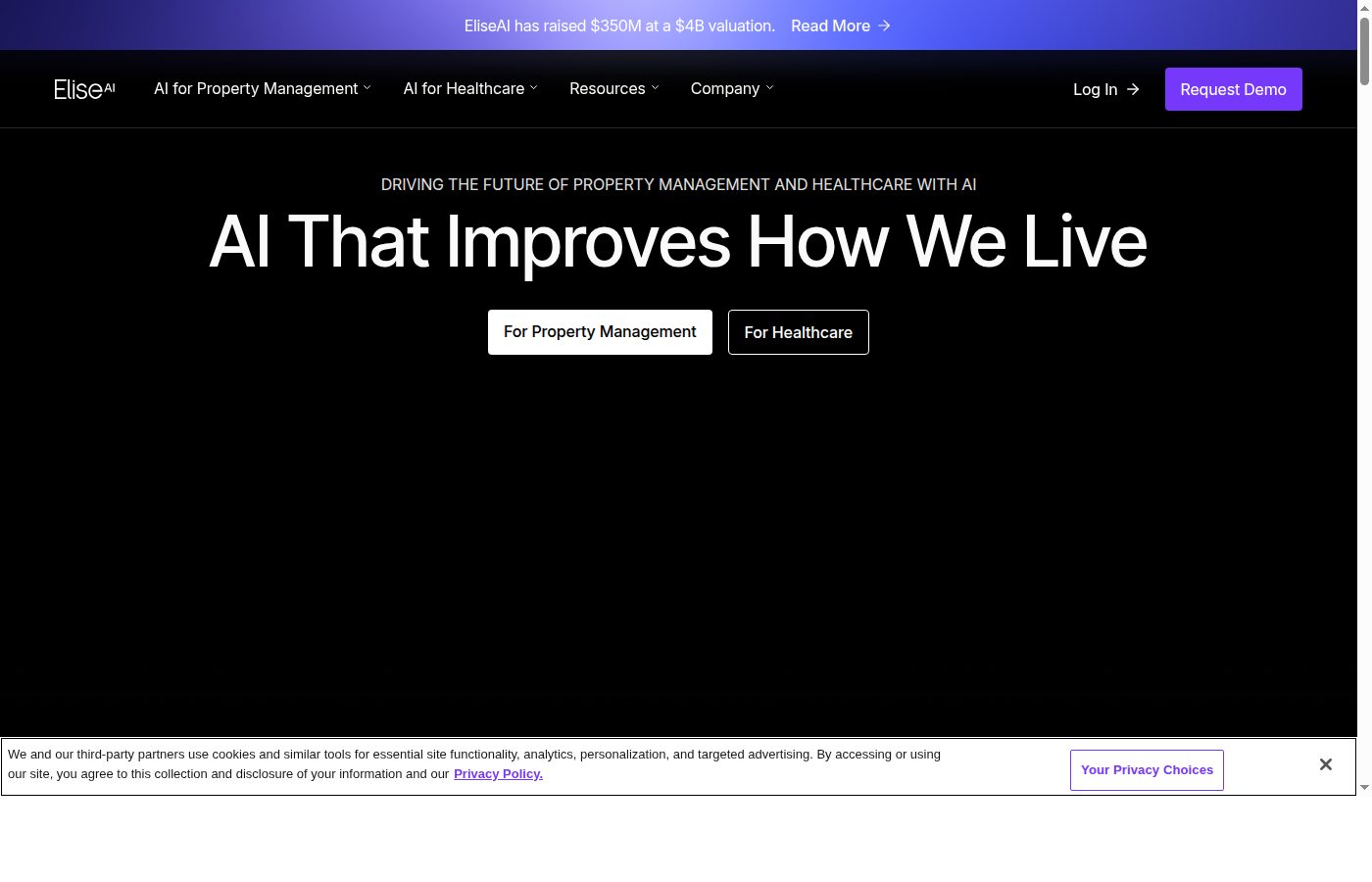
EliseAI is an enterprise-grade artificial intelligence platform designed to automate leasing operations, resident communications, and maintenance triage for multifamily property managers. According to BestCRE research, the company secured a $250 million Series E funding round in August 2025, pushing its valuation to $2.2 billion. This capitalization makes it one of the most heavily funded AI vendors in the commercial real estate sector. Originally launched as MeetElise in 2017, the platform has evolved from a simple lead-capture chatbot into a comprehensive communication layer that sits on top of existing property management systems. For a CRE principal evaluating the tool in August 2026, the value proposition centers on labor reduction and lead conversion speed.
The platform targets large operators who struggle with high-volume inbound inquiries and the resulting administrative burden on site-level staff. Analysis indicates that EliseAI operates by intercepting prospect emails, texts, and web chats, responding to them using natural language processing, and directly scheduling property tours without human intervention. While the vendor has recently expanded its operations into the healthcare sector, its core architecture remains deeply rooted in multifamily real estate. The system is categorized in the BestCRE Master Database as a CRE-Native, Tier 1 application. However, buyers must weigh the operational efficiencies against the reality of enterprise software deployments, which require significant data mapping and process realignment to function correctly.
What EliseAI does and how it works
EliseAI functions as an autonomous communication layer that intercepts and manages inbound traffic from prospective and current residents. When a leasing lead originates from an Internet Listing Service (ILS), the property website, or a direct email, the platform reads the inquiry and generates a contextual response. It answers specific questions about unit availability, pet policies, parking fees, and amenity details by pulling data directly from the operator’s integrated property management system. If the prospect is interested, the AI assistant proposes available tour times, coordinates the calendar, and logs the appointment into the CRM.
Beyond initial leasing, the platform handles resident lifecycle communications. When a tenant submits a maintenance request via text or the resident portal, the system triages the issue. It asks follow-up questions to categorize the severity of the problem, for example, distinguishing between a routine dripping faucet and an active leak, and routes the ticket to the appropriate maintenance queue. The AI also executes automated outreach for lease renewals, sending reminders and answering basic questions about rent increases or lease terms based on the property’s predefined parameters.
Mechanically, the tool operates across text messaging, email, web chat, and voice channels. Analysis of the platform’s architecture shows it relies heavily on bidirectional data syncing with the underlying system of record. It does not replace the core accounting or property management software; instead, it acts as a conversational interface for the data housed within those systems. Property managers retain oversight through a centralized dashboard where they can monitor AI conversations, intervene when a human touch is required, and review analytics on lead conversion rates and response times.
9AI Framework: the score, dimension by dimension
CRE Relevance: 9/10
EliseAI is classified as a CRE-Native, Tier 1 application in the BestCRE Master Database, reflecting its deep integration into multifamily operations. Founded specifically to address the inefficiencies of apartment leasing, the platform understands the nuanced vocabulary of commercial real estate. It correctly parses concepts like net effective rent, concession structures, and prorated move-in costs. Unlike general-purpose chatbots that require extensive prompting to understand property management workflows, this tool is pre-trained on millions of renter interactions. The system recognizes the difference between a guarantor and a co-signer, and it can navigate the complexities of affordable housing requirements if configured to do so. This domain specificity allows operators to deploy the tool with confidence that it will represent the asset accurately. In practice: The system speaks the language of multifamily real estate out of the box, requiring minimal custom training on industry terminology.
Data Quality and Sources: 8/10
The platform’s output is entirely dependent on the quality of the data housed in the operator’s property management system. Because EliseAI pulls pricing, availability, and unit details directly from the core database, any latency or error in that system will cascade into the AI’s conversations. If a leasing agent fails to update a unit’s status, the AI will confidently offer a leased apartment to a new prospect. However, the system itself maintains high data fidelity in how it logs interactions. Every text, email, and call is transcribed and pushed back into the CRM, ensuring the guest card is accurate and comprehensive. Analysis shows that the vendor employs strict data structuring protocols to prevent hallucinations regarding critical lease terms. In practice: The AI relies on your existing database, meaning poor internal data hygiene will directly result in inaccurate prospect communications.
Ease of Adoption: 7/10
Deploying an enterprise-grade AI assistant across a large portfolio is a complex undertaking. While the vendor provides structured onboarding, the process requires significant time from the operator’s IT and operations teams. Buyers must map out automated workflows, define escalation protocols, and establish the specific personality and constraints of the AI. Training site-level staff to trust the system and stop manually intervening in automated conversations is often the most difficult hurdle. Analysis indicates that pilot programs typically take 60 to 90 days to tune before full portfolio rollout. The software demands a high degree of change management, as leasing agents must transition from answering emails to managing exceptions and closing complex deals. In practice: Implementation requires dedicated project management and a willingness to overhaul legacy site-level workflows.
Output Accuracy: 8/10
EliseAI demonstrates a high degree of precision in its natural language generation. The responses are contextually aware and avoid the rigid, robotic phrasing typical of older decision-tree chatbots. When answering prospect inquiries, the system accurately synthesizes multiple data points, such as combining pet fees, deposit requirements, and current concessions into a single, coherent explanation. However, analysis of user deployments reveals that the system can occasionally struggle with highly specific, localized questions, such as the exact dimensions of a specific closet or the noise level of a particular street-facing unit. In these instances, the AI is programmed to gracefully hand off the conversation to a human agent rather than guessing. In practice: The tool handles routine inquiries with near-perfect accuracy but relies on human intervention for highly subjective or undocumented property details.
Integration and Workflow Fit: 9/10
The platform excels in its ability to connect with the established commercial real estate technology stack. Research confirms that EliseAI offers native integrations with major property management systems and CRMs, including Yardi, RealPage, AppFolio, Entrata, Rent Manager, and ResMan. This bidirectional syncing ensures that guest cards are updated in real-time and that the AI always has access to live pricing and availability. Furthermore, it connects with access control systems like ButterflyMX to facilitate self-guided tours, automatically issuing digital keys to verified prospects. This level of connectivity prevents the creation of data silos and allows the AI to function as a true extension of the existing infrastructure. In practice: The system plugs directly into the most common multifamily software platforms, eliminating the need for manual data entry.
Pricing Transparency: 4/10
Per the BestCRE Master Database, EliseAI operates on a custom enterprise pricing model. The vendor does not publish its software tiers, per-unit costs, or implementation fees on its website. Consequently, this dimension cannot exceed a score of 5 under the 9AI framework. Market research indicates that contracts typically involve an annual minimum expenditure, which effectively prices out small, independent operators. Pricing is generally calculated based on unit count and the specific modules selected, such as leasing automation versus resident communication or maintenance triage. Buyers must engage in a formal sales process to receive a quote, making it difficult to perform a rapid financial analysis during the initial software selection phase. In practice: Operators cannot determine the cost of the software without committing to a sales discovery process.
Support and Reliability: 8/10
Backed by substantial venture capital and a $2.2 billion valuation, EliseAI maintains a large, dedicated support infrastructure. The company assigns customer success managers to enterprise accounts to monitor AI performance metrics and assist with workflow optimization. Research shows the vendor has expanded its workforce significantly following its 2025 Series E funding, hiring across engineering and customer experience departments. This scale allows for rapid technical support and consistent system uptime. However, because the product is deeply intertwined with third-party property management systems, resolving integration errors sometimes requires coordination between EliseAI and the underlying PMS vendor, which can delay resolution times. In practice: Buyers receive enterprise-grade support and dedicated account management, though complex integration bugs may require multi-vendor troubleshooting.
Innovation and Roadmap: 8/10
The vendor has demonstrated a consistent track record of expanding its product capabilities. Originally focused solely on top-of-funnel leasing, the platform now encompasses resident renewals, delinquency follow-ups, and maintenance coordination. Recent updates have introduced voice AI capabilities, allowing the system to handle inbound phone calls with natural conversational cadence. However, analysis of the company’s trajectory reveals a strategic push into the healthcare sector, automating patient scheduling and communications. While this diversification proves the underlying technology’s adaptability, commercial real estate operators should monitor whether this dual focus dilutes engineering resources dedicated to multifamily-specific features. In practice: The product continues to evolve rapidly, though the company’s expansion into healthcare introduces questions about its long-term focus on real estate.
Market Reputation: 9/10
EliseAI holds a dominant position in the multifamily AI landscape. It is widely recognized by large real estate investment trusts and institutional property managers as a standard-bearer for conversational automation. The company’s ability to secure $250 million in late-stage funding in August 2025 signals immense confidence from institutional investors regarding its market penetration and revenue growth. Competitors frequently benchmark their own tools against EliseAI’s feature set. While some operators express frustration over the high barrier to entry and enterprise minimums, the platform’s ability to deliver measurable reductions in site-level labor costs has solidified its reputation as a highly effective operational tool. In practice: The vendor is widely considered a market leader in multifamily AI, trusted by some of the largest institutional owners in the United States.
Who should use EliseAI
EliseAI is engineered for scale and is best suited for organizations that can absorb the cost of enterprise software in exchange for significant labor efficiencies. The ideal buyer operates a large portfolio where centralized leasing and standardized communications can yield measurable financial returns.
Institutional multifamily operators: Firms managing thousands of units that want to centralize their leasing operations and reduce site-level headcount.
Operators with high inbound lead volume: Properties in competitive urban markets that struggle to respond to internet listing service inquiries within minutes.
Firms executing a centralized management strategy: Portfolios looking to pool leasing agents across multiple properties, using AI as the first line of defense.
Owners focused on standardizing resident experience: Managers who want to ensure every maintenance request and renewal notice is handled consistently across all assets.
Who should look elsewhere
The platform’s enterprise architecture and pricing model make it a poor fit for operators who lack the scale or technical infrastructure to support it.
Small portfolio managers: Operators with fewer than 1,000 units who will find the annual minimum costs prohibitive compared to the labor savings.
Firms using unsupported legacy software: Buyers relying on outdated or custom-built property management systems that cannot support modern API integrations.
Operators seeking a complete PMS replacement: Teams looking for an all-in-one accounting and property management tool, as this is strictly a communication and automation layer.
Pricing and ROI
EliseAI does not publish its pricing. The BestCRE Master Database classifies its pricing model as custom enterprise, requiring buyers to undergo a scoping process to receive a quote. Market research from Q3 2026 indicates that contracts generally include an annual minimum expenditure, reportedly around $25,000, which effectively acts as a barrier to entry for smaller portfolios. Above this minimum, costs are typically calculated on a per-unit, per-month basis, varying depending on whether the operator purchases the standalone leasing module or the full suite including resident communications and maintenance triage.
To calculate the return on investment, a commercial real estate principal must measure the software cost against the reduction in site-level labor and the increase in lead conversion. If an operator manages 3,000 units and pays an estimated $4 per unit monthly, the annual software cost is $144,000. If the AI assistant successfully automates 70 percent of top-of-funnel leasing inquiries and routine resident communications, the firm could potentially eliminate or reallocate three to four full-time leasing positions across the portfolio. Assuming a fully burdened cost of $65,000 per leasing agent, the labor savings alone would exceed $195,000 annually, generating an immediate positive ROI. Furthermore, the system’s ability to respond to leads 24/7 often results in a higher conversion rate, reducing vacancy days and directly increasing net operating income.
Integration and CRE tech stack fit
EliseAI is designed to sit on top of the existing commercial real estate technology stack, acting as an intelligent interface rather than a replacement for core systems. Research confirms that the platform offers deep, bidirectional integrations with the industry’s most prominent property management systems, including Yardi Voyager, RealPage OneSite, AppFolio, Entrata, and Rent Manager. This connectivity is critical; it allows the AI to read live unit availability, pull accurate pricing and concession data, and write guest cards directly into the system of record without manual data entry.
Beyond the core PMS, the platform integrates with specialized proptech tools to facilitate end-to-end automation. For example, it connects with customer relationship management platforms like Funnel and Knock to orchestrate lead follow-up sequences. It also integrates with access control systems such as ButterflyMX and Brivo. This specific integration allows the AI to schedule a self-guided tour with a prospect and automatically issue a temporary digital access code to the building, entirely removing the leasing agent from the physical tour coordination process. Analysis indicates that this broad ecosystem compatibility makes it highly effective for operators executing a centralized leasing model.
Competitive landscape
The market for multifamily AI automation is highly competitive, and operators evaluating EliseAI should consider several real alternatives based on their portfolio size and operational philosophy. DoorLoop (BestCRE Score: 93) and AppFolio (BestCRE Score: 86) represent a different approach, embedding AI directly into the core property management system. AppFolio’s Realm-X, for instance, offers native AI capabilities that do not require a third-party integration, making it a compelling choice for operators who prefer a unified, all-in-one platform over a bolted-on point solution.
For operators specifically focused on leasing and CRM automation, Funnel is the most direct competitor. While EliseAI excels at automating discrete, high-volume conversations at the property level, Funnel is often favored by firms looking to restructure their entire operating model around a centralized, portfolio-wide view of the renter. The choice between the two often comes down to whether an operator wants to automate existing site-level tasks or completely overhaul their leasing architecture.
Conduit (BestCRE Score: 87) and ResiDesk offer alternatives for operators prioritizing resident intelligence and human-in-the-loop workflows. ResiDesk, in particular, appeals to teams that want AI to assist rather than entirely replace human communication, providing sentiment analysis and intervention points. Finally, for smaller operators priced out by EliseAI’s enterprise minimums, tools like Leasey.ai provide basic conversational lead capture and syndication at a lower price point. Buyers must evaluate whether they need a specialized communication layer or if the AI tools bundled within their existing PMS provide sufficient automation.
The bottom line
EliseAI is a highly capable, enterprise-grade automation platform that delivers on its promise to reduce site-level administrative burden. For large multifamily operators and institutional owners, it is a necessary evaluation. The system’s ability to accurately handle leasing inquiries, schedule tours, and triage maintenance across multiple channels directly translates to lower labor costs and faster lead conversion. However, it is not a casual purchase. The software requires a significant financial commitment, rigorous data hygiene, and a willingness to fundamentally change how site staff operate. If your firm manages fewer than 1,000 units, the enterprise minimums will likely destroy the ROI, and you should rely on the AI features native to your property management system. But for scaled operators executing a centralized management strategy, EliseAI provides the sophisticated communication infrastructure required to operate efficiently in Q3 2026.
Frequently asked questions
Does EliseAI replace my property management system?
No. EliseAI is a communication layer that integrates with your existing property management system, such as Yardi, RealPage, or AppFolio. It reads data from your PMS to answer questions and writes data back to update guest cards, but it does not handle accounting or core property operations.
How much does EliseAI cost per unit?
The vendor does not publish pricing, operating on a custom enterprise model. Market analysis indicates costs range from $3 to $6 per unit monthly, but contracts typically require an annual minimum around $25,000. This structure makes it cost-prohibitive for small portfolios.
Can EliseAI handle maintenance requests?
Yes. The platform includes a module that intercepts resident maintenance requests via text or email. The AI asks follow-up questions to diagnose the issue, categorizes the severity, and routes the ticket to the appropriate maintenance queue in your core system.
Does EliseAI support voice calls?
Yes. Recent updates to the platform introduced voice AI capabilities. The system can answer inbound phone calls from prospective and current residents, holding natural conversations to answer questions and schedule property tours just as it does via text or email.
What CRMs integrate with EliseAI?
The platform offers native integrations with major multifamily CRMs, including Funnel, Knock, and the native CRM modules within Yardi and RealPage. This ensures that all AI-driven conversations and scheduled tours are accurately logged in the prospect’s unified guest card.
How long does it take to implement EliseAI?
Deploying the platform across a portfolio typically requires a 60 to 90-day pilot and onboarding phase. Implementation involves mapping data from your PMS, configuring the AI’s specific responses and constraints, and training site-level staff to adapt to the new automated workflows.
Related Reviews
Compare EliseAI with other Property Management & Operations tools BestCRE has scored: Moved (87/100), Venn (86/100), Rely Estate (67/100) and Inspiren (67/100). Browse every review in CRE Property Management & Operations, the full Best CRE AI Tools directory, or the 20 CRE Sectors hub.