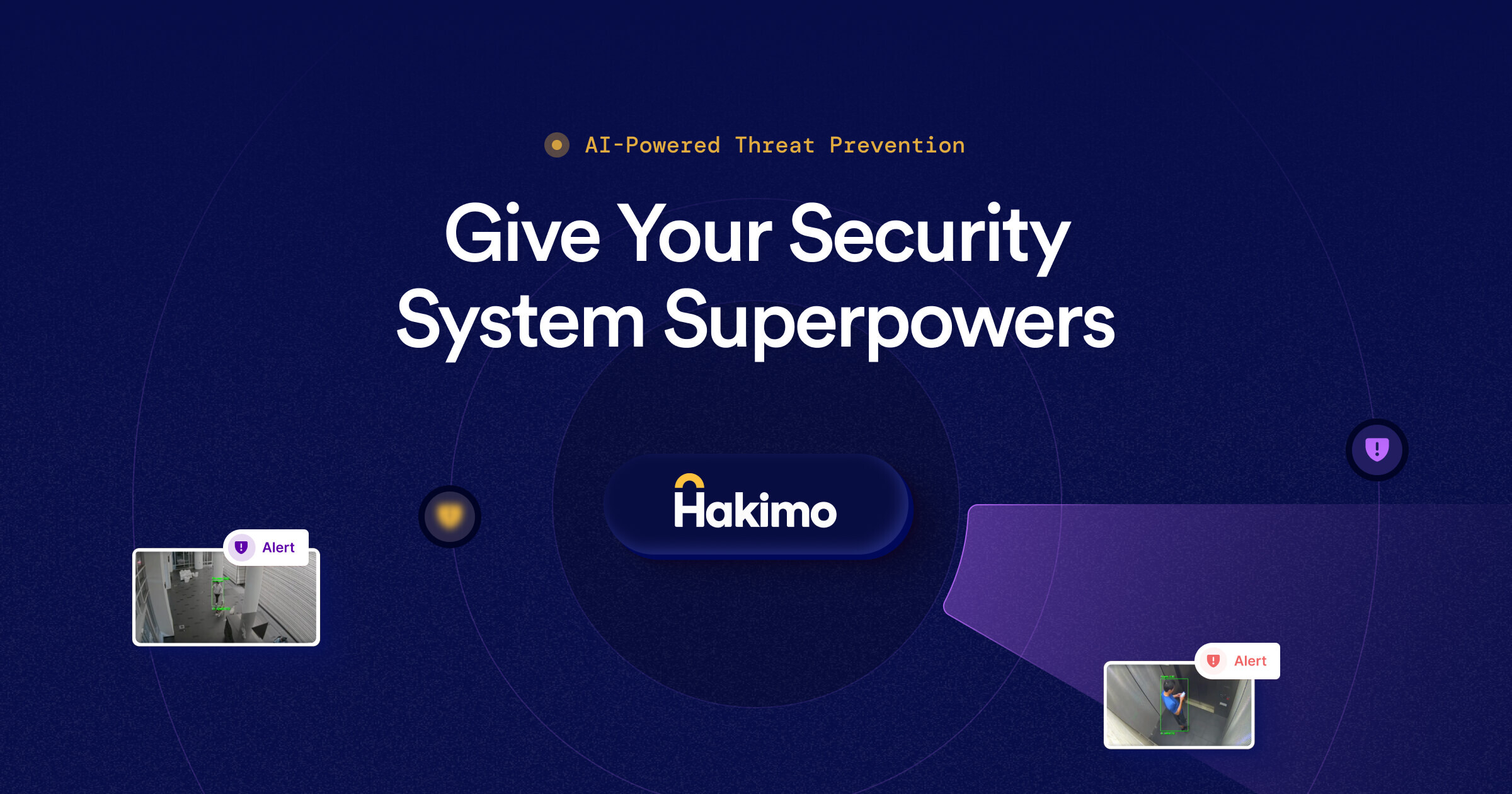
Hakimo is an AI-powered physical security and remote guarding platform designed to monitor commercial real estate properties, filter out false alarms, and prevent unauthorized access. Founded to address the inefficiencies of traditional video surveillance, the company recently secured a $12 million growth funding round in July 2026, bringing its total capital raised to $32 million. Hakimo operates by layering artificial intelligence over a property’s existing camera infrastructure, effectively converting passive video feeds into an active, automated monitoring system.
For commercial real estate principals and asset managers, physical security remains a significant operational expense, often plagued by high turnover rates among guard staff and an overwhelming volume of nuisance alarms. Hakimo addresses this by utilizing its AI Operator to analyze video streams in real time. The software identifies specific behaviors such as tailgating, loitering, or perimeter breaches, and filters out non-threatening events like moving shadows or animals. By reducing false positives by up to 90%, the platform allows on-site personnel or remote security operations centers to focus exclusively on verified threats. The system is hardware-agnostic, meaning it does not require property owners to replace their current cameras or network video recorders. Instead, it connects directly to existing RTSP-enabled cameras and major video management systems. When a legitimate threat is detected, Hakimo can initiate automated responses, such as triggering audio warnings through on-site speakers, or escalate the event to a human operator for immediate intervention. This approach provides commercial assets with continuous oversight while structurally lowering the costs associated with physical guard patrols.
What Hakimo does and how it works
Hakimo functions as an autonomous security overlay that integrates with a property’s existing video surveillance and access control systems. At its core, the platform ingests live video feeds from standard IP cameras and applies computer vision algorithms to detect anomalies and unauthorized activities. The primary mechanic is the AI Operator, an autonomous agent that continuously monitors these streams to identify specific events, such as a person piggybacking through a secured door, a vehicle loitering in a restricted zone, or a perimeter fence being breached.
When an event occurs, Hakimo evaluates the footage to determine if it constitutes a genuine security threat. Traditional systems often trigger alerts for benign movements, leading to alarm fatigue among security staff. Hakimo’s algorithms filter out these false positives—such as weather conditions, moving foliage, or animals—ensuring that only verified incidents are escalated. If a threat is confirmed, the system immediately alerts the designated security personnel, providing them with the exact camera feed and location data. Beyond passive monitoring, Hakimo enables active deterrence through its remote guarding capabilities. When the system detects an intrusion, it can automatically trigger on-site deterrents, such as flashing lights or sirens. Additionally, it allows remote security operators to perform live voice-downs using 120-decibel speakers to verbally warn trespassers, often preventing a crime before property damage occurs.
The platform also includes an AI-powered forensic search feature, which allows property managers to quickly locate specific incidents within hours of recorded footage by searching for descriptive terms, such as a person in a red shirt or a white delivery van. Furthermore, Hakimo provides an insights dashboard that aggregates security data across a portfolio, highlighting vulnerabilities like frequently propped doors or recurring tailgating incidents. This data allows asset managers to address systemic security flaws and enforce compliance with building policies.
9AI Framework: the score, dimension by dimension
CRE Relevance: 7/10
While physical security applies to multiple industries, Hakimo’s focus on access control monitoring, tailgating prevention, and remote guarding aligns directly with the operational priorities of commercial real estate. Asset managers in multifamily, office, and industrial sectors face constant pressure to secure premises without inflating operating expenses through 24/7 on-site guard patrols. Hakimo addresses these specific pain points by automating the monitoring of lobbies, parking garages, and perimeter fences. The platform’s ability to integrate with existing building infrastructure makes it highly relevant for retrofitting older properties. In practice: Commercial operators use Hakimo to replace or supplement overnight guard shifts, directly reducing property-level operating expenses while maintaining continuous security coverage.
Data Quality and Sources: 8/10
Hakimo relies on the visual data captured by a property’s existing camera network, meaning the quality of its inputs is inherently tied to the resolution and placement of the host hardware. However, the platform excels at processing this data accurately. By utilizing advanced computer vision, Hakimo effectively distinguishes between human activity, vehicles, and environmental noise. The system routinely achieves a 90% reduction in false alarms, ensuring that the data presented to security operators is highly actionable. The inclusion of forensic search capabilities further enhances the utility of recorded footage. In practice: Security teams stop wasting hours reviewing empty footage or responding to wind-blown debris, focusing instead on verified human or vehicular threats.
Ease of Adoption: 8/10
Deploying new security technology often requires extensive hardware replacements, but Hakimo bypasses this hurdle by operating as a hardware-agnostic software layer. The platform connects directly to any RTSP-enabled camera and interfaces smoothly with leading Video Management Systems (VMS) and Network Video Recorders (NVR). Deployment is handled via a lightweight virtual machine, allowing properties to activate the AI monitoring in a matter of hours rather than months. No proprietary cameras are required, dramatically lowering the barrier to entry. In practice: Asset managers can upgrade their entire portfolio’s security capabilities using the cameras already bolted to their buildings, avoiding massive capital expenditure requests.
Output Accuracy: 8/10
The primary metric for any AI security tool is its ability to correctly identify threats without overwhelming users with false positives. Hakimo performs exceptionally well in this regard, utilizing its AI Operator to analyze complex scenes and apply contextual reasoning. The system accurately identifies tailgating events, perimeter breaches, and loitering, while discarding alerts triggered by shadows, animals, or weather. Customers report zero missed critical incidents alongside drastic reductions in nuisance alarms. The real-time escalation process ensures that human operators receive precise, verified video clips of the event. In practice: A property manager receives an alert only when a person actually breaches a fence, rather than every time a stray cat walks across the parking lot.
Integration and Workflow Fit: 9/10
Hakimo is designed to sit at the center of a property’s existing security tech stack. It offers native integrations with major video management and access control platforms, including Genetec, Avigilon, Milestone, Hikvision, and Axis. This interoperability ensures that Hakimo can pull video feeds and push verified alerts back into the central systems that security operations centers already use. The platform also supports automated reporting to compliance and law enforcement bodies when necessary. By connecting access control events like a badge swipe with video analytics, it creates a unified security record. In practice: Security directors do not need to train their staff on a completely new interface, as Hakimo’s verified alerts populate directly within their existing dashboard.
Pricing Transparency: 4/10
Hakimo does not publish its pricing on its website, requiring prospective buyers to engage with their sales team for a custom quote. The pricing model is typically structured as a software-as-a-service subscription based on the number of camera streams being monitored and the specific features activated, such as the remote guarding service. While this custom approach is standard for enterprise security deployments, it prevents asset managers from running preliminary cost-benefit analyses without entering the sales funnel. Because pricing is entirely opaque upfront, the score in this dimension is strictly capped. In practice: Buyers must request a formal demo and conduct a site audit with Hakimo’s team to determine the exact recurring software costs for their specific camera counts.
Support and Reliability: 7/10
As a growth-stage company that recently closed a $12 million funding round in July 2026, Hakimo demonstrates strong financial backing and momentum. The company has achieved SOC 2 Type I compliance, indicating a formal commitment to data security and infrastructure resilience, and is actively working toward Type II. They offer 24/7 continuous system health monitoring to ensure camera feeds remain active and connected. However, as an emerging vendor scaling rapidly to support over 300 customers, their long-term support infrastructure is still maturing compared to legacy security conglomerates. In practice: Customers rely on Hakimo’s continuous health checks to know immediately if a camera goes offline, ensuring no blind spots develop unnoticed.
Innovation and Roadmap: 8/10
Hakimo’s development trajectory is highly focused on advancing autonomous security capabilities. The 2025 launch of the AI Operator marked a shift from simple motion detection to contextual, agentic AI that can reason through security instructions. The recent capital injection is earmarked for accelerating product innovation and expanding into new verticals. Features like AI-powered forensic search demonstrate a commitment to solving practical operational bottlenecks. The roadmap points toward deeper behavioral analytics and broader integrations with IoT building systems. In practice: Users can expect the platform to become increasingly autonomous, eventually handling routine security communications and access verifications without any human intervention.
Market Reputation: 8/10
Hakimo has rapidly built a strong reputation within the commercial real estate and enterprise security sectors. Backed by prominent investors like Zigg Capital and Vertex Ventures, the company has successfully deployed its software across hundreds of properties, including high-profile clients like Skanska and major regional airports. Customer testimonials frequently highlight the dramatic reduction in false alarms and the tangible cost savings achieved by reducing physical guard hours. While newer than legacy systems, Hakimo is widely viewed as a leader in the emerging category of AI-native video analytics. In practice: Security integrators and property managers increasingly view Hakimo as a proven, reliable upgrade path for modernizing outdated surveillance networks.
Who should use Hakimo
Hakimo is best suited for commercial operators looking to optimize security expenditures.
- Asset managers looking to reduce the operating expenses associated with 24/7 on-site security guards.
- Property managers dealing with high volumes of false alarms from legacy motion-detection cameras.
- Security directors at large commercial facilities who need to monitor extensive perimeters or multiple access points simultaneously.
- Owners of multifamily high-rises experiencing issues with tailgating, package theft, or unauthorized access in lobbies.
Who should look elsewhere
The platform may not be the right fit for every asset type.
- Small property owners with minimal security needs or only one to two cameras.
- Operators constructing new buildings who prefer to install a unified, proprietary hardware-and-software system from a single vendor.
- Organizations operating in highly regulated environments that prohibit cloud-based video processing or remote access.
Pricing and ROI
Hakimo operates on a custom pricing model and does not publish its subscription rates publicly. Prospective customers must engage with the sales team to receive a quote tailored to their specific portfolio. The cost is generally structured as a recurring software-as-a-service (SaaS) fee, calculated based on the total number of camera streams integrated into the platform and the specific modules activated, such as the AI Operator, forensic search, or the 24/7 remote guarding service.
Despite the lack of upfront pricing transparency, the return on investment (ROI) math is highly compelling for commercial operators currently relying on physical security personnel. Traditional on-site guards represent a significant and escalating operating expense, often costing upwards of $80,000 to $120,000 annually for a single 24/7 post. By deploying Hakimo’s AI monitoring and remote voice-down capabilities, properties can frequently eliminate overnight guard shifts or reduce total guard headcount. Hakimo claims that customers regularly see a 3.5x return on investment within the first few months of deployment, with average annual savings reaching $125,000 on manual patrol costs. For portfolios suffering from high incident rates, the reduction in property damage, theft, and liability claims further accelerates the payback period.
Integration and CRE tech stack fit
Hakimo is engineered to function as an interoperable layer within a commercial property’s existing technology stack. Because it is hardware-agnostic, it connects directly to any RTSP-enabled IP camera, eliminating the need for expensive hardware overhauls.
The platform boasts deep native integrations with the industry’s leading Video Management Systems (VMS) and Network Video Recorders (NVR), including Genetec, Avigilon, Milestone, ExacqVision, and Hikvision. This allows Hakimo to pull live video feeds, process them through its cloud or edge-based AI engine, and push verified alerts directly back into the VMS dashboards that on-site security teams already monitor.
Additionally, Hakimo integrates with major access control platforms. By marrying access control data, such as a badge swipe, with video analytics, the system can automatically detect and flag tailgating or piggybacking events—situations where an authorized user opens a door and an unauthorized person follows them inside. This cross-system communication ensures that Hakimo enhances, rather than replaces, the established security infrastructure of a commercial asset.
Competitive landscape
The market for AI-powered video analytics and remote guarding is expanding rapidly, presenting commercial real estate operators with several viable alternatives to Hakimo.
Verkada is a prominent competitor that offers a unified ecosystem of cloud-native cameras, access control, and environmental sensors. Unlike Hakimo, which overlays onto existing hardware, Verkada requires a rip-and-replace approach, mandating the purchase of their proprietary cameras. This makes Verkada highly attractive for new developments or total retrofits, but less cost-effective for properties with functional legacy cameras.
Rhombus Systems operates similarly to Verkada, providing proprietary smart cameras with built-in AI analytics. Rhombus is known for its open API and strong integrations with other cloud-based IT tools, appealing to organizations that want a modern, unified hardware platform.
For software-only overlays, Actuate (now part of Motorola Solutions) offers AI video analytics that integrate with existing cameras to detect firearms, intruders, and loitering. Actuate competes directly with Hakimo in the hardware-agnostic space, though Hakimo’s recent launch of its autonomous AI Operator and specialized focus on tailgating give it a distinct edge in complex commercial environments.
Finally, traditional remote guarding firms like Elite Interactive Solutions provide similar active monitoring services, but rely more heavily on human operators watching screens rather than Hakimo’s AI-first filtering approach. Hakimo’s ability to filter out 90% of false alarms before a human ever sees the feed makes it a more scalable and cost-efficient option for large portfolios.
The bottom line
Hakimo delivers a highly effective, software-driven solution for commercial real estate operators struggling with the high costs and inefficiencies of traditional physical security. By layering intelligent analytics over existing camera infrastructure, it transforms passive recording devices into proactive threat-detection systems. The platform’s ability to filter out 90% of false alarms ensures that security personnel only respond to genuine incidents, while its remote guarding capabilities offer a viable, cost-effective alternative to expensive overnight guard patrols.
While the lack of transparent pricing requires buyers to commit to a sales process to determine costs, the potential ROI from reduced guard labor and mitigated property damage is substantial. For asset managers seeking to modernize their security posture, eliminate tailgating, and optimize operating expenses without ripping out their current hardware, Hakimo is a premier choice in the current market.
Frequently asked questions
Does Hakimo require me to buy new security cameras?
No. Hakimo is a hardware-agnostic software platform. It connects directly to your existing RTSP-enabled IP cameras and integrates with leading Video Management Systems, allowing you to upgrade your security without a costly hardware replacement.
How does Hakimo reduce false security alarms?
Hakimo uses advanced computer vision and its AI Operator to analyze video feeds in real time. It can distinguish between actual human or vehicular threats and harmless movements like wind, shadows, or animals, filtering out up to 90% of nuisance alarms.
Can Hakimo replace on-site security guards?
Yes, in many scenarios. By utilizing AI monitoring combined with remote guarding services and 120-decibel audio speakers for live voice-downs, Hakimo can deter intruders effectively, allowing properties to reduce or eliminate expensive overnight manual patrols.
What is Hakimo’s AI Operator?
Launched in 2025, the AI Operator is an autonomous agent that continuously monitors video streams. It can detect specific events described in plain language, reason through complex situations, and escalate verified threats to human operators instantly.
How much does Hakimo cost for a commercial property?
Hakimo does not publish its pricing. Costs are customized based on the number of camera streams monitored and the specific software modules or remote guarding services activated. Buyers must contact their sales team for a custom quote.
Does Hakimo integrate with access control systems?
Yes. Hakimo integrates with major access control platforms. By combining badge swipe data with video analytics, the system automatically detects and flags tailgating or piggybacking events, helping properties enforce strict access policies.