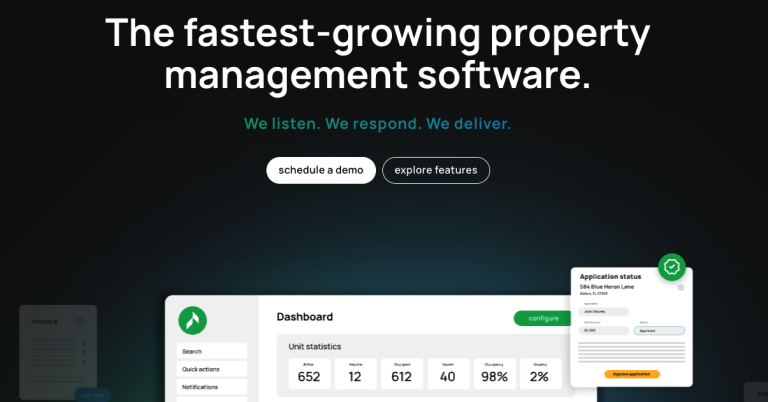
Knock CRM is a front office platform built for multifamily owners, operators, property managers, marketers, and leasing teams. It changes the workflow between initial renter inquiry and signed lease by collecting prospect communication, scheduling, follow up, task management, and performance reporting in one operating environment. That specialization matters. Generic sales CRMs can record contacts and activities, but they usually require substantial configuration to represent properties, units, tours, leasing agents, and portfolio reporting.
The practical value proposition is operational control. Prospects can enter from multiple marketing channels, schedule tours, communicate through common channels, and remain visible to onsite or centralized leasing teams. Managers can monitor activity across employees and properties instead of reconstructing performance from spreadsheets, phone records, inboxes, and separate marketing reports. Knock also extends beyond lead handling into resident retention, visitor experience, mobile work, source attribution, and portfolio analytics.
RealPage ownership materially shapes the buying decision. Knock is no longer best evaluated as an isolated startup CRM. It is marketed as part of a larger multifamily technology suite, which can improve strategic fit for operators already committed to RealPage. It can also create questions about implementation boundaries, data portability, contracting, and the future treatment of integrations outside that ecosystem. Buyers should require a written architecture showing which system owns each prospect, unit, resident, communication, and reporting field.
BestCRE’s analysis is that Knock is a credible specialist for operators with enough leasing volume and organizational complexity to benefit from structured workflows. Its strongest case is not that it replaces every property management system. It is that it gives the leasing front office a purpose built layer for communication, execution, and oversight. The principal weaknesses are limited public pricing information and insufficient public detail for independently judging artificial intelligence accuracy, integration breadth, and total implementation cost. A controlled portfolio pilot is therefore more informative than a feature checklist.
What Knock CRM Does and How It Works
Knock begins with lead capture and engagement. Leasing teams can manage conversations across email, text, voice, and chat from a consolidated interface, reducing the need to search separate inboxes or communication tools. Prospects can schedule tours through Knock Now, while staff can see the associated lead, activity history, and next actions. Marketing attribution connects inquiries with their sources, and automated campaigns help teams maintain contact without manually composing every follow up. The underlying operational goal is consistent treatment of every inquiry across properties and shifts.
Task management converts prospect activity into work for leasing personnel. Agents receive follow up responsibilities, while managers gain visibility into response behavior and unresolved opportunities. Mobile access lets employees update work while touring properties or moving between communities. Centralized teams can serve prospects across a portfolio rather than treating every property as a separate queue. This can help an operator redirect demand when a prospect’s first choice lacks a suitable unit, although the actual routing rules and portfolio permissions should be demonstrated against the buyer’s operating model.
The reporting layer covers leasing activity, team performance, marketing attribution, property comparisons, and planning. Knock Insights is positioned for corporate and onsite users who need to move from individual interactions to portfolio trends. Knock Tours adds structured visibility into the touring process and the actions occurring during visits. BestCRE’s analysis is that the product is most valuable when management actively uses these records to coach staff, allocate marketing spend, and enforce follow up standards. Simply installing the CRM will not correct weak lead definitions, inconsistent source coding, or poor operating discipline. Buyers should test duplicate handling, attribution logic, transfer workflows, permissions, reporting exports, and the reconciliation process with their property management system before approving a broad deployment.
9AI Framework: Dimension by Dimension Analysis
CRE Relevance: 9/10
Knock earns a 9 for CRE relevance because its core objects and workflows are designed specifically for multifamily leasing operations. The product addresses prospect intake, property and portfolio activity, tour scheduling, leasing follow up, marketing attribution, team supervision, and resident retention. These are operating concerns that a generic CRM would require configuration or custom development to represent well. Its audience also spans the people who actually control this process, including onsite agents, centralized leasing teams, marketers, regional managers, and ownership groups. The score stops short of 10 because Knock is concentrated in multifamily rather than the broader commercial property market. An office leasing broker, industrial owner, hotel operator, or construction team would find little direct workflow fit. Even within multifamily, buyers still need a property management or accounting system for functions outside the front office.
Data Quality and Sources: 7/10
Knock earns a 7 for data quality. Its consolidated communication history, scheduling records, lead activity, source attribution, tour information, and employee performance data can create a more coherent operating record than disconnected inboxes and spreadsheets. Portfolio reporting is especially useful when properties follow consistent definitions and staff record activities inside the platform. The constraint is that much of the data originates from users, marketing sources, communication channels, and connected property systems. Incorrect source tags, duplicate prospects, incomplete unit information, or activity completed outside Knock can weaken the record. The vendor does not publish enough technical evidence to independently quantify completeness, matching performance, or error rates. BestCRE’s analysis is that buyers should evaluate data quality through a representative import, duplicate test, source reconciliation, and property management system comparison before treating dashboard figures as authoritative.
Ease of Adoption: 8/10
Knock earns an 8 for ease of adoption because the interface and workflow are organized around familiar leasing activities rather than abstract CRM administration. Messaging, tours, tasks, prospect records, and mobile access align with how multifamily teams already work. Centralization can also reduce the number of places agents must check for pending activity. Adoption risk remains meaningful because leasing teams often include employees with different technical skills, high turnover, and established habits involving phones, personal inboxes, or property management screens. Managers must define response standards, ownership rules, escalation paths, and required fields before rollout. RealPage customers may have a clearer suite path, but they should not assume deployment effort is negligible. BestCRE’s analysis is that a phased launch, role specific training, and weekly exception reporting will matter more than the initial demonstration when determining whether the system becomes the daily workspace.
Output Accuracy: 7/10
Knock earns a 7 for output accuracy. Its operational outputs include activity histories, task queues, attribution reports, performance views, property comparisons, and analytics derived from recorded prospect interactions. These outputs should be dependable when source connections, user behavior, and field definitions are controlled. The principal limitation is that public information does not establish independent accuracy benchmarks for attribution, automated classification, analytics, or artificial intelligence features. A polished dashboard may still reflect incomplete activities, ambiguous marketing sources, duplicated leads, or mismatched leasing outcomes. BestCRE’s analysis is that accuracy should be validated at the workflow level rather than assumed from the interface. Buyers should select completed leases, trace them backward through tours and initial sources, compare results with accounting and property management records, and document discrepancies. Any automated recommendation or generated communication should retain human review until the operator understands its failure patterns and control options.
Integration and Workflow Fit: 8/10
Knock earns an 8 for integration because it is positioned within RealPage and supports a front office role that naturally depends on property, unit, lead, marketing, and resident information from other systems. RealPage ownership gives the product a potentially strong fit for organizations using that ecosystem. Knock also promotes a Data Cloud and API, indicating an architecture intended to connect operational data rather than remain a closed contact database. However, public materials do not provide enough detail to score every connector’s field coverage, synchronization direction, latency, support responsibility, or additional cost. Buyers using Entrata, Yardi, or several property systems should insist on connector specific demonstrations. BestCRE’s analysis is that integration quality should be judged by ownership of records, duplicate prevention, status synchronization, failure alerts, historical import, and export rights, not by the presence of a partner logo or an API reference.
Pricing Transparency: 4/10
Knock earns a 4 for pricing transparency. The vendor does not publish standard subscription prices, implementation charges, contract minimums, support tiers, or typical integration costs on its public site. Prospective buyers must request a demonstration and commercial proposal, which makes early comparison and budget planning more difficult. Pricing may reasonably vary by portfolio size, modules, communication volume, and implementation scope, but the absence of even indicative packaging reduces transparency. RealPage ownership may also lead buyers to consider Knock within a wider suite negotiation rather than as a stand alone purchase. BestCRE’s analysis is that procurement teams should request a complete multiyear cost schedule covering licenses, properties or units, setup, data migration, integrations, messaging usage, training, support, renewal increases, and termination assistance. They should also separate mandatory components from optional analytics or artificial intelligence products before calculating the business case.
Support and Reliability: 8/10
Knock earns an 8 for support. Public customer commentary frequently describes responsive service, implementation assistance, and attention to operational feedback. The product also maintains support resources and serves operating teams whose workflow cannot tolerate prolonged communication or scheduling failures. That combination supports an above average assessment, although testimonials are selected by the vendor and do not substitute for independently published service metrics. The vendor does not publish comprehensive information about response time commitments, resolution performance, staffing ratios, or service availability by contract tier. RealPage ownership may expand available resources, but buyers should verify whether support is delivered by a dedicated Knock group or through a shared suite structure. BestCRE’s analysis is that contract diligence should cover severity definitions, escalation access, weekend coverage, data incident communication, service credits, named implementation responsibility, and the process for resolving failures involving another vendor’s connector.
Innovation and Roadmap: 8/10
Knock earns an 8 for innovation because it combines communication, scheduling, attribution, task management, mobile leasing, centralized staffing, tour intelligence, and portfolio analytics around a coherent multifamily front office model. Its focus on both renter experience and employee execution is more substantive than attaching a general chatbot to a contact database. Centralized portfolio workflows are particularly relevant as operators experiment with shared leasing resources across properties. Knock also markets artificial intelligence solutions, but public information does not provide enough technical detail to award a higher score based on model architecture or independently measured outcomes. BestCRE’s analysis is that buyers should distinguish mature workflow automation from newer artificial intelligence functions during evaluation. Each feature should be assessed for its data inputs, human controls, audit trail, exception handling, and measurable effect on response time or conversion. Innovation is valuable only when it reduces work or improves decisions without creating unreviewed customer communication.
Market Reputation: 8/10
Knock earns an 8 for market reputation. It is an established multifamily specialist with publicly named operator customers, detailed customer commentary, visible industry positioning, and ownership by RealPage. Its longevity and focus provide more evidence than is available for a young leasing technology company with only a small set of undisclosed users. The acquisition also indicates that a major property technology vendor considered the platform strategically relevant to the multifamily front office. However, ownership introduces a different diligence question: customers must assess Knock’s product direction within RealPage rather than relying only on its earlier identity as an independent company. The vendor does not publish comprehensive retention rates, customer totals, market share, or independently audited satisfaction measures. BestCRE’s analysis is that references should include operators with similar unit counts, centralization strategies, property systems, and implementation dates, plus at least one customer that experienced a difficult integration or rollout.
Who Should Use Knock CRM
Knock is best suited to multifamily owners and third party managers with several properties, meaningful inbound lead volume, and a need to standardize leasing execution. The strongest buyer profile has marketing teams acquiring leads across multiple channels, onsite agents managing tours and follow up, and regional leaders who need comparable performance data. Operators building centralized leasing functions should also consider it because the platform is designed to let teams manage prospects across a portfolio rather than remain confined to one property’s inbox.
It is also a logical candidate for organizations already using RealPage and seeking a leasing front office within the same strategic vendor relationship. That does not remove the need for technical diligence, but it can make the product map easier to evaluate. Buyers should have an executive owner, an operations lead responsible for workflow design, and an integration lead who can define data ownership. BestCRE’s analysis is that Knock delivers the most value when management will actively inspect response behavior, source attribution, tour activity, and unresolved tasks. A company seeking only a basic contact list or occasional automated email will probably pay for more operating structure than it needs.
Who Should Not Use Knock CRM
Knock is not a natural fit for office, industrial, retail, hospitality, or land brokerage workflows. Its terminology, workflow design, and operating model are centered on multifamily prospects, tours, leasing teams, and residents. Small landlords with limited inquiry volume may also find that a simpler property management product, including TurboTenant or DoorLoop, covers enough of the process at lower organizational complexity.
Multifamily operators should be cautious if they require fully published pricing, insist on a vendor independent technology strategy, or cannot dedicate staff to implementation and data governance. Organizations with heavily customized Yardi, Entrata, or proprietary workflows should verify exact integration behavior before selection. Knock should also be avoided when management expects software alone to fix inconsistent follow up, weak training, or unreliable source coding. BestCRE’s analysis is that the platform amplifies a defined leasing process. It does not create that process for an operator that has not agreed on ownership, service levels, and performance definitions.
Pricing and ROI Analysis
Knock does not publish standard pricing. Public information does not disclose subscription rates, per property or per unit charges, implementation fees, contract minimums, communication charges, integration fees, or renewal terms. Buyers must contact the vendor for a proposal. A useful request should separate Knock CRM, analytics, artificial intelligence options, mobile capabilities, implementation, migration, training, and each connector. Procurement should also ask whether pricing changes with occupied units, total units, properties, users, messages, or portfolio expansion.
BestCRE analysis: calculate return on investment with the buyer’s own figures. If the annual fully loaded cost is C, the average contribution from an incremental signed lease is M, and the proportion of that contribution retained after variable costs is R, the required incremental leases equal C divided by M times R. Separately, estimate labor savings by multiplying verified hours removed from weekly leasing administration by loaded hourly cost and active weeks. Do not combine conversion gains and labor savings unless the pilot measures both without overlap. A useful pilot should establish baseline response time, tour attendance, application progression, signed leases, and labor effort, then compare matched properties over a defined period. The purchase is justified only when measured benefit exceeds subscription, implementation, training, integration, and change management costs by the operator’s required margin.
Integration and CRE Tech Stack Fit
Knock sits between demand generation and the property management record. It receives prospect activity from marketing and communication channels, organizes tours and follow up, and then must exchange status, property, unit, and resident information with core systems. Its RealPage ownership makes it strategically attractive for RealPage centered portfolios. Public references to a Data Cloud and API also suggest options for broader data movement, but the vendor does not publish complete technical specifications or connector economics for every configuration.
For portfolios using Entrata, Yardi, or mixed systems, the demonstration should follow a prospect through inquiry, duplicate detection, tour, application, lease outcome, and reporting. Buyers should confirm which platform is authoritative at each stage, how frequently records synchronize, what happens when a connector fails, and whether historical communication can be exported in usable form. BestCRE’s analysis is that portfolio fit depends less on the existence of an integration than on field coverage, exception management, and clear support ownership when two vendors are involved.
Competitive Landscape
Funnel is the closest strategic alternative for operators seeking a multifamily renter management platform with centralized leasing ambitions. Entrata is a stronger candidate when the buyer wants leasing, property management, accounting, and resident functions within a broader operating platform. Yardi offers similar suite logic for organizations already standardized on its property and accounting products. Zuma is relevant for teams placing greater emphasis on artificial intelligence assisted prospect communication and qualification.
AppFolio and DoorLoop deserve consideration when the buyer prefers a broader property management system and can accept less specialization in enterprise leasing workflow. TurboTenant is more appropriate for smaller landlords with simpler processes. VTS serves a different center of gravity, particularly commercial leasing and asset workflows, so it is not a direct substitute for multifamily front office operations. Moved focuses more narrowly on resident onboarding and moving experiences.
BestCRE’s analysis is that Knock should win when specialized multifamily leasing execution, portfolio oversight, and RealPage alignment outweigh the benefits of consolidating everything into another property management suite. Funnel is the most important direct comparison. Entrata and Yardi should be included when the decision could change the system of record rather than add a front office layer. Buyers should compare actual configured workflows, exports, service commitments, and total contract cost instead of counting feature names.
The Bottom Line
Knock belongs on the shortlist for multifamily operators that need disciplined lead handling, centralized communication, tour management, attribution, and portfolio visibility. It is particularly credible for RealPage customers and for organizations formalizing centralized leasing. The product’s CRE specificity and operating depth distinguish it from generic CRMs, while its public customer evidence supports confidence that it has been used in demanding property environments.
Do not approve Knock from a demonstration alone. Require a priced architecture, connector documentation, data ownership map, export test, service commitments, and a pilot using representative properties. Compare it directly with Funnel, then test whether Entrata or Yardi can meet the same need with fewer system boundaries. BestCRE’s decision is conditional approval for scaled multifamily portfolios with defined leasing processes. Smaller operators, nonmultifamily buyers, and teams demanding transparent self service pricing should choose another path.
About BestCRE
BestCRE.com is the definitive authority on commercial real estate AI, analysis, and investment intelligence. Every article advances the platform’s mission to help CRE professionals identify, evaluate, and adopt the best tools and strategies in the industry. We benchmark platforms using the 9AI Framework so CRE leaders can compare tools with clear evidence. Explore the category map at 20 CRE sectors for deeper coverage across the CRE stack.
Frequently Asked Questions
What is Knock CRM?
Knock CRM is a multifamily front office platform used by property managers, leasing teams, marketers, operations leaders, and owners. It organizes prospect communication, tour scheduling, lead follow up, marketing attribution, tasks, mobile leasing work, and management reporting. The product is designed around the workflow from renter inquiry through lease and retention rather than around a generic business sales pipeline. Knock is owned by RealPage and is marketed within its wider multifamily technology suite. It is not a complete substitute for property accounting or every property management function. BestCRE’s analysis is that its primary role is to provide the leasing organization with a consistent operating workspace and give portfolio leadership better visibility into how teams respond to demand.
How does Knock CRM compare with Funnel and Entrata?
Knock and Funnel are close competitors because both focus on multifamily prospect management, communication, leasing workflow, and centralized operations. The deciding factors should include workflow fit, integrations, reporting, data exports, implementation support, and total contract terms. Entrata is a broader operating platform that can combine leasing with property management, accounting, and resident functions. It may be preferable when a buyer wants fewer major systems, while Knock can be preferable when a specialized front office layer is the priority. Knock’s RealPage ownership strengthens its case in a RealPage centered portfolio. BestCRE’s analysis is that buyers should configure the same representative journey in each finalist and compare exceptions, duplicate handling, source attribution, staff effort, and system ownership rather than relying on scripted demonstrations.
How much does Knock CRM cost?
Knock does not publish standard prices, implementation fees, contract minimums, integration charges, or communication usage rates. Buyers must request a commercial proposal. The quote should identify every required module and specify whether charges depend on properties, units, users, messages, or other usage measures. It should also disclose migration, training, integration, support, renewal, and termination costs. BestCRE’s analysis is that pricing should be evaluated against a measured operational baseline rather than projected conversion claims alone. Calculate the number of additional leases or verified labor hours required to recover the full annual cost, including internal implementation work. A portfolio pilot should then test whether those improvements occur under normal staffing and market conditions before the buyer commits to a broad rollout.
Who should use Knock CRM?
Knock is best suited to multifamily owners and property managers with multiple communities, substantial inquiry volume, and a need to standardize leasing behavior. It is especially relevant to teams centralizing prospect response across properties or giving regional managers consistent visibility into response, tours, tasks, and marketing sources. Existing RealPage customers should evaluate it because suite alignment may simplify the strategic vendor map, although exact integration behavior still requires testing. Small landlords with modest lead volume may find a lighter property management product sufficient. Office, industrial, retail, and hotel operators should generally look elsewhere because Knock is designed around apartment leasing. BestCRE’s analysis is that the ideal customer has clear workflow ownership, reliable source data, and managers prepared to use performance information for coaching and resource allocation.
What should buyers expect from Knock CRM in the future?
Knock’s direction will likely be shaped by its position within RealPage, increased centralization of multifamily leasing, and greater use of artificial intelligence in prospect communication and operational analysis. That is an inference, not a published product commitment. Buyers should ask for the current roadmap, but contractual decisions should rely only on capabilities available and tested today. Important questions include how RealPage will connect Knock with its property data, which artificial intelligence features retain human approval, how automated decisions are audited, and whether integrations outside the RealPage ecosystem will receive continuing investment. BestCRE’s analysis is that the opportunity is a more unified leasing operation across properties. The corresponding diligence issue is whether customers retain adequate data access, configuration control, and vendor choice as the suite develops.
Related Reviews
Compare Knock CRM with other tools BestCRE has scored in the same category: DoorLoop, Entrata, Moved. Explore more CRE AI tool reviews in our Best CRE AI Tools directory. For sector-specific analysis and market intelligence, visit our 20 CRE Sectors hub.