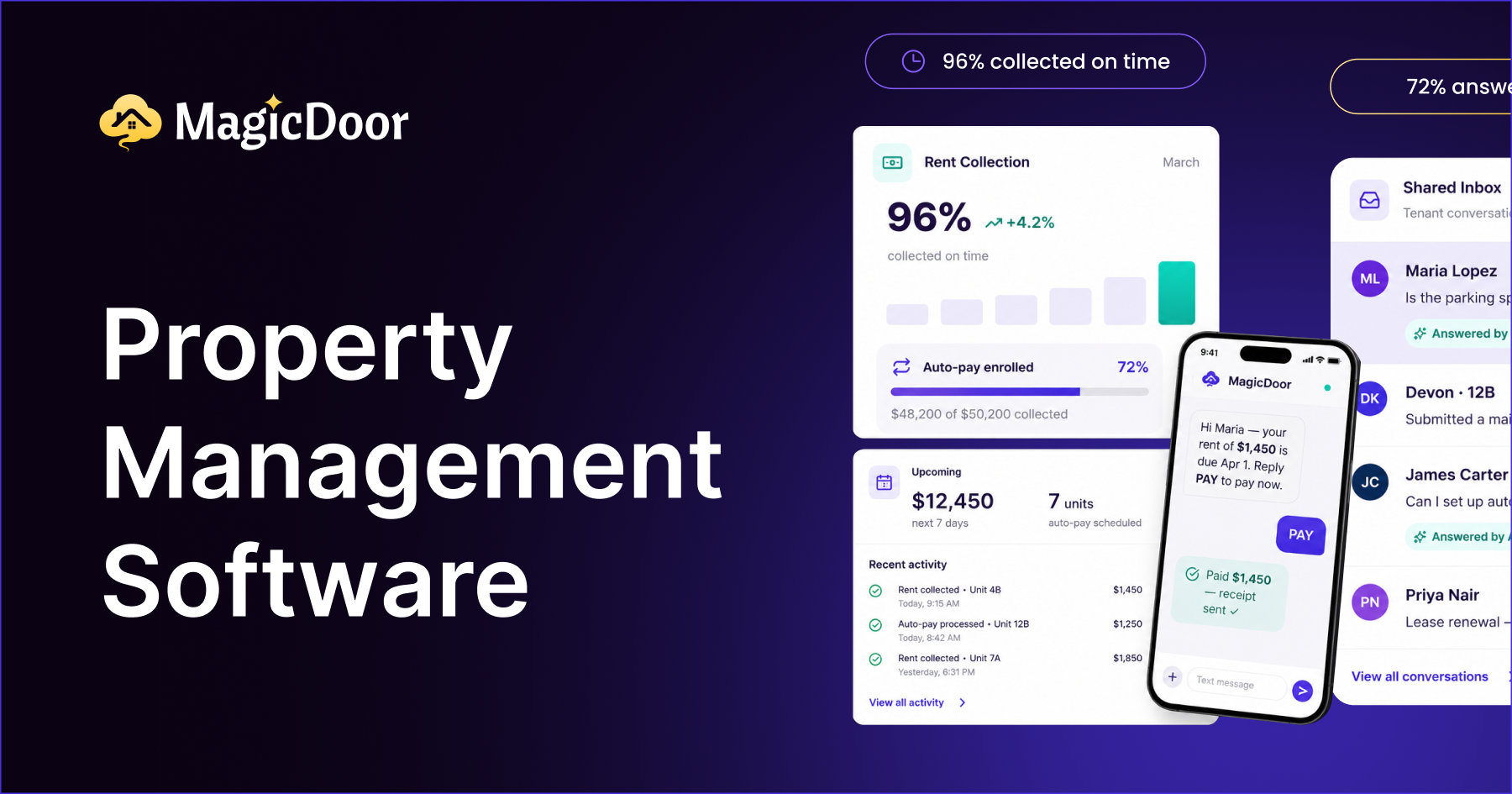
MagicDoor is an AI-powered rental management software platform focused on automating collections and communications, currently classified as a CRE-Native, Tier 2 application in the BestCRE Master Database. Operating within the commercial real estate property management and operations category, the tool targets operators seeking to reduce the administrative burden of tenant interactions and payment tracking. As of August 2026, the company has elected not to disclose its pricing details publicly, requiring prospective buyers to engage directly with their sales team to understand the financial commitment required for deployment. This positions MagicDoor as a specialized utility rather than a broad ecosystem platform, distinguishing it from legacy property management systems that attempt to handle all aspects of asset management.
Our analysis indicates that MagicDoor enters a crowded market segment where established players have already set high expectations for functionality. By narrowing its focus strictly to the automation of rent collection workflows and routine tenant communications, the software attempts to solve specific operational bottlenecks rather than replacing entire accounting or facility management suites. The platform utilizes artificial intelligence to parse tenant messages, draft contextual responses, and trigger automated follow-ups for delinquent accounts. For a commercial real estate principal or analyst evaluating a purchase, the primary question is whether this focused functionality justifies adding another layer to the existing technology stack, especially when compared to comprehensive alternatives that already score highly in our assessments.
What MagicDoor does and how it works
MagicDoor functions primarily as an intelligent communication and ledger-monitoring layer that sits between property managers and tenants. The core mechanic involves the system ingesting incoming tenant communications via email, text message, or a dedicated portal, and applying natural language processing to categorize the intent of the message. If a tenant asks about a late fee policy or reports a minor maintenance issue, the artificial intelligence drafts a response based on the specific property rulebook and historical data. Property managers can set the system to either automatically reply for low-risk inquiries or hold drafts for human approval. This reduces the daily inbox volume that site staff must process manually.
The second major component is its automated collections engine. MagicDoor connects to the property primary ledger to monitor payment statuses in real time. When an account falls into arrears, the software initiates a programmed sequence of communications. Instead of sending generic, static templates, the artificial intelligence adjusts the tone and frequency of the messages based on the tenant payment history and previous interactions. For example, a chronically late tenant receives a different sequence than a long-term tenant who missed a payment for the first time. The system tracks engagement with these messages, logging when they are opened and whether the tenant has clicked through to the payment portal.
From an operational standpoint, the platform aggregates these interactions into a central dashboard, providing asset managers with visibility into collection metrics and communication response times. The dashboard highlights accounts requiring immediate human intervention, effectively triaging the collections workload. By automating the repetitive elements of collections and tenant inquiries, MagicDoor aims to increase the capacity of property management teams without requiring additional headcount. However, our analysis notes that the effectiveness of these mechanics relies entirely on the accuracy of the underlying property data and the strict configuration of communication parameters during setup.
9AI Framework: the score, dimension by dimension
CRE Relevance: 8/10
MagicDoor is classified as a CRE-Native platform, meaning its architecture and data models are designed specifically for commercial and multifamily real estate operations rather than general business applications. The system understands industry-specific concepts such as lease structures, common area maintenance charges, and eviction notice periods. This domain specificity allows the artificial intelligence to interpret tenant communications with a higher degree of contextual accuracy than a generic customer service chatbot. However, as a Tier 2 application focusing strictly on collections and communications, it lacks the broader asset management capabilities found in comprehensive property management suites. The tool solves a narrow set of problems deeply rather than attempting to address the entire real estate lifecycle. In practice: The software requires minimal training on real estate terminology but will only address a fraction of a property manager daily responsibilities.
Data Quality and Sources: 7/10
The effectiveness of MagicDoor depends heavily on the quality of the data it ingests from external property management systems and rent rolls. Because the platform relies on historical payment data and lease terms to generate automated communications, any discrepancies in the source ledger will result in incorrect late notices or inaccurate tenant responses. The system does not inherently clean or standardize incoming data; it assumes the connected ledger is the single source of truth. Our analysis shows that portfolios with poorly maintained lease abstracts or delayed payment posting schedules will struggle to generate accurate automated workflows. The artificial intelligence models themselves are trained on standard real estate interactions, but the localized output is entirely dependent on the client data hygiene. In practice: Operators must audit and correct their existing rent rolls and ledger entries before deploying the platform to avoid sending erroneous delinquency notices.
Ease of Adoption: 7/10
Deploying MagicDoor involves mapping existing lease data and communication templates into the proprietary engine. The user interface is straightforward, focusing on a centralized inbox and a collections dashboard that requires little technical expertise to navigate. However, the initial configuration of the artificial intelligence parameters demands significant time from senior property managers. Teams must define the specific tone and escalation paths for different tenant profiles, which can be a tedious process for portfolios with highly variable lease agreements. Once configured, the daily operation is highly automated, but the upfront investment in workflow design is substantial. The lack of published pricing also complicates the procurement phase, adding friction to the initial adoption process. In practice: Implementation requires a dedicated operational lead to map communication workflows before site-level staff can begin using the system.
Output Accuracy: 8/10
When evaluating the accuracy of automated responses and collection notices, the platform performs well within its strictly defined operational boundaries. The natural language processing engine accurately categorizes routine tenant inquiries regarding payment portals, ledger balances, and standard lease clauses. For the collections module, the system correctly calculates late fees and triggers escalation sequences based on the programmed rules. However, our analysis indicates that the artificial intelligence occasionally struggles with complex, multi-part tenant emails that combine a maintenance request with a dispute over a specific utility charge. In these edge cases, the system defaults to holding the message for human review, which is a safe fallback but slightly reduces the overall automation rate. The generated text is professional and avoids hallucinations when constrained to ledger data. In practice: The system reliably handles standard payment inquiries but correctly defers complex tenant disputes to human property managers.
Integration and Workflow Fit: 7/10
As a specialized operational layer, MagicDoor must communicate continuously with a property primary accounting and property management software. The platform provides application programming interfaces designed to sync ledger balances, lease expirations, and tenant contact information in real time. Our analysis indicates that while the tool connects effectively with major industry databases, the depth of these integrations varies. For standard data points like outstanding balances, the synchronization is highly reliable. However, writing complex data back into the primary ledger, such as modifying a late fee structure based on an AI-negotiated payment plan, often requires manual intervention or custom development work. The platform acts primarily as a read-heavy application, pulling data to inform its communications rather than serving as the central system of record. In practice: Buyers should verify the exact read and write capabilities of the software with their specific accounting system before committing.
Pricing Transparency: 4/10
MagicDoor operates with a completely opaque pricing model, as the company has not disclosed any cost details publicly. Prospective buyers cannot access standard software-as-a-service tiers, per-unit costs, or implementation fees without entering a direct sales process. This lack of transparency forces commercial real estate analysts to invest time in vendor meetings simply to determine if the tool fits within their operational budget. Based on our framework rules, a vendor that does not publish pricing cannot score higher than a five in this category. This approach makes it difficult to calculate an expected return on investment during the initial evaluation phase and prevents quick comparisons against competitors who list their base rates online. The hidden pricing structure suggests enterprise-style negotiations rather than standardized subscription plans. In practice: Analysts must engage the sales team directly and should demand a detailed breakdown of implementation costs and recurring unit fees.
Support and Reliability: 6/10
As an unproven startup in the Tier 2 category, MagicDoor has yet to establish a long-term track record of support reliability across large-scale enterprise deployments. The company provides standard technical assistance, including email support and an assigned customer success representative during the onboarding phase. However, there is limited evidence regarding their ability to handle high-volume support tickets during critical periods, such as the first of the month when rent collection activities peak. Buyers must rely on service level agreements negotiated during the contract phase, as public metrics on uptime and average resolution times are not available. The framework dictates that unproven startups cannot exceed a score of six in this dimension, reflecting the inherent risk of adopting software from a newer vendor without a deep history of client retention. In practice: Organizations should negotiate strict service level agreements and demand dedicated support contacts for critical collection periods.
Innovation and Roadmap: 7/10
The development trajectory for MagicDoor focuses heavily on expanding the capabilities of its natural language processing engine and adding predictive analytics to its collections module. The company has outlined plans to introduce sentiment analysis, which would allow the system to gauge tenant frustration levels and escalate specific communications to senior management automatically. Additionally, there are planned updates to support multi-lingual communications, addressing a significant need in diverse metropolitan markets. While these planned features align well with the operational needs of commercial real estate managers, they remain in the development phase. The current iteration is strictly a rules-based automation tool with basic artificial intelligence drafting capabilities. The roadmap indicates a clear understanding of property management pain points, but execution will determine its ultimate value. In practice: Buyers should evaluate the platform based entirely on its current collection and communication features rather than future predictive analytics promises.
Market Reputation: 5/10
MagicDoor is currently building its brand presence within the commercial real estate technology sector, but as an unproven startup, its market reputation remains limited. It does not yet possess the widespread industry recognition or extensive case studies associated with legacy property management platforms. Early adopters report satisfaction with the specific communication automation features, but the sample size of verified user feedback is too small to draw definitive conclusions about enterprise-scale performance. The lack of published pricing and a relatively quiet marketing presence further contribute to its low profile. Under the 9AI framework, an unproven startup cannot score above a six in market reputation, reflecting the reality that the company has not yet weathered multiple economic cycles or proven its long-term viability to institutional investors. In practice: Prospective clients must conduct thorough reference checks with current users holding similar portfolio sizes before signing a contract.
Who should use MagicDoor
MagicDoor is designed for specific operational profiles within the commercial and multifamily real estate sectors. The tool provides the most value to organizations that struggle with high volumes of routine tenant communications and manual collection processes. It is best suited for teams that already have a stable primary ledger but need a specialized communication layer to handle administrative overflow.
- Mid-sized property management firms seeking to increase their door count without proportionally increasing their administrative headcount.
- Asset managers overseeing portfolios with historically high delinquency rates who require structured, automated follow-up sequences to improve cash flow.
- Operators of workforce housing or large multifamily complexes where the volume of basic tenant inquiries overwhelms on-site staff.
- Portfolios with highly standardized lease agreements and late fee policies that can be easily mapped into an automated rules engine.
Who should look elsewhere
This platform is not a comprehensive property management system and will not solve fundamental operational issues stemming from poor data hygiene or disorganized accounting practices. Organizations requiring an all-in-one solution will find this tool insufficient for their needs.
- Firms looking for a complete property management suite to handle accounting, maintenance dispatch, and marketing simultaneously.
- Operators of highly complex commercial assets, such as specialized retail or industrial properties, where lease terms and collection protocols require manual negotiation.
- Small portfolios where the cost of implementing and maintaining a specialized AI communication layer outweighs the time saved on manual email drafting.
- Companies with strict budget transparency requirements that cannot engage in lengthy sales negotiations to discover baseline software costs.
Pricing and ROI
MagicDoor has elected to keep its pricing details entirely confidential, meaning no base rates, per-unit fees, or implementation costs are published for public review. This lack of transparency requires prospective buyers to engage directly with the sales team to obtain a custom quote based on their specific portfolio size and integration requirements. Based on our analysis of similar Tier 2 operational tools in the current market, buyers should anticipate a model that includes a significant upfront implementation fee to cover the complex mapping of lease data and communication workflows, followed by a recurring monthly subscription based on the total number of active units or total square footage under management.
To calculate the return on investment, analysts must quantify the current cost of manual collections and communication drafting. If a property manager spends twenty hours per month tracking delinquent accounts, drafting notices, and responding to basic ledger inquiries, at an hourly rate of forty dollars, the manual cost is eight hundred dollars per month per manager. If MagicDoor can automate eighty percent of these tasks, the operational savings amount to six hundred and forty dollars per manager monthly. Furthermore, if the automated sequences reduce average days delinquent by even two days across a large portfolio, the improved cash flow and reduction in bad debt can quickly offset the undisclosed subscription costs. However, without published pricing, confirming this return on investment requires a formal vendor proposal.
Integration and CRE tech stack fit
Integrating MagicDoor into an existing commercial real estate technology stack requires careful planning, as the platform must function as a synchronized layer on top of your primary system of record. Because MagicDoor focuses exclusively on communications and collections, it relies entirely on the data housed within your core accounting or property management software. Our analysis indicates that the tool is designed to pull tenant contact information, lease terms, and real-time ledger balances via application programming interfaces.
For the system to operate effectively, the data flow must be continuous and bidirectional. While the platform excels at reading data to trigger automated emails and text messages, writing data back, such as logging a communication event into the primary ledger tenant file, can sometimes require custom configuration. Buyers must verify that their current property management system permits third-party applications to extract and update ledger data without imposing excessive API usage fees. If the primary system restricts data access, MagicDoor will be unable to accurately calculate late fees or halt automated notices when a payment is manually posted, severely limiting its utility within the broader tech stack.
Competitive landscape
When evaluating MagicDoor, commercial real estate analysts must compare it against both specialized communication tools and comprehensive property management platforms that have recently upgraded their own automation capabilities. DoorLoop, which scored a 93 in our assessments, represents a formidable alternative. While DoorLoop is a full property management system rather than a specialized layer, its built-in automated rent collection and communication features are highly refined, making a secondary tool like MagicDoor potentially redundant for DoorLoop users. Similarly, Entrata, scoring an 88, offers an extensive suite of operational tools with deep automation for multifamily operators, providing a single-system approach that many enterprise portfolios prefer over stacking multiple Tier 2 applications.
AppFolio, scoring an 86, also competes directly for the attention of property managers. AppFolio has heavily invested in artificial intelligence to automate routine workflows, including tenant communications and delinquency tracking. For operators already utilizing AppFolio, adding MagicDoor would likely introduce unnecessary complexity.
In the realm of specialized artificial intelligence tools, Relevance AI, scoring an 85, offers customizable AI agents that can be trained for property management tasks. While Relevance AI requires more technical configuration than MagicDoor, it provides greater flexibility for firms wanting to build bespoke operational workflows beyond just collections. Conduit, scoring an 87, also operates in the automation space and presents a strong alternative for data integration and workflow management. Ultimately, MagicDoor must prove that its hyper-focused collections engine outperforms the native features of these higher-scoring, established platforms.
The bottom line
MagicDoor offers a highly specific solution to a universal property management problem: the administrative drain of rent collections and routine tenant communications. For mid-sized operators struggling with delinquency follow-ups and inbox management, the platform provides a structured, automated workflow that reduces manual administrative hours. However, as an unproven startup with undisclosed pricing, it carries inherent procurement and adoption risks. The decision to purchase hinges entirely on your current technology stack. If your organization relies on a legacy accounting system with poor communication features, MagicDoor serves as a valuable modernization layer. Conversely, if you are already utilizing high-scoring comprehensive platforms like DoorLoop or AppFolio, the marginal benefit of adding this specialized tool will not justify the integration effort or the additional subscription cost. Buyers should demand a strict proof of concept to verify data synchronization before committing capital.
Frequently asked questions
Does MagicDoor replace our existing property management accounting software?
No. MagicDoor is a specialized operational layer designed to handle communications and automated collections. It does not possess full accounting, maintenance dispatch, or general ledger capabilities. It must be integrated with your primary property management system to function correctly and pull accurate tenant balance data.
How much does MagicDoor cost to implement and run?
The company does not publish its pricing details publicly. Prospective buyers must engage directly with their sales team to receive a custom quote. Based on industry standards for similar operational tools, expect an initial implementation fee followed by a recurring subscription based on unit count.
Can the AI negotiate payment plans with delinquent tenants?
The artificial intelligence operates strictly within the rules and parameters configured by the property manager during setup. While it can offer pre-approved payment plan options based on your established policies, it does not autonomously negotiate terms outside of those strict operational boundaries.
What happens if a tenant disputes a charge via email?
The natural language processing engine is trained to recognize complex disputes or issues that fall outside routine inquiries. When it detects a dispute regarding a specific charge or maintenance issue, the system automatically halts the automated sequence and flags the message for human review.
Is MagicDoor suitable for complex commercial retail portfolios?
It is generally less effective for highly complex commercial assets. Retail and industrial leases often feature highly individualized terms, percentage rent calculations, and custom collection protocols that are difficult to map into a standardized automated rules engine without extensive manual oversight.
How long does it take to deploy this software?
Deployment timelines vary based on the cleanliness of your existing data and the complexity of your communication workflows. Because senior staff must map out specific escalation paths and tone guidelines for the AI, operators should plan for a multi-week configuration process before launching to tenants.