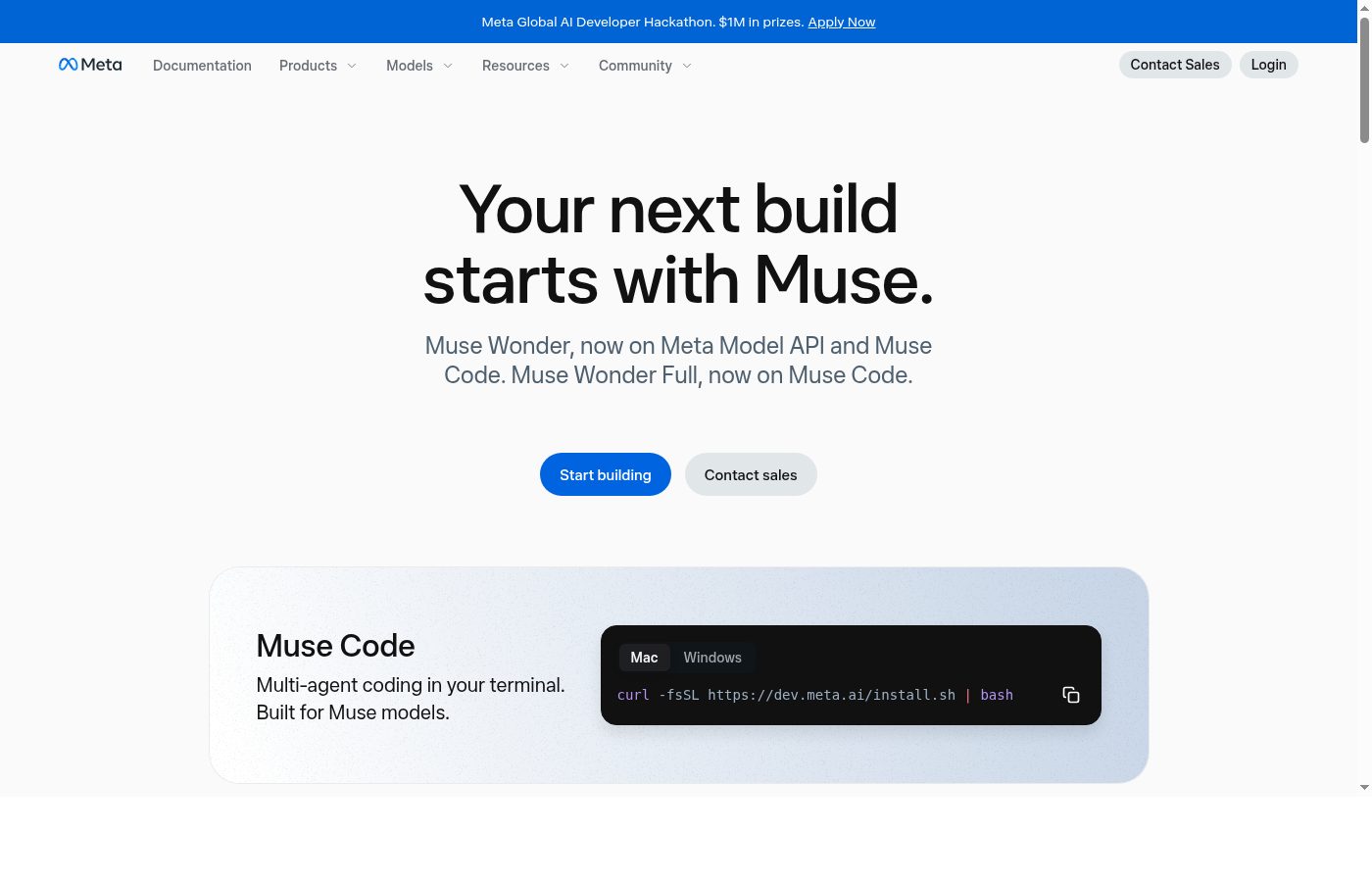
Meta LLaMA is an open-source foundation large language model developed by Meta, functioning primarily as a text generation and embedding engine for developers. As verified in our March 2026 BestCRE database research, the system operates on a dual distribution model, offering open-source weights for local deployment alongside API pay-per-token access through various cloud providers. Unlike specialized commercial real estate applications that offer out-of-the-box user interfaces for analysts or brokers, LLaMA represents the underlying infrastructure layer. For a commercial real estate principal or technology officer, evaluating LLaMA is not about buying a ready-made software product, but rather selecting the cognitive engine that will power proprietary internal tools or assessing the technical backbone of third-party vendor platforms.
The commercial real estate sector has traditionally relied on proprietary software vendors for data analysis, lease abstraction, and market research. The introduction of highly capable, open-weight models shifts this dynamic, allowing well-resourced firms to build secure, private AI environments without sending sensitive rent rolls or investment committee memos to external commercial APIs. While it requires significant technical expertise to implement, LLaMA provides the raw reasoning capabilities necessary to process complex real estate documents, generate property descriptions, and structure unstructured market data. Our analysis approaches this foundation model strictly from the perspective of its utility in a commercial real estate technology stack, measuring how effectively its general-purpose architecture can be adapted to the specific, high-stakes demands of property valuation and portfolio management.
What Meta LLaMA does and how it works
At its core, Meta LLaMA processes natural language inputs and generates text or embeddings based on its extensive pre-training data. For a commercial real estate firm, this means the model can read, summarize, and extract structured data from lengthy, complex documents such as commercial leases, offering memorandums, or zoning codes. Because it is a foundation model, it does not come with a real estate-specific interface or pre-loaded property databases. Instead, developers must build applications around the LLaMA API or local instance, feeding it specific commercial real estate documents through techniques like retrieval-augmented generation to ground its answers in factual, proprietary data.
The text generation capabilities allow the model to draft investment committee memos, write property marketing copy, or summarize lengthy environmental site assessments. Its embedding capabilities are equally critical for commercial real estate applications. Embeddings convert text into numerical vectors, enabling a firm to create highly searchable internal databases. For example, a developer could use LLaMA embeddings to index ten years of past deal memos, allowing an analyst to instantly retrieve all historical transactions involving adaptive reuse projects in specific submarkets with similar capitalization rates.
Because the model weights are open-source, commercial real estate firms have the unique ability to fine-tune LLaMA directly on their own proprietary datasets. A brokerage could train the model on thousands of its successful lease negotiations to teach it the firm’s specific analytical frameworks and risk tolerances. This local deployment capability ensures that highly sensitive financial data, such as tenant sales figures or unannounced acquisition targets, never leaves the firm’s private servers, solving one of the primary compliance hurdles that has historically prevented institutional real estate players from adopting cloud-based artificial intelligence solutions.
9AI Framework: the score, dimension by dimension
CRE Relevance: 3/10
Meta LLaMA is a general-purpose foundation model trained on a broad internet corpus, containing absolutely no proprietary commercial real estate data, specialized property metrics, or out-of-the-box real estate workflows. It does not natively understand the nuances of a triple net lease versus a gross lease beyond basic definitions found in public texts. To achieve actual relevance in a real estate context, a firm must supply all the domain-specific context, proprietary data, and workflow logic through custom development. While the raw reasoning capability is exceptionally high, the baseline product offers zero immediate utility for a broker or analyst without significant engineering intervention. In practice: You are acquiring a highly capable blank slate that requires your developers and proprietary data to become a functional real estate tool.
Data Quality and Sources: 5/10
As an open-source foundation model, LLaMA relies entirely on the data it is fed during pre-training and the context provided by the user at runtime. Meta does not publish a commercial real estate-specific training dataset, meaning its baseline knowledge of market trends, capitalization rates, or zoning laws is limited to publicly scraped internet data, which is often outdated or generalized. The quality of the outputs relies entirely on the quality of the proprietary rent rolls, offering memorandums, or market reports that a firm’s developers pipe into the model via retrieval-augmented generation. If your internal data is poorly structured, the model will reflect those flaws. In practice: The model’s data quality is strictly a mirror of your firm’s internal data governance and documentation standards.
Ease of Adoption: 4/10
Adopting Meta LLaMA is an engineering project, not a software subscription. There is no user interface, no login screen for analysts, and no customer success team to onboard your brokers. Implementation requires a dedicated team of software developers, data engineers, and cloud architects to host the model, build the surrounding application infrastructure, and maintain the system. For a typical mid-sized commercial real estate firm without an in-house software engineering department, direct adoption is effectively impossible without hiring expensive third-party technical consultants. Firms seeking immediate productivity gains should look to packaged applications rather than foundation models. In practice: Adoption requires a substantial upfront investment in technical talent and infrastructure before a single analyst can use the system.
Output Accuracy: 8/10
When properly configured and grounded with high-quality commercial real estate documents, LLaMA demonstrates strong reasoning and extraction accuracy. However, as a generative model, it is inherently prone to hallucination if asked to perform calculations or recall specific market data without explicit context. It cannot be trusted to independently calculate internal rates of return or accurately quote current market rents from its pre-trained memory. Its accuracy peaks when used strictly for natural language processing tasks, such as summarizing a provided lease document or extracting specific clauses into a structured format, provided the prompt engineering is highly constrained. In practice: Analysts must rigorously verify all numerical outputs and treat the model as a document processor rather than a financial calculator.
Integration and Workflow Fit: 9/10
Because LLaMA is deployed as a foundational layer or accessed via standard API pay-per-token endpoints, its integration potential is virtually limitless for a capable development team. It can be wired directly into a firm’s proprietary deal management system, connected to cloud storage repositories containing property documents, or embedded into custom underwriting spreadsheets. However, this fit is entirely manual; there are no native, plug-and-play integrations with standard commercial real estate platforms like Yardi, Argus, or VTS. Your engineering team must build and maintain every connection, handling API authentications, data formatting, and security protocols independently. In practice: The model will integrate with any system your engineers are capable of writing custom connection code for.
Pricing Transparency: 10/10
Meta LLaMA operates on a highly transparent open-source and API pay-per-token pricing model. The model weights themselves are available for free download, meaning a firm can host the system on its own hardware without paying licensing fees to Meta. For firms opting to use cloud-hosted versions through providers like AWS or Azure, pricing is strictly based on compute usage or a published per-token rate for input and output text. There are no hidden enterprise licensing tiers, no per-seat subscription costs for analysts, and no opaque negotiation processes. The primary financial variables are internal cloud hosting costs and developer salaries, which are predictable based on standard IT infrastructure metrics. In practice: Real estate firms pay only for the raw computing power and developer time required to run the model.
Support and Reliability: 8/10
Meta provides the foundation model but offers absolutely no dedicated technical support, customer success managers, or service level agreements for open-source deployments. Reliability is entirely dependent on the commercial real estate firm’s internal IT infrastructure or the chosen third-party cloud hosting provider. If the model crashes or generates errors during a critical underwriting process, your internal engineering team is solely responsible for troubleshooting and resolving the issue. While the open-source community provides extensive documentation and community forums, enterprise-grade support requires contracting with specialized AI infrastructure vendors or relying on the support tiers of cloud providers hosting the API. In practice: You are entirely reliant on your internal technical team or paid third-party infrastructure hosts to keep the system operational.
Innovation and Roadmap: 9/10
Meta has consistently demonstrated a commitment to advancing the LLaMA architecture, releasing successive generations with expanded context windows, improved reasoning capabilities, and enhanced multimodal functions. The open-source nature of the project means that a massive global community of researchers is constantly developing new fine-tuning techniques, optimization methods, and integration frameworks that benefit all users. For a commercial real estate firm, this ensures the foundational technology will remain highly competitive with proprietary models. However, Meta’s roadmap is focused on general artificial intelligence capabilities, not specific real estate features, meaning firms must independently adapt these broad advancements to their specific property analysis workflows. In practice: Your firm benefits from billions of dollars in AI research, but must translate those general advancements into real estate utility.
Market Reputation: 10/10
Meta LLaMA holds a dominant position in the open-source artificial intelligence landscape, widely respected by developers and enterprise technology officers alike. Within the commercial real estate sector, it is increasingly recognized as the standard backbone for firms building proprietary, highly secure internal applications. While end-users like brokers or acquisitions analysts rarely interact with the LLaMA brand directly, real estate technology leaders view it as a highly credible, tier-one alternative to closed systems. Its reputation is built on delivering high performance without the data privacy concerns associated with sending proprietary deal information to external commercial APIs. In practice: Chief Technology Officers at institutional real estate firms widely trust this model for building secure, proprietary artificial intelligence applications.
Who should use Meta LLaMA
Meta LLaMA is strictly an infrastructure play, suitable only for organizations with the technical capacity to build and maintain custom software. It is designed for institutions that view technology as a core competitive advantage rather than a simple operational expense.
Institutional Investment Managers: Firms requiring absolute data privacy for highly sensitive investment committee memos and proprietary market forecasts, necessitating a locally hosted model.
Real Estate Technology Vendors: Proptech startups and established software companies needing a cost-effective, customizable foundation model to power the natural language features of their commercial products.
Large Brokerage Networks: Global brokerages with dedicated data engineering teams looking to build proprietary, internal-only search and summarization tools across decades of historical transaction data.
Quantitative Real Estate Funds: Highly technical funds building automated pipelines to extract structured financial data from unstructured public filings and municipal zoning documents.
Who should look elsewhere
This model offers zero out-of-the-box functionality and is entirely inappropriate for individuals or firms seeking immediate software solutions for daily real estate tasks.
Independent Brokers and Small Teams: Professionals looking for a ready-to-use assistant to draft emails or summarize leases; these users require packaged applications, not foundation models.
Firms Without In-House Developers: Organizations lacking dedicated software engineers, cloud architects, and data scientists will find it impossible to implement or maintain this technology.
Boutique Syndicators: Small investment shops that need immediate underwriting automation or financial modeling tools without the overhead of building custom software infrastructure.
Pricing and ROI
Based on our database research, Meta LLaMA operates on an open-source and API pay-per-token model. The model weights are available for free, meaning there is no software licensing fee to acquire the core technology. However, “free” in the context of foundation models does not mean zero cost. Deploying LLaMA locally requires significant investment in high-performance computing hardware, specifically advanced GPUs, which can cost tens of thousands of dollars per server. Alternatively, firms can access LLaMA through cloud providers via an API pay-per-token structure. In this model, costs are typically measured in fractions of a cent per 1,000 tokens processed. For example, processing a standard 50-page commercial lease might consume roughly 40,000 tokens, costing just a few cents in API fees. The true cost of LLaMA lies in the human capital required to implement it. A commercial real estate firm must budget for full-time software engineers, data scientists, and cloud infrastructure specialists to build the application layer, manage data pipelines, and maintain system security. When calculating return on investment, a firm must weigh these substantial development and infrastructure costs against the operational savings of automating document extraction and the strategic value of maintaining complete data privacy over proprietary deal information.
Integration and CRE tech stack fit
Meta LLaMA does not offer native integrations with standard commercial real estate technology stacks. You cannot simply connect it to Yardi, Argus Enterprise, or Dealpath via a pre-built settings menu. Instead, it serves as a foundational building block that your engineering team must manually integrate into your firm’s architecture using custom code and API endpoints. For a sophisticated real estate firm, this means developers can write scripts to pull rent roll data from a proprietary SQL database, feed it into LLaMA for natural language summarization, and push the resulting text into a custom Salesforce dashboard. The model integrates natively into standard modern software development environments, supporting Python, JavaScript, and enterprise cloud architectures like AWS, Google Cloud, and Microsoft Azure. Because it is highly adaptable, it can be embedded into custom underwriting models in Excel via custom scripts or linked to internal document repositories like SharePoint for enterprise search. The integration fit is technically universal, but practically limited entirely by the skill, bandwidth, and budget of your internal software engineering department.
Competitive landscape
When evaluating Meta LLaMA, commercial real estate technology leaders must compare it against both other foundation models and specialized real estate applications. In the foundation model category, the primary alternatives are proprietary models like OpenAI’s GPT-4 or Anthropic’s Claude. Unlike LLaMA, these proprietary models cannot be hosted locally, meaning highly sensitive real estate data must be sent to external servers, which often violates institutional compliance policies. However, OpenAI and Anthropic generally offer superior out-of-the-box reasoning capabilities for complex tasks compared to base open-source models, though a heavily fine-tuned LLaMA model can close this gap for specific real estate workflows. For firms seeking actual software applications rather than infrastructure, LLaMA competes indirectly with platforms like Cursor (Scored 90), Agentforce (Scored 88), and Replit (Scored 88). Cursor and Replit provide AI-assisted development environments that help engineers write code faster, which is a different utility than hosting a foundation model. Agentforce, Gumloop (Scored 87), Manus (Scored 87), and Conduit (Scored 87) offer more structured agentic workflows or automation capabilities that require significantly less custom engineering than building an application from scratch on top of LLaMA. Ultimately, choosing LLaMA over these alternatives is a decision to prioritize absolute data control, customizability, and open-source economics over the immediate deployment speed and convenience offered by packaged proprietary software or managed automation platforms.
The bottom line
Meta LLaMA is not a commercial real estate software product; it is the raw industrial material used to build one. For institutional investors, large brokerages, and proptech vendors with dedicated engineering teams, it offers an exceptionally powerful, cost-effective way to develop proprietary artificial intelligence tools without compromising the security of highly sensitive deal data. The open-source and API pay-per-token pricing model provides excellent long-term economics for high-volume text processing tasks like lease abstraction and market report generation. However, firms lacking in-house software developers should entirely avoid this technology, as it offers zero immediate utility for a real estate analyst or broker. The decision to adopt LLaMA is fundamentally a decision to become a software development organization. If your firm views custom technology as a core strategic asset and possesses the budget to support an engineering team, LLaMA is a premier foundational choice.
Frequently asked questions
Can my analysts use Meta LLaMA to underwrite properties?
Not directly. LLaMA is a foundation model that lacks a user interface or built-in real estate calculators. To utilize it for underwriting, your engineering team must build a custom application around the model, feeding it specific property data to assist analysts with extracting and structuring financial information.
Does Meta LLaMA store our proprietary rent rolls and deal memos?
If you deploy the open-source weights locally on your own internal servers, your data remains entirely private and is never transmitted to Meta. Conversely, if you access the model through a third-party cloud API provider, your data storage and privacy protections will depend entirely on that specific provider’s enterprise terms of service.
Is Meta LLaMA trained on commercial real estate data?
No, it is not explicitly trained on proprietary property data. The model learns from a massive corpus of general internet text. While it understands basic real estate terminology, it lacks deep market knowledge unless your developers explicitly provide that proprietary context through fine-tuning or retrieval-augmented generation techniques.
How much does a Meta LLaMA subscription cost for a brokerage?
There are no traditional user subscriptions. The model weights are free to download, or you can pay per token via various cloud APIs. Your primary financial costs will consist of the cloud hosting infrastructure and the salaries of the software engineers required to build and maintain your application.
Can LLaMA integrate directly with Argus or Yardi?
There are absolutely no pre-built integrations for standard commercial real estate platforms like Argus or Yardi. Any connection to your existing property management systems, valuation software, or internal databases must be manually custom-coded by your software development team using standard API protocols and data pipelines.
Why choose LLaMA over specialized real estate AI tools?
The primary advantages are absolute data privacy achieved through local hosting and the unique ability to heavily customize the model’s baseline behavior. This path is strictly recommended for institutions that want to own their proprietary technology stack rather than renting closed, off-the-shelf software from external vendors.
Related Reviews
Compare Meta LLaMA with other AI Assistants & Copilots tools BestCRE has scored: Google Gemini (84/100), Grammarly (83/100), Excel 4 CRE Add-in (73/100) and Yoodli (73/100). Browse every review in CRE AI Assistants & Copilots, the full Best CRE AI Tools directory, or the 20 CRE Sectors hub.