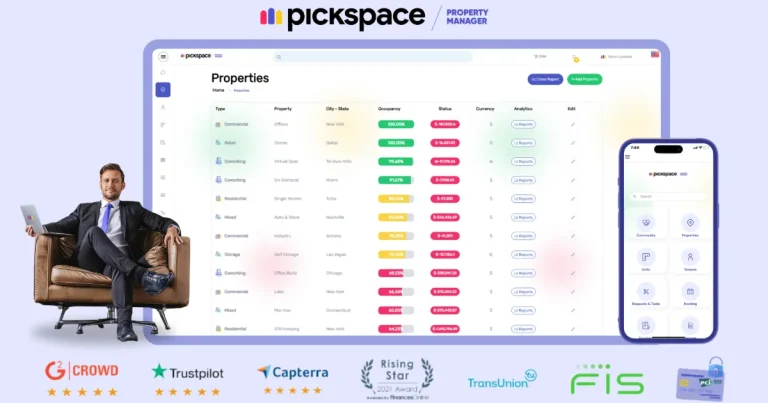
Pickspace is property management software for owners, operators and third party managers overseeing commercial, retail, coworking, mixed use and several residential property types. Its central proposition is operational consolidation. Instead of running collections, lease administration, maintenance, communications and reporting through separate systems, a manager can coordinate those workflows in one web and mobile platform. Commercial functions advertised by the vendor include NNN billing, CAM reconciliation, percentage rent, multi tenant invoicing and owner reporting.
The strongest CRE case is not simply collecting rent. It is connecting lease obligations to recurring charges, accounting activity, service requests and tenant communications. Pickspace combines operator dashboards with tenant and owner portals, giving each participant an appropriate view of payments, documents and activity. That structure could reduce spreadsheet handling and repeated data entry for a manager whose portfolio has outgrown basic accounting software but does not require the complexity of a large enterprise suite.
Pickspace also spans coworking memberships, meeting room reservations, access control connections, residential leases and shared amenities. Analysis: this breadth is most valuable for mixed use operators and management companies serving different asset types. It is less decisive for institutional owners seeking deep specialization in one sector. Buyers should test whether individual modules support their exact lease clauses, accounting policies, approval rules and reporting packages, rather than assuming broad feature coverage means equal depth everywhere.
The vendor presents artificial intelligence as an operations layer for leasing, billing and maintenance, but it does not publicly disclose enough performance evidence to quantify accuracy or labor savings. Pickspace reports processing more than $500 million in rent payments, although buyers should confirm the scope and measurement period during diligence. The resulting verdict is measured: Pickspace appears to be a credible, CRE relevant operating platform with an unusually broad functional range, but its economics, AI performance and enterprise service capacity require direct validation.
What Pickspace Does and How It Works
Pickspace organizes the property lifecycle from marketing and applications through agreements, billing, collections and ongoing service. Operators can create recurring invoices, accept online payments and autopay, apply fees, reconcile transactions and expose relevant information through tenant and owner portals. Lease and contract capabilities include templates, electronic signatures and document storage. For commercial portfolios, the advertised workflow includes lease administration, CAM reconciliation, NNN charges and multi tenant billing. Retail operators can also manage percentage rent, pop ups, marketing spaces and tenant mix.
Maintenance begins with service requests submitted through the portal or mobile experience. Teams can convert requests into work orders, assign vendors, monitor service levels and retain an activity record. Vendor management covers onboarding, certificates of insurance, dispatch and ACH payouts. Communication tools support messages, announcements, alerts and document workflows, while reservation functions handle rooms, parking, amenities and other shared resources. Analysis: bringing these interactions into the same property record should improve operational visibility, provided that implementation establishes consistent naming, permissions and ownership across teams.
The platform includes accounting and reporting workflows, portfolio dashboards, branded applications and connections to payment, accounting, customer relationship management and access systems. Named connections include Stripe, Worldpay, QuickBooks, Xero, SAP, HubSpot, Salesforce, OpenPath and Zapier. Pickspace markets AI automation across leasing, billing, maintenance and other repetitive work, including an operations copilot. Public product information does not specify model architecture, evaluation results, exception rates or the exact boundary between generated recommendations and autonomous actions. Buyers therefore need a controlled demonstration using realistic leases, invoices and work orders, followed by a pilot that measures corrections, processing time and auditability.
9AI Framework: Dimension by Dimension Analysis
CRE Relevance: 8/10
Pickspace earns 8 for CRE relevance because its commercial workflows extend beyond generic rent collection. The product addresses NNN billing, CAM reconciliation, percentage rent, lease administration, multi tenant invoicing, vendor compliance and owner reporting. It also recognizes operational distinctions among offices, shopping centers, coworking locations and mixed use properties. Those capabilities map directly to work performed by commercial property managers. The score stops short of the top band because Pickspace serves several residential categories alongside CRE, and public information does not demonstrate equally deep treatment of every commercial lease structure, asset class or institutional reporting requirement. Analysis: the product is clearly CRE native, but a buyer should verify recoveries, complex amendments, approval hierarchies and portfolio accounting against actual documents before treating it as a full enterprise system.
Data Quality and Sources: 6/10
Pickspace earns 6 for data quality. Its unified design should reduce fragmentation by connecting leases, invoices, payments, maintenance records, vendor documents and communications within a common operating environment. Role based access and activity logging can also support cleaner accountability when configured carefully. However, the vendor does not publish detailed information about data validation rules, duplicate detection, lease abstraction controls, accounting reconciliation tolerances or the provenance of AI generated responses. It also does not publish independent benchmarks showing completeness or error rates across imported portfolio data. Analysis: the platform can become a useful system of record, but software consolidation does not automatically correct inconsistent source data. Buyers should test migrations from accounting systems and spreadsheets, inspect field mappings, and determine who reviews exceptions before relying on dashboards or automated actions.
Ease of Adoption: 7/10
Pickspace earns 7 for ease of adoption. The platform combines browser access, native mobile applications, tenant and owner portals, and a product structure organized around recognizable property workflows. The vendor says onboarding can occur in days, but it does not publish a representative implementation schedule segmented by portfolio complexity. Adoption should be comparatively approachable for smaller managers replacing spreadsheets or disconnected point products, especially when their processes fit standard billing, leasing and work order patterns. Analysis: complexity rises quickly when portfolios contain unusual recovery clauses, historical accounting structures, multiple legal entities or custom approval chains. White labeling also adds decisions around branding, permissions and app deployment. Buyers should request a documented implementation plan covering migration, configuration, training, parallel operations and acceptance testing rather than relying on a general onboarding claim.
Output Accuracy: 6/10
Pickspace earns 6 for output accuracy. The platform can draw from operational records that are directly relevant to invoices, maintenance, leases and stakeholder reporting, which gives it a stronger basis than a general purpose assistant. Audit logging and scoped permissions should help teams trace activity. Yet the vendor does not publish accuracy evaluations for its AI functions, extraction tests for lease documents, hallucination rates, reconciliation error rates or human review requirements. It is therefore unclear how consistently AI generated recommendations correspond to executed leases and accounting policy. Analysis: accuracy will depend heavily on source configuration and the degree of autonomous action allowed. A buyer should create a test set containing amendments, partial payments, recovery caps, vendor exceptions and conflicting records, then compare system outputs with calculations approved by accounting and asset management.
Integration and Workflow Fit: 8/10
Pickspace earns 8 for integration. Its published ecosystem includes payment processors, accounting products, customer relationship management systems, marketing tools, access control and Zapier connections. Named products include QuickBooks, Xero, SAP, Salesforce, HubSpot, Stripe, Worldpay and OpenPath. This range is particularly useful for operators that want Pickspace to coordinate workflows without immediately replacing every existing system. The vendor also describes the platform as API first, although detailed public documentation about endpoints, rate limits, webhooks and data models is limited. Analysis: the integration posture appears stronger than that of many smaller property management platforms, but a logo is not proof of workflow depth. Buyers should verify bidirectional synchronization, failure handling, identity management, accounting dimensions and data ownership for each required connection before assigning architectural responsibility to the platform.
Pricing Transparency: 3/10
Pickspace earns 3 for pricing transparency. The vendor presents plans for different portfolio sizes and directs prospective buyers to a demonstration, but it does not publish enough price detail to calculate a dependable total cost from public information. Base subscription charges, minimum commitments, implementation fees, payment processing economics, integration costs, mobile branding charges and premium security costs are not clearly available. Buyers therefore cannot compare Pickspace with alternatives using a consistent public unit such as price per unit, property, user or transaction. Analysis: this does not mean the product is expensive, only that commercial evaluation begins later than it should. Procurement teams should require a multiyear pricing schedule, explicit usage assumptions, renewal limits and a separation of mandatory charges from optional services before evaluating return on investment.
Support and Reliability: 5/10
Pickspace earns 5 for support because its public presence offers demonstrations, contact channels, an academy, operator resources and onboarding claims, but it provides limited evidence about the service model behind them. The vendor does not publish standard response targets, support hours, escalation procedures, implementation staffing ratios or named service tiers in enough detail for operational comparison. Enterprise buyers also need clarity on incident communications, release management and coverage across the regions and languages Pickspace advertises. Analysis: available resources suggest a functioning customer enablement layer, but the strength and consistency of human support remain unproven publicly. Contract diligence should specify severity definitions, response and resolution expectations, data migration ownership, training entitlements and an escalation path. Reference calls with customers operating similar commercial portfolios would provide more useful evidence than general testimonials.
Innovation and Roadmap: 7/10
Pickspace earns 7 for innovation. Its most interesting design choice is not AI alone, but the combination of commercial billing, payments, maintenance, leasing, stakeholder portals, bookings and branded applications across multiple property types. That breadth can support mixed use operations that otherwise depend on several specialized products. The proposed AI layer could also help coordinate routine tasks across modules because it sits close to operational data. However, the vendor does not publish technical documentation or measured results that distinguish its AI from workflow automation, search and conversational interfaces already appearing throughout property technology. Analysis: Pickspace shows thoughtful product ambition and a modern operating model, but buyers should reward demonstrated outcomes rather than terminology. A pilot should identify which tasks are genuinely automated, where approval remains necessary and whether exceptions are easier to resolve than under the current process.
Market Reputation: 5/10
Pickspace earns 5 for market reputation. The company displays customer names and states that operators use the product across several international regions, but it does not publish customer counts, retention rates, portfolio totals or independently verified market share. Public information also does not establish the breadth of adoption among large institutional commercial owners. That makes Pickspace less proven than longstanding platforms such as Yardi and MRI Software, even if its interface and operating model may feel more current. Analysis: the available evidence supports treating Pickspace as an established emerging option, not as a default industry standard. Buyers should request references that match their property types, accounting complexity and geographic requirements. They should also evaluate company stability, product investment, security documentation and continuity provisions as part of normal vendor diligence.
Who Should Use Pickspace
Pickspace best suits commercial owners and third party managers that want one operating environment for billing, collections, maintenance, vendors, leasing and stakeholder communication. The fit is strongest when the portfolio includes neighborhood retail, office, coworking or mixed use properties with recurring charges, shared resources and frequent tenant interaction. A growing manager replacing spreadsheets, basic accounting tools and isolated work order products may gain a clearer operational record without adopting the full complexity of a traditional enterprise suite.
Mixed use operators are especially relevant buyers because Pickspace can address commercial tenants, residential occupants, memberships, amenities and owner reporting within one platform. Coworking businesses that combine recurring memberships with room reservations and access systems also merit a close look. Analysis: the ideal buyer has enough process complexity to value consolidation, but retains the organizational flexibility to configure a newer platform around its procedures. The evaluation team should include property operations, accounting, asset management and information technology, since success depends on lease logic and financial controls as much as interface usability.
Who Should Not Use Pickspace
Large institutional landlords should not select Pickspace solely on the promise of an all in one platform. Organizations with complex fund accounting, extensive custom reporting, mature data warehouses, strict global controls or hundreds of specialized integrations may find Yardi or MRI Software easier to defend as an enterprise standard. Pickspace could still serve a defined portfolio, but the buyer would need stronger evidence regarding scale, controls, support and long term integration governance.
Pickspace is also a weaker fit for operators seeking a narrow point solution or fully published self service pricing. A team that only needs work order management may prefer Building Engines, while a commercial landlord focused primarily on lease centered portfolio management may find Re Leased more targeted. Analysis: buyers unwilling to conduct a structured pilot should wait. The public record does not establish AI accuracy, implementation effort or service performance well enough to justify an untested portfolio wide migration.
Pricing and ROI Analysis
Pickspace does not publish enough pricing detail for a buyer to determine subscription cost or total ownership economics without contacting sales. Public product information indicates plans for different portfolio sizes, but it does not clearly state unit rates, minimum contract values, implementation charges, processing fees or charges for integrations, white labeling and premium security options. A usable proposal should separate recurring software, payment economics, configuration, migration, training and optional services. It should also define renewal terms and the operational metric that drives price.
Analysis: a simple ROI model should start with verified labor and error costs, not assumed automation percentages. If a management team spends 120 staff hours each month reconciling charges, following up on payments and moving information among systems, and loaded labor costs $45 per hour, the current monthly process costs $5,400. If a documented pilot removes 30 hours while adding $1,500 in monthly software and processing expense, the initial net benefit is negative by $150 before implementation costs. At 50 hours saved, the benefit becomes $750 monthly. These examples are analysis, not Pickspace pricing or promised savings. Buyers should replace every assumption with pilot evidence.
Integration and CRE Tech Stack Fit
Pickspace can sit between daily property operations and an existing finance or customer stack. Its named connections cover QuickBooks, Xero, SAP, Salesforce, HubSpot, payment processors, access control and common communication tools. Zapier extends the available connection set for lighter workflows. This makes the product potentially useful as an operational hub while a general ledger, customer relationship system or access platform remains authoritative.
The main diligence issue is connection depth. Buyers should establish which records synchronize in each direction, how often updates occur, how errors are surfaced and whether transaction identifiers survive reconciliation. Accounting teams should test entities, properties, chart mappings, tax treatment and closed periods. Information technology teams should examine authentication, API documentation, audit logs and export rights. Analysis: Pickspace appears integration friendly, but mission critical stack fit depends on tested data behavior rather than the number of displayed partner logos.
Competitive Landscape
Re Leased is the most direct alternative for commercial managers that prioritize lease administration, property accounting and portfolio reporting. Building Engines is a relevant option when building operations, tenant experience and work orders carry more weight than broad payments and leasing coverage. Pickspace differentiates itself through a wider combination of payments, portals, bookings, mixed use workflows and white labeled experiences. Analysis: that breadth is attractive, but buyers must determine whether its commercial accounting depth matches the more focused systems.
Yardi and MRI Software remain stronger reference points for complex enterprise portfolios, established accounting controls and extensive ecosystems. They can demand more implementation effort and administrative expertise, but their market histories reduce certain scale and continuity questions. Pickspace is the more plausible challenger for a smaller or midmarket operator that values speed, usability and consolidated workflows over maximum configurability.
Within BestCRE’s category context, DoorLoop and AppFolio offer broad property management coverage, while Entrata is particularly prominent in multifamily. VTS focuses more heavily on commercial leasing, tenant experience and asset workflows than on being a complete property accounting replacement. Analysis: Pickspace should be shortlisted against products that match the buyer’s actual asset mix. A generic feature matrix will obscure the decisive differences in recoveries, accounting, permissions, implementation and service.
The Bottom Line
Pickspace deserves a shortlist for commercial and mixed use operators seeking to consolidate rent collection, lease workflows, maintenance, vendors and stakeholder portals. Its coverage is meaningfully aligned with CRE, and the integration range could let a manager modernize operations without replacing every surrounding system. The strongest case is a growing portfolio whose current process depends on spreadsheets and disconnected applications.
Do not buy it on AI positioning alone. Require a configured demonstration using real lease scenarios, followed by a pilot that tests invoices, recoveries, maintenance exceptions, accounting synchronization and user permissions. Obtain complete pricing and contractual service commitments before comparing returns. Analysis: proceed when Pickspace can reproduce the buyer’s most difficult workflows accurately and show measurable administrative savings. If it cannot, favor Re Leased for commercial specialization or Yardi and MRI Software for deeper enterprise requirements.
About BestCRE
BestCRE.com is the definitive authority on commercial real estate AI, analysis, and investment intelligence. Every article advances the platform’s mission to help CRE professionals identify, evaluate, and adopt the best tools and strategies in the industry. We benchmark platforms using the 9AI Framework so CRE leaders can compare tools with clear evidence. Explore the category map at 20 CRE sectors for deeper coverage across the CRE stack.
Frequently Asked Questions
What is Pickspace property management software?
Pickspace is a web and mobile property management platform for commercial, retail, coworking, mixed use, residential and related property types. It brings payments, recurring billing, accounting workflows, leasing, maintenance, vendor management, communications and owner and tenant portals into one system. Commercial capabilities advertised by the vendor include NNN billing, CAM reconciliation, percentage rent, lease administration and multi tenant invoicing. It also supports reservations, memberships and access related workflows that matter to coworking and shared space operators. Analysis: its defining value is operational consolidation rather than any single module. A buyer should still test the depth of commercial accounting, lease clauses, permissions and reporting against actual portfolio requirements.
How does Pickspace compare with Yardi and Re Leased?
Pickspace positions itself as a modern, broad operating platform spanning payments, portals, maintenance, leasing, bookings and several property types. Re Leased is a closer specialist comparison for commercial lease administration, accounting and portfolio management. Yardi offers a much larger enterprise product family, a long market history and support for highly complex portfolios, but implementation and administration can be more demanding. Analysis: Pickspace is most compelling when usability, mixed use coverage and operational consolidation matter more than maximum enterprise depth. Re Leased may be preferable for a commercial first workflow, while Yardi may better suit institutions with extensive accounting, reporting and integration requirements. A scenario based pilot is more informative than comparing feature labels.
How much does Pickspace cost?
Pickspace does not publish enough pricing information to calculate a reliable total cost from public sources. Prospective customers need a sales proposal covering the base subscription, pricing unit, minimum commitment, implementation, data migration, payment processing, integrations, training, branded applications and any premium security services. Buyers should also request renewal limits and termination assistance. Analysis: compare proposals over at least three years and normalize costs by the operational measure that matters, such as properties, leases or transactions. Include internal implementation time and any continuing system administration. The absence of public pricing does not establish that Pickspace is expensive, but it does prevent an independent value comparison before sales engagement.
Who is Pickspace best suited for?
Pickspace is best suited for growing owners and property managers that oversee commercial, retail, coworking or mixed use assets and want to replace several disconnected operating tools. It is particularly relevant when teams manage recurring charges, tenant requests, vendors, shared amenities and owner communications across one portfolio. Coworking operators may value the combination of memberships, bookings, payments and access connections. Analysis: the strongest buyer has meaningful workflow complexity but enough flexibility to adopt a newer platform and standardize processes around it. Very large institutions should examine accounting controls, reporting, integration governance, service capacity and portfolio scale carefully. Small landlords needing only basic rent collection may find the platform broader than necessary.
Will Pickspace AI replace manual property workflows?
Pickspace may reduce repetitive work across leasing, billing, communications and maintenance, but the vendor does not publish sufficient accuracy benchmarks or customer level productivity evidence to quantify that outcome. Buyers should not assume that an AI label means end to end autonomy. Analysis: the likely near term value is assisted operations, including faster retrieval, suggested actions, routing and workflow automation, with people retaining approval over financial and contractual decisions. Future usefulness will depend on better evidence, stronger exception handling and clear auditability as the product develops. A buyer should ask for the current AI roadmap, but contract only for capabilities demonstrated today. Pilot results should measure corrected errors, staff time, unresolved exceptions and user adoption.
Related Reviews
Compare Pickspace with other tools BestCRE has scored in the same category: DoorLoop, Entrata, Moved. Explore more CRE AI tool reviews in our Best CRE AI Tools directory. For sector-specific analysis and market intelligence, visit our 20 CRE Sectors hub.