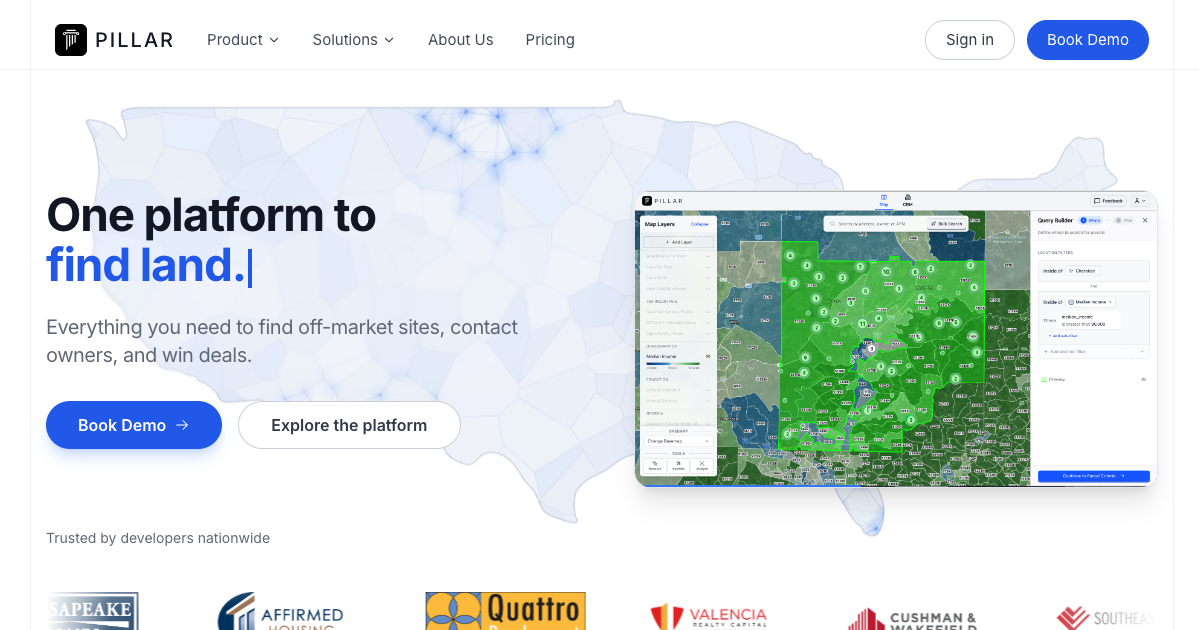
Pillar (pillar.codes) is an automated land acquisition platform for developers that combines nationwide parcel mapping, property intelligence, CRM features, and direct mail outreach into a single workspace. Classified in the BestCRE Master Database as a CRE-Native, Tier 2 application within the CRE Underwriting & Deal Analysis category, Pillar is designed specifically to accelerate site selection and due diligence for residential and commercial developers. The platform aggregates massive amounts of public data and allows users to query it using a natural language, paragraph-based interface, turning what is traditionally a fragmented, manual process into a centralized workflow. Led by CEO Dylan Goren, the company has recently gained traction among developers looking to identify off-market parcels and assemblages without relying on traditional broker networks or manual county record searches.
Evaluating Pillar requires a skeptical look at its ability to deliver on the promise of automated site selection. While competitors like Cotality (BestCRE Score: 91) and HelloData (BestCRE Score: 91) have established themselves in the underwriting and data aggregation space, Pillar attempts to carve out a niche specifically focused on the very top of the development funnel: finding and acquiring dirt. Our analysis indicates that the platform’s core strength lies in its ability to quickly filter sub-markets using points of interest, zoning data, and demographic criteria, then immediately push those results into a Kanban-style project pipeline for direct mail outreach and skiptracing. However, as an unproven startup in a crowded proptech landscape, buyers must weigh its intuitive interface against the inherent risks of adopting early-stage software. As of August 2026, the tool presents a compelling vision for data-driven land acquisition, but requires careful validation of its underlying public data sources before committing capital to a subscription.
What Pillar does and how it works
Pillar operates as a comprehensive workspace for land acquisition, accessed entirely through a unified web interface that prevents constant page reloading. The core mechanic revolves around an interactive parcel map that serves as the primary analytical environment. Users begin by executing bulk searches using a paragraph-based query system, which allows non-technical analysts to define complex parameters, such as minimum acreage, distance from specific grocery stores, daily traffic counts, and median income, using plain language. The software then scans its aggregated public database to highlight parcels that match the exact criteria, effectively automating the initial site selection phase.
Once target parcels are identified, Pillar moves the workflow from spatial analysis into active pipeline management. Users can save selected sites into custom lists and push them into a built-in Kanban-style project board. This CRM functionality tracks deals from initial lead through the closing process. Crucially, the platform includes integrated skiptracing capabilities, allowing acquisition teams to perform bulk owner contact lookups directly within the same interface. This eliminates the need to export parcel data to a third-party service just to find phone numbers or mailing addresses for off-market property owners.
The final mechanical step in the Pillar workflow is direct outreach execution. The platform features a native direct mail campaign management tool, enabling users to design, order, and track letters sent to the owners of the identified parcels. By combining the interactive map, the Kanban pipeline, the skiptracing engine, and the direct mail sender into one continuous loop, Pillar attempts to replace the traditional tech stack of a land developer. Our analysis shows that this consolidation is the product’s defining mechanical advantage, allowing a single analyst to perform the work of a dedicated site selection team without leaving the browser window.
9AI Framework: the score, dimension by dimension
CRE Relevance: 10/10
Pillar is unequivocally built for commercial real estate, specifically targeting the land acquisition and development sector. As a CRE-Native, Tier 2 application, it addresses a highly specific, notoriously inefficient phase of the real estate lifecycle: site selection and off-market deal sourcing. The platform’s features, including zoning data layers, parcel mapping, and bulk skiptracing, are entirely tailored to the daily realities of a development analyst or acquisitions manager. Unlike generic CRM or mapping tools that require extensive customization to understand property boundaries or ownership structures, this software understands the fundamental concepts of assemblages, parcels, and land use right out of the box. Our analysis confirms that its focus on the developer’s workflow makes it highly relevant to its target audience. In practice: Development teams can immediately begin filtering parcels by acreage and zoning without needing to configure custom data fields or build external integrations.
Data Quality and Sources: 9/10
The platform relies heavily on aggregating public county records, demographic information, and points of interest to fuel its mapping and search functions. While the breadth of data is extensive, covering nationwide parcels, the inherent nature of public real estate data means that accuracy can vary significantly by municipality. Pillar uses automated systems to parse and standardize this information, but analysts must remain aware that zoning changes, recent deed transfers, or lot splits may not instantly reflect in the system. Compared to Tier 1 data providers like CompStak (BestCRE Score: 88) which rely on proprietary, verified transaction data, Pillar’s reliance on public sources introduces a standard margin of error common to all public data aggregators. In practice: Analysts should use the platform to quickly identify potential sites, but must still perform manual verification with local municipalities during the formal due diligence period.
Ease of Adoption: 9/10
Adoption is one of the software’s strongest attributes, driven primarily by its paragraph-based query interface. Instead of forcing users to navigate complex dropdown menus or write SQL queries to filter parcels, the platform allows analysts to define criteria using natural language structures. The single-workspace design, where the map, lists, and Kanban boards are accessible from a single left-hand rail without page reloads, significantly reduces the learning curve. For a real estate firm transitioning from manual spreadsheet tracking and disparate county GIS portals, the user experience is highly intuitive. Training a new analyst to run bulk searches and initiate direct mail campaigns can likely be accomplished in a matter of hours rather than weeks. In practice: Non-technical acquisitions staff can successfully execute complex spatial queries and manage direct mail campaigns on their first day of using the software.
Output Accuracy: 8/10
When evaluating the accuracy of Pillar’s outputs, our analysis separates the spatial filtering from the skiptracing results. The geographic and demographic filtering performs reliably, accurately highlighting parcels that meet the specified distance and size criteria. However, the contact information generated by the bulk skiptracing feature is subject to the same decay rates seen in all public record databases. Phone numbers may be disconnected, and mailing addresses for LLC owners often point to registered agents rather than the actual decision-makers. While the platform excels at identifying the right piece of dirt, the accuracy of the contact data required to actually acquire that dirt will require human persistence to validate. In practice: Users should expect a standard bounce rate on direct mail campaigns and will need to cross-reference LLC ownership structures to reach the true principals of off-market parcels.
Integration and Workflow Fit: 8/10
Pillar aims to replace multiple tools by offering an all-in-one workspace for mapping, CRM, and direct mail. While this consolidation is efficient for boutique developers, it presents integration challenges for larger institutional players with established tech stacks. The software features an open architecture, but specific details regarding native API connections to enterprise ERP systems or heavy-duty CRMs like Salesforce are not published. For firms already utilizing platforms like Cherre (BestCRE Score: 86) for data warehousing, adopting a closed-loop system for acquisitions might create data silos between the development team and the rest of the organization. Our analysis suggests it functions best as a standalone tool for the acquisitions department rather than a fully integrated enterprise node. In practice: Mid-sized developers will likely use this as their primary acquisitions system, manually exporting successful deals into their main accounting or project management software.
Pricing Transparency: 4/10
The BestCRE Master Database confirms that Pillar operates on a Paid/Subscription model, but the vendor does not publish specific pricing tiers, minimum seat requirements, or data overage fees on its public website. This lack of transparency forces prospective buyers to engage in a sales process simply to determine if the software fits their budget. For a tool that includes variable costs like direct mail credits and bulk skiptracing lookups, the absence of clear, public pricing creates friction for analysts attempting to model the total cost of ownership. Following the BestCRE 9AI Framework guidelines, a vendor that obscures its pricing cannot receive a high score in this dimension. In practice: Buyers must schedule a demonstration and directly request a detailed breakdown of subscription costs, skiptracing fees, and direct mail credit pricing before committing to a pilot.
Support and Reliability: 6/10
As a relatively new entrant in the proptech space, Pillar is an unproven startup, which inherently limits its score for support reliability. While the platform offers basic tutorials and a support contact option, it lacks the extensive documentation, dedicated customer success teams, and guaranteed service level agreements (SLAs) provided by mature competitors. If the system experiences downtime or a bug in the direct mail ordering process, users are entirely dependent on a small startup team for resolution. The company has demonstrated recent growth and secured funding, but it has not yet established a multi-year track record of maintaining uptime during critical business hours for a large enterprise user base. In practice: Early adopters should maintain backup methods for accessing county GIS data in the event of unexpected platform outages or delayed support response times.
Innovation and Roadmap: 9/10
The development trajectory of Pillar shows a clear focus on automating the most tedious aspects of land acquisition. By incorporating AI-driven natural language queries and modular architecture, the company is actively pushing the boundaries of how developers interact with spatial data. Their roadmap appears centered on expanding the types of public data ingested and refining the user interface to make complex demographic and zoning analysis accessible to non-technical users. Compared to legacy GIS software that has remained stagnant for a decade, this platform is iterating rapidly. Our analysis indicates that the leadership team is highly attuned to the specific pain points of modern site selection and is deploying capital to solve them efficiently. In practice: Users can expect frequent feature updates and continuous improvements to the search interface as the startup refines its data aggregation models.
Market Reputation: 6/10
Pillar is currently building its reputation among residential and commercial developers, primarily driven by word-of-mouth and appearances on industry podcasts by its CEO, Dylan Goren. However, as an unproven startup, it does not yet possess the widespread market validation or institutional trust enjoyed by established data platforms like CompStak or Cherre. Early case studies suggest strong revenue growth and satisfied initial users who appreciate the time saved on manual site selection. Yet, the broader commercial real estate industry remains largely unaware of the tool. It is viewed as an intriguing, specialized utility rather than an industry-standard platform. According to our framework, its reputation score must remain capped until it achieves deeper market penetration. In practice: Buyers will find enthusiastic early adopters willing to provide references, but will struggle to find extensive third-party reviews or long-term institutional case studies.
Who should use Pillar
Pillar is highly specialized, making it an excellent fit for teams focused entirely on the top of the development funnel. The ideal buyers are those who spend excessive hours cross-referencing county GIS maps with demographic data and manually managing outreach.
Residential Land Developers: Teams looking to identify off-market assemblages or single-family lot opportunities based on specific zoning and acreage requirements.
Retail Site Selection Analysts: Professionals tasked with finding commercial parcels that meet strict demographic, traffic count, and distance-from-competitor metrics.
Boutique Acquisitions Teams: Small to mid-sized firms that want to consolidate their mapping, CRM, and direct mail tools into a single, cost-effective workspace.
Proptech-Forward Principals: Leaders willing to adopt early-stage software to gain a competitive advantage in sourcing off-market dirt before it hits the brokerage community.
Who should look elsewhere
Because the platform is built specifically for land acquisition and relies on public data, it is not suitable for every commercial real estate professional. Firms requiring deep financial modeling or enterprise-grade integrations should look elsewhere.
Asset Managers: Professionals focused on the operational performance and leasing of existing buildings will find no value in a land acquisition tool.
Institutional Core Investors: Funds that strictly acquire stabilized, Class A assets through institutional brokerages do not need off-market parcel mapping or skiptracing.
Enterprise Firms Requiring Custom ERP Integration: Organizations that mandate strict API data flows into legacy systems like Yardi or MRI will find the standalone nature of this workspace limiting.
Pricing and ROI
Based on the BestCRE Master Database, Pillar operates on a Paid/Subscription model. However, specific pricing tiers, seat licenses, and data overage costs are not published publicly on their website. Prospective buyers must engage directly with the sales team to obtain a custom quote. It is highly likely that the cost structure involves a base platform fee for access to the nationwide parcel map and CRM, coupled with variable, usage-based fees for bulk skiptracing lookups and direct mail credits. This opaque approach makes initial budget approvals difficult for analysts.
To evaluate the return on investment (ROI), buyers must calculate the labor hours currently spent on manual site selection. If an acquisitions analyst earning $100,000 annually spends 15 hours a week cross-referencing county GIS portals, pulling ownership records, and formatting direct mail spreadsheets, the hard cost of that labor is approximately $37,500 per year. If Pillar can compress that workflow into two hours a week, it effectively frees up $32,500 in labor capacity. Assuming the unpublished subscription and variable costs fall below $15,000 annually, the software delivers a clear, positive ROI simply through labor efficiency, before factoring in the potential profit from successfully acquiring an off-market development site ahead of competitors.
Integration and CRE tech stack fit
Pillar is designed to be a consolidated workspace, which inherently changes how it fits into a traditional commercial real estate tech stack. Rather than acting as a middleware data connector like Cherre (BestCRE Score: 86) or a specialized underwriting plug-in like HelloData (BestCRE Score: 91), it attempts to replace the top-of-funnel stack entirely. For many development firms, adopting this tool means abandoning disparate subscriptions to generic CRMs, standalone skiptracing services, and manual direct mail houses.
However, our analysis indicates that its integration capabilities with downstream enterprise systems are not fully detailed. Once a parcel is successfully acquired, the project must transition into construction management and formal accounting. Because native integrations with industry-standard ERPs like Yardi, MRI, or Procore are not published, analysts should expect to manually export closed deal data or utilize custom API workarounds to push information out of the Kanban pipeline. Ultimately, it fits best as an isolated, high-speed engine for the acquisitions team, operating parallel to, rather than deeply integrated with, the firm’s core financial and property management software architecture.
Competitive landscape
The landscape for real estate data and site selection is highly competitive, forcing buyers to carefully compare Pillar against both established data giants and specialized AI tools. For pure data aggregation and property intelligence, CompStak (BestCRE Score: 88) and Cherre (BestCRE Score: 86) offer vastly superior enterprise data warehousing and verified transaction histories. However, neither provides the native direct mail or Kanban pipeline features that make Pillar a closed-loop acquisition tool.
When looking at automated underwriting and market analysis, Cotality (BestCRE Score: 91) and HelloData (BestCRE Score: 91) are formidable peers. HelloData excels at extracting insights from existing property documents and automating valuations, which is highly valuable for acquiring existing assets, but less relevant for raw land assemblage. Akkio (BestCRE Score: 86) and RETS AI (BestCRE Score: 86) offer powerful predictive analytics and machine learning capabilities that can be applied to real estate, but they are general-purpose or broad CRE tools that require significant user configuration, whereas Pillar is strictly CRE-Native and ready out of the box for developers.
The most direct alternatives are legacy GIS platforms like LandVision or specialized mapping tools like Regrid. While these competitors provide excellent parcel data, they often lack the intuitive, natural language query interface and built-in CRM functionality. Our analysis concludes that while competitors may offer deeper data or broader AI capabilities, Pillar has uniquely positioned itself by bundling mapping, skiptracing, and direct mail specifically for the off-market land developer.
The bottom line
Pillar is a highly effective, purpose-built tool for development teams that need to accelerate their land acquisition pipeline. If your firm’s current process involves manually scraping county GIS websites, exporting CSV files, and managing direct mail through disconnected third-party vendors, this software will immediately reduce your operational friction. The paragraph-based query interface is genuinely intuitive, allowing non-technical staff to perform complex spatial analysis. However, as an unproven startup with unpublished pricing, it carries inherent adoption risks. Institutional investors requiring verified, proprietary transaction data or deep enterprise ERP integrations should pass. Conversely, for residential developers, retail site selectors, and boutique acquisition teams focused on finding off-market dirt, the efficiency gains in the initial site selection phase easily justify the investment. Buy it to automate your top-of-funnel outreach, but maintain rigorous manual due diligence before closing any deal.
Frequently asked questions
Does Pillar provide verified commercial real estate transaction comps?
No. The platform focuses heavily on public parcel data, zoning restrictions, and demographic information to aid in site selection and land acquisition. For verified, proprietary transaction or lease comparables, analysts should utilize dedicated data providers like CompStak rather than relying on this software.
Can I send direct mail to property owners directly through the platform?
Yes. The software includes a native direct mail campaign management tool. Users can design letters, order them, and track their delivery to off-market property owners directly from the same workspace used to map the parcels and manage the CRM pipeline, eliminating third-party vendors.
How does the software handle finding contact information for LLC-owned properties?
The platform features built-in bulk skiptracing capabilities designed to look up owner contact information. However, our analysis notes that reaching the true decision-maker behind an LLC often requires manual persistence, as public records frequently point to registered agents or attorneys rather than principals.
Is the pricing for the software based on a flat monthly fee or usage?
Pricing is not published publicly on the vendor’s website. Based on standard industry practices for similar acquisition tools, buyers should expect a base subscription fee for general platform access, combined with variable, usage-based costs for executing bulk skiptracing lookups and sending direct mail campaigns. You must request a custom quote.
Will this tool integrate directly with my enterprise accounting software like Yardi?
Native integrations with legacy enterprise resource planning systems like Yardi or MRI are not explicitly detailed by the vendor. The platform is designed primarily as a standalone workspace for acquisitions, meaning users will likely need to manually export closed deal data to their accounting systems.
Do I need to know how to write SQL code to filter parcel data?
No. The software utilizes a paragraph-based query interface that allows users to filter parcels using simple natural language. This intuitive design enables non-technical real estate professionals to execute complex spatial searches, such as minimum acreage or traffic counts, without any prior coding or GIS knowledge.
Related Reviews
Compare Pillar with other Underwriting & Deal Analysis tools BestCRE has scored: Crexi (84/100), redIQ (83/100), Enaia (73/100) and Endex (73/100). Browse every review in CRE Underwriting & Deal Analysis, the full Best CRE AI Tools directory, or the 20 CRE Sectors hub.