Prophia is a commercial real estate lease abstraction and document intelligence platform that uses artificial intelligence to convert unstructured lease PDFs into structured, searchable data. Supporting over 330 million square feet of commercial space for clients like Nuveen, RXR, and Spear Street Capital, the platform is classified in the BestCRE Master Database as a CRE-Native, Tier 1 application. Founded to address the specific data extraction challenges of the commercial real estate sector, Prophia replaces manual lease abstraction with an automated pipeline that extracts critical dates, financial obligations, and tenant rights, linking every data point directly back to the source document.
As of August 2026, commercial real estate firms continue to struggle with trapped data inside complex, fifty-to-one-hundred-page lease agreements. Manual abstraction is prone to human error and often results in disconnected spreadsheets that quickly become outdated. Prophia solves this by ingesting these documents, applying optical character recognition and natural language processing tailored specifically to commercial real estate terminology, and outputting highly accurate abstracts. The platform combines machine extraction with human-in-the-loop expert review to ensure confidence in the data. This dual approach allows asset managers, property managers, and acquisition teams to trust the outputs when making critical financial decisions, evaluating portfolio risk, or updating rent rolls. In our analysis, the tool differentiates itself not just through extraction speed, but through its strict adherence to source verification—users can click any extracted clause and view the exact paragraph in the original PDF. This verifiable audit trail addresses the primary skepticism most principals hold regarding artificial intelligence in underwriting and asset management.
What Prophia does and how it works
At its core, Prophia operates as a document ingestion and data structuring engine. Users upload commercial leases, amendments, and rent rolls into the system in PDF format. The software’s artificial intelligence models scan the text, identify key commercial real estate concepts, and extract over 200 specific fields. These fields include base rent schedules, escalation clauses, co-tenancy requirements, tenant improvement allowances, and critical notification dates for renewals or terminations.
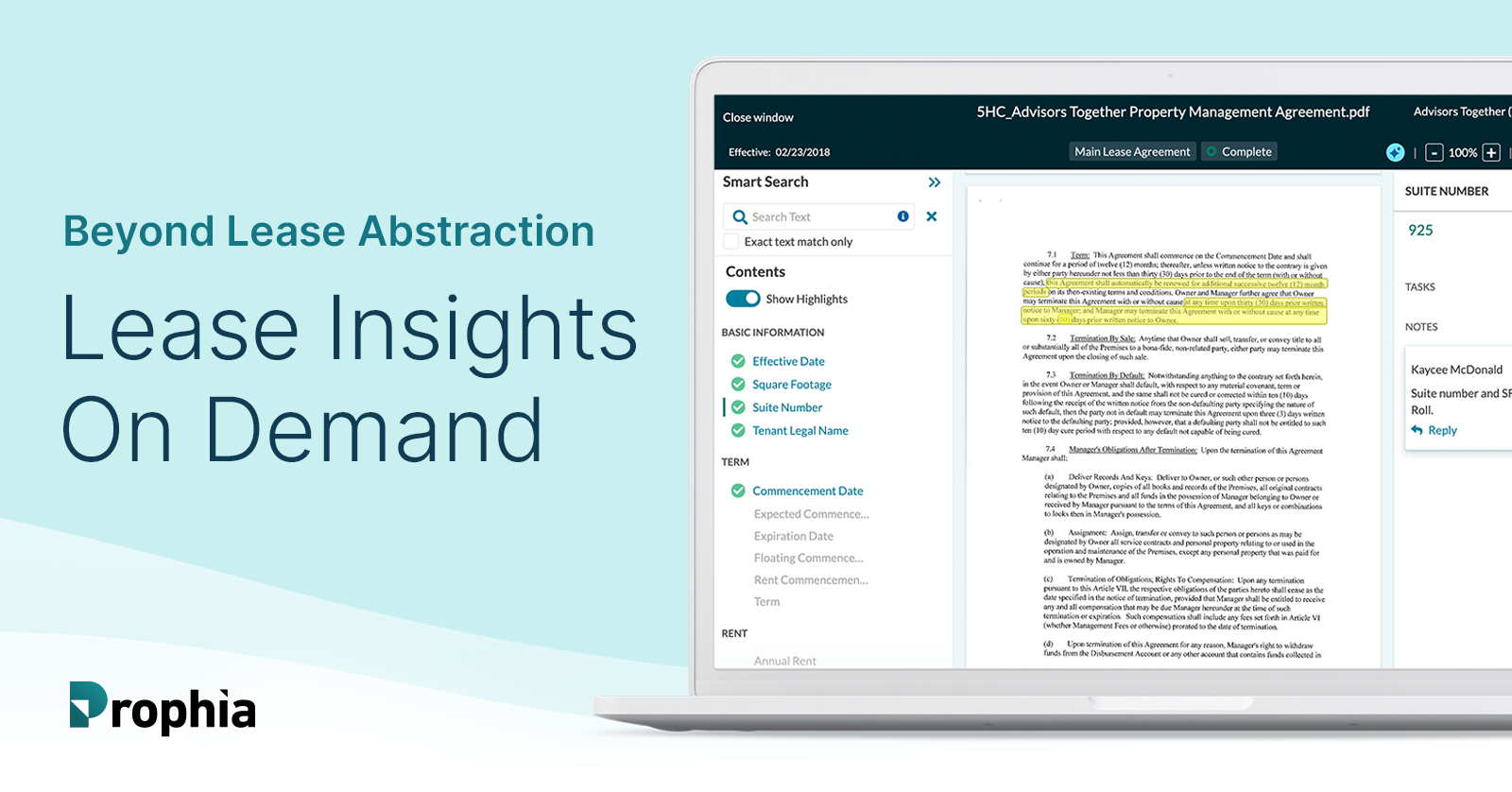
Once the data is extracted, Prophia generates a standardized digital lease abstract. Unlike static PDF or spreadsheet abstracts, this output is interactive. Every extracted data point features a hyperlink that routes the user directly to the corresponding text in the original source document. This source-linking mechanic means analysts never have to blindly trust the machine; they can verify a complex operating expense exclusion or a specific termination right in one click. For firms utilizing the Prophia Essentials or Portfolio tiers, the platform includes a layer of human validation where commercial real estate experts review the machine’s output to catch edge cases and highly bespoke legal phrasing before the data reaches the client dashboard.
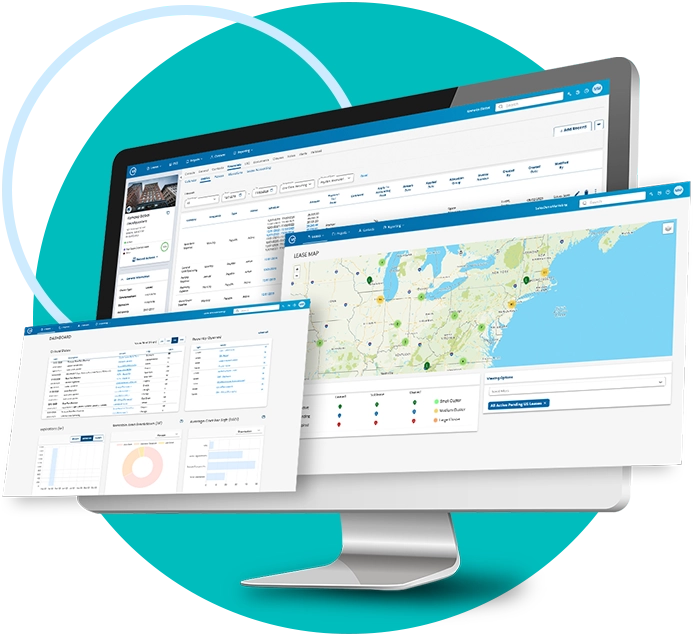
Beyond individual lease abstraction, the platform aggregates this data at the property and portfolio levels. Users can view dynamic stacking plans that visually represent building occupancy, lease expirations, and encumbrances across different floors. The system also includes a portfolio health dashboard and artificial intelligence search capabilities, allowing asset managers to query their entire database to find specific clauses—such as identifying every tenant with a pandemic-related force majeure clause or calculating total exposure to a specific retail anchor. In our analysis, this transition from document storage to a queryable database fundamentally changes how quickly an asset management team can respond to market shifts or prepare for disposition.
9AI Framework: the score, dimension by dimension
CRE Relevance: 10/10
Prophia was engineered exclusively for the commercial real estate sector, earning its Tier 1, CRE-Native classification in our database. The artificial intelligence models are trained specifically on the dense, highly specialized legal language found in commercial leases, amendments, and rent rolls. This specialization allows the software to accurately identify complex industry concepts like base year calculations, common area maintenance exclusions, and co-tenancy clauses that generic text extraction tools miss. The platform understands the hierarchy of real estate data, organizing information logically by tenant, asset, fund, and portfolio. In our analysis, this deep industry alignment means teams do not have to spend time teaching the software basic property management concepts. In practice: Commercial real estate analysts can upload complex retail or office leases and immediately receive outputs structured around standard industry underwriting metrics.
Data Quality and Sources: 10/10
The platform maintains exceptional data quality by utilizing a hybrid approach of machine extraction and human validation. Prophia claims a 99 percent accuracy rate, which is achieved by passing the artificial intelligence output through a secondary review by commercial real estate experts on their Essentials and Portfolio tiers. Furthermore, the software prevents data degradation by hyperlinking every extracted field directly back to the source PDF. If a user questions a rent step-up or a renewal notice period, they can instantly audit the source text. This strict traceability ensures that the database remains a single source of truth rather than a collection of unverified machine guesses. In practice: Asset managers can confidently rely on the extracted data for financial reporting and rent roll updates without conducting redundant manual audits of the original documents.
Ease of Adoption: 9/10
Transitioning from manual abstraction to Prophia is relatively straightforward for most commercial real estate firms. The web-based interface is intuitive, requiring minimal technical training for leasing brokers or property managers to navigate. Unlike custom-built data pipelines that can take months to deploy, Prophia’s subscription model allows teams to begin uploading documents and generating abstracts within days. The primary hurdle for adoption is the initial ingestion phase for large, historical portfolios, which requires gathering and uploading all active leases and amendments. However, once the historical data is processed, adding new leases becomes a simple operational step. The platform also offers unlimited user licenses, removing internal friction regarding who gets access. In practice: A mid-sized property management team can integrate the software into their daily workflow within a single quarter without hiring dedicated technical staff.
Output Accuracy: 9/10
Accuracy is the most critical metric for lease abstraction, and Prophia delivers highly reliable results. By extracting over 200 specific fields from complex legal documents, the software captures the nuances of commercial leases that dictate cash flow and risk. The inclusion of human oversight on premium tiers ensures that highly bespoke or poorly drafted clauses are interpreted correctly. In our analysis, the system excels at identifying critical dates and financial obligations, significantly reducing the risk of missed renewal windows or unbilled tenant improvements. While no automated system is entirely flawless, the mandatory source-linking feature effectively mitigates the risk of hallucination, as users are always one click away from the underlying legal text. In practice: Principals can trust the system to catch critical expiration dates and complex rent escalations that manual reviewers frequently overlook during bulk portfolio acquisitions.
Integration and Workflow Fit: 9/10
Prophia offers strong integration capabilities with major commercial real estate property management and accounting systems, most notably Yardi and MRI Software. The platform features an automated Yardi audit function that actively checks for discrepancies between the lease data extracted by Prophia and the billing data entered into the accounting system. This continuous sync ensures that rent rolls and payment schedules remain accurate across the tech stack, preventing billing errors and revenue leakage. While API options are available for custom integrations, the native connections to industry-standard ERPs provide immediate value for institutional owners. In our analysis, this bidirectional data flow elevates the tool from a simple abstraction utility to a core component of the property management infrastructure. In practice: Property accountants receive automated alerts when a tenant’s billing profile in Yardi does not match the executed lease terms in Prophia.
Pricing Transparency: 8/10
Prophia provides a moderate level of pricing transparency compared to its peers. The BestCRE Master Database confirms the entry-level Prophia Abstract plan is priced at $20 per lease document, operating on a pay-per-use model that is highly attractive for smaller brokerages or independent sponsors. However, the more comprehensive Prophia Essentials and Prophia Portfolio tiers—which include the human expert review, ongoing leasing support, and accounting integrations—require custom pricing quotes based on portfolio size and complexity. While the entry-level price is public, enterprise buyers must engage the sales team to understand the total cost of ownership for full portfolio deployment. In our analysis, the lack of published enterprise tiers slightly limits upfront budget planning. In practice: Small firms can easily calculate the cost of abstracting twenty leases, while institutional buyers must undergo a scoping process to determine their annual subscription fee.
Support and Reliability: 10/10
The company demonstrates strong support reliability, evidenced by its reported 100 percent customer retention rate and its roster of institutional clients. Prophia assigns dedicated Customer Success Managers to assist with onboarding, workflow optimization, and ongoing portfolio management. This human element is crucial for commercial real estate teams transitioning away from legacy processes. The vendor also provides ongoing leasing support to ensure that new amendments and modifications are accurately reflected in the database. In our analysis, the combination of technical support and real estate expertise ensures that clients are not left stranded if they encounter highly unusual lease structures or integration challenges. The platform’s SOC 2 security certification further guarantees that enterprise data is handled with appropriate protocols. In practice: Users encountering a complex, non-standard lease amendment can rely on their dedicated support representative to ensure the data is accurately captured and structured.
Innovation and Roadmap: 10/10
Prophia continues to expand its capabilities beyond basic text extraction. Recent updates include advanced artificial intelligence search functions that allow users to query their entire portfolio using natural language, as well as dynamic stacking plans and portfolio health dashboards. The vendor is actively developing features that transition the product from a static abstraction tool into a comprehensive business intelligence platform. In our analysis, the roadmap indicates a clear focus on predictive analytics and deeper integrations with capital markets workflows. By consistently refining its natural language processing models, the company aims to further reduce the need for human-in-the-loop validation, eventually offering near-perfect automated extraction for even the most obscure legal phrasing. In practice: Forward-looking asset managers can expect the platform to continually release new analytical tools that turn static lease data into actionable portfolio strategy insights.
Market Reputation: 10/10
Prophia has established a formidable reputation in the commercial real estate technology sector. The platform is trusted by major institutional players, including Nuveen, RXR, and Spear Street Capital, with over 330 million square feet of commercial space under management. This enterprise adoption signals high confidence in the product’s security, accuracy, and scalability. In the BestCRE Master Database, Prophia is recognized as a Tier 1 solution, competing closely with peers like Findable and RETS AI. Reviews consistently highlight the platform’s intuitive interface and the reliability of its hyperlinked source tracking. In our analysis, the vendor is widely regarded as a safe, proven choice for mid-market and institutional owners seeking to modernize their lease administration processes. In practice: A principal evaluating the software can be confident that the technology has been thoroughly vetted and deployed by major asset managers.
Who should use Prophia
Prophia is highly effective for organizations that manage complex, multi-tenant commercial properties and require immediate, verified access to lease data.
- Institutional Asset Managers: Teams managing millions of square feet need the portfolio-wide search and dynamic stacking plans to quickly assess risk and identify revenue opportunities across multiple funds.
- Acquisition and Due Diligence Teams: Buyers evaluating new assets can use the $20 per document abstract tier to rapidly underwrite rent rolls and uncover hidden lease liabilities without waiting weeks for manual legal review.
- Property Management Firms: Operators utilizing Yardi or MRI will benefit immensely from the automated audit features, ensuring that billing schedules perfectly match the executed lease agreements.
- Commercial Brokerages: Leasing brokers who need fast, accurate summaries of existing tenant obligations to structure competitive renewal proposals or market vacant spaces.
Who should look elsewhere
While powerful, this software is not the correct fit for every real estate operation, particularly those with simple or low-volume data needs.
- Single-Family Residential Investors: The platform is engineered for the complexity of commercial leases; using it for standard residential agreements is an unnecessary expense.
- Firms Requiring Fully Bespoke On-Premise Solutions: Organizations with strict internal data mandates that forbid cloud-based processing will find the SaaS model incompatible with their IT policies.
- Small Owner-Operators with Static Portfolios: A sponsor holding three triple-net retail assets with long-term leases and no near-term rollover will not generate enough ROI to justify an ongoing enterprise subscription.
Pricing and ROI
Prophia offers a tiered pricing structure that accommodates both transactional users and enterprise portfolios. According to the BestCRE Master Database, the entry-level Prophia Abstract plan is published at $20 per lease document. This pay-per-use model is highly transparent and allows smaller teams or due diligence professionals to process documents on demand without a long-term commitment. However, pricing for the Prophia Essentials and Prophia Portfolio tiers is not published and requires a custom quote. These enterprise tiers operate on an annual subscription basis and include the human-in-the-loop expert review, accounting system integrations, ongoing leasing support, and advanced portfolio analytics.
When calculating the return on investment, principals must weigh the software subscription against the hard costs of manual abstraction and the hidden costs of data errors. Traditional third-party lease abstraction services often charge between $75 and $150 per lease and take days to return the data. At $20 per document, the immediate cost savings for a 200-lease portfolio is substantial. Furthermore, the automated Yardi audit feature routinely uncovers unbilled tenant improvement reimbursements or missed rent escalations. In our analysis, recovering just one missed common area maintenance charge on a mid-sized office lease often pays for the entire annual software subscription, making the financial justification straightforward for active asset managers.
Integration and CRE tech stack fit
A lease abstraction tool is only as valuable as its ability to feed downstream systems, and Prophia excels in this area. The software offers direct integrations with industry-standard property management and accounting platforms, specifically Yardi and MRI Software. The standout feature is Prophia’s automated Yardi audit, which continuously scans for discrepancies between the extracted lease data and the billing figures entered into the ERP. This bidirectional relationship ensures that the accounting system remains a true reflection of the legal documents.
For firms utilizing alternative software stacks, the platform provides API access and Single Sign-On capabilities on its enterprise tiers, allowing IT departments to build custom connections to proprietary data warehouses or business intelligence dashboards like Tableau or PowerBI. In our analysis, the native integrations cover the vast majority of institutional commercial real estate operators. By embedding itself directly into the financial workflow, the tool eliminates the need for manual dual-entry, significantly reducing the administrative burden on property accountants and ensuring that asset managers are always analyzing accurate rent rolls.
Competitive landscape
The commercial real estate document intelligence sector is highly competitive, with several Tier 1 platforms vying for institutional market share. Prophia’s most direct peers in the BestCRE Master Database include Findable (scored 87), RETS AI (scored 86), Wilson AI (scored 82), and MRI Software AI (scored 76).
Findable and RETS AI slightly edge out Prophia in overall scoring due to broader document management capabilities that extend beyond leases into construction and compliance documentation. However, Prophia remains highly competitive specifically within the lease abstraction niche, particularly because of its rigorous source-linking interface and dedicated commercial real estate expert review. Wilson AI offers similar artificial intelligence extraction but lacks the native, automated Yardi audit functionality that makes Prophia so attractive to property accountants. MRI Software AI provides excellent native connectivity for existing MRI clients, but Prophia is generally viewed as more system-agnostic, offering equally strong support for Yardi environments.
When evaluating these alternatives, buyers must consider their primary use case. If a firm requires a holistic document management system for all property records, Findable may be the better choice. If the goal is strictly to extract, verify, and sync complex lease data with an accounting system to prevent revenue leakage, Prophia’s specialized feature set is difficult to beat. In our analysis, Prophia wins in scenarios where data accuracy and direct ERP auditing are the highest priorities for the asset management team.
The bottom line
Prophia is a highly effective, specialized tool that successfully solves one of the most frustrating data challenges in commercial real estate. By combining advanced artificial intelligence with human expert validation and direct source-linking, the platform delivers lease data that asset managers and accountants can actually trust. The published $20 per document entry tier makes it accessible for due diligence, while the custom enterprise tiers provide the necessary integrations for institutional portfolio management. It is not a broad, general-purpose document storage system, nor is it priced for small residential investors. However, for commercial operators managing complex office, retail, or industrial assets, the automated Yardi audit and dynamic stacking plans provide immediate, measurable financial returns. If your firm struggles with outdated rent rolls, missed critical dates, or manual data entry errors, Prophia is a mandatory evaluation that will likely become a permanent fixture in your technology stack.
Frequently asked questions
Does Prophia integrate with Yardi and MRI?
Yes, the software offers direct integrations with both Yardi and MRI Software. A key feature is the automated Yardi audit, which continuously checks for discrepancies between the extracted lease data and your accounting system to prevent billing errors and ensure accurate rent rolls.
How much does Prophia cost?
The entry-level Prophia Abstract plan costs $20 per lease document on a pay-per-use basis. The Prophia Essentials and Prophia Portfolio tiers, which include expert human review and accounting integrations, require custom pricing quotes based on the size and complexity of your portfolio.
How accurate is the artificial intelligence extraction?
The vendor claims a 99 percent accuracy rate. On enterprise tiers, the machine extraction is paired with a secondary review by commercial real estate experts. Additionally, every extracted data point is hyperlinked to the source document, allowing users to verify the exact legal text instantly.
Can small commercial real estate firms use this software?
Yes. While trusted by institutional owners managing millions of square feet, the $20 per document pricing tier makes the platform highly accessible for small brokerages, independent sponsors, and boutique acquisition teams who need fast, accurate lease abstracts without committing to an expensive enterprise subscription.
Does the platform support custom API connections?
Yes, Prophia offers API options and Single Sign-On capabilities on its enterprise subscription tiers. This allows IT departments at larger firms to connect the extracted lease data to proprietary data warehouses, custom underwriting models, or third-party business intelligence tools like PowerBI.
How long does it take to implement the software?
Implementation is relatively fast compared to custom-built data pipelines. The primary time commitment involves gathering and uploading your historical lease PDFs. Once uploaded, the software generates abstracts within days, allowing a mid-sized property management team to fully adopt the system within a single quarter.