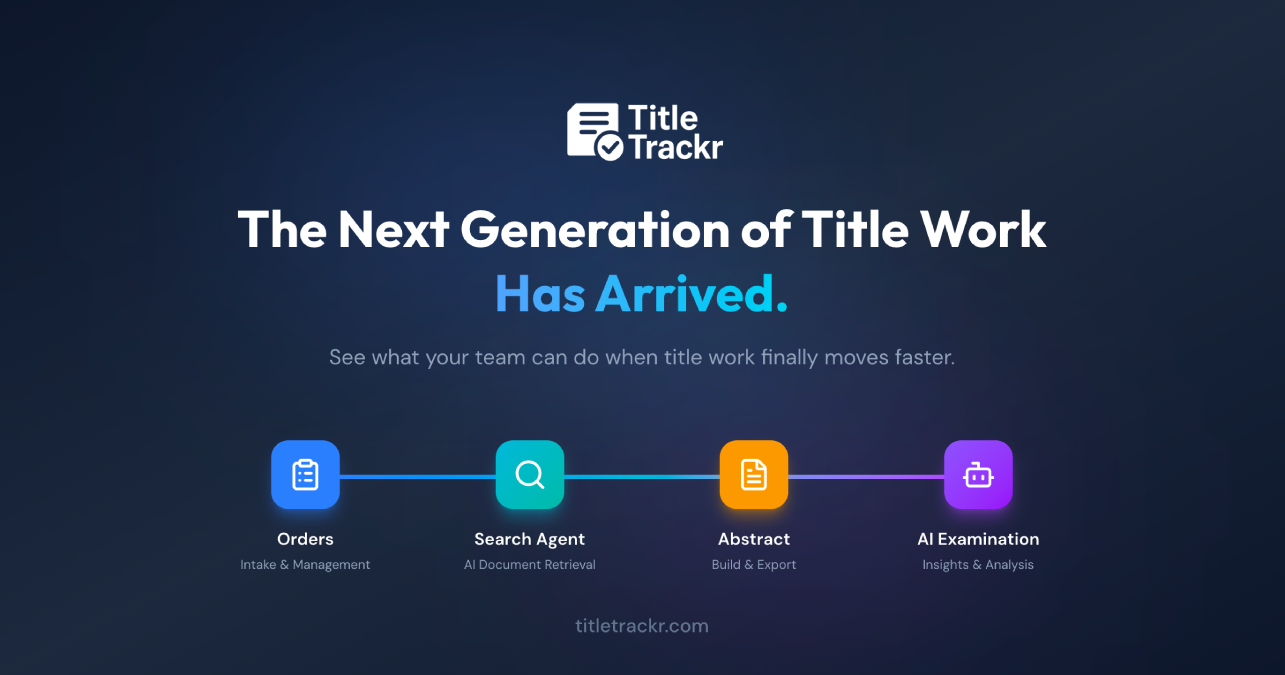
TitleTrackr is an artificial intelligence application engineered specifically for commercial real estate title searchers, focusing on extracting critical data points from municipal deeds and lien documents. Entering the market as a Tier 2 CRE-native database tool, the platform aims to reduce the manual hours required during the legal due diligence phase of property transactions. The company currently offers a free trial but relies entirely on custom pricing models for full deployments, making it difficult for firms to budget without entering a sales pipeline. In the broader landscape of CRE Legal, Compliance, and Due Diligence software, TitleTrackr competes for attention in a sector where established players like DocumentCrunch hold strong positions with scores of 86. However, TitleTrackr narrows its focus exclusively to title and municipal record analysis rather than broad lease abstraction or general contract review.
The commercial real estate transaction process remains heavily reliant on county-level public records, which are notoriously unstructured and often poorly digitized. Analysts and title professionals spend significant time parsing these PDFs to identify encumbrances, easements, and ownership histories. TitleTrackr applies large language models to this specific problem, attempting to turn unstructured deed text into structured, exportable data. While the promise of automated extraction is appealing for high-volume acquisition teams, the reality of municipal data means the software faces significant hurdles regarding image quality and non-standardized legal language. Buyers evaluating this platform in Q3 2026 must weigh the potential time savings against the necessity of manual verification, as errors in title analysis carry severe financial consequences. The tool remains a specialized utility rather than a comprehensive legal suite.
What TitleTrackr does and how it works
At its core, TitleTrackr functions as a specialized optical character recognition and natural language processing engine tuned for real estate title documents. Users upload batches of scanned deeds, mortgage documents, lien filings, and easement records directly into the platform. The system then processes these files, identifying the document type and extracting specific fields such as grantor, grantee, parcel identification numbers, recording dates, and legal descriptions. Instead of forcing analysts to read through pages of boilerplate legal text, the software presents a side-by-side view where the extracted data points are highlighted alongside the original source document. This interface allows users to click on an extracted field and immediately see where that information originated in the scanned file, facilitating rapid verification.
Beyond basic field extraction, TitleTrackr attempts to identify potential red flags within the chain of title. The software flags anomalies such as missing sequential recording dates, unresolved mechanic’s liens, or unexpected easements that might restrict development. These findings are aggregated into a dashboard that provides a preliminary risk assessment for the parcel in question. The system also includes a workflow management component, allowing title searchers to assign specific documents to different team members, track the review status, and compile the final extracted data into a standardized report format.
The final output from TitleTrackr is typically exported as a structured spreadsheet or a formatted PDF summary, which can then be appended to the formal title commitment or due diligence package. While the platform excels at processing standard warranty deeds and straightforward liens, its performance heavily depends on the legibility of the source files. Historical documents with handwritten notes or poor microfilm scans often require manual intervention. The tool is designed to assist, rather than replace, the trained eye of a title professional, acting as a first-pass filter to accelerate the overall review process.
9AI Framework: the score, dimension by dimension
CRE Relevance: 9/10
As a platform built exclusively for extracting data from deeds and liens, TitleTrackr is deeply embedded in the commercial real estate workflow. Unlike general-purpose document parsers, its underlying models are trained specifically on municipal property records, allowing it to recognize industry-specific terminology like ‘metes and bounds’ or ‘appurtenant easements.’ This specialized focus means analysts do not need to spend time configuring the software to understand basic property concepts. The tool directly addresses the bottleneck of manual title review, a critical component of every commercial transaction. It speaks the language of title searchers and underwriters out of the box. In practice: CRE professionals will find the taxonomy and data fields immediately applicable to their daily due diligence tasks without requiring extensive custom mapping.
Data Quality and Sources: 7/10
The quality of the data generated by TitleTrackr is fundamentally constrained by the input material. Municipal records are frequently low-resolution scans, and while the platform utilizes modern optical character recognition, it struggles with historical documents, cursive handwriting, and faded microfilm prints. When processing modern, digitally generated PDFs, the extraction is highly reliable. However, for properties with long ownership histories, the data output can become fragmented, requiring users to manually fill in the gaps. The software does a commendable job of assigning confidence scores to its extractions, which helps users prioritize their verification efforts. In practice: Analysts must remain vigilant and treat the AI-generated data as a preliminary draft, particularly when dealing with county records recorded prior to the widespread use of digital filing systems.
Ease of Adoption: 7/10
TitleTrackr offers a straightforward user interface that mimics the traditional side-by-side review process familiar to most legal analysts. The learning curve is minimal; uploading documents and initiating the extraction process requires only a few clicks. The platform avoids overly complex configuration screens, opting instead for a standardized workflow that guides the user from upload to export. However, because it is a specialized tool, organizations must establish clear protocols for how the extracted data integrates into their broader due diligence checklists. Training new users takes hours rather than days, making it relatively simple to deploy across a team of title searchers. In practice: Firms can expect their analysts to begin processing documents and generating useful outputs within the first week of deployment, provided they have standardized source files ready.
Output Accuracy: 7/10
The platform demonstrates strong accuracy when extracting standard fields like parcel numbers, recording dates, and party names from legible documents. Its natural language processing models are adept at parsing standard legal descriptions and identifying encumbrances. However, accuracy drops significantly when dealing with complex, non-standard easements or highly bespoke legal clauses that deviate from typical county boilerplate. The software occasionally misinterprets the hierarchy of liens if the document structure is unusual. The inclusion of source-linking—where extracted text is tied directly to the original PDF—is crucial for mitigating these errors, allowing users to quickly verify the machine’s work. In practice: Users must enforce a strict human-in-the-loop review process, as the software is not yet capable of producing a flawless title report without manual oversight and correction.
Integration and Workflow Fit: 5/10
As a Tier 2 startup offering, TitleTrackr currently lacks the extensive API ecosystem found in more mature enterprise platforms. While it allows for basic exports to standard formats like CSV and Excel, direct, two-way integrations with major commercial real estate deal management platforms or enterprise resource planning systems are limited. Users typically have to download the processed data and manually upload it into their primary systems of record. The platform functions primarily as a standalone utility rather than a deeply integrated component of the broader technology stack. Future development may improve this, but current users should expect siloed operations. In practice: Technology officers should plan for manual data transfer workflows, as the platform does not currently offer automated synchronization with dominant CRE underwriting or legal compliance software suites.
Pricing Transparency: 4/10
TitleTrackr operates on a custom pricing model, which severely limits an organization’s ability to evaluate the financial commitment prior to engaging with the sales team. While the company advertises a free trial, there is no public schedule of fees, tier structures, or per-document processing costs available on their website. This lack of transparency forces prospective buyers into a lead-generation funnel simply to determine if the tool fits their budget. For a specialized utility, unpredictable pricing creates friction for mid-sized firms trying to forecast their technology expenditures for Q3 2026. Custom pricing often implies variable rates based on volume, but without published baselines, buyers are left negotiating in the dark. In practice: Procurement teams must prepare for protracted contract negotiations and should demand clear service level agreements regarding volume limits and overage charges before committing.
Support and Reliability: 6/10
Being a Tier 2 CRE-native tool, TitleTrackr is still establishing its support infrastructure. Users typically rely on email-based ticketing systems and scheduled video calls for troubleshooting, rather than 24/7 dedicated account management. While the support team is reportedly knowledgeable about both the software and the nuances of title documents, response times can vary depending on the complexity of the issue. The platform is generally stable, but users processing massive batches of high-resolution PDFs occasionally experience latency. The company lacks the extensive documentation and community forums that characterize larger, more established software vendors. In practice: Firms should anticipate occasional delays in technical support and must ensure they have internal champions capable of troubleshooting basic workflow issues without immediate vendor assistance.
Innovation and Roadmap: 7/10
TitleTrackr demonstrates a clear focus on improving its core extraction capabilities, particularly regarding difficult-to-read historical documents and complex legal descriptions. The company’s development trajectory suggests upcoming enhancements to its natural language processing models, aiming to better identify subtle encumbrances and cross-reference multiple documents within a chain of title. While they are not pursuing broad, general-purpose contract analysis, their commitment to the niche of municipal records is evident. The roadmap includes promises of better workflow automation and potential integrations with county databases, though timelines remain vague. In practice: Buyers are investing in a highly specialized roadmap and should not expect the platform to evolve into a comprehensive lease abstraction or general legal due diligence tool in the near future.
Market Reputation: 5/10
As an emerging player in the CRE legal tech space, TitleTrackr is still building its brand awareness. It does not yet command the widespread recognition of broader legal AI tools like DocumentCrunch or Imprima, which score in the mid-80s on the BestCRE index. Early adopters note the platform’s utility for specific title search tasks, but the user base remains relatively small, consisting primarily of specialized title agencies and regional acquisition teams. Independent validation of their success stories is limited, and the company has yet to establish a track record of long-term enterprise deployments. In practice: Organizations adopting this software are taking on the typical risks associated with early-stage vendors, trading proven market stability for the potential efficiency gains of a highly targeted, niche application.
Who should use TitleTrackr
TitleTrackr is built for teams that process high volumes of municipal property records and need to accelerate their initial review phases.
- Title Agency Analysts: Professionals who spend hours daily parsing warranty deeds and lien filings to build chain-of-title reports.
- High-Volume Acquisition Teams: Investment firms evaluating large portfolios where rapid identification of encumbrances is necessary for preliminary underwriting.
- CRE Legal Support Staff: Paralegals tasked with organizing and extracting metadata from disorganized county record dumps prior to formal attorney review.
- Right-of-Way Consultants: Specialists analyzing easements and property boundaries for infrastructure or utility projects.
Who should look elsewhere
This platform is too narrow for teams seeking a broad legal analysis suite or those dealing primarily with standardized private contracts.
- General CRE Asset Managers: Teams looking for lease abstraction or property management contract analysis will find this tool entirely unsuited to their needs.
- Firms Requiring Deep Integrations: Organizations that mandate native API connections to platforms like Yardi or MRI will be frustrated by the standalone nature of this software.
- Small Brokerages: Teams that only occasionally review title documents will not process enough volume to justify the onboarding and custom enterprise pricing.
Pricing and ROI
TitleTrackr does not publish its pricing publicly, operating instead on a custom quoting model based on the specific needs and volume of the client. The only publicly available entry point is a free trial, which allows users to test the extraction capabilities on a limited number of documents. Because the vendor obscures its pricing, BestCRE limits its pricing transparency score to a maximum of 5, and TitleTrackr receives a 4 due to the complete absence of baseline tier information.
For CRE principals calculating return on investment, the analysis relies entirely on time saved during the due diligence phase. If an analyst typically spends 45 minutes manually reviewing and extracting data from a complex commercial deed and lien package, and TitleTrackr reduces that time to 15 minutes of verification, the firm saves 30 minutes per transaction. Assuming an analyst’s fully loaded cost is $75 per hour, the software generates $37.50 in value per package. To achieve a positive ROI, the custom per-document or monthly subscription cost negotiated with the vendor must fall significantly below this threshold, factoring in the time required for initial training and the handling of documents that fail the OCR process.
Integration and CRE tech stack fit
TitleTrackr currently operates primarily as a standalone application, which presents challenges for firms looking to build a highly connected commercial real estate technology stack. As a Tier 2 startup, the company has focused its engineering resources on the core AI extraction engine rather than building native connectors to industry-standard platforms. Users will not find out-of-the-box integrations with major deal management systems like Dealpath, nor does it connect directly to enterprise resource planning software such as Yardi or MRI.
The standard workflow relies heavily on manual data movement. Analysts upload PDFs directly into the TitleTrackr interface, perform their review, and then export the structured data as CSV or Excel files. These flat files must then be manually imported into the firm’s primary underwriting models or legal compliance systems. While the vendor may offer custom API access for enterprise clients willing to fund the development, standard users should expect a siloed experience. This lack of connectivity increases the risk of version control issues and requires strict internal protocols to ensure the extracted title data is accurately reflected in the final deal documentation.
Competitive landscape
The commercial real estate legal and compliance software market is increasingly crowded, but TitleTrackr differentiates itself through extreme specialization. When comparing options, buyers must distinguish between general legal AI and specialized title tools. DocumentCrunch, which holds a BestCRE score of 86, is a dominant force in the broader CRE legal space. However, DocumentCrunch is primarily utilized for lease abstraction and complex commercial contract review, whereas TitleTrackr is engineered specifically for municipal deeds and liens. Firms needing comprehensive lease analysis should look to DocumentCrunch, while those bogged down in county records might prefer TitleTrackr’s niche focus.
Imprima (BestCRE score 82) offers highly secure virtual data rooms with integrated AI for due diligence, making it a strong choice for the actual transaction phase and mass document organization. Imprima provides a more holistic environment for deal execution, but may lack the specialized municipal taxonomy that TitleTrackr provides out of the box. Other highly rated platforms like InvestNext (90) and Deal Intel (83) serve entirely different functions—capital raising and deal pipeline management, respectively—and do not directly compete with TitleTrackr’s extraction capabilities.
For organizations evaluating TitleTrackr, the primary alternative is often the status quo: manual review by paralegals or the use of generic OCR tools like Adobe Acrobat’s built-in text recognition. While generic tools can digitize text, they cannot categorize a ‘grantee’ or identify a ‘mechanic’s lien’ without human intervention, which is the specific gap TitleTrackr attempts to fill.
The bottom line
TitleTrackr is a highly specialized, CRE-native extraction tool that addresses a very specific pain point: parsing unstructured municipal deeds and lien records. It is not a comprehensive legal suite, nor does it attempt to be. For high-volume acquisition teams and title agencies drowning in county PDFs, the platform offers a legitimate way to accelerate the initial data extraction process. However, buyers must approach the tool with realistic expectations regarding optical character recognition limitations on historical documents and the absolute necessity of human verification. The lack of transparent pricing and limited integration capabilities reflect its status as a Tier 2 vendor. Firms should only pursue TitleTrackr if their current manual title review process is a significant bottleneck that justifies the deployment of a standalone, single-purpose application. It requires a targeted use case to deliver a meaningful return on investment.
Frequently asked questions
Does TitleTrackr integrate directly with Yardi or MRI?
No, TitleTrackr does not currently offer native integrations with major property management systems like Yardi or MRI. As a specialized Tier 2 application, it operates primarily as a standalone utility. Users must export the extracted title data into CSV or Excel formats and then manually import that information into their broader enterprise platforms.
Can the software process historical, handwritten property deeds?
The platform struggles significantly with cursive handwriting and poor-quality microfilm scans typical of older county records. While it attempts to apply optical character recognition to these files, the error rate is high. Users will need to rely heavily on manual review and data entry when processing historical documents prior to digital recording standards.
Is TitleTrackr suitable for commercial lease abstraction?
No, the software is engineered specifically for analyzing municipal deeds, mortgages, and lien filings. Its natural language processing models are not trained to identify key clauses in commercial leases. Firms looking for lease abstraction should evaluate alternative platforms like DocumentCrunch, which are designed specifically for complex commercial contract analysis.
How much does TitleTrackr cost per user?
The vendor does not publish its pricing structure, operating entirely on a custom quoting model. Prospective buyers must contact the sales team to negotiate rates, which are typically based on document processing volume and specific organizational needs. A free trial is available to test the platform before committing to a contract.
Does the AI automatically flag risks in the chain of title?
The software attempts to identify anomalies, such as missing sequential dates or unresolved mechanic’s liens, and aggregates these into a preliminary risk dashboard. However, it is not a substitute for a licensed title professional. The AI acts as a first-pass filter, and all flagged risks require thorough human verification.
How long does it take to train a team on this platform?
The user interface is highly focused and mimics traditional side-by-side document review, making the learning curve minimal. Most title analysts and legal support staff can learn the basic upload, review, and export workflows within a few hours. The primary training involves establishing internal protocols for handling the exported data.

