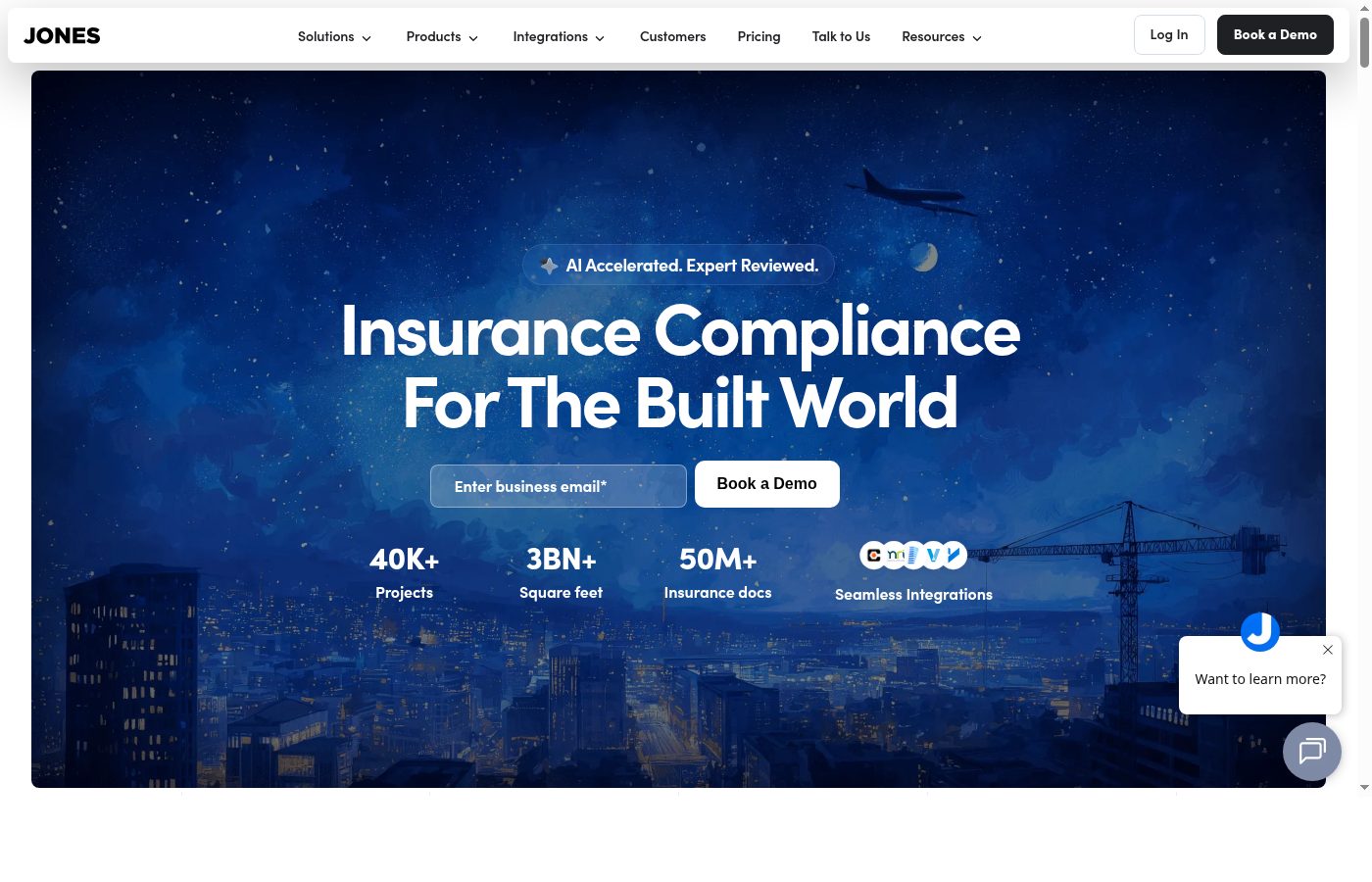
Jones is a specialized commercial real estate and construction artificial intelligence platform designed to automate Certificate of Insurance (COI) tracking and compliance management. Unlike generic document storage systems, Jones combines optical character recognition technology with a network of human insurance experts to audit complex policy documents for property managers and general contractors. Our research confirms that Jones currently processes documents across more than three billion square feet of commercial space and 40,000 projects. The platform addresses a critical liability gap in the built environment: the manual verification of vendor, tenant, and subcontractor insurance policies. By extracting data from submitted documents and cross-referencing it against specific lease or contract requirements, the software prevents underinsured entities from stepping onto a property or job site.
For asset managers and construction principals evaluating risk management software in Q3 2026, Jones represents a shift from reactive record-keeping to proactive compliance enforcement. The platform evaluates nuanced insurance details, such as additional insured endorsements and specific coverage exclusions, which basic automated trackers routinely miss. By embedding its compliance status directly into the industry’s primary accounting and property management systems, Jones ensures that compliance is a prerequisite for operational actions like dispatching vendors or releasing payments. This review examines how the tool performs against the BestCRE 9AI Framework, comparing its capabilities against peers like DocumentCrunch and Deal Intel in the legal and due diligence category to determine if its hybrid AI-human approach justifies the enterprise investment.
What Jones does and how it works
Jones operates as a centralized clearinghouse for third-party insurance compliance. The workflow begins when a property manager or project accountant initiates a COI request from within their existing property management or construction software. Jones sends an automated, branded link to the vendor or subcontractor. Crucially, vendors do not need to create an account or remember a password to submit their documents; they simply click the link and upload their standard ACORD forms or custom policy endorsements. Once uploaded, the platform’s artificial intelligence extracts the text, identifying coverage limits, expiration dates, and specialized clauses.
The system does not rely entirely on machine extraction. After the initial scan, the extracted data routes to a team of specialized insurance auditors who verify complex requirements like waiver of subrogation language or completed operations coverage. This two-step process typically concludes in under 24 hours. If the vendor’s policy falls short of the specific project or property requirements, Jones automatically generates a deficiency notification detailing exactly what is missing and sends it directly to the vendor’s insurance broker to secure the necessary amendments.
On the client side, users monitor a centralized dashboard that displays real-time compliance statuses across their entire portfolio. The system categorizes vendors as compliant, non-compliant, or expired, and initiates automated follow-up sequences well before a policy lapses. Because the platform maintains a proprietary database of over 30,000 vendor insurance profiles, many contractors working across multiple buildings already have their active policies pre-loaded in the system, instantly satisfying compliance checks for new jobs. The software also provides portfolio-wide analytics, highlighting systemic risk exposure and tracking waiver approvals across different assets.
9AI Framework: the score, dimension by dimension
CRE Relevance: 10/10
Jones scores perfectly here because it is engineered exclusively for the commercial real estate and construction sectors. Generic compliance trackers fail in this industry because they do not understand the nuanced risk transfer mechanisms required by general contractors and institutional landlords. Jones explicitly targets these workflows, auditing for specific endorsements, certificate holder language, and complex liability limits that define real estate contracts. The platform’s architecture maps directly to the physical built environment, organizing compliance data by property, project, and tenant rather than just a flat list of vendors. This hyper-focus ensures the software understands the difference between a high-risk structural subcontractor and a low-risk office supplier. In practice: Real estate operators do not have to teach the software about construction insurance requirements because the platform already speaks the industry’s specific legal language.
Data Quality and Sources: 9/10
The platform maintains exceptional data integrity by refusing to trust optical character recognition alone for legal compliance. AI models frequently misinterpret the dense, standardized text of ACORD forms or miss customized policy endorsements buried in the addendums. Jones solves this by routing the machine-extracted data through a secondary review conducted by human insurance specialists. This hybrid approach yields an audited accuracy rate that far exceeds purely automated competitors. Furthermore, the system standardizes incoming data across a massive network of over 50 million insurance documents, creating a structured, highly reliable database of vendor risk profiles. The platform also logs every upload, deficiency, and communication to maintain a pristine audit trail. In practice: Asset managers can confidently rely on the system’s compliance status during an insurance claim or a portfolio audit without second-guessing the underlying data.
Ease of Adoption: 9/10
Adoption friction in compliance software usually stems from the vendors, not the internal team. If subcontractors refuse to use a portal, the system fails. Jones eliminates this barrier by utilizing a no-login, single-click upload process for third parties. Vendors receive an email, click a link, and attach their PDF. For internal staff, the learning curve is minimal because the software embeds directly into the tools they already use daily. Project accountants do not need to log into a separate Jones dashboard to check compliance; they view the status directly within their primary accounting or property management interface. Automated follow-ups further remove the administrative burden of chasing down expired certificates. In practice: Internal teams experience immediate time savings because the software handles the tedious vendor follow-up sequences entirely in the background.
Output Accuracy: 9/10
When evaluating legal and due diligence tools like DocumentCrunch or Jones, precision is the primary metric. A false positive in insurance compliance exposes a property owner to catastrophic liability. The output from Jones is highly accurate because it audits against the specific, granular requirements of each individual lease or contract, rather than a generic baseline. The platform correctly identifies missing additional insured language, verifies aggregate limits, and catches subtle exclusions that automated-only systems routinely bypass. The deficiency reports generated by the system are precise and actionable, telling the vendor’s broker exactly which clause needs amendment. The sub-24-hour turnaround time ensures this accuracy does not create operational bottlenecks. In practice: Risk managers receive definitive, binary compliance statuses that they can trust when authorizing vendor access or approving subcontractor pay applications.
Integration and Workflow Fit: 9/10
The integration capabilities of this platform represent its strongest technical advantage. Jones provides deep, bi-directional connections with the core systems of record in commercial real estate and construction. The software embeds directly into Procore, MRI Software, Yardi Voyager, Sage 300 CRE, Viewpoint Vista, and CMiC. These are not superficial data dumps; they are native-feeling API connections. For example, the integration can automatically block accounts payable workflows in Sage or MRI if a vendor’s compliance status shifts to expired. Users can initiate document requests and view real-time statuses without ever leaving their primary enterprise resource planning environment. The availability of a public API also allows developers to build custom compliance widgets into proprietary systems. In practice: The software functions as an invisible compliance layer operating silently behind the screens of your existing property management and accounting tech stack.
Pricing Transparency: 5/10
The company utilizes a fixed rate per square foot pricing model for commercial real estate portfolios, which aligns costs with the scale of the physical assets rather than user seats. However, exact dollar figures or tier thresholds are entirely absent from the public website. Buyers must engage with the sales team to receive a custom quote based on their portfolio size, project volume, and specific integration requirements. While enterprise software in the real estate sector frequently gates pricing behind a sales motion, this lack of public visibility prevents analysts and mid-market buyers from conducting independent financial modeling early in the procurement cycle. Due to this standard enterprise opacity, the platform receives a baseline score for this dimension. In practice: Prospective buyers should prepare a detailed portfolio and vendor volume analysis before engaging sales to secure an accurate cost estimate.
Support and Reliability: 8/10
The support infrastructure extends beyond traditional software troubleshooting to include actual risk management expertise. Because the platform relies on a team of insurance specialists to audit documents, clients effectively gain an outsourced compliance department. Customer success teams assist in configuring the initial insurance requirement templates, ensuring that the baseline rules match the organization’s specific risk tolerance. The company has a proven track record supporting massive institutional portfolios, including major clients like JLL and ENR 400 general contractors, indicating a highly reliable service architecture capable of handling enterprise scale. During peak renewal seasons, the hybrid review model prevents the multi-week backlogs that plague smaller competitors. In practice: Clients receive consistent, expert-backed document reviews that maintain strict turnaround times even during heavy seasonal lease or contract renewal periods.
Innovation and Roadmap: 8/10
The company continues to push the boundaries of compliance automation by expanding its network effects and deepening its enterprise resource planning integrations. The development of The Jones Network, a shared database of pre-verified vendor insurance profiles, represents a significant step toward instant compliance verification. As this database grows, the likelihood of a vendor already existing in the system increases, theoretically reducing audit times to zero for overlapping contractors. The firm is also actively deploying specialized artificial intelligence agents designed to handle more complex document extraction and broker communications autonomously. Their open API architecture suggests a future where insurance compliance can be plugged into any bespoke real estate application. In practice: Buyers are investing in a platform that is actively transitioning from a workflow automation tool into a comprehensive, predictive risk intelligence network.
Market Reputation: 9/10
Within the commercial real estate and construction sectors, the platform commands a premium reputation. It is widely regarded as the top-tier solution for organizations prioritizing audit depth over raw software speed. Managing compliance for over three billion square feet of real estate and 40,000 construction projects, the company has secured the trust of major institutional landlords and top-tier general contractors. In competitive evaluations against peers like myCOI and TrustLayer, analysts consistently highlight this tool’s superior turnaround times and specialized focus on the built environment. The brand is synonymous with rigorous risk transfer and enterprise-grade reliability, avoiding the pitfalls of lightweight trackers that fail under complex contract scrutiny. In practice: Adopting this software signals to investors and joint venture partners that the organization employs an institutional-grade approach to liability and risk management.
Who should use Jones
The platform is engineered for organizations managing high volumes of third-party risk across physical assets. It excels in environments where compliance failure carries severe financial or legal consequences, and where internal accounting teams are currently wasting hours chasing expired paperwork.
Institutional property management firms overseeing millions of square feet and thousands of tenant and vendor policies.
Top 400 General Contractors who need to verify complex subcontractor endorsements before releasing pay applications.
Real estate developers managing multiple active construction sites with rotating pools of specialized trades.
Enterprise risk management teams seeking centralized visibility into portfolio-wide liability gaps.
Who should look elsewhere
Organizations with minimal physical risk exposure or those operating outside the built environment will find the platform over-engineered and misaligned with their needs. The specialized focus on property and construction means generic businesses should look elsewhere.
Small property operators with only a handful of stable vendors where manual tracking remains manageable.
Companies in industries like manufacturing, logistics, or retail that require generic compliance tracking without real estate-specific integrations.
Budget-constrained firms looking for a basic, software-only repository to simply store PDFs without verifying the coverage details.
Pricing and ROI
The vendor does not publish its pricing on its website, requiring prospective buyers to undergo a scoping call to receive a custom quote. Our research indicates that the company utilizes a fixed rate per square foot model for commercial real estate portfolios, and likely a project-volume or revenue-based model for construction firms. This structure aligns the software cost with the scale of the physical assets rather than penalizing companies for adding more internal users to the system. While the lack of transparent pricing complicates early-stage budgeting, the return on investment math is highly compelling for enterprise operators. The primary ROI driver is the elimination of manual auditing hours. If a project accountant spends three hours per week chasing and reviewing certificates across ten active projects, a firm is losing hundreds of high-value administrative hours annually. By automating the collection, review, and deficiency resolution processes, the software reallocates this time to core financial operations. Furthermore, the secondary ROI comes from risk avoidance. A single uninsured claim resulting from a lapsed subcontractor policy can easily exceed the multi-year cost of the software. For organizations evaluating tools like Deal Intel or Imprima for risk reduction, this platform offers a similarly definitive financial safeguard against hidden liabilities.
Integration and CRE tech stack fit
The platform’s integration architecture is a primary differentiator, designed specifically to fit within the established commercial real estate and construction technology stacks. Rather than forcing users to adopt a new standalone dashboard, the software operates as an embedded compliance layer. It features deep, bi-directional integrations with industry standards including Procore, MRI Software, Yardi Voyager, Sage 300 CRE, Viewpoint Vista, and CMiC. For example, the Procore integration is fully embedded, allowing project managers to create projects, request documents, and view compliance statuses without ever leaving the Procore interface. In accounting systems like MRI or Sage, the software can automatically cross-reference compliance data against accounts payable workflows, placing a hold on vendor payments if their insurance has expired. This prevents the accidental release of funds to non-compliant subcontractors. Additionally, the company offers a public API, enabling developers to build custom compliance checks into proprietary procurement or tenant experience applications. This ecosystem operability ensures that risk management remains synchronized with daily financial and operational activities.
Competitive landscape
The market for certificate of insurance tracking is crowded, but heavily segmented by industry focus and audit methodology. Jones competes directly with platforms like myCOI, TrustLayer, BCS, and Certificial. When compared to myCOI, Jones typically wins on audit speed and user experience; myCOI relies heavily on human review which can lead to multi-day backlogs during peak renewal seasons, whereas the hybrid AI approach of Jones consistently delivers sub-24-hour turnarounds. TrustLayer is a strong competitor pushing toward real-time policy verification, but it serves a broader range of industries. Jones maintains a distinct advantage for real estate and construction buyers because its templates, integrations, and expert reviewers are exclusively focused on the nuances of the built environment.
BCS offers both software and fully outsourced risk management, appealing to firms that want to completely abdicate the process, but their software interface is often viewed as less modern than Jones. Certificial represents a different architectural approach, attempting to connect directly to insurance broker systems for live data feeds. While Certificial’s real-time monitoring is impressive, the industry still heavily relies on custom endorsements and complex ACORD forms that require the deep, document-level auditing that Jones provides. For CRE principals who have evaluated due diligence tools like DocumentCrunch (Scored 86) or Wilson AI (Scored 82), Jones offers a similarly specialized, high-accuracy approach to a specific legal workflow, easily justifying its position as a Tier 2 CRE-native platform.
The bottom line
Jones is the definitive choice for institutional commercial real estate operators and enterprise general contractors who require rigorous, accurate insurance compliance without sacrificing operational speed. It is not a cheap, lightweight document storage tool; it is a comprehensive risk transfer engine. By combining artificial intelligence with specialized human auditors, the platform solves the accuracy problem that plagues purely automated systems, while its deep integrations with Yardi, Procore, and MRI solve the adoption friction that ruins manual processes. If your organization manages millions of square feet or hundreds of active subcontractors, the liability exposure of a lapsed policy is too great to leave to spreadsheets or generic trackers. The software forces compliance into your core operational workflows, ensuring no vendor is paid or permitted on-site without verified coverage. For enterprise CRE teams, it is a mandatory upgrade.
Frequently asked questions
Does the software integrate with Procore?
Yes, it features a fully embedded integration with Procore. Project managers and accountants can request insurance documents, review detailed compliance statuses, and manage vendor requirements directly within the native Procore interface. This eliminates the need to constantly switch between platforms or manually sync data.
How long does it take to review a submitted certificate?
The platform utilizes a hybrid approach combining artificial intelligence extraction with human insurance expert review. This system consistently delivers complete document audits and compliance verifications in under 24 business hours, maintaining this rapid turnaround time even during peak seasonal renewal periods.
Do vendors have to pay or create an account to submit documents?
No, the vendor experience is designed to be completely frictionless. Subcontractors and tenants receive a branded email containing a secure, direct link. They simply click the link and upload their PDF documents immediately, requiring absolutely no login credentials, account creation, or usage fees.
Can the system block payments to non-compliant vendors?
Yes, the software excels at financial control. Through its bi-directional API integrations with major accounting systems like MRI Software and Sage 300 CRE, the platform can automatically place holds on accounts payable workflows whenever a vendor’s insurance status becomes expired or non-compliant.
What industries does the platform support?
The software is engineered exclusively for the commercial real estate and construction sectors. It is highly specialized to handle the complex risk transfer requirements, specific endorsements, and unique operational workflows demanded by institutional property managers, developers, and enterprise general contractors.
How does the company price its software?
Pricing details are not published publicly on the vendor’s website. For commercial real estate portfolios, the company utilizes a fixed rate per square foot model. Prospective buyers must contact the enterprise sales team to receive a customized quote based on their specific portfolio size and required integrations.
Related Reviews
Compare Jones with other Legal, Compliance & Due Diligence tools BestCRE has scored: InvestNext (90/100), UpCodes (84/100), TitleTrackr (63/100) and AI Rulebook (62/100). Browse every review in CRE Legal, Compliance & Due Diligence, the full Best CRE AI Tools directory, or the 20 CRE Sectors hub.