Leasecake is a commercial real estate lease and contract management platform designed specifically for multi-location operators. According to the BestCRE master database, the platform focuses on centralizing lease administration for retail, restaurant, and franchise tenants. Rather than targeting institutional landlords or massive asset management firms, Leasecake has carved out a distinct niche serving the operational side of commercial real estate. By combining document storage, critical date tracking, and artificial intelligence, the software attempts to replace the fragmented spreadsheets and shared folders that typically plague distributed portfolios. Multi-unit businesses often struggle with missed renewal deadlines and unverified common area maintenance charges, which this system aims to prevent through automated alerts and structured data extraction.
The platform relies heavily on its proprietary artificial intelligence assistant, Cakebot, to abstract lease documents and answer natural language queries directly from the contract text. While enterprise-grade competitors often require extensive implementation periods and dedicated administrative staff, Leasecake positions itself as an accessible alternative for lean real estate teams. The software bridges the gap between basic document storage and complex lease accounting systems, offering specialized tools for tracking common area maintenance caps, renewal options, and franchise agreements. As of August 2026, the company continues to expand its footprint among multi-unit operators seeking to minimize compliance risks without adopting overly complicated enterprise resource planning modules. The focus remains strictly on tenant-side operational efficiency.
What Leasecake does and how it works
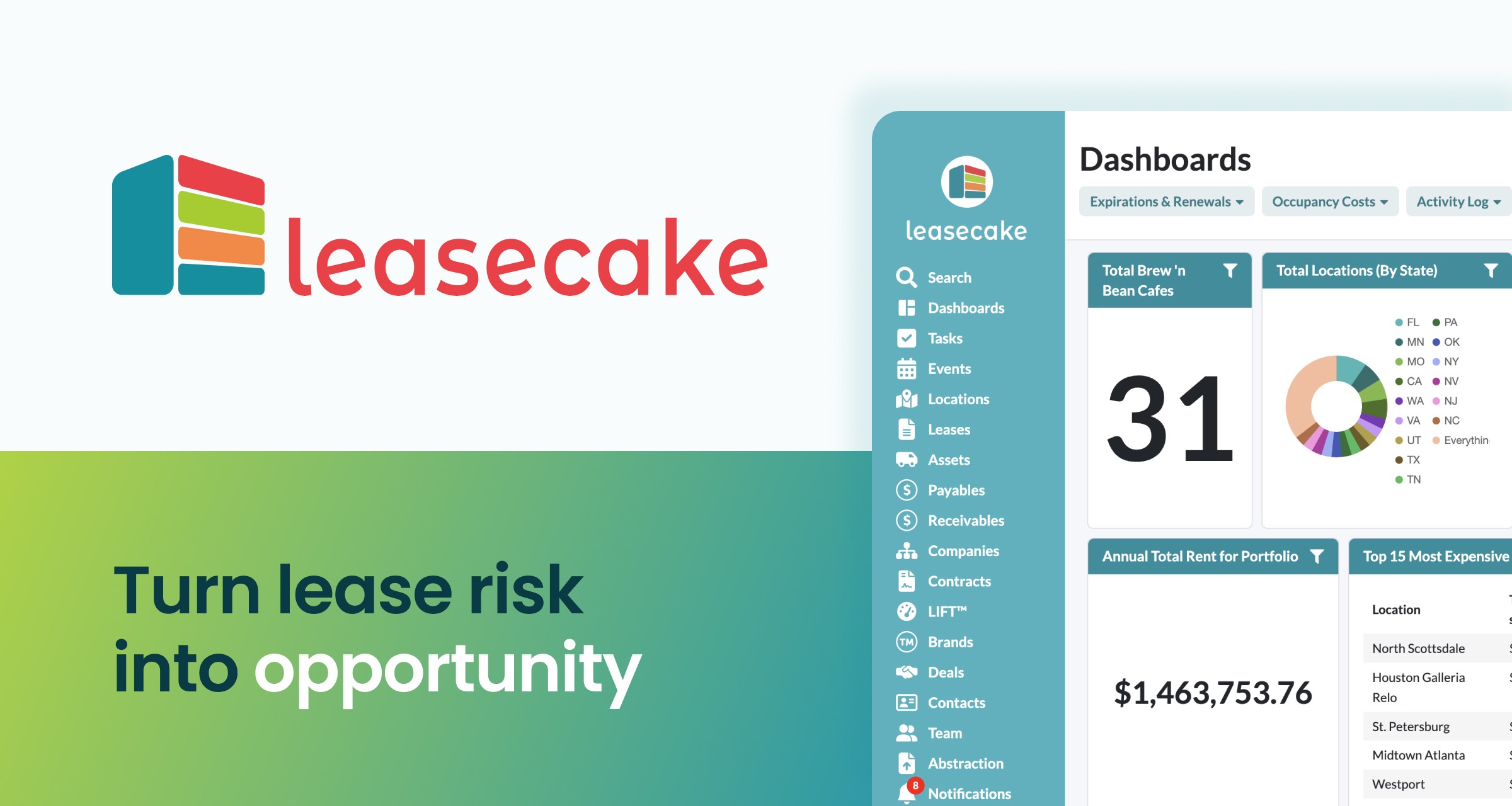
Leasecake functions as a centralized repository and operational dashboard for lease administration. Users upload their lease agreements, amendments, and related documents into the platform, where the system’s artificial intelligence engine, Cakebot, processes the text. The AI extracts critical clauses, financial obligations, and key dates, populating a structured database. This abstraction process identifies specific variables such as rent escalations, common area maintenance fixed caps, and tenant responsibilities. Users can interact with Cakebot using natural language queries, asking questions like “Who is responsible for HVAC repairs at the Main Street location?” to receive instant answers cited directly from the source document.
Beyond abstraction, the software automates critical date management. Real estate managers configure custom alerts for upcoming renewals, option expirations, and compliance deadlines. The platform triggers notifications based on required notice periods rather than just the ultimate expiration date, giving teams adequate time to negotiate or plan relocations. These alerts integrate into a task management system that tracks the progress of lease renewals and facility maintenance requests across the entire portfolio. The mobile application allows field operators and regional managers to access lease details, contact information, and critical documents directly from their smartphones while conducting site visits.
For financial operations, Leasecake provides structured exports and integrations to assist with ASC 842 and IFRS 16 compliance. While it is primarily a lease administration tool rather than a dedicated accounting engine, it organizes the underlying financial data required for journal entries. The platform tracks rent schedules, amortizes payments, and reconciles expenses. By maintaining a single source of truth for both the real estate and finance departments, the software reduces the friction typically associated with month-end close processes and annual audits.
9AI Framework: the score, dimension by dimension
CRE Relevance: 9/10
Leasecake is entirely dedicated to commercial real estate, with a highly specific focus on tenant-side lease administration for multi-unit operators. The platform understands the nuances of commercial leases, including common area maintenance reconciliations, percentage rent breakpoints, and complex renewal options. Unlike generic contract management software, the data architecture is built around locations, leases, and franchise agreements. The system natively supports the specific workflows required by retail and restaurant operators, acknowledging the operational realities of managing physical storefronts. This deep industry alignment ensures that the terminology and data structures match the daily requirements of real estate managers. In practice: Multi-location operators will find a system that speaks their language and immediately accommodates standard commercial lease structures without custom configuration.
Data Quality and Sources: 8/10
The platform relies on its AI engine to extract data from uploaded documents, which introduces standard risks associated with automated abstraction. While Cakebot effectively identifies standard clauses and dates, complex lease amendments or non-standard legal language may require manual review. The system provides confidence scoring to highlight potential extraction errors, prompting users to verify the AI’s work against the original text. Because the software is designed for operational teams rather than just data entry clerks, the ongoing accuracy depends heavily on user discipline during the document upload process. Competitors in the Tier 1 space often provide human-in-the-loop verification services, whereas Leasecake relies more on the end user. In practice: Real estate teams must implement internal auditing procedures to ensure the AI-extracted data remains entirely accurate across complex lease amendments.
Ease of Adoption: 9/10
Leasecake excels in user experience, prioritizing simplicity over exhaustive enterprise configuration. The interface is clean and intuitive, allowing non-technical staff to navigate portfolios and locate documents immediately. Implementation is notably faster than traditional lease accounting systems, as the platform avoids heavy customization requirements. The availability of a fully functional mobile application significantly boosts adoption among field teams and regional managers who rarely sit at a desktop. Training requirements are minimal, and users can typically begin querying their lease data within days of uploading their portfolio. The natural language search capabilities further reduce the learning curve for new employees. In practice: Lean real estate teams can deploy the software and achieve high internal adoption rates without relying on external implementation consultants.
Output Accuracy: 8/10
The accuracy of the platform’s reporting and alert systems is generally high, provided the initial abstraction is verified. Critical date notifications trigger reliably based on user-defined notice periods, preventing missed options or accidental holdovers. The financial outputs, including rent schedules and common area maintenance tracking, calculate correctly based on the inputted variables. However, the system’s reliance on user verification means that abstraction errors can propagate into financial reports if left unchecked. When querying Cakebot, the AI provides accurate answers to straightforward questions but can occasionally struggle with highly convoluted, multi-amendment lease histories where clauses supersede one another. In practice: The automated alerts and financial schedules are highly dependable, but complex legal queries require users to double-check the cited source documents.
Integration and Workflow Fit: 8/10
The software offers established connections with mid-market enterprise resource planning systems and accounting software, including Sage Intacct, NetSuite, and Restaurant365. These integrations facilitate the transfer of rent schedules and journal entries, bridging the gap between real estate operations and corporate finance. However, the platform’s integration capabilities are somewhat closed compared to developer-first tools. While it pushes data effectively to supported accounting systems, custom integrations via an open application programming interface are limited. Organizations utilizing niche or proprietary internal systems may find it difficult to establish automated two-way data syncing without relying on flat-file exports. In practice: Companies using supported accounting platforms will enjoy automated financial syncing, but those requiring complex custom API connections will face technical limitations.
Pricing Transparency: 4/10
Based on the BestCRE master database, Leasecake utilizes a custom pricing model and does not publish standard subscription tiers or per-location costs on its website. Prospective buyers must engage with the sales team to receive a customized quote based on portfolio size and required features. While the company markets the software as costing a fraction of standard rent expenditures, the lack of public pricing prevents independent financial modeling prior to vendor engagement. Additional services, such as managed lease abstraction or common area maintenance reconciliation support, carry separate fees that are not publicly detailed. In practice: Buyers must commit to a full sales discovery process to determine if the platform fits within their real estate technology budget.
Support and Reliability: 8/10
The company provides standard software support through email and a live chat interface, though it lacks native telephone support for immediate troubleshooting. Despite the absence of a dedicated phone line, user feedback indicates that the support team is highly responsive and knowledgeable about commercial real estate operations. The vendor offers extensive onboarding assistance to ensure initial data uploads and system configurations are successful. Additionally, the company actively monitors user feedback and frequently rolls out minor updates to address workflow friction. For organizations requiring hands-on help, third-party partnerships exist to provide managed lease administration services directly within the platform. In practice: Users receive prompt and effective digital support, though traditional enterprise buyers might miss having a direct telephone hotline.
Innovation and Roadmap: 8/10
Leasecake has demonstrated a consistent commitment to enhancing its artificial intelligence capabilities, most notably through the continuous improvement of Cakebot. Recent updates have focused on expanding the natural language processing engine to handle more complex lease queries and improving the mobile application experience. The company is actively deepening its accounting integrations to better support ASC 842 compliance workflows. While it may not release experimental features as rapidly as venture-backed Tier 1 startups, the roadmap is highly pragmatic and aligned with the actual needs of multi-unit operators. The focus remains on practical automation rather than theoretical technology. In practice: Customers can expect steady, reliable updates that directly improve day-to-day lease administration rather than flashy but unusable experimental features.
Market Reputation: 8/10
Within the retail, restaurant, and franchise sectors, Leasecake has built a strong reputation as a dependable operational tool. It is widely utilized by major franchise networks and private equity holding companies managing distributed physical locations. While it may lack the prestige of Tier 1 enterprise platforms favored by institutional landlords, it is highly respected within its specific target market. The software consistently wins industry awards for lease administration and maintains high satisfaction scores among non-technical end users. Competitors occasionally highlight its limitations in complex lease accounting, but operational users praise its simplicity and immediate return on investment. In practice: Multi-location retail and franchise operators view the platform as a trusted, purpose-built solution for their specific portfolio challenges.
Who should use Leasecake
Leasecake is optimized for tenant-side operators who need to organize distributed portfolios without implementing heavy enterprise software.
Franchise operators managing dozens or hundreds of retail or restaurant locations.
Private equity firms requiring portfolio visibility across multiple operating companies.
Lean real estate teams seeking to automate critical date tracking and eliminate spreadsheets.
Healthcare and service-based retail businesses needing mobile access to lease documents.
Who should look elsewhere
Organizations with highly complex, institutional-grade requirements or those operating primarily as landlords will find the platform misaligned with their needs.
Institutional landlords managing complex multi-tenant office or industrial parks.
Enterprise corporations requiring highly customized, developer-first API integrations.
Companies seeking a standalone, comprehensive ASC 842 lease accounting engine without an existing ERP.
Firms that require guaranteed human-in-the-loop verification for all AI-abstracted data natively.
Pricing and ROI
According to the BestCRE master database, Leasecake operates on a custom pricing model and does not publish its subscription costs publicly. Buyers must engage directly with the sales team to obtain a quote, which is typically structured based on the total number of locations or leases managed within the platform. While historical industry data suggests entry-level pricing previously hovered around a monthly per-user fee, the current enterprise model scales with portfolio complexity. Additional professional services, such as historical lease abstraction and common area maintenance reconciliation audits, are billed separately from the core software subscription.
To calculate the return on investment, analysts must weigh the undisclosed software cost against the prevention of specific financial penalties. The primary financial return is generated by avoiding missed renewal options, which can result in costly holdover rent penalties or the loss of a profitable retail location. Secondary returns come from identifying common area maintenance overcharges through the platform’s expense tracking features. A multi-unit operator saving a single location from a fifty percent holdover rent increase will typically justify the annual cost of the software immediately.
Integration and CRE tech stack fit
Leasecake fits into the commercial real estate technology stack primarily as a specialized operational system that feeds data into broader financial platforms. The software provides native, established integrations with major mid-market accounting systems such as Sage Intacct, NetSuite, QuickBooks, and Restaurant365. These connections allow real estate teams to manage the operational aspects of a lease while automatically syncing rent schedules and journal entries to the finance department for ASC 842 compliance and general ledger management.
Despite these strong accounting connections, the platform is less flexible when connecting to proprietary internal data lakes or niche property management systems. The lack of a fully open, developer-friendly application programming interface means that custom data pipelines require significant workarounds or reliance on scheduled flat-file exports. For standard retail and franchise operators, the existing ERP connections are more than sufficient. However, enterprise technologists attempting to build a highly interconnected, custom digital ecosystem may find the platform’s data boundaries restrictive.
Competitive landscape
When evaluating Leasecake, commercial real estate analysts should consider alternative platforms depending on their specific operational or financial requirements. In the BestCRE master database, Prophia scored 94 and serves as a premium alternative for institutional landlords and enterprise tenants requiring highly advanced, human-verified AI abstraction. While Leasecake focuses on simplicity and operational task management, Prophia delivers deeper data structuring for complex office and industrial portfolios.
For organizations prioritizing strict lease accounting compliance over operational task management, Occupier presents a strong alternative. Occupier bridges the gap between real estate and finance more aggressively, offering in-house certified public accountant support and more rigid financial controls. Conversely, Findable, which scored 87, competes in the document intelligence space by automating the organization of building documentation and warranties, though it lacks the specific franchise-focused workflow tools found in Leasecake.
If a company requires a massive, all-in-one enterprise resource planning system, legacy platforms like MRI Software AI (Scored 76) offer comprehensive modules that cover everything from lease administration to facility management and investor reporting. However, MRI requires a significantly longer implementation period and a steeper learning curve. Ultimately, Leasecake wins against these competitors when the buyer is a multi-unit tenant seeking rapid deployment, mobile accessibility, and straightforward critical date management without the bloat of a massive enterprise system.
The bottom line
Leasecake is a highly effective, purpose-built lease administration platform for multi-location tenants, franchises, and retail operators. It successfully solves the most common operational failures in distributed portfolios: missed renewal dates, lost documents, and siloed communication. The integration of the Cakebot AI assistant provides genuine utility for non-technical users who need immediate answers from their contracts without parsing hundreds of pages of legal text. However, buyers must recognize its limitations. It is not an open-architecture data platform for enterprise developers, nor is it a dedicated accounting engine designed to handle the most complex ASC 842 edge cases independently. For lean real estate teams managing dozens or hundreds of physical locations, Leasecake delivers an immediate, tangible return on investment by bringing order to chaotic lease portfolios and preventing costly operational mistakes.
Frequently asked questions
Does Leasecake provide full ASC 842 lease accounting compliance?
Leasecake organizes the necessary financial data and rent schedules for compliance, but it is primarily a lease administration tool. For full ASC 842 compliance, most organizations integrate the platform with dedicated accounting software like Sage Intacct or NetSuite to handle complex journal entries and final reporting.
Can Leasecake automatically extract data from scanned lease documents?
Yes, the platform utilizes an artificial intelligence tool called Cakebot to read and abstract data from uploaded lease agreements, amendments, and permits. However, users are encouraged to manually verify the extracted variables, such as common area maintenance caps and complex renewal options, to ensure total accuracy.
How much does Leasecake cost for a small business?
The company utilizes a custom pricing model based on portfolio size and required features, meaning exact costs are not published online. Prospective buyers must contact the sales team for a customized quote. Additional services like historical lease abstraction carry separate, variable fees.
Is there a mobile app available for Leasecake users?
Yes, the platform features a fully functional mobile application. This is particularly useful for regional managers and field operators who need immediate access to lease documents, critical dates, and vendor contact information while visiting physical retail or franchise locations.
Does Leasecake offer an open API for custom integrations?
The platform provides established integrations with major accounting systems, but its capabilities for custom developer integrations are limited. Organizations relying on proprietary internal systems may need to utilize scheduled flat-file exports rather than automated two-way data syncing via an open application programming interface.
Who is the target audience for Leasecake software?
The platform is specifically designed for multi-location tenants, including retail operators, restaurant franchises, healthcare clinics, and private equity holding companies. It is optimized for operational real estate teams managing physical storefronts rather than institutional landlords managing multi-tenant office buildings.
Related Reviews
Compare Leasecake with other Lease Abstraction & Document Intelligence tools BestCRE has scored: Occupier (78/100), LeasePilot (78/100), Kolena (72/100) and Evisort (70/100). Browse every review in CRE Lease Abstraction & Document Intelligence, the full Best CRE AI Tools directory, or the 20 CRE Sectors hub.