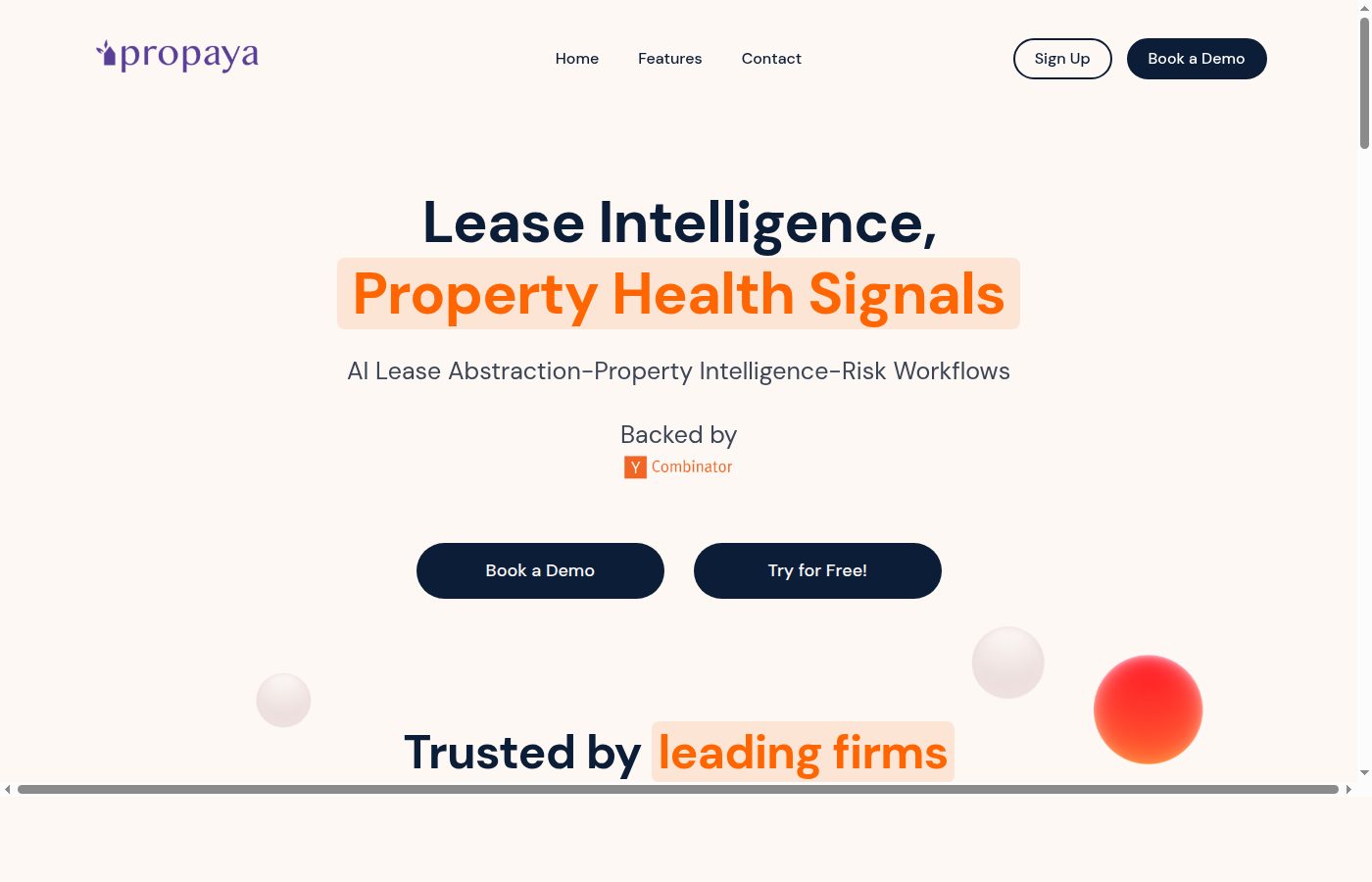
Propaya is an AI-driven commercial lease abstraction and review platform that operates with custom pricing models. As a Tier 2 CRE-native application, it targets commercial real estate principals and analysts who need to process dense legal documents without relying entirely on manual legal review or outsourced abstraction services. The platform enters a crowded market of document intelligence tools, positioning itself specifically around the extraction of critical lease clauses, rent schedules, and tenant obligations. Because it is classified as a Tier 2 solution in the BestCRE database, it represents an emerging player rather than a legacy incumbent, meaning buyers must weigh its specialized focus against the maturity of its support infrastructure.
Our analysis indicates that Propaya is designed to accelerate the due diligence process during acquisitions and streamline ongoing asset management. By converting unstructured PDF leases and amendments into structured data, it aims to reduce the hours spent cross-referencing tenant options, co-tenancy clauses, and expense recovery structures. However, as of March 2026, prospective buyers face a landscape where established peers like Prophia and Findable have already set high benchmarks for accuracy and system integration. Evaluating Propaya requires a strict look at its actual extraction capabilities versus its marketing claims, particularly given the lack of published, transparent pricing. The software must prove that its commercial real estate data models can handle the nuances of complex retail or industrial leases, rather than just standard office templates. For asset managers managing high-velocity lease rollovers, the tool’s core utility will depend entirely on how well it minimizes human verification time.
What Propaya does and how it works
Propaya functions primarily as an engine for AI commercial lease abstractions and review. Users upload executed lease agreements, amendments, and related addenda into the system, which then applies natural language processing to identify and extract key commercial terms. The software isolates variables such as base rent schedules, escalation clauses, tenant improvement allowances, and critical dates. Instead of a human analyst reading hundreds of pages to find a specific termination option or holdover penalty, the platform parses the document and presents these data points in a structured, tabular format. This allows asset management teams to populate their property management systems or underwriting models with extracted data.
Beyond basic extraction, the platform provides a review interface where users can verify the AI-generated outputs against the source document. When an analyst clicks on an extracted data point, such as a renewal notice deadline, the software highlights the exact paragraph in the original PDF where that information was found. This human-in-the-loop verification is a standard requirement for CRE document intelligence, as no automated system achieves perfect accuracy on bespoke legal text. Propaya’s architecture is built specifically for commercial real estate, meaning its underlying models are trained to recognize the difference between a gross lease and a triple net lease, and to properly categorize complex common area maintenance caps.
Our analysis shows that the primary mechanical value of Propaya lies in its ability to handle document hierarchies. Commercial leases rarely exist as a single document; they are typically accompanied by multiple amendments, side letters, and commencement date agreements. The software attempts to synthesize these disparate files into a single, current-state view of the tenant’s obligations. By mapping these relationships, it helps analysts avoid errors that occur when an old clause is superseded by a new amendment but missed during manual review.
9AI Framework: the score, dimension by dimension
CRE Relevance: 8/10
Propaya is designated as a CRE-native platform in the BestCRE database, meaning its architecture and machine learning models are built specifically for commercial real estate use cases rather than general legal or contract review. The software focuses entirely on AI commercial lease abstractions and review, targeting the specific vocabulary of property management and asset valuation. It understands the nuances of percentage rent, cotenancy thresholds, and complex expense recoveries. Because it is not a generic optical character recognition tool, analysts do not have to spend time training the system on basic real estate concepts. In practice: Users can expect the system to immediately recognize standard commercial lease clauses without requiring extensive initial configuration or custom rule creation.
Data Quality and Sources: 7/10
As a Tier 2 application, Propaya delivers solid data extraction but lacks the extensive, multi-cycle training data reservoirs of top-tier incumbents. The quality of the structured data it produces depends heavily on the scan quality of the uploaded PDFs and the standardization of the lease language. While it successfully categorizes standard financial terms and critical dates, highly bespoke legal clauses may result in less structured, purely textual outputs that require manual normalization. The platform relies on its human-in-the-loop interface to ensure final data fidelity before that data moves into a system of record. In practice: Analysts must still perform a detailed review of the extracted data, particularly for complex retail or industrial leases with non-standard addenda.
Ease of Adoption: 7/10
The platform offers a relatively straightforward user interface centered around document upload and split-screen review. Because the primary use case is specific to lease abstraction, the learning curve for a commercial real estate professional is minimal. Users familiar with reading leases will intuitively understand the dashboard layout and the verification workflow. However, establishing the initial document hierarchy and organizing historical files before ingestion can be a time-consuming administrative burden. The software requires a clean input strategy to generate accurate outputs, meaning firms must invest time in document preparation. In practice: A typical asset management team can begin extracting basic lease data within the first week, provided their source documents are organized and legible.
Output Accuracy: 7/10
Propaya achieves competent accuracy rates for standard commercial office leases, successfully extracting base rent schedules, expiration dates, and standard notice periods. However, our analysis suggests that accuracy can degrade when the system encounters heavily amended documents, poor quality scans, or highly negotiated retail leases with complex radius restrictions and percentage rent breakpoints. The software mitigates these errors through its source-linking feature, which directs the user to the exact location of the extracted text for rapid verification. It does not eliminate the need for human oversight, but it significantly reduces the time required to find the information. In practice: Users should anticipate a baseline accuracy that accelerates the review process but still mandates careful human auditing for final validation.
Integration and Workflow Fit: 6/10
Propaya’s integration capabilities reflect its status as a Tier 2 provider. While it can export structured data into standard CSV or Excel formats for use in underwriting models, direct API connections to major property management systems like Yardi, MRI, or RealPage are not published or guaranteed to be plug-and-play. Firms looking to automatically sync abstracted lease data directly into their enterprise resource planning software may face custom development requirements or rely on flat-file transfers. The tool functions well as a standalone abstraction environment but requires manual effort to bridge the gap between extraction and the broader technology stack. In practice: Technical teams should prepare for manual data imports or custom API configuration if they require direct database synchronization.
Pricing Transparency: 4/10
Propaya operates strictly on a custom pricing model, with no published tiers, per-lease fees, or subscription rates available on their website. This lack of transparency forces prospective buyers into a sales cycle simply to determine if the software aligns with their budget. For a tool categorized as Tier 2, this approach makes it difficult for mid-market firms to evaluate its cost-effectiveness against competitors who offer clear, volume-based pricing. Buyers must negotiate based on their specific portfolio size, document volume, and expected usage, which can lead to unpredictable long-term costs as a firm scales its acquisitions. In practice: Analysts must engage directly with the vendor’s sales team to obtain a baseline quote and should aggressively negotiate implementation fees.
Support and Reliability: 6/10
As an emerging Tier 2 vendor, Propaya provides standard customer support but lacks the global, 24/7 infrastructure of larger enterprise software companies. Support is typically routed through email ticketing or scheduled calls, which may cause friction during high-stakes acquisition due diligence when immediate assistance is required. The company does not publish specific service level agreements regarding uptime or response times. While users generally report adequate assistance during the initial onboarding phase, the depth of ongoing technical support for complex integration issues remains unproven compared to market leaders. In practice: Teams utilizing the software for time-sensitive transactions should establish clear communication channels with their dedicated account manager to mitigate potential delays.
Innovation and Roadmap: 6/10
Propaya’s development trajectory focuses heavily on refining its core AI commercial lease abstractions and review capabilities. The company is actively working to improve its natural language processing models to better handle non-standard lease clauses and complex document hierarchies. However, as an unproven startup in the Tier 2 category, its roadmap lacks the aggressive expansion into broader portfolio analytics or automated compliance tracking seen in higher-scoring peers. The focus remains narrow, which is beneficial for the immediate use case but raises questions about long-term platform evolution. Future updates appear centered on incremental accuracy improvements rather than entirely new product modules. In practice: Buyers should evaluate the software based entirely on its current functionality rather than promises of future feature deployments.
Market Reputation: 6/10
Propaya holds a modest market reputation, consistent with its Tier 2 classification in the BestCRE database. It is recognized among early adopters for its specialized focus on AI commercial lease abstractions, but it does not yet command the widespread brand recognition of competitors like Prophia or Findable. The platform has secured a foothold among mid-sized asset managers and regional investment firms, though it lacks a deep roster of publicly verifiable enterprise case studies. Its reputation is still being formed, heavily dependent on the success of its current user base in realizing actual time savings. In practice: Prospective buyers should request specific reference calls with current clients who manage similar asset classes and document volumes.
Who should use Propaya
Propaya is best suited for commercial real estate teams that process a moderate to high volume of leases but do not require complex, enterprise-grade integrations out of the box. The ideal user is focused on reducing the manual hours spent reading and summarizing documents.
Acquisitions analysts conducting due diligence on multi-tenant properties who need to quickly abstract rent rolls and critical dates.
Asset managers at mid-sized firms looking to digitize legacy lease files and create a searchable database of tenant obligations.
Lease administration teams that want a human-in-the-loop AI tool to accelerate their manual data entry workflows.
Third-party property management firms needing a standalone tool to standardize lease summaries across different client portfolios.
Who should look elsewhere
Firms requiring immediate, out-of-the-box synchronization with major ERPs or those with highly complex, non-standard portfolios may find Propaya insufficient for their needs. It is not designed for organizations seeking a fully automated, zero-touch extraction process.
Enterprise institutions requiring native, bi-directional API integrations with Yardi Voyager or MRI without custom development.
Retail landlords managing highly complex percentage rent and co-tenancy structures that demand specialized, rules-based extraction engines.
Firms with very low transaction volumes where the time spent onboarding the software outweighs the time saved on manual abstraction.
Pricing and ROI
Propaya does not publish its pricing, operating entirely on a custom pricing model. Our research confirms that prospective buyers must engage directly with the sales team to obtain a quote, which is typically structured around portfolio size, total square footage, or the annual volume of leases processed. This lack of transparency makes initial budget forecasting difficult for commercial real estate analysts comparing multiple vendors. Because it is a Tier 2 platform, buyers should expect costs to be lower than premium competitors like Prophia, but they must carefully negotiate implementation and onboarding fees, which are often obscured in custom contracts.
To calculate the return on investment, firms must measure the software’s cost against the fully burdened hourly rate of the analysts or external legal counsel currently performing manual abstractions. If an analyst earning $60 per hour takes four hours to abstract a complex commercial lease, the manual cost is $240 per document. If Propaya reduces that review time to one hour, the firm saves $180 per lease. For a portfolio generating 100 new leases or amendments annually, this yields $18,000 in gross operational savings. The platform’s ROI becomes positive only if the annualized custom subscription fee and the amortized implementation costs fall significantly below this threshold. Buyers must also factor in the administrative time required to organize and upload the documents before the AI can process them.
Integration and CRE tech stack fit
In the context of a modern commercial real estate technology stack, Propaya functions primarily as a point solution rather than a central data hub. Because it is a Tier 2 application, it lacks the extensive ecosystem of pre-built connectors found in more mature platforms. Our analysis indicates that users typically export extracted lease data into CSV or Excel formats, which are then manually imported into primary systems of record such as Argus Enterprise for valuation, or accounting platforms like Yardi and RealPage.
Firms attempting to build automated workflows will likely need to rely on custom API development or middleware solutions to push Propaya’s structured data into their property management systems. This creates a technical hurdle for lean organizations without dedicated IT resources. While the software excels at the specific task of AI commercial lease abstractions and review, it forces the user to take responsibility for data routing. For asset managers, this means the tool sits adjacent to the core tech stack, acting as a processing engine for unstructured PDFs rather than an integrated component of the daily financial reporting infrastructure. Buyers must plan for this manual data transfer step when mapping out their operational workflows.
Competitive landscape
The market for CRE document intelligence is highly competitive, and Propaya faces significant pressure from both established incumbents and specialized startups. Prophia, which holds a BestCRE score of 94, is the dominant alternative. Prophia offers superior accuracy, deeper integration capabilities, and a more proven track record with institutional landlords, making it the safer choice for enterprise firms, albeit likely at a higher price point. Findable, scoring 87, provides another strong alternative with a broader focus on overall building documentation and compliance, rather than just lease abstraction.
For firms specifically focused on lease administration and critical date tracking, Leasecake (scoring 78) and Occupier (scoring 78) present compelling alternatives. Both of these platforms combine lease abstraction with dedicated lease accounting and administration modules, offering a more comprehensive workflow solution compared to Propaya’s narrower focus on document extraction. RETS AI (scoring 86) and Wilson AI (scoring 82) also compete directly in the AI extraction space, with both platforms generally offering more transparent pricing or better-documented API capabilities.
Propaya’s primary differentiator must be its specific user interface and potentially lower custom pricing, though the latter cannot be verified without a formal quote. When evaluating Propaya, analysts must weigh its focused extraction capabilities against the broader feature sets and proven reliability of Prophia and Findable. If a firm only needs a standalone tool to accelerate manual review and is willing to accept a Tier 2 vendor’s limitations, Propaya is a viable candidate. However, organizations requiring mature, end-to-end lease administration should look toward the higher-scoring peers.
The bottom line
Propaya is a capable but narrow tool for AI commercial lease abstractions and review. It successfully accelerates the extraction of critical dates and financial terms from unstructured PDFs, allowing analysts to process due diligence materials faster than manual methods. However, its status as an unproven Tier 2 vendor, combined with a complete lack of pricing transparency and limited native integrations, restricts its appeal for enterprise institutions. The software requires a firm commitment to human-in-the-loop verification and manual data routing. Commercial real estate principals should only purchase Propaya if they have a clear, high-volume bottleneck in lease abstraction and have negotiated a custom price that significantly undercuts premium competitors like Prophia. For mid-market firms willing to manage the data export process manually, it offers a functional entry point into document intelligence, but it is not a comprehensive lease administration platform.
Frequently asked questions
What is the primary use case for Propaya in commercial real estate?
Propaya is designed specifically for AI commercial lease abstractions and review. It extracts critical data points like rent schedules, expiration dates, and tenant options from unstructured PDF lease documents, converting them into structured formats for asset managers and analysts.
Does Propaya integrate directly with Yardi or MRI?
Direct, plug-and-play integrations with major property management systems like Yardi or MRI are not published. Users typically export the abstracted lease data to Excel or CSV files for manual import, or they must invest in custom API development to synchronize the systems.
How much does Propaya cost for a mid-sized portfolio?
Propaya does not publish its pricing tiers or subscription rates. The company utilizes a custom pricing model, requiring prospective buyers to engage directly with their sales team to negotiate a contract based on portfolio size, document volume, and specific feature requirements.
Can Propaya completely replace manual lease abstraction?
No. While the software significantly accelerates the extraction process by identifying key clauses and linking them to the source document, it requires human-in-the-loop verification. Analysts must still review the AI-generated outputs to ensure complete accuracy, especially for complex or highly amended leases.
How does Propaya handle multiple lease amendments?
The platform is built to process document hierarchies, allowing users to upload the original lease alongside subsequent amendments. It attempts to synthesize these files to present the current state of tenant obligations, though users must verify that newer clauses correctly supersede older ones.
How does Propaya compare to Prophia?
Prophia is a higher-rated, Tier 1 platform with a BestCRE score of 94, offering superior accuracy, proven enterprise integrations, and a stronger market reputation. Propaya is a Tier 2 alternative that may offer competitive custom pricing but lacks the maturity and comprehensive feature set of Prophia.
Related Reviews
Compare Propaya with other Lease Abstraction & Document Intelligence tools BestCRE has scored: Occupier (78/100), LeasePilot (78/100), Bryckel AI (68/100) and Lucernex (67/100). Browse every review in CRE Lease Abstraction & Document Intelligence, the full Best CRE AI Tools directory, or the 20 CRE Sectors hub.