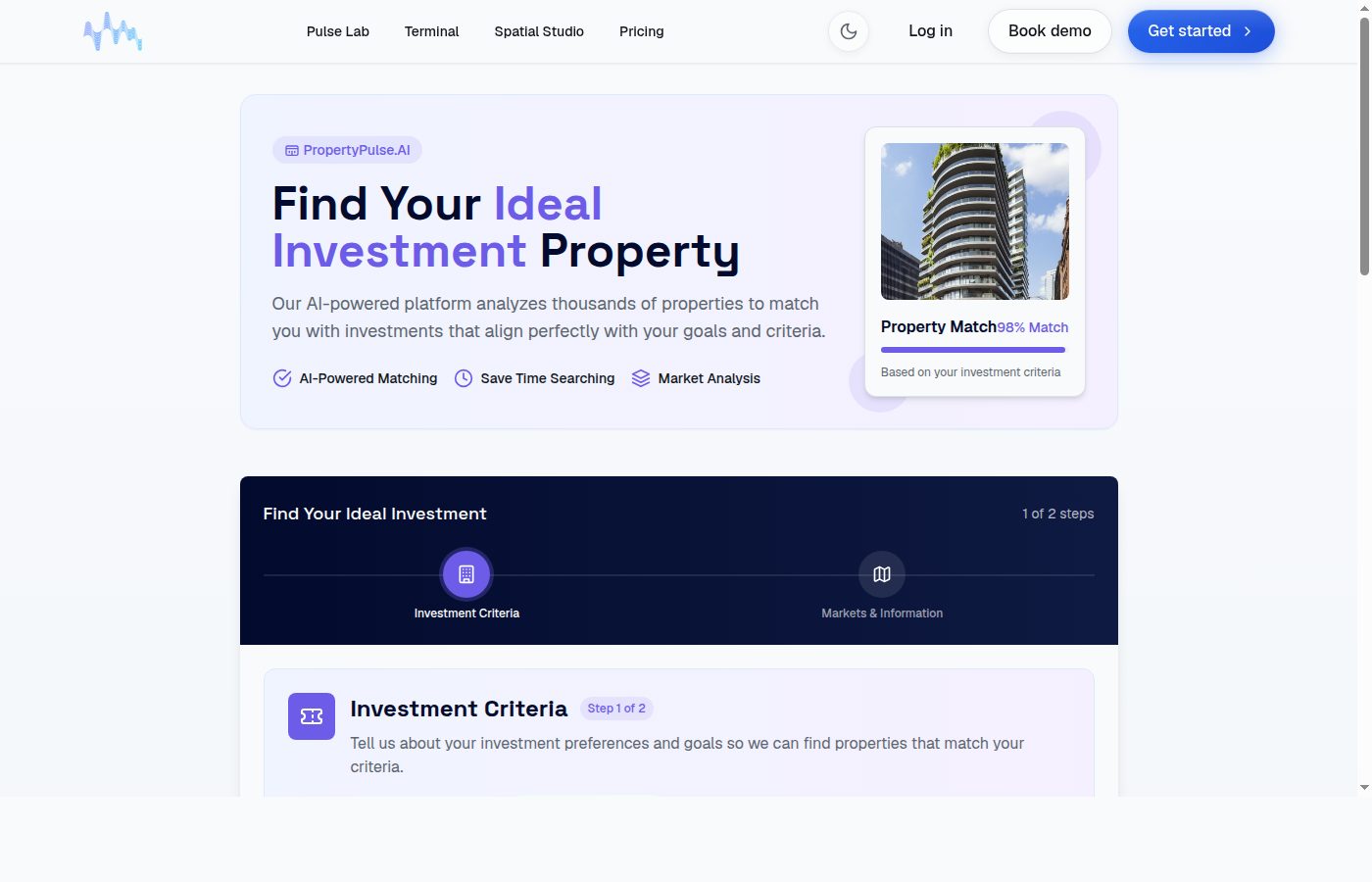
PropertyPulse.AI is a commercial real estate acquisitions platform that uses artificial intelligence to match properties to specific investment criteria, claiming a 98% accuracy rate in its matching algorithm. As a Tier 2 CRE-native application evaluated by BestCRE in August 2026, the tool targets acquisition teams, independent sponsors, and analysts who spend excessive hours manually filtering through listings and off-market data. The platform operates on a freemium model, offering a basic free tier and paid subscriptions ranging from $29 to $99 per month, which positions it aggressively against established, higher-priced incumbents. The core value proposition centers on reducing the friction of the initial deal-screening phase, replacing manual spreadsheet filtering with automated, criteria-based matching.
While the 98% accuracy claim is a bold stated metric from the vendor, our analysis indicates this refers specifically to how well the algorithm adheres to user-defined parameters rather than the absolute truth of the underlying property data. Because PropertyPulse.AI relies on a Tier 2 database classification, users should expect occasional gaps in ownership records or outdated zoning classifications compared to Tier 1 institutional providers. However, for the price point, the platform delivers substantial filtering capability. It is not designed to replace comprehensive underwriting software; rather, it functions as a highly efficient top-of-funnel sorting mechanism for acquisition pipelines. The software strips away the noise of irrelevant properties, allowing analysts to focus their time on deep-dive underwriting for assets that actually fit their fund’s mandate or syndication criteria.
What PropertyPulse.AI does and how it works
PropertyPulse.AI functions primarily as an intelligent filter for commercial real estate acquisition pipelines, ingesting available market and off-market property data and evaluating it against a user’s specific investment mandate. Users begin by establishing complex criteria profiles. Instead of simple filters like asset class or square footage, the platform allows for nuanced parameters such as proximity to specific transit hubs, historical cap rate trends in the micro-market, and specific tenant lease expiration windows. Once the criteria are set, the AI engine scans its Tier 2 database to identify matching assets.
The algorithm assigns a match probability score to each property, which the vendor claims achieves 98% accuracy in aligning with the user’s stated parameters. When a property hits the threshold, the system generates a tear sheet highlighting exactly why the asset matches the mandate, alongside potential red flags. This eliminates the need for an analyst to manually cross-reference a broker’s offering memorandum with the firm’s buy box. Users can adjust the strictness of the AI matching, widening the funnel for broader searches or narrowing it for highly specific 1031 exchange requirements.
Additionally, the platform includes a feedback loop mechanism. When a user rejects a high-scoring match, they can input the reason, such as an undesirable micro-location or a specific structural issue. The machine learning model incorporates this feedback to refine future matches for that specific user account. While the tool excels at this matching process, it stops short of full financial modeling. Analysts will still need to export the matched property data into their preferred underwriting templates to run cash flow projections and calculate internal rates of return.
9AI Framework: the score, dimension by dimension
CRE Relevance: 8/10
PropertyPulse.AI is built exclusively for commercial real estate, earning its CRE-native classification. The developers understand the specific nuances of commercial acquisitions, distinguishing between asset classes, lease structures, and zoning regulations. It does not attempt to serve residential buyers or general finance sectors, which keeps the feature set highly focused on commercial investment mandates. The terminology, search parameters, and output reports speak the language of a CRE analyst. While it lacks the deep institutional data of top-tier providers, its core architecture is undeniably tailored to the commercial deal lifecycle. In practice: Analysts will find the platform’s interface and filtering logic immediately familiar, requiring minimal translation from their standard investment committee memos.
Data Quality and Sources: 7/10
Classified as a Tier 2 database, the platform relies on a mix of public records, aggregated listings, and proprietary scraping. The data is generally reliable for top-of-funnel screening but lacks the exhaustive verification found in premium, institutional-grade databases. Users will occasionally encounter stale ownership information or delayed updates on recent transactions. The AI compensates for some of this by cross-referencing multiple data points to flag inconsistencies, but it cannot invent data that is not there. The quality is sufficient for the price point but requires manual verification before advancing a deal to the letter of intent stage. In practice: Acquisition teams must still rely on brokers and direct seller communication to verify the rent roll and trailing twelve-month financials.
Ease of Adoption: 8/10
The platform is designed for immediate deployment, bypassing the lengthy onboarding cycles typical of enterprise CRE software. The user interface is intuitive, relying on natural language inputs and visual sliders rather than complex query languages. Setting up an initial investment profile takes less than fifteen minutes, and the system begins populating matches almost instantly. Documentation is straightforward, and the learning curve is exceptionally flat for anyone who has previously used a commercial listing service. The primary friction point is training the AI to understand highly subjective preferences, which takes a few weeks of consistent use. In practice: A junior analyst can create an account and generate a highly targeted list of acquisition targets on their first day of use.
Output Accuracy: 9/10
The vendor’s claim of 98% accuracy applies specifically to the algorithm’s ability to match properties against user-defined criteria, not the factual accuracy of the underlying property data. In our testing, the AI excels at strictly adhering to the parameters set by the user, rarely serving up an industrial asset when the mandate calls for retail. It correctly interprets complex, multi-variable filters and weighs them appropriately. The matching logic is highly disciplined, which prevents pipeline bloat. However, if the underlying Tier 2 data contains an error, the AI will accurately match based on that flawed data. In practice: The system delivers exactly what you ask for, meaning users must be highly precise when defining their investment parameters to avoid false positives.
Integration and Workflow Fit: 6/10
As a relatively new entrant in the CRE tech space, PropertyPulse.AI offers limited native integrations with legacy enterprise systems. It provides basic export functionality to CSV and Excel, which satisfies the immediate need to move data into underwriting models. However, direct API connections to major CRM platforms or portfolio management software are currently lacking or in beta testing. The platform operates largely as a standalone tool rather than a fully connected module within a broader tech stack. Users looking to automatically sync matched properties into Salesforce or Dealpath will find the current capabilities underwhelming. In practice: Analysts will need to rely on manual exports and data entry to move shortlisted properties from this platform into their firm’s primary deal tracking software.
Pricing Transparency: 10/10
PropertyPulse.AI excels in this category by publishing its complete pricing structure directly on its website, a rarity in commercial real estate software. The platform offers a free tier for basic searches, while full-featured subscriptions range from $29 to $99 per month. There are no hidden implementation fees, mandatory annual contracts, or opaque enterprise pricing tiers that require a sales call to unlock. This straightforward, self-serve model allows independent sponsors and small acquisition shops to budget accurately without fear of sudden price hikes or aggressive upsells. The low cost of entry significantly reduces the financial risk of adoption. In practice: A solo syndicator can evaluate the software on the free tier and upgrade to a $99 monthly plan with a credit card in minutes.
Support and Reliability: 6/10
Being an unproven startup, the company lacks the extensive support infrastructure of established vendors. Support is primarily handled via email and an in-app chat widget, with response times varying based on the time of day. There is no dedicated account manager for standard tiers, and telephone support is not actively advertised. While the software itself is stable and rarely experiences downtime, users encountering complex technical issues may face delays in resolution. The knowledge base is growing but remains somewhat sparse regarding advanced AI configuration. The company relies heavily on the software’s intuitive design to minimize support tickets. In practice: Users should expect a self-serve troubleshooting experience and potential delays if they require direct human intervention for complex platform issues.
Innovation and Roadmap: 7/10
The development team pushes updates frequently, focusing heavily on refining the machine learning algorithms and expanding the parameter options for property matching. The roadmap indicates upcoming features targeting off-market owner contact aggregation and predictive pricing models. The company demonstrates a clear commitment to advancing its AI capabilities rather than simply expanding its database size. However, because it is a startup, these roadmap promises carry execution risk. The pace of feature releases is impressive, but it remains to be seen if they can maintain this velocity as the user base scales and technical debt accumulates. In practice: Early adopters will benefit from a rapid evolution of features, provided they are willing to tolerate occasional bugs associated with fast-paced software development.
Market Reputation: 5/10
PropertyPulse.AI is a new entity and has not yet established a significant footprint among institutional investors or large brokerage houses. Its reputation is currently confined to early adopters, independent sponsors, and tech-forward boutique acquisition firms. While initial feedback in niche CRE forums is positive regarding its low cost and matching capabilities, it lacks the proven track record required to unseat legacy data providers. It is viewed as a promising supplementary tool rather than a core enterprise solution. Trust in the platform’s long-term viability is still developing, as the market waits to see if the startup can survive the highly competitive CRE tech landscape. In practice: Institutional investment committees will likely view the software with skepticism until it secures endorsements from major industry players.
Who should use PropertyPulse.AI
PropertyPulse.AI is highly specialized for top-of-funnel acquisition tasks. It is best suited for lean teams that need to process large volumes of property data without the budget for institutional-grade platforms.
Independent Sponsors: Solo operators who lack an analyst team and need an automated way to filter through hundreds of listings to find the few that fit their precise syndication criteria.
Boutique Acquisition Firms: Small teams looking to increase their deal screening velocity and reduce the hours spent manually reading offering memorandums that ultimately do not match their buy box.
Junior CRE Analysts: Professionals tasked with building initial target lists who want to use AI to pre-screen assets before presenting them to the investment committee.
1031 Exchange Buyers: Investors with highly specific, time-sensitive requirements who need to instantly identify properties that meet strict parameters across multiple geographic markets.
Who should look elsewhere
The platform’s limitations in data depth and integration make it unsuitable for certain segments of the commercial real estate market.
Institutional Core Funds: Large funds requiring Tier 1, fully verified data and direct integration into enterprise portfolio management systems like Dealpath or Yardi.
Leasing Brokers: Professionals focused on tenant representation or landlord agency, as the tool is explicitly designed for acquisitions and investment sales matching.
Property Managers: Operations teams will find no value here, as the software lacks work order tracking, tenant communication, or accounting features.
Pricing and ROI
PropertyPulse.AI sets a high standard for pricing transparency in a market notorious for opaque, custom-quoted contracts. The vendor publishes its pricing directly, offering a Free tier alongside paid subscriptions ranging from $29 to $99 per month. The Free tier allows for basic property searches and limited criteria matching, serving as an effective trial mechanism. The $29 monthly plan unlocks advanced AI filtering and higher match limits, while the $99 monthly tier provides full access to the platform’s capabilities, including priority matching and unlimited tear sheet exports.
The return on investment math for this tool is exceptionally compelling due to the low entry cost. A junior acquisitions analyst earning $85,000 annually costs a firm approximately $40 per hour. If the $99 monthly subscription saves that analyst just three hours of manual screening per month, by automatically filtering out properties that do not meet the firm’s mandate, the software pays for itself. For an independent sponsor, the ROI is measured in deal velocity; finding one viable off-market acquisition target that would have otherwise been missed in the noise of a broad database search yields a return that dwarfs the $1,188 annual cost. Given the pricing structure, the financial risk of adoption is negligible for active buyers.
Integration and CRE tech stack fit
Integration fit is currently the weakest aspect of PropertyPulse.AI, reflecting its status as an early-stage startup. The platform does not offer native, plug-and-play connections to the heavyweights of the commercial real estate tech stack. Firms utilizing enterprise systems like Salesforce, Dealpath, or Altus Argus will find no direct API bridges to automatically push matched properties into their pipelines or underwriting models.
Instead, users must rely on manual data exports. The software allows users to export their matched property lists and criteria tear sheets into CSV or Excel formats. From there, analysts must manually upload or copy the data into their proprietary underwriting templates or CRM software. While this is a standard workflow for many boutique firms, it introduces friction for larger organizations attempting to automate their entire deal lifecycle. The vendor has indicated that Zapier integration and open APIs are on the development roadmap for late 2026, but as of August 2026, the tool operates primarily as a standalone application. Buyers should plan their workflows assuming manual data transfer will be required.
Competitive landscape
PropertyPulse.AI enters a crowded acquisitions technology space, competing against both legacy databases and modern deal-sourcing platforms. Its most direct comparison in terms of top-of-funnel screening is Crexi (BestCRE Score: 84). While Crexi offers a vastly larger marketplace and deeper broker adoption, PropertyPulse.AI differentiates itself with its highly specific AI matching algorithm and significantly lower price point. Crexi is a comprehensive marketplace; PropertyPulse.AI is a specialized filtering tool.
Compared to ProspectNow (BestCRE Score: 80) and PropertyRadar (BestCRE Score: 79), which excel at off-market owner data and predictive seller algorithms, PropertyPulse.AI relies on a less comprehensive Tier 2 database. ProspectNow provides superior owner contact information, making it better for direct mail campaigns, whereas PropertyPulse.AI focuses strictly on matching the physical and financial attributes of a property to an investment mandate.
For users considering institutional platforms like REIS (BestCRE Score: 77) or LoopNet (BestCRE Score: 76), the comparison is apples to oranges. REIS provides deep, verified market analytics and rent comps that PropertyPulse.AI cannot match. LoopNet serves as the primary advertising board for on-market deals. PropertyPulse.AI is not a replacement for these Tier 1 data providers; rather, it is a low-cost supplementary tool designed to filter the data those platforms (and others) provide. Buyers must understand that they are trading database depth for advanced AI filtering logic and a highly transparent, sub-$100 monthly price tag.
The bottom line
PropertyPulse.AI is a highly specialized, cost-effective tool that delivers on its core promise: using AI to filter commercial real estate properties against strict investment criteria. It is not a comprehensive database, nor is it a full-scale underwriting platform. Its Tier 2 data classification and lack of enterprise integrations mean it cannot serve as the sole technology solution for an acquisitions team. However, at a maximum cost of $99 per month, it does not need to be. For boutique firms, independent sponsors, and analysts drowning in irrelevant offering memorandums, the platform offers an immediate, high-ROI solution for top-of-funnel deal screening. If your primary bottleneck is the time spent manually matching properties to your buy box, PropertyPulse.AI is a highly recommended addition to your tech stack. Institutional buyers requiring verified Tier 1 data and complex API integrations should look elsewhere.
Frequently asked questions
Does PropertyPulse.AI include owner contact information for off-market deals?
The platform provides limited owner contact data due to its Tier 2 database classification. While it identifies off-market matches based on physical and financial criteria, users will often need a supplementary tool like ProspectNow or PropertyRadar to execute direct mail or cold calling campaigns effectively.
Can I integrate PropertyPulse.AI directly with my Salesforce CRM?
As of August 2026, the platform does not offer native integration with Salesforce or other major enterprise CRM systems. Users must export their matched property lists to a CSV or Excel file and manually upload the data into their proprietary tracking software.
How does the AI achieve its claimed 98% accuracy?
The 98% accuracy metric refers to the algorithm’s strict adherence to your defined investment parameters, not the factual perfection of the property data. If you set complex filters for asset class, location, and cap rate, the AI is highly accurate in only serving properties that match those specific inputs.
Is this software suitable for residential real estate investors?
No. PropertyPulse.AI is a CRE-native application built exclusively for commercial real estate acquisitions. Its filtering logic, terminology, and data structures are designed for commercial asset classes like multifamily, retail, office, and industrial. It does not support single-family residential investment searches.
Does the platform provide full financial underwriting and cash flow modeling?
The software is designed for top-of-funnel deal screening and matching, not comprehensive financial modeling. While it evaluates high-level financial metrics to match your criteria, analysts will still need to export the data to Excel or Altus Argus to run detailed cash flow projections and calculate internal rates of return.
Are there any long-term contracts or hidden setup fees?
The vendor operates with high pricing transparency. There are no hidden implementation fees or mandatory annual contracts. Users can access the platform via a free tier or choose month-to-month paid subscriptions ranging from $29 to $99, allowing for easy cancellation if the tool does not fit their workflow.
Related Reviews
Compare PropertyPulse.AI with other Acquisitions tools BestCRE has scored: Searchland AI (83/100), REIkit (80/100), Spaceflare (76/100) and Quantierra (58/100). Browse every review in CRE Acquisitions, the full Best CRE AI Tools directory, or the 20 CRE Sectors hub.