PropertyRadar is a commercial real estate property intelligence and owner contact platform designed to drive off-market deal sourcing. Originally built around distressed property data, the platform has evolved into a comprehensive prospecting engine that maps over 150 million properties nationwide, linking physical parcels to the actual human beings who own them. For CRE principals and acquisition analysts, the core value proposition is unmasking the principals behind anonymous LLCs, trusts, and corporate entities, allowing deal teams to bypass gatekeepers and initiate direct conversations with likely sellers. As verified in our BestCRE master database, PropertyRadar focuses its primary use case on data insights and automation for off-market deal sourcing, offering subscription tiers from $119 to $599 per month.
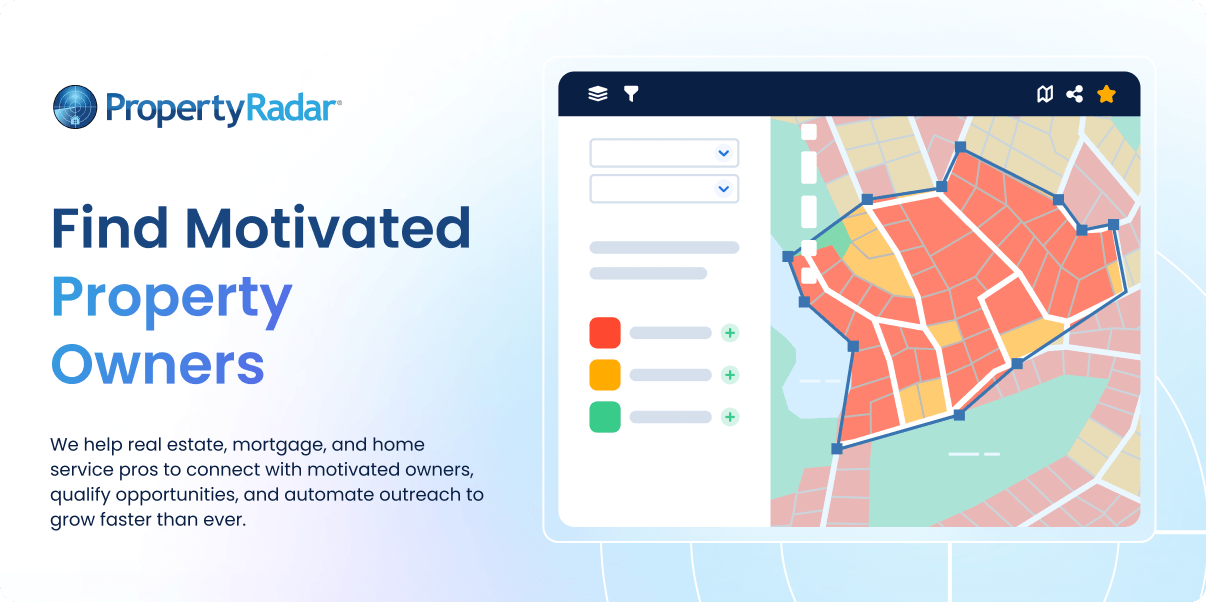
In the current August 2026 acquisition climate, finding yield requires looking beyond fully marketed deals on LoopNet or Crexi. PropertyRadar equips acquisition teams with the geospatial mapping, equity filtering, and skip-tracing tools necessary to identify properties that fit specific investment mandates before they ever hit the market. While institutional players might rely on expensive legacy databases, PropertyRadar democratizes access to granular property records, tax delinquencies, and demographic data. By combining public records with proprietary contact databases, the platform allows an analyst to draw a polygon on a map, filter for multifamily assets with high equity and out-of-state owners, and immediately export a list of verified mobile phone numbers and email addresses for those owners. This direct-to-owner approach fundamentally shifts how boutique and mid-sized CRE firms build their acquisition pipelines.
What PropertyRadar does and how it works
PropertyRadar functions as a multi-layered search engine and outreach automation tool for real estate acquisitions. At its foundation, the software aggregates county assessor data, transaction histories, and recorded documents across the United States. Users begin by utilizing the platform’s advanced search capabilities, which offer over 200 filtering criteria. An analyst can isolate specific commercial asset classes, such as retail, industrial, or mixed-use, and apply situational filters like recent tax defaults, long hold periods, or specific loan-to-value ratios. This allows teams to identify distress signals or equity positions that indicate a high probability of a near-term sale.
Once a target list is generated, the platform’s most critical mechanical feature takes over: LLC resolution and skip tracing. Instead of exporting a list of dead-end corporate names, PropertyRadar cross-references business registry data to identify the managing members or actual human principals behind the owning entities. The system then appends contact information, including mobile numbers, landlines, and email addresses, directly to the property record. This eliminates the need for third-party skip-tracing services and keeps the entire prospecting workflow within a single environment.
Beyond data aggregation, PropertyRadar includes built-in marketing and outreach mechanics. Users can push their targeted lists into automated direct mail campaigns, trigger email sequences, or utilize an add-on power dialer for cold calling. The platform also features dynamic list monitoring. If an analyst builds a highly specific criteria set, for example, industrial properties in a specific zip code that suddenly receive a notice of default, the system will actively monitor the market and automatically update the list when new properties meet the threshold. This active monitoring ensures that acquisition teams are the first to know about potential off-market opportunities, allowing them to act faster than competing buyers relying on static quarterly data pulls.
9AI Framework: the score, dimension by dimension
CRE Relevance: 8/10
PropertyRadar delivers substantial value for commercial real estate acquisitions, particularly in the sub-institutional market. While it initially gained traction in the residential space, its commercial capabilities are highly effective for sourcing multifamily, retail, and industrial assets. The ability to filter by asset type, zoning, and commercial loan details makes it a highly relevant tool for CRE brokers and investors. However, it lacks the deep institutional financial metrics, tenant lease data, or rent roll estimates found in platforms like REIS. It is strictly an ownership and physical property database, not a financial underwriting tool. In practice: CRE teams use it to find who owns a building and how to call them, not to underwrite the asset’s cash flow.
Data Quality and Sources: 7/10
The platform aggregates public records, assessor data, and third-party contact databases to create a comprehensive property profile. The physical property data and transaction histories are highly accurate, relying on direct county feeds. The true test of data quality for this tool, however, is its skip tracing and LLC resolution. While PropertyRadar performs exceptionally well at piercing corporate veils, phone number and email accuracy inherently suffers from some decay, as people change numbers or use burner contacts for public filings. Users should expect a solid hit rate, but not perfection. In practice: Analysts will find the property data flawless, but must accept that a percentage of the appended phone numbers will ring dead or reach the wrong person.
Ease of Adoption: 8/10
Implementing PropertyRadar is remarkably straightforward compared to legacy CRE databases. The user interface is highly visual, relying on interactive maps and intuitive drop-down menus for filtering. New users can typically build their first targeted list and export contacts within an hour of account creation. The platform is entirely cloud-based, requiring no complex local installations, and includes a highly functional mobile application for field research. Training requirements are minimal, though mastering the more complex multi-layered filters and automated list monitoring takes a few weeks of active use. In practice: An analyst can sign up in the morning and be cold-calling off-market commercial owners by the afternoon.
Output Accuracy: 7/10
The outputs generated by PropertyRadar, primarily lists of properties and associated owner contact details, are reliable but require realistic expectations regarding contact data. The geospatial mapping and property boundary outputs are precise, and the foreclosure or tax delinquency alerts trigger accurately based on recorded county documents. When resolving LLCs, the platform correctly identifies the managing members the vast majority of the time. However, the exactness of the contact output varies by market and the complexity of the corporate ownership structure. Some highly obfuscated institutional owners will still manage to hide behind multiple layers of trusts. In practice: The system accurately identifies the target property and the likely owner, but users will occasionally need to do manual digging for highly protected institutional contacts.
Integration and Workflow Fit: 9/10
PropertyRadar excels in its ability to fit into an existing commercial real estate technology stack. Recognizing that it is primarily a top-of-funnel sourcing tool, the company has heavily prioritized connectivity. It offers native connections to major platforms like Salesforce, HubSpot, and Pipedrive. Furthermore, its extensive Zapier integration allows users to push new off-market leads directly into almost any modern CRM or marketing automation platform without manual data entry. For enterprise users on the highest tier, direct API access and webhooks are available for custom database syncing. In practice: Deal teams can easily configure the system so that newly identified distressed properties automatically appear as fresh leads in their CRM.
Pricing Transparency: 10/10
The vendor provides absolute clarity regarding its costs, publishing all tiers publicly on its website. Pricing is divided into three main tiers: Solo at $119 per month, Team at $249 per month, and Business at $599 per month. These prices reflect monthly billing, with discounts available for annual commitments. The tiers clearly define the limits on users, monthly exports, and included contact reveals. There are no hidden setup fees, and the limits are stated upfront, allowing buyers to accurately calculate their customer acquisition costs before signing up. In practice: A solo acquisition professional knows exactly what they will pay and how many owner phone numbers they can export each month.
Support and Reliability: 8/10
Having been in the property data business since the late 2000s, originally operating as Foreclosure Radar, the company has established a highly reliable infrastructure. Platform uptime is excellent, and the data feeds from county assessors update consistently without major latency. Customer support is accessible, with higher-tier plans receiving dedicated success representatives. The documentation and training libraries are extensive, helping users navigate complex search queries and integration setups. While standard support is ticket-based, the response times are generally fast and technically competent. In practice: Users rarely experience downtime, and the support team actually understands real estate terminology when troubleshooting complex search queries.
Innovation and Roadmap: 6/10
The platform continues to evolve, primarily focusing on improving its automated marketing triggers and expanding its integration ecosystem. Recent updates have focused on deeper webhook capabilities to allow for more automated, real-time lead routing. However, the core product remains fundamentally a data aggregator and skip-tracer. While they market artificial intelligence features, these are largely applied to the marketing automation side rather than predictive analytics for asset valuation. The roadmap is practical and user-focused, but not highly experimental compared to pure AI startups. In practice: Buyers can expect continuous refinement of data accuracy and CRM integrations, rather than experimental generative AI models.
Market Reputation: 8/10
PropertyRadar holds a strong reputation among regional investors, boutique commercial brokerages, and high-volume acquisition teams. It is widely respected for its data accuracy and its specific focus on the West Coast, though it now offers reliable nationwide coverage. While it may not have the institutional prestige of a platform like REIS or the massive commercial listing volume of LoopNet, it is viewed as a highly practical, execution-oriented tool. Users consistently praise its ability to reliably unmask LLCs and its straightforward pricing model. In practice: The platform is highly regarded by the people actually doing the cold calling and direct mail to source off-market deals.
Who should use PropertyRadar
PropertyRadar is specifically engineered for professionals who need to proactively source off-market real estate transactions and bypass traditional gatekeepers.
Boutique CRE acquisition teams looking to build proprietary pipelines of off-market multifamily, retail, or industrial assets.
Commercial real estate brokers who need to farm specific submarkets and identify likely sellers based on equity or hold periods.
Real estate investors targeting distressed commercial assets, tax delinquencies, or pre-foreclosure opportunities.
Wholesalers and high-volume prospectors who require integrated skip tracing and direct mail capabilities in a single platform.
Who should look elsewhere
This platform is not designed for deep financial underwriting or for professionals dealing exclusively in fully marketed, institutional-grade trophy assets.
Analysts needing historical rent comps, lease expirations, or tenant-level data for underwriting.
Passive investors who rely on brokers to bring them fully packaged, on-market deals.
Institutional core-plus funds targeting Class A office towers where ownership is highly public and deals are brokered by major global firms.
Pricing and ROI
PropertyRadar operates on a highly transparent, subscription-based pricing model with three distinct tiers. As verified in August 2026, the Solo plan costs $119 per month and includes access for one user with 10,000 monthly exports. The Team plan is priced at $249 per month, expanding access to three users and 25,000 exports. For larger operations, the Business plan costs $599 per month, covering up to ten users, 50,000 exports, and adding API access along with a dedicated success representative. Users can achieve savings of up to 20% by opting for annual billing. The return on investment math for an acquisition team is highly compelling. A single commercial transaction sourced off-market can yield tens of thousands of dollars in acquisition fees or immediate equity capture. If a boutique firm spends $2,988 annually on the Team plan, they only need to source one successful off-market deal every several years to justify the software expense. Furthermore, by consolidating property data, LLC resolution, and skip tracing into one $249 per month platform, teams eliminate the need to pay separate per-match fees to third-party skip-tracing vendors, which can easily exceed $500 a month for high-volume prospectors.
Integration and CRE tech stack fit
PropertyRadar is built to act as the top-of-funnel data engine for a modern CRE technology stack. It natively integrates with major CRM platforms like Salesforce, HubSpot, and Pipedrive, ensuring that newly discovered property owners flow directly into an analyst’s pipeline. For teams utilizing more specialized or fragmented tools, the platform’s extensive Zapier integration connects it to over 5,000 applications. This allows users to create highly automated workflows; for example, adding a distressed multifamily property to a specific list in PropertyRadar can automatically create a new deal card in Trello, draft a personalized outreach email in Mailchimp, and send a notification to the acquisitions channel in Slack. For enterprise clients on the Business tier, direct API access and real-time webhooks provide the ability to feed proprietary internal databases or custom-built underwriting models with live county data and ownership changes. This level of connectivity prevents data silos and ensures that acquisition teams spend their time calling owners rather than manually exporting and importing spreadsheets.
Competitive landscape
When evaluating PropertyRadar, acquisition teams must consider how it compares to other data providers in the BestCRE universe. For pure off-market list building and skip tracing, PropStream is the most direct competitor, offering similar pricing starting around $99 per month, but it is heavily focused on residential and light commercial. PropertyRadar generally offers superior geospatial mapping and slightly better LLC resolution in West Coast markets. If the goal is analyzing fully marketed deals and accessing national commercial listings, Crexi (BestCRE Score: 84) and LoopNet (BestCRE Score: 76) are the industry standards. However, those platforms are built for on-market discovery, whereas PropertyRadar is strictly for off-market hunting. For deep institutional data, tenant information, and historical rent trends, platforms like REIS (BestCRE Score: 77) or Reonomy provide a much more comprehensive commercial dataset. Reonomy, in particular, is a strong alternative for pure commercial ownership data, but it comes at a significantly higher price point, often costing thousands of dollars per year compared to PropertyRadar’s entry-level $119 per month tier. DealMachine is another alternative for teams focused on mobile-first field research, but it lacks the deep commercial filtering capabilities of PropertyRadar. Ultimately, PropertyRadar occupies a highly specific niche: it is the most cost-effective, execution-oriented tool for mid-market CRE professionals who need to find out who owns a building and call them today.
The bottom line
PropertyRadar is a mandatory acquisition for boutique commercial real estate teams, brokers, and investors focused on off-market deal sourcing. It effectively bridges the gap between raw county assessor data and actionable outreach by resolving LLCs and providing accurate contact information at a highly competitive price point. While it will not replace REIS for financial underwriting or Crexi for on-market deal flow, it dominates the top of the funnel for proactive prospecting. If your acquisition strategy relies on calling property owners before they list with a broker, the $119 to $599 monthly investment is mathematically trivial compared to the potential fee generation. However, institutional core funds or analysts requiring deep tenant-level data should allocate their budget toward higher-tier, enterprise data providers. For the execution-minded dealmaker, this platform provides exactly what is needed to bypass gatekeepers and get directly to the principal.
Frequently asked questions
Does PropertyRadar provide commercial tenant information or rent rolls?
No. PropertyRadar focuses exclusively on physical property characteristics, transaction history, debt profiles, and owner contact information. It does not provide tenant lists, historical lease rates, or rent rolls. Analysts will need a separate tool like REIS or CoStar for detailed lease and tenant data.
Can I integrate PropertyRadar directly with Salesforce?
Yes. PropertyRadar offers native integrations with major CRMs including Salesforce, HubSpot, and Pipedrive. This allows deal teams to automatically sync newly discovered off-market properties and owner contact details directly into their sales pipelines without manual data entry, keeping your outreach organized.
How accurate is the skip tracing for LLC-owned commercial properties?
The platform is highly effective at resolving LLCs and identifying the managing members or actual human owners. While the physical property data is nearly perfect, the appended phone numbers and emails are subject to standard data decay, meaning users should expect some disconnected numbers during their cold outreach campaigns.
Is the dialer included in the base subscription price?
No. The built-in power dialer is sold as an optional add-on feature. The base subscription tiers, ranging from $119 to $599 per month, cover platform access, list building, property data, and a set limit of monthly contact exports. You will need to pay extra to dial directly from the system.
Does PropertyRadar cover all commercial asset classes?
Yes. Users can filter and search for multifamily, retail, industrial, office, and mixed-use properties. The platform allows analysts to target specific commercial zoning codes and building uses across its database of over 150 million nationwide properties, making it highly versatile for various commercial real estate investment strategies.
Do I need to sign an annual contract to use the platform?
No. PropertyRadar offers month-to-month billing across all its standard tiers, allowing users to cancel at any time without long-term commitments. However, the company does offer discounted rates, saving users up to twenty percent, for those who choose to prepay for an annual subscription.
Related Reviews
Compare PropertyRadar with other Acquisitions tools BestCRE has scored: Prospect by Buildout (89/100), Searchland AI (83/100), Leadflow (74/100) and Altrio (74/100). Browse every review in CRE Acquisitions, the full Best CRE AI Tools directory, or the 20 CRE Sectors hub.