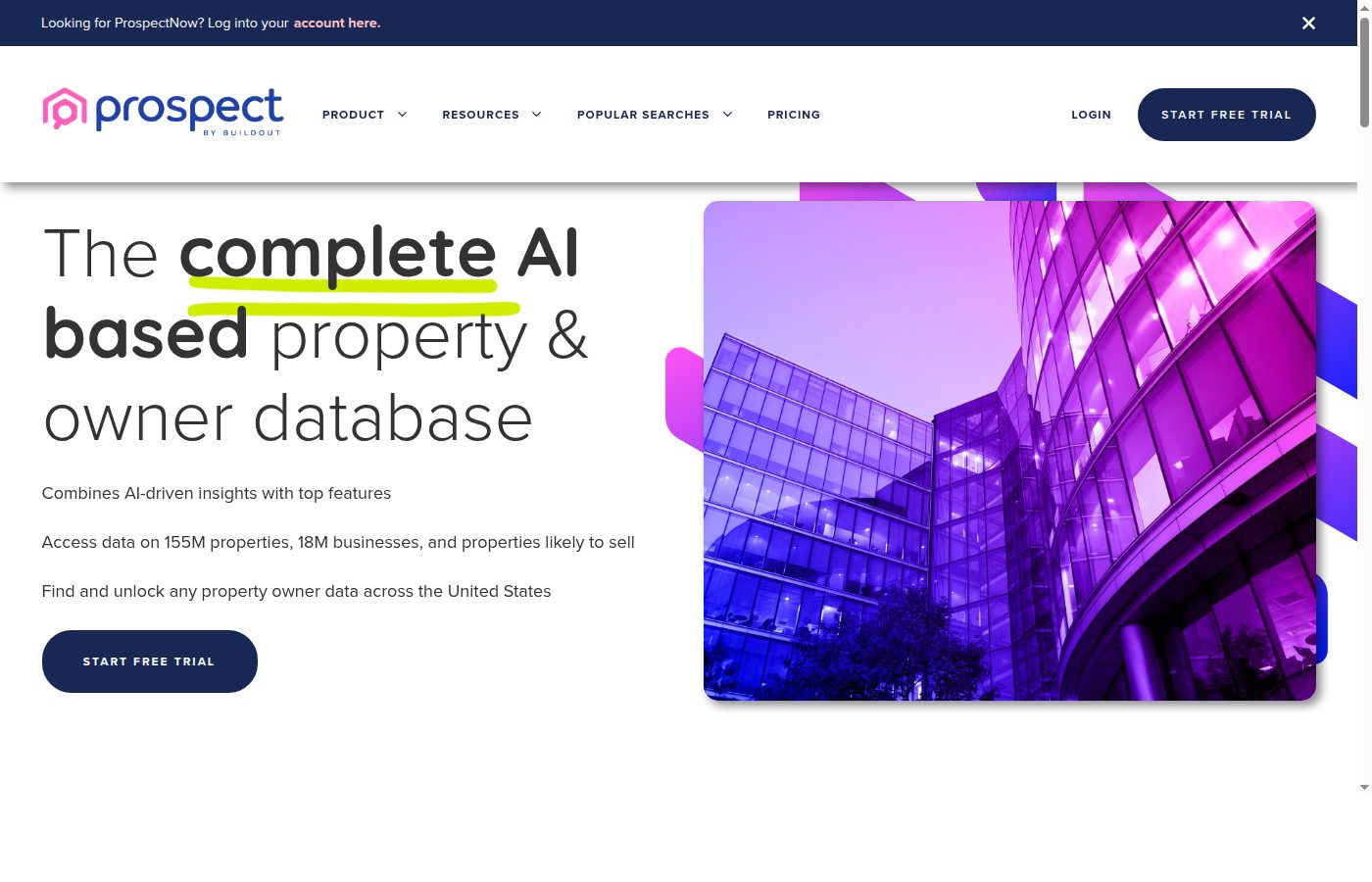
Prospect by Buildout is a commercial real estate acquisitions platform that applies artificial intelligence to ownership and transaction data to predict likely sellers, currently priced between $199 and $499 per month. Operating as a specialized module within the broader Buildout ecosystem, it targets brokerages and principal investors who need to transition from reactive listing searches to proactive off-market deal origination. The platform aggregates property records, tax data, and historical sales information, applying machine learning algorithms to identify distress signals or typical hold-period expirations. As a Tier 2 CRE-native database, it does not attempt to replace primary core research terminals but instead focuses strictly on the top of the acquisitions funnel. By scoring properties based on their statistical likelihood to transact, the software allows acquisition teams to prioritize their cold outreach efforts and allocate resources toward owners who are mathematically more likely to entertain an offer in the near term. The product was formerly sold as ProspectNow, before Buildout acquired it and moved it under the Buildout brand.
Evaluating Prospect by Buildout requires understanding its position relative to the wider market of predictive analytics tools. While primary data providers offer vast, encyclopedic databases of property attributes, Prospect distinguishes itself by synthesizing this data into actionable seller propensity scores. The platform is designed for users who already understand the fundamentals of commercial real estate prospecting but lack the data science capabilities to build their own predictive models. Analysts reviewing this tool must weigh its monthly subscription cost against the expected yield of off-market conversations. For teams heavily reliant on manual public record searches or basic mailing lists, the introduction of algorithmic targeting represents a structural shift in how they source deals. However, the system demands a disciplined user who will consistently execute outreach based on the AI-generated leads, as the software only identifies the target and cannot negotiate the transaction.
What Prospect by Buildout does and how it works
Prospect by Buildout functions as an intelligent filtering engine that sits on top of aggregated public and proprietary property datasets. Users begin by defining their acquisition criteria, selecting specific asset classes, geographic boundaries, and property sizes. Once the parameters are set, the system queries its database of ownership records, tax assessments, and historical transaction data. Instead of returning a static list of every property matching the physical criteria, the software applies its predictive algorithms to assign a seller propensity score to each asset. This score is calculated by analyzing patterns such as the length of current ownership, recent changes in local market velocity, mortgage maturity dates, and other demographic or financial indicators that historically precede a sale.
After the AI generates the ranked list of properties, the platform provides the critical contact information necessary for execution. The system attempts to pierce LLC structures to reveal the actual decision-makers, appending phone numbers, email addresses, and mailing coordinates to the target profiles. Users can click into individual property records to review the underlying data that contributed to the high propensity score, allowing analysts to tailor their outreach messaging based on the specific circumstances of the owner. This transition from property data to contact data is the mechanical core of the product, bridging the gap between market research and active prospecting.
The workflow concludes with campaign management and export functionalities. Users can organize their highest-scored targets into specific lists, tracking which owners have been contacted and when. While it serves as a lightweight contact manager for these specific campaigns, it is primarily built to feed this enriched, prioritized data into a dedicated CRM. Analysts can export the targeted lists via CSV or push them directly into Buildout CRM, ensuring that the acquisitions team can execute their cold calling or direct mail campaigns without manually re-entering property addresses or owner contact details.
9AI Framework: the score, dimension by dimension
CRE Relevance: 10/10
Prospect by Buildout is fundamentally engineered for commercial real estate professionals, entirely bypassing residential or generalized B2B data models. The platform understands the nuances of commercial asset classes, recognizing that the drivers for selling a multi-tenant retail center differ significantly from those prompting the sale of an industrial warehouse. Its algorithms are trained on CRE-specific data points, such as commercial mortgage terms, capitalization rates, and corporate ownership structures. Because it is a purpose-built application rather than an adapted generic sales tool, the interface and the predictive variables align directly with the daily realities of commercial brokers and acquisition analysts. The entire architecture assumes the user is hunting for commercial yield rather than single-family flips. In practice: Acquisition teams will find the terminology, filters, and asset classifications immediately familiar and aligned with institutional commercial real estate standards.
Data Quality and Sources: 8/10
Classified as a Tier 2 CRE-native database, the platform relies on aggregating public records, tax assessor files, and third-party data feeds rather than deploying a massive proprietary research team. The underlying property data is generally accurate, capturing square footage, lot size, and zoning with standard reliability. However, the true test of its data quality lies in its LLC resolution and contact information accuracy. Like all aggregators, it occasionally struggles with highly obfuscated holding companies or outdated phone numbers, requiring users to perform secondary verification on critical targets. The transaction history data is solid, though non-disclosure states present the usual blind spots for accurate pricing history. In practice: Analysts should expect a reliable baseline of property and ownership data but must remain prepared to cross-reference contact details for highly complex corporate structures.
Ease of Adoption: 9/10
The interface is designed for immediate utility, stripping away unnecessary complexity to focus strictly on list generation and seller prediction. New users can typically execute their first targeted search and generate a list of likely sellers within an hour of logging in. The learning curve is minimal, as the platform relies on standard map interfaces and drop-down filtering menus that anyone familiar with basic listing sites will recognize. Buildout has historically prioritized clean, intuitive user experiences, and this module continues that trend by avoiding cluttered dashboards. Training requirements are extremely low, making it highly accessible for junior analysts or brokers who need to start dialing immediately rather than spending weeks learning a new software environment. In practice: A newly hired analyst can be fully operational and pulling targeted off-market lead lists on their first day.
Output Accuracy: 8/10
The core value proposition relies heavily on the accuracy of its AI-driven seller propensity scores. While the algorithms successfully identify owners who fit the statistical profile of a seller, such as those nearing the end of a ten-year hold period, predictive analytics cannot account for human unpredictability. The system accurately flags distress indicators and demographic triggers, but a high score does not guarantee the owner is actually willing to transact today. The contact data output hits industry standard match rates, meaning a majority of the provided phone numbers and emails will connect to the correct individual, though a noticeable percentage will inevitably bounce or disconnect. In practice: Users must treat the high-propensity scores as highly qualified starting points for outreach rather than absolute guarantees of an impending transaction.
Integration and Workflow Fit: 9/10
As a component of the broader Buildout ecosystem, the platform naturally excels when paired with Buildout CRM and its associated marketing tools. The data flow between the prospecting module and the CRM is tight, allowing teams to move from identifying a likely seller to initiating a tracking sequence without friction. For teams utilizing third-party systems like Salesforce or Hubspot, the integration relies more heavily on standard CSV exports or API connections, which introduces a slight administrative burden. However, because the primary output is structured data, mapping names, numbers, addresses, and scores cleanly into almost any modern relational database used by commercial real estate firms is a straightforward process. In practice: Firms already utilizing Buildout CRM will experience immediate operational harmony, while others will rely on straightforward data exports to feed their existing tech stacks.
Pricing Transparency: 10/10
The vendor maintains excellent visibility regarding its commercial terms, openly publishing a price range of $199 to $499 per month. This explicit public pricing allows acquisition teams to accurately model their software expenses without being forced into lengthy preliminary sales calls. The tiering structure is straightforward, typically scaling based on the volume of data exported or the number of user seats required. By avoiding opaque, enterprise-only pricing models, the company demonstrates confidence in its value proposition and respects the buyer’s time. This level of clarity is particularly valuable for independent brokers or boutique investment firms operating with strict monthly technology budgets. In practice: Buyers can confidently calculate their exact annual software expenditure and determine their required return on investment before ever speaking to a sales representative.
Support and Reliability: 9/10
Backed by Buildout, an established entity in the commercial real estate technology sector, the platform benefits from institutional-grade support infrastructure. Users have access to comprehensive documentation, responsive email support, and dedicated account managers for higher-tier subscriptions. The software itself is highly stable, experiencing minimal downtime during critical business hours. Because the parent company has a long track record of serving commercial brokerages, the support team understands the specific urgency and context of CRE transactions. Bug fixes and system updates are deployed systematically without disrupting the user experience. This is not a fragile beta product; it is a mature application supported by a well-capitalized organization. In practice: Users can rely on the platform to be fully operational during critical prospecting blocks and expect prompt, knowledgeable assistance when technical issues arise.
Innovation and Roadmap: 8/10
The development trajectory focuses on refining the machine learning models and expanding the breadth of the contact database. The company consistently pushes updates aimed at improving LLC resolution algorithms and incorporating new alternative data signals into the seller propensity score. While they do not frequently release entirely new product categories, their commitment to deepening the predictive capabilities of the existing tool is evident. The roadmap indicates a clear focus on integrating more macroeconomic indicators and hyper-local market velocity metrics into the scoring engine. They remain disciplined in their focus on the acquisitions use case rather than attempting to build a generalized commercial real estate platform. In practice: Subscribers can expect incremental, highly relevant improvements to the predictive algorithms and contact match rates rather than distracting peripheral features.
Market Reputation: 9/10
Buildout is a highly respected name in commercial real estate marketing and operations, and this prospecting module benefits significantly from that halo effect. The platform is widely regarded by brokers and analysts as a practical, reliable tool for off-market deal origination. While it competes with heavily funded standalone data providers, it holds its own by offering a specialized, AI-driven approach at a highly competitive price point. User feedback frequently highlights the platform’s clean interface and the utility of the seller propensity scores, though some power users occasionally request deeper historical transaction data. Overall, it is viewed as a pragmatic, high-value addition to the acquisitions tech stack. In practice: The software is widely recognized by industry peers as a legitimate, professional-grade tool for executing proactive off-market acquisition strategies.
Who should use Prospect by Buildout
Prospect by Buildout is optimized for commercial real estate professionals who prioritize proactive deal origination over waiting for on-market listings. The platform is best suited for teams that have the discipline to execute consistent cold outreach campaigns and need algorithmic assistance to prioritize their call lists.
Boutique investment firms seeking to identify off-market acquisition targets before they are broadly marketed by brokers.
Commercial real estate brokers looking to build their listing pipelines by targeting owners statistically likely to sell in the next twelve months.
Acquisitions analysts tasked with building high-volume direct mail or cold calling lists who need to filter out long-term hold owners.
Firms already utilizing the Buildout ecosystem that want to natively feed high-quality seller leads directly into their existing CRM.
Who should look elsewhere
The platform is not a substitute for deep, primary property research or comprehensive market analytics. Organizations requiring encyclopedic data on every commercial parcel or those that do not engage in proactive cold outreach will find the predictive scoring unnecessary.
Passive investors who rely strictly on broker-marketed deals and do not conduct their own off-market origination campaigns.
Appraisers or valuation professionals who require exhaustive historical transaction comps and deep lease-level data rather than seller predictions.
Firms operating exclusively in the residential single-family market, as the algorithms and data structures are heavily optimized for commercial assets.
Teams without the internal capacity or discipline to actually call or mail the leads generated by the software.
Pricing and ROI
As of August 2026, Prospect by Buildout offers highly transparent pricing, with monthly subscriptions ranging from $199 to $499 per month. This tiered structure is typically based on the volume of data exports required, the number of target markets, or the inclusion of premium contact data features. At the entry level of $199 per month, a solo practitioner or junior analyst can access the predictive scoring and basic ownership data necessary to begin a localized campaign. The $499 per month tier is designed for highly active acquisition teams that require extensive export capabilities to feed large-scale direct mail or cold calling operations.
To evaluate the return on investment, an analyst must consider the standard metrics of commercial real estate transactions. At the maximum tier of $499 per month, the annual software expenditure totals $5,988. If the AI-driven propensity scores allow an acquisition team to secure just one off-market industrial or retail asset with a purchase price of $2,000,000, the value generated vastly eclipses the software cost. Assuming a standard 3% acquisition fee or equivalent equity value creation of $60,000, that single transaction delivers a 10x return on the annual software investment. The math heavily favors adoption, provided the user actually commits the labor required to contact the predicted sellers.
Integration and CRE tech stack fit
The integration profile of Prospect by Buildout is defined by its position within the parent company’s broader software suite. For firms already utilizing Buildout CRM, the integration is native and highly efficient. Users can push targeted properties, owner contact details, and predictive scores directly into their pipeline, triggering automated task assignments and outreach sequences without manual data entry. This creates a closed-loop system where market research immediately translates into actionable sales workflows.
For organizations operating outside the Buildout ecosystem, the platform relies on standard CSV exports. While it lacks native, push-button API integrations with generalized platforms like Salesforce, Hubspot, or Microsoft Dynamics, the exported data is cleanly structured. Analysts can easily map the exported columns, such as owner name, LLC entity, phone number, and propensity score, into their existing databases. The software does not attempt to replace enterprise resource planning systems or financial modeling tools like Argus; it sits strictly at the top of the funnel. It serves as a specialized lead generation engine that feeds downstream CRM and marketing applications, making it a low-friction addition to almost any standard commercial real estate technology stack.
Competitive landscape
The landscape for commercial real estate prospecting tools is highly competitive, and Prospect by Buildout faces direct challenges from several established platforms. ProspectNow (Scored 80) is the most direct historical competitor, offering similar predictive analytics and contact data. While ProspectNow has a longer tenure in the predictive space, Prospect by Buildout often appeals to users who prefer the modernized interface and native integration with the Buildout CRM ecosystem.
PropertyRadar (scored 79) presents another strong alternative, particularly for users who demand hyper-granular, map-based filtering and deep public records integration. PropertyRadar excels in complex list building, though it leans slightly more toward a generalized real estate audience, whereas Buildout remains strictly focused on commercial professionals. Crexi (Scored 84) offers a massive national database and is a dominant force in the market, but its primary utility is rooted in active listings and transaction comps rather than purely algorithmic off-market seller prediction. Crexi acts as a comprehensive marketplace and research terminal, whereas Prospect is a surgical off-market targeting tool.
Finally, CityBldr (Scored 79) competes in the predictive space but focuses heavily on spatial analytics and identifying highest-and-best-use development opportunities rather than simply predicting when an existing asset will change hands. Buyers must choose between Prospect by Buildout’s streamlined, CRM-friendly seller predictions, PropertyRadar’s deep public records manipulation, or the broader marketplace gravity of Crexi.
The bottom line
Prospect by Buildout is a highly effective, specialized tool that successfully bridges the gap between raw property data and actionable acquisition targets. At $199 to $499 per month, it represents an asymmetrical bet for commercial real estate professionals; the cost is negligible compared to the potential fee or equity generation of a single off-market deal. Analysts evaluating this software should approve the purchase if their firm has the operational discipline to execute consistent cold calling or direct mail campaigns based on the AI outputs. It is not a passive research terminal, and it will not negotiate deals for you. However, for proactive deal-makers looking to mathematically prioritize their outreach and stop wasting time on owners with no statistical incentive to sell, this platform is a mandatory addition to the acquisitions tech stack.
Frequently asked questions
Does Prospect by Buildout provide owner phone numbers and emails?
Yes, the platform actively resolves LLC structures to identify the true corporate officers or individual owners. It appends available contact information, including mobile phone numbers, business emails, and mailing addresses, allowing acquisition teams to launch immediate outreach campaigns to the highest-scoring prospects.
How does the AI calculate the seller propensity score?
The algorithms analyze historical transaction data, ownership tenure, mortgage maturity dates, tax assessments, and local market velocity. By comparing these variables against the profiles of properties that have recently sold, the machine learning model identifies current owners who exhibit similar statistical markers of an impending transaction.
Can I integrate this tool with Salesforce or Hubspot?
While it offers tight native integration with Buildout CRM, connecting to third-party platforms like Salesforce or Hubspot requires exporting the target lists as CSV files. The exported data is cleanly formatted, making it straightforward to map and upload into any modern relational database or CRM.
Does the platform cover residential single-family properties?
No, the software is a CRE-native application engineered specifically for commercial real estate asset classes. The predictive algorithms, filtering criteria, and data structures are optimized for multifamily, retail, industrial, office, and commercial land, ignoring the fundamentally different drivers of the single-family residential market.
Is the pricing based on the number of users or data exports?
The published pricing tiers, ranging from $199 to $499 per month, generally scale based on the volume of data you need to export and the depth of the contact information required. Higher tiers accommodate aggressive acquisition teams executing large-scale direct mail or high-volume cold calling campaigns.
Can it replace my primary commercial real estate data terminal?
It is not designed to replace comprehensive research terminals that provide deep lease-level data, exhaustive historical comps, or complex demographic mapping. It is a specialized, top-of-funnel acquisitions tool built specifically to identify likely sellers and provide their contact information for proactive off-market deal origination.
Related Reviews
Compare Prospect by Buildout with other Acquisitions tools BestCRE has scored: Searchland AI (83/100), REIkit (80/100), Leadflow (74/100) and Locate.ai (74/100). Browse every review in CRE Acquisitions, the full Best CRE AI Tools directory, or the 20 CRE Sectors hub.