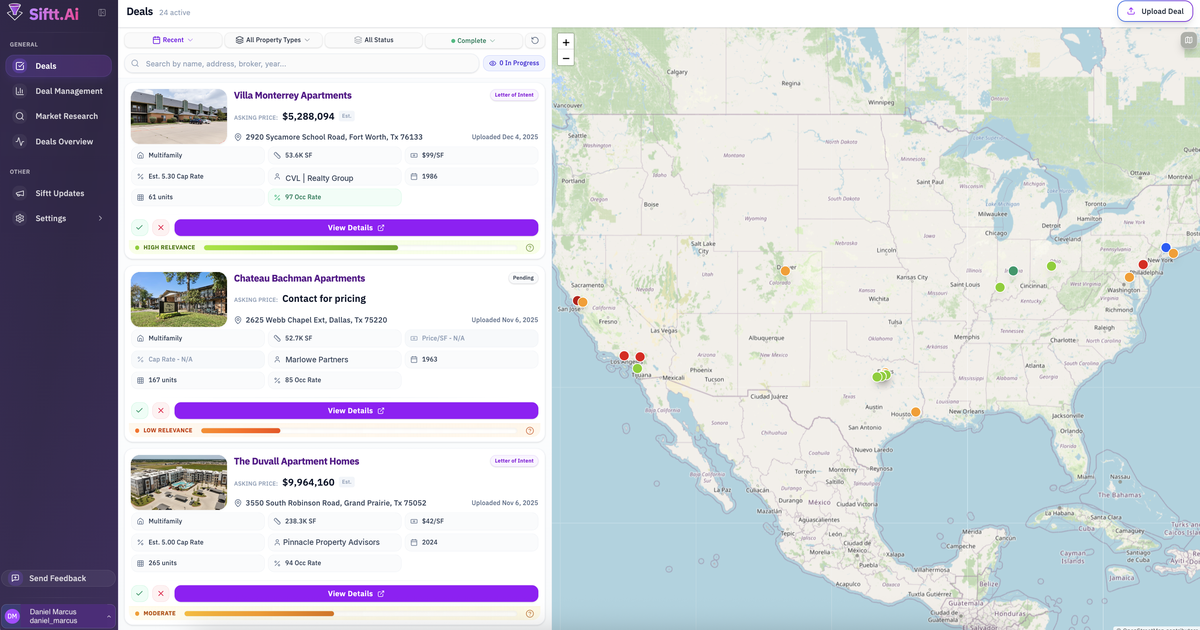
Siftt AI is an artificial intelligence platform purpose-built for commercial real estate acquisitions and underwriting, designed to automate document extraction and deal screening. The company operates as a Tier 2 CRE-Native database tool, focusing strictly on the acquisition pipeline rather than broad market analytics. According to our BestCRE Master Database Record, Siftt AI targets accelerated underwriting through Offering Memorandum (OM) extraction, BuyBox matching, and an AI copilot interface. Co-founded by Maayan and emerging as a specialized solution for investment firms, the platform aims to solve the acute pain point of inbox overload by triaging inbound broker blasts and scoring them against a firm’s specific investment criteria.
As of August 2026, the commercial real estate sector is flooded with general-purpose AI wrappers, making specialized, workflow-specific tools highly sought after. Siftt AI positions itself directly in the path of the acquisitions analyst, intercepting deals before they require hours of manual data entry. By reading unstructured documents like OMs, rent rolls, and T12 financials, the software attempts to turn static PDFs into structured, actionable intelligence. While older platforms focus on historical lease comps or macroeconomic trends, Siftt AI is entirely forward-looking, analyzing the deals currently sitting in a buyer’s pipeline. The critical question for any principal or analyst evaluating this software is whether its document extraction accuracy and scoring algorithms actually replace manual triage, or simply add another software layer to an already complex technology stack.
What Siftt AI does and how it works
Siftt AI functions as an automated intake and triage system for commercial real estate acquisition teams. The core mechanic begins when a deal arrives via email. Instead of an analyst manually downloading the Offering Memorandum and searching for key metrics, Siftt AI ingests the documents and uses natural language processing to extract the critical data points. This includes property details, financial summaries, tenant rosters, and asking prices. The platform then structures this unstructured data into a standardized format, eliminating the initial data entry phase of the underwriting process.
Once the data is extracted, the software applies its BuyBox matching algorithm. Users configure their specific investment criteria, such as asset class, geographic focus, target cap rate, vintage, and deal size, within the platform. Siftt AI compares the extracted deal metrics against these parameters and assigns a fit score. Deals are automatically tagged with verdicts like kill, watch, pursue, or priority. This visual pipeline tracking allows acquisitions directors to immediately see which opportunities warrant deep underwriting and which should be discarded, effectively filtering out the noise of high-volume broker blasts.
Beyond extraction and scoring, the platform features an AI copilot designed for interactive deal analysis. Analysts can query the copilot about specific nuances within the OM, asking questions like “What are the near-term lease expirations?” or “Are there any environmental concerns mentioned in the disclosures?” The copilot retrieves answers directly from the source documents, providing citations for easy verification. This interactive layer serves as an assistant during the preliminary underwriting phase, helping teams validate assumptions and identify red flags without having to read hundreds of pages of marketing materials. The entire system is built to accelerate the time from deal receipt to initial decision.
9AI Framework: the score, dimension by dimension
CRE Relevance: 9/10
Unlike generic large language models that struggle with the specific terminology of commercial real estate, Siftt AI is explicitly trained on industry-standard documents like Offering Memorandums, rent rolls, and operating statements. The platform understands the difference between a triple-net lease and a gross lease, and it correctly parses complex capital stacks and trailing twelve-month financials. This deep domain specificity means users do not have to spend time engineering complex prompts to get the AI to understand basic property metrics. The entire user interface is designed around the standard acquisition workflow, reflecting a clear understanding of how investment teams actually evaluate opportunities. In practice: Analysts can upload standard broker packages and expect the system to accurately identify Net Operating Income without needing to explain what the acronym means.
Data Quality and Sources: 7/10
Siftt AI relies entirely on the data provided by the user, meaning its quality is directly tied to the accuracy of the inbound broker documents. It does not bring a massive proprietary dataset of historical lease comps or property records to the table. However, its ability to accurately extract and structure the data trapped within user-uploaded PDFs is highly effective. The platform excels at pulling text and tables from OMs, though it can occasionally struggle with heavily stylized or poorly scanned financial documents. Because it acts as a processor rather than a provider of external market data, users must remain vigilant about the underlying assumptions baked into the broker’s pro forma. In practice: The software accurately digitizes the numbers you feed it, but it will not independently verify if the broker’s rent growth assumptions are realistic.
Ease of Adoption: 8/10
The platform is designed with a highly intuitive, visual pipeline interface that mimics modern project management software, making it immediately familiar to younger analysts. Setting up the BuyBox criteria takes only a few minutes, and the drag-and-drop document upload process requires zero technical training. The AI copilot uses natural language, so users can interact with it just as they would with consumer-grade chatbots. While configuring custom data exports to specific Excel underwriting models requires some initial mapping, the baseline functionality works out of the box. The learning curve is minimal, allowing teams to see value on the first day of deployment. In practice: A new acquisitions associate can begin screening deals and generating summaries within an hour of receiving their login credentials.
Output Accuracy: 8/10
When extracting standard metrics like square footage, year built, and asking price from text-heavy OMs, Siftt AI performs with high precision. The natural language processing engine is highly capable of identifying key terms even when brokers use varying terminology. Table extraction for rent rolls and T12s is generally reliable, though heavily nested or merged cells in PDF tables can sometimes cause alignment issues that require manual correction. The BuyBox matching algorithm correctly flags deals that violate hard constraints, preventing wasted time on obvious misfits. The AI copilot provides accurate answers based strictly on the uploaded documents, minimizing the risk of hallucinated data. In practice: Users will trust the system for initial triage and high-level summaries, but will still manually verify the extracted rent roll before finalizing a binding letter of intent.
Integration and Workflow Fit: 7/10
Siftt AI fits neatly into the very front end of the commercial real estate technology stack. It serves as the intake valve, sitting between the email inbox and the deep underwriting models. The platform offers basic export capabilities, allowing analysts to push structured data into standard Excel templates or CSV files. However, direct API connections to enterprise resource planning systems or legacy property management software are currently limited. The tool works best as a standalone triage environment where deals are scored and debated before the surviving opportunities are manually advanced into the firm’s primary database or complex financial models. In practice: Firms will use Siftt AI as their primary deal screening dashboard, but will still rely on standard Excel exports to move the data into their proprietary underwriting templates.
Pricing Transparency: 4/10
Siftt AI operates on a paid, enterprise-style pricing model and does not publish its software tiers or base costs on its website. This lack of public pricing forces prospective buyers into a sales motion just to determine if the tool fits their budget. For a platform targeting acquisitions teams that value rapid screening and efficiency, the opaque pricing strategy creates unnecessary friction during the procurement process. While enterprise pricing is common for tools that require custom onboarding or data mapping, the absence of even a starting baseline makes it difficult for smaller shops to evaluate feasibility prior to a demo. In practice: Buyers must engage directly with the sales team to get a custom quote, which will likely scale based on deal volume or the number of active user seats.
Support and Reliability: 6/10
As a relatively new entrant in the commercial real estate technology space, Siftt AI is still establishing its long-term support infrastructure. The founding team is highly responsive, often providing direct, hands-on assistance during onboarding and troubleshooting. However, the company lacks the massive, global support teams found at legacy software providers. Documentation is adequate for core features, but edge cases involving complex document extraction failures may require direct intervention from their engineering team. Uptime has been stable, but the startup nature of the business means buyers are betting on the team’s continued growth and ability to scale customer success operations alongside their user base. In practice: Users will receive highly personalized, fast support from core team members, but cannot rely on a 24/7 enterprise call center for immediate weekend resolutions.
Innovation and Roadmap: 8/10
The development trajectory for Siftt AI is highly focused on deepening its automated underwriting capabilities. The company is actively iterating on its document parsing engines to handle increasingly complex and poorly formatted financial statements. Future updates are expected to enhance the AI copilot, moving it from a simple query tool to a proactive assistant that flags underwriting inconsistencies and suggests alternative scenarios. The roadmap also indicates a push toward better integration with third-party market data sources, which would allow the system to cross-reference broker claims against independent market realities. The pace of feature releases is rapid, reflecting an agile engineering culture. In practice: Buyers are investing in a platform that will likely look significantly more advanced in twelve months, particularly regarding its ability to automate complex financial modeling tasks.
Market Reputation: 6/10
Siftt AI is building a strong, albeit niche, reputation among forward-thinking acquisitions teams and boutique investment firms. It is frequently discussed in commercial real estate AI communities as a practical solution for deal triage, often compared favorably against manual inbox management. However, as an unproven startup, it lacks the widespread brand recognition and institutional trust enjoyed by older, established data providers. Larger private equity firms and institutional investors may view the platform with cautious optimism, waiting for more extensive case studies and long-term viability signals before committing to enterprise-wide deployments. The current user base is highly enthusiastic, but relatively small. In practice: The software is highly regarded by early adopters for solving a specific pain point, but it has not yet achieved default-status across the broader commercial real estate industry.
Who should use Siftt AI
Siftt AI is purpose-built for teams drowning in inbound deal flow who need a faster way to separate viable opportunities from irrelevant noise. It delivers the highest value to organizations that spend excessive hours on preliminary data entry.
High-volume acquisition teams: Firms receiving dozens of broker blasts weekly that need to quickly score deals against a strict buy box.
Lean investment boutiques: Small shops without an army of junior analysts to manually read every Offering Memorandum that hits the inbox.
Brokerage evaluation teams: Investment sales brokers who need to quickly parse seller financials to determine if an asset is worth pitching.
Value-add syndicators: Sponsors who rely on rapid triage to find mispriced assets before competitors can complete their initial underwriting.
Who should look elsewhere
This platform is highly specialized for the intake and triage phase of acquisitions. It will not serve firms looking for broad market analytics or complete, end-to-end property management solutions.
Macro-level market researchers: Analysts looking for historical lease comps, market trends, or demographic data, as the tool relies on user-uploaded documents.
Firms with minimal deal flow: Investors who only evaluate one or two highly targeted off-market deals a month will not see a return on the automation features.
Property managers: Operations teams looking for tenant communication tools, work order tracking, or facility maintenance software.
Pricing and ROI
Siftt AI operates on a paid, enterprise-tier model and does not publish its pricing publicly. Prospective buyers must engage with the sales team to receive a custom quote, which is typically structured around the volume of deals processed or the number of active user seats required by the firm. This opaque pricing strategy is common among specialized commercial real estate software, but it requires firms to commit time to a discovery process before understanding the financial commitment.
When calculating the return on investment, buyers should focus strictly on analyst hours saved during the preliminary screening phase. If a junior analyst spends an average of 45 minutes downloading an OM, finding the rent roll, extracting the trailing twelve-month financials, and checking those metrics against the firm’s buy box, a firm processing 40 deals a month is spending roughly 30 hours on pure data entry. By automating this extraction and scoring process, Siftt AI theoretically returns those 30 hours to the analyst for deeper, more critical underwriting tasks. To justify the enterprise cost, the firm must value that recovered time higher than the software’s annual licensing fee, or prove that the accelerated screening process allows them to submit competitive offers faster than rival buyers.
Integration and CRE tech stack fit
In a modern commercial real estate technology stack, Siftt AI occupies the very top of the acquisition funnel. It is designed to sit between your email client and your primary underwriting models. The platform excels at standardizing unstructured data, allowing users to export the extracted metrics via CSV or basic Excel formats. This makes it relatively straightforward to map Siftt AI’s outputs into proprietary Excel pro formas, provided your firm uses consistent data structures.
However, deep, bi-directional API integrations with enterprise databases or legacy pipeline management tools are currently limited. You will not find native, out-of-the-box connectors for heavy enterprise resource planning systems. Instead, Siftt AI functions best as an isolated triage environment. Deals are ingested, scored, and debated within the Siftt AI dashboard. Once an opportunity passes the initial screening and is marked for pursuit, the data is typically exported and manually uploaded into the firm’s primary deal tracking software. It is a highly effective intake valve, but it requires a disciplined export process to ensure data flows smoothly into the rest of your tech stack.
Competitive landscape
The market for AI-driven commercial real estate underwriting and deal screening has become highly competitive, with several distinct approaches to the problem. Siftt AI competes directly with other triage-and-score platforms, but buyers must also weigh it against established data providers and broader AI platforms.
HelloData (Scored 91) and Cotality (Scored 91) represent the top tier of automated deal analysis. HelloData excels in automated underwriting and document extraction, offering highly accurate parsing that directly rivals Siftt AI’s core functionality. Cotality provides a similarly strong AI-driven approach to deal screening, often with more transparent pricing and established integration pathways. Firms evaluating Siftt AI must demo these two platforms to compare extraction accuracy on their specific document types.
For firms that want external market data injected into their screening process, CompStak (Scored 88) remains a formidable alternative. While Siftt AI relies strictly on the documents you upload, CompStak brings a massive proprietary database of crowdsourced lease and sales comps, allowing for immediate cross-referencing of broker claims. Cherre (Scored 86) offers a different angle, focusing heavily on data connection and warehousing, making it a better fit for enterprise firms needing to unify disparate data streams rather than just screen inbound OMs.
Finally, general-purpose predictive platforms like Akkio (Scored 86) and specialized tools like RETS AI (Scored 86) offer alternative ways to model outcomes. Siftt AI differentiates itself from these by remaining hyper-focused on the visual pipeline and the specific workflow of reading a broker blast, scoring it against a buy box, and providing an AI copilot for immediate document querying.
The bottom line
Siftt AI is a highly capable, specialized tool for commercial real estate acquisition teams suffering from deal fatigue. It successfully automates the most tedious part of the investment process: reading dense Offering Memorandums and manually typing metrics into a screening model. The visual pipeline and strict buy box matching provide immediate clarity to an otherwise chaotic inbox. However, its lack of published pricing and its status as an unproven startup mean buyers must be willing to engage in a custom sales process and bet on the founding team’s long-term viability. If your firm processes a high volume of inbound deals and your analysts are bogged down by data entry, Siftt AI offers a clear, immediate return on investment. If you only look at a handful of targeted deals a month, the automation will not justify the enterprise cost.
Frequently asked questions
Does Siftt AI provide market comps or historical lease data?
No. Siftt AI functions strictly as a document extraction and deal screening tool. It analyzes the specific financial documents and OMs you upload into the system, but it does not provide an external database of market comparables, historical property records, or macroeconomic trends to supplement your underwriting.
Can Siftt AI read scanned PDFs or only native text documents?
The platform utilizes advanced optical character recognition to read and parse scanned PDFs, including complex tables like rent rolls and trailing twelve-month financials. However, heavily distorted, watermarked, or poorly scanned documents may require manual correction after extraction to ensure the data maps correctly to your underwriting model.
How much does Siftt AI cost?
Siftt AI does not publish its pricing publicly on its website. It operates on a paid, enterprise-tier model, requiring prospective buyers to contact their sales team directly for a custom quote. Pricing is typically structured around your firm’s deal volume and the number of active user seats.
Does the platform integrate directly with Excel?
Siftt AI allows users to export all extracted deal metrics into standard Excel and CSV formats. While it does not currently feature a live, bi-directional Excel add-in for real-time syncing, the structured exports can be easily mapped into your firm’s proprietary underwriting templates with minimal formatting.
What is the BuyBox matching feature?
The BuyBox is a set of custom investment criteria you define within the platform, such as target cap rate, asset class, geography, and deal size. Siftt AI automatically scores every inbound deal against these specific parameters to determine its overall fit, flagging it for pursuit or rejection.
Is Siftt AI suitable for property management operations?
No. The platform is strictly designed for the acquisitions and underwriting phase of the commercial real estate lifecycle. It does not include operational features for tenant communication, work order tracking, lease administration, or daily facility management, making it unsuitable for dedicated property management teams.
Related Reviews
Compare Siftt AI with other Underwriting & Deal Analysis tools BestCRE has scored: Crexi (84/100), redIQ (83/100), Terrakotta.ai (71/100) and Archer (70/100). Browse every review in CRE Underwriting & Deal Analysis, the full Best CRE AI Tools directory, or the 20 CRE Sectors hub.