Clockwise is an AI-powered calendar assistant designed to automatically resolve scheduling conflicts and create contiguous blocks of focus time for knowledge workers. Originally launched to solve the pervasive issue of meeting bloat, the platform integrates directly with Google Workspace and Microsoft 365 to analyze team availability and shift flexible internal meetings to optimal times. According to the BestCRE Master Database, its primary use case is acting as an AI calendar assistant for smart scheduling, and it operates on a paid pricing model. At its peak, the company claimed to have generated over 8 million hours of focus time for its user base.
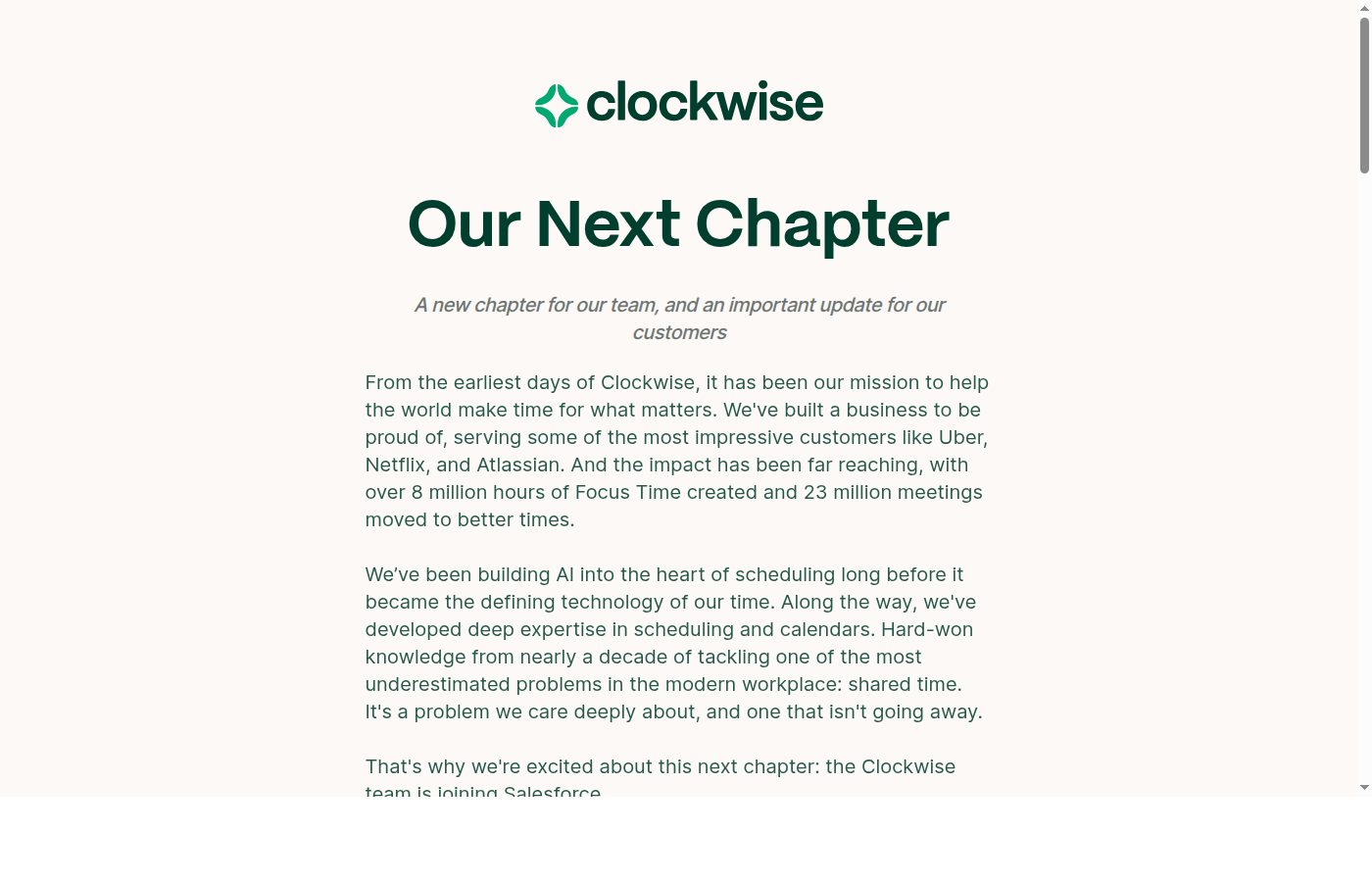
However, any evaluation of Clockwise in Q1 2026 must be framed by a singular, terminal event: the company was acquired by Salesforce and announced the complete shutdown of its product effective March 27, 2026. The engineering team has been absorbed to work on Salesforce’s Agentforce initiatives, leaving existing Clockwise customers with only weeks to migrate their data, scheduling links, and calendar holds to alternative platforms. For a commercial real estate firm evaluating a net-new purchase, this reality changes the calculus entirely. What was once a leading tier-two, CRE-adjacent productivity tool is now a cautionary tale about the platform risks associated with venture-backed software. This review examines the mechanics and merits of the software as it existed prior to the shutdown, while ultimately advising buyers on how to navigate the current market landscape.
What Clockwise does and how it works
At its core, Clockwise functions as an automated scheduling engine that treats the corporate calendar as a dynamic puzzle rather than a static ledger. When a user connects their Google or Outlook account, the AI scans their upcoming weeks to identify patterns, recurring meetings, and fragmented gaps of free time. Users manually designate which internal meetings are flexible, giving the system permission to move them within specific parameters. If a thirty-minute sync is wedged between two larger blocks of free time, the algorithm will automatically reschedule that sync to abut another meeting, thereby consolidating the free time into a larger, uninterrupted focus time block.
The platform extends beyond basic rescheduling by enforcing user-defined boundaries. It can automatically place holds for lunch, calculate and block travel time for in-person meetings, and sync personal calendars to prevent professional commitments from overriding private appointments. When scheduling new meetings, the AI suggests optimal times that minimize disruption for all attendees, taking into account the collective focus time of the entire team. This team-aware optimization is the defining mechanical feature of the software; it does not just look at when people are free, but when meeting would be least destructive to their deep work.
Finally, the software acts as a communication bridge. Through its Slack integration, it automatically updates user statuses to reflect their current calendar state, such as being in a meeting, and mutes incoming notifications accordingly. It also provided external scheduling links that dynamically offered times protecting the user’s focus blocks. While these mechanics were highly effective for internal coordination, they required significant organizational buy-in to function properly, as the AI could only optimize meetings where all participants were active users of the system.
9AI Framework: the score, dimension by dimension
CRE Relevance: 3/10
Clockwise is a general-purpose AI scheduling assistant, entirely agnostic to commercial real estate. It does not understand property tours, lease expiration dates, or capital markets cycles. Its sole function is reading calendar availability and moving flexible meetings to create contiguous blocks of focus time. For a CRE analyst underwriting a portfolio or a broker managing client calls, the tool offers basic time management rather than industry-specific intelligence. There are no integrations with Yardi, Argus, or CoStar. It treats a high-stakes LP pitch exactly the same as an internal sync. Because it lacks any CRE data or workflow awareness, its utility is strictly horizontal. In practice: CRE professionals will find it useful for general time blocking, but it offers zero real estate specific advantages.
Data Quality and Sources: 7/10
The tool relies entirely on the metadata within Google Calendar and Microsoft Outlook. Clockwise analyzes meeting participants, duration, and user-defined preferences to determine which events are flexible. The data quality is only as good as the hygiene of the user’s calendar. If a broker blocks time vaguely or fails to tag external clients, the AI will make incorrect assumptions and potentially shuffle critical meetings. It does not enrich calendar data with external context or verify the actual importance of an event beyond its internal rules engine. When team adoption is high, the system’s understanding of organizational availability improves significantly, allowing for better optimization. In practice: You must maintain immaculate calendar hygiene and clearly mark external meetings to prevent the AI from making disastrous rescheduling decisions.
Ease of Adoption: 8/10
Deploying Clockwise requires minimal technical friction. Users authenticate via Google Workspace or Microsoft 365, set their working hours, and define their preference for focus time. The onboarding sequence is straightforward, guiding users through the process of marking recurring internal meetings as flexible. However, the true hurdle is organizational behavior. For the AI to effectively optimize a schedule, it requires a critical mass of teammates to also use the platform. If only one analyst in a brokerage team adopts it, the system cannot move shared meetings. The interface sits natively within the calendar browser, reducing the need to learn a completely new software application. In practice: Technical setup takes five minutes, but achieving the necessary team-wide behavioral shift requires top-down enforcement and collective participation.
Output Accuracy: 7/10
Clockwise executes its core mandate of moving flexible meetings to create focus time with mechanical precision. The algorithm successfully identifies gaps in the schedule and plays calendar Tetris to consolidate them. However, accuracy in scheduling is highly subjective. The AI sometimes moves meetings to awkward times, such as right before a hard stop or immediately after a stressful client presentation, because it lacks human context. It accurately respects the parameters set by the user, like lunch hours and travel time, but its aggressive optimization can frustrate colleagues who suddenly find their morning sync pushed to the late afternoon without prior warning. In practice: The AI correctly follows its scheduling rules, but users must tightly constrain its permissions to avoid socially awkward or exhausting meeting placements.
Integration and Workflow Fit: 8/10
Clockwise integrates deeply with the standard corporate productivity stack. It natively supports Google Workspace and Microsoft 365, which covers the vast majority of commercial real estate firms. Beyond the calendar, it offers a strong Slack integration that automatically updates user statuses and silences notifications to prevent distractions during focus blocks. It also connects with Asana to block time for specific tasks. However, it completely ignores the CRE technology ecosystem. There is no connectivity to CRMs like Dealpath or Apto, nor does it sync with property management software. It exists purely in the communication layer, blind to the actual assets being managed. In practice: It fits perfectly into your email and Slack environment, but will remain entirely disconnected from your deal pipelines and property databases.
Pricing Transparency: 8/10
Clockwise publishes its pricing tiers clearly on its website, earning high marks for financial transparency. The platform operates on a per-user, per-month model. The Free tier provides basic smart scheduling, while the Teams plan is advertised at $6.75 per user per month when billed annually. The Business tier, which adds admin controls and advanced analytics, costs $11.50 per user per month. Enterprise pricing requires a custom quote. This straightforward structure allows IT buyers and team leads to calculate exact deployment costs without enduring a mandatory sales call. All features associated with each tier are explicitly listed, leaving no ambiguity about what is included. In practice: Buyers can easily model the financial impact of a team-wide rollout using the publicly available pricing data.
Support and Reliability: 2/10
This is where the evaluation collapses for any new buyer. In March 2026, Salesforce acquired the Clockwise team to build out its Agentforce capabilities and announced the immediate shutdown of the Clockwise product. The service is slated to go offline completely on March 27, 2026. All user data, scheduling links, and smart holds will be deleted. Prior to this acquisition, the platform demonstrated high uptime and reliable customer support, but evaluating a product that has been given a terminal sunset date renders historical reliability moot. Any firm adopting this tool now is walking into a dead end with zero future support. In practice: The product is being killed by its acquirer in March 2026, making it an entirely unreliable choice for any new deployment.
Innovation and Roadmap: 1/10
The innovation roadmap for Clockwise is officially nonexistent. Following the Salesforce acquisition in Q1 2026, all product development has ceased. The engineering team has been reallocated to internal AI initiatives at the acquiring company. There will be no new features, no bug fixes, and no expansions into other calendar ecosystems. While the company previously pioneered the concept of AI-driven focus time and conversational scheduling interfaces, that intellectual property is now being absorbed into a different enterprise ecosystem. Buyers looking for a forward-thinking roadmap must look to competitors who are actively developing and supporting their standalone products for the long term. In practice: With the product shutting down, the roadmap is permanently frozen, forcing existing users to migrate to active alternatives.
Market Reputation: 7/10
Before the shutdown announcement, Clockwise held a strong reputation as a pioneer in AI calendar optimization. It successfully scheduled millions of hours of focus time for major tech companies and knowledge workers. It was widely regarded as a premium, reliable tool for large organizations struggling with meeting bloat. However, the abrupt nature of the March 2026 shutdown, giving users only weeks to migrate their data and scheduling links, has severely damaged its standing among loyal users. The sudden exit highlights the platform risk inherent in relying on venture-backed productivity startups for critical daily workflows, leaving many teams scrambling for replacements. In practice: While historically respected for its technology, the abrupt shutdown has left a cautionary stain on its legacy regarding vendor lock-in.
Who should use Clockwise
Prior to the shutdown announcement, Clockwise was best suited for specific operational profiles within commercial real estate who suffered from severe meeting density.
- Managing Directors: Leaders burdened with back-to-back internal syncs who needed automated intervention to carve out time for strategic planning.
- Cross-Functional Analysts: Underwriters and researchers who required long, uninterrupted blocks of time to build complex financial models without constant Slack interruptions.
- Operations Managers: Professionals tasked with coordinating large team meetings across multiple time zones and conflicting schedules.
- Tech-Forward Brokerage Teams: Highly collaborative teams willing to adopt a unified toolset to protect their collective prospecting time.
Who should look elsewhere
Given the current status of the product and its inherent limitations, the following profiles should entirely avoid this tool.
- Net-New Buyers: Any CRE firm looking to deploy a new scheduling tool in March 2026, as the product is permanently shutting down.
- Client-Facing Brokers: Professionals whose calendars are dominated by external client meetings and property tours, which the AI cannot and should not reschedule.
- Solo Practitioners: Independent agents who do not have a team to coordinate with, rendering the core team-optimization engine useless.
- Firms with Strict Data Silos: Organizations that prohibit third-party applications from reading and modifying calendar metadata for compliance reasons.
Pricing and ROI
Clockwise operates on a transparent, per-user SaaS pricing model, though its availability is ending. The Free tier provides basic smart scheduling and personal calendar syncing at no cost. For organizational deployment, the Teams plan is priced at $6.75 per user per month when billed annually, unlocking team-wide meeting optimization and focus time blocks. The Business tier costs $11.50 per user per month, adding administrative controls and meeting load analytics. Enterprise deployments require custom pricing.
To calculate the ROI on the Teams plan, consider a CRE analyst earning $100,000 annually, which translates to roughly $50 per hour. The software costs $81 per year per user. If the AI successfully consolidates their schedule to create just two additional hours of uninterrupted underwriting time per month, preventing the context-switching tax of fragmented meetings, the tool generates $100 of value monthly, or $1,200 annually. This yields a massive 1,380 percent return on the software cost. However, this mathematical ROI is entirely theoretical for new buyers in Q1 2026. Because the product is shutting down on March 27, the actual ROI of a new deployment is deeply negative, as the time spent configuring the software and training the team will be entirely wasted when the servers go dark.
Integration and CRE tech stack fit
Clockwise was built to sit squarely within the horizontal corporate productivity stack, offering zero native integrations with the commercial real estate technology ecosystem. It connects deeply with Google Workspace and Microsoft 365, requiring read and write access to the user’s calendar to function. This allows it to manipulate events directly within the native calendar interface without forcing users into a separate dashboard.
Beyond the calendar, its most vital integration is with Slack. The AI uses calendar data to automatically update Slack statuses and manage notification settings, ensuring that focus time is actually respected by colleagues. It also offers an integration with Asana, allowing project managers to automatically block calendar time for specific tasks assigned within the project management tool.
For a CRE tech stack, this means Clockwise operates in a vacuum. It cannot pull property tour dates from VTS, it does not log client interactions into Salesforce, and it cannot read deal milestones from Dealpath. It is strictly a communication and time-management layer, completely isolated from the actual asset and transaction data that drives a real estate business.
Competitive landscape
The abrupt sunset of Clockwise in March 2026 has forced the market to evaluate immediate alternatives. The competitive landscape for AI scheduling is divided between team-focused optimization engines and individual task managers.
Reclaim AI: The most direct competitor and the primary beneficiary of the Clockwise shutdown. Reclaim is highly effective at auto-scheduling tasks, habits, and focus blocks around existing meetings. Unlike Clockwise, which required team-wide adoption to shine, Reclaim is fundamentally individual-first, making it highly valuable for a solo CRE broker or analyst. It supports both Google Calendar and Outlook, and is actively offering migration support for stranded Clockwise users.
Motion: A heavier, more comprehensive alternative that combines calendar management, task tracking, and project planning into a single interface. Motion uses AI to automatically schedule tasks based on deadlines and priorities. It is significantly more expensive and requires users to abandon their native calendar interface in favor of the Motion app, but it offers a far more aggressive approach to time management for project-heavy real estate development teams.
Morgen: A strong alternative for professionals who use multiple calendar providers, such as managing a corporate Outlook and a personal Google Calendar. Morgen consolidates these feeds and offers smart scheduling links, though it relies less on autonomous AI reshreshuffling and more on intentional, manual time-blocking.
While tools like Cursor (scored 90), Agentforce (scored 88), and Replit (scored 88) dominate the broader AI developer and agent space, the scheduling category requires specialized calendar intelligence. Reclaim currently stands as the safest harbor for former Clockwise loyalists.
The bottom line
Clockwise was a highly effective, elegantly designed solution for the specific problem of internal meeting bloat. Its ability to autonomously play calendar Tetris and carve out focus time made it a favorite among knowledge workers. However, for any commercial real estate firm evaluating the software in March 2026, the decision is a hard pass. The acquisition by Salesforce and the subsequent announcement that the product will shut down on March 27, 2026, makes deploying this tool an exercise in futility.
Do not waste capital or political goodwill installing a system that will cease to exist in a matter of weeks. The underlying technology was impressive, but the platform risk has fully materialized. CRE leaders should immediately redirect their attention and budgets toward stable, individual-first alternatives like Reclaim AI or Motion to solve their scheduling bottlenecks. Clockwise is no longer a viable software purchase; it is simply a closed chapter in the evolution of AI productivity tools.
Frequently asked questions
Is Clockwise shutting down?
Yes. Following its acquisition by Salesforce to support the Agentforce ecosystem, Clockwise announced it will completely shut down its product on March 27, 2026. All user data, calendar holds, and scheduling links will be permanently deleted, forcing existing users to migrate immediately.
Does Clockwise work with Microsoft Outlook?
Yes, prior to its sunset, the platform fully supported both Microsoft 365 and Google Workspace. This dual compatibility allowed it to optimize calendars and create focus time across the two most dominant corporate email providers used by commercial real estate firms.
Can Clockwise reschedule meetings with external clients?
No. The AI is explicitly designed to only reschedule internal meetings that users have manually designated as flexible. It will never automatically move meetings that include external email domains, ensuring that high-stakes client pitches and property tours are strictly protected from algorithmic changes.
How much does Clockwise cost for a team?
The published pricing for the Teams plan was $6.75 per user per month when billed annually. For larger organizations requiring administrative controls and meeting analytics, the Business tier cost $11.50 per user per month. Enterprise deployments required a custom negotiated contract.
Does Clockwise integrate with real estate CRMs like Yardi or VTS?
No. The software is a horizontal productivity tool focused entirely on corporate communication. While it integrates deeply with Slack and Asana to update statuses and block task time, it offers absolutely zero native integrations with commercial real estate CRMs or property management platforms.
What is the best alternative to Clockwise?
Reclaim AI is widely considered the strongest direct alternative. It offers similar focus time protection and calendar optimization, but utilizes an individual-first architecture. This means a solo commercial real estate broker can gain immediate value without requiring their entire brokerage team to adopt the software.