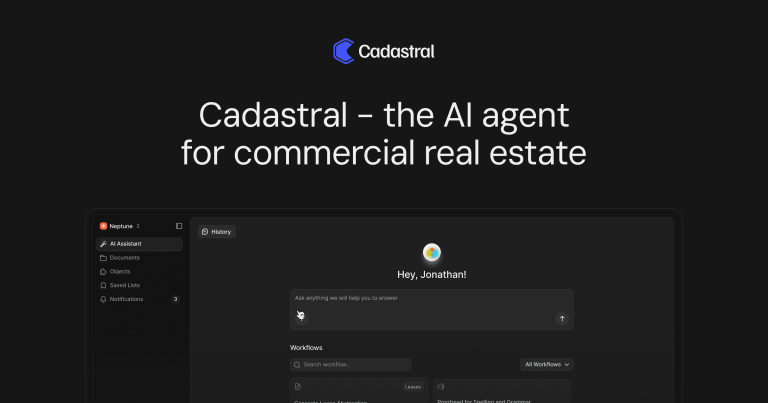
Cadastral is a CRE-native AI platform for investors, owners, operators, brokers and professional teams that need to analyze property documents and complete labor-intensive workflows. Its core proposition is broader than a document chatbot. The product is positioned as an AI analyst that can move from source material to a usable work product, covering tasks such as acquisition due diligence, lease abstraction, contract review and financial impact analysis. It supports multifamily alongside office, industrial, retail, hospitality, data centers and other property types.
The workflow change is straightforward. A team can give Cadastral leases, offering materials, contracts or other deal documents, then ask questions that require both extraction and real estate reasoning. The platform says it can identify clauses, compare documents, calculate financial consequences and draft outputs. One illustrated use case identifies leases containing early termination rights and estimates the associated income exposure. That is more useful than merely locating the relevant words, provided the calculation and source references survive human review.
Cadastral also presents itself as an organization-wide system. It targets acquisitions, asset management, leasing, capital markets, finance, legal, development and investor relations, among other departments. Public case studies identify JLL and Continental Realty Corporation, while AvalonBay and Equity Residential are associated with the company as backers. Cadastral raised $9.5 million in 2026 and has since announced that it was acquired by Legora, a legal and professional services AI platform.
BestCRE’s analysis is that Cadastral has a compelling product direction and unusually broad CRE workflow coverage, but the buying decision still requires diligence. Pricing is not published, detailed integration documentation is not prominent, and public evidence does not establish dependable accuracy across every advertised asset class and workflow. The acquisition could add resources and professional-services expertise, yet it also creates questions about product roadmap, account ownership and long-term CRE focus. Buyers should test the platform against their own documents, calculations and approval standards before committing.
What Cadastral Does and How It Works
Cadastral ingests the documents that underpin commercial real estate decisions and lets users interrogate them in natural language. The practical starting point may be a lease set, contract package, due diligence folder, offering memorandum or other property record. The system is designed to extract terms and connect related facts across files, rather than forcing an analyst to search each document independently. Its example workflows include finding termination provisions, identifying affected suites and estimating lost income. The important distinction is that the requested result combines document retrieval, clause interpretation and a financial calculation. Buyers should confirm during evaluation whether every answer links back to the precise source language, how conflicting amendments are resolved and whether calculation assumptions are visible.
The product also packages recurring CRE tasks into built-in workflows. Those workflows span due diligence, abstractions, asset management reviews and contract drafting, with claimed applicability across many departments and property sectors. In practice, the attraction is repeatability. A firm could define a standard review process, apply it to a new document set and receive a structured output without rebuilding prompts for each assignment. Cadastral says no setup is required, but BestCRE’s analysis is that meaningful adoption will still involve document organization, workflow selection, output validation and internal approval design. A demonstration should therefore use a buyer’s actual documents, including amendments, scanned pages, inconsistent naming and incomplete records, rather than a clean vendor-prepared example.
Cadastral appears intended to complete multistep work, not simply answer isolated questions. That makes it relevant when an output must move from discovery to analysis and drafting, such as reviewing a lease portfolio, quantifying a contractual risk and preparing a summary for an investment committee. It can serve multiple asset types, including multifamily, office, industrial, retail, hospitality, life science, healthcare and alternative properties. Security claims include SOC 2 Type II certification, end-to-end encryption, single sign-on, role-based access controls and a commitment not to use customer data for training. Those controls provide a credible enterprise baseline. However, the vendor does not publicly provide enough technical detail to determine every supported repository, data export, model control or administrative configuration.
9AI Framework: Dimension by Dimension Analysis
CRE Relevance: 9/10
Cadastral earns a 9 for CRE relevance because the product is designed around commercial property documents, terminology, departments and decisions. Its stated workflows include lease and letter of intent abstraction, acquisition due diligence, asset management, capital markets, development, finance and legal review. The example of identifying termination options and calculating the resulting income exposure reflects a real underwriting and portfolio-management task, not a generic question-answering demonstration. Coverage extends across major and specialist property types, which gives diversified owners a potential common platform. BestCRE’s analysis is that the breadth carries some execution risk because the reasoning needed for a hotel agreement, multifamily lease and development contract differs materially. Even so, Cadastral’s workflow design, target users and examples are unmistakably CRE-native. It falls short of a perfect score because public information does not prove equal depth across every department and asset class advertised.
Data Quality and Sources: 7/10
Cadastral earns a 7 for data quality. The platform works from a customer’s own property documents, which can be more relevant than a generic external dataset because the evidence directly reflects the asset, tenant and agreement under review. Its usefulness nevertheless depends on document completeness, scan quality, amendment sequencing, naming consistency and the platform’s ability to preserve citations and context. The vendor does not publish comprehensive benchmark results for extraction quality across document types or asset classes. It also does not publicly establish a proprietary market dataset comparable with a transaction, rent or property intelligence provider. BestCRE’s analysis is that buyers should treat Cadastral primarily as an intelligence layer over first-party documents. A controlled evaluation should include original leases, amendments, exhibits, handwritten pages and known exceptions. The score recognizes strong source relevance while withholding higher marks until broader, independently verifiable performance evidence is available.
Ease of Adoption: 8/10
Cadastral earns an 8 for ease of adoption because its natural-language interface and packaged workflows reduce the need for users to build models or prompts from scratch. A deal or asset management team can begin with familiar documents and questions, which is a lower behavioral hurdle than replacing a system of record. The platform also claims no setup is required and addresses multiple departments through one interface. BestCRE’s analysis is that initial access may be easy, but production adoption is not automatic. Teams still need permissions, folder conventions, review thresholds, naming standards and clarity about which outputs require legal or financial approval. Single sign-on and role-based access controls should help an enterprise deployment. Buyers should test how quickly occasional users can find sources, correct assumptions and export results. The score reflects a product that appears approachable while recognizing the operational work required to make AI-generated analysis dependable.
Output Accuracy: 7/10
Cadastral earns a 7 for output accuracy. Its product examples show the right ambition: identify controlling clauses, connect them to the relevant premises and quantify financial consequences. That is considerably more demanding than extracting a date or copying a rent figure. The vendor also emphasizes accuracy, but it does not publish a comprehensive independent benchmark, error rate or methodology that would justify a higher score. BestCRE’s analysis is that accuracy must be separated into extraction, interpretation and calculation. A correct clause can still produce a wrong conclusion if an amendment is missed, and a correct interpretation can still produce a wrong financial estimate if assumptions are hidden. Buyers should require page-level citations, calculation transparency and exception handling during a pilot. Human review remains appropriate for investment, legal and accounting decisions. The score recognizes credible workflow intelligence but stops short of treating marketing examples as proof of consistently auditable performance.
Integration and Workflow Fit: 6/10
Cadastral earns a 6 for integration. The platform is positioned for use across acquisitions, asset management, leasing, finance and legal teams, and it offers enterprise identity and permission controls. Those features matter when sensitive property documents must be shared under defined access policies. However, the vendor does not prominently publish a complete connector catalog, public application programming interface specification or detailed implementation architecture. It is therefore difficult to assess native interoperability with common document repositories, property management systems, deal rooms, customer relationship platforms and underwriting models. BestCRE’s analysis is that Cadastral can still deliver value as a focused workspace if uploads and exports are practical. Larger owners should establish where source documents reside, how metadata is preserved, whether outputs can enter existing review systems and what happens when files change. The score reflects credible organizational fit, balanced against limited public evidence of deep ecosystem connectivity.
Pricing Transparency: 3/10
Cadastral earns a 3 for pricing transparency because the vendor does not publish subscription prices, package boundaries, usage allowances or standard implementation fees. Prospects are directed toward a demonstration and access request, indicating a sales-led purchasing process. Private pricing is common for enterprise CRE software, particularly when document volume, user count, security review and workflow configuration affect cost. It still makes initial comparison and budget planning harder for buyers. BestCRE’s analysis is that a proposal should separate platform fees, seats, document or page limits, onboarding, integrations, support and any model-related consumption charges. Buyers should also ask how pricing changes when additional departments or assets are added and whether the Legora acquisition affects contracting. The score is intentionally low under BestCRE’s framework. Cadastral may ultimately offer attractive economics, but a buyer cannot determine that from public information and should not equate an unpriced demonstration with a clear commercial offer.
Support and Reliability: 6/10
Cadastral earns a 6 for support. The enterprise sales motion and breadth of promoted departmental workflows suggest that customer engagement is part of deployment, but the vendor does not publish enough detail about service tiers, guaranteed response times, onboarding scope, training programs or named customer success coverage. Public case studies indicate experience working with institutional real estate organizations, which is encouraging because those customers typically require security review and workflow coordination. BestCRE’s analysis is that support quality will be especially important when a result depends on document hierarchy, firm-specific terminology or a calculation convention. Buyers should ask who configures workflows, how errors are escalated, whether subject-matter specialists participate and what assistance is included after launch. The Legora acquisition may expand support resources, but future arrangements are not yet sufficiently public to award extra credit. The score reflects credible enterprise signals combined with substantial unanswered questions about the actual service commitment.
Innovation and Roadmap: 9/10
Cadastral earns a 9 for innovation. The product’s strongest idea is not conversational search by itself, but the combination of document interpretation, CRE reasoning, financial impact analysis and work-product generation within a single agent-oriented workflow. Moving from a lease clause to an estimated economic consequence is closer to an analyst assignment than a standard abstraction tool. Extending that approach across acquisition, leasing, asset management and legal functions could reduce handoffs between search, spreadsheets and drafting tools. BestCRE’s analysis is that this design is differentiated, particularly for firms whose work is trapped in long, inconsistent document sets. Innovation does not guarantee dependable execution, and buyers should resist assuming that every advertised workflow has equal maturity. Still, Cadastral is pursuing a more ambitious operating model than simple extraction or dashboard software. Its acquisition by a professional-services AI company also creates a plausible path toward deeper contract and diligence capabilities, although the resulting roadmap is not published.
Market Reputation: 6/10
Cadastral earns a 6 for market reputation, the maximum appropriate for a young company with a limited public customer record under BestCRE’s framework. The company presents case studies involving JLL and Continental Realty Corporation, and its backers include major multifamily owners AvalonBay and Equity Residential. These are meaningful industry signals because they connect the product with sophisticated CRE participants. The announced acquisition by Legora adds another form of validation and may provide greater organizational resources. However, the market does not yet have the breadth of public references, long operating history or independently documented deployments associated with the category’s established leaders. BestCRE’s analysis is that named relationships should open the door to evaluation, not replace reference checks. Prospective customers should request contacts with similar asset types, workflows and document volumes. They should also clarify whether existing Cadastral leadership, product commitments and service teams will remain in place after the acquisition.
Who Should Use Cadastral
Cadastral is best suited to institutional and mid-market CRE owners, operators and investment managers whose teams repeatedly review large document packages. Acquisition groups can use it to investigate lease provisions, contracts and diligence materials before an investment committee decision. Asset managers can apply similar workflows to portfolio questions that otherwise require manual file review. Leasing, legal and finance teams may also benefit when they need structured abstractions, risk summaries or draft work products based on the same underlying agreements. Multifamily firms are a natural audience given the company’s backing, but the platform also addresses office, industrial, retail, hospitality and specialist assets.
The strongest buyer profile has enough document volume to make repeated manual review expensive, but also has experienced staff available to validate results. Cadastral should appeal to organizations seeking a shared AI workspace across departments rather than another narrow extraction utility. It may be particularly valuable when analysts spend significant time locating clauses, reconciling amendments and translating contractual terms into economic implications. BestCRE’s analysis is that the ideal customer will run a measured pilot using completed deals with known answers, define approval requirements and compare the resulting time savings with the full subscription and implementation cost.
Who Should Not Use Cadastral
Cadastral is less suitable for small investors that review only a few uncomplicated deals each year. Those teams may not generate enough recurring document work to justify an enterprise sales process or an additional platform. A buyer seeking a ready-made database of market rents, sales comparables or property ownership records should also look elsewhere. Cadastral’s primary value comes from analyzing documents and workflows, not replacing a broad external CRE data service.
Organizations that require fully autonomous legal, accounting or investment decisions should not buy the product on that expectation. The platform can accelerate analysis, but material conclusions still need qualified review, especially when amendments conflict or calculations depend on judgment. It may also be a poor fit for firms that need documented native connections to every existing system before conducting a pilot. The vendor does not publish enough integration detail to confirm that requirement. Buyers uncomfortable with private pricing or post-acquisition roadmap uncertainty should wait for clearer commercial and product documentation.
Pricing and ROI Analysis
Cadastral does not publish pricing, package levels, minimum commitments, implementation charges or usage limits. Access is handled through a demonstration request, so buyers should expect a negotiated enterprise proposal. The quotation should identify the number of users, included departments, supported workflows, document or page allowances, storage terms, onboarding services, integrations and support coverage. It should also state whether model consumption, additional assets or higher processing volumes create variable charges. Because Cadastral has been acquired by Legora, prospects should confirm the contracting entity, renewal terms and whether product packaging is expected to change.
BestCRE analysis: a buyer can create simple ROI boundaries before seeing a quote. If five analysts each save four hours per week and the fully loaded internal cost is $75 per hour, the annual gross labor value is about $78,000 using 52 weeks. That is not a forecast and excludes implementation effort, review time and any value from better decisions. The team should replace every assumption with its own figures, then discount the estimated benefit for work that cannot be removed or redirected. A sound pilot records time spent before and after Cadastral, correction rates and the percentage of outputs accepted without substantial rework.
Integration and CRE Tech Stack Fit
Cadastral fits most naturally beside existing document storage, underwriting and property systems as an analysis layer. Teams can bring leases, contracts and diligence files into an AI workspace, generate findings and then move approved outputs into established models or review processes. Single sign-on and role-based access controls support enterprise identity management. The vendor also states that customer data is encrypted and not used for model training, which addresses common baseline concerns for confidential deal information.
The open question is how much of that movement is automated. Cadastral does not prominently publish a full catalog of native integrations or detailed public technical documentation. Buyers should map the path from their deal room or repository into Cadastral, then trace citations, structured fields and drafted outputs back into the systems where decisions are recorded. BestCRE’s analysis is that manual upload and export may be acceptable for a focused diligence pilot. A portfolio-wide deployment needs clearer answers about synchronization, version control, metadata, access revocation, audit logs, data retention and application programming interface availability.
Competitive Landscape
Cadastral competes most directly with emerging CRE AI analyst platforms such as Archer, Keyway, Starboard AI and Endex. The relevant comparison is not simply whether each product can answer questions. Buyers should test which one can reliably carry a task from mixed source documents through interpretation, calculation and an auditable deliverable. Cadastral differentiates itself through broad, agent-oriented workflows across property departments and through its emphasis on completing work rather than only extracting fields. Its institutional backing and public customer examples strengthen the case, while private pricing and limited public integration detail weaken comparability.
Broader BestCRE category alternatives include Cotality, HelloData, CompStak, Akkio, RETS AI, Cherre, Shortcut AI and TripleZip. These products are not interchangeable. HelloData is particularly relevant to multifamily market analysis, CompStak centers on commercial lease and sales comparables, and Cotality offers a much larger property information environment. Cherre focuses on connecting and governing real estate data, while Akkio offers general analytical AI capabilities. Shortcut AI is useful for spreadsheet-centered work. Cadastral is the better conceptual fit when document-heavy CRE workflows are the bottleneck. A data coverage problem, integration problem or spreadsheet modeling problem may point to a different vendor.
BestCRE’s analysis is that buyers should shortlist by workflow, not by the breadth of an AI claim. Give each vendor the same difficult file set and require source citations, amendment handling, calculation assumptions and exportable results. Cadastral can win that evaluation if its agent completes more of the real assignment with less correction. It should not receive credit for advertised breadth where a tested workflow remains shallow.
The Bottom Line
Cadastral merits a serious pilot for CRE organizations that lose substantial analyst, legal or asset management time to document review. Its CRE-specific design and ability to connect contractual language with financial implications are meaningful differentiators. Security claims are suitable for beginning enterprise diligence, and the public customer examples provide credible signals. The platform is most persuasive when evaluated as a workflow system, not as a generic chat interface.
Do not sign on the strength of a polished demonstration. Require a pilot using messy historical files, known exceptions and calculations that your team can independently verify. Set thresholds for citation quality, correction effort and usable time savings, then obtain a fully itemized commercial proposal. BestCRE’s decision is to consider Cadastral for document-intensive workflows, subject to successful accuracy testing and clear post-acquisition commitments. Buyers primarily needing market data, transparent self-service pricing or extensively documented integrations should choose a more specialized alternative.
About BestCRE
BestCRE.com is the definitive authority on commercial real estate AI, analysis, and investment intelligence. Every article advances the platform’s mission to help CRE professionals identify, evaluate, and adopt the best tools and strategies in the industry. We benchmark platforms using the 9AI Framework so CRE leaders can compare tools with clear evidence. Explore the category map at 20 CRE sectors for deeper coverage across the CRE stack.
Frequently Asked Questions
What is Cadastral AI for commercial real estate?
Cadastral is an AI platform built to analyze documents and complete workflows for commercial real estate investors, owners, operators and professional teams. It addresses tasks such as due diligence, lease and letter of intent abstraction, contract review, asset management analysis and drafting. Users can ask questions across property files, identify provisions and connect extracted terms with financial consequences. The product supports multifamily, office, industrial, retail, hospitality and several specialist asset classes. It is intended to act more like an AI analyst than a basic document search tool. Cadastral also advertises SOC 2 Type II certification, encryption, single sign-on, role-based access controls and a policy against using customer data for training. Legora has announced its acquisition of Cadastral.
How does Cadastral compare with other CRE AI tools?
Cadastral focuses on multistep work across CRE documents. Its intended advantage is the ability to find relevant terms, interpret them, estimate financial effects and prepare an output within one workflow. Archer, Keyway, Starboard AI and Endex are closer emerging alternatives. Other products solve different problems: HelloData emphasizes multifamily market analysis, CompStak provides commercial comparable data, Cherre connects enterprise real estate data, and Shortcut AI supports spreadsheet workflows. BestCRE’s analysis is that the right comparison starts with a specific assignment. Buyers should give vendors the same leases, amendments and expected answers, then compare citations, calculation assumptions, missed exceptions, correction time and export quality. Cadastral is most attractive when document interpretation is the central bottleneck, rather than external market data or database consolidation.
How much does Cadastral cost?
Cadastral does not publish prices, package levels, minimum contract values or standard implementation fees. Prospective customers must request access or schedule a demonstration to receive a proposal. Buyers should ask whether the quote is based on users, document volume, pages, workflows, departments, assets or model consumption. They should also request separate figures for onboarding, integrations, premium support and renewals. BestCRE analysis: calculate an internal break-even point before negotiating. Multiply the hours expected to be saved by the fully loaded hourly cost of affected employees, then reduce that estimate for review time and work that cannot be eliminated or reassigned. Compare the resulting annual benefit with the complete first-year cost. Since Cadastral has been acquired by Legora, confirm the contracting entity and future packaging before signing.
Who should use Cadastral?
Cadastral is best suited to CRE investment managers, owners, operators, brokers and professional teams that repeatedly review substantial property document sets. Acquisition analysts can use it to investigate diligence materials and lease risks. Asset managers can query portfolio documents and quantify contractual exposure. Leasing and legal teams may benefit from abstractions, clause comparison and draft work products. The strongest fit is an organization with enough recurring work to justify an enterprise platform and enough subject-matter expertise to validate important conclusions. Small investors with infrequent, simple transactions may struggle to establish sufficient return. Cadastral is also not a direct substitute for a market comparable database or property management system. BestCRE’s analysis is that buyers should start with one high-volume, measurable workflow and expand only after accuracy and time savings are demonstrated.
What will the Legora acquisition mean for Cadastral customers?
Cadastral states that it has been acquired by Legora, an AI platform serving legal and professional services work. The combination could support deeper contract analysis, broader product resources and stronger professional workflow capabilities. Those benefits remain forward-looking, however, because a detailed public roadmap is not available. Existing and prospective customers should ask whether the Cadastral brand and interface will remain, which team will own product development, how CRE-specific workflows will be prioritized and whether pricing or contracts will change. They should also confirm data location, support contacts, renewal rights and integration plans. BestCRE’s analysis is that the acquisition is strategically logical because legal documents are central to property work, but buyers should obtain written commitments for any roadmap feature that materially affects their purchasing decision.
Related Reviews
Compare Cadastral with other tools BestCRE has scored in the same category: Cotality, HelloData, CompStak. Explore more CRE AI tool reviews in our Best CRE AI Tools directory. For sector-specific analysis and market intelligence, visit our 20 CRE Sectors hub.