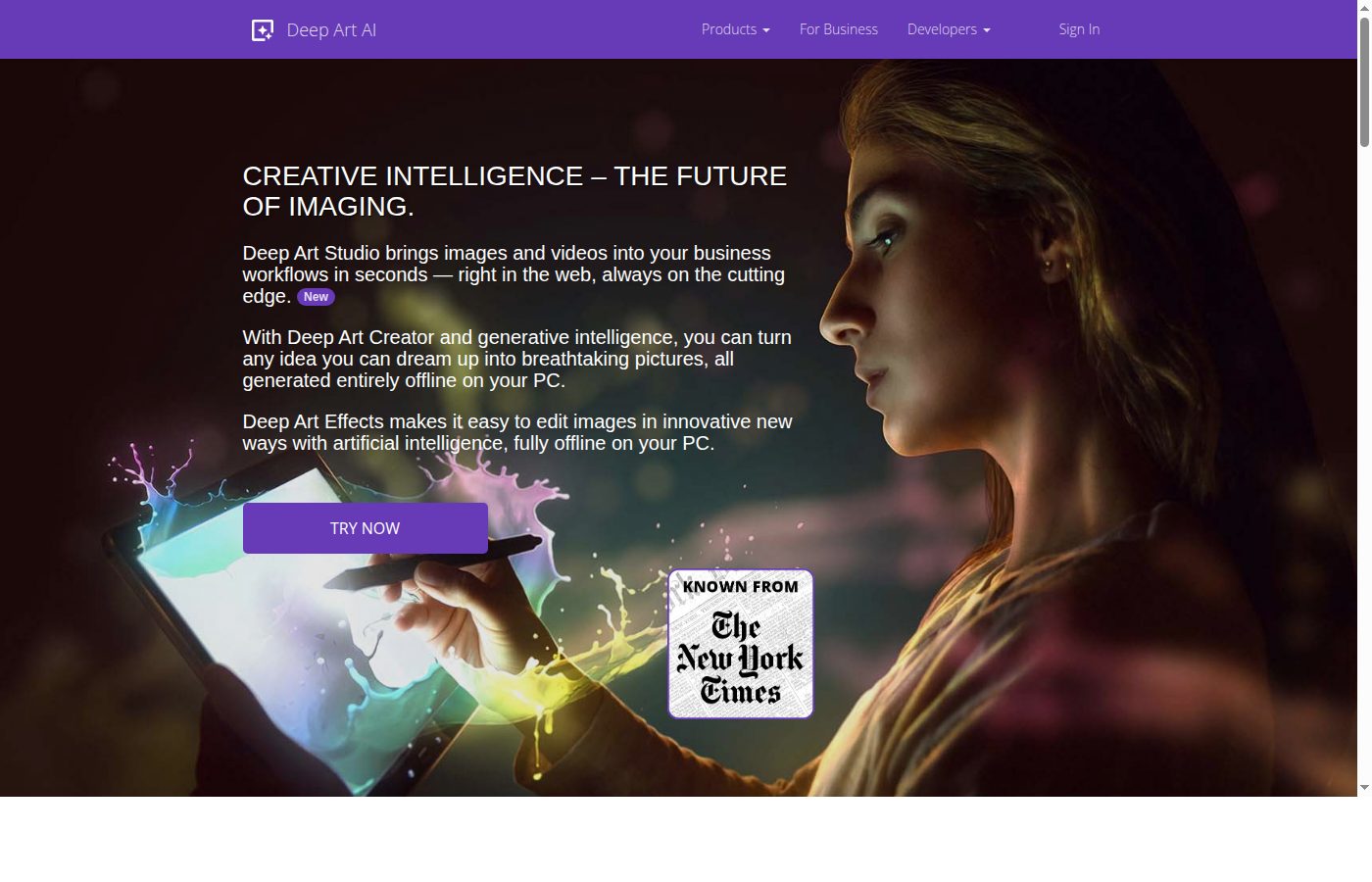
Deep Art Effects is a general-purpose AI image editing and stylization software company that applies neural network filters to photographs and videos. Verified research confirms its primary use case centers on artistic AI filters and image stylization, offering over 120 built-in artistic styles that mimic famous painters. While the commercial real estate industry typically prioritizes photorealistic rendering and precise architectural visualizations, this platform takes a strictly artistic approach. It operates primarily as a downloadable desktop application for Windows and Mac, alongside mobile versions, which allows for offline processing. This localized approach ensures that proprietary property images or unreleased development plans do not need to be uploaded to a cloud server, providing a distinct privacy advantage for highly sensitive marketing assets.
As of March 2026, BestCRE classifies this platform as a Tier 2, general-purpose marketing application due to its lack of real estate-specific training data and workflow integrations. The software relies heavily on style transfer algorithms rather than generative architectural design. Commercial real estate analysts and marketing directors evaluating this application will find a consumer-grade interface designed for broad creative use rather than specialized property marketing. While it includes secondary utilities like image upscaling and automatic colorization of black-and-white photos, its core value proposition remains rooted in transforming standard photos into stylized digital art. Buyers should weigh the novelty of these artistic filters against the practical requirements of institutional property marketing, which rarely calls for abstract or impressionistic property imagery.
What Deep Art Effects does and how it works
Deep Art Effects operates by utilizing neural style transfer algorithms to map the visual characteristics of one image onto the structure of another. Users begin by importing a source photograph, such as a property exterior or interior space, into the desktop or mobile application. They then select from a library of over 120 pre-loaded artistic styles, which encompass various painting techniques, pencil sketches, and abstract patterns. The software processes the image locally on the user’s hardware, applying the chosen style while attempting to preserve the underlying geometry of the original photograph. Users can adjust sliders for filter intensity and brush size, allowing for partial stylization where the original property details remain partially visible beneath the applied effect.
Beyond basic style transfer, the software includes a feature that allows users to create custom filters by uploading their own reference images. If a commercial real estate marketing team wants to match a specific corporate brand pattern or a unique architectural texture, the artificial intelligence analyzes the uploaded reference and applies its structural patterns to the target property photo. The platform also offers selective editing capabilities, enabling users to isolate the foreground from the background. This allows marketers to apply an artistic filter to a distracting background while keeping the primary building in sharp, photorealistic focus, or vice versa.
In addition to its stylization core, the desktop application incorporates several utility functions powered by machine learning. It features an AI upscaling tool designed to quadruple the resolution of low-quality images without introducing significant pixelation, which can be applied to older property photos or low-resolution drone captures. A colorization tool is also included, which automatically applies color to grayscale images based on trained object recognition models. Because all processing occurs offline on the user’s local machine, the speed and efficiency of these rendering tasks depend entirely on the local hardware specifications, specifically the available GPU memory.
9AI Framework: the score, dimension by dimension
CRE Relevance: 2/10
As a general-purpose photo editing application, this software possesses no specialized knowledge of commercial real estate. The artificial intelligence models are trained on classical art and general photography, not architectural styles, floor plans, or property types. Consequently, the platform cannot generate photorealistic virtual staging, remove specific structural elements, or interpret spatial dimensions. Its utility in the commercial sector is strictly limited to niche marketing campaigns that require an abstract or artistic visual approach, rather than the accurate representation demanded by most investors and tenants. The lack of industry-specific templates or real estate data sets severely restricts its everyday applicability for brokerages. In practice: Commercial real estate teams will rarely find a use for neural style transfers in institutional offering memorandums or standard property listings.
Data Quality and Sources: 4/10
The platform does not aggregate, analyze, or output commercial real estate data. Instead, data quality in this context refers to the training of its neural style models and the fidelity of its local image processing. The software relies on established machine learning frameworks for style transfer, which generally produce consistent and recognizable artistic interpretations. However, because it operates offline, the application does not benefit from continuous, cloud-based model updates unless the user downloads a software patch. The upscaling and colorization models perform adequately on standard photography but frequently misinterpret complex architectural geometries, leading to artifacts in highly detailed property images. In practice: Users must rely on their own high-quality source images, as the software’s offline models cannot correct fundamental lighting or structural flaws.
Ease of Adoption: 8/10
Deploying the software is straightforward, requiring a standard download and installation process for the desktop client or mobile application. The user interface is highly visual and consumer-oriented, prioritizing simple sliders and one-click filter applications over complex technical configurations. Marketing personnel with no prior graphic design or artificial intelligence experience can generate stylized images within minutes of installation. However, because the desktop version relies entirely on local hardware for processing, users with older computers or insufficient graphics processing units will experience significant lag and slow rendering times. The absence of cloud processing shifts the hardware burden entirely onto the buyer. In practice: Marketing analysts can learn the interface immediately, provided their local workstations possess the necessary hardware specifications to handle localized neural processing.
Output Accuracy: 6/10
Evaluating accuracy for an artistic filter tool is inherently subjective, as the goal is stylization rather than photorealism. When applying built-in styles, the software successfully maps textures and colors to the source image, though it frequently obscures critical architectural details like window mullions or brickwork. The AI upscaling feature provides measurable accuracy improvements for low-resolution files, but it struggles with the rigid, straight lines common in commercial real estate photography, occasionally introducing curved artifacts or blurred edges. The automatic colorization tool often misidentifies building materials, applying inaccurate hues to concrete or glass facades based on generalized training assumptions. In practice: The generated images are suitable for stylized social media posts but lack the precision required for formal architectural presentations or detailed property brochures.
Integration and Workflow Fit: 3/10
This application operates as a completely standalone software environment. It does not offer native plugins for industry-standard graphic design software like Adobe Photoshop or Illustrator, nor does it connect to commercial real estate marketing platforms such as Buildout, SharpLaunch, or standard CRM systems. Users must manually export their finished images as standard file types (JPEG, PNG) and manually upload them into their existing marketing stacks. While the vendor offers a separate API for developers, the core desktop application provides no automated workflow linkages. This isolated operation creates friction for high-volume marketing teams accustomed to interconnected cloud environments. In practice: Marketing coordinators will need to manually transfer files between this standalone application and their primary publishing or design platforms.
Pricing Transparency: 4/10
The vendor operates with a consumer-focused pricing model, primarily offering a paid desktop version alongside a free mobile application with in-app purchases. While the research confirms it is a paid tool, the vendor does not publish standard B2B SaaS pricing tiers, enterprise licensing costs, or team-based subscription models on its primary marketing pages. Instead, it frequently utilizes consumer marketing tactics, such as limited-time discount codes, which obscures the baseline cost for commercial teams seeking multi-seat licenses. The lack of clear, published enterprise pricing requires commercial real estate firms to contact the vendor directly to negotiate team deployments or API access. In practice: Buyers should expect a consumer-grade purchasing experience and must proactively negotiate any multi-user licenses required for a corporate marketing department.
Support and Reliability: 5/10
As a smaller software provider catering heavily to a consumer and hobbyist demographic, the company lacks the dedicated enterprise support infrastructure typical of commercial real estate technology vendors. User reviews indicate mixed experiences with customer service, highlighting delayed response times and a reliance on basic email ticketing rather than dedicated account managers or live chat. The offline nature of the desktop application means that troubleshooting often involves diagnosing local hardware conflicts rather than server-side issues, which can complicate the support process. Furthermore, the vendor does not offer published service level agreements (SLAs) or guaranteed uptime for its API products. In practice: Commercial real estate teams must rely on self-service troubleshooting and should not expect rapid, enterprise-grade technical support during critical marketing deadlines.
Innovation and Roadmap: 4/10
The core technology of neural style transfer experienced a surge in popularity several years ago, and the underlying mechanics have remained relatively static since. While the vendor has expanded the software’s utility by adding AI upscaling and automatic colorization, these features are now standard across most modern graphic design applications. The company has not signaled any intention to develop industry-specific models or transition toward generative AI capabilities that could create original architectural concepts from text prompts. The roadmap appears focused on adding incremental artistic filters and maintaining local processing capabilities rather than pushing the boundaries of commercial image generation. In practice: Buyers are purchasing a mature, static feature set focused on artistic filters rather than an evolving suite of generative real estate marketing tools.
Market Reputation: 6/10
The software maintains a recognizable presence within the consumer photo editing and digital art communities, but it holds virtually no brand recognition within the commercial real estate sector. Online reviews reflect a polarized user base; many praise the offline privacy and the sheer volume of available art styles, while others criticize the consumer-heavy marketing tactics and occasional software instability on lower-end hardware. Compared to specialized real estate visualization tools or dominant graphic design suites, this application is viewed as a niche novelty rather than a fundamental business requirement. It is generally regarded as a reliable tool for hobbyists rather than a professional-grade marketing asset for institutional firms. In practice: Real estate professionals will view this as an experimental creative utility rather than a trusted, industry-standard marketing platform.
Who should use Deep Art Effects
While its application in institutional property marketing is highly restricted, certain creative professionals within the commercial real estate sector may find specific utility in this software. The offline processing capability and upscaling features provide niche benefits for teams handling sensitive or low-quality archival imagery.
Marketing directors executing avant-garde or highly stylized social media campaigns where abstract property imagery is desired.
In-house graphic designers needing to upscale low-resolution historical property photos or early-stage development sketches without uploading them to cloud servers.
Boutique brokerage owners looking for a low-cost, one-click tool to differentiate their digital brand with artistic, non-traditional visual assets.
Content creators managing real estate blogs or newsletters who require unique, copyright-free artistic headers generated from their own property photographs.
Who should look elsewhere
The vast majority of commercial real estate professionals require precise, realistic, and highly professional visual assets. Teams focused on traditional property marketing, architectural accuracy, or high-volume listing generation will find this tool entirely unsuited to their core objectives.
Investment sales brokers preparing institutional offering memorandums that demand photorealistic property representations.
Architectural and development teams requiring accurate generative modifications, virtual staging, or structural visualizations.
High-volume marketing coordinators who need automated integrations with platforms like Buildout or Adobe Creative Cloud.
Enterprise IT departments seeking cloud-based, centrally managed software with strict service level agreements and dedicated B2B support.
Pricing and ROI
The vendor operates a primarily consumer-oriented pricing model and does not publish standard enterprise or B2B team pricing tiers on its main website. Verified research confirms it is a paid application, typically sold as a one-time perpetual license or a consumer subscription for the desktop version, alongside a free mobile app supported by in-app purchases. Because the company frequently utilizes consumer marketing tactics, such as limited-time discount codes, the exact baseline cost for a commercial real estate marketing department remains obscured. Buyers requiring multi-seat licenses or API access must contact the vendor directly for custom quotes.
To calculate the return on investment, a commercial real estate firm must measure the time saved on manual graphic design against the software’s licensing cost and the required hardware investments. If an in-house designer spends four hours per week manually stylizing images or attempting to upscale low-resolution archival photos using traditional methods at an hourly rate of $40, the firm incurs $160 in weekly labor costs. If this software reduces that task to one hour per week, the firm saves $120 weekly. However, because the software requires local processing, firms must also account for the capital expenditure of upgrading local workstations with high-performance GPUs. The ROI is only positive if the firm has a consistent, recurring need for artistic stylization and already possesses the necessary computing hardware.
Integration and CRE tech stack fit
Deep Art Effects offers virtually no native integration with the standard commercial real estate technology stack. The desktop application functions as an entirely isolated environment, requiring users to manually import raw image files and export the finished, stylized assets. It does not connect to industry-specific marketing platforms such as Buildout, SharpLaunch, or RealNex, nor does it sync with property databases like CoStar or standard CRM systems like Salesforce.
Furthermore, the software lacks direct plugin support for professional graphic design ecosystems such as Adobe Creative Cloud. Marketing professionals must save their AI-generated images to a local drive before importing them into InDesign or Photoshop for final layout and typography. While the vendor does offer a separate API for developers looking to build custom applications, this requires significant in-house engineering resources and is not a viable solution for the average brokerage marketing department. The complete reliance on manual file handling creates workflow bottlenecks, making this tool highly inefficient for teams that manage large volumes of property listings or require synchronized, cloud-based asset management across multiple office locations.
Competitive landscape
When evaluating Deep Art Effects against the broader landscape of AI marketing and visualization tools, commercial real estate buyers must distinguish between artistic novelties and professional-grade utilities. Within the BestCRE database, general-purpose AI design tools like Beautiful.ai (Scored 89) offer far more practical value for real estate professionals by automating the creation of pitch decks and offering memorandums, rather than simply applying artistic filters to photos. For teams specifically seeking image manipulation and enhancement, Adobe Photoshop’s native Generative Fill provides vastly superior utility. Unlike Deep Art Effects, Adobe allows marketers to realistically add or remove structural elements, stage empty offices, and correct lighting while maintaining photorealism, a critical requirement for property marketing.
For pure architectural visualization and spatial understanding, platforms like Matterport (Scored 92) remain the industry standard, offering precise 3D digital twins that provide actual value to investors and tenants. If a marketing department strictly requires AI upscaling for low-resolution drone shots or historical photos, dedicated tools like Topaz Photo AI or Pixelcut deliver superior, specialized upscaling models without the consumer-focused artistic bloat. Furthermore, for AI-driven marketing copy and content generation, tools like Jasper AI (Scored 89) and Copy.ai (Scored 87) connect directly into corporate workflows to produce property descriptions and email campaigns. Ultimately, Deep Art Effects competes in a narrow consumer niche of neural style transfer, making it an outlier with very little competitive overlap against the serious, enterprise-focused applications that drive modern commercial real estate marketing.
The bottom line
Deep Art Effects is a consumer-grade novelty application that holds almost no practical value for the vast majority of commercial real estate professionals. While the offline processing ensures data privacy and the AI upscaling provides marginal utility for low-resolution files, the core feature set, transforming photographs into simulated oil paintings or sketches, directly contradicts the industry’s demand for precise, photorealistic property representation. The lack of enterprise pricing transparency, zero integrations with standard commercial real estate marketing platforms, and heavy reliance on local GPU hardware further diminish its viability for institutional teams. Boutique brokerages seeking to experiment with avant-garde social media content may find brief entertainment in the software, but professional marketing directors should allocate their budgets toward generative AI tools that enhance architectural accuracy, automate virtual staging, or streamline document creation. This software is an artistic toy, not a commercial real estate marketing solution.
Frequently asked questions
Can this software generate realistic virtual staging for empty office spaces?
No. The platform applies artistic filters and neural style transfers to existing images. It does not possess generative architectural capabilities and cannot insert realistic furniture, alter floor plans, or create photorealistic virtual staging for commercial properties.
Does the application require an active internet connection to process images?
The desktop version operates entirely offline, utilizing your local computer’s hardware to process the artificial intelligence models. This ensures complete privacy for sensitive property images, though it requires a sufficiently powerful graphics processing unit (GPU) to function efficiently.
Are there native integrations with Adobe Photoshop or Buildout?
No. The software functions as a completely standalone application. Users must manually export their stylized images as standard files (such as JPEG or PNG) and manually upload them into Adobe Creative Cloud, Buildout, or any other marketing platform.
Is enterprise pricing available for large commercial real estate brokerages?
The vendor does not publish standard B2B enterprise pricing or team-based subscription tiers. It primarily targets consumers with single-user licenses. Commercial teams requiring multiple seats must contact the vendor directly to negotiate custom licensing agreements.
Can the AI upscaling feature improve low-resolution drone photography?
Yes, the software includes an AI upscaling tool designed to increase image resolution while minimizing pixelation. However, because the models are not trained specifically on architectural geometry, it may occasionally introduce visual artifacts along straight building lines.
Will this tool help me write property descriptions or marketing copy?
No. This is strictly a visual editing application focused on artistic image stylization. For AI-generated text, commercial real estate professionals should evaluate dedicated copywriting platforms like Jasper AI or Copy.ai.
Related Reviews
Compare Deep Art Effects with other Marketing tools BestCRE has scored: Henry (83/100), Canva (80/100), Lofty (72/100) and Twain (72/100). Browse every review in CRE Marketing, the full Best CRE AI Tools directory, or the 20 CRE Sectors hub.