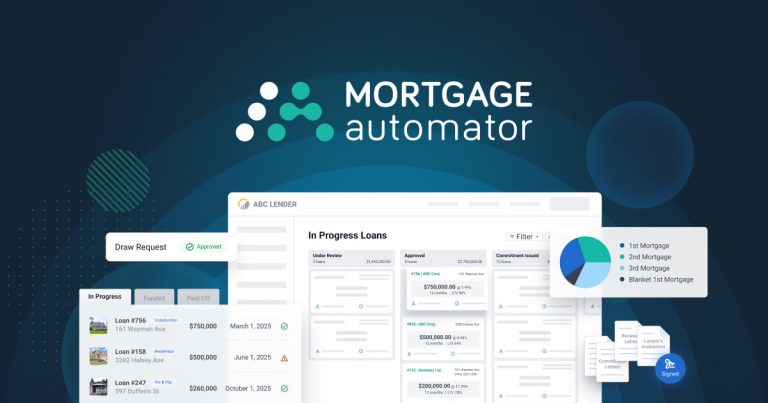
Mortgage Automator is loan origination and servicing software built primarily for private lenders, mortgage investment funds and internal servicing teams. Its place in the commercial real estate workflow is operational rather than analytical: it moves a loan from application and document collection through servicing, payment administration and investor or fund management. That breadth matters for bridge and private credit shops that otherwise coordinate loan files, borrower communications and servicing records across several systems. The product also offers borrower and broker portals, workflow automation and construction draw management.
For a CRE buyer, the central attraction is consolidation. Mortgage Automator is positioned to replace a collection of spreadsheets, document folders, task trackers and point applications with one operating environment. A lender can begin a deal in the origination module, maintain the resulting loan in servicing and connect relevant activity to fund and investor administration. This is a more consequential proposition than adding another underwriting widget because the system can become part of the lender’s daily recordkeeping and borrower communication process.
The limitation is specialization. Mortgage Automator is CRE adjacent rather than a purpose-built institutional CRE platform. It serves private lending workflows that can include commercial property, construction and fix-and-flip loans, but it is not presented as a source of property intelligence, market comparables, surveillance data or institutional credit research. Buyers should therefore separate two questions: whether the platform can operate their loans effectively, and whether it can perform the deeper property analysis required by their credit policy. The answer may be yes to the first and incomplete on the second.
BestCRE’s analysis is that Mortgage Automator is most compelling for a private lender seeking one system across origination and servicing, particularly when construction draws or fund administration are meaningful operational burdens. Its MCP server, which connects loan data to ChatGPT and Claude, is a notable product direction, although access to an AI interface does not by itself establish reliable credit analysis. Public pricing is not available, and the vendor does not publish enough standardized performance evidence to make a purchase decision without a configured demonstration, security review and reference calls.
What Mortgage Automator Does and How It Works
The loan origination component is designed to start, process and manage new loans. In practical terms, that means collecting application information, organizing documents, advancing files through defined stages and coordinating work among the lender, borrower and broker. Borrower and broker portals provide an external channel for applications and document sharing, reducing dependence on email attachments. Automation can handle recurring tasks and workflow triggers, although buyers should ask the vendor to demonstrate exactly which events, approvals and exceptions can be configured without custom work. The important test is whether the platform reflects the lender’s actual credit and closing process rather than forcing staff into a generic residential mortgage sequence.
After closing, the servicing component supports ongoing loan management. The product’s value proposition is continuity between the information gathered during origination and the records needed for administration after funding. Fund management tools extend that operating model to funds and investors, which is relevant to private lenders that both originate loans and manage outside capital. Construction draw management covers construction and fix-and-flip budgets, with BRDG identified as a partner in this area. Buyers should test budget setup, draw requests, inspections, approvals, retainage treatment, change handling and the resulting audit trail because construction servicing becomes difficult at the exceptions, not at the initial budget entry.
Mortgage Automator also markets integrations, workflow automation and an MCP server that can connect loan data to ChatGPT and Claude. The MCP capability could let authorized users query or act on loan information through a conversational interface, subject to the implemented permissions and controls. BestCRE’s analysis is that this is useful as an access layer, not proof that the underlying data is complete or that generated answers are suitable for credit decisions. A serious evaluation should examine source citations, record permissions, logging, data retention and the handling of ambiguous questions. The vendor does not publish comprehensive accuracy benchmarks for AI generated responses, so lenders should keep human review around financial, servicing and compliance outputs.
9AI Framework: Dimension by Dimension Analysis
CRE Relevance: 7/10
Mortgage Automator earns a 7 for CRE relevance because its private lending, bridge lending, fund administration and construction draw workflows overlap materially with commercial real estate finance. A lender financing income property, construction or transitional assets can use the system to coordinate application intake, closing activities and post-closing administration. The inclusion of servicing is particularly relevant because many CRE lending products stop at origination or underwriting. The score does not rise higher because Mortgage Automator is not presented as an institutional CRE intelligence platform. It does not appear to center property comparables, rent rolls, lease analysis, market research or portfolio surveillance based on third-party CRE datasets. BestCRE’s analysis is that the product fits the operating layer of a private CRE lender better than the analytical layer of a bank, debt fund or institutional investment manager.
Data Quality and Sources: 6/10
Mortgage Automator earns a 6 for data quality. Its end-to-end structure should help preserve borrower, loan, document and servicing information across the life of a loan, reducing re-entry between separate origination and servicing products. Borrower and broker portals can also move information collection closer to its source. Those are meaningful process advantages, but they do not establish that incoming data is correct, normalized or complete. The vendor does not publish independent data quality studies, field completion rates or standardized error benchmarks. BestCRE’s analysis is that quality will depend heavily on configuration, required fields, user discipline, integrations and migration work. Buyers should inspect validation rules, duplicate handling, document versioning, calculation sources and audit history. They should also test whether changes to loan terms flow consistently into servicing, fund reporting and any connected AI interface.
Ease of Adoption: 7/10
Mortgage Automator earns a 7 for ease of adoption. Combining origination, servicing, portals and fund tools can simplify the user environment for a private lender that currently relies on fragmented software and spreadsheets. Product segmentation for individual lenders, internal servicers, fund managers and credit unions also suggests that workflows can be matched to distinct operating models. Adoption is still more involved than installing a narrow application because the platform may hold core loan records, payment processes, documents and investor information. Data migration, charting of loan products, user permissions and staff training require deliberate implementation. BestCRE’s analysis is that smaller private lenders with a clear process owner should find the concept approachable, while firms replacing established servicing infrastructure should expect a controlled transition. A demonstration using real loan scenarios is necessary to judge navigation and configuration.
Output Accuracy: 6/10
Mortgage Automator earns a 6 for output accuracy. An integrated loan record can reduce discrepancies caused by copying information between origination, servicing and fund administration systems. Workflow automation may also improve consistency for recurring tasks. However, the vendor does not publish independent calculation accuracy tests, servicing reconciliation results or AI response benchmarks. That absence matters because payment schedules, balances, fees, investor allocations and construction draw records can have financial consequences. The MCP server adds another output channel but does not guarantee that a language model will interpret loan data correctly. BestCRE’s analysis is that accuracy should be treated as configurable and testable rather than assumed. Prospective buyers should run parallel calculations across representative fixed, interest-only, extension, default and payoff scenarios, then test amendments and backdated changes. AI answers should identify their underlying records and remain subject to human confirmation.
Integration and Workflow Fit: 6/10
Mortgage Automator earns a 6 for integration. The product explicitly offers integrations and identifies BRDG as a construction draw partner, which supports a meaningful private lending use case. Its MCP server also creates a modern connection path between authorized loan information and conversational systems such as ChatGPT and Claude. Still, the vendor does not publish a complete integration inventory, supported data objects, synchronization behavior or implementation requirements in the available public product description. That makes it difficult to assess fit with accounting, banking, document, payment, CRM and business intelligence systems before a sales process. BestCRE’s analysis is that the integration story is promising but must be verified at the field and workflow level. Buyers should distinguish native connections from API access, file exports and vendor-assisted custom work, then confirm ownership of monitoring, error recovery and ongoing maintenance.
Pricing Transparency: 4/10
Mortgage Automator earns a 4 for pricing transparency. The vendor provides a pricing section on its site navigation, but specific public prices are not established in the available public product information. Buyers therefore cannot calculate expected subscription cost, implementation expense or module premiums without contacting sales. The vendor also does not publicly specify whether pricing depends on users, loans, balances, transactions, entities or selected capabilities. This is a material procurement limitation for smaller lenders that need to qualify affordability before investing time in demonstrations. BestCRE’s analysis is that the platform may still offer sound value, but value cannot be compared cleanly until the proposal separates recurring fees, onboarding, migration, training, integrations, portals, draw management and AI access. Contract discussions should also cover minimum terms, renewal adjustments, support tiers and charges for data extraction.
Support and Reliability: 7/10
Mortgage Automator earns a 7 for support. The company publicly provides a help center, contact channels and customer success content, indicating that implementation and ongoing assistance are established parts of the offering. That is important for servicing software because configuration errors can persist across payment processing, reporting and borrower communication. The public information does not establish response time commitments, named account coverage, after-hours availability or the scope of included onboarding. BestCRE’s analysis is that support appears credible for the platform’s target private lending audience, but buyers should turn general assurances into contractual expectations. References should be asked about migration, issue escalation and help with nonstandard loan structures. The purchase agreement should define support hours, severity levels, response targets, training resources and responsibility for integration failures. A lender should also confirm how support differs across subscription tiers and regions.
Innovation and Roadmap: 8/10
Mortgage Automator earns an 8 for innovation. The combination of origination, servicing, fund management, portals and construction draw functionality is more operationally ambitious than a single-purpose loan workflow product. The MCP server is the clearest differentiator because it offers a way to connect controlled loan information to ChatGPT and Claude rather than limiting users to fixed screens and reports. BestCRE’s analysis is that this direction could improve search, summarization and workflow access for lending teams. It also introduces governance questions that the buyer must resolve. Innovation should be judged by permission enforcement, traceability and practical time savings, not by the presence of a conversational interface alone. The score remains below the top tier because the vendor does not publish independent evidence showing that its AI connection improves decision quality or produces consistently accurate answers across complex servicing scenarios.
Market Reputation: 7/10
Mortgage Automator earns a 7 for market reputation. It has a clear identity in private lending software and publishes customer success stories addressing growth and operating speed. Its breadth across origination and servicing also indicates a more established product proposition than an early single-feature application. The vendor does not publish a verified total customer count, retention rate or independent market share figure, so its scale cannot be assessed precisely from public information. BestCRE’s analysis is that the company has credible recognition within private lending but does not carry the same broad institutional CRE data reputation as Trepp or the category visibility of some larger mortgage technology providers. Buyers should seek references from lenders with similar asset types, loan structures, servicing volumes and fund arrangements. A recognizable logo is less informative than evidence that the platform handles comparable operational complexity.
Who Should Use Mortgage Automator
Mortgage Automator should make the shortlist for private lenders and mortgage investment funds that originate and service their own loans. It is especially relevant when the same team needs to coordinate borrower intake, broker communication, loan documents, servicing tasks and investor or fund administration. Bridge lenders and construction or fix-and-flip lenders may gain additional value from construction draw management and the BRDG partnership. The strongest buyer profile has repeatable loan products, identifiable workflow owners and a desire to make one platform the operational record across the loan life cycle.
It also suits a growing lender moving beyond spreadsheets or a collection of lightly connected applications. An internal servicing team that wants continuity from closing into administration is a logical user, as is a fund manager that needs loan operations and capital management in the same environment. BestCRE’s analysis is that the product will deliver the clearest benefit where staff currently re-enter the same information, chase documents by email or reconcile records between origination and servicing. Buyers interested in conversational access to loan data may find the MCP server valuable, provided their security and review procedures are mature.
Who Should Not Use Mortgage Automator
Mortgage Automator is less suitable for institutional CRE investors seeking property acquisition analysis, market forecasting, lease abstraction, comparable sales or portfolio surveillance from a large external dataset. Those buyers need an analytics or intelligence platform, and Mortgage Automator should not be mistaken for one. A bank with highly customized core systems, complex regulatory reporting and extensive enterprise integration requirements may also find that a private lending platform requires too much adaptation.
A lender seeking only construction draw administration should compare focused products before adopting a broader operating system. Likewise, a business satisfied with its current origination and servicing platforms may not justify the disruption of replacing both merely to gain portals or AI access. BestCRE’s analysis is that the product is a poor fit when no executive owns process standardization, data cleanup and implementation. Organizations that cannot test servicing calculations, permission models and migration results should postpone adoption because the operational risk exceeds the likely near-term efficiency gain.
Pricing and ROI Analysis
Mortgage Automator does not publish sufficiently specific pricing for an independent buyer to determine total cost from public information. Prospects should request a written proposal that separates subscription fees from implementation, historical data migration, training, integrations, borrower and broker portals, construction draw capabilities, fund management and MCP access. The proposal should define the pricing unit and identify minimum commitments, usage thresholds, support entitlements, renewal terms and export charges. Without those details, comparisons against competitors can understate the cost of switching and operating the platform.
Analysis: a buyer can frame return on investment without assuming an undisclosed price. Multiply the monthly hours currently spent on duplicate entry, document chasing, servicing reconciliation and manual reporting by the fully loaded hourly cost of the employees performing that work. Add measurable costs from existing software that would actually be retired, then subtract implementation labor and the quoted annual platform expense. The result is a simple first-year benefit estimate. Do not count theoretical staff reductions or applications that will remain in use. The investment case is strongest when the lender can document frequent handoffs between origination and servicing, recurring errors or a material construction draw workload.
Integration and CRE Tech Stack Fit
Mortgage Automator’s natural position is near the center of a private lender’s technology stack because it spans origination and servicing rather than feeding a single task. Borrower and broker portals cover external intake, while fund management and construction draw functions extend the record downstream. BRDG is the named construction draw partner. The vendor also promotes integrations, but a complete public catalog and detailed object coverage are not published in the available product information.
The MCP server can connect loan data to ChatGPT and Claude, creating a potential interface for questions and workflow assistance. BestCRE’s analysis is that buyers should treat this as a governed integration, not a general AI permission slip. Test access controls by role, record-level restrictions, source traceability, logging and data retention. For the broader stack, obtain a field map covering CRM, accounting, banking, payments, document storage and reporting. Confirm whether each connection is native, API based or file based, and identify which party owns failed synchronization and schema changes.
Competitive Landscape
Land Gorilla, Rabbet and Built are the most relevant alternatives when construction lending administration and draw management drive the purchase. These products are more directly associated with construction loan workflows, while Mortgage Automator’s distinction is the combination of origination and servicing for private and bridge lenders. A buyer should compare inspection and draw controls, budget management, exception handling and audit history, then decide whether specialized construction depth or broader loan lifecycle coverage matters more. The BRDG partnership strengthens Mortgage Automator’s construction proposition, but it also makes the division of responsibility between connected products an important diligence question.
For lenders focused on mortgage origination workflow and borrower experience, Maxwell and Snapdocs merit consideration, although their market positioning and workflow emphasis differ from Mortgage Automator’s private lending orientation. CommLoan is another relevant name for commercial mortgage marketplace and lending workflows. Trepp, Blooma and CRED iQ address different parts of CRE credit intelligence, underwriting or surveillance and should be considered complements or alternatives only when the actual need is analysis rather than loan administration.
BestCRE’s analysis is that Mortgage Automator wins consideration when a private lender values one operating environment from application through servicing and fund administration. It is less differentiated when the buyer needs only a narrow draw tool or institutional property intelligence. Competitive demonstrations should use the same representative loan, including an amendment, draw exception, payment issue and payoff, so workflow breadth can be compared against actual depth.
The Bottom Line
Private lenders that originate, service and fund their own loans should put Mortgage Automator on the shortlist. Its combination of loan origination, servicing, portals, fund tools and construction draw management addresses a real operational gap between deal intake and post-closing administration. The MCP server adds an interesting access layer for firms prepared to govern AI use. The decision should depend on configured workflow fit and calculation testing, not feature count.
Do not buy before obtaining a complete price, integration map, security response and references from comparable lenders. Run representative loans through origination, amendment, servicing, draw and payoff scenarios, then reconcile every financial output. BestCRE’s analysis is that Mortgage Automator is a strong specialist for private lending operations, but not a substitute for CRE market data or institutional property analytics. Choose it when consolidating the loan lifecycle creates measurable value, and choose a narrower competitor when construction administration or credit intelligence is the only unresolved problem.
About BestCRE
BestCRE.com is the definitive authority on commercial real estate AI, analysis, and investment intelligence. Every article advances the platform’s mission to help CRE professionals identify, evaluate, and adopt the best tools and strategies in the industry. We benchmark platforms using the 9AI Framework so CRE leaders can compare tools with clear evidence. Explore the category map at 20 CRE sectors for deeper coverage across the CRE stack.
Frequently Asked Questions
What is Mortgage Automator?
Mortgage Automator is loan origination and servicing software aimed primarily at private lenders, mortgage investment funds and internal servicing teams. It supports the operating lifecycle of a loan, including application intake, document sharing, workflow management, servicing and fund or investor administration. Borrower and broker portals provide external access for applications and documents, while construction draw management addresses construction and fix-and-flip budgets. The product also offers integrations and an MCP server that can connect authorized loan data to ChatGPT and Claude. BestCRE’s analysis is that it is best understood as a private lending operating platform. It is not primarily a source of commercial property market data, comparable sales, lease analytics or institutional surveillance.
How does Mortgage Automator compare with Land Gorilla, Rabbet and Built?
Mortgage Automator competes with Land Gorilla, Rabbet and Built where construction lenders need budget and draw administration, but its broader proposition includes both loan origination and servicing. That can make it more attractive to a private lender seeking one operating system across application, closing and post-closing work. Land Gorilla, Rabbet and Built should receive closer attention when construction lending controls are the dominant requirement. BestCRE’s analysis is that buyers should avoid comparing feature labels alone. Use the same loan scenario to test budget setup, draw requests, inspections, exceptions, approvals, amendments, payment administration and payoff. Also confirm whether Mortgage Automator’s BRDG-supported draw workflow keeps a complete audit trail across systems and who handles integration failures.
How much does Mortgage Automator cost?
Mortgage Automator does not publish sufficiently specific prices for an independent buyer to calculate total cost from public information. Prospects need a sales proposal. Ask the vendor to separate recurring subscription fees from implementation, migration, training, integrations, portals, fund management, construction draw functionality, support and MCP access. The proposal should also identify the pricing unit, minimum term, usage limits, renewal rules and any charge for exporting data. Analysis: compare the quoted annual cost with documented savings from applications that will be retired and staff time currently spent on duplicate entry, document chasing and reconciliation. Exclude speculative savings. This produces a more defensible return calculation than relying on a generic efficiency claim.
Who is Mortgage Automator best for?
Mortgage Automator is best suited to private lenders, bridge lenders, mortgage investment funds and internal servicing teams that want continuity between origination and loan administration. The fit is strongest when a business handles recurring borrower and broker communication, services its own portfolio, manages investor capital or administers construction draws. It may also suit a growing lender moving from spreadsheets and loosely connected applications into a defined workflow. BestCRE’s analysis is that the ideal buyer has an internal owner for implementation, documented loan processes and enough operational repetition to justify consolidation. Institutional CRE investors seeking market intelligence, lease analysis or property surveillance should look elsewhere or treat Mortgage Automator as an operating system alongside dedicated analytical tools.
Will Mortgage Automator’s MCP server improve lending decisions?
The MCP server may make authorized loan information easier to query through ChatGPT or Claude, but it does not automatically improve credit decisions. Its value will depend on the completeness of the underlying records, user permissions, source traceability and the way the connected model handles ambiguous questions. The vendor does not publish independent benchmarks establishing the accuracy of AI generated answers across complex lending or servicing scenarios. BestCRE’s analysis is that the near-term benefit is more likely to come from faster information access, summarization and workflow assistance than autonomous underwriting. Buyers should test record-level access, citations, logging, retention and error handling, while requiring human review for calculations, servicing actions, compliance matters and credit conclusions.
Related Reviews
Compare Mortgage Automator with other tools BestCRE has scored in the same category: Snapdocs, Maxwell, Trepp. Explore more CRE AI tool reviews in our Best CRE AI Tools directory. For sector-specific analysis and market intelligence, visit our 20 CRE Sectors hub.