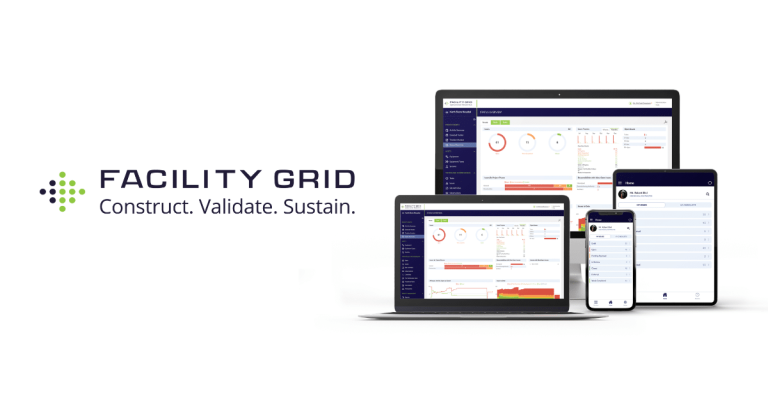
Facility Grid is a CRE-native commissioning and operational readiness platform used by building owners, commissioning providers, general contractors and trade contractors. It changes the workflow between equipment installation and owner acceptance, where asset records, checklists, functional tests, deficiencies and turnover documents often sit in separate spreadsheets or project systems. The product is most relevant to complex commercial buildings, particularly data centers, hospitals, universities, airports and large developments where incomplete commissioning can delay occupancy or operations.
The platform is organized into FG Construct, FG Validate and FG Sustain. Together, these products cover construction readiness, autonomous testing of building automation systems, energy audits and emissions reporting. That breadth distinguishes Facility Grid from narrower commissioning tools, although buyers should distinguish an integrated product family from a fully unified data model. BestCRE would require a demonstration using the buyer’s own equipment hierarchy, commissioning plan and building automation environment before accepting that all three modules operate as one continuous workflow.
Facility Grid reports more than 8,000 projects managed worldwide and a reduction of more than 25 percent in administrative tasks. Those are vendor claims, not independently audited results. The company also identifies Stack Infrastructure and refers to leading data center operators, but it does not publish enough customer-level outcome data to establish typical savings across property types. Its private equity backing from Nexa Equity gives it a different operating profile from an early-stage startup, while the acquisition of PingCx, now FG Validate, expands its reach into automated building-system verification.
Our analysis is that Facility Grid has a credible product thesis: commissioning should begin with structured asset readiness during construction and continue through operational testing, drift detection and sustainability work. The practical buying question is whether an organization needs that full lifecycle or only a better digital replacement for checklists and closeout binders. Facility Grid looks strongest when equipment volume, stakeholder count and turnover risk justify process standardization. It looks less compelling for uncomplicated projects, buyers seeking public pricing or teams without disciplined asset data and clear commissioning ownership.
What Facility Grid Does and How It Works
FG Construct creates a shared operational readiness record around building assets and systems. Teams can organize equipment, assign and complete checklists, track installation and quality-control status, manage punch items, conduct commissioning activities and prepare turnover information. Owners and project leaders can see which assets are ready, blocked or carrying unresolved work against the project schedule. Field users capture information through mobile applications for iPhone and iPad, while office teams monitor status and reporting. This replaces much of the manual reconciliation between spreadsheets, PDFs, email and contractor submissions. The important mechanic is the asset-centered record: tasks, evidence, issues and acceptance activities follow the equipment rather than remaining isolated in separate documents.
FG Validate connects to building automation systems and performs repeatable commissioning tests across the asset lifecycle. It is based on the acquired PingCx technology and is positioned as autonomous commissioning. In practice, that means software can run or support broader, more frequent QA and commissioning checks than a team could economically perform through manual point-by-point testing alone. The system is intended to identify control problems, performance drift and energy waste during construction and operations. Buyers should ask exactly which systems, protocols, sequences and equipment types are supported, what requires custom engineering, and whether detected conditions are recommendations or verified faults. Facility Grid does not publish enough validation methodology to treat every automated finding as conclusive without human review.
FG Sustain addresses work after turnover, including repeatable energy audits, annual emissions reporting and document processing. Facility Grid says AI is used to extract information, generate insights and reduce manual entry across workflows. The value depends heavily on source-document consistency, field mapping and review controls. Buyers should request measured extraction accuracy for their document classes and insist that every generated field remain traceable to its source. Across the suite, integrations include native bidirectional synchronization with Procore, Bluebeam workflows, Autodesk Build and Construction Cloud, Maximo, connections to CMMS products, and an open REST API with webhooks. The combined design can preserve construction records for operations, but implementation quality will determine whether that handoff becomes usable asset data or merely a larger digital archive.
9AI Framework: Dimension by Dimension Analysis
CRE Relevance: 9/10
Facility Grid earns a 9 for CRE relevance because its core objects and workflows are building assets, systems, commissioning activities, quality-control records, punch items and turnover requirements. It is not a general task manager adapted to construction. The platform addresses a costly coordination gap among owners, general contractors, trades and commissioning providers, then extends the resulting records into building operations. Its focus on data centers and other mission-critical properties further reinforces the fit, since readiness and functional performance directly affect opening schedules and operational risk. The score stops short of 10 because its applicability is concentrated in complex construction and building-system workflows. Many brokers, asset managers and owners of simpler properties will find little direct use for it, and the value outside commissioning-intensive assets is less evident. This score is BestCRE analysis.
Data Quality and Sources: 7/10
Facility Grid earns a 7 for data quality. Its asset-centered structure should produce cleaner commissioning records than disconnected spreadsheets, emails and static closeout files. Field capture, standardized checklists, BAS connections and continuity from construction to operations can improve completeness and preserve context around each asset. However, software structure does not guarantee accurate source data. Contractors still enter equipment details, completion states and evidence, while integrations must map identifiers consistently across project and operating systems. AI-based document processing introduces another review requirement because extracted fields can be wrong or attached to the wrong asset. The vendor does not publish independent benchmarks for extraction accuracy, data completeness or matching precision. Buyers should test duplicate handling, required-field controls, audit trails and source traceability before relying on the platform as an authoritative asset register. This score is BestCRE analysis.
Ease of Adoption: 7/10
Facility Grid earns a 7 for ease of adoption. The product maps to familiar commissioning activities, including checklists, issues, tests, punch work, reports and turnover, which should reduce conceptual friction for experienced project teams. Native mobile applications support field participation, and the Procore connection may reduce duplicate work for contractors already standardized on that environment. Adoption will still require more than account setup. Owners and commissioning leaders must define asset hierarchies, naming conventions, permissions, required evidence and responsibility for closing exceptions. Trade contractors also need consistent field participation, often under schedule pressure. The broader the deployment across Construct, Validate and Sustain, the more integration and change-management work buyers should expect. Facility Grid does not publish typical implementation timelines or training effort, so buyers should request a phased deployment plan tied to one representative project. This score is BestCRE analysis.
Output Accuracy: 7/10
Facility Grid earns a 7 for output accuracy. Structured commissioning status, checklist completion and issue reports can be dependable when required fields, approvals and audit trails are configured correctly. Automated BAS testing may improve consistency by repeating defined checks without the variability of manual execution. Still, an automated test result is only as reliable as the sequence definition, sensor quality, point mapping and operating context behind it. Drift alerts and energy-waste findings can also generate false positives when schedules, overrides or temporary conditions are not represented correctly. Facility Grid does not publish independent accuracy, false-positive or false-negative rates for FG Validate or its AI document processing. Buyers should therefore treat machine-generated findings as reviewable evidence rather than final acceptance decisions until performance is established on their buildings. This score is BestCRE analysis.
Integration and Workflow Fit: 8/10
Facility Grid earns an 8 for integration. The published ecosystem covers Procore with native bidirectional synchronization, Bluebeam, Autodesk Build and Construction Cloud, Maximo, CMMS handoff, an open REST API and webhooks. That is a useful mix for construction coordination, document review and facilities operations. BAS integration through FG Validate is particularly important because it connects administrative commissioning records with actual system behavior. The remaining risk is depth. A named integration does not establish which objects, attachments, statuses and custom fields move in each direction, how conflicts are resolved or how frequently data synchronizes. The broad claim of compatibility with any CMMS also requires project-specific validation. Buyers should obtain a field-level integration specification and test equipment identifiers, document links and issue closure before committing to enterprise rollout. This score is BestCRE analysis.
Pricing Transparency: 3/10
Facility Grid earns a 3 for pricing transparency. The vendor does not publish subscription prices, module prices, implementation fees, support tiers or standard contract terms. Prospective customers must request a demonstration and enter a sales process before they can compare total cost with other commissioning platforms. That approach may reflect project complexity, equipment counts and multiple user groups, but it makes early budgeting difficult and weakens direct comparison. Buyers should request separate pricing for FG Construct, FG Validate and FG Sustain, plus integration work, data migration, training, travel, premium support, storage, API usage and renewal increases. They should also clarify whether pricing follows projects, assets, buildings, users or portfolio size. Until those components are disclosed, buyers cannot determine whether the lifecycle suite is economical for limited deployments. This score is BestCRE analysis.
Support and Reliability: 6/10
Facility Grid earns a 6 for support. The company publishes access to a dedicated support team and maintains a knowledge base, which are useful foundations for a workflow that touches field teams, commissioning specialists and owners. Its focus on complex projects suggests familiarity with implementation demands beyond ordinary software onboarding. However, the vendor does not publish response-time commitments, service-level tiers, training entitlements, implementation staffing ratios or customer satisfaction measures. That absence matters because delayed configuration or integration support can affect active construction schedules. Buyers should establish named escalation paths, support hours, severity definitions and resolution targets in the contract. They should also determine who configures commissioning templates, validates BAS mappings and trains subcontractors joining after project launch. The available public evidence supports competence, but not a higher rating for consistently documented service performance. This score is BestCRE analysis.
Innovation and Roadmap: 9/10
Facility Grid earns a 9 for innovation. Its strongest idea is not digitizing checklists, which many competitors already do, but carrying structured commissioning data from construction readiness into automated controls testing, ongoing drift detection, energy audits and emissions work. The acquisition of PingCx and its conversion into FG Validate give the company a credible technical bridge between project administration and live building-system behavior. This can turn commissioning from a periodic documentation exercise into a recurring operational control. The score is tempered by evidence: the vendor does not publish enough technical evaluation data to show how broadly autonomous tests work across diverse BAS environments or how accurately its AI processes documents. Buyers should reward the architecture while independently validating the automation. This score reflects product direction and workflow design, not an assumption that every feature performs equally well in production.
Market Reputation: 7/10
Facility Grid earns a 7 for market reputation. The company presents a meaningful record in complex commissioning and reports worldwide project use, while its named relationship with Stack Infrastructure and emphasis on data centers support credibility in a demanding property segment. Private equity backing from Nexa Equity can provide operating resources and discipline, and the Procore Marketplace presence gives buyers a recognizable ecosystem reference. Public evidence is still thinner than the strongest construction platforms. Facility Grid does not publish detailed customer counts, retention, independently verified outcome studies or a broad set of named enterprise references with comparable results. Awards and vendor-reported scale help establish visibility but do not substitute for reference calls. Buyers should speak with owners, contractors and commissioning providers using the same modules on similar building types. This score is BestCRE analysis.
Who Should Use Facility Grid
Facility Grid best suits owners and developers delivering data centers, hospitals, laboratories, airports, campuses and other technically dense buildings. These buyers have thousands of assets, formal commissioning plans and meaningful financial exposure when systems are not ready at turnover. An owner seeking one record of installation status, functional testing, deficiencies, documentation and acceptance should consider the platform, particularly when the same team wants to continue monitoring performance after occupancy. Portfolio owners can gain additional value if they standardize templates, asset naming and reporting across projects rather than configuring every job independently.
Commissioning providers and general contractors are also strong buyer profiles. A commissioning firm can use the platform to standardize checklists, tests, issues and reporting while giving clients current visibility. A general contractor can coordinate trades and demonstrate readiness without manually consolidating updates. FG Validate is most relevant to teams with access to building automation data and enough controls expertise to interpret automated findings. The ideal buyer has an executive sponsor, a clear system administrator and contractual authority to require subcontractor participation. Without those conditions, even a well-designed commissioning platform can become another partial record beside existing project systems.
Who Should Not Use Facility Grid
Small owners, brokers and asset managers without active construction or formal commissioning programs should not buy Facility Grid merely for general project tracking. Simpler renovations may be handled adequately in an existing construction platform, issue tracker or commissioning tool with a narrower scope. The product is also a weak fit when the owner does not control contractor workflows, lacks a consistent equipment hierarchy or cannot secure access to BAS data. In those settings, the lifecycle proposition will be difficult to realize.
Buyers demanding immediate self-service procurement or transparent price comparison should look elsewhere because Facility Grid does not publish pricing. Organizations seeking photogrammetric site capture, autonomous schedule optimization or development financial management should also choose a specialist. OpenSpace, ALICE Technologies and Northspyre address those distinct problems more directly. Finally, teams should avoid FG Validate if they are unwilling to validate point mappings, test logic and exception handling. Automated commissioning can expand coverage, but it does not remove the need for qualified engineering judgment or formal acceptance governance.
Pricing and ROI Analysis
Facility Grid does not publish pricing for FG Construct, FG Validate or FG Sustain. It also does not publish standard implementation charges, minimum commitments, contract length, training fees or integration costs. Buyers should expect a quoted sale shaped by project scope and should insist on a total-cost schedule covering configuration, data migration, templates, BAS connections, API work, support and renewals. Comparable bids should use the same assumptions for project count, equipment volume, users, buildings and required modules. A pilot price should include conversion into production rather than leaving that work for a later change order.
BestCRE analysis: calculate ROI from avoided labor and reduced delay exposure, not broad efficiency claims. Suppose a project has eight team members who each spend five hours per week reconciling commissioning records for 40 weeks. At a fully loaded labor cost of $90 per hour, the addressable administrative cost is $144,000. If Facility Grid removes 20 percent of that work, the modeled labor benefit is $28,800. This is an illustrative scenario, not a Facility Grid result. Add only delay, rework or energy savings that the buyer can document and attribute. Compare that conservative benefit with the complete first-year cost, then run a downside case where adoption reaches only half the expected level.
Integration and CRE Tech Stack Fit
Facility Grid fits best between the construction management system and the owner’s operating stack. Procore synchronization can connect project coordination with commissioning status, while Bluebeam and Autodesk connections address drawings, markup and construction records. Maximo support and CMMS handoff can move accepted asset information toward facilities management. The REST API and webhooks provide options for portfolio reporting or specialized systems. FG Validate adds a separate operational layer by connecting to building automation systems for testing and ongoing performance checks.
Integration diligence should focus on data behavior, not logo coverage. Buyers should identify the system of record for every asset field, define identifier ownership and document how changes flow after turnover. A proof of concept should test new assets, renamed equipment, attachments, issue status, approvals and rejected updates. For BAS work, validate point discovery, mapping, credentials, network security and the treatment of overrides. Facility Grid reports SOC 2 compliance, but buyers should still review the current report, scope, exceptions, data residency and subcontractors through their own security process.
Competitive Landscape
Procore is the clearest alternative for organizations that want commissioning activities to remain inside a broad construction management environment. It offers greater general project coverage and may reduce vendor sprawl, while Facility Grid is more specialized around asset readiness, commissioning and continuity into operations. CxAlloy, Bluerithm and CxPlanner are closer functional comparisons for commissioning providers and owners evaluating checklist, test, issue and reporting workflows. Buyers should compare template control, offline field use, report flexibility, owner visibility and the effort required to structure equipment data.
OpenSpace is not a direct commissioning replacement. It is stronger when the core requirement is visual site capture and progress documentation. ALICE Technologies focuses on construction planning and schedule simulation, while Northspyre focuses on development project controls and financial oversight. These products may complement Facility Grid because they solve different parts of the development workflow. Autodesk Build can also be considered when a buyer prioritizes consolidation within Autodesk Construction Cloud over commissioning specialization.
Facility Grid becomes the stronger candidate when the buying objective spans readiness tracking, formal commissioning, automated BAS testing and post-turnover performance. Its weakness is commercial and evidentiary transparency. Competitors with narrower scopes may be easier to evaluate, deploy or price. A serious selection should use one representative system, such as chilled water or emergency power, and require each vendor to demonstrate asset import, field completion, deficiency management, functional testing, reporting and final handoff with the buyer’s own data.
The Bottom Line
Facility Grid should make the shortlist for complex building programs where commissioning quality affects opening dates, operational reliability or energy performance. Its combination of construction readiness, automated controls validation and sustainability workflows is unusually coherent for a CRE-specific platform. BestCRE would favor it over a generic project tool when the owner intends to preserve asset-level commissioning records and use them after turnover.
Do not approve an enterprise purchase on product breadth alone. Require a paid or contractually defined pilot, field-level integration documentation, reference calls for the same property type and measured results from FG Validate using the buyer’s BAS environment. Pricing must be evaluated as a complete first-year and renewal cost. If Facility Grid proves reliable on one critical system and contractors actually maintain the records, it can become valuable lifecycle infrastructure. If those conditions are absent, buy a narrower commissioning product and keep the implementation simpler.
About BestCRE
BestCRE.com is the definitive authority on commercial real estate AI, analysis, and investment intelligence. Every article advances the platform’s mission to help CRE professionals identify, evaluate, and adopt the best tools and strategies in the industry. We benchmark platforms using the 9AI Framework so CRE leaders can compare tools with clear evidence. Explore the category map at 20 CRE sectors for deeper coverage across the CRE stack.
Frequently Asked Questions
What is Facility Grid?
Facility Grid is commissioning and operational readiness software for complex commercial buildings. Owners, general contractors, trade contractors and commissioning providers use it to organize equipment records, complete checklists, track quality-control work, manage deficiencies, document functional tests and prepare assets for turnover. Its product family includes FG Construct for construction readiness and commissioning management, FG Validate for automated testing through building automation systems, and FG Sustain for energy audits, emissions reporting and document processing. The platform is particularly relevant to data centers, hospitals, universities, airports and large developments where building-system failures or incomplete records can delay operations. It is a specialized CRE and construction product, not a general property management, brokerage or development accounting system.
How does Facility Grid compare with Procore and CxAlloy?
Facility Grid is more specialized than Procore and broader across the building lifecycle than a conventional commissioning management product. Procore covers a much wider range of construction workflows, making it attractive for teams that prioritize one central project platform. Facility Grid focuses more deeply on equipment readiness, commissioning evidence, turnover and continued performance. CxAlloy is a closer alternative for buyers centered on commissioning checklists, tests, issues and reporting. Facility Grid’s distinguishing proposition is FG Validate, which extends into automated BAS testing, drift detection and energy-waste identification, plus FG Sustain for later operational work. Buyers should compare the products using their own asset hierarchy and functional tests because feature labels do not establish workflow depth, integration quality or reporting accuracy.
How much does Facility Grid cost?
Facility Grid does not publish prices for its products. Public information does not establish subscription levels, per-project charges, user fees, equipment-based pricing, implementation costs or minimum contract terms. A buyer should request an itemized quote for each required module and separate recurring software from one-time services. The quote should address configuration, template development, data migration, mobile access, Procore or CMMS integration, BAS connectivity, API use, training, support, storage and renewal adjustments. Compare proposals using a fixed project profile so vendors price the same number of buildings, systems, assets and participants. The contract should also define what happens when a project ends, including data access, exports, archival charges and the cost of carrying records into operations.
Who should use Facility Grid?
Facility Grid suits owners, commissioning providers and contractors responsible for technically complex buildings with formal readiness and acceptance requirements. The strongest candidates manage data centers, healthcare facilities, campuses, airports or major commercial projects containing large quantities of mechanical, electrical and controls equipment. It is particularly useful when multiple trades must submit structured evidence and the owner wants commissioning records to remain useful after construction. A successful buyer should have standardized asset naming, a defined commissioning plan, an internal administrator and authority to require field participation. Small projects with limited building systems may not justify the configuration and integration effort. Organizations seeking general construction management, visual progress capture or development accounting should consider tools designed specifically for those purposes.
Can Facility Grid become the system of record for lifecycle commissioning?
Facility Grid has the product architecture to become a lifecycle commissioning record, but that outcome depends on implementation rather than branding. FG Construct can establish the asset, evidence and acceptance history, while FG Validate can add operating test results and FG Sustain can support later energy and reporting work. To make that continuity credible, an owner must govern identifiers, required fields, approvals, document retention and synchronization with the CMMS and BAS. The organization should also define whether Facility Grid or another platform remains authoritative after turnover. Looking toward future deployments, buyers should ask for versioned test logic, traceable AI outputs, portfolio-level benchmarking and clear export rights. The opportunity is significant, but the vendor still needs stronger public evidence showing consistent, long-term use across complete building lifecycles.
Related Reviews
Compare Facility Grid with other tools BestCRE has scored in the same category: Civils.ai, Field Materials, Attentive.ai. Explore more CRE AI tool reviews in our Best CRE AI Tools directory. For sector-specific analysis and market intelligence, visit our 20 CRE Sectors hub.