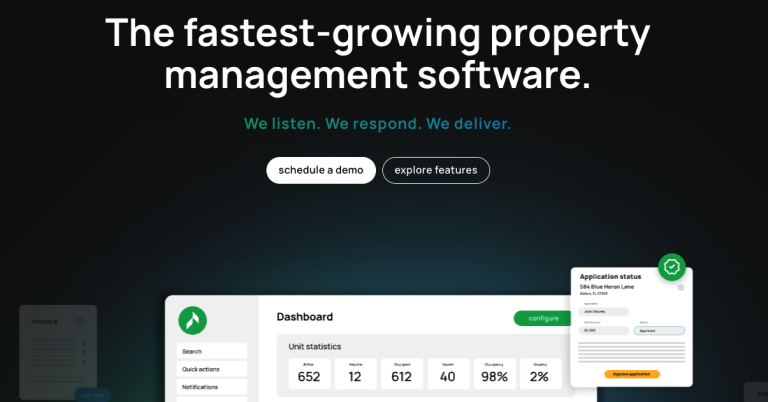
Rentvine is cloud property management and accounting software designed primarily for professional residential property managers and landlords. It changes the operating workflow around rent collection, trust accounting, owner reporting, leasing and maintenance by placing those functions in one system. For commercial real estate buyers, the important qualification is product fit: Rentvine addresses recurring property administration well, but it is not presented as a dedicated platform for office, retail, industrial or other complex commercial assets.
The product covers accounting, payments, owner statements, properties, maintenance, portals, screening, marketing, electronic signatures, customer relationship management, reports and configurable workflows. Its accounting proposition centers on integrated trust accounting rather than an external accounting package or loosely connected ledger. Rentvine also promotes financial onboarding assistance, including initial reconciliation support, which matters because data conversion and opening balances are common sources of risk during a property management system migration.
Rentvine’s clearest technical differentiator is its combination of an open application programming interface and a Model Context Protocol server. The vendor positions these capabilities as a foundation for connecting portfolio data with AI agents, external applications and custom automations. That architecture is more consequential than adding a generic chat window to an established product. However, buyers still need to test permission controls, record level accuracy, approval steps and auditability before allowing an AI workflow to initiate accounting or tenant facing actions.
BestCRE’s analysis is that Rentvine deserves consideration from residential operators whose requirements sit near the commercial market, particularly mixed rental businesses with standardized leases and centralized accounting. It is less persuasive for institutional CRE teams that require sophisticated lease abstraction, recoveries, percentage rent, tenant sales reporting or asset management analytics. The vendor publishes product scope and its pricing structure at a high level, but not the actual subscription rates needed to calculate ownership cost without a sales conversation.
What Rentvine Does and How It Works
At its core, Rentvine maintains property, unit, tenant, owner and financial records in a shared cloud database. Staff can collect rent, process payments, maintain ledgers, reconcile accounts, prepare owner statements and schedule reports without moving the same information among separate operational systems. Dashboards and custom fields allow managers to adapt views and capture portfolio specific information. The product also supports portfolios and pods, suggesting that larger managers can divide responsibility across teams or books of business. Rentvine says pricing scales with active units, and new accounts require at least 30 units. Buyers should confirm how inactive units, commercial spaces, associations and ancillary assets are counted.
The operational modules extend from marketing and screening through leasing, electronic signatures and resident portals. Maintenance functionality allows tenants and vendors to coordinate work, reducing the number of routine updates handled manually by a property manager. Rentvine also provides mobile access, global search, reporting and workflow tools. These mechanics can reduce duplicate entry when the organization adopts the platform as its system of record. The practical limitation for CRE is depth rather than breadth. The published product description does not establish specialized support for commercial lease clauses, recoveries, complex tenant billing or capital project administration, so those requirements should be demonstrated using the buyer’s own leases and accounting scenarios.
Rentvine lists AI tools, Rentvine AI MCP, Rentvine Cru and RentFinder.ai within its platform offering. The open interface and MCP server are intended to let authorized software or AI agents interact with Rentvine data and functions. That could support natural language retrieval, workflow automation and connections to a manager’s preferred AI stack. Exact model providers, evaluation results, error rates and the boundaries of autonomous actions are not published. BestCRE’s analysis is that the architecture is promising, but architecture alone does not prove reliable production outcomes. A procurement test should examine source citations, access scopes, approval requirements, logs, data retention and recovery when an automated action is incorrect.
9AI Framework: Dimension by Dimension Analysis
CRE Relevance: 6/10
Rentvine scores 6 for CRE relevance because it performs genuine real estate operating work but is built primarily for residential property management companies and landlords. Rent collection, accounting, owner reporting, maintenance and leasing all matter in commercial operations, especially for smaller mixed portfolios. The limitation is the absence of publicly established depth in commercial lease administration, common area maintenance reconciliation, percentage rent, tenant sales reporting, critical dates and asset level investment analysis. A manager of standardized residential rentals may find broad coverage, while an office or retail operator could encounter material gaps. BestCRE’s analysis is that Rentvine is CRE adjacent rather than a direct institutional commercial platform. The score recognizes meaningful property operations capability without treating residential functionality as equivalent to specialized CRE functionality.
Data Quality and Sources: 7/10
Rentvine scores 7 for data quality. Accounting, property, owner, tenant, payment and maintenance information appears to reside within one operating platform, which can reduce reconciliation problems caused by fragmented records. Custom fields, global search and direct reporting also give operators mechanisms to capture and retrieve portfolio information. The open interface may help keep connected systems synchronized, although actual results depend on implementation discipline and integration design. The vendor does not publish independent data quality benchmarks, completeness rates or AI retrieval evaluations. Buyers should therefore test migrated balances, entity relationships, duplicate handling and report totals against their existing books. BestCRE’s analysis is that the underlying integrated data model is a sound basis for property management, but there is insufficient public evidence to award a top tier score for governed, institutionally validated data.
Ease of Adoption: 8/10
Rentvine scores 8 for ease of adoption. Its product scope follows familiar property management workflows, and the vendor describes dedicated financial onboarding, help with opening reconciliations and substantial setup assistance. A unified product for leasing, accounting and maintenance can also reduce the number of interfaces employees must learn. Portals, dashboards, mobile access and configurable fields should make common tasks approachable for property managers already accustomed to cloud software. Migration remains a consequential project because trust balances, tenant ledgers, owner records and payment settings must be correct at launch. The vendor does not publish typical implementation duration or independently verified adoption metrics. BestCRE’s analysis is that Rentvine appears easier to deploy than a heavily customized enterprise suite, but buyers should require a conversion plan, parallel reconciliation and role based training before committing to a cutover.
Output Accuracy: 7/10
Rentvine scores 7 for output accuracy. Its accounting design is intended to keep trust accounting, payments, reconciliations and owner statements within the same ledger environment. That arrangement can improve consistency because reports derive from operational transactions rather than manually assembled exports. Scheduled reports and configurable dashboards can further standardize recurring output. Still, the vendor does not publish audited accuracy rates, AI evaluation results or error statistics. AI generated responses and agent actions should not be assumed correct simply because they access first party portfolio data. BestCRE’s analysis is that conventional accounting outputs should be dependable when configuration and opening balances are correct, while AI outputs require separate controls. Buyers should test a representative reporting period, trace statement amounts to transactions and require human approval for any AI initiated payment, posting or external communication.
Integration and Workflow Fit: 9/10
Rentvine scores 9 for integration because openness is central to the product rather than an incidental connector strategy. The platform advertises an open application programming interface, integrations and an MCP server that can expose authorized Rentvine capabilities to AI agents and custom tools. This gives technically capable operators more options for connecting communications, analytics, maintenance vendors and internal automation. It may also reduce dependence on the vendor’s own AI interface. Public availability of an interface does not guarantee that every record and action is supported, however. Buyers must inspect documentation, authentication, rate limits, webhooks, sandbox access, versioning and fees. BestCRE’s analysis is that the architecture compares favorably with many closed property management systems, although the score reflects integration potential and stated access, not proof that every commercial real estate application connects without custom engineering.
Pricing Transparency: 5/10
Rentvine scores 5 for pricing transparency, the maximum available when a vendor does not publish actual prices. The company explains that charges are based on active unit count and that new accounts begin with a 30 unit minimum, a monthly platform fee and applicable transaction and screening fees. That gives buyers useful information about the billing model, but not enough to calculate total annual cost. Public dollar rates for the core subscription, implementation, data migration, payments, screening and optional services are not published. BestCRE’s analysis is that the structure is clearer than a completely opaque enterprise quote, yet buyers still need a proposal to compare Rentvine with alternatives. Procurement should request a full fee schedule, renewal terms, minimum commitments, implementation charges, payment economics and the treatment of inactive or mixed use units.
Support and Reliability: 8/10
Rentvine scores 8 for support. The vendor promotes access to human assistance, a knowledge base, account specialists and financial onboarding support. It also states an average response time of 35 minutes, although BestCRE has not independently verified that claim and buyers should ask how it is measured. The emphasis on initial reconciliation is particularly relevant because accounting conversion is where property management implementations often fail. Support quality after launch can vary by issue severity, staffing and contract tier, and the vendor does not publish a complete service level agreement on its public site. BestCRE’s analysis is that support appears to be a meaningful part of the offer rather than a secondary channel. References should still be asked about complex accounting cases, escalation ownership, weekend coverage and response quality during payment or closing periods.
Innovation and Roadmap: 9/10
Rentvine scores 9 for innovation. Its strongest idea is not merely attaching generative AI to the interface, but pairing an open application programming interface with an MCP server intended for AI agents and custom workflows. That design can give an operator more choice over models, applications and automation patterns while keeping property data connected to the system of record. The platform also presents named AI products within leasing and broader operations. The remaining question is operational maturity. The vendor does not publish benchmark results, adoption rates, security evaluations or detailed examples establishing how frequently agents complete sensitive workflows without correction. BestCRE’s analysis is that Rentvine is taking an unusually forward looking architectural approach for property management software. The score rewards the design direction, while recognizing that buyers must validate real controls and outcomes rather than purchase on AI positioning alone.
Market Reputation: 6/10
Rentvine scores 6 for market reputation. It has a visible product presence, customer testimonials and a defined position among professional residential property managers. It competes in an established market against recognized platforms including AppFolio, Buildium, DoorLoop and Propertyware. However, the vendor does not publish enough independently verifiable information about customer count, managed unit volume, financial scale or retention to support a higher score. Its claim of being the leading or highest rated platform should be evaluated against the methodology, sample and date behind each rating source. BestCRE’s analysis is that Rentvine has credible market traction but has not yet established the broad public footprint of the category’s largest incumbents. Buyers should speak with references similar in portfolio size, accounting complexity and operating model, especially if considering a large or mixed commercial deployment.
Who Should Use Rentvine
Rentvine best suits professional residential property management companies that have outgrown spreadsheets or fragmented point solutions and want accounting, leasing, maintenance and owner reporting in one system. It is particularly relevant for operators that treat trust accounting as the center of the workflow and want guided financial onboarding. Firms with internal technical resources may extract additional value from the open interface and MCP server by connecting analytics, communications or AI workflows. The minimum account threshold also makes the product more appropriate for operating businesses than for an individual landlord with a handful of rentals.
Within CRE, the strongest candidates are residential focused managers, scattered site rental operators and mixed portfolios whose commercial requirements are limited and standardized. A buyer that wants control over its data and expects to build integrations should place Rentvine on the shortlist. BestCRE’s analysis is that the product becomes more attractive when workflow flexibility and data access carry greater weight than specialized commercial lease functionality. Before purchase, these buyers should run a scripted demonstration covering reconciliation, owner distributions, maintenance approvals, leasing, reporting and at least one real integration.
Who Should Not Use Rentvine
Rentvine is not the natural choice for institutional office, retail or industrial operators that depend on commercial lease abstraction, complicated escalation schedules, expense recoveries, percentage rent or tenant sales reporting. The public product description does not demonstrate those capabilities at the depth such portfolios require. Owners seeking investment management, fund accounting, valuation, deal pipeline or portfolio performance modeling will also need other systems. Adding custom fields is not an adequate substitute for a purpose built commercial lease and asset data model.
Very small landlords fall outside the product’s stated new account minimum and may find simpler products more economical. Organizations without resources to govern integrations or AI access may also capture less value from Rentvine’s technical openness. BestCRE’s analysis is that buyers wanting a large, proven enterprise ecosystem or extensive public performance evidence should compare established alternatives carefully. A commercial operator should not assume residential workflows will transfer cleanly merely because both businesses collect rent and manage maintenance.
Pricing and ROI Analysis
Rentvine does not publish actual subscription prices. It states that pricing is based on active units and that new accounts carry a 30 unit minimum, a monthly platform fee and applicable transaction and screening charges. Public rates for implementation, migration, payments, optional accounting services and other add ons are not available. Buyers should obtain a written quote that separates recurring software charges from usage fees and one time conversion costs. The quote should also define annual increases, contract length, cancellation terms, data export, support entitlements and whether commercial spaces or inactive units affect billing.
Analysis: a simple return test should divide total annual ownership cost by the fully loaded hourly cost of the employees whose work the platform reduces. If software, implementation and payment related charges total C, and each saved staff hour is worth H, the required annual time savings is C divided by H. A buyer can then compare that threshold with measured time spent on reconciliation, duplicate entry, owner statements, maintenance coordination and reporting. No savings should be credited until a workflow owner identifies the exact step removed. Revenue improvements from faster leasing or collections should be modeled separately and discounted for uncertainty.
Integration and CRE Tech Stack Fit
Rentvine should fit well in a modern residential property technology stack because it offers an open application programming interface, named integrations and an MCP server. These components can support data exchange with external applications, custom reporting and AI agents. The platform’s claim that customers retain access to their data for 12 months after cancellation also reduces one common switching concern, although buyers should confirm export formats, attachments and availability contractually. Public materials do not establish that every endpoint or bulk export is included without extra fees.
Commercial operators should map required systems before selecting it. Accounting exports, banking, screening, websites, communications, business intelligence and maintenance partners may be workable, while commercial lease administration or asset management systems could require custom connections. BestCRE’s analysis is that Rentvine provides an unusually favorable technical starting point, but implementation effort depends on endpoint coverage and data semantics. A proof of concept should move actual records in both directions, test error handling and verify that permissions prevent an AI agent from accessing properties or financial actions outside its assigned role.
Competitive Landscape
DoorLoop is the clearest alternative for buyers prioritizing an accessible all around property management platform, and BestCRE scored it 93 in this category. AppFolio, scored 86, offers a broader established platform and market presence for residential operators, but buyers should compare pricing, implementation complexity and data access. Buildium is another familiar option for residential managers seeking accounting, leasing and resident operations. Propertyware remains relevant for single family property managers with portfolio specific requirements.
Rentvine’s competitive case is strongest when trust accounting, onboarding support and an open technical architecture rank above incumbent scale. Its MCP server distinguishes it from vendors whose AI functionality is available only through closed, vendor controlled interfaces. That distinction has value for operators building their own workflows, but only after security and action controls are validated. DoorLoop may appeal more to a buyer seeking rapid standardization, while AppFolio may appeal more to a firm prioritizing ecosystem breadth and an established market footprint.
For dedicated commercial real estate, VTS and Yardi Virtuoso, each scored 82 by BestCRE, address different needs and should not be treated as direct residential property management substitutes. VTS is more relevant to leasing and tenant activity in commercial portfolios. Yardi’s broader environment is more credible for complex property types and accounting structures. BestCRE’s analysis is that Rentvine can outperform larger systems on openness and approachability, but it should lose a commercial procurement process when specialized lease administration is a central requirement.
The Bottom Line
Rentvine belongs on the shortlist for professional residential managers that want integrated trust accounting and operational software without giving up technical access to their data. Its open interface and MCP server make the AI strategy more credible than a superficial assistant layered onto a closed platform. The buyer should still demand proof that automation is controlled, logged and accurate within its own accounting structure.
For mainstream commercial property operations, do not select Rentvine until it passes a lease and reporting demonstration built from actual portfolio examples. BestCRE’s analysis is that the product is a strong residential operating platform with credible AI architecture, not a complete institutional CRE system. Proceed when the portfolio is residential led and workflow openness matters. Choose a commercial specialist when recoveries, complex clauses, asset management or fund reporting determine the purchase.
About BestCRE
BestCRE.com is the definitive authority on commercial real estate AI, analysis, and investment intelligence. Every article advances the platform’s mission to help CRE professionals identify, evaluate, and adopt the best tools and strategies in the industry. We benchmark platforms using the 9AI Framework so CRE leaders can compare tools with clear evidence. Explore the category map at 20 CRE sectors for deeper coverage across the CRE stack.
Frequently Asked Questions
What is Rentvine property management software?
Rentvine is cloud software for professional residential property managers and landlords. It combines trust accounting, payments, owner statements, leasing, electronic signatures, tenant screening, maintenance, portals, reports and configurable workflows in one platform. It also offers an open application programming interface and an MCP server intended to connect Rentvine data and functions with external software, custom automations and AI agents. The product is relevant to commercial real estate only at the adjacent edge of the market. Standardized mixed portfolios may use many of its capabilities, but the vendor does not publicly demonstrate the specialized lease administration, recoveries and asset management depth expected by complex office, retail or industrial operators.
How does Rentvine compare with AppFolio and DoorLoop?
Rentvine competes directly with AppFolio and DoorLoop across residential accounting, leasing, payments, maintenance and reporting. Rentvine’s notable distinction is its emphasis on trust accounting, an open application programming interface and an MCP server for AI and custom workflows. AppFolio has a broader established market presence and product ecosystem, while DoorLoop is a strong contender for operators prioritizing approachable, consolidated property management. BestCRE scored DoorLoop 93 and AppFolio 86 in this category. Product scores alone should not decide the purchase because portfolio type and accounting complexity matter. Buyers should compare all three using the same migrated ledger, owner statement, maintenance request and integration test, then assess total contract cost and implementation obligations.
How much does Rentvine cost?
Rentvine does not publish actual dollar prices on its public site. The vendor says pricing is based on the number of active units under management. New accounts begin at a minimum of 30 units and include a monthly platform fee, with applicable transaction and screening charges. Public rates for the core subscription, onboarding, migration, payments and optional services are not available. A serious quote comparison should request each fee separately, along with contract length, renewal increases, minimum commitments and cancellation provisions. Buyers should also confirm how inactive units, mixed use properties, commercial spaces and transferred portfolios are counted. BestCRE’s analysis is that the billing basis is understandable, but pricing remains insufficiently transparent for budget approval without direct vendor contact.
Who should use Rentvine?
Rentvine is best suited to professional residential property management companies that need centralized trust accounting, owner reporting, rent collection, leasing and maintenance. It should be especially attractive to growing managers that want implementation support and the ability to connect their property records with outside applications or internally developed automation. Residential led mixed portfolios may also be suitable when their commercial leases are simple and do not require specialized calculations. It is not the strongest fit for individual landlords below the stated account minimum or institutional commercial operators with complicated expense recoveries, percentage rent, lease clauses, fund accounting or asset management requirements. Those buyers should examine purpose built commercial platforms and require demonstrations using their actual leases before selecting any system.
Will Rentvine’s AI tools replace existing property management workflows?
Rentvine’s AI direction could change how managers search portfolio information, initiate routine workflows and connect external agents to their property management system. Its open application programming interface and MCP server provide a more flexible foundation than a closed assistant, because operators may be able to choose their own tools and automation patterns. The future value will depend on controls rather than access alone. Rentvine does not publish comprehensive benchmark results, production error rates or detailed limits for autonomous actions. BestCRE’s analysis is that buyers should expect gradual workflow augmentation, beginning with retrieval, drafting and low risk routing. Financial postings, payments, lease decisions and tenant communications should retain defined approval steps until the operator has measured accuracy, audit coverage and exception handling with its own data.
Related Reviews
Compare Rentvine with other tools BestCRE has scored in the same category: DoorLoop, Entrata, Moved. Explore more CRE AI tool reviews in our Best CRE AI Tools directory. For sector-specific analysis and market intelligence, visit our 20 CRE Sectors hub.