The commercial real estate appraisal industry is approaching a structural inflection point. The Appraisal Institute reports that more than 10,000 appraisers have left the profession over the past nine years, and approximately half of those remaining are nearing retirement age. CBRE’s Valuation and Advisory division processes thousands of assignments annually across all commercial asset classes, yet turnaround times for complex CRE appraisals regularly stretch to four to six weeks in secondary markets where appraiser availability is most constrained. The Interagency Appraisal and Evaluation Guidelines require USPAP-compliant valuations for federally regulated lending transactions, creating a regulatory floor beneath which technology cannot substitute for credentialed human judgment. For lenders and investors operating in regional markets across the Gulf Coast and Southeast, the combination of appraiser scarcity, rising appraisal costs (reaching $800 or more for complex assignments), and compressed lending timelines creates urgent demand for firms that can deliver MAI-certified quality with technology-enhanced speed.
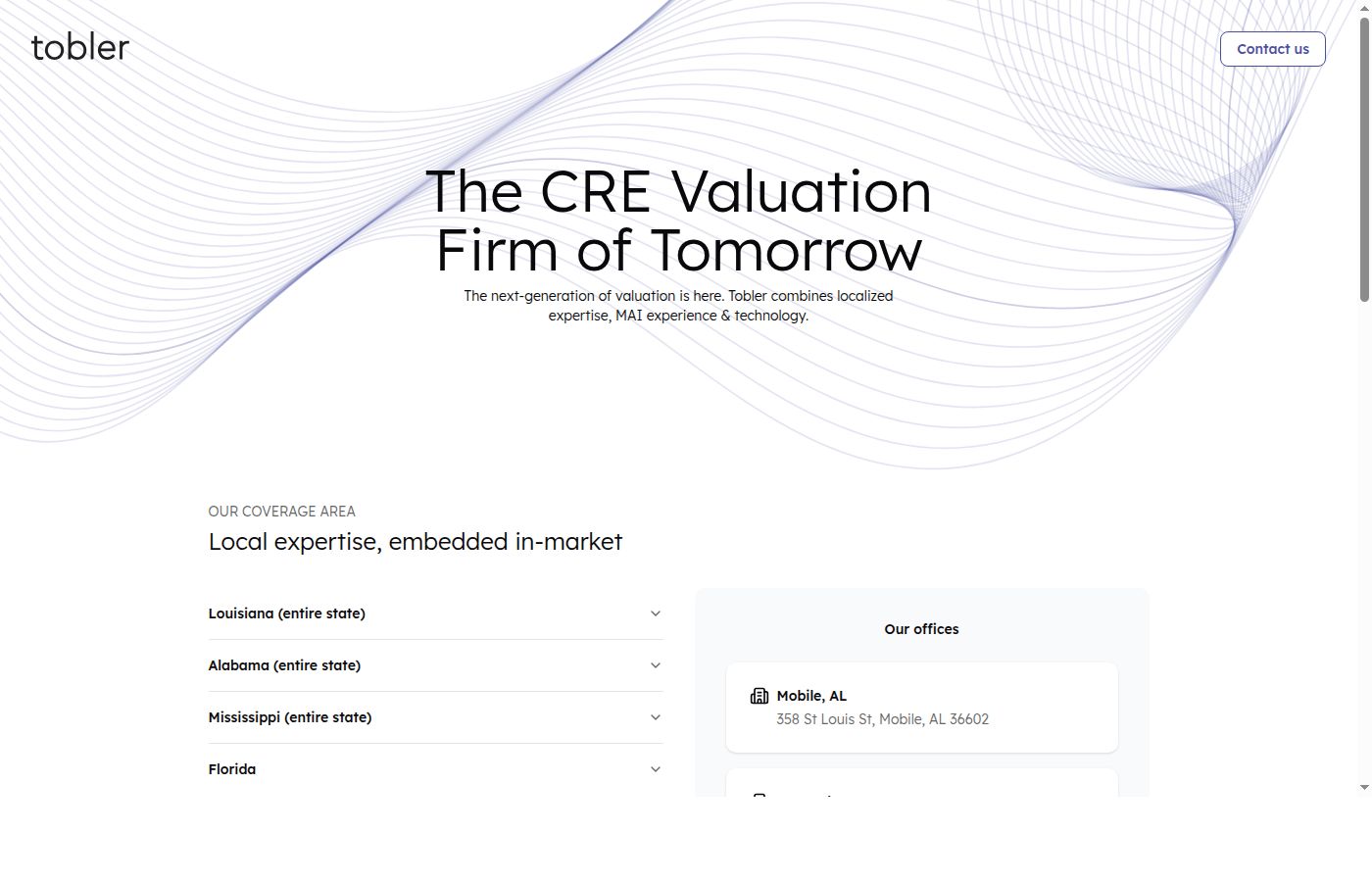
Tobler Valuation is a commercial real estate appraisal firm headquartered in the Gulf Coast region, serving Louisiana, Alabama, Mississippi, and Florida with MAI-certified valuation products. Unlike SaaS platforms that provide automated valuation models, Tobler operates as a technology-augmented appraisal practice that embeds seasoned appraisers in each regional market and equips them with proprietary productivity tools and AI-enhanced data aggregation workflows. Every report is USPAP-compliant, digitally assembled, and signed by an MAI-designated professional. The firm’s service model targets lenders and investors who need institutional-quality appraisals delivered faster and at lower cost than traditional appraisal firms, without sacrificing the analytical rigor that MAI designation represents.
BestCRE assigns Tobler Valuation a 9AI Score of 62/100, reflecting strong CRE relevance and output quality through MAI certification and USPAP compliance, balanced by its positioning as a regional service firm rather than a scalable technology product, limited geographic coverage, and the inherent constraints of a service-based model in a framework designed primarily for software platforms.
This review is part of BestCRE’s systematic coverage of commercial real estate AI tools across 20 CRE sectors. For the full AI tools directory, see our Best CRE AI Tools hub.
What Tobler Valuation Does and How It Works
Tobler Valuation operates at the intersection of traditional MAI-certified appraisal practice and modern technology-enabled workflow optimization. The firm’s approach differs fundamentally from automated valuation model (AVM) platforms like HouseCanary or PriceHubble: rather than generating algorithmic property estimates, Tobler produces full narrative appraisal reports and evaluations that carry the legal weight and regulatory compliance required for commercial lending transactions. The technology layer accelerates the appraiser’s workflow rather than replacing the appraiser’s judgment.
The firm’s proprietary productivity tools handle the most time-consuming components of appraisal production: data aggregation from multiple sources, comparable transaction identification and analysis, market condition documentation, and digital report assembly. AI-enhanced data aggregation automates the collection and organization of property records, transaction histories, market statistics, and regulatory information that traditionally requires manual research across multiple databases. This automation compresses the time between engagement and delivery, enabling Tobler to offer turnaround timelines that competitors using purely manual workflows cannot match without sacrificing quality.
The regional embedding strategy is central to Tobler’s value proposition. By stationing MAI-certified appraisers in Louisiana, Alabama, Mississippi, and Florida, the firm combines hyperlocal market knowledge with centralized technology infrastructure. Each appraiser brings deep familiarity with regional transaction patterns, local economic drivers, and market-specific valuation considerations that national appraisal management companies often lack in secondary and tertiary markets. The firm handles a range of assignment types from concise evaluations for smaller loan transactions to comprehensive appraisals for complex commercial assets, including tax credit valuations for historic redevelopment and Low-Income Housing Tax Credit (LIHTC) projects. Notable assignments include a 3.5 million square foot former GM production plant in Shreveport repurposed for multi-tenant industrial use, a former bank headquarters in Mobile converted to mixed office, retail, and residential, and scattered maritime and industrial leasehold assets for Edison Chouest in Port Fourchon. The ideal client profile includes regional and community banks originating commercial real estate loans in Gulf Coast markets, institutional investors conducting due diligence on Southeast acquisition targets, developers seeking tax credit valuations for adaptive reuse projects, and lenders requiring FIRREA-compliant appraisals with accelerated turnaround in markets where appraiser availability is constrained.
9AI Framework: Dimension-by-Dimension Analysis
CRE Relevance: 9/10
Tobler Valuation is 100 percent focused on commercial real estate appraisal, making it one of the most directly CRE-relevant entities in the 9AI review universe. Every product the firm delivers serves a specific CRE workflow: loan origination, acquisition due diligence, portfolio valuation, tax credit assessment, or disposition analysis. The MAI designation represents the highest professional credential in CRE appraisal, and the firm’s USPAP compliance ensures that outputs meet the regulatory standards required by federally regulated lending institutions. The relevance extends to complex, specialized asset types that generic technology platforms cannot address: industrial repurposing, maritime leaseholds, LIHTC projects, and mixed-use conversions in secondary markets. The single point deduction reflects that Tobler is a service firm rather than a technology product, which limits scalability and self-serve accessibility. In practice: lenders and investors in Gulf Coast markets receive appraisal products that are purpose-built for CRE lending and investment decisions, with MAI certification that carries legal and regulatory weight.
Data Quality and Sources: 7/10
Data quality reflects the combination of proprietary technology aggregation and professional appraiser judgment. Tobler’s AI-enhanced data workflows aggregate property records, transaction histories, and market statistics from multiple sources, but the specific data vendors and coverage depth are not publicly disclosed. The strength of the data quality lies in the human overlay: MAI-certified appraisers in each market verify, contextualize, and interpret data through the lens of local market expertise that automated systems cannot replicate. Comparable selection, condition adjustments, and market condition analysis all benefit from the appraiser’s firsthand knowledge of properties and transactions in their coverage area. The limitation is transparency: prospective clients cannot evaluate the data infrastructure independently because the firm does not publish its technology stack, data sources, or methodology documentation in the way that SaaS platforms typically do. In practice: the data quality is validated by the MAI credential and USPAP compliance requirements, which impose professional standards on data sourcing and verification that exceed what most technology platforms offer.
Ease of Adoption: 6/10
Adopting Tobler Valuation means engaging a professional services firm, not subscribing to a software platform. The onboarding process involves initial engagement discussions, scope definition for each assignment, and the establishment of ongoing client relationships for repeat business. This is fundamentally different from the self-serve onboarding that SaaS platforms offer, where users can create accounts and begin generating outputs within hours. For lenders who already have established appraisal vendor relationships and procurement processes, adding Tobler to their approved vendor panel is a familiar workflow. For firms seeking on-demand, self-serve access to valuation outputs, the service model introduces higher friction than automated platforms. The geographic limitation to four Gulf Coast states means that firms with national or multi-regional coverage requirements will need to maintain separate appraisal vendor relationships outside Tobler’s coverage area. In practice: adoption is straightforward for lenders and investors who need traditional appraisal services in Gulf Coast markets, but the service-based engagement model is less convenient than the instant access that technology platforms provide.
Output Accuracy: 8/10
Output accuracy benefits from the combination of MAI certification, USPAP compliance, and regional market expertise. MAI-designated appraisers have demonstrated competency through the Appraisal Institute’s rigorous education, examination, and experience requirements, providing a quality assurance layer that automated valuation models cannot match for complex commercial properties. Every report undergoes quality review before delivery, ensuring that valuation conclusions are well-supported, methodology is sound, and regulatory requirements are met. The firm’s experience with complex asset types, including industrial repurposing, tax credit valuations, and maritime leaseholds, demonstrates capability with assignments that require nuanced judgment beyond algorithmic analysis. The primary accuracy risk in any appraisal practice is the potential for individual appraiser bias or incomplete comparable data in thin markets, though MAI oversight and firm-level quality control processes mitigate these risks. In practice: outputs carry the regulatory credibility and professional accountability that lenders require for loan origination decisions, with accuracy standards that exceed what automated platforms can deliver for complex commercial assets.
Integration and Workflow Fit: 4/10
Integration capabilities are limited by the service-based business model. Tobler delivers digital reports (PDF format) through direct client communication channels rather than through API endpoints, webhook integrations, or automated data feeds. There is no documented connectivity to loan origination systems, appraisal management platforms, portfolio management databases, or CRE analytics tools. The firm does not appear to offer white-label or embedded solutions that would allow lender platforms to integrate Tobler’s appraisal capabilities directly into their digital workflows. Clients receive completed reports through traditional delivery methods and must manually incorporate valuation conclusions into their underwriting, credit, and portfolio systems. For lenders using appraisal management companies (AMCs) as intermediaries, Tobler’s position as an independent appraisal firm may require coordination outside the AMC’s standard vendor management platform. In practice: Tobler operates as a standalone professional service with manual report delivery, requiring clients to handle integration with their own systems through traditional document management processes.
Pricing Transparency: 4/10
Pricing transparency is limited, consistent with the custom engagement model used by most CRE appraisal firms. Tobler does not publish fee schedules, per-assignment pricing ranges, or standardized rate cards on its website. Appraisal fees in the CRE industry vary significantly based on assignment complexity, asset type, property size, geographic location, and regulatory requirements, making standardized pricing difficult. However, the absence of any pricing guidance forces prospective clients to engage in conversations before understanding whether Tobler’s services fit within their cost parameters. The firm’s value proposition includes reduced costs relative to traditional appraisal firms through technology-enabled workflow efficiencies, but without published benchmarks, this claim is difficult to validate independently. For context, CRE appraisal fees in Gulf Coast secondary markets typically range from $2,500 for straightforward single-asset assignments to $15,000 or more for complex portfolio or specialty valuations. In practice: clients should request detailed fee proposals that break down per-assignment costs, turnaround commitments, and any volume pricing structures available for ongoing engagement.
Support and Reliability: 6/10
Support operates through direct professional relationships between Tobler’s appraisers and their clients, which is typical of boutique CRE appraisal practices. The firm’s regional embedding model means that clients work with specific, named MAI-designated professionals who develop familiarity with the client’s portfolio, lending standards, and reporting preferences over time. This relationship-driven model can deliver higher-quality support than call centers or ticket systems because the appraiser providing support is the same person who produced the report. However, the small firm scale introduces capacity risk: if a primary appraiser is unavailable, backup coverage may be limited. There are no published service level agreements, guaranteed turnaround times, or formal escalation procedures. Reliability is implicitly validated by the firm’s ongoing client relationships and repeat business, but prospective clients cannot evaluate these metrics externally. In practice: clients receive personalized, expert-level support from credentialed professionals, with the tradeoff being limited formal support infrastructure and potential capacity constraints during peak demand periods.
Innovation and Roadmap: 7/10
Tobler’s innovation lies in applying AI and technology to a traditionally manual profession rather than building a software product from scratch. The firm’s AI-enhanced data aggregation and digital report assembly represent meaningful workflow innovation within the CRE appraisal industry, where many practitioners still rely on manual data collection, Word document templates, and PDF assembly processes that have changed little in decades. The proprietary productivity tools compress the time between engagement and delivery, creating competitive advantage in markets where turnaround speed directly impacts lender deal flow. However, the innovation is applied internally rather than productized for external users, limiting its scalability and broader market impact. The firm does not appear to offer its technology tools as a standalone product or license them to other appraisal practices. The innovation score reflects genuine advancement within the appraisal practice model, while acknowledging that service-firm innovation operates on a different scale than SaaS product innovation. In practice: Tobler demonstrates how AI can enhance rather than replace traditional appraisal practice, producing faster turnaround and lower costs while maintaining MAI-quality analytical rigor.
Market Reputation: 5/10
Market reputation is concentrated within the Gulf Coast CRE lending and investment community. Tobler’s client relationships with regional banks, institutional investors, and developers in Louisiana, Alabama, Mississippi, and Florida provide local credibility. The MAI designation itself carries significant weight within the appraisal profession and among lending institutions that require designated appraisers for their most important assignments. Notable project experience, including large industrial repurposing, port portfolio valuations, and LIHTC projects, demonstrates capability with complex assignment types. However, Tobler lacks the national brand recognition, published client lists, industry awards, venture funding, or media coverage that would signal broader market validation. The firm does not appear to have a significant presence at national CRE conferences or in industry publications outside its regional market. For lenders and investors operating within Tobler’s four-state coverage area, the local reputation and MAI credential provide adequate credibility. In practice: reputation is strong regionally and within the MAI-designated appraiser community, but limited visibility outside the Gulf Coast reduces the firm’s recognizability in national CRE technology evaluations.
Who Should Use Tobler Valuation
Tobler Valuation serves regional and community banks originating commercial real estate loans in Louisiana, Alabama, Mississippi, and Florida who need MAI-certified appraisals with faster turnaround than traditional appraisal firms can deliver. Institutional investors conducting due diligence on acquisition targets in Gulf Coast markets benefit from the firm’s hyperlocal expertise and complex asset experience. Developers pursuing tax credit projects (historic redevelopment, LIHTC) need specialized valuation capabilities that generic appraisal firms and automated platforms cannot provide. Lenders facing appraiser shortages in secondary and tertiary Gulf Coast markets gain access to credentialed professionals who combine regulatory compliance with technology-enhanced delivery speed.
Who Should Not Use Tobler Valuation
Tobler is not appropriate for firms needing self-serve, on-demand automated property valuations or subscription-based analytics platforms. Organizations requiring national coverage or multi-regional appraisal vendor relationships will need to supplement Tobler with additional providers outside its four-state footprint. Firms seeking API-driven valuation data feeds for portfolio analytics or loan origination platforms will not find the integration capabilities they need. Residential-focused operations or firms needing high-volume automated valuations should evaluate AVM platforms like HouseCanary or PriceHubble instead. Organizations that prioritize published pricing and standardized procurement processes may find the custom engagement model a barrier.
Pricing and ROI Analysis
Tobler does not publish pricing. CRE appraisal fees in the Gulf Coast region typically range from $2,500 for straightforward single-asset assignments to $15,000 or more for complex portfolio, specialty, or tax credit valuations. The firm’s value proposition centers on delivering comparable quality at lower cost and faster turnaround than traditional appraisal practices through technology-enabled workflow efficiencies. ROI for lenders materializes through reduced loan processing timelines, which accelerate revenue recognition on origination fees and improve borrower experience. For investors, the value lies in receiving reliable, defensible valuations that support underwriting decisions and satisfy regulatory requirements without the multi-week delays that constrain deal flow in markets with limited appraiser availability.
Integration and CRE Tech Stack Fit
Tobler operates as a standalone professional services firm with traditional report delivery (digital PDF). The firm does not offer API access, automated data feeds, or pre-built integrations with loan origination systems, appraisal management platforms, or portfolio analytics tools. Clients incorporate Tobler’s appraisal products into their workflows through standard document management processes. For lenders using appraisal management companies, coordination may be required outside the AMC’s standard vendor platform. The firm’s digital report assembly represents internal workflow innovation but does not extend to external system connectivity. Organizations that need appraisal data flowing automatically into underwriting models or portfolio databases will need to handle extraction and integration manually.
Competitive Landscape
Tobler competes with other regional CRE appraisal firms across the Gulf Coast, national appraisal management companies like SitusAMC and Apprise by Walker & Dunlop, and the valuation advisory divisions of CBRE, JLL, and Cushman & Wakefield. Against national AMCs, Tobler differentiates through hyperlocal market expertise and direct appraiser relationships rather than the intermediated model that AMCs typically employ. Against Big Four advisory firms, Tobler offers faster turnaround and potentially lower costs for assignments in its coverage markets, though it lacks the national coverage and institutional brand recognition those firms carry. The firm’s technology-augmented approach positions it between traditional boutique practices (manual workflows, longer timelines) and fully automated platforms (no human judgment, limited to simple asset types), occupying a middle ground that preserves MAI-quality analysis while capturing some of the speed advantages that technology enables.
The Bottom Line
Tobler Valuation represents an important model for how AI and technology can enhance rather than replace traditional CRE appraisal practice. The 9AI Score of 62/100 reflects the honest tension between strong CRE relevance and output quality within its coverage area and the practical limitations of a regional service firm in a framework designed primarily for scalable technology products. For lenders and investors operating in Gulf Coast markets who need MAI-certified appraisals delivered faster and at lower cost than traditional alternatives, Tobler merits inclusion in the vendor evaluation process. The firm demonstrates that the most impactful AI applications in CRE valuation may not replace appraisers but rather make credentialed professionals more productive, addressing the industry’s structural appraiser shortage through workflow innovation rather than algorithmic substitution.
About BestCRE
BestCRE.com is the definitive authority on commercial real estate AI, analysis, and investment intelligence. Our 9AI Framework provides institutional-quality, independent assessments of every significant AI tool serving the CRE industry. For coverage across all 20 CRE sectors, visit the BestCRE Sector Hub.
Frequently Asked Questions
What is Tobler Valuation and how does it serve commercial real estate?
Tobler Valuation is an MAI-certified commercial real estate appraisal firm serving Louisiana, Alabama, Mississippi, and Florida. The firm combines seasoned, regionally embedded appraisers with proprietary AI-enhanced productivity tools and data aggregation workflows to deliver USPAP-compliant valuation products faster and at lower cost than traditional appraisal practices. Services include comprehensive appraisals, concise evaluations, tax credit valuations for historic redevelopment and LIHTC projects, and specialty assignments for complex commercial assets. The firm targets lenders, institutional investors, and developers who need regulatory-grade appraisals in Gulf Coast secondary and tertiary markets where appraiser availability is often constrained.
How does Tobler Valuation use AI in its appraisal process?
Tobler applies AI primarily through enhanced data aggregation and workflow automation rather than through automated valuation models (AVMs). The firm’s proprietary tools automate the collection and organization of property records, comparable transaction data, market statistics, and regulatory information from multiple sources, compressing the research phase that traditionally consumes the majority of an appraiser’s time on each assignment. Digital report assembly tools streamline the production of final deliverables. The AI layer accelerates the appraiser’s workflow without replacing the appraiser’s judgment, maintaining the analytical rigor and professional accountability that MAI certification requires. This approach contrasts with AVM platforms that generate algorithmic estimates without human review.
What types of CRE assets does Tobler Valuation appraise?
Tobler handles a range of commercial real estate asset types across the Gulf Coast region. Notable assignments include a 3.5 million square foot former GM production plant repurposed for multi-tenant industrial use in Shreveport, a former bank headquarters converted to mixed office, retail, and residential in Mobile, scattered maritime and industrial leasehold assets for Edison Chouest in Port Fourchon, and container terminal and logistics park valuations for the Mobile Port Authority. The firm also specializes in tax credit valuations including historic redevelopment and Low-Income Housing Tax Credit (LIHTC) projects, which require specialized expertise in navigating tax credit structures alongside traditional valuation methodology.
How does Tobler Valuation compare to automated valuation platforms?
Tobler and automated valuation model (AVM) platforms like HouseCanary or PriceHubble serve fundamentally different needs. AVMs generate algorithmic property estimates in seconds at low per-query cost, suitable for screening, portfolio monitoring, and residential lending where regulatory requirements permit automated approaches. Tobler produces full narrative appraisal reports signed by MAI-designated professionals, carrying the legal weight and regulatory compliance required for commercial lending transactions under FIRREA guidelines. The tradeoff is speed and cost versus depth and defensibility: an AVM can estimate 10,000 properties in minutes, while Tobler delivers one comprehensive appraisal in days, but that appraisal meets the evidentiary standard that bank examiners, courts, and regulators require.
Where is the CRE appraisal industry headed with AI adoption?
The CRE appraisal industry faces a structural workforce shortage, with more than 10,000 appraisers leaving the profession over the past nine years and approximately half of remaining practitioners approaching retirement. AI adoption is accelerating in response, with the Appraisal Institute’s leadership acknowledging that technology restrictions will “inevitably have to drop” as AI becomes omnipresent. The most likely trajectory is hybrid models like Tobler’s approach, where AI handles data aggregation, comparable analysis, and report production while credentialed appraisers provide the judgment, market knowledge, and professional accountability that regulatory frameworks require. Retrieval-augmented generation and advanced data synthesis tools are already compressing lease abstraction from 45 minutes to under five minutes per document, signaling broader workflow transformation ahead.
Related Reviews
Compare Tobler Valuation with other Valuation & Appraisal tools BestCRE has scored: Hover (86/100), V7 Go (73/100), LocaleScan (61/100) and ValueMate (60/100). Browse every review in CRE Valuation & Appraisal, the full Best CRE AI Tools directory, or the 20 CRE Sectors hub.