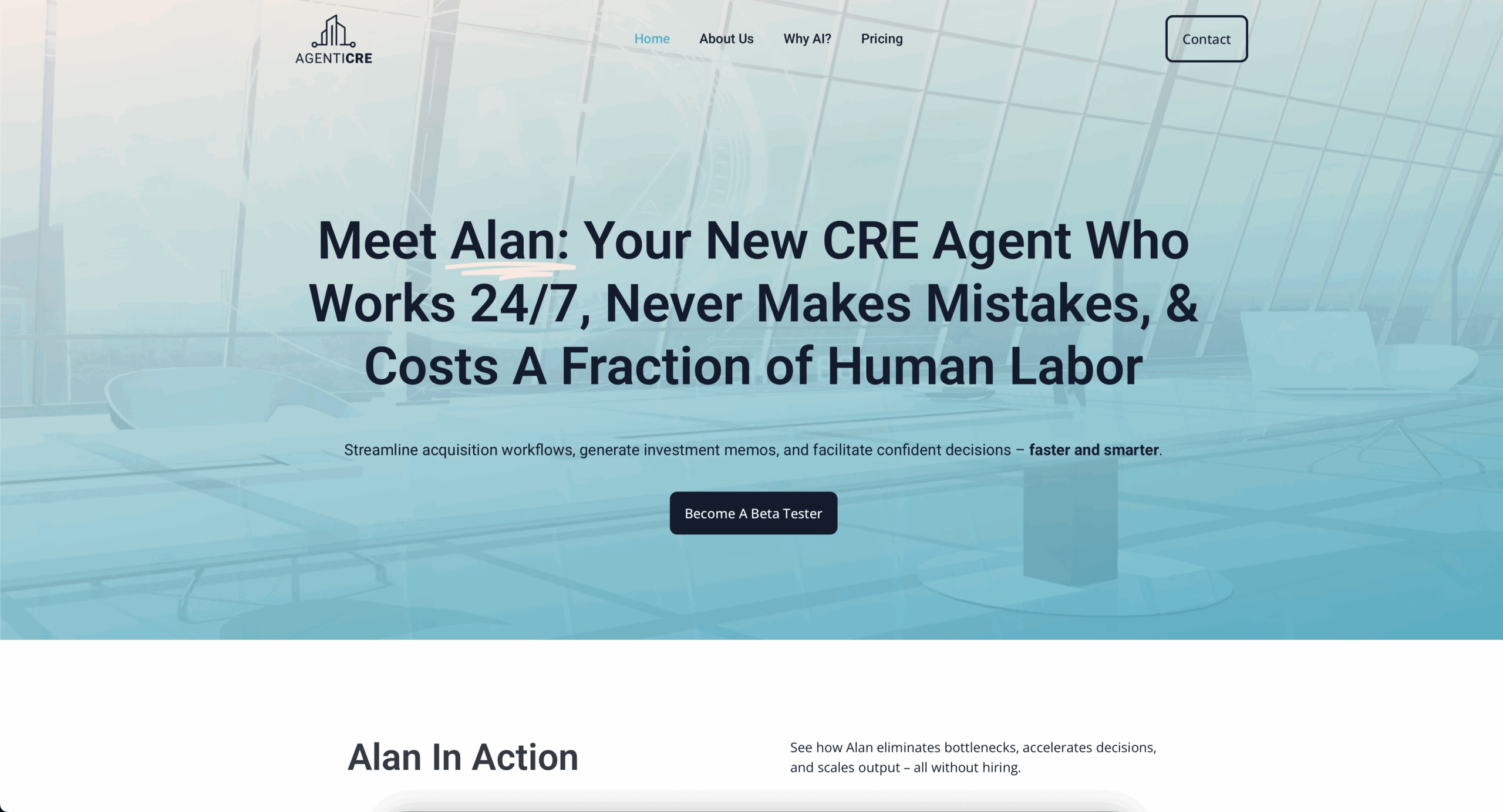
AgentiCRE is a commercial real estate artificial intelligence platform designed to function as an automated analyst, specifically built for reading offering memorandums, running cash flow models, and drafting investment memos. Classified in the BestCRE master database as a CRE-Native, Tier 2 application, this tool targets acquisition teams and brokerage shops looking to accelerate their initial deal screening phases. The platform operates on a paid subscription model, though exact pricing tiers remain unpublished. As the volume of marketed deals fluctuates in Q3 2026, principals are increasingly evaluating AI solutions to handle the repetitive data extraction tasks that typically consume junior analyst hours.
The core premise of AgentiCRE centers on ingesting unstructured deal documents and converting them into structured financial models and narrative memos. Unlike general-purpose large language models, this software is specifically trained on commercial real estate deal structures, terminology, and standard underwriting metrics. However, as a Tier 2 vendor in a crowded category, it faces significant competition from established players and other specialized startups. Buyers must weigh the potential time savings in document processing against the inevitable need for manual review of the generated cash flow projections. This review will analyze how well the platform executes its primary use cases and where it fits within the broader ecosystem of CRE underwriting and deal analysis software.
What AgentiCRE does and how it works
AgentiCRE functions as a specialized document processing and financial modeling engine for commercial real estate professionals. The workflow begins when a user uploads an offering memorandum (OM), rent roll, or historical operating statement into the platform. Using natural language processing and computer vision, the software scans these documents to identify key property metrics, lease terms, historical expenses, and market assumptions. It then extracts this unstructured data and maps it to standardized fields within its proprietary database architecture.
Once the data extraction is complete, AgentiCRE initiates its cash flow modeling sequence. The system attempts to reconstruct the property’s financial performance by applying standard commercial real estate underwriting logic. It projects rental income based on the extracted lease expirations, calculates potential vacancy loss, and estimates operating expenses using the historical figures provided in the uploaded documents. Analysts can then adjust these baseline assumptions through the user interface, tweaking growth rates, capitalization rates, and capital expenditure reserves to match their specific investment criteria.
The final mechanical step involves drafting the investment memo. AgentiCRE synthesizes the extracted property details, the generated cash flow model outputs, and any user-defined adjustments into a formatted narrative document. This module generates text sections covering the property description, location analysis, tenant roster summaries, and financial returns. The resulting memo is designed to serve as a first draft for investment committee review, requiring the human analyst to verify the math, refine the narrative tone, and add qualitative market context that the software cannot independently verify.
9AI Framework: the score, dimension by dimension
CRE Relevance: 9/10
AgentiCRE is entirely dedicated to the commercial real estate sector, earning its CRE-Native classification. The platform is explicitly built to handle the unique structure of offering memorandums, rent rolls, and trailing twelve-month operating statements. Unlike generic AI chatbots, its underlying architecture understands the relationship between lease terms, expense reimbursements, and net operating income. The tool focuses strictly on underwriting and deal analysis, ignoring residential or non-real estate financial modeling. This narrow focus ensures that the terminology and outputs align with the expectations of commercial acquisitions teams and brokers. In practice: Analysts will find that the software immediately recognizes standard industry acronyms and financial metrics without requiring extensive background prompting.
Data Quality and Sources: 7/10
The quality of the data generated by AgentiCRE is inherently tied to the quality of the documents uploaded by the user. Because it relies on parsing offering memorandums and broker-provided financials, the system is susceptible to extracting aggressive pro forma assumptions rather than objective historical facts. As a Tier 2 application, it lacks the proprietary, verified market data layers found in larger platforms like CompStak. The software accurately transcribes what is on the page, but it does not independently audit the truthfulness of the broker’s rent roll or expense figures. In practice: Users must treat the extracted data as a direct reflection of the marketing materials, requiring independent verification before finalizing any underwriting model.
Ease of Adoption: 7/10
Deploying AgentiCRE requires a shift in how junior staff approach deal screening. Instead of building models from scratch, analysts must learn to review and correct AI-generated outputs. The interface is designed to be intuitive for users already familiar with commercial real estate finance, minimizing the learning curve for navigating the dashboard. However, training the team to trust the extraction process and understanding how to adjust the automated cash flow assumptions takes time. Firms will need to establish new standard operating procedures for verifying the AI’s math against the original source documents. In practice: Teams should expect a two- to four-week transition period as analysts adapt from primary data entry to a supervisory review role.
Output Accuracy: 8/10
AgentiCRE performs well when extracting structured data like rent rolls and historical expenses from cleanly formatted offering memorandums. The cash flow models it generates are mathematically sound, applying standard formulas for net operating income and internal rate of return. However, accuracy drops when processing heavily stylized marketing documents, scanned PDFs with poor optical character recognition, or complex, non-standard lease clauses. The drafted investment memos provide a solid structural foundation but often read mechanically and may miss subtle nuances regarding tenant credit risk or submarket dynamics. In practice: The platform delivers a highly accurate first draft of the quantitative model, but the qualitative memo sections require significant human editing.
Integration and Workflow Fit: 6/10
As a Tier 2 solution, AgentiCRE’s ability to connect with the broader commercial real estate technology stack is currently limited. The platform primarily functions as a standalone application where users manually upload documents and export the resulting models to Excel or memos to Word. While these export formats are universally accepted, the lack of direct, automated data pipelines into enterprise portfolio management systems or established data warehouses like Cherre creates friction for institutional users. The vendor has not published detailed documentation regarding open APIs or native integrations with common CRM platforms. In practice: Analysts will need to rely on manual file exports and imports to move data between AgentiCRE and their firm’s primary systems of record.
Pricing Transparency: 4/10
The BestCRE master database confirms that AgentiCRE operates on a paid subscription model. However, the vendor does not publish its specific pricing tiers, user license costs, or implementation fees on its public-facing website. This lack of transparency requires potential buyers to engage directly with the sales team to determine the financial commitment. It is unclear whether the pricing is based on a flat enterprise fee, a per-user license, or a consumption model tied to the volume of offering memorandums processed. Without public pricing, evaluating the initial return on investment is difficult for smaller firms. In practice: Buyers must enter the sales pipeline blindly and should prepare to negotiate custom contract terms based on their anticipated deal volume.
Support and Reliability: 5/10
AgentiCRE is classified as an unproven startup within the Tier 2 database segment, which directly impacts its support and reliability profile. While the core application successfully executes its primary use cases, the company lacks the extensive customer success infrastructure of larger, more mature software vendors. Users may experience variable response times for technical support tickets, and the availability of dedicated account managers is not guaranteed. Furthermore, as an early-stage platform, occasional bugs or downtime during peak usage hours are possible as the engineering team scales the underlying infrastructure. In practice: Firms adopting this tool should designate an internal super-user to troubleshoot basic issues rather than relying entirely on the vendor’s nascent support team.
Innovation and Roadmap: 7/10
The development trajectory for AgentiCRE appears focused on refining its core document extraction and modeling capabilities. Operating in the rapidly evolving AI analyst space, the vendor is forced to continuously update its natural language processing models to keep pace with broader technological advancements. The roadmap likely includes improving the handling of complex lease structures and expanding the export functionalities. However, as a smaller entity, the company may struggle to deploy major feature updates as quickly as its better-funded competitors. The focus remains strictly on underwriting automation rather than expanding into property management or leasing software. In practice: Users can expect incremental improvements to document parsing accuracy rather than massive expansions into entirely new product categories.
Market Reputation: 5/10
AgentiCRE is currently building its reputation among commercial real estate acquisitions teams and brokerage shops. As a Tier 2, unproven startup, it does not yet possess the widespread brand recognition or institutional trust enjoyed by established platforms like CompStak. Early adopters are testing the software primarily for its time-saving potential on initial deal screens, but widespread enterprise adoption remains limited. The company is actively working to secure case studies and public testimonials to validate its claims regarding efficiency gains. Skepticism remains high among veteran principals who doubt an AI’s ability to accurately underwrite complex commercial assets. In practice: The software is viewed as an intriguing, specialized tool for early adopters rather than a mandatory industry standard.
Who should use AgentiCRE
AgentiCRE is designed for commercial real estate professionals who spend a disproportionate amount of time manually extracting data from marketing materials. The ideal users are those who need to quickly triage a high volume of potential investments before committing deep analytical resources.
- Acquisitions Analysts: Junior staff tasked with reading dozens of offering memorandums weekly can use the tool to automate the initial data entry and baseline cash flow modeling.
- Investment Sales Brokers: Brokerage teams can accelerate the creation of their own marketing materials by using the software to draft initial property descriptions and financial summaries based on seller-provided financials.
- Boutique Private Equity Firms: Lean investment shops lacking a large pool of junior analysts can deploy the software to increase their deal screening capacity without increasing headcount.
Who should look elsewhere
This software is not a universal solution for all commercial real estate operations. Firms requiring deep, proprietary market data or those managing complex, non-standard assets will find the platform lacking.
- Institutional Portfolio Managers: Teams needing automated data pipelines into enterprise systems like Cherre will find the manual export processes insufficient for their scale.
- Development Firms: The platform is built for underwriting existing, stabilized, or value-add assets based on OMs, not for modeling complex ground-up construction draws and development timelines.
- Firms Seeking Market Data: Users looking for independent, verified lease comparables or sales comps should look to platforms like CompStak, as AgentiCRE only processes the documents provided by the user.
Pricing and ROI
AgentiCRE operates on a paid subscription model, but the vendor does not publish its specific pricing tiers, implementation fees, or contract minimums on its website. Buyers must engage directly with the sales team to receive a custom quote. Based on the pricing structures of similar Tier 2 underwriting tools, buyers should anticipate either a per-user annual licensing fee or a tiered structure based on the volume of documents processed monthly.
When calculating the return on investment, principals must focus on the reduction of manual data entry hours. If a junior analyst earns $90,000 annually and spends 15 hours per week reading offering memorandums and typing historical financials into Excel, the firm is spending approximately $33,750 per year on basic data transcription. If AgentiCRE can automate 70 percent of that initial extraction and modeling process, the firm reclaims over 500 hours of analyst capacity annually. This time can be redirected toward verifying the math, touring properties, and conducting deeper submarket research. However, because the exact subscription cost is not published, firms must carefully weigh the quoted price against this recovered labor value to ensure the software delivers a definitive net financial benefit.
Integration and CRE tech stack fit
AgentiCRE currently occupies an isolated position within the commercial real estate technology stack. As a Tier 2 application focused heavily on initial deal screening, it lacks the deep, native integrations found in more mature platforms. The software does not offer direct API connections to major property management systems like Yardi or MRI, nor does it pipe data directly into enterprise data warehouses such as Cherre.
Instead, the platform relies on universal export formats to interact with the rest of a firm’s software ecosystem. Analysts will primarily export the generated cash flow models to Microsoft Excel, where they can apply their firm’s proprietary macros or formatting standards. The drafted investment memos are exported to Microsoft Word for final editing and formatting. While this reliance on Excel and Word ensures compatibility with virtually every commercial real estate firm, it creates a disconnected workflow. Users must manually move files between AgentiCRE, their local drives, and their firm’s shared cloud storage. Firms seeking a highly connected, automated data environment will need to build custom middleware or wait for the vendor to release documented APIs.
Competitive landscape
The market for commercial real estate AI and underwriting software is highly competitive, and AgentiCRE faces pressure from both specialized startups and established data providers. Buyers evaluating this platform must consider alternatives that offer different balances of document processing, market data, and predictive analytics.
For firms specifically focused on extracting data from offering memorandums and rent rolls, HelloData (BestCRE Score: 91) presents a formidable alternative. HelloData offers highly accurate document parsing capabilities and often features more transparent pricing models. Similarly, Cotality (BestCRE Score: 91) provides strong underwriting automation and may offer better integration options for firms looking to connect their deal screening process with their broader CRM systems.
If the primary goal is accessing verified market data rather than just processing user-uploaded documents, CompStak (BestCRE Score: 88) remains the superior choice. While AgentiCRE relies entirely on the assumptions printed in the broker’s OM, CompStak provides independent, crowdsourced lease and sales comparables to validate those assumptions. Furthermore, firms looking to build custom machine learning models on top of their own proprietary datasets might prefer a platform like Akkio (BestCRE Score: 86), which offers broader predictive modeling capabilities. Finally, for teams prioritizing enterprise-grade data management and integration, Cherre (BestCRE Score: 86) provides the infrastructure necessary to connect disparate data sources, a feature currently lacking in AgentiCRE’s standalone architecture.
The bottom line
AgentiCRE offers a highly specific solution for a highly specific problem: the manual transcription of commercial real estate offering memorandums into baseline cash flow models. For lean acquisitions teams drowning in initial deal screens, the platform provides a legitimate method to accelerate the triage process and reclaim junior analyst hours. However, buyers must approach the software with realistic expectations. It is a document processor and a first-draft generator, not an autonomous investment committee. The lack of published pricing and native integrations limits its appeal for large institutional players who require transparent enterprise contracts and connected data ecosystems. Firms should purchase AgentiCRE only if they are willing to establish strict internal protocols for verifying the AI-generated math against the source documents. If your team treats the output as a starting point rather than a final answer, the software justifies its place in the underwriting workflow.
Frequently asked questions
Does AgentiCRE provide independent market data for underwriting?
No, the software does not supply proprietary lease comparables, sales data, or independent market research. It strictly extracts and processes the information contained within the offering memorandums, rent rolls, and historical financials that the user uploads into the system. You must verify the broker’s assumptions independently.
Can the platform model complex ground-up development projects?
The platform is engineered primarily for underwriting existing, stabilized, or value-add commercial assets based on standard marketing materials. It is not designed to handle the intricate construction draw schedules, zoning variables, and phased delivery timelines required for complex ground-up development financial modeling.
How much does an AgentiCRE subscription cost?
The vendor operates on a paid subscription model but does not publish its pricing tiers, implementation fees, or user license costs publicly. Prospective buyers must contact the sales team directly to request a custom quote based on their specific firm size and anticipated document processing volume.
Does AgentiCRE integrate directly with Yardi or MRI?
Currently, the platform functions as a standalone application and does not offer native, automated integrations with major property management systems or enterprise data warehouses. Users must rely on exporting their finalized cash flow models to Excel and memos to Word for use outside the platform.
Will this software replace the need for junior acquisitions analysts?
No. While the tool automates the initial data extraction and baseline modeling, it requires a human analyst to verify the math, adjust the automated assumptions, and refine the narrative memos. It shifts the analyst’s role from manual data entry to supervisory review and strategic analysis.
What asset classes does the software support?
Because it is a CRE-Native application, the software is trained to process standard commercial real estate asset classes, including multifamily, retail, office, and industrial properties. It recognizes the specific lease structures, expense categories, and underwriting metrics unique to these core commercial property types.