
Category: CRE Property Management & Operations

  • Buildium Review: Property management software for residential and mixed portfolios

    Buildium Review: Property management software for residential and mixed portfolios

    BestCRE 9AI Score

    72/100 · Contender

    Buildium ranks #189 of 450 commercial real estate AI tools scored on the 9AI Framework. Nine dimensions, each scored out of 10: CRE relevance, data quality, ease of adoption, output accuracy, integration fit, pricing transparency, support, innovation and market reputation.

    Buildium is cloud property management software used primarily by small and midsize residential managers, single-family rental operators, community associations and multifamily owners. It brings accounting, payments, leasing, screening, maintenance and resident communication into one operating system. For a CRE operator, the workflow change is straightforward: recurring property administration moves from separate accounting files, inboxes, payment portals and maintenance trackers into property-level records with shared reporting. Buildium is headquartered in Boston and is owned by RealPage.

    The platform can also support mixed-use and commercial properties. Buildium identifies CAM reconciliations, lease escalations, tenant billing, property-specific accounting and centralized reporting among its commercial capabilities. That makes it relevant to an owner or manager whose portfolio combines apartments, storefronts, associations or smaller commercial leases. It is not positioned primarily as an institutional commercial asset management, lease administration or investment management system.

    Buildium’s practical appeal is breadth. Online applications can feed leasing workflows, approved applicants can become residents, payments can post into the accounting environment, and maintenance requests can be tracked against properties and units. Mobile applications and self-service resident functions reduce routine calls and emails. The Marketplace and open API provide routes to specialist products when the native feature set is insufficient. BestCRE analysis: this consolidation is more valuable for lean operating teams than an isolated AI feature would be.

    The buying question is therefore not whether Buildium can manage properties. It can. The question is whether its residential foundation fits the portfolio’s lease structures, reporting obligations and accounting complexity. A residential manager adding neighborhood retail may find the commercial coverage sufficient. An office, industrial or retail platform with complicated recoveries, amendments, percentage rent, abstracting requirements or institutional reporting should validate those workflows carefully. Buildium is a credible operating platform with commercial reach, not a commercial-first system.

    What Buildium Does and How It Works

    Buildium organizes operating data around properties, units, residents, owners, vendors, leases and financial transactions. Its accounting functions include property-specific reporting, bank reconciliation, accounts payable workflows, rent collection and tax-related administration such as 1099 electronic filing. Payments can be accepted from residents and used for owner or vendor transactions, subject to the services and fees selected. For mixed-use and commercial properties, tenant billing, lease escalations and CAM reconciliation are the most relevant advertised functions. Buyers should test how calculations, recoveries and approval controls map to their actual lease language.

    The leasing workflow covers listing syndication, applications, tenant screening and digital leases. Screening can include credit, criminal and eviction information, with property-level prescreening criteria. Approved applicants can move into the operating workflow without re-entering the same basic information. Maintenance functions accept requests, track work-order status, schedule recurring work and connect invoices or bills with property operations. Resident Center and manager applications provide mobile access and self-service options. A maintenance contact center is also offered, although service scope and commercial terms require confirmation with Buildium.

    Buildium also promotes automation, configurable workflows, permissions, reporting and Lumina AI. The public positioning describes AI-assisted property management and agentic capabilities, but buyers need a controlled demonstration of each proposed use case. Ask what data the AI can access, what actions require approval, how outputs are logged, whether customer data trains shared models, and how errors are corrected. BestCRE analysis: the core value remains the transaction system beneath the AI. Automation is useful when leases, ledgers, contacts and work orders are complete and consistently structured. It cannot compensate for weak migration, inconsistent chart-of-accounts design or poorly defined operating responsibilities.

    9AI Framework: Dimension by Dimension Analysis

    CRE Relevance: 6/10

    BestCRE analysis: Buildium earns 6 because it handles real property operations but remains residential-first. Property accounting, payments, maintenance, leasing and owner reporting are directly relevant to CRE operations, while advertised support for mixed-use portfolios, CAM reconciliation, lease escalations and commercial tenant billing extends its usefulness. That coverage should work best for smaller commercial assets attached to a residential portfolio or for straightforward commercial leases. Dedicated office, industrial and retail operators often require deeper lease abstraction, recovery calculations, amendment tracking, critical-date controls and institutional reporting than a residential operating platform naturally emphasizes. Buildium therefore clears the threshold for CRE relevance, but it is not equivalent to a commercial-first lease administration, asset management or investment management product. Buyers should make their own leases the centerpiece of the demonstration.

    Data Quality and Sources: 7/10

    BestCRE analysis: Buildium earns 7 for creating a structured operating record across accounting, leasing, payments, screening and maintenance. Keeping transactions and property activity in one platform can reduce duplicate entry and improve consistency, particularly when applications become leases and payments flow into property accounts. Property-specific reporting and bank reconciliation support basic financial control. Data quality still depends heavily on implementation choices, including the chart of accounts, property hierarchy, opening balances, lease setup and user permissions. Screening information comes from external reporting sources, while listing, payment and marketplace connections introduce additional dependencies. Buildium does not publicly establish a universal accuracy rate for imported, matched or AI-generated data. Prospective customers should test migration exceptions, duplicate detection, reconciliation procedures and the audit trail before treating reports as authoritative.

    Ease of Adoption: 8/10

    BestCRE analysis: Buildium earns 8 because its feature set is packaged around familiar property management tasks rather than technical infrastructure. Leasing, rent collection, maintenance, accounting and resident communication sit within a common product, and mobile applications support staff away from a desk. A free trial using sample data can help a smaller team understand basic workflows before committing. Adoption will still require disciplined configuration, data cleanup, accounting decisions and staff training. Commercial users face additional work because lease economics and recoveries need to be represented correctly, rather than merely entered as recurring charges. The platform offers onboarding, a Help Hub, Buildium Academy and customer care, but the exact assistance included can vary by plan or service arrangement. Ease is strongest for teams whose operating model already resembles Buildium’s residential property management structure.

    Output Accuracy: 7/10

    BestCRE analysis: Buildium earns 7 because its accounting and operational outputs can be dependable when the underlying configuration and source transactions are correct. Automated bank reconciliation, property-level reporting, payment posting and integrated billing can reduce manual handling, but they do not eliminate accounting review. CAM reconciliations and lease escalations deserve particular scrutiny because errors can arise from exclusions, caps, gross-ups, allocation methods, base years or lease amendments. Buildium does not publish a comprehensive accuracy benchmark for financial reports, screening results, workflow automation or Lumina AI outputs. Buyers should reconcile a representative reporting period against their current ledger, reproduce several complicated lease calculations and inspect the approval history for adjustments. AI-generated summaries or recommended actions should remain reviewable, with material accounting and tenant decisions approved by a qualified person.

    Integration and Workflow Fit: 8/10

    BestCRE analysis: Buildium earns 8 for its open API and established Marketplace of property management applications. Those options give operators ways to connect specialist services and extend functions that are not deep enough natively. Integration is especially valuable when Buildium serves as the operating ledger while separate products handle marketing, communications, maintenance services or portfolio analysis. Marketplace presence does not guarantee that every connector is bidirectional, real time or included in the base subscription. Buyers should document the system of record for each data object, confirm available API fields, understand authentication and rate limits, and determine who supports failures between vendors. Commercial operators should also check connections to their reporting warehouse, banking workflow, document repository and any dedicated lease administration platform. The architecture is flexible, but integration quality must be assessed connector by connector.

    Pricing Transparency: 7/10

    BestCRE analysis: Buildium earns 7 because it uses published subscription tiers and provides a trial path, giving buyers more visibility than vendors that require a sales conversation before revealing any plan structure. Exact Q4 2026 charges are not stated in this review because current plan rates, unit allowances, transaction charges and optional-service fees should be confirmed directly on Buildium’s pricing page and order form. The final cost can extend beyond the core subscription through payment processing, screening, contact-center services, marketplace products, implementation needs or other usage-based items. Buyers should request a complete schedule covering minimums, included features, annual commitments, price increases, data migration and exit costs. Transparency is good enough for initial budgeting, but an apples-to-apples total requires a portfolio-specific quote and contract review.

    Support and Reliability: 7/10

    BestCRE analysis: Buildium earns 7 based on its published onboarding, Help Hub, Buildium Academy, customer care and optional maintenance contact-center resources. That combination can support both initial learning and recurring operational questions. A mature knowledge base is particularly useful for smaller managers that lack internal systems administrators. Public product descriptions do not establish uniform response times, named support personnel or resolution commitments for every plan. Buyers should confirm support hours, channels, escalation procedures, accounting expertise and service-level terms before signing. Commercial and mixed-use operators should ask whether support staff routinely troubleshoot CAM configurations, escalation schedules and tenant billing, rather than assuming residential expertise transfers automatically. References from customers with similar portfolios are more informative than general satisfaction claims. Support quality also depends on whether an issue belongs to Buildium or a marketplace partner.

    Innovation and Roadmap: 7/10

    BestCRE analysis: Buildium earns 7 for adding Lumina AI, broader automation and configurable workflows to an established property management platform. The opportunity is credible because the system already contains operational context from leases, payments, maintenance activity and communications. AI can be useful for reducing repetitive work, identifying relevant information and guiding staff through routine processes. Public positioning alone does not show how consistently each capability performs, how autonomous it is or how much time it saves for a particular portfolio. Buyers should insist on live demonstrations using representative scenarios and should test permissions, human approvals, audit logs and data-governance controls. Innovation deserves credit when it shortens a verified workflow without weakening control. Buildium’s advantage is the surrounding operating system, although specialist AI products may move faster on narrow tasks.

    Market Reputation: 8/10

    BestCRE analysis: Buildium earns 8 because it is a well-known property management software brand with an established presence among residential managers and ownership by RealPage since 2019. Its broad product coverage, customer education resources and partner marketplace indicate a mature commercial operation rather than an early-stage experiment. The brand is especially recognizable in the small and midsize residential segment. Reputation should not be confused with universal fit, and public customer stories are selected by the vendor rather than independent performance audits. Commercial buyers should request references that match their asset type, unit count, accounting complexity and integration needs. They should also review current support feedback, product release practices and contract terms during diligence. Buildium’s market standing reduces vendor maturity risk, but it does not remove the need for workflow testing.

    9AI Score Card Buildium
    72
    72 / 100
    Solid Platform
    Property Management Software
    Buildium
    Buildium combines property accounting, leasing, payments, maintenance and resident services, with commercial functions available but secondary to its residential operating model.
    9 Dimensions, Scored 1 to 10
    1. CRE Relevance
    6/10
    2. Data Quality & Sources
    7/10
    3. Ease of Adoption
    8/10
    4. Output Accuracy
    7/10
    5. Integration & Workflow Fit
    8/10
    6. Pricing Transparency
    7/10
    7. Support & Reliability
    7/10
    8. Innovation & Roadmap
    7/10
    9. Market Reputation
    8/10
    BestCRE.com, 9AI Framework v2 Reviewed October 2026

    Who Should Use Buildium

    Buildium is best suited to small and midsize property management companies that need one system for residential accounting, online payments, leasing, screening, maintenance and resident communication. It is also a sensible candidate for single-family rental managers, smaller multifamily owners, community association managers and operator-led firms whose administrative teams need guided workflows. The strongest buyer has enough complexity to benefit from centralization but does not want to assemble and maintain a large enterprise software stack.

    Mixed-use owners deserve a closer look, particularly when residential units dominate and the commercial component consists of relatively straightforward storefront, office or service leases. Buildium can place those properties within the same accounting and reporting environment while supporting tenant billing, escalation schedules and CAM reconciliation. BestCRE analysis: the ideal commercial buyer values operational breadth more than specialized lease administration depth. A trial should use actual property structures, a representative CAM pool, a lease amendment, an owner statement and a complete month-end close before the team commits.

    Who Should Not Use Buildium

    Buildium should not be the default choice for institutional office, industrial or retail portfolios with highly negotiated leases, layered recoveries, percentage rent, complex amendments, extensive critical dates or demanding investor reporting. Those operators may need a commercial-first lease administration and accounting platform, or a specialist system connected to a general ledger. Large enterprises should also verify entity controls, consolidation, permissions, data warehousing and service requirements before assuming the enterprise positioning covers their governance model.

    It is also a poor fit for teams seeking only an AI assistant while keeping every existing operating system unchanged. Buildium’s value comes from running core property workflows and maintaining structured records. Migrating solely to obtain automation can create more disruption than benefit. BestCRE analysis: buyers with unusual processes, limited implementation capacity or a strong need for custom commercial reporting should compare the cost of adapting Buildium with the cost of selecting a product designed around those requirements.

    Pricing and ROI Analysis

    Buildium publishes tiered subscription options and offers a free trial, but the exact Q4 2026 prices are not stated here because rates and package contents can change. Buyers should confirm the current monthly or annual subscription, portfolio or unit rules, included support and feature differences directly with Buildium. The complete budget should also include payment processing, tenant screening, marketplace applications, maintenance contact-center services, implementation labor, data migration and staff training where applicable. Contract review should cover renewal increases, minimum commitments, data export and termination assistance.

    BestCRE analysis: use simple labor and error-cost math rather than relying on a generic return claim. If the platform saves 40 staff hours per month and the fully loaded labor cost is $35 per hour, the gross operating benefit is $1,400 per month. Subtract the subscription, transaction costs, connected applications and the monthly equivalent of implementation expense. Then estimate avoided vacancy days, payment delays or accounting corrections separately, using the buyer’s own records. The purchase is financially sound only if verified recurring benefits exceed recurring costs within the organization’s required payback period.

    Integration and CRE Tech Stack Fit

    Buildium can function as the operating center for leasing, resident records, property accounting, payments and maintenance. Its Marketplace offers connections to specialist property technology products, while the open API provides another route for approved data exchange and custom workflows. This is a useful structure for operators that want a central property system without limiting every function to native modules. Availability, direction of data flow and additional charges vary by connection.

    Commercial buyers should map integrations before contracting. Confirm how Buildium exchanges data with banking services, business intelligence tools, document storage, communications platforms, maintenance vendors and any dedicated lease system. Determine which platform owns each record, how frequently data synchronizes, how errors are surfaced and who resolves connector failures. BestCRE analysis: Buildium fits best when it is given a clear system-of-record role. Using overlapping applications without ownership rules can create conflicting balances, duplicate contacts and unreliable portfolio reports.

    Competitive Landscape

    DoorLoop is the clearest alternative for smaller property managers prioritizing a modern interface, broad operating coverage and an accessible buying process. BestCRE has scored DoorLoop at 93, reflecting a strong overall proposition in this category. AppFolio, scored at 86, is another established residential property management platform with accounting, leasing, payments and automation. Buyers should compare workflow depth, implementation, support access, payment economics and the exact functions included at the expected portfolio size.

    Rent Manager merits consideration when configuration and property accounting flexibility carry more weight, while TenantCloud may appeal to smaller landlords seeking a lighter operating product. Entrata, scored at 88, is relevant to larger multifamily organizations that need an extensive operating environment, although it may exceed the needs of a smaller manager. These are not interchangeable products, and demonstrations should follow the same operating script so differences are measurable.

    BestCRE analysis: Buildium’s differentiator is the combination of brand familiarity, residential operating breadth and a substantial partner marketplace. Its commercial positioning helps mixed portfolios, but dedicated commercial operators should include commercial-first products in the selection even if those products sit outside this peer group. The winning choice should reproduce the buyer’s hardest lease, closing and reporting workflows, not merely show the cleanest standard demonstration.

    The Bottom Line

    Choose Buildium when the portfolio is primarily residential, the operating team wants one property management system, and commercial exposure is limited to mixed-use or relatively straightforward leases. Its accounting, payments, leasing, maintenance and resident functions cover the core workload, while the Marketplace and API leave room for selected extensions. The company has sufficient market maturity to deserve a serious evaluation.

    Do not approve the purchase from a generic demonstration. Require Buildium to model an actual property, complete a month-end close, process a lease escalation, reconcile a CAM pool and show the resulting tenant and owner reports. BestCRE analysis: if those tests pass without spreadsheets or material workarounds, Buildium is a defensible choice for an SMB operator. If they fail, select a commercial-first platform even if its implementation is more demanding.

    About BestCRE

    BestCRE.com is the definitive authority on commercial real estate AI, analysis, and investment intelligence. Every article advances the platform’s mission to help CRE professionals identify, evaluate, and adopt the best tools and strategies in the industry. We benchmark platforms using the 9AI Framework so CRE leaders can compare tools with clear evidence. Explore the category map at 20 CRE sectors for deeper coverage across the CRE stack.

    Frequently Asked Questions

    What is Buildium property management software?

    Buildium is a cloud property management platform for residential managers, single-family rental operators, multifamily owners, community associations and mixed-use portfolios. It combines property accounting, online payments, leasing, tenant screening, maintenance tracking, resident communication and reporting. Commercial features include tenant billing, lease escalations and CAM reconciliation, but the product’s center of gravity remains residential property management. Buildium is headquartered in Boston and is owned by RealPage. BestCRE analysis: it is best understood as an operating system for day-to-day property administration, not as a dedicated institutional asset management, investment management or commercial lease abstraction platform.

    How does Buildium compare with AppFolio and DoorLoop?

    Buildium, AppFolio and DoorLoop all address core property management workflows such as accounting, leasing, payments, maintenance and communications. Buildium stands out for its familiar SMB brand, partner marketplace, open API and coverage of residential, association, mixed-use and selected commercial workflows. DoorLoop is a strong alternative for buyers emphasizing interface simplicity and broad operating functionality. AppFolio is another established platform that should be compared on automation, accounting, support and portfolio fit. BestCRE analysis: buyers should run identical demonstrations using their own chart of accounts, lease structures, work orders and reports. Published feature lists do not reveal configuration effort, transaction economics or exception handling.

    How much does Buildium cost?

    Buildium uses published subscription tiers and offers a free trial, but buyers should verify the current Q4 2026 pricing and package details directly with the vendor. The subscription is only one part of total cost. Payment processing, screening, marketplace products, contact-center services, data migration, implementation work and training may affect the final budget. Ask for an itemized order form that identifies minimum commitments, included features, usage charges, renewal terms and data-export costs. BestCRE analysis: calculate value from documented staff hours saved, fewer corrections and faster collections, then subtract every recurring and implementation expense. Do not justify the purchase using vendor-wide savings claims that have not been reproduced for your portfolio.

    Who is Buildium best suited for?

    Buildium is best suited to small and midsize residential property managers, single-family rental operators, multifamily owners and community association managers that want accounting and daily operations in one platform. It can also fit mixed-use owners whose commercial leases are comparatively straightforward and whose residential units remain operationally important. Teams with limited systems staff may value the packaged workflows, mobile access, education resources and marketplace. BestCRE analysis: a good candidate should be willing to standardize its chart of accounts, leasing process, payment handling and maintenance workflow. Institutional commercial portfolios with complicated recoveries, amendments, percentage rent or specialized investor reporting should test commercial-first alternatives before committing.

    Will Buildium’s AI materially change property management workflows?

    Buildium is adding Lumina AI, agentic capabilities and automation across its property management environment. The potential advantage is context: the platform can work with structured information from accounting, leases, payments, maintenance and communications. Public descriptions do not establish a universal productivity gain or accuracy rate, so future value should be tested rather than assumed. Buyers should ask which tasks AI can perform, what requires human approval, how actions are logged, how customer data is protected and whether outputs can be corrected. BestCRE analysis: the most credible gains will come from narrowing repetitive administrative work while retaining review for accounting, screening, tenant charges and other consequential decisions.

    Related Reviews

    Compare Buildium with other Property Management & Operations tools BestCRE has scored: DoorLoop (73/100), Entrata (72/100), Binsr Inspect (69/100) and Surface AI (68/100). Browse every review in CRE Property Management & Operations, the full Best CRE AI Tools directory, or the 20 CRE Sectors hub.

  • Rent Manager Review: Configurable property management for mixed real estate portfolios

    Rent Manager Review: Configurable property management for mixed real estate portfolios

    BestCRE 9AI Score

    70/100 · Contender

    Rent Manager ranks #240 of 450 commercial real estate AI tools scored on the 9AI Framework. Nine dimensions, each scored out of 10: CRE relevance, data quality, ease of adoption, output accuracy, integration fit, pricing transparency, support, innovation and market reputation.

    Rent Manager is property management and accounting software for operators overseeing residential, commercial, and mixed real estate portfolios. It centralizes the recurring work between lease administration, tenant charges, vendor bills, financial reporting, maintenance, communications, and unit marketing. For a CRE operator, the practical change is less dependence on separate accounting, work order, and tenant communication systems. The product is CRE adjacent rather than purpose built exclusively for institutional commercial real estate, but its commercial support and configurable structure give it more relevance than a residential only platform.

    The strongest buying case is operational breadth. Rent Manager supports cash and accrual accounting, accounts payable and receivable, electronic reconciliations, budgeting, payments, leasing, inspections, service issues, maintenance scheduling, and owner reporting. Its reporting library contains more than 450 reports, while report writing and automation tools allow users to adapt recurring outputs. That scope can suit managers who need one operational system across several property types and cannot justify maintaining parallel platforms.

    Configuration is the key differentiator. Buyers can design specialized workflows, customize the interface, create reports, and connect outside applications through an open API. That flexibility matters for mixed portfolios, where commercial leases, residential units, storage facilities, associations, and other operating models may coexist. Analysis: flexibility also creates implementation risk. A team must define its chart of accounts, permissions, workflows, reporting standards, and integration ownership carefully, or the system can reproduce inconsistent processes instead of correcting them.

    Rent Manager is not the obvious choice for every CRE organization. Institutional owners seeking advanced investment management, underwriting, fund accounting, or highly specialized commercial lease abstraction will likely need additional systems. Public pricing is not available, which prevents buyers from estimating total cost before engaging sales. The definitive verdict is that Rent Manager deserves a shortlist position for operationally complex property managers, particularly those with mixed assets, but buyers should test commercial lease requirements and implementation effort in a structured demonstration.

    What Rent Manager Does and How It Works

    Rent Manager begins with a shared property, unit, tenant, owner, vendor, and accounting database. Charges and receipts flow through accounts receivable, while invoices, approvals, and payments flow through accounts payable. The system can maintain cash and accrual views simultaneously, which is useful when ownership reporting and operating practices require different perspectives. Electronic bank reconciliation, tax tools, budgeting, financial statements, rent rolls, vacancy reports, and custom reporting sit within the same environment. Report automation can distribute recurring information without requiring staff to rebuild each package manually.

    On the operating side, users can manage prospects, guest cards, screening, leasing activity, portals, websites, listing distribution, resident communications, inspections, work orders, maintenance scheduling, and make ready processes. Mobile capabilities extend selected tasks to staff in the field. Maintenance technicians can record job activity, while office teams can track service issues and related billing. Communication tools cover text, email, web chat, letters, and phone broadcasts. These capabilities make Rent Manager more than a ledger, although each buyer should confirm which functions, applications, bundles, and outside services are included in its proposal.

    The platform also provides customization and integration options. Teams can adapt screens and workflows, build specialized reports, use templates, and connect other property technology through the API and available integrations. Orion AI adds an emerging automation and insight layer, but the vendor does not publish enough detailed performance evidence to treat AI as the primary purchase reason. Analysis: the more defensible value comes from connecting accounting records with daily property operations. Buyers should ask Rent Manager to demonstrate a complete workflow using their own scenarios, from lease setup and recurring charges through collections, maintenance, reconciliation, owner reporting, and data export.

    9AI Framework: Dimension by Dimension Analysis

    CRE Relevance: 7/10

    Rent Manager earns a 7 for CRE relevance because it directly supports commercial property management alongside residential and several specialized housing categories. Core functions such as rent rolls, receivables, payables, budgeting, property reporting, work orders, inspections, tenant communications, and owner reporting map well to recurring CRE operations. Its particular strength is serving managers whose portfolios cross asset or occupancy types. The limitation is specialization. Rent Manager is not presented as an institutional commercial real estate platform for acquisitions, underwriting, fund management, investor relations, or advanced lease abstraction. Commercial operators must verify support for their exact escalation structures, recoveries, amendments, options, and reporting conventions. Analysis: it is sufficiently relevant to be a serious operating system candidate, but not sufficiently CRE specific to assume that every commercial workflow is native.

    Data Quality and Sources: 7/10

    Rent Manager earns a 7 for data quality. Accounting and operational records share an integrated platform, reducing the reconciliation problems created when tenant, property, payment, and maintenance data live in unrelated systems. Custom reports, financial report writing, reconciliation tools, and a large report library give operators several ways to inspect and distribute information. Data quality still depends heavily on implementation discipline. Property hierarchies, opening balances, tenant records, vendor files, account mappings, permissions, and migration rules must be configured correctly. The vendor offers data migration assistance, but it does not publish independent accuracy benchmarks for migrations or AI generated insights. Analysis: Rent Manager provides a credible data foundation, yet buyers should not confuse a broad schema with clean data. A staged migration and reconciliation protocol remains necessary.

    Ease of Adoption: 6/10

    Rent Manager earns a 6 for ease of adoption. It places accounting, leasing, communications, reporting, and maintenance in one environment, which can reduce application switching after implementation. The company also offers onboarding, implementation consulting, training, certification, guided online instruction, and continuing user resources. Those services improve the adoption case for teams willing to invest in process design. The tradeoff is that configurability introduces decisions. Users must learn not only the interface but also the organization’s chosen workflows, reports, permissions, and data standards. A mixed portfolio can require additional setup because operating rules vary by property type. Analysis: adoption should be manageable for an established property management organization with an internal owner, but smaller teams expecting immediate use with minimal configuration may find simpler competitors easier to deploy.

    Output Accuracy: 7/10

    Rent Manager earns a 7 for output accuracy. Its accounting system, reconciliation functions, financial reporting tools, and property management reports can produce dependable operational outputs when the underlying configuration and transactions are correct. Cash and accrual capabilities support different reporting needs, while custom reports can address portfolio specific requirements. Accuracy is not automatic. Custom calculations, account mappings, lease setup, recoveries, imported balances, and user permissions can all introduce errors. The vendor does not publish audited accuracy rates for reports, data migration, Orion AI, or automated recommendations. Analysis: buyers should consider standard accounting and operational reports more dependable than newer AI outputs until those outputs are tested. Acceptance testing should compare trial balances, tenant ledgers, bank reconciliations, rent rolls, and owner statements against approved source records before production use.

    Integration and Workflow Fit: 8/10

    Rent Manager earns an 8 for integration because connectivity and customization are central to the product proposition. The platform offers an open API and an integration marketplace covering complementary property management technologies, allowing operators to keep specialist applications while using Rent Manager as an operational and accounting core. Native functions across marketing, payments, maintenance, communications, and reporting can also reduce the number of connections required. The score stops short of the maximum because an available API does not guarantee that every connector is complete, current, or included in the base contract. Analysis: buyers should inventory each required system and test the exact direction, frequency, field mapping, error handling, and ownership of every data flow. Export access and termination procedures should also be documented before signing.

    Pricing Transparency: 5/10

    Rent Manager earns a 5 for pricing transparency, the highest score permitted when a vendor does not publish pricing. Buyers must request a demonstration or sales proposal to understand subscription costs, implementation services, data migration, training, payment processing, applications, integrations, support terms, and any bundle requirements. This sales led approach may allow pricing to reflect portfolio complexity, but it makes early comparison difficult. Analysis: procurement teams should request a written total cost schedule that separates recurring software charges from implementation and usage based costs. They should also ask how pricing changes when units, properties, entities, users, storage, integrations, or service volumes grow. Without that detail, a seemingly competitive subscription can produce a materially different total cost after deployment.

    Support and Reliability: 8/10

    Rent Manager earns an 8 for support. The vendor describes implementation consultants, data importing, individual training, continuing phone support, customer success resources, guided online training, certification, a training calendar, and Rent Manager University. That range is meaningful for a configurable accounting and operations platform, where support quality can influence both adoption and reporting integrity. The company also runs a dedicated user conference, creating another channel for product education. Public materials do not establish response time performance, resolution rates, staffing levels, or customer satisfaction metrics, so service quality should still be tested during diligence. Analysis: buyers should request escalation procedures, support hours, severity definitions, expected response targets, and named responsibilities during implementation. Reference calls should focus on difficult accounting, migration, and integration issues rather than routine questions.

    Innovation and Roadmap: 7/10

    Rent Manager earns a 7 for innovation. Orion AI introduces automation and insight capabilities within a mature property management environment, while report automation, mobile tools, configurable workflows, maintenance mapping, web chat, and API access show continued product development beyond basic accounting. The platform’s practical innovation is its capacity to combine established operating functions with adaptable processes across mixed portfolios. However, the vendor does not publish enough detail about Orion AI models, evaluation methods, error rates, governance controls, or measurable customer outcomes to justify a higher score. Analysis: buyers should evaluate AI features as optional productivity tools rather than assume they transform the investment case. Demonstrations should show the source data, user approvals, audit trail, correction process, and permissions behind any AI assisted output.

    Market Reputation: 8/10

    Rent Manager earns an 8 for market reputation. It is an established property management platform with a broad product footprint, formal training resources, industry affiliations, integrations, and a recurring user conference. Its continued presence across residential, commercial, manufactured housing, associations, student housing, self storage, affordable housing, and other operating categories supports the view that it has substantial domain experience. The vendor does not publish a verified customer count or enough independently comparable satisfaction data to support a higher score. Analysis: its reputation is strongest as a configurable property management and accounting system, not as a specialized institutional CRE investment platform. Buyers should still obtain references from organizations matching their property types, accounting complexity, portfolio scale, and integration requirements.

    9AI Score Card Rent Manager
    70
    70 / 100
    Solid Platform
    Property Management Software
    Rent Manager
    Rent Manager combines property accounting, leasing, maintenance, communications, reporting, and portfolio customization for operators managing residential and commercial assets in one system.
    9 Dimensions, Scored 1 to 10
    1. CRE Relevance
    7/10
    2. Data Quality & Sources
    7/10
    3. Ease of Adoption
    6/10
    4. Output Accuracy
    7/10
    5. Integration & Workflow Fit
    8/10
    6. Pricing Transparency
    5/10
    7. Support & Reliability
    8/10
    8. Innovation & Roadmap
    7/10
    9. Market Reputation
    8/10
    BestCRE.com, 9AI Framework v2 Reviewed October 2026

    Who Should Use Rent Manager

    Rent Manager best suits third party property managers and owner operators that need accounting and daily operations in one configurable system. The strongest profile is a company managing a mixture of residential and commercial assets, or several specialized property categories, that wants consistent tenant records, receivables, payables, maintenance, communications, and reporting. It also fits organizations whose current workflow depends on spreadsheets and disconnected applications, provided management is prepared to standardize processes during implementation.

    The ideal buyer has an internal project owner, knowledgeable accounting staff, and enough operational complexity to benefit from configuration. Teams that require custom reports, mobile maintenance workflows, owner statements, recurring communication, and connections to specialist applications should find meaningful coverage. Commercial managers should enter diligence with representative leases and reporting packages. Analysis: Rent Manager becomes more attractive when mixed portfolio flexibility matters more than highly specialized institutional CRE functionality.

    Who Should Not Use Rent Manager

    Rent Manager is a weaker fit for investment managers primarily seeking acquisitions, underwriting, waterfall calculations, fund accounting, investor portals, or portfolio analytics designed around institutional capital. Those organizations may use it for property operations, but they will probably need other systems for investment management. Pure commercial operators with complex recovery calculations, lease options, amendments, and abstraction requirements should not assume full coverage without a detailed demonstration.

    Very small landlords wanting published pricing and minimal setup may prefer a simpler product. Enterprises committed to a standardized Yardi or Entrata environment may also gain little from adding another operational core. Analysis: buyers without an accountable implementation owner should pause. Rent Manager’s configuration creates value only when someone governs data, workflows, permissions, reporting definitions, integrations, and user training.

    Pricing and ROI Analysis

    Rent Manager does not publish standard subscription pricing. Public information also does not provide a complete schedule for implementation, migration, training, integrations, payment services, optional applications, or support tiers. Buyers should request a proposal that identifies every recurring, one time, and usage based charge. The proposal should state the pricing unit, included users and entities, contract length, renewal terms, data export rights, implementation scope, and costs associated with portfolio growth.

    Analysis: use simple ROI math before purchasing. If the platform saves 25 staff hours each month and the fully loaded labor cost is $40 per hour, the monthly labor benefit is $1,000. Add any measurable reduction in duplicate applications, late reporting, manual reconciliation, or outsourced administration, then subtract the full monthly equivalent of software, implementation, migration, training, and integration costs. This is an illustrative method, not a claimed Rent Manager result. Require a payback case using your own payroll, application contracts, transaction volumes, and implementation estimate.

    Integration and CRE Tech Stack Fit

    Rent Manager can serve as the accounting and operational hub of a property technology stack. Its open API and integration marketplace support connections with listing services, payments, screening, communications, insurance, utilities, and other specialist tools. Native features may replace some point solutions, while the API gives larger operators a path to preserve systems that remain strategically important.

    Buyers should evaluate integrations individually, not as a single platform claim. Confirm whether each connection is native, vendor maintained, partner maintained, or custom. Document supported objects, synchronization direction, timing, historical data access, error alerts, security controls, and additional fees. Analysis: Rent Manager’s stack fit is strongest when the operator maintains clear system ownership and treats accounting records as governed data, rather than allowing multiple applications to overwrite the same fields.

    Competitive Landscape

    AppFolio is the most direct alternative for many residential and mixed portfolio managers. It offers a modern property management suite with accounting, leasing, maintenance, communications, and automation. BestCRE scored AppFolio at 86. Rent Manager should receive closer attention when detailed configuration and mixed portfolio adaptability are priorities. AppFolio may appeal more to buyers emphasizing a cohesive user experience, but exact fit depends on property type, required workflows, and contract scope.

    Yardi is the stronger alternative for organizations requiring a broad real estate technology ecosystem, particularly larger commercial and institutional portfolios. Yardi Virtuoso adds AI capabilities across that environment. The tradeoff can be greater platform and implementation complexity. Entrata, scored at 88, is another major suite option, especially for multifamily operators seeking an integrated operating environment. Buildium is often considered by smaller residential managers that value simpler adoption.

    DoorLoop, scored at 93, is a notable alternative for buyers prioritizing usability and broad property management coverage. Moved, Conduit, Banner, Venn, and Relevance AI address narrower workflow, resident experience, project, or automation needs and are not always direct replacements for an accounting centered property management system. Analysis: Rent Manager’s defensible position is as a configurable operational core for mixed portfolios, not as the newest interface or the most specialized CRE platform.

    The Bottom Line

    Shortlist Rent Manager if your organization manages mixed residential and commercial properties, needs serious property accounting, and wants maintenance, leasing, reporting, and communications connected to the same records. Its breadth, configuration options, reporting, API, training, and established market presence support a disciplined evaluation. Do not buy primarily for Orion AI until the vendor demonstrates specific workflows, controls, and measurable value.

    The buying decision should depend on a scripted demonstration and a complete cost proposal. Require Rent Manager to process representative leases, charges, recoveries, vendor bills, work orders, reconciliations, and owner reports using your operating scenarios. Analysis: proceed when the platform handles those cases with acceptable configuration and clear accountability. Choose a more specialized alternative if institutional investment management or complex commercial lease administration dominates the requirement.

    About BestCRE

    BestCRE.com is the definitive authority on commercial real estate AI, analysis, and investment intelligence. Every article advances the platform’s mission to help CRE professionals identify, evaluate, and adopt the best tools and strategies in the industry. We benchmark platforms using the 9AI Framework so CRE leaders can compare tools with clear evidence. Explore the category map at 20 CRE sectors for deeper coverage across the CRE stack.

    Frequently Asked Questions

    What is Rent Manager property management software?

    Rent Manager is an integrated property management and accounting platform for residential, commercial, and mixed real estate portfolios. It combines receivables, payables, payments, reconciliation, budgeting, reporting, leasing, tenant communications, maintenance, inspections, and workflow customization. Operators can use mobile tools in the field and connect outside property technologies through an API and integration marketplace. Its primary role is to become the operating record for properties, tenants, owners, vendors, transactions, and service activity. It is not primarily an acquisitions, underwriting, fund management, or investor relations system. Analysis: its best use is as an accounting and operational core for property managers that need more flexibility than a basic landlord application provides.

    How does Rent Manager compare with AppFolio and Yardi?

    Rent Manager competes with AppFolio on integrated property management, accounting, leasing, maintenance, communications, and reporting. Rent Manager stands out for configuration and its ability to support mixed property types. AppFolio may attract buyers that place greater weight on a cohesive experience and packaged automation. Yardi offers a wider real estate technology ecosystem and is often considered by larger commercial or institutional organizations, but its scope can bring additional implementation complexity. Analysis: Rent Manager occupies a practical middle position for operators that need meaningful accounting depth and adaptable workflows without automatically adopting a larger enterprise ecosystem. The correct comparison requires identical scenarios, including commercial lease setup, recoveries, reporting, integrations, migration, and total contract cost.

    How much does Rent Manager cost?

    Rent Manager does not publish standard pricing, so buyers must contact the company for a proposal. Public information does not provide a complete price schedule for subscriptions, implementation, data migration, training, optional applications, integrations, payment services, or usage charges. Request a written total cost model covering the initial term and renewal period. It should identify the pricing basis, included users and entities, support terms, implementation responsibilities, export rights, and the cost of portfolio growth. Analysis: compare proposals using a monthly equivalent that includes both recurring fees and allocated one time costs. Do not compare only the quoted subscription, since configuration, migration, integrations, and training can materially affect the purchase economics.

    Who is Rent Manager best suited for?

    Rent Manager is best suited to established property managers and owner operators running residential, commercial, or mixed portfolios. It is particularly relevant when accounting, maintenance, leasing, communications, and owner reporting need to share one database. Buyers with multiple property types, custom reporting needs, or specialist technology connections can benefit from its configuration and API. The strongest implementation team includes an executive sponsor, an accounting lead, an operations lead, and a system owner who can govern workflows and data. Analysis: very small landlords may prefer a simpler application with public pricing, while institutional investment managers may require separate platforms for underwriting, fund accounting, investor reporting, and advanced portfolio analytics.

    Will Orion AI make Rent Manager more useful?

    Orion AI could make Rent Manager more useful by adding automation and insights within an existing property management environment. Its practical value will depend on which workflows it supports, what data it uses, how users verify outputs, and whether approvals and audit trails are preserved. The vendor does not publish enough performance evidence, accuracy measures, or quantified customer outcomes to make AI the main buying reason. Analysis: buyers should ask for demonstrations using their own operating scenarios and evaluate time saved, correction rates, permission controls, source visibility, and exception handling. Rent Manager’s near term value remains its integrated accounting and operations foundation. AI should be treated as an additional capability whose value must be proven during evaluation.

    Related Reviews

    Compare Rent Manager with other Property Management & Operations tools BestCRE has scored: DoorLoop (73/100), Entrata (72/100), HqO (70/100) and Property Meld (70/100). Browse every review in CRE Property Management & Operations, the full Best CRE AI Tools directory, or the 20 CRE Sectors hub.

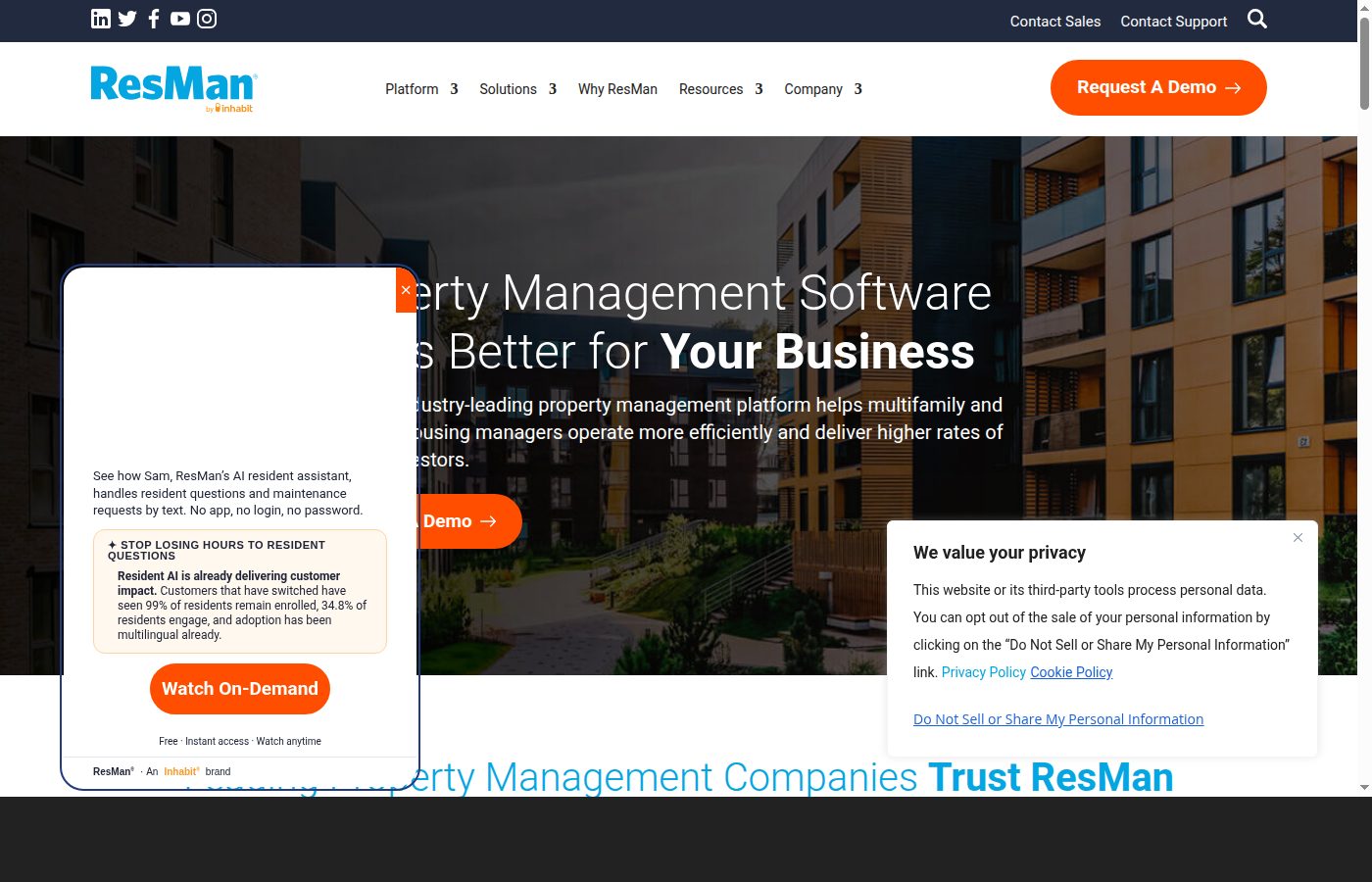
  • ResMan Review: Property management and accounting for multifamily operators

    ResMan Review: Property management and accounting for multifamily operators

    BestCRE 9AI Score

    72/100 · Contender

    ResMan ranks #105 of 584 commercial real estate AI tools scored on the 9AI Framework. Nine dimensions, each scored out of 10: CRE relevance, data quality, ease of adoption, output accuracy, integration fit, pricing transparency, support, innovation and market reputation.

    ResMan is a cloud property management and accounting platform built for conventional multifamily and affordable housing owners, operators, property managers, and accounting teams. It changes the daily workflow by placing leasing, resident administration, maintenance, payments, compliance, reporting, and general property accounting within one operating system. The practical buying question is whether ResMan can replace a fragmented collection of point products while remaining manageable for site teams and corporate users.

    The platform is most relevant when property activity must flow into portfolio reporting and accounting without repeated exports, spreadsheet reconciliation, or manual reentry. BoardRoom provides customizable dashboards with drill down access to portfolio and property indicators. ResMan also offers budgeting, CRM, lead management, screening, websites, resident portals, payments, utilities, maintenance, and marketing capabilities. Affordable housing operators receive workflows for HUD programs, RAD conversions, Rural Development, Tax Credit properties, and state or local rental assistance programs.

    Artificial intelligence is present, but ResMan should not be evaluated primarily as an AI company. Its listed AI products include leasing and resident assistants, fraud detection, and identity validation. BestCRE analysis: the central value remains the transactional property management system, its accounting foundation, and the operational data collected through everyday work. AI can improve response coverage and selected decision points, but buyers should require demonstrations of escalation rules, audit trails, data retention, model oversight, and measurable workload reduction.

    ResMan sits under the Inhabit umbrella and offers mid market multifamily operators a credible alternative to Yardi, RealPage, Entrata, and AppFolio. Its industry specificity, affordable housing depth, and broad operating scope are meaningful strengths. The main procurement weakness is transparency: the vendor does not publish standard pricing, implementation costs, typical contract terms, or enough technical detail to evaluate every AI claim before a sales process. The resulting verdict is positive but conditional. ResMan belongs on a serious shortlist when accounting and compliance matter as much as leasing experience, provided the buyer runs a disciplined implementation and commercial review.

    What ResMan Does and How It Works

    ResMan organizes the core records and transactions required to operate multifamily properties. Leasing teams can manage prospects, applications, screening, leases, resident communications, and move related workflows. Site teams can receive payments, coordinate maintenance, access resident records, and use reporting tools without treating the accounting system as a separate destination. Corporate teams can monitor occupancy, preleases, delinquency, and other indicators through BoardRoom, then drill from portfolio level results into the properties requiring attention.

    Accounting is a central part of the product rather than a peripheral connector. ResMan supports property accounting, budgeting, payments, reporting, and the movement of operating information from site activity into corporate financial processes. BudgetsPro guides budgeting through a structured workflow and includes capital items. For affordable housing, ResMan adds compliance functions covering major federal and local program structures. Buyers should still map their exact chart of accounts, ownership entities, approval rules, subsidy programs, reporting packages, and audit requirements during evaluation because broad feature coverage does not guarantee configuration fit.

    The wider platform extends into marketing and resident experience. ResMan lists CRM, lead management, websites, contact center services, screening, utilities, a resident portal, credit building, identity validation, fraud detection, an AI Leasing Assistant, and an AI Resident Assistant. These components can reduce the number of vendors surrounding the property management system and preserve more activity inside a common workflow. BestCRE analysis: the advantage is strongest when modules share records, permissions, status changes, and reporting definitions. Buyers should test that claim with complete scenarios, such as moving a lead through application, screening, lease execution, payment, service requests, renewal, and accounting treatment. They should also identify which capabilities are native, separately contracted, partner supplied, or dependent on an integration. ResMan presents an open platform position, but the vendor does not publish enough implementation detail to assume every connection is immediate or included.

    9AI Framework: Dimension by Dimension Analysis

    CRE Relevance: 10/10

    ResMan earns a 10 for CRE relevance because it is designed specifically around multifamily and affordable housing operations. Its core records, workflows, and terminology address leasing, residents, units, properties, portfolios, maintenance, payments, property accounting, budgeting, and compliance. The affordable housing coverage is particularly important because HUD, RAD conversion, Rural Development, Tax Credit, and rental assistance workflows require more than generic accounting or customer relationship software. The product also connects site activity to corporate reporting, which reflects how multifamily operators actually divide responsibility. BestCRE analysis: this is not a horizontal business application adapted with a property template. It is a CRE native operating platform. The score does not mean it serves every property type. Office, industrial, retail, hospitality, and investment sales teams should not assume the multifamily data model will fit their work.

    Data Quality and Sources: 7/10

    ResMan earns a 7 for data quality. A property management system can create a coherent operational record because leasing, resident, payment, maintenance, compliance, and accounting events originate within connected workflows. BoardRoom adds portfolio and property visibility with drill down capability, reducing reliance on manually assembled snapshots. That architecture is favorable for consistent reporting, but software cannot correct weak property setup, duplicate residents, inconsistent coding, delayed posting, or poorly governed integrations on its own. BestCRE analysis: data quality will depend heavily on chart of accounts design, property onboarding, required fields, user permissions, close procedures, and interface monitoring. Buyers should request field dictionaries, validation behavior, correction history, import controls, and integration error handling. ResMan does not publish independent measures of completeness, error rates, or reconciliation performance, so a 7 reflects strong structural potential rather than externally verified data quality across every deployment.

    Ease of Adoption: 7/10

    ResMan earns a 7 for ease of adoption, held back by a demo-led sales process with no self-serve trial. The platform presents related property, accounting, dashboard, leasing, and resident workflows within one product family, which can reduce context switching for site and corporate users. Public customer commentary emphasizes usability, training, rapid staff onboarding, and intuitive accounting or budgeting tasks. Those accounts are useful signals, but they are vendor selected and should not replace buyer testing. BestCRE analysis: adoption is likely easier for a focused multifamily operator than for an organization attempting to preserve years of customized processes from another enterprise system. Data conversion, permission design, accounting configuration, affordable program setup, integrations, and staff training remain material projects. Buyers should conduct role based demonstrations with a property manager, leasing agent, maintenance coordinator, compliance specialist, accountant, and regional operator. A controlled pilot and documented acceptance criteria are more informative than a polished executive demonstration.

    Output Accuracy: 7/10

    ResMan earns a 7 for output accuracy because its reporting and dashboards draw from the same operational environment used for property activity and accounting. That can reduce transcription errors and disagreements caused by multiple spreadsheets. Drill down reporting also gives users a path from a portfolio indicator to underlying property information. Accuracy still depends on configuration, timing, source transactions, accounting policy, and user behavior. BestCRE analysis: buyers should not interpret a real time dashboard as automatically correct. They should reconcile occupancy, delinquency, concessions, deposits, receivables, payables, bank activity, and affordable housing compliance outputs against known control totals during implementation. AI assistant responses deserve separate evaluation because generated language may not carry the same controls as ledger reports. ResMan does not publish independently audited accuracy rates for its dashboards, compliance outputs, fraud detection, identity validation, or AI assistants. The score therefore recognizes a sound transactional foundation while preserving room for verification.

    Integration and Workflow Fit: 7/10

    ResMan earns a 7 for integration, the cap when no native Yardi, MRI, CoStar or Argus connection is documented. The platform is positioned as open and includes a broad set of functions that can reduce the need for external systems. Its listed scope covers marketing, CRM, screening, payments, utilities, websites, maintenance, resident services, reporting, and accounting. Customer commentary also describes integration needs associated with centralized leasing models. BestCRE analysis: this breadth makes ResMan a plausible system of record around which a multifamily technology stack can be organized. However, buyers must distinguish embedded modules from partner connections and custom interfaces. They should ask for current documentation covering APIs, authentication, webhooks, data direction, synchronization frequency, rate limits, error queues, sandbox access, and ownership of support incidents. The vendor does not publish enough detail to confirm that every desired product connects at equal depth. A 7 reflects strong stack potential, not proof that a particular integration will satisfy a buyer’s workflow.

    Pricing Transparency: 4/10

    ResMan earns a 4 for pricing transparency. The vendor invites prospects to contact sales and request a demonstration, but it does not publish standard subscription prices, per unit rates, module charges, implementation fees, minimum commitments, support tiers, or typical contract terms. That approach is common among enterprise property management vendors, yet it prevents buyers from estimating total cost before entering a sales process. BestCRE analysis: procurement teams should request a complete commercial schedule covering the base platform, each optional module, integrations, data migration, training, implementation, payment processing, annual increases, support, test environments, and exit assistance. They should also confirm whether pricing changes with property count, unit count, affordable housing programs, users, transaction volume, or portfolio growth. The score remains below 5 under the BestCRE framework because the absence of published pricing materially limits direct comparison and budget planning.

    Support and Reliability: 8/10

    ResMan earns an 8 for support. The vendor presents implementation, support, industry training, and partner resources as parts of its offering. Public customer stories praise training, responsiveness, onboarding help, and the ability to resolve operating issues. Those reports suggest that service is an important component of the product’s market position, especially for buyers that want more guidance than a self service software model provides. BestCRE analysis: the decisive evidence should come from contract terms and reference calls, not testimonials alone. Buyers should inspect support hours, response targets, severity definitions, escalation paths, named implementation roles, data conversion responsibility, training scope, and post launch coverage. Affordable housing operators should verify access to specialists who understand their programs. ResMan does not publish comprehensive service level performance, average resolution times, or customer satisfaction statistics. The score therefore recognizes positive public signals while stopping short of treating service quality as independently proven.

    Innovation and Roadmap: 7/10

    ResMan earns a 7 for innovation. Its product direction extends beyond traditional property accounting into AI leasing assistance, AI resident assistance, fraud detection, identity validation, centralized leasing support, configurable dashboards, and integrated marketing. This shows active development around current multifamily operating problems. BestCRE analysis: the innovation is practical rather than category defining. Several competing property platforms also offer automation, AI assisted communications, screening, analytics, and broad resident journeys. ResMan does not publish enough technical information to assess model architecture, training data, evaluation methods, hallucination controls, or comparative performance. Buyers should judge the AI products by completed tasks, response quality, human escalation, accessibility, multilingual behavior, auditability, and reduction in staff effort. A 7 rewards relevant product expansion while recognizing that named AI features alone do not establish technical differentiation or superior business outcomes.

    Market Reputation: 8/10

    ResMan earns an 8 for market reputation. It is an established multifamily property management option with publicly identified customers and a position under Inhabit. The vendor publishes customer accounts from operators using the platform for accounting, dashboards, training, portfolio growth, centralized leasing, and property onboarding. Several comments explicitly compare the experience with major industry systems, although those testimonials are selected by ResMan. BestCRE analysis: the company has sufficient visibility to make a serious enterprise shortlist, particularly among mid market multifamily and affordable housing operators. It does not receive a 9 or 10 because comprehensive public data on customer retention, implementation outcomes, support performance, platform availability, or independently measured satisfaction is not published. Buyers should speak with references resembling their portfolio size, program mix, accounting structure, and migration source. They should also ask specifically about difficult implementations and support escalations, not only successful deployments.

    9AI Score Card ResMan
    77
    72 / 100
    Solid Platform
    Property Management Software
    ResMan
    ResMan combines property operations, accounting, affordable housing compliance, leasing, maintenance, payments, reporting, and resident services in one multifamily focused platform.
    9 Dimensions, Scored 1 to 10
    1. CRE Relevance
    10/10
    2. Data Quality & Sources
    7/10
    3. Ease of Adoption
    7/10
    4. Output Accuracy
    7/10
    5. Integration & Workflow Fit
    7/10
    6. Pricing Transparency
    4/10
    7. Support & Reliability
    8/10
    8. Innovation & Roadmap
    7/10
    9. Market Reputation
    8/10
    BestCRE.com, 9AI Framework v2 Reviewed October 2026

    Who Should Use ResMan

    ResMan best suits conventional multifamily owners, fee managers, and operators seeking one primary platform for leasing, resident administration, maintenance, payments, accounting, budgeting, and portfolio reporting. It is particularly relevant to mid market organizations that find smaller property software too limited but want a credible alternative to Yardi, RealPage, or Entrata. Buyers with centralized accounting teams and distributed property staff should examine how ResMan moves site transactions into corporate reporting. The product also deserves attention from operators consolidating separate marketing, resident, and operational tools, although module economics and integration depth require confirmation.

    Affordable housing owners and managers are another strong fit. ResMan explicitly addresses HUD programs, RAD conversions, Rural Development, Tax Credit properties, and state or local rental assistance. That scope can be valuable where compliance work is inseparable from leasing and accounting. BestCRE analysis: the ideal buyer has enough operational discipline to standardize its chart of accounts, data definitions, permissions, and property onboarding process. A team prepared to run detailed scenario testing will get more from the evaluation than one selecting on feature count. Include accounting, compliance, operations, leasing, maintenance, information technology, and an executive sponsor in the decision.

    Who Should Not Use ResMan

    ResMan is not the natural choice for office, retail, industrial, hotel, self storage, construction, brokerage, or investment management businesses seeking software built around their own asset and transaction models. Small landlords with simple portfolios may also find the platform broader than necessary, particularly if they need transparent self service pricing and minimal implementation work. The vendor does not publish pricing, so cost sensitive buyers cannot quickly determine fit without engaging sales.

    Multifamily enterprises committed to highly customized Yardi, RealPage, or Entrata environments should not assume migration will produce immediate savings. Historical data conversion, accounting redesign, retraining, interfaces, and parallel operations can outweigh license differences. ResMan is also a weaker fit for buyers whose main requirement is a deeply documented standalone AI platform. Its AI tools sit inside a wider property management proposition, and public technical detail is limited. BestCRE analysis: if model governance, configurable AI workflows, or independent model selection is the primary buying criterion, evaluate specialist products alongside ResMan rather than treating its assistant labels as sufficient evidence.

    Pricing and ROI Analysis

    ResMan does not publish standard pricing for its property management platform or individual modules. Public information does not establish a base subscription, per unit fee, implementation charge, contract minimum, annual increase, integration cost, or separate price for affordable housing functionality and AI products. Buyers should request a five year cost schedule that includes software, implementation, data conversion, training, integrations, payment related fees, support, test access, portfolio additions, and termination assistance. Quotes should separate required components from optional modules so competing proposals can be normalized.

    Analysis: simple ROI math should begin with verified labor and vendor costs, not an assumed industry benchmark. If an operator expects ResMan to save 300 staff hours per month and values loaded labor at $35 per hour, estimated annual labor benefit is 300 multiplied by $35 multiplied by 12, or $126,000. If retiring other software saves another $60,000 annually, total estimated benefit becomes $186,000. Against a hypothetical first year cost of $150,000, estimated first year net benefit is $36,000. These figures are an illustrative calculation, not ResMan pricing or a promised outcome. Replace every input with proposal terms, payroll data, current vendor invoices, migration expense, and measured pilot results.

    Integration and CRE Tech Stack Fit

    ResMan can function as the operational center of a multifamily technology stack because it spans property accounting, leasing, CRM, maintenance, payments, resident services, screening, utilities, websites, marketing, compliance, and reporting. Keeping these functions close to the property system can reduce duplicate records and clarify ownership of resident, lease, unit, and financial data. BoardRoom can then expose portfolio indicators without requiring every executive user to assemble separate reports.

    Buyers should still build an interface inventory before contracting. For each connection, document the system of record, fields exchanged, direction of travel, update timing, failure handling, security method, vendor owner, and reconciliation control. Ask ResMan to demonstrate existing integrations with the buyer’s actual screening, banking, payment, utility, data warehouse, business intelligence, document, and communications products. BestCRE analysis: an open platform claim is a useful starting point, but production fit depends on accessible documentation and support accountability. ResMan does not publish enough technical detail to confirm every connection in advance.

    Competitive Landscape

    Entrata is the closest broad platform comparison for buyers prioritizing an integrated multifamily operating environment and resident journey. AppFolio is a relevant alternative for organizations that value usability and a broad cloud suite, especially across smaller or mixed portfolio structures. ResMan differentiates itself through its position as a mid market multifamily platform with explicit affordable housing depth and an accounting centered operating model. The decision should turn on workflow demonstrations, conversion risk, module coverage, support terms, and total cost, not feature checklist totals.

    Yardi offers a wide enterprise ecosystem and is often the comparison for portfolios needing extensive accounting, investment, commercial, or specialized property capabilities. RealPage combines property operations with a large set of multifamily products, including revenue management. Both can offer greater ecosystem breadth, but that breadth may bring more complex procurement and administration. BestCRE analysis: ResMan is most compelling when a buyer wants a serious alternative to these large incumbents without stepping down to a lightweight landlord product. Entrata scored 88 and AppFolio scored 86 in this category, while ResMan’s strongest relative case is affordable housing plus core accounting. Buyers should run the same scripted scenarios in every finalist and require each vendor to identify third party dependencies.

    The Bottom Line

    Put ResMan on the shortlist if you operate conventional multifamily or affordable housing and need property operations, accounting, compliance, leasing, and reporting in one primary system. Its CRE specificity is excellent, its functional breadth is credible, and its public customer evidence supports serious evaluation. It is especially persuasive for mid market operators seeking an alternative to Yardi, RealPage, and Entrata.

    Do not select it from a general demonstration. Require a configured accounting walkthrough, affordable compliance scenarios where applicable, full lead to ledger testing, migration samples, integration documentation, reference calls, and a five year commercial schedule. BestCRE analysis: ResMan is a strong operational platform with useful AI additions, not an AI purchase by itself. The buying decision should depend on verified workflow fit, implementation accountability, and total cost. If the vendor meets those tests, ResMan is capable of becoming the portfolio’s central operating system.

    About BestCRE

    BestCRE.com is the definitive authority on commercial real estate AI, analysis, and investment intelligence. Every article advances the platform’s mission to help CRE professionals identify, evaluate, and adopt the best tools and strategies in the industry. We benchmark platforms using the 9AI Framework so CRE leaders can compare tools with clear evidence. Explore the category map at 20 CRE sectors for deeper coverage across the CRE stack.

    Frequently Asked Questions

    What is ResMan property management software?

    ResMan is a cloud property management and accounting platform for conventional multifamily and affordable housing owners, operators, and management companies. It combines leasing, resident administration, maintenance, payments, budgeting, reporting, marketing, screening, compliance, and resident services within one product family. BoardRoom provides customizable portfolio dashboards with drill down access to property information. ResMan also lists AI leasing and resident assistants, fraud detection, and identity validation. Its affordable housing capabilities address HUD programs, RAD conversions, Rural Development, Tax Credit properties, and state or local rental assistance. BestCRE analysis: ResMan should be evaluated first as a CRE operating system with accounting and compliance depth. Its AI functionality is an extension of that system, not the sole reason to purchase it.

    How does ResMan compare with Yardi, RealPage, and Entrata?

    ResMan competes as a multifamily focused alternative to Yardi, RealPage, and Entrata. Yardi offers a particularly broad property and investment management ecosystem. RealPage provides a large multifamily product portfolio that includes revenue management. Entrata emphasizes an integrated property and resident operating environment. ResMan’s clearest position is among mid market multifamily and affordable housing operators that want strong property accounting, compliance, and daily operations without defaulting to the largest incumbents. BestCRE analysis: no comparison is settled by module names. Buyers should test identical scenarios for leasing, receipts, maintenance, month end close, portfolio reporting, compliance, integrations, and user permissions. They should then compare migration responsibility, service terms, five year cost, and the number of third party products required.

    How much does ResMan cost?

    ResMan does not publish standard subscription pricing, implementation fees, per unit charges, module prices, contract minimums, or typical annual increases. A buyer must contact sales for a proposal. Request a line item schedule covering the core platform, accounting, affordable housing functionality, AI products, marketing, payments, screening, integrations, data migration, training, support, test environments, and exit assistance. Also ask which charges change with units, properties, users, programs, transactions, or portfolio growth. BestCRE analysis: compare proposals over five years rather than comparing only the initial subscription. Include internal implementation labor, parallel operation, data cleanup, retained integrations, and staff training. Any ROI claim should use the buyer’s current invoices and measured labor savings rather than vendor supplied assumptions.

    Who should use ResMan?

    ResMan is best suited to conventional multifamily and affordable housing owners, operators, and third party managers seeking a central platform for property operations and accounting. It is especially relevant to mid market portfolios that have outgrown basic landlord software or want an alternative to Yardi, RealPage, and Entrata. Affordable housing teams should consider it when HUD, RAD conversion, Rural Development, Tax Credit, or rental assistance workflows are important. Organizations with centralized accounting and distributed property teams may also benefit from shared records and portfolio dashboards. BestCRE analysis: the strongest buyer has defined accounting policies, executive sponsorship, and staff available for configuration, conversion testing, training, and integration review. Other CRE sectors and very small landlords will usually find products designed for their specific scale or property type more appropriate.

    Will ResMan’s AI features become more important?

    ResMan’s AI leasing assistant, resident assistant, fraud detection, and identity validation could become more important as multifamily operators centralize leasing, extend response coverage, and manage more resident interactions without matching staff growth. Their value will depend on access to current property data, reliable handoff to people, clear permissions, audit trails, and measurable completion of useful work. BestCRE analysis for Q4 2026: buyers should expect AI to become a more visible interface to the property management system, but should not assume that every conversation or decision can be automated safely. Ask ResMan for current evaluation methods, escalation behavior, data retention terms, security controls, language coverage, and documented error handling. Renewal decisions should tie AI fees to measured conversion, response, fraud, or labor outcomes.

    Related Reviews

    Compare ResMan with other Property Management & Operations tools BestCRE has scored: DoorLoop (73/100), Entrata (72/100), Mason (70/100) and Wayline (70/100). Browse every review in CRE Property Management & Operations, the full Best CRE AI Tools directory, or the 20 CRE Sectors hub.

  • Wayline Review: AI voice and text assistant automating property management frontline communications

    Wayline Review: AI voice and text assistant automating property management frontline communications

    BestCRE 9AI Score

    70/100 · Contender

    Wayline ranks #240 of 450 commercial real estate AI tools scored on the 9AI Framework. Nine dimensions, each scored out of 10: CRE relevance, data quality, ease of adoption, output accuracy, integration fit, pricing transparency, support, innovation and market reputation.

    Wayline is an AI-powered voice and text virtual assistant built specifically for commercial and residential property management operations. Backed by Y Combinator, the company targets the high-volume administrative burden of frontline property communications. The core premise is replacing traditional call centers and static robo-menus with an automated front desk capable of handling leasing inquiries, maintenance triage, and tenant support around the clock. Wayline’s Y Combinator backing signals early institutional confidence in their approach to operational automation.

    The platform distinguishes itself by focusing entirely on real estate workflows rather than generic customer service. It ingests property-specific knowledge bases, allowing the AI to answer detailed questions about lease terms, building policies, and available units with high accuracy. For a CRE principal evaluating the tool, the primary value proposition centers on reducing administrative headcount costs and capturing after-hours leads that would otherwise be lost to voicemail. However, as a relatively new entrant in a highly competitive and crowded proptech market, Wayline faces the immediate challenge of proving its long-term reliability against established incumbents like DoorLoop and Entrata. Our independent analysis indicates that while the technology demonstrates significant promise for reducing manual workloads, buyers must carefully weigh the operational risks of deploying an early-stage startup’s product as the primary voice of their property portfolio.

    What Wayline does and how it works

    Wayline functions as an always-on digital operator that intercepts inbound communications across voice, SMS, and email channels. When a prospective tenant calls a property, the AI answers in natural language, utilizing a custom knowledge base to provide specific details about available floor plans, pricing, and building amenities. If the caller wishes to schedule a tour, Wayline cross-references the leasing agent’s calendar and books the appointment directly, updating the property management system without human intervention. This eliminates the traditional phone tag associated with leasing operations and ensures that inquiries received outside of standard business hours are processed immediately.

    For existing tenants, the platform acts as a first line of defense for maintenance requests and general support. A resident reporting a leaking faucet via text message will interact with the AI, which triages the issue based on urgency and property protocols. Wayline can generate a work order, schedule the appropriate vendor from the property’s approved list, and notify the tenant of the expected resolution timeline. If a situation escalates or requires physical intervention, the system executes a warm transfer to the designated on-call staff member, complete with a transcript of the interaction.

    Behind the scenes, the software centralizes all communication logs into a single dashboard for property managers. This visibility allows operators to audit the AI’s performance, track recurring maintenance issues, and monitor leasing conversion rates. By automating the repetitive tasks that typically consume a property manager’s day, answering basic policy questions, coordinating schedules, and logging tickets, Wayline allows on-site teams to focus on high-value tenant retention and asset management strategies. The system is designed to integrate with existing property management software, acting as an intelligent routing layer rather than requiring a complete replacement of the operational stack.

    9AI Framework: the score, dimension by dimension

    Dimension Score
    CRE Relevance 9/10
    Data Quality and Sources 8/10
    Ease of Adoption 8/10
    Output Accuracy 7/10
    Integration and Workflow Fit 7/10
    Pricing Transparency 4/10
    Support and Reliability 6/10
    Innovation and Roadmap 8/10
    Market Reputation 6/10
    Composite 9AI Score 70/100

    CRE Relevance: 9/10

    Wayline is entirely dedicated to the real estate sector, avoiding the pitfalls of generic conversational AI tools that struggle with industry-specific terminology. The platform is engineered to understand the nuances of property management, from distinguishing between routine maintenance and emergency work orders to navigating complex leasing inquiries involving guarantor requirements and pet policies. This deep vertical focus ensures the AI can accurately interpret resident requests and prospect questions without requiring extensive custom programming from the buyer. Because it is a CRE-Native application, the underlying architecture inherently supports the multi-unit, multi-property structures typical of commercial and residential portfolios. In practice: Property managers do not need to teach the AI what a rent roll or a CAM charge is, as the system arrives pre-trained on real estate operations.

    Data Quality and Sources: 8/10

    The effectiveness of any virtual assistant relies heavily on the accuracy of its underlying knowledge base. Wayline ingests data from a property’s existing documentation, including lease agreements, building policies, and public-facing marketing materials, to build a comprehensive reference library for the AI. Our analysis shows that the platform maintains high data fidelity by restricting the AI’s responses to this verified information, minimizing the risk of hallucinations or incorrect policy enforcement. The system also structures unstructured data from tenant conversations, converting spoken maintenance complaints into standardized work orders with categorized priority levels. However, the quality of the output is strictly dependent on the cleanliness of the input data provided by the operator. In practice: If your property policy documents are outdated or contradictory, the AI will confidently provide incorrect information to your tenants.

    Ease of Adoption: 8/10

    Deploying a new communication layer across a property portfolio typically involves significant operational disruption, but Wayline mitigates this by functioning as an overlay to existing systems. The AI is designed to be configured quickly, primarily because it relies on ingesting existing documents rather than requiring manual rule building. The interface for property managers is straightforward, focusing on a centralized inbox and call log rather than complex backend configurations. Training on-site staff to use the system is minimal, as their primary interaction involves reviewing escalated tickets and monitoring the AI’s automated actions. In practice: A property manager can forward their main office number to the Wayline system on a Friday and have the AI handling weekend inquiries without extensive staff retraining.

    Output Accuracy: 7/10

    In the context of automated property management, output accuracy is critical; a misclassified emergency maintenance request can lead to severe property damage. Wayline utilizes advanced natural language processing to correctly identify the intent behind caller inquiries, demonstrating high precision in distinguishing between urgent issues, routine requests, and leasing questions. The system’s ability to accurately parse dates, times, and specific unit numbers during tour scheduling reduces the likelihood of double-booking or missed appointments. While the AI performs exceptionally well within the boundaries of its training data, it is programmed to default to a human transfer when encountering ambiguous or highly complex scenarios, prioritizing safety over automation. In practice: The system will accurately book a Tuesday afternoon tour for a two-bedroom unit, but will route a caller reporting a vague structural issue directly to human staff.

    Integration and Workflow Fit: 7/10

    A communication tool is only as effective as its ability to sync with the core property management system. Wayline is designed to connect with industry-standard platforms, facilitating the automatic transfer of guest cards, work orders, and communication logs. Our research indicates that it aims to operate alongside major systems like AppFolio and Yardi, ensuring that data silos are not created when the AI handles an interaction. The ability to pull real-time unit availability and pricing from the primary database is essential for the AI to function as an effective leasing agent. However, buyers should verify the depth of these API connections, as some integrations may offer read-only access rather than full bidirectional syncing. In practice: When the AI schedules a vendor for a plumbing repair, the corresponding work order automatically populates in your primary property management dashboard.

    Pricing Transparency: 4/10

    Wayline operates on a paid subscription model, but the company does not publish its specific pricing tiers or implementation fees on its public website. Prospective buyers must engage with the sales team to receive a custom quote, which is typical for enterprise software but hinders initial cost-benefit analysis for smaller operators. Because the pricing is opaque, it is difficult to determine how costs scale, whether by unit count, call volume, or feature set. This lack of transparency forces analysts to invest time in the sales process simply to determine if the tool fits within their operational budget. Based on our 9AI Framework constraints, a vendor that obscures its pricing cannot receive a high score in this category. In practice: You will need to complete a discovery call and provide your portfolio metrics before obtaining a baseline cost estimate.

    Support and Reliability: 6/10

    As an early-stage startup, Wayline lacks the extensive track record of established enterprise software vendors. While the founding team possesses relevant industry experience, the company is still building its dedicated support infrastructure. Buyers should expect highly personalized, founder-led support during the onboarding phase, which can be advantageous for rapid issue resolution. However, the long-term reliability of their support operations remains unproven as they scale their customer base. The risk of service interruptions or delayed response times during high-volume periods is higher with a smaller team compared to legacy providers with global support centers. Under our framework, an unproven startup is structurally limited in this dimension. In practice: If the system encounters a critical routing error on a Sunday, your support request may be handled directly by a company founder rather than a tiered helpdesk.

    Innovation and Roadmap: 8/10

    Wayline demonstrates a strong commitment to advancing its product capabilities, supported by its Y Combinator backing. The company’s development velocity is high, focusing on refining its voice AI models to sound more conversational and expanding its text-based automation workflows. Its maintenance coordination use case already covers triage, work orders, and vendor follow-through. The focus on multi-modal communication, handling voice, SMS, and email through a unified intelligence layer, positions them well to adapt to changing tenant preferences. In practice: Buyers can expect frequent software updates and new feature releases as the engineering team rapidly iterates on early customer feedback.

    Market Reputation: 6/10

    Wayline is currently building its brand presence in the commercial real estate technology sector. As a recent entrant, it does not yet have the widespread name recognition or extensive library of verified user reviews enjoyed by platforms like DoorLoop or Entrata. Early adopters report positive outcomes regarding lead conversion and after-hours call handling, but these case studies represent a small sample size. The company’s association with Y Combinator provides a degree of credibility within the tech community, but traditional CRE operators may remain skeptical until the platform demonstrates sustained performance across large, institutional portfolios. As an unproven startup, their market reputation score is inherently constrained. In practice: You will be adopting a promising but relatively unknown tool, requiring you to conduct thorough reference checks rather than relying on industry consensus.

    Who should use Wayline

    Wayline is best suited for property operators who experience high volumes of inbound communication that overwhelm their existing staff.

    Mid-Market Multifamily Operators: Firms managing 500 to 5,000 units that want to reduce their reliance on third-party call centers for after-hours maintenance triage.

    Student Housing Managers: Properties experiencing massive cyclical spikes in leasing inquiries where immediate response times are critical for conversion.

    Scattered-Site Portfolio Owners: Operators managing distributed single-family rentals who lack centralized front desk staff and need a unified communication layer.

    Lean Property Management Startups: New firms looking to scale their unit count aggressively without linearly increasing their administrative headcount.

    Who should look elsewhere

    Certain operational models will not realize a sufficient return on investment from an automated communication platform.

    Class A Commercial Office Operators: Managers of high-end corporate assets where tenants expect white-glove, human-to-human interaction for all requests.

    Institutional Portfolios with Custom Stacks: Large REITs utilizing highly customized, proprietary legacy systems that lack standard API connectivity for third-party integrations.

    Small Operators under 100 Units: Landlords with low call volumes where the cost of implementation outweighs the time saved by automating occasional inquiries.

    Pricing and ROI

    Wayline operates on a paid subscription model, but specific pricing details are strictly not published on their public website. Prospective buyers must engage in a sales consultation to receive a customized quote. Based on standard industry practices for similar AI communication tools, pricing is likely structured around either total unit count or monthly interaction volume, potentially with an initial implementation fee for knowledge base setup and system integration.

    For a CRE analyst calculating the return on investment, the math requires comparing the opaque subscription cost against current operational expenditures. If a mid-market multifamily operator currently spends $3,000 per month on an after-hours call center and loses an estimated five leases per quarter due to missed weekend inquiries (valued at $1,500 per lease), the baseline cost of poor communication is roughly $5,500 per month. If Wayline’s unstated pricing falls below this threshold while maintaining a 99% after-hours handling rate and improving lead-to-showing conversions, the software achieves a positive ROI. However, buyers must explicitly confirm whether API calls, SMS segments, and voice minutes are metered or included in the base subscription to avoid unexpected overages during peak leasing periods.

    Integration and CRE tech stack fit

    In the commercial real estate tech stack, an AI communication tool must function as a reliable intermediary between the public and the core database. Wayline is listed as integrating with property management systems including AppFolio, Yardi, RealPage, MRI Software, Buildium, Rent Manager and DoorLoop on its integrations page. Our analysis indicates that the platform targets compatibility with industry standards like AppFolio, Yardi, and Entrata.

    The critical integration points involve read-and-write capabilities for unit availability, guest cards, and work orders. When a prospect inquires about a unit, Wayline must query the primary database in real time to ensure the quoted price and availability are accurate. Similarly, when a maintenance request is triaged, the system must push a formatted work order into the property management software, complete with the tenant’s exact phrasing and priority level. Buyers must rigorously test these API connections during the trial phase. A unidirectional integration, where the AI can read data but cannot update the primary system, will severely limit the tool’s utility, forcing staff to manually transcribe the AI’s call logs into the main database.

    Competitive landscape

    The market for property management automation is highly competitive, with Wayline facing pressure from both established platforms and specialized AI startups. Legacy property management systems like DoorLoop (BestCRE Score: 93), Entrata (88), and AppFolio (86) have begun incorporating native AI features into their core offerings. Entrata, for example, offers built-in communication tools that benefit from direct, native access to the underlying ledger and resident data, eliminating the need for third-party API integrations entirely. For operators already entrenched in these ecosystems, activating a native feature is often simpler than onboarding an external vendor.

    In the specialized AI communication space, Wayline competes with tools like Conduit (87) and Moved (87). Conduit provides sophisticated workflow automation and integration capabilities, often appealing to larger institutional buyers who require complex, multi-step routing logic. Moved focuses heavily on the tenant onboarding and moving experience, offering a different angle on operational automation. Wayline attempts to differentiate itself through its hyper-focus on voice AI and its ability to completely replace traditional answering services with a conversational agent that mimics human interaction. While Wayline’s Y Combinator pedigree and rapid development cycle are advantages, it must prove that its standalone voice and text capabilities are superior enough to justify purchasing an additional software layer rather than relying on the expanding feature sets of comprehensive platforms like DoorLoop or AppFolio.

    The bottom line

    Wayline presents a compelling solution for property managers burdened by high-volume, repetitive communications. By effectively automating leasing inquiries and maintenance triage, the platform offers a tangible path to reducing administrative headcount and capturing missed after-hours leads. The technology’s specific focus on real estate workflows ensures a high degree of relevance and accuracy compared to generic AI receptionists. However, as an unproven startup with unpublished pricing, adopting Wayline carries inherent vendor risk. It is best suited for mid-market operators who are agile enough to deploy new technology and desperately need to scale their communication capabilities without hiring additional on-site staff. Conservative buyers heavily reliant on legacy systems like Yardi or AppFolio may prefer to wait for those platforms to mature their native AI offerings. Proceed with a pilot program to verify integration depth before committing your entire portfolio.

    Frequently asked questions

    Does Wayline replace my current property management software?

    No, Wayline acts as a communication layer that integrates with your existing property management system to handle voice and text inquiries.

    Can the AI handle emergency maintenance calls?

    The system is programmed to triage calls and will execute a warm transfer to your designated on-call human staff when an emergency is identified.

    Is Wayline’s pricing based on unit count or call volume?

    Wayline does not publish its pricing structure publicly; buyers must complete a sales consultation to receive a custom quote based on their portfolio.

    How long does it take to implement the AI front desk?

    The system is designed to be configured quickly by ingesting your existing property documentation.

    Does the system support multiple languages?

    While primarily focused on English, modern AI voice models typically support multiple languages, though buyers should verify specific language capabilities during the demo.

    Will Wayline automatically update unit availability on my website?

    Wayline reads availability from your primary database to answer prospect questions, but it relies on your core property management software to manage the actual listings.

    Related Reviews

    Compare Wayline with other Property Management & Operations tools BestCRE has scored: Venn (71/100), Brickwise AI (71/100), ServiceChannel (71/100) and Moved (66/100). Browse every review in CRE Property Management & Operations, the full Best CRE AI Tools directory, or the 20 CRE Sectors hub.
  • Venn Review: AI-powered resident experience platform for multifamily operators

    Venn Review: AI-powered resident experience platform for multifamily operators

    BestCRE 9AI Score

    71/100 · Contender

    Venn ranks #227 of 584 commercial real estate AI tools scored on the 9AI Framework. Nine dimensions, each scored out of 10: CRE relevance, data quality, ease of adoption, output accuracy, integration fit, pricing transparency, support, innovation and market reputation.

    Venn is an AI-powered resident experience operating system designed for multifamily property owners and operators, consolidating property management tasks, resident communications, and community engagement into a single platform. Founded in 2017 by Or Bokobza and Chen Avni, the company recently secured a $52 million Series B funding round in November 2025 to accelerate its artificial intelligence roadmap and expand its footprint across the United States. Operating from dual headquarters in New York and Israel, Venn currently powers the daily lives of over 500,000 residents across more than 30 states. The platform targets enterprise-scale operators, boasting a client roster that includes prominent names like Related Companies, Bozzuto, Veris Residential, and Kairoi Residential.

    For commercial real estate principals and asset managers, Venn represents a structural shift away from fragmented point solutions toward a unified data ecosystem. Rather than relying on separate applications for rent collection, access control, package management, and maintenance requests, property teams utilize Venn Intelligence to centralize these touchpoints. The system acts as a behavioral data engine, translating everyday resident interactions into actionable insights that can predict renewal likelihood and identify ancillary revenue opportunities. By hiring former Salesforce executive Marc Mathieu in early 2025 to lead its artificial intelligence strategy, the company signaled a clear intent to move beyond basic workflow automation. The platform now incorporates predictive analytics and automated leasing agents, aiming to directly impact net operating income by reducing vacancy periods and optimizing onsite operational efficiency.

    What Venn does and how it works

    Venn functions as a comprehensive resident operating system that bridges the gap between backend property management software and the frontend tenant experience. At its core, the platform replaces the traditional cluster of disjointed tenant applications with a single, unified interface. When a prospective renter begins their journey, Venn’s artificial intelligence leasing agent handles inquiries, schedules tours, and facilitates the application process. Following a successful lease execution, the software transitions the user into a resident portal where they manage their entire lifecycle. This includes processing rent payments through integrations with major processors like Stripe or Bilt, submitting maintenance requests with photo attachments, and receiving automated status updates as technicians are dispatched.

    Beyond basic transactional functions, the product mechanics rely heavily on behavioral data capture and automated workflows. The system features an artificial intelligence-driven package management module that scans delivery labels in under three seconds, cross-referencing the resident database to correct incomplete names or addresses before sending instant pickup notifications. For access control, Venn connects directly with hardware providers like Avigilon Alta, allowing residents to unlock doors via smartphone taps and provision temporary guest access without physical fobs. The software also includes a community marketplace and event management system, enabling property teams to organize gatherings or allow residents to coordinate shared interests, which generates data on tenant engagement levels.

    On the operator side, the Venn Resident Management System acts as a command center for onsite teams. It aggregates data from every resident interaction to create a predictive health score for each unit, flagging tenants who are at risk of non-renewal based on their engagement patterns, maintenance history, and payment timeliness. Asset managers can view portfolio-wide analytics to understand amenity utilization rates, track maintenance resolution times, and identify specific properties that require operational intervention. The system also automates reputation management by triggering satisfaction surveys immediately after positive interactions, such as a completed work order, directing satisfied residents to public review sites.

    9AI Framework: the score, dimension by dimension

    Dimension Score
    CRE Relevance 9/10
    Data Quality and Sources 7/10
    Ease of Adoption 6/10
    Output Accuracy 6/10
    Integration and Workflow Fit 9/10
    Pricing Transparency 4/10
    Support and Reliability 8/10
    Innovation and Roadmap 8/10
    Market Reputation 7/10
    Composite 9AI Score 71/100

    CRE Relevance: 9/10

    As a CRE-native platform built explicitly for the multifamily sector, Venn demonstrates a strong understanding of property management workflows, concentrated on multifamily resident experience rather than the full asset lifecycle. The architecture aligns directly with the operational realities of institutional landlords, addressing the specific pain points of lease-ups, tenant retention, and onsite staff efficiency. Unlike generic customer relationship management tools adapted for real estate, this software speaks the language of rent rolls, unit mix, and net operating income. The platform’s ability to handle the nuances of roommate ledger splitting, amenity reservations, and specialized maintenance routing proves its deep industry focus. In practice: Asset managers can deploy the system knowing it natively supports multifamily operational structures without requiring heavy customization to fit real estate use cases.

    Data Quality and Sources: 7/10

    The platform excels at aggregating disparate data streams into a cohesive resident profile, effectively eliminating the blind spots caused by siloed software. By capturing behavioral inputs from access control swipes, payment histories, and event attendance, the system builds a multidimensional view of tenant engagement, though Venn publishes no accuracy metrics or independent validation of this data. The data architecture ensures that information flows cleanly between the frontend application and the backend ledger, minimizing the risk of duplicate entries or synchronization errors. Furthermore, the artificial intelligence engine actively cleanses inputs, such as correcting misspelled names on package deliveries by matching them against the master tenant database. In practice: Property teams rely on a single source of truth for resident information, ensuring that operational decisions are based on real-time, accurate behavioral data.

    Ease of Adoption: 6/10

    Deploying an enterprise-wide operating system inherently involves change management, but Venn mitigates this friction through structured onboarding and intuitive interface design. The resident-facing application mimics the user experience of popular consumer applications, driving high organic adoption rates without requiring extensive tenant education. For onsite staff, the backend dashboard consolidates daily tasks into a logical workflow, reducing the learning curve for new leasing agents or maintenance coordinators. While the initial setup requires careful mapping of existing processes to the new system, the vendor provides dedicated implementation teams and Forward Deployed Engineers to handle the technical heavy lifting, and access begins with a booked demo because there is no self-serve sign-up or trial, which makes this a heavier implementation than a self-serve tool. In practice: Regional managers can transition a newly acquired property onto the platform with vendor-led implementation support, though timelines depend on the property management system and portfolio size.

    Output Accuracy: 6/10

    The predictive models and automated features within the platform are described as reliable in high-volume transactional environments, but Venn publishes no accuracy metrics and the claims rest on vendor material. The artificial intelligence leasing agent accurately answers prospect questions by pulling from a structured database of property-specific facts, which reduces, but does not remove, the hallucination risk common in generative models. Similarly, the package scanning module consistently identifies the correct recipient even when shipping labels are partially obscured or missing apartment numbers. The predictive renewal scoring accurately weighs recent negative experiences, such as delayed maintenance, against historical engagement to provide a realistic assessment of retention probability. In practice: Onsite teams can trust the automated notifications and predictive alerts, allowing them to focus on high-value resident interactions rather than double-checking the software’s work.

    Integration and Workflow Fit: 9/10

    The software’s architecture is designed to sit on top of existing property management systems, acting as the engagement layer rather than forcing a complete backend replacement. It holds certified partnerships with major industry databases like Yardi, RealPage, and Rent Manager, ensuring reliable two-way data synchronization. The platform also connects deeply with specialized point solutions, such as Engrain for map-based visualization and Avigilon for access control. This open-API approach prevents data lock-in and allows operators to maintain their preferred accounting and ledger systems while upgrading the resident-facing experience. In practice: Technology directors can integrate the platform into their current technology stack without disrupting established financial reporting or compliance workflows.

    Pricing Transparency: 4/10

    Venn operates on an enterprise pricing model and does not publish its software costs publicly, which severely limits upfront cost visibility for prospective buyers. The vendor requires interested parties to engage in a sales discovery process to receive a customized quote based on unit count, portfolio complexity, and specific module requirements. While historical reports from 2021 suggested pricing around $40 per unit per month, the current expanded feature set and artificial intelligence capabilities likely command a different structure. This opacity forces analysts to invest time in vendor meetings simply to determine if the solution fits within the capital expenditure budget. In practice: Procurement teams must initiate formal sales discussions to obtain accurate pricing, making rapid preliminary budget modeling impossible.

    Support and Reliability: 8/10

    Backed by significant venture capital and serving major institutional clients, the vendor provides an enterprise-grade support infrastructure. The company assigns dedicated customer success managers to large portfolios, ensuring that operators have a direct line of communication for strategic guidance and technical troubleshooting. For onsite teams, the support system includes rapid-response ticketing and a comprehensive knowledge base to resolve daily operational queries. The platform’s SOC 2 Type II certification further validates its commitment to data security, although no uptime commitment or SLA is published on the vendor site, providing peace of mind for IT departments managing sensitive tenant information. In practice: Property managers receive responsive, knowledgeable assistance when issues arise, minimizing downtime and ensuring continuous service delivery to residents.

    Innovation and Roadmap: 8/10

    The company’s trajectory indicates a strong commitment to advancing artificial intelligence within the multifamily sector, now extending into portfolio-wide agents under a Company Brain concept. The strategic hiring of a former Salesforce artificial intelligence executive in early 2025 and the subsequent $52 million funding round in November 2025 highlight a clear focus on predictive analytics and automation. Recent product releases, such as the automated leasing agent and deep integrations with search platforms like Engrain, demonstrate an ability to execute on ambitious development goals. The roadmap points toward further automation of the leasing lifecycle and deeper monetization of the resident experience through integrated services. In practice: Investors purchasing this software are acquiring a platform that will continuously evolve, keeping their properties aligned with the latest technological expectations of modern renters.

    Market Reputation: 7/10

    The vendor has established a growing presence in the institutional multifamily space, securing contracts with highly respected operators like Bozzuto, Veris Residential, and Related Companies. This client roster serves as a strong endorsement of the platform’s ability to handle complex, high-volume operations at luxury and Class A properties. Industry feedback highlights the software’s effectiveness in centralizing operations and improving resident satisfaction scores. While smaller operators might find the enterprise focus daunting, the company is a fast-growing Series B challenger rather than a dominant incumbent in the resident experience space. In practice: Asset managers can confidently present this vendor to investment committees, knowing it is a proven entity trusted by some of the largest names in commercial real estate.

    Who should use Venn

    Venn is engineered for institutional operators and large-scale property management firms that prioritize tenant retention and operational efficiency. The platform is best suited for organizations ready to consolidate their technology stack and invest in a unified digital experience.

    Institutional multifamily owners seeking to standardize the resident experience across a geographically diverse portfolio of Class A and Class B assets.

    Asset managers focused on increasing net operating income through improved tenant retention rates and the introduction of ancillary revenue streams.

    Property management companies looking to reduce onsite staff burnout by automating high-volume tasks like package processing and maintenance routing.

    Real estate developers wanting to establish a strong, technology-forward brand identity for new lease-up projects.

    Who should look elsewhere

    The platform’s enterprise architecture and comprehensive feature set make it an over-engineered solution for certain segments of the real estate market. Operators with simple requirements or highly constrained budgets will struggle to justify the investment.

    Independent landlords managing small portfolios of single-family rentals or scattered-site duplexes who only need basic rent collection tools.

    Commercial office or industrial property managers, as the platform is explicitly designed around residential living workflows and community engagement.

    Budget-conscious operators who are unwilling to commit to enterprise-level software contracts and prefer piecemeal, low-cost point solutions.

    Pricing and ROI

    Venn does not publish its pricing publicly, adhering to a strict enterprise sales model that requires operators to request a custom quote. Because the vendor does not publish pricing, prospective buyers cannot perform immediate cost comparisons against competitors like AppFolio or DoorLoop without engaging the sales team. Industry data from the company’s earlier stages indicated costs around $40 per unit per month, but the platform’s evolution into a comprehensive artificial intelligence operating system means current enterprise agreements are highly customized. Pricing is typically structured based on total unit count, the specific modules activated, and the complexity of backend integrations required for the portfolio.

    To justify the undisclosed enterprise costs, analysts must model the return on investment through operational savings and revenue protection. The math relies on three primary variables: reduced vacancy loss, onsite labor optimization, and ancillary revenue capture. If the platform’s predictive analytics and community engagement tools reduce tenant turnover by just 3 percent across a 1,000-unit portfolio with an average monthly rent of $2,000, the saved vacancy and turn costs can easily exceed $100,000 annually. Furthermore, the artificial intelligence package scanner and automated leasing agent can save onsite staff an estimated 10 to 15 hours per week per property. When evaluating the software, principals should demand a clear pilot program to validate these operational efficiencies before committing to a portfolio-wide rollout.

    Integration and CRE tech stack fit

    A resident experience platform is only as effective as its ability to communicate with the core property management system, and Venn handles this requirement with deep, certified API connections. The software integrates directly with industry-standard databases including Yardi Voyager, RealPage, and Rent Manager. This ensures that when a resident submits a payment or signs a renewal in the Venn application, the data writes back to the master ledger instantly, maintaining financial accuracy without manual data entry.

    Beyond the core accounting systems, the platform fits smoothly into the broader commercial real estate technology stack through strategic partnerships. It connects with Engrain’s SightMap to pull rentable items and pricing directly into the leasing interface, preventing data loss between the search and application phases. For physical infrastructure, the system integrates with major access control providers like Avigilon Alta, allowing operators to manage digital keys and visitor access directly from the centralized dashboard. This open architecture allows technology directors to deploy the software as a unified frontend layer while retaining their preferred backend operational tools.

    Competitive landscape

    The resident experience and property management software category is highly contested, with Venn competing against both specialized point solutions and massive all-in-one platforms. AppFolio (BestCRE Score: 86) and Entrata (BestCRE Score: 88) represent the most significant structural alternatives. These legacy platforms offer built-in resident portals and communication tools natively tied to their accounting systems. While they provide a single-vendor solution, their resident-facing interfaces often lack the sophisticated behavioral tracking, community building, and artificial intelligence automation that Venn delivers.

    In the dedicated resident experience space, Livly and ElevateOS are direct challengers. Livly offers a highly polished mobile application focused on amenity management, package delivery, and digital rent payments, targeting a similar Class A multifamily demographic. ElevateOS focuses heavily on monetizing the resident base through integrated home services and fitness classes. Venn differentiates itself from these peers through its heavy investment in artificial intelligence, specifically its predictive renewal scoring and automated leasing agents, which appeal strongly to institutional asset managers focused on data-driven decision making.

    For operators focused purely on leasing automation, Funnel offers a specialized CRM that handles the prospect journey exceptionally well but stops short of managing the entire post-move-in community experience. Ultimately, the decision comes down to architectural philosophy. Operators who want an all-in-one accounting and property management tool will lean toward Entrata or DoorLoop (BestCRE Score: 93). Those who wish to keep their existing backend ledger but completely overhaul the frontend tenant experience and onsite operational workflows will find Venn to be the superior, albeit likely more expensive, alternative.

    The bottom line

    Venn is a highly capable, enterprise-grade operating system that successfully bridges the gap between backend property accounting and frontend resident expectations. By centralizing disparate workflows, from package scanning to lease renewals, into a single artificial intelligence-driven platform, it provides asset managers with unprecedented visibility into tenant behavior and operational bottlenecks. The recent capital injection and strategic leadership hires indicate a product that will continue to mature rapidly, particularly in predictive analytics.

    However, this is not a lightweight tool for casual deployment. The opaque pricing model and requirement for deep integrations mean it demands a serious commitment of capital and change management resources. For institutional operators managing thousands of units who are frustrated by fragmented point solutions, the investment is justified by the resulting labor efficiencies and retention gains. Principals should proceed with a portfolio-wide rollout only after validating the integration capabilities with their specific property management system during a controlled pilot phase.

    Frequently asked questions

    Does Venn replace my existing property management software?

    No, the platform is designed to sit on top of your existing property management system. It integrates with major providers like Yardi, RealPage, and Rent Manager, acting as the frontend resident interface and onsite operational dashboard while your current software handles the core accounting and master ledger.

    How does the artificial intelligence package scanner work?

    Onsite staff use a tablet to scan delivery labels. The system processes the image in under three seconds, cross-references the resident database to correct any missing apartment numbers or misspelled names, and immediately sends an automated pickup notification to the correct tenant.

    Is the pricing based on the number of units or properties?

    The vendor utilizes an enterprise pricing model that is not published publicly. Costs are typically calculated on a per-unit, per-month basis, with the final rate depending on the total portfolio size, the specific modules activated, and the complexity of the required backend integrations.

    Can residents pay rent directly through the application?

    Yes, the platform includes a fully integrated payment gateway. It connects with major processors like Stripe and Bilt to handle monthly rent, amenity fees, and marketplace purchases, automatically writing the transaction data back to your master property management ledger.

    What access control systems integrate with the platform?

    The software features an open API architecture that connects with major access control hardware providers, including Avigilon Alta. This allows residents to unlock building doors and amenity spaces using their smartphones, and permits operators to provision temporary access for guests or maintenance vendors.

    How does the software predict resident renewals?

    The system aggregates behavioral data from every tenant interaction, including maintenance request frequency, payment timeliness, event attendance, and survey responses. The artificial intelligence engine analyzes these patterns to generate a predictive health score, alerting property managers to residents who are at a high risk of moving out.

    Related Reviews

    Compare Venn with other Property Management & Operations tools BestCRE has scored: Facilio (72/100), ServiceChannel (71/100), TurboTenant (68/100) and Moved (66/100). Browse every review in CRE Property Management & Operations, the full Best CRE AI Tools directory, or the 20 CRE Sectors hub.
  • TurboTenant Review: Property management platform automating listings screening and payments for independent landlords

    TurboTenant Review: Property management platform automating listings screening and payments for independent landlords

    BestCRE 9AI Score

    68/100 · Niche

    TurboTenant ranks #359 of 584 commercial real estate AI tools scored on the 9AI Framework. Nine dimensions, each scored out of 10: CRE relevance, data quality, ease of adoption, output accuracy, integration fit, pricing transparency, support, innovation and market reputation.

    TurboTenant is an all-in-one property management platform built specifically for independent residential landlords and small-portfolio real estate investors. Founded to replace manual spreadsheets and fragmented workflows, the software centralizes the entire rental lifecycle into a single dashboard. According to our BestCRE Master Database Record, the platform focuses on landlord rental management with core modules for listings, tenant screening, and rent payments. While enterprise-grade solutions target institutional operators, TurboTenant captures the fragmented market of do-it-yourself owners managing anywhere from one to one hundred doors. The platform operates on a freemium model, offering a baseline free tier alongside paid subscriptions ranging from $10 to $15 per month.

    For a commercial real estate principal or asset manager, evaluating TurboTenant requires understanding its specific market position. It is not designed to replace heavy-duty property management and accounting systems used for large multifamily complexes or commercial office portfolios. Instead, it serves as a lightweight, highly functional utility for scattered-site residential portfolios, townhomes, and small multifamily assets. In August 2026, the platform continues to expand its feature set, introducing artificial intelligence tools for maintenance troubleshooting and lease auditing. By automating routine administrative tasks, such as syndicating rental listings to major platforms, running background checks, and enforcing late fees, the software allows lean operators to reduce overhead. Our analysis indicates that while it lacks the deep custom reporting required by institutional investors, its high adoption rate proves its efficacy for its target demographic.

    What TurboTenant does and how it works

    At its core, TurboTenant functions as a centralized hub for tenant acquisition and lease administration. The workflow begins with property marketing. Users input property details, upload photos, and the software automatically syndicates the listing to dozens of major rental websites. When prospective tenants inquire, the platform captures the leads and directs them to a standardized online application. From there, landlords initiate tenant screening, which pulls credit, criminal, and eviction reports directly from TransUnion. The applicant typically pays the screening fee, keeping the landlord’s out-of-pocket costs at zero. This automated funnel eliminates the need for manual data entry and physical paper applications.

    Once a tenant is selected, the platform facilitates the leasing and onboarding process. TurboTenant generates state-specific lease agreements, which are regularly updated to comply with local housing laws. Both parties can sign the documents electronically within the portal. Post-signature, the system transitions into an operational mode centered on rent collection and maintenance tracking. Landlords can mandate automatic payments, enforce late fees, and track security deposits. Tenants receive access to a dedicated mobile application where they can schedule bank transfers or credit card payments, submit maintenance requests, and communicate with property management.

    Recent updates in 2026 have introduced artificial intelligence to handle routine operational friction. The platform now features an AI-powered maintenance coordinator that intercepts tenant repair requests. Before notifying the landlord, the system prompts the tenant with troubleshooting steps for common issues like clogged drains or reset switches, potentially deflecting unnecessary service calls. Additionally, an AI lease audit tool scans uploaded documents to identify missing clauses or compliance risks. For accounting, the software tracks income and expenses by property, allowing landlords to export financial data for tax preparation. Our analysis shows these mechanics are highly effective for operators who do not require complex double-entry accounting systems.

    9AI Framework: the score, dimension by dimension

    Dimension Score
    CRE Relevance 5/10
    Data Quality and Sources 6/10
    Ease of Adoption 9/10
    Output Accuracy 7/10
    Integration and Workflow Fit 5/10
    Pricing Transparency 9/10
    Support and Reliability 6/10
    Innovation and Roadmap 7/10
    Market Reputation 7/10
    Composite 9AI Score 68/100

    CRE Relevance: 5/10

    TurboTenant is classified in our database as a CRE-Native, Tier 2 solution. It is explicitly engineered for the real estate sector, focusing entirely on residential property management. Unlike generic task management or accounting software, every module is built around the landlord-tenant relationship. The platform handles industry-specific requirements such as fair housing compliance, state-specific lease addendums, and TransUnion credit screening. However, our analysis notes that its relevance is strictly confined to residential assets, single-family homes, small multifamily buildings, and room rentals. It does not support commercial lease structures, triple-net reconciliation, or retail percentage rent calculations. For its intended residential use case, it provides a highly focused and relevant toolset, but with no commercial lease, triple-net or retail features it is CRE-adjacent rather than CRE-native for a commercial real estate audience, which holds the score at 5. In practice: Residential landlords receive a purpose-built environment that immediately aligns with their daily operational workflows, while commercial office or retail operators will find it entirely unsuitable.

    Data Quality and Sources: 6/10

    The platform relies heavily on user-generated inputs and third-party API connections for its data ecosystem. For tenant screening, data quality is exceptional, as it pulls direct, unmodified credit and background reports from TransUnion. This ensures landlords base their leasing decisions on accurate, institutional-grade financial histories. On the accounting and property data side, the quality is entirely dependent on the landlord’s diligence in manual entry. The software does not automatically pull in external market data or perform complex portfolio benchmarking. Beyond the TransUnion reports there is no market data, benchmarking or independent validation, which holds the score at 6. Furthermore, while the state-specific lease templates are drafted by legal professionals, the platform does not independently verify the accuracy of custom addendums added by users. In practice: Landlords can trust the tenant screening reports implicitly, but must maintain strict internal discipline when categorizing expenses and inputting property metrics to ensure accurate financial reporting.

    Ease of Adoption: 9/10

    One of the primary competitive advantages of this software is its near-zero barrier to entry. Designed specifically for do-it-yourself landlords who may lack technical expertise, the interface is highly intuitive. Account creation takes minutes, and there are no mandatory implementation fees, lengthy onboarding calls, or complex data migration protocols. Users can list a property, invite a tenant to apply, and set up rent collection on their first day of use. The availability of a highly rated mobile application further lowers the learning curve, allowing owners to manage tasks directly from their smartphones. Our analysis indicates that compared to enterprise systems like AppFolio or Entrata, the setup process here is remarkably frictionless. In practice: A non-technical property owner can transition from a spreadsheet-based workflow to a fully functional digital management system in a single afternoon without external IT support.

    Output Accuracy: 7/10

    The system delivers high accuracy in its core automated functions, particularly regarding financial transactions and legal documentation. Rent collection workflows automatically calculate late fees based on the exact parameters set in the lease, removing human error from payment enforcement. The state-specific lease generator is a standout feature, dynamically compiling clauses that adhere to current local statutes, which significantly reduces liability for independent landlords. The recently introduced AI lease audit tool further enhances accuracy by flagging potential compliance issues in custom documents. However, for accounting outputs, the accuracy of the final tax export relies entirely on the user correctly categorizing expenses throughout the year. No published accuracy metrics or independent validation exist for the lease generator or AI lease audit, which holds the score at 7. In practice: The software reliably executes payment logic and generates legally sound residential contracts, provided the initial parameters are configured correctly by the operator.

    Integration and Workflow Fit: 5/10

    As a Tier 2 solution aimed at small portfolios, the platform operates primarily as a closed ecosystem rather than a node in a larger tech stack. It does not offer the extensive open APIs or native integrations with enterprise resource planning (ERP) systems found in higher-tier competitors like DoorLoop or AppFolio. While it successfully syndicates listings to major consumer real estate portals and integrates with TransUnion for background checks, it lacks deep connectivity with external accounting software like QuickBooks or Xero. Users must export their financial data as CSV files for tax preparation. With no open API, no QuickBooks or Xero sync and no documented Yardi, MRI, CoStar or Argus connection, the score is held at 5. Our analysis suggests this standalone approach is adequate for its target market but limits scalability for growing firms. In practice: Buyers should expect to use this as their primary operational hub, relying on manual data exports rather than automated syncs with external accounting or CRM platforms.

    Pricing Transparency: 9/10

    TurboTenant excels in this dimension by publishing its exact costs directly on its website, avoiding the opaque contact sales models common in commercial real estate technology. According to our BestCRE Master Database Record, the pricing structure includes a free tier and a paid tier ranging from $10 to $15 per month. The free plan covers core features like listing syndication and rent collection, shifting the cost of screening to the tenant. The paid subscription, billed annually at approximately $149 to $179, unlocks premium features such as automated rent reminders, expedited payout times, and state-specific lease agreements. There are no hidden implementation fees or unit-based scaling costs. In practice: Investors can calculate their exact annual software expenditure before creating an account, ensuring absolute predictability for their operating budgets.

    Support and Reliability: 6/10

    Support infrastructure is scaled to match the platform’s price point and target demographic. Free tier users primarily rely on an extensive self-service knowledge base, written documentation, and email support. Response times for email inquiries are generally reliable, though they lack the immediacy of a dedicated account manager. Paid subscribers receive priority support, which includes faster response times and access to live chat functionality. However, the platform does not offer 24/7 phone support or dedicated implementation specialists, which is standard for enterprise platforms like Entrata or Conduit. Our analysis indicates that while the support is adequate for routine troubleshooting, complex issues may require patience. With no phone support, SLA or published security attestation cited, the score is held at 6. In practice: Users should expect competent, asynchronous digital support for most issues, but must be comfortable troubleshooting basic software navigation independently without immediate phone assistance.

    Innovation and Roadmap: 7/10

    The company demonstrates a clear commitment to modernizing the independent landlord experience. In 2026, the product roadmap has heavily emphasized practical artificial intelligence applications. The introduction of Maintenance AI, which attempts to troubleshoot and deflect tenant repair requests before they reach the landlord, shows a sophisticated understanding of operational pain points. Additionally, the AI-driven lease audit feature highlights a focus on risk mitigation. While it is not building complex predictive analytics for institutional portfolio valuation, its development trajectory aligns with the needs of its user base, though the AI additions are practical rather than category-defining, which holds the score at 7. The consistent rollout of these practical tools indicates a healthy engineering pipeline. In practice: Subscribers benefit from a platform that regularly deploys new, time-saving technologies specifically engineered to reduce the daily administrative burden of residential property management.

    Market Reputation: 7/10

    Within the fragmented market of independent landlords, the platform holds a dominant position. The vendor reports more than 1 million self-managing landlords, making it one of the most widely adopted tools in its specific niche. User reviews consistently highlight its ease of use and cost-effectiveness. While it does not compete for the enterprise contracts dominated by AppFolio or DoorLoop, it is highly respected in the do-it-yourself real estate investment community, but it lists no named commercial real estate clients and has no standing among commercial operators, which holds the score at 7. Our analysis confirms that its reputation is built on delivering exactly what it promises: a functional, low-cost alternative to manual property management. It is widely recommended in real estate investment forums and educational platforms. In practice: Buyers are adopting a thoroughly battle-tested system that is trusted by hundreds of thousands of peers for small-scale residential management.

    Who should use TurboTenant

    This platform is explicitly designed for lean operators who need to transition away from manual spreadsheets without incurring heavy software overhead. It is best suited for those managing residential assets who require a centralized, easy-to-deploy system.

    Independent DIY Landlords: Owners managing 1 to 20 residential units who want to automate rent collection and tenant screening without paying monthly minimums.

    Small-Portfolio Investors: Real estate investors scaling up to 100 doors who need state-specific legal templates and basic income tracking.

    Accidental Landlords: Homeowners renting out a single property who need a professional, compliant way to handle applications and background checks.

    House Hackers: Owner-occupants renting out spare rooms or units in a duplex who require a structured system to manage tenant relationships.

    Who should look elsewhere

    Operators with complex asset classes, large headcounts, or sophisticated reporting requirements will find this software fundamentally inadequate for their needs.

    Commercial Real Estate Operators: Managers of retail, office, or industrial properties requiring CAM reconciliations and triple-net lease structures.

    Institutional Multifamily Managers: Firms managing hundreds of units that require deep integrations with enterprise accounting systems like Yardi or MRI.

    Third-Party Property Management Companies: Agencies managing portfolios for multiple different owners that need advanced trust accounting and owner portal functionalities.

    Operators Requiring Open APIs: Tech-forward firms looking to build custom integrations with their existing CRM or data visualization tools.

    Pricing and ROI

    According to our BestCRE Master Database Record, TurboTenant operates on a highly transparent freemium model with published pricing of Free or $10 to $15 per month. The baseline Free plan costs $0 per month and includes core functionalities such as listing syndication, basic rent collection, and expense tracking. Under this model, the financial burden of tenant screening is passed directly to the applicant, who pays the background check fee. For operators seeking advanced features, the platform offers paid subscriptions billed annually. The Pro plan costs approximately $149 per year (averaging $12.42 per month), while the Premium plan costs $179 per year (averaging $14.92 per month). These paid tiers unlock critical upgrades, including state-specific lease agreements, faster rent payout times, automated rent reminders, and advanced AI tools. From an ROI perspective, the math is highly compelling for small operators. If a landlord managing five units values their administrative time at $50 per hour, saving just three hours a month on lease drafting, rent chasing, and maintenance coordination yields $150 in monthly value. Against an annual cost of $179, the software pays for itself within the first six weeks of use, delivering an exceptional return on investment for the independent investor.

    Integration and CRE tech stack fit

    When evaluating TurboTenant for commercial real estate tech stack fit, analysts must recognize that it is designed as a standalone ecosystem rather than a highly connected API node. The platform excels at external consumer integrations, automatically syndicating rental listings to dozens of major residential platforms like Redfin and Apartments.com. It also features a native, hardcoded integration with TransUnion to facilitate instantaneous credit and background checks. However, for back-office operations, its connectivity is limited. It does not offer native, two-way syncs with standard accounting software such as QuickBooks Online or Xero, nor does it integrate with popular CRM platforms like Salesforce or HubSpot. Instead, users must rely on manual CSV exports to move financial data into their tax preparation software. Our analysis indicates that while this closed-loop approach prevents non-technical landlords from dealing with broken API connections, it restricts the platform’s utility for growing firms that rely on a heavily integrated, multi-vendor technology stack.

    Competitive landscape

    The property management software landscape is highly stratified, and TurboTenant occupies a specific niche at the entry-level of the market. Its most direct competitors are other freemium or low-cost platforms aimed at independent landlords, such as Avail and RentRedi. Like TurboTenant, these platforms focus on tenant screening, rent collection, and basic maintenance tracking without requiring long-term enterprise contracts. However, when compared to peers scored by BestCRE, the distinctions become clear. DoorLoop (Scored 93) offers a significantly more advanced interface, open API capabilities, and custom reporting, making it a better fit for mid-sized portfolios and third-party managers, though at a higher price point. AppFolio (Scored 86) and Entrata (Scored 88) operate in an entirely different weight class. These are enterprise-grade systems designed for institutional multifamily operators, featuring advanced double-entry accounting, AI-driven leasing agents, and complex utility billing modules. They require substantial implementation fees and unit minimums that would immediately disqualify the typical TurboTenant user. Conduit (Scored 87) and Banner (Scored 85) also target more sophisticated commercial and multifamily operations. For the do-it-yourself landlord managing ten doors, paying for AppFolio is a massive misallocation of capital. Conversely, a firm managing five hundred units would find TurboTenant dangerously limited. Buyers must align their software choice strictly with their portfolio size and operational complexity.

    The bottom line

    TurboTenant is a highly effective, purpose-built utility that definitively solves the administrative burden for independent residential landlords. If you manage a small portfolio of single-family homes or small multifamily properties and are currently relying on spreadsheets, paper checks, and manual lease drafting, adopting this platform is a mandatory operational upgrade. The return on investment is immediate, driven by its negligible cost and rapid deployment time. However, commercial operators, third-party property managers, and investors scaling beyond one hundred units must look elsewhere. The lack of open APIs, commercial lease support, and advanced double-entry accounting makes it a liability for complex institutional portfolios. Purchase the Premium annual plan if you need state-specific legal compliance and automated rent enforcement; otherwise, the free tier is an excellent starting point for the entry-level investor.

    Frequently asked questions

    Does TurboTenant charge a monthly fee for basic rent collection?

    No, the core platform, including basic rent collection, expense tracking, and listing syndication, is completely free for landlords. The company monetizes by charging tenants directly for background checks and by offering optional annual premium subscriptions that unlock advanced operational features.

    Can I use this software to manage commercial office or retail spaces?

    No. The platform is strictly designed for residential properties and small multifamily assets. It does not support commercial lease structures, complex triple-net expense reconciliations, or the percentage rent calculations that are absolutely required for standard retail, industrial, and office property management.

    How does the tenant screening process work?

    The software integrates directly with TransUnion to provide institutional-grade data. When a prospective tenant applies for a unit, they are prompted to pay a screening fee and authorize a background check, which instantly generates a comprehensive credit, criminal, and eviction report for the landlord to review.

    Does the platform integrate with QuickBooks for accounting?

    It does not offer a native, two-way synchronization with QuickBooks Online, Xero, or other external enterprise accounting software. Landlords must manually export their property income and expense data as CSV files to import into their preferred tax preparation software at the end of the year.

    Are the lease agreements legally binding in my state?

    Yes, provided you purchase the premium subscription, you gain access to state-specific lease templates drafted by legal professionals. These documents are dynamically updated to comply with current local residential housing laws, include standard addendums, and can be executed entirely via electronic signature within the portal.

    How does the new Maintenance AI feature help landlords?

    The recently introduced AI tool intercepts repair requests submitted by tenants and offers automated troubleshooting steps for common household issues, such as tripped breakers or clogged drains. This functionality can resolve minor problems instantly without requiring the landlord to dispatch a vendor or pay a service call fee.

    Related Reviews

    Compare TurboTenant with other Property Management & Operations tools BestCRE has scored: RentZoro (73/100), Cambio (73/100), Venn (71/100) and Moved (66/100). Browse every review in CRE Property Management & Operations, the full Best CRE AI Tools directory, or the 20 CRE Sectors hub.

  • Tenex Review: All-in-one property management software with virtual reality and community features

    Tenex Review: All-in-one property management software with virtual reality and community features

    BestCRE 9AI Score

    68/100 · Niche

    Tenex ranks #286 of 450 commercial real estate AI tools scored on the 9AI Framework. Nine dimensions, each scored out of 10: CRE relevance, data quality, ease of adoption, output accuracy, integration fit, pricing transparency, support, innovation and market reputation.

    Tenex is a commercial real estate property management and operations platform that functions as an all-in-one system with integrated virtual reality and community features. As a Tier 2 CRE-native database entrant, the platform attempts to bridge the gap between traditional asset operations and tenant experience applications. The vendor relies on custom pricing models rather than transparent public tiers, which requires prospective buyers to engage in direct sales negotiations to determine baseline costs. Our analysis indicates that the inclusion of virtual reality tours and spatial planning tools directly within the core property management interface separates Tenex from legacy systems that treat these functions as third-party add-ons.

    For commercial real estate principals evaluating property management software in August 2026, the primary question is whether an all-in-one approach sacrifices depth for breadth. BestCRE categorizes Tenex as an emerging player competing against established platforms like AppFolio and Entrata. While the community features aim to increase tenant retention metrics by centralizing communication, maintenance requests, and building announcements, the lack of published pricing makes initial ROI calculations difficult. The software targets operators who want to consolidate their technology stack, replacing separate point solutions for leasing, accounting, and tenant engagement with a single unified dashboard. However, buyers must weigh this consolidation against the risks of adopting a Tier 2 platform that is still establishing its market reputation and support infrastructure compared to highly rated peers like DoorLoop.

    What Tenex does and how it works

    Tenex operates as a centralized operating system for commercial real estate portfolios, combining core property management functions with specialized tenant experience modules. At its foundation, the software handles standard operational workflows, including lease administration, rent collection, maintenance ticketing, and basic financial reporting. Users navigate through a primary dashboard that aggregates portfolio-level metrics, allowing asset managers to drill down into specific properties or individual tenant accounts. The system processes maintenance requests through an automated routing protocol, assigning tasks to internal engineering staff or external vendors based on predefined rules established during implementation.

    The defining mechanical difference in Tenex is its native integration of virtual reality and community features directly into the leasing and tenant management modules. Leasing teams utilize the virtual reality component to host remote property tours, allowing prospective tenants to navigate available spaces using standard web browsers or VR hardware. This module links directly to the inventory database, automatically updating availability statuses when leases are executed. On the community side, the platform provides a tenant-facing portal that functions as a localized social network and service hub. Tenants use this interface to book building amenities, register guests, communicate with property management, and interact with other businesses within the building.

    From an administrative perspective, the platform captures interaction data from both the virtual reality tours and the community portal to generate behavioral analytics. Property managers receive weekly reports detailing which amenities are most frequently booked, the average time to resolution for maintenance tickets, and the conversion rates of virtual tours to signed leases. Our analysis shows that while these features provide actionable data for asset repositioning, they require active participation from both property staff and tenants to generate statistically significant insights. The software fundamentally requires a shift in how building operators interact with their occupants, moving from reactive facility management to proactive community administration.

    9AI Framework: the score, dimension by dimension

    Dimension Score
    CRE Relevance 9/10
    Data Quality and Sources 7/10
    Ease of Adoption 7/10
    Output Accuracy 8/10
    Integration and Workflow Fit 7/10
    Pricing Transparency 4/10
    Support and Reliability 6/10
    Innovation and Roadmap 8/10
    Market Reputation 5/10
    Composite 9AI Score 68/100

    CRE Relevance: 9/10

    Tenex was built specifically for the commercial real estate sector, earning its CRE-native classification. The architecture natively understands complex commercial lease structures, including triple net leases, common area maintenance reconciliations, and tiered rent escalations. Unlike generic task management or accounting software adapted for real estate, the data model requires properties, units, and leases as foundational elements before any workflows can be activated. The inclusion of virtual reality tools specifically designed for commercial floor plans further demonstrates a deep understanding of the commercial leasing lifecycle. Our analysis confirms the platform addresses the specific operational friction points that commercial asset managers face daily. In practice: Asset managers can input complex commercial lease terms without relying on manual workarounds or custom fields.

    Data Quality and Sources: 7/10

    As a Tier 2 database platform, Tenex maintains strict validation rules for user inputs, particularly within its financial and lease administration modules. The system prevents users from entering conflicting lease dates or overlapping tenant assignments for a single commercial unit. However, the behavioral data generated by the community features and virtual reality tours is inherently less structured and relies heavily on consistent user engagement. Our analysis indicates that while the core operational data remains highly reliable for financial reporting, the qualitative metrics derived from tenant interactions require manual review to ensure accuracy. The platform employs basic deduplication protocols for tenant records but lacks advanced AI-driven data cleansing capabilities. In practice: Financial and lease data remains highly structured and reliable, but tenant engagement metrics should be viewed as directional rather than absolute.

    Ease of Adoption: 7/10

    Implementing an all-in-one property management system with specialized virtual reality components requires significant organizational bandwidth. Tenex demands a comprehensive initial setup phase, including the digitization of floor plans for the VR module and the manual migration of historical lease data. The user interface for core property management tasks follows standard industry conventions, minimizing the learning curve for staff familiar with legacy systems. However, training leasing teams to effectively utilize the virtual reality presentation tools and property managers to moderate the community features introduces additional onboarding friction. Our analysis suggests that full deployment takes considerably longer than adopting simple point solutions. In practice: Organizations must dedicate a specific implementation team and allocate several weeks for staff training to utilize the advanced features effectively.

    Output Accuracy: 8/10

    The financial reporting and rent roll generation within Tenex produce highly accurate outputs when the underlying lease data is entered correctly. The system calculates common area maintenance charges and percentage rent obligations with precision, matching the capabilities of established competitors. The automated maintenance routing accurately directs tickets based on the predefined parameters without dropping requests. Where accuracy becomes variable is within the predictive analytics tied to the community features, as limited tenant participation can skew engagement reports. Our analysis confirms that for core accounting and operational reports, the platform functions exactly as a commercial operator would require for institutional reporting. In practice: Controllers and asset managers can rely on the system-generated financial reports for investor communications and internal audits without requiring external spreadsheet validation.

    Integration and Workflow Fit: 7/10

    Tenex attempts to minimize the need for external integrations by providing an all-in-one solution, but it still must connect with broader enterprise systems. The platform offers standard API connections to major general ledger accounting software and established banking portals for payment processing. However, our analysis reveals that its closed ecosystem approach makes it difficult to connect with specialized third-party tenant experience apps or alternative virtual reality providers. If a property already utilizes a different community platform, forcing a migration to the Tenex native module can create friction. The lack of published documentation regarding open API endpoints limits custom integration development by internal IT teams. In practice: Buyers should expect to use the native modules for most functions rather than connecting their existing specialized point solutions.

    Pricing Transparency: 4/10

    Tenex operates with custom pricing models and does not publish its subscription tiers, implementation fees, or per-unit costs on its public website. This approach forces prospective buyers into a traditional enterprise sales cycle simply to determine basic budget feasibility. It is not published whether the virtual reality and community features are included in the base platform cost or if they require additional premium licensing. Our analysis notes that this lack of transparency is common among legacy enterprise software but is increasingly frustrating for modern commercial real estate operators who expect clear, consumption-based pricing models. In practice: Procurement teams must engage directly with sales representatives and negotiate contracts without the benefit of public benchmarks to evaluate the fairness of the quoted rates.

    Support and Reliability: 6/10

    As a Tier 2 unproven startup in the highly competitive property management space, Tenex is still building its customer support infrastructure. The company provides standard email and web-based ticketing for technical issues, but it is not published whether they offer dedicated account managers or 24/7 emergency support for critical operational failures. Our analysis indicates that while the development team is responsive to bug fixes, the overall support organization lacks the scale and historical track record of established peers like AppFolio or Entrata. Early adopters must accept the inherent risks of relying on a smaller vendor for mission-critical operational software. In practice: Users may experience longer resolution times for complex technical issues compared to the immediate support provided by mature, publicly traded software vendors.

    Innovation and Roadmap: 8/10

    The integration of virtual reality and community features directly into the core property management platform demonstrates a clear forward-looking development strategy. Tenex is actively attempting to merge spatial visualization with daily asset operations, moving beyond basic rent collection and maintenance tracking. Our analysis suggests that their roadmap focuses heavily on enhancing the tenant experience through digital interfaces, anticipating a market shift where commercial tenants demand consumer-grade technology in their workplaces. While the core accounting features remain relatively static, the frequent updates to the VR rendering capabilities and community portal functionality indicate a strong commitment to product evolution. In practice: Clients benefit from a platform that continuously introduces new tenant-facing technologies, keeping their properties competitive in a challenging leasing environment.

    Market Reputation: 5/10

    Tenex operates as an emerging player with limited historical footprint in the commercial real estate sector. As an unproven startup, it lacks the extensive case studies, widespread industry recognition, and large user communities that characterize platforms like DoorLoop or Conduit. Our analysis shows that while early adopters praise the unified approach to virtual reality and property management, institutional investors remain skeptical of migrating massive portfolios to a Tier 2 vendor. The company has yet to weather multiple real estate cycles, making its long-term viability a valid concern for risk-averse asset managers looking for a permanent technology partner. In practice: Buyers must champion the software internally, as the brand name alone will not provide immediate validation to institutional partners or executive boards.

    Who should use Tenex

    Tenex is best suited for forward-looking commercial operators who prioritize tenant experience and are willing to adopt emerging technologies to differentiate their assets.

    Mid-sized commercial property management firms looking to consolidate their technology stack into a single platform.

    Asset managers overseeing Class A office or retail spaces where virtual reality tours can accelerate the leasing cycle.

    Operators focused on building active tenant communities to improve retention rates.

    Tech-forward principals willing to partner with an emerging vendor to gain access to specialized features.

    Who should look elsewhere

    Risk-averse institutions and operators with highly complex, existing technology ecosystems will find this platform unsuitable for their immediate needs.

    Institutional investors who require software vendors with decades of proven market stability and extensive public track records.

    Operators who already utilize deeply integrated, specialized third-party applications for tenant experience and virtual tours.

    Budget-conscious buyers who require immediate, transparent pricing before committing resources to a software evaluation.

    Industrial or warehouse asset managers where community features and virtual reality tours offer minimal operational value.

    Pricing and ROI

    Tenex utilizes a custom pricing model and does not publish specific subscription tiers, implementation fees, or per-square-foot costs on its website. Prospective buyers must engage directly with the sales team to receive a tailored quote based on portfolio size, asset type, and the specific modules required. It is not published whether the virtual reality tours and community features are included in the base property management license or if they function as premium add-ons requiring separate fees. This lack of transparency requires significant upfront effort from procurement teams to determine basic financial viability.

    For ROI math, our analysis assumes a hypothetical mid-sized commercial portfolio transitioning from three separate point solutions (property management, VR tours, and tenant experience) to the Tenex all-in-one platform. If the legacy systems cost a combined $2,500 per month, and Tenex quotes a consolidated price of $2,000 per month, the direct software savings yield $6,000 annually. However, the true return on investment depends on the operational efficiencies gained from the community features and VR tools. If the virtual reality module accelerates leasing velocity, reducing vacancy time by just one month for a $5,000-per-month commercial suite, that single transaction covers multiple months of the software subscription. Conversely, if tenants fail to adopt the community portal, the premium paid for those integrated features becomes a sunk cost.

    Integration and CRE tech stack fit

    Evaluating Tenex for integration fit requires understanding its fundamental design as a consolidated, all-in-one platform. The software is engineered to replace multiple disparate systems, meaning it expects to act as the central hub for your commercial real estate technology stack. Our analysis indicates that while it successfully handles core property management, virtual reality, and community engagement internally, it presents challenges for operators who prefer a best-of-breed approach. The platform provides standard data exports and basic API connections for essential financial data, allowing integration with enterprise general ledger systems or external banking platforms for rent processing.

    However, Tenex is less accommodating when attempting to connect competing third-party point solutions. If an asset manager wishes to continue using a specialized tenant experience application or a different virtual tour provider, forcing those external tools to communicate with the Tenex database often requires custom development work. The vendor does not publish a comprehensive marketplace of pre-built integrations. Therefore, buyers must approach this software with the intention of adopting its native modules entirely, rather than attempting to wire it into a complex web of existing applications.

    Competitive landscape

    The commercial property management software category is highly saturated, forcing Tenex to compete against established industry giants and highly rated specialized platforms. BestCRE has scored several peers in this space, providing a clear benchmark for evaluation. DoorLoop (Scored 93) remains the top-tier recommendation for operators seeking an intuitive, rapidly deployable system with transparent pricing, though it lacks the native virtual reality capabilities found in Tenex. Entrata (Scored 88) and AppFolio (Scored 86) represent the traditional enterprise alternatives, offering massive scale, proven support reliability, and deep accounting functionality, but often require third-party integrations to achieve the community and VR features that Tenex builds natively.

    For operators specifically focused on tenant experience and workflow automation, Conduit (Scored 87) and Moved (Scored 87) offer compelling alternatives. While these platforms excel in specific operational niches, they typically require a separate core accounting system to function as a complete property management solution. Banner (Scored 85) also competes in the mid-market space, providing strong financial reporting but relying on more traditional tenant portal interfaces rather than advanced community networks. Our analysis concludes that Tenex differentiates itself solely through its bundled approach to VR and community management. Buyers who do not strictly require these advanced visual and engagement tools will likely find better value and reliability in higher-scoring, established platforms like DoorLoop or AppFolio.

    The bottom line

    Tenex presents a specific proposition for commercial real estate operators: trade the proven stability of legacy platforms for an integrated suite that natively includes virtual reality and community management. For tech-forward asset managers overseeing Class A office or retail portfolios where tenant engagement and visual leasing tools directly impact revenue, the platform justifies its custom pricing and unproven startup status. The ability to manage a lease, render a virtual tour, and broadcast a building event from a single dashboard eliminates significant administrative friction. However, for risk-averse institutions, industrial operators, or those heavily reliant on transparent pricing and established support networks, the software introduces unnecessary operational risk. If your primary goal is strictly efficient rent collection and financial reporting, higher-rated alternatives provide safer, more transparent solutions. Purchase Tenex only if you are fully committed to utilizing its advanced visual and community features to actively differentiate your physical assets.

    Frequently asked questions

    Does Tenex publish its pricing tiers online?

    No, Tenex utilizes a custom pricing model. The vendor does not publish subscription tiers, implementation fees, or per-unit costs on its public website. Prospective buyers must engage directly with the sales team to receive a tailored quote based on their specific portfolio size and required modules.

    Are virtual reality tours included in the base Tenex platform?

    It is not published whether the virtual reality capabilities are included in the core property management license or if they require an additional premium subscription. Buyers must clarify this distinction during the sales process to accurately calculate their total cost of ownership.

    How does Tenex compare to DoorLoop for property management?

    DoorLoop scored 93 in our evaluation, offering superior pricing transparency, proven support reliability, and ease of adoption. Tenex differentiates itself by natively integrating virtual reality and community features, but it operates as an unproven startup, making DoorLoop the safer choice for standard property management needs.

    Can I integrate my existing tenant experience app with Tenex?

    While Tenex offers basic API connectivity for financial data, it is designed as an all-in-one platform. Integrating competing third-party tenant experience applications is difficult and counterproductive, as the software expects users to adopt its native community portal rather than connecting external point solutions.

    What type of commercial real estate is best suited for Tenex?

    The platform provides the most value for Class A office, retail, and mixed-use assets where visual leasing tools and tenant engagement directly impact retention. Industrial or warehouse operators will find little operational value in the virtual reality and community features.

    Is Tenex a reliable software vendor for large institutional portfolios?

    As a Tier 2 unproven startup, Tenex lacks the historical track record and massive support infrastructure of legacy providers like AppFolio or Entrata. Risk-averse institutional investors should carefully evaluate the company’s long-term viability and support capabilities before migrating massive commercial portfolios to the platform.

    Related Reviews

    Compare Tenex with other Property Management & Operations tools BestCRE has scored: Hank AI (73/100), IronLedger.ai (73/100), Venn (71/100) and TurboTenant (68/100). Browse every review in CRE Property Management & Operations, the full Best CRE AI Tools directory, or the 20 CRE Sectors hub.

  • Tango Analytics Review: Enterprise integrated workplace management and AI predictive site selection suite

    Tango Analytics Review: Enterprise integrated workplace management and AI predictive site selection suite

    BestCRE 9AI Score

    68/100 · Niche

    Tango Analytics ranks #324 of 584 commercial real estate AI tools scored on the 9AI Framework. Nine dimensions, each scored out of 10: CRE relevance, data quality, ease of adoption, output accuracy, integration fit, pricing transparency, support, innovation and market reputation.

    Tango Analytics is an enterprise-grade Integrated Workplace Management System (IWMS) and Store Lifecycle Management platform designed for corporate real estate teams managing extensive property portfolios. According to BestCRE’s Master Database Record, Tango functions as an integrated CRE, facilities, and workplace management suite, aiming to consolidate fragmented property data into a single intelligence layer. The platform targets large organizations, such as retail chains, corporate offices, and institutional facilities, that require unified oversight of their physical footprint. Rather than functioning as a lightweight point solution, Tango acts as a comprehensive operational backbone, combining operational workflows with predictive analytics to guide portfolio strategy, site selection, and lease accounting.

    In our analysis, Tango distinguishes itself by bridging the gap between high-level strategic planning and daily facility operations. The software incorporates specialized modules for market and site selection, lease administration, construction project management, and space management. Recent industry recognition, including its inclusion in the Verdantix Buyer’s Guide to Hybrid Workplace Solutions, highlights its application of machine learning for space utilization and automated lease document abstraction. However, adopting a system of this magnitude requires a significant commitment of time, internal alignment, and capital. For CRE principals and analysts evaluating the platform in August 2026, the primary question is whether the organizational complexity of deploying an end-to-end IWMS is justified by the analytical outputs and operational consolidation it ultimately provides.

    What Tango Analytics does and how it works

    At its core, Tango Analytics operates as a central repository and active management engine for the entire real estate lifecycle. The platform begins with site selection and market optimization. Using AI-driven predictive analytics, the software processes demographic data, mobile tracking metrics, and historical sales performance to model potential retail or corporate locations. Users can generate geospatial maps that overlay competitor locations, lease expiration dates, and occupancy costs, allowing analysts to forecast revenue cannibalization or expansion potential before committing to a new lease.

    Once a site is selected, Tango transitions into lease administration and project management. The software utilizes natural language processing to automate lease abstraction, extracting critical clauses, dates, and financial obligations from complex legal documents. This data feeds directly into its lease accounting module, which generates pre-formatted journal entries to maintain compliance with current accounting standards. Concurrently, the project management module tracks construction milestones, soft costs, and vendor bidding, providing executives with a consolidated view of capital expenditures across multiple concurrent development programs.

    For ongoing operations, Tango provides extensive workplace and space management capabilities. The software integrates with IoT sensors, Wi-Fi networks, and desk-booking systems to measure actual space utilization against planned capacity. Its algorithms actively filter out duplicate network pings to provide a precise count of daily occupancy. Facilities teams use this data to adjust maintenance schedules, while HR and CRE leaders analyze the metrics to determine if their current square footage aligns with hybrid work policies. In our analysis, this continuous feedback loop, from initial site selection to daily utilization, forms the mechanical foundation of Tango’s value proposition.

    9AI Framework: the score, dimension by dimension

    Dimension Score
    CRE Relevance 9/10
    Data Quality and Sources 6/10
    Ease of Adoption 6/10
    Output Accuracy 7/10
    Integration and Workflow Fit 7/10
    Pricing Transparency 4/10
    Support and Reliability 7/10
    Innovation and Roadmap 8/10
    Market Reputation 7/10
    Composite 9AI Score 68/100

    CRE Relevance: 9/10

    Tango Analytics is fundamentally designed for the commercial real estate sector, specifically targeting corporate occupiers, retail chains, and large institutional portfolios. Unlike generic enterprise resource planning (ERP) systems that require heavy customization to handle real estate metrics, Tango is a CRE-native platform. Its architecture inherently understands the nuances of lease accounting, co-tenancy clauses, space utilization, and retail cannibalization. The platform addresses the specific operational silos that traditionally separate real estate, human resources, IT, and finance departments, forcing them into a unified data standard. In our analysis, this deep industry alignment allows CRE professionals to execute complex portfolio strategies without translating their requirements into generic business software terms. In practice: CRE teams can immediately utilize industry-standard metrics like occupancy cost per seat and sales transfer impact without building custom data models.

    Data Quality and Sources: 6/10

    The accuracy and reliability of data within Tango Analytics depend heavily on the initial implementation and the ongoing integration with external systems. Because Tango ingests information from diverse sources, including demographic databases, IoT sensors, lease documents, and financial systems, maintaining data integrity is critical. The platform employs machine learning to cleanse incoming data, notably by eliminating duplicate occupant counts from Wi-Fi and network logs to ensure accurate space utilization metrics. However, our analysis indicates that the predictive analytics for site selection are only as reliable as the historical sales and market data provided by the user. If a company’s internal data is fragmented or outdated, the resulting forecasts will degrade. In practice: Organizations must enforce strict data governance during onboarding to ensure the AI models generate valid location strategies and occupancy reports.

    Ease of Adoption: 6/10

    Deploying an end-to-end Integrated Workplace Management System is inherently complex and resource-intensive. Tango Analytics is not a plug-and-play solution; it requires a structured enterprise implementation process. Transitioning from legacy systems or fragmented spreadsheets involves significant data migration, workflow mapping, and user training. While the user interface is designed to present complex data cleanly through geospatial maps and dashboards, the underlying configuration demands dedicated project management from the buyer. In our analysis, smaller teams or those lacking a centralized IT and real estate strategy will struggle with the deployment scale. The platform’s extensive capabilities mean that users often face a steep learning curve before realizing the full operational benefits. In practice: Buyers should anticipate a multi-month implementation timeline requiring cross-departmental coordination between real estate, finance, and IT personnel.

    Output Accuracy: 7/10

    Tango Analytics delivers strong outputs, particularly in its lease administration and predictive modeling modules, though it publishes no accuracy metrics. The automated lease abstraction tool effectively extracts financial obligations and critical dates, reducing human error in lease accounting compliance. For site selection, the AI-driven models generate revenue forecasts and cannibalization estimates that adapt as new market data is introduced. Furthermore, the space management module provides exact occupancy metrics by filtering out false positives from sensor data. In our analysis, these outputs provide a reliable foundation for high-stakes capital allocation decisions, such as whether to renew a lease, relocate a store, or consolidate office space. The accuracy of the pre-formatted journal entries also streamlines financial auditing. In practice: Analysts can reasonably rely on the platform’s revenue forecasts and utilization metrics when presenting portfolio optimization strategies to the executive board.

    Integration and Workflow Fit: 7/10

    As an enterprise platform, Tango Analytics is built to sit at the center of a corporate technology stack. It offers established data pipelines to connect with major ERP systems, human capital management (HCM) software, and workplace IoT infrastructure, though no native Yardi, MRI, CoStar or Argus connector is named. This connectivity is essential for its function as a unified intelligence layer. For example, integrating with HR systems allows the platform to align headcount projections with space planning, while financial integrations ensure lease accounting data flows directly into the general ledger. In our analysis, the platform’s ability to ingest data from third-party desk booking tools and environmental sensors makes it highly adaptable to modern hybrid workplace architectures. In practice: IT departments will find the system capable of replacing several disjointed point solutions while securely connecting to the company’s core financial and HR databases.

    Pricing Transparency: 4/10

    Tango Analytics operates exclusively on a custom, enterprise pricing model. According to BestCRE’s Master Database Record, pricing details are not published on their website. Prospective buyers must engage with the sales team to receive a tailored quote based on portfolio size, module selection, and user count. This opacity is standard for comprehensive IWMS platforms, but it prevents analysts from independently estimating total cost of ownership during the early stages of procurement. In our analysis, the lack of public pricing tiers forces organizations into a protracted sales cycle simply to determine budget feasibility. We assess that the costs will reflect the enterprise nature of the software, encompassing software licensing, implementation fees, and ongoing support. In practice: Procurement teams must initiate formal sales discussions and clearly define their module requirements to obtain actionable budget figures.

    Support and Reliability: 7/10

    For a mission-critical platform managing enterprise real estate, support infrastructure is a vital consideration. Tango Analytics provides dedicated enterprise support, which is necessary given the complexity of its modules and integrations. While specific service level agreements are not published, the company’s established market presence indicates a structured approach to account management and technical troubleshooting. In our analysis, successful utilization of the platform requires ongoing partnership with the vendor, particularly when updating predictive models or expanding the system to new geographic markets. Users typically rely on assigned account representatives to navigate complex workflow configurations or resolve integration disruptions. The vendor’s focus on large corporate clients suggests a high-touch support model rather than a self-serve knowledge base. In practice: Buyers should negotiate strict service level agreements and demand a dedicated account manager during the contracting phase.

    Innovation and Roadmap: 8/10

    Tango Analytics demonstrates a clear trajectory of integrating advanced artificial intelligence into traditional real estate workflows. The company’s roadmap, highlighted by recent industry recognition in August 2026, focuses on enhancing machine learning capabilities for predictive site selection and automated document processing. Their development of algorithms that refine occupancy data by filtering out network noise shows a commitment to solving practical hybrid workplace challenges. In our analysis, the vendor is actively moving beyond static data storage to provide prescriptive analytics, advising users not just on what is happening in their portfolio, but what actions to take next. This focus on AI-driven decision support ensures the platform remains relevant as corporate real estate strategies become more data-dependent. In practice: Users can expect ongoing feature releases that further automate data entry and improve the precision of location strategy forecasts.

    Market Reputation: 7/10

    Tango Analytics holds a solid position among enterprise corporate real estate and retail organizations, although our source material names no clients. It is frequently evaluated alongside legacy IWMS providers and specialized site selection tools. The platform’s inclusion in recent analyst reports, such as the Verdantix Buyer’s Guide, solidifies its status as a credible, tier-2 CRE-native solution. In our analysis, Tango is respected for its ability to handle complex, multi-location portfolios and its sophisticated predictive analytics. However, its reputation is strictly confined to the enterprise space; it is rarely considered by small to mid-sized property managers who favor lighter, more agile tools like AppFolio or DoorLoop. The market views Tango as a heavy-duty operational engine for organizations with dedicated real estate departments. In practice: Real estate executives will find Tango to be a highly defensible, institutionally recognized software choice for managing large-scale portfolios.

    Who should use Tango Analytics

    Tango Analytics is engineered for complex, multi-location organizations that require a unified view of their real estate lifecycle. It is highly effective for teams that need to align site selection, lease accounting, and daily facility operations within a single data environment.

    Corporate real estate executives managing large, distributed office portfolios and navigating hybrid work models.

    Retail chain operators requiring predictive analytics to optimize site selection and forecast revenue cannibalization.

    Lease administration teams seeking automated document abstraction and compliance with current accounting standards.

    Facilities managers needing precise, sensor-validated occupancy data to optimize maintenance and space utilization.

    Who should look elsewhere

    This platform is entirely unsuited for small-scale operators or those looking for a lightweight property management point solution. The implementation requirements and enterprise architecture will overwhelm organizations without dedicated IT and real estate personnel.

    Multifamily property managers or independent landlords who would be better served by tools like AppFolio or DoorLoop.

    Small businesses with a limited number of leased locations that can manage their portfolio via spreadsheets.

    Organizations seeking a quick, plug-and-play desk booking application without the need for comprehensive lease and project management.

    Investors focused purely on real estate financial modeling rather than physical space operations.

    Pricing and ROI

    Tango Analytics does not publish its pricing structure. According to BestCRE’s Master Database Record, the vendor operates exclusively on a custom, enterprise pricing model. Prospective buyers must undergo a scoping process with the sales team to receive a tailored quote. In our analysis, the final cost will depend heavily on the size of the real estate portfolio, the number of active users, and the specific modules selected (e.g. predictive analytics, lease administration, space management). Buyers should also budget significantly for initial implementation fees, data migration, and potential integration costs with existing ERP or HR systems.

    When calculating the return on investment (ROI) for Tango Analytics, analysts must look beyond the software licensing costs and evaluate the operational efficiencies gained. Hard ROI is typically realized through the identification of underutilized square footage, allowing the company to consolidate space and reduce overall occupancy costs. Furthermore, the predictive analytics module can prevent costly site selection errors by accurately forecasting retail cannibalization or poor location performance before a lease is signed. Soft ROI includes the reduction of manual hours spent on lease abstraction and the mitigation of financial compliance risks in lease accounting. For an enterprise spending tens of millions annually on real estate, optimizing the portfolio by even a low single-digit percentage will rapidly offset the unstated, but undoubtedly high, enterprise software costs.

    Integration and CRE tech stack fit

    Tango Analytics is designed to function as the central hub of a corporate real estate technology stack, requiring deep integration with an organization’s broader enterprise architecture. In our analysis, the platform’s effectiveness relies on its ability to pull data from disparate corporate systems to form a unified intelligence layer. It connects with major Enterprise Resource Planning (ERP) and financial systems to ensure lease accounting data and capital expenditure tracking sync efficiently with the general ledger.

    On the operational side, Tango integrates with Human Capital Management (HCM) platforms to align real estate capacity with current and projected employee headcounts. For space management, the software connects with workplace IoT infrastructure, including environmental sensors, Wi-Fi networks, and badge swipe systems, to capture real-time occupancy data. By filtering this data through its proprietary algorithms, Tango provides a clean, deduplicated view of space utilization. This comprehensive integration capability allows IT departments to replace multiple isolated point solutions, such as standalone lease administration tools or basic desk-booking apps, with a single, cohesive platform that serves HR, finance, and real estate stakeholders simultaneously.

    Competitive landscape

    In the enterprise Integrated Workplace Management System (IWMS) and site selection market, Tango Analytics faces competition from both legacy software giants and specialized point solutions. For comprehensive portfolio and facility management, IBM TRIRIGA and Oracle Primavera are the most direct legacy alternatives. These platforms offer massive scale and deep ERP integrations but often suffer from dated user interfaces and slower innovation cycles compared to Tango’s agile, AI-driven approach.

    When evaluating predictive analytics and site selection specifically, retail operators frequently compare Tango against specialized tools like SiteZeus or Placer.ai. SiteZeus provides highly focused franchise revenue forecasting, while Placer.ai dominates in foot traffic and visitation benchmarking. However, these tools lack Tango’s end-to-end operational capabilities, such as lease accounting and construction project management.

    It is critical to distinguish Tango from standard property management software evaluated by BestCRE. Platforms like DoorLoop (Scored 93), Entrata (Scored 88), and AppFolio (Scored 86) are fundamentally designed for multifamily and commercial landlords managing tenant relationships, rent collection, and maintenance ticketing. Tango, conversely, is built for corporate occupiers and retailers managing their own leased or owned footprint. In our analysis, an organization choosing between Tango and AppFolio is fundamentally confused about their own business model. For corporate real estate teams, the decision usually comes down to whether they want to stitch together best-of-breed point solutions for lease, space, and site selection, or consolidate entirely onto a unified platform like Tango Analytics.

    The bottom line

    Tango Analytics is a heavy-duty, highly capable platform that demands a serious operational commitment. Do not purchase this software if you are simply looking to digitize a few lease documents or implement a basic desk-booking system. The platform’s value is only realized when its predictive analytics, lease accounting, and space management modules are fully integrated with your corporate data streams. For large retail chains and corporate occupiers struggling with fragmented data across HR, finance, and real estate departments, Tango offers a decisive path to portfolio optimization. In our analysis, the AI-driven site selection and automated lease abstraction capabilities justify the steep implementation curve. If your organization has the capital to fund an enterprise deployment and the discipline to enforce strict data governance, Tango Analytics will transform your real estate footprint from a static expense into an actively managed strategic asset. Buy it to consolidate your CRE operations, but prepare for a rigorous onboarding process.

    Frequently asked questions

    Does Tango Analytics publish its pricing?

    No, pricing is not published. According to BestCRE research, Tango operates on a custom, enterprise pricing model. Buyers must engage with their sales team to receive a quote based on portfolio size, user count, and specific module requirements, which typically includes software licensing and implementation fees.

    Is Tango Analytics suitable for multifamily property management?

    No. Tango is an Integrated Workplace Management System designed for corporate occupiers, retail chains, and institutional portfolios. Multifamily operators or independent landlords should evaluate dedicated property management platforms like DoorLoop, Entrata, or AppFolio, which focus on tenant portals and rent collection.

    How does Tango handle lease abstraction?

    Tango utilizes artificial intelligence and natural language processing to automate lease abstraction. The software extracts critical financial obligations, co-tenancy clauses, and important dates from complex legal documents, feeding this data directly into its lease accounting module to ensure regulatory compliance.

    Can Tango Analytics track employee space utilization?

    Yes. The platform integrates with workplace IoT sensors, Wi-Fi networks, and badge systems to monitor real-time occupancy. Its algorithms are designed to filter out duplicate network signals, providing facilities teams with highly accurate space utilization metrics to optimize hybrid work environments.

    What is Tango’s predictive analytics module used for?

    The predictive analytics module is primarily used for market strategy and site selection. It processes demographic data, mobile tracking, and historical sales to forecast revenue, model sales cannibalization, and identify the most profitable locations for new retail or corporate expansion.

    Does Tango integrate with existing corporate ERP systems?

    Yes. As an enterprise platform, Tango provides data pipelines to connect with major ERP, financial, and Human Capital Management systems. This ensures that lease accounting data syncs with the general ledger and space planning aligns with corporate headcount projections.

    Related Reviews

    Compare Tango Analytics with other Property Management & Operations tools BestCRE has scored: Rentana (74/100), Venn (71/100), Mason (70/100) and Moved (66/100). Browse every review in CRE Property Management & Operations, the full Best CRE AI Tools directory, or the 20 CRE Sectors hub.
  • RentZoro Review: Canadian tenant screening platform using direct financial data to eliminate application fraud

    RentZoro Review: Canadian tenant screening platform using direct financial data to eliminate application fraud

    BestCRE 9AI Score

    73/100 · Contender

    RentZoro ranks #162 of 450 commercial real estate AI tools scored on the 9AI Framework. Nine dimensions, each scored out of 10: CRE relevance, data quality, ease of adoption, output accuracy, integration fit, pricing transparency, support, innovation and market reputation.

    RentZoro is a Toronto-based property technology company that provides tenant screening and digital leasing software specifically designed for the Canadian commercial real estate and multifamily market. The platform operates as a data-verified screening utility, connecting directly to banking and identity data sources to authenticate applicant information. According to BestCRE research, RentZoro offers a free basic tier alongside a premium subscription priced at approximately $75 per month. Founded by David Odishou and Robbie Lem, the company has positioned itself as an alternative to traditional document-heavy screening processes, which are increasingly vulnerable to falsified pay stubs and altered credit reports. By forcing applicants to authenticate through their financial institutions, the software shifts the burden of proof from static documents to live data feeds.

    In the context of the Canadian multifamily sector, operators face unique regulatory and privacy constraints that make tenant screening a high-liability operational phase. RentZoro attempts to mitigate this risk by acting as an impartial data broker between the prospective tenant and the property manager. The platform recently introduced a feature called Express Screen in Q1 2026, which automates identity, income, credit, and background checks into an instant report. While major property management systems include native screening modules, RentZoro targets portfolio landlords and mid-sized property management firms that require specialized, localized verification tools. Our analysis indicates that the platform’s SOC 2 Type II certification and direct API connections to financial institutions provide a layer of security that traditional manual underwriting simply cannot match. However, as a newer entrant in the Tier 2 CRE-native database classification, its long-term viability remains a point of evaluation for institutional buyers.

    What RentZoro does and how it works

    RentZoro functions as an end-to-end tenant verification and digital leasing application, replacing the traditional PDF application and manual reference check workflow. When a prospective tenant applies for a unit, the property manager sends a secure link generated by the RentZoro platform. Instead of uploading static documents like bank statements, pay stubs, or scanned identification cards, the applicant is prompted to log into their financial institution directly through the platform’s secure portal. This direct connection allows the software to pull verified data regarding income deposits, account balances, and credit standing. The system cross-references this financial data with identity verification protocols to confirm the applicant is who they claim to be, effectively eliminating the risk of document forgery.

    Once the applicant completes the authentication process, the software compiles the data into a standardized, easy-to-read dashboard for the leasing team. The Express Screen feature, launched in early 2026, delivers these results instantly. Leasing agents can view a clear pass/fail recommendation based on the property’s custom underwriting criteria, such as rent-to-income ratios or minimum credit thresholds. The platform also includes court record checks and background screening tailored to Canadian jurisdictions, providing a comprehensive risk profile of the applicant. This automated underwriting process removes human bias and manual calculation errors from the leasing equation.

    Beyond the initial screening phase, RentZoro facilitates the final steps of the leasing lifecycle. The software includes digital leasing capabilities, allowing property managers to generate, send, and execute lease agreements via electronic signature directly within the same interface. This creates a centralized audit trail from the initial application to the final executed contract. Our analysis shows that by consolidating identity verification, financial screening, and document execution into a single workflow, the platform significantly reduces the time a unit sits vacant while waiting for administrative approvals.

    9AI Framework: the score, dimension by dimension

    Dimension Score
    CRE Relevance 7/10
    Data Quality and Sources 9/10
    Ease of Adoption 8/10
    Output Accuracy 9/10
    Integration and Workflow Fit 5/10
    Pricing Transparency 9/10
    Support and Reliability 6/10
    Innovation and Roadmap 7/10
    Market Reputation 6/10
    Composite 9AI Score 73/100

    CRE Relevance: 7/10

    RentZoro targets the multifamily and residential property management segment of the commercial real estate market, focusing exclusively on Canadian jurisdictions. Tenant screening is a critical operational function for multifamily operators, directly impacting cash flow, eviction rates, and physical asset security. While it does not serve office, industrial, or retail asset classes, its utility in the multifamily space is highly specialized. The platform addresses specific localized pain points, such as Canadian privacy laws and regional court record access, which broad-based international tools often mishandle. However, its strict focus on residential leasing limits its applicability for diversified CRE portfolios. In practice: Multifamily operators in Canada will find the tool highly aligned with their daily leasing operations, while commercial-only landlords will have zero use for it.

    Data Quality and Sources: 9/10

    The platform fundamentally changes how applicant data is sourced by eliminating user-uploaded documents in favor of direct financial API connections. By forcing applicants to authenticate through their banks, RentZoro ensures that income and balance figures reflect actual, unalterable financial realities rather than potentially modified PDFs. Furthermore, the company holds a SOC 2 Type II certification, verifying that its data security and privacy controls meet strict institutional standards. This is critical when handling sensitive personally identifiable information and banking credentials. Our analysis indicates that the accuracy of the data is inherently tied to the reliability of the underlying banking APIs, which are generally highly stable. In practice: Leasing teams can trust the income and credit figures presented in the dashboard without needing to manually verify pay stubs or call employers.

    Ease of Adoption: 8/10

    Implementing RentZoro requires minimal technical heavy lifting from the property management side. Because it functions primarily as a web-based portal where applicants do the majority of the data entry, leasing agents only need to learn how to generate application links and read the resulting dashboards. The absence of complex software installations or lengthy onboarding cycles makes it highly accessible for mid-sized operators. However, adoption friction may occur on the applicant side. Some prospective tenants may express hesitation about logging directly into their bank accounts through a third-party application, requiring leasing teams to provide reassurance regarding the platform’s SOC 2 compliance. In practice: Property managers can deploy the software and start screening applicants within a single afternoon, provided they are prepared to handle occasional tenant pushback regarding bank login requirements.

    Output Accuracy: 9/10

    The accuracy of RentZoro’s screening reports is exceptionally high due to the direct sourcing of financial and identity data. Traditional background checks rely on manual data entry, which is prone to human error, or document uploads, which are vulnerable to sophisticated fraud. By automating the extraction of income deposits and credit histories directly from financial institutions, the software eliminates the variables that typically lead to inaccurate underwriting. The Express Screen feature compiles this data instantly, preventing the lag time that can result in outdated financial snapshots. Our analysis confirms that the binary pass/fail recommendations generated by the system strictly adhere to the parameters set by the operator. In practice: Property owners receive a mathematically precise calculation of an applicant’s financial health, drastically reducing the probability of admitting a fraudulent tenant.

    Integration and Workflow Fit: 5/10

    RentZoro is designed to operate alongside existing property management systems, but its depth of integration varies. While the company states it partners with property management platforms across the country, specific API integrations with major legacy systems are not published in detail. For operators using comprehensive suites like AppFolio or Entrata, RentZoro may require a parallel workflow where screening occurs outside the primary system of record. Leasing agents must manually update the core property management software once a tenant is approved via RentZoro. While the tool excels as a standalone utility, the lack of published, out-of-the-box integrations with enterprise CRE software limits its technical cohesion. In practice: Teams will likely use RentZoro in a separate browser tab, manually transferring the final approval status and executed lease documents into their main accounting system.

    Pricing Transparency: 9/10

    RentZoro excels in pricing visibility, a rarity in the commercial real estate technology sector. According to BestCRE research, the vendor publishes a clear, two-tiered pricing model. The basic tenant screening service is offered entirely for free, which disrupts the traditional model where landlords or tenants pay per-report fees. For advanced features and higher volume needs, the company offers a premium subscription priced at approximately $75 per month. This straightforward approach allows operators to accurately forecast their software expenses without engaging in lengthy sales negotiations or navigating opaque, unit-based pricing matrices. The public availability of these figures ensures that buyers know exactly what financial commitment is required before booking a demo. In practice: Analysts can immediately plug the $75 monthly cost into their operating budgets without waiting for a custom quote.

    Support and Reliability: 6/10

    As a relatively young PropTech company founded recently and classified as an unproven startup in the Tier 2 database, RentZoro’s long-term support infrastructure remains untested at an institutional scale. The company provides standard support channels, including an email address and a Toronto-based phone number, but does not publish service level agreements or guaranteed response times for enterprise clients. While early adopters report satisfactory assistance during onboarding, the vendor lacks the massive, dedicated support teams found at legacy software providers. Buyers must weigh the agility of a startup against the potential for bottlenecked support during peak leasing seasons. Per BestCRE scoring rules, an unproven startup cannot exceed a score of 6 in this category. In practice: Users should expect personalized but potentially delayed support, as the company scales its customer success operations to match user growth.

    Innovation and Roadmap: 7/10

    RentZoro has demonstrated a rapid pace of product development since its inception. The launch of the Express Screen feature in Q1 2026 highlights a clear focus on automating the most time-consuming aspects of the leasing lifecycle. The company’s roadmap appears heavily weighted toward refining data verification techniques and expanding its digital leasing capabilities to combat sophisticated tenant fraud. Our analysis suggests that future updates will likely focus on deepening integrations with third-party property management systems and expanding the types of financial data analyzed during underwriting. While the vendor does not publish a public roadmap, its recent feature releases indicate a strong commitment to modernizing Canadian PropTech. In practice: Buyers are investing in a platform that is actively evolving to counter new forms of application fraud, rather than a static legacy tool.

    Market Reputation: 6/10

    Within the Canadian multifamily sector, RentZoro is rapidly gaining traction as a disruptor to traditional screening methods. The company reports tens of thousands of users across Ontario and other provinces, indicating strong localized product-market fit. However, its reputation is strictly confined to the Canadian market; it has zero brand presence in the United States or other international CRE sectors. As an early-stage company, it has yet to endure a full macroeconomic real estate cycle, which is the ultimate test of a vendor’s staying power. Per BestCRE scoring rules, an unproven startup cannot exceed a score of 6 in this category, reflecting the inherent risk of adopting newer technology over entrenched incumbents. In practice: Canadian landlords view the tool as a promising, cost-effective alternative, but institutional investors may wait for further market validation.

    Who should use RentZoro

    This platform is highly specialized for specific operational models within the Canadian market. Operators who struggle with application fraud or those looking to reduce the administrative burden on their leasing teams will find the most value here.

    Canadian Portfolio Landlords: Operators managing mid-sized residential portfolios in Ontario and across Canada who need a standardized, legally compliant screening process.

    Multifamily Property Managers: Third-party management firms seeking to differentiate their services by offering owners fraud-resistant, instant tenant verification.

    Leasing Agents: Professionals wasting hours manually calling employers and verifying altered bank statements who need an automated underwriting solution.

    Cost-Conscious Operators: Landlords looking to eliminate the $30 to $50 per-applicant screening fees charged by traditional background check providers.

    Who should look elsewhere

    Despite its strengths in data verification, RentZoro is not a general-purpose real estate tool. Its strict geographic and asset-class limitations make it entirely unsuitable for many CRE professionals.

    Commercial-Only Landlords: Operators of office, retail, or industrial assets, as the tool is exclusively designed for residential tenant screening.

    US-Based Operators: Property managers operating outside of Canada, as the background checks and court records are localized to Canadian jurisdictions.

    Institutional Enterprises: Massive REITs that require deeply integrated, custom-built screening modules native to their enterprise resource planning systems.

    Operators Serving Unbanked Demographics: Landlords renting to populations that cannot or will not authenticate via digital banking credentials.

    Pricing and ROI

    RentZoro offers a highly transparent and disruptive pricing model that challenges legacy background check providers. According to BestCRE research, the vendor provides a fully functional basic tenant screening tier for free. This is a significant departure from the industry standard, where landlords or applicants typically pay between $30 and $50 per screening report. For operators requiring advanced capabilities, RentZoro offers a premium subscription priced at approximately $75 per month. This premium tier generally unlocks higher volume capacities and more sophisticated digital leasing features.

    The return on investment calculation for this software is straightforward and highly favorable. If a mid-sized property management firm processes 50 applications per month using a traditional vendor at $30 per report, their screening costs equate to $1,500 monthly. By migrating to RentZoro’s free tier, that $1,500 becomes immediate operational savings. Even if the firm upgrades to the $75 per month premium tier, the net savings remain $1,425 per month, yielding an exceptional ROI. Furthermore, this hard-dollar calculation does not account for the soft-dollar savings achieved by reducing the manual labor required to verify pay stubs and call references. Our analysis concludes that the pricing structure makes adoption a low-risk financial decision for Canadian operators looking to modernize their leasing workflow while simultaneously cutting operational overhead.

    Integration and CRE tech stack fit

    In the context of a commercial real estate technology stack, RentZoro currently functions best as a specialized, standalone utility rather than a deeply embedded module. The vendor states that it partners with various property management platforms, but specific, out-of-the-box API integrations with major industry titans like Entrata (BestCRE Score: 88) or AppFolio (BestCRE Score: 86) are not published. For operators using these comprehensive systems, RentZoro will likely sit adjacent to the core tech stack.

    Leasing agents will initiate the screening process via the RentZoro portal, wait for the instant Express Screen results, and then manually input the final approval status and upload the executed lease documents back into their primary system of record. While this creates a slight disjoint in the workflow, the superior fraud prevention capabilities of direct financial API connections often justify the extra data entry step. The platform’s SOC 2 Type II certification ensures that data passed between the applicant’s bank and the RentZoro dashboard is secure, meeting the compliance requirements of most IT departments. However, until the vendor publishes native integrations with major enterprise resource planning systems, its technical cohesion score will remain constrained.

    Competitive landscape

    The tenant screening and property management software landscape is highly competitive, but RentZoro differentiates itself through its Canadian focus and direct-to-bank verification model. When compared to comprehensive property management systems like DoorLoop (BestCRE Score: 93) or AppFolio (BestCRE Score: 86), RentZoro is a point solution rather than a complete operational suite. DoorLoop and AppFolio offer native screening modules, but they often rely on traditional credit bureaus and manual document uploads, which are increasingly susceptible to fraud. RentZoro’s requirement for applicants to authenticate via their bank accounts provides a higher degree of data integrity than these legacy modules.

    Other peers in the broader CRE operations category, such as Entrata (BestCRE Score: 88), provide massive, enterprise-grade platforms that include screening, accounting, and resident portals. Entrata is built for institutional-scale operators across North America, whereas RentZoro is laser-focused on the Canadian mid-market. Tools like Conduit (BestCRE Score: 87) and Moved (BestCRE Score: 87) focus on different aspects of the tenant experience and operational workflow, making them complementary rather than direct competitors.

    For Canadian landlords, the primary alternatives to RentZoro are localized background check services like Naborly or SingleKey. While these competitors offer similar regional expertise, RentZoro’s free basic tier and instant Express Screen feature give it a distinct advantage in cost and speed. Our analysis indicates that while RentZoro cannot replace the accounting and maintenance functions of a Banner (BestCRE Score: 85) or an AppFolio, it serves as a vastly superior upgrade to the standard screening modules included in those platforms, provided the operator is based in Canada.

    The bottom line

    RentZoro delivers a highly effective, fraud-resistant tenant screening solution tailored specifically for the Canadian multifamily market. By replacing easily forged PDF documents with direct financial API connections, the platform provides operators with mathematical certainty regarding an applicant’s income and credit health. The introduction of the free basic tier and the instant Express Screen feature drastically lowers the barrier to entry, offering immediate operational savings and faster leasing cycles. However, buyers must acknowledge its limitations: it is entirely unsuitable for commercial-only assets, useless outside of Canada, and lacks published, deep integrations with enterprise property management systems. As an unproven startup, institutional buyers may hesitate, but for mid-sized Canadian portfolio landlords and property managers plagued by application fraud, RentZoro is a mandatory evaluation. Adopt this tool to secure your leasing pipeline, but maintain your primary accounting software for core property operations.

    Frequently asked questions

    Does RentZoro support commercial office tenant screening?

    No. The platform is exclusively designed for residential and multifamily tenant screening. It analyzes personal banking data, individual credit histories, and residential court records, which do not apply to commercial entity underwriting. Commercial landlords must use specialized corporate credit tools.

    How does the software prevent document fraud?

    Instead of allowing applicants to upload static PDFs like pay stubs or bank statements, the platform requires prospective tenants to log directly into their financial institutions via a secure API. This direct connection pulls unalterable, verified data, effectively eliminating the possibility of forged documents.

    Is RentZoro available for properties in the United States?

    No. The software is built specifically for the Canadian real estate market. It utilizes localized court records, regional background checks, and compliance frameworks tailored specifically to Canadian privacy laws. US-based operators must seek alternative screening solutions designed for their specific jurisdictions.

    What is the cost of the premium subscription?

    According to BestCRE research, the vendor offers a highly disruptive pricing model where the basic tenant screening service is completely free. For operators requiring advanced capabilities and higher volume processing, the premium subscription tier is priced at approximately $75 per month.

    Does the platform integrate with AppFolio or Entrata?

    The vendor does not publish specific, out-of-the-box native integrations with major enterprise systems like AppFolio or Entrata. In practice, leasing teams typically use the software as a standalone utility, manually transferring final approval statuses and executed leases into their primary accounting software.

    Is the applicant’s banking data secure?

    Yes. The company holds a SOC 2 Type II certification, meaning its data security, privacy controls, and infrastructure have been independently audited. This ensures that the sensitive banking credentials and personally identifiable information handled during the screening process meet strict institutional compliance standards.

    Related Reviews

    Compare RentZoro with other Property Management & Operations tools BestCRE has scored: Hakimo (74/100), Venn (71/100), SmartRent (70/100) and Moved (66/100). Browse every review in CRE Property Management & Operations, the full Best CRE AI Tools directory, or the 20 CRE Sectors hub.

  • RentalBuddy.ai Review: AI-driven platform matching renters with homes and compatible roommates.

    RentalBuddy.ai Review: AI-driven platform matching renters with homes and compatible roommates.

    BestCRE 9AI Score

    62/100 · Niche

    RentalBuddy.ai ranks #376 of 450 commercial real estate AI tools scored on the 9AI Framework. Nine dimensions, each scored out of 10: CRE relevance, data quality, ease of adoption, output accuracy, integration fit, pricing transparency, support, innovation and market reputation.

    RentalBuddy.ai is a CRE-native, Tier 2 artificial intelligence platform primarily focused on connecting renters with available homes and compatible roommates, operating on a freemium model that peaks at approximately $9 per month. For multifamily property managers and leasing agents, the platform represents a top-of-funnel lead generation and tenant qualification utility rather than a core property management system. While enterprise platforms handle the entire operational lifecycle, RentalBuddy.ai attempts to solve a specific friction point in the leasing process: the roommate search and initial property matchmaking phase. By shifting the burden of finding co-tenants away from leasing offices and onto an algorithmic matching engine, the software aims to accelerate lease-ups for multi-bedroom units that traditionally suffer from longer vacancy periods.

    Evaluating this tool requires understanding its position in the broader commercial real estate technology stack. It is fundamentally a consumer-facing application that yields operational benefits for property managers, rather than a B2B enterprise tool. As of August 2026, the multifamily sector continues to face pressure on occupancy rates, making specialized lead-generation channels more attractive to asset managers. However, because RentalBuddy.ai targets the renter directly, its utility to a CRE principal depends entirely on its localized user adoption. If renters in a specific submarket are not using the application to find roommates, the platform offers zero value to the property operator in that exact geography. Analysts must weigh the low cost of entry against the reality that this is an early-stage, unproven startup attempting to build a two-sided marketplace from scratch.

    What RentalBuddy.ai does and how it works

    At its core, RentalBuddy.ai functions as a dual-sided matching engine. On the consumer side, prospective tenants create profiles detailing their budget, location preferences, lifestyle habits, and roommate compatibility parameters. The artificial intelligence component processes these natural language inputs and structured data points to suggest potential roommates and available rental units. For the commercial real estate operator, the platform acts as a syndication and lead-routing endpoint. Property managers list their available inventory on the network, specifically highlighting multi-bedroom floor plans that often require co-living arrangements to meet income requirements. The algorithm then pushes these listings to pre-matched roommate groups whose combined financial profiles align with the property’s screening criteria.

    The mechanics of the AI matching rely heavily on behavioral clustering and natural language processing of user bios. Instead of basic filters like budget and move-in date, the system attempts to predict co-living success by analyzing lifestyle compatibility markers. When a match is made, the platform facilitates initial communication and allows the grouped users to apply for a listed unit collectively. From the property manager’s perspective, the dashboard provides visibility into these incoming applications, displaying the matched group as a single entity rather than fragmented individual leads. This aggregation theoretically reduces the administrative overhead associated with processing multiple separate applications for a single unit.

    However, the platform currently lacks deep backend processing capabilities. It does not execute the actual lease agreement or perform the final legally binding background checks. Instead, it hands off the matched, highly qualified lead to the property’s existing property management software. The tool serves purely as an intelligent acquisition channel, identifying renters, pairing them up to increase their purchasing power, and directing them toward suitable multifamily assets before stepping out of the transaction flow.

    9AI Framework: the score, dimension by dimension

    Dimension Score
    CRE Relevance 7/10
    Data Quality and Sources 6/10
    Ease of Adoption 8/10
    Output Accuracy 6/10
    Integration and Workflow Fit 4/10
    Pricing Transparency 9/10
    Support and Reliability 5/10
    Innovation and Roadmap 6/10
    Market Reputation 5/10
    Composite 9AI Score 62/100

    CRE Relevance: 7/10

    RentalBuddy.ai occupies a highly specific niche within the multifamily sector of commercial real estate. While it does not address industrial, retail, or office asset classes, its focus on residential leasing solves a genuine operational headache: filling multi-bedroom units. The platform understands the basic parameters of CRE leasing, such as combined income requirements, guarantor structures, and lease terms. However, because it is primarily a consumer-facing application, its direct relevance to a CRE principal is limited to top-of-funnel marketing and lead generation. It does not handle net operating income calculations, maintenance ticketing, or capital expenditure forecasting. The tool is strictly an acquisition channel for residential operators. In practice: Multifamily operators will find it useful for marketing larger floor plans, but commercial asset managers outside of residential real estate will find zero utility here.

    Data Quality and Sources: 6/10

    The platform relies entirely on user-generated inputs to fuel its artificial intelligence matching engine. Prospective renters input their own income levels, lifestyle habits, and preferences, which inherently introduces a high degree of subjective bias and potential inaccuracy. While the algorithm is efficient at clustering these data points to suggest roommates, the underlying data is not verified until the property manager conducts a formal background and credit check through their primary operational software. There is no integration with authoritative financial databases at the initial profile creation stage. Consequently, the leads generated may look perfect on the dashboard but fail during the actual underwriting process. In practice: Analysts should treat the platform’s matched groups as unverified prospects requiring standard, rigorous screening rather than pre-qualified applicants.

    Ease of Adoption: 8/10

    Because the software is designed to appeal to everyday consumers searching for housing, the user interface is highly intuitive and requires zero technical training. For property managers, onboarding consists of creating an account, claiming properties, and uploading available inventory. There are no complex enterprise implementations, lengthy data migrations, or mandatory multi-day training seminars for leasing staff. The dashboard is straightforward, focusing solely on incoming messages and matched lead profiles. However, this simplicity comes at the cost of advanced customization. Property managers cannot easily alter the algorithm’s parameters or build custom reporting dashboards to track lead velocity. In practice: Leasing teams can deploy the platform and begin listing inventory within a single afternoon, requiring no IT department intervention or specialized external consultants.

    Output Accuracy: 6/10

    The core output of RentalBuddy.ai is the suggested match between multiple renters and a specific property. The accuracy of this matching algorithm is difficult to quantify because roommate compatibility is inherently subjective. The natural language processing engine does an adequate job of parsing user bios to prevent obvious mismatches, such as pairing a night-shift worker with a musician. However, the system occasionally struggles with geographic nuances, sometimes suggesting properties that fit the budget but require an impractical commute for the matched users. Furthermore, the AI cannot account for human unpredictability, meaning a mathematically perfect roommate match may still dissolve before signing a lease. In practice: The algorithm successfully filters out egregious mismatches, but leasing agents must still expect a moderate drop-off rate before lease execution.

    Integration and Workflow Fit: 4/10

    As an early-stage Tier 2 application, RentalBuddy.ai operates largely as a standalone silo. It does not currently offer native, bi-directional API connections with major property management systems like Yardi, RealPage, or Entrata. Property managers must manually enter their available inventory into the platform and, conversely, manually extract the lead data to input into their primary CRM for the actual lease execution. There are no automated inventory syncs or dynamic pricing updates pulled from revenue management software. This lack of connectivity forces leasing staff into a swivel-chair workflow, duplicating data entry across multiple screens. In practice: Operations teams must dedicate administrative hours to manually updating listings and transferring lead data, as the software refuses to communicate directly with existing enterprise tech stacks.

    Pricing Transparency: 9/10

    The vendor excels in making its financial model clear and accessible to the public. RentalBuddy.ai operates on a freemium structure, allowing users to create basic profiles and browse listings at no cost. Premium features, which include advanced AI matching filters and priority messaging, are capped at approximately $9 per month. For property managers, basic listing syndication is generally free, with potential future monetization tied to featured listings or premium lead routing. By publishing these exact figures directly on their website, the company eliminates the frustrating enterprise software tradition of hiding costs behind a mandatory sales call. The pricing is straightforward and highly predictable. In practice: Buyers can calculate their exact financial exposure immediately without engaging a sales representative or negotiating a custom enterprise contract.

    Support and Reliability: 5/10

    Given its status as an unproven startup charging less than $10 a month, the support infrastructure is predictably bare-bones. There are no dedicated customer success managers, no 24/7 phone support lines, and no guaranteed service level agreements for uptime. Users and property managers alike are directed to a self-serve knowledge base and a generic email ticketing system. Response times can vary significantly depending on ticket volume, and complex technical issues are often escalated to the core engineering team, causing further delays. While the simple nature of the application means catastrophic failures are rare, users experiencing bugs will find themselves waiting for asynchronous email replies. In practice: Property managers must be comfortable troubleshooting minor issues independently, as immediate, white-glove technical support is entirely absent from this tier.

    Innovation and Roadmap: 6/10

    The company has articulated a clear desire to expand beyond basic roommate matching, but concrete deliverables remain scarce. Current development appears focused on refining the natural language processing models to better interpret user preferences and improving the mobile application interface. The vendor has hinted at future features such as integrated background checks and direct API connections to major CRE platforms, but no firm timelines have been published. As an early-stage company, their engineering resources are likely constrained, meaning ambitious roadmap items may face significant delays. The current product is functional, but the trajectory of future enterprise-grade enhancements remains highly speculative. In practice: Buyers should evaluate and implement the software based strictly on its current capabilities rather than purchasing based on promised future integrations or features.

    Market Reputation: 5/10

    RentalBuddy.ai is a new entrant in the proptech space and lacks the established track record of industry heavyweights. It has not yet accumulated a critical mass of verified case studies, enterprise client testimonials, or long-term retention metrics. While early adopters in specific urban markets report positive experiences with the consumer-facing app, the brand is virtually unknown among institutional asset managers and large-scale multifamily operators. The company is still in the phase of proving its core concept and demonstrating that its two-sided marketplace can achieve sustainable liquidity. Until it secures partnerships with major REITs or property management firms, its reputation remains that of a speculative startup. In practice: Institutional buyers will likely view the platform as too experimental for portfolio-wide deployment until it establishes a proven track record.

    Who should use RentalBuddy.ai

    This platform is best suited for multifamily operators dealing with specific inventory challenges and those operating in high-density urban markets.

    Leasing directors at student housing properties who need to fill multi-bedroom units efficiently.

    Property managers in expensive urban submarkets where co-living is a financial necessity for most renters.

    Independent landlords managing small portfolios of large single-family rentals looking for consolidated applicant groups.

    Marketing analysts seeking low-cost, top-of-funnel lead generation channels outside of traditional listing syndicates.

    Who should look elsewhere

    Commercial real estate professionals outside of the residential sector, or those requiring enterprise-grade automation, will find no value here.

    Asset managers overseeing office, retail, or industrial portfolios.

    Institutional multifamily operators who require strict API integrations with platforms like Entrata or Yardi.

    Leasing teams operating in suburban markets where single-family or single-renter dynamics dominate.

    IT directors who mandate SOC 2 compliance and guaranteed service level agreements for all vendor software.

    Pricing and ROI

    RentalBuddy.ai offers an exceptionally transparent and low-risk pricing model, operating primarily on a freemium basis. Core functionality is entirely free, while premium consumer features peak at approximately $9 per month. For property managers, listing basic inventory on the platform does not currently require a massive enterprise contract or a per-unit monthly fee, which is a stark departure from traditional CRE marketing platforms. Analysts note that this published pricing structure is highly predictable.

    To calculate the return on investment, analysts must look at the cost of vacancy and traditional lead acquisition. If a three-bedroom multifamily unit sits vacant for an extra fifteen days because a single applicant cannot meet the income requirements alone, the property loses thousands of dollars in potential revenue. By utilizing a free or $9 per month tool to instantly connect with a pre-matched group of three roommates who collectively meet the financial criteria, the property manager accelerates the lease-up process. Even if the platform only successfully fills one multi-bedroom unit per year that would have otherwise sat vacant, the ROI is overwhelmingly positive due to the negligible upfront cost. However, the true cost of the software is measured in administrative time, as the lack of integrations requires leasing staff to manually input listings and extract lead data.

    Integration and CRE tech stack fit

    The integration capabilities of RentalBuddy.ai are severely limited, reflecting its status as an early-stage, Tier 2 startup. As of August 2026, the platform operates as a closed ecosystem. It does not offer native API connections to the dominant commercial real estate property management systems such as AppFolio, DoorLoop, or Yardi.

    For a CRE technology stack, this means the software cannot function as a system of record or a direct extension of existing workflows. Property managers cannot automatically push their available inventory from their central database to the RentalBuddy.ai network, nor can they automatically pull matched applicant data back into their CRM for background screening and lease generation. Every action requires manual data entry. Furthermore, the platform lacks connections to dynamic revenue management tools, meaning pricing updates must be adjusted manually to ensure the listings remain accurate. While the consumer-facing application is modern and intuitive, the backend reality for property operators is a disjointed workflow that requires constant human intervention to bridge the gap between the matching engine and the actual leasing software.

    Competitive landscape

    When evaluating RentalBuddy.ai, it is crucial to understand that it does not compete directly with comprehensive property management platforms. Tools like DoorLoop (BestCRE Score: 93), Entrata (BestCRE Score: 88), and AppFolio (BestCRE Score: 86) are end-to-end operational systems that handle accounting, maintenance, and lease execution. RentalBuddy.ai is merely a top-of-funnel marketing channel that sits entirely outside of these heavyweights.

    Its true competitors are other lead generation platforms, listing syndicates, and specialized tenant experience applications. For example, platforms like Moved (BestCRE Score: 87) focus heavily on the tenant onboarding and moving experience, providing utility to the renter while streamlining operations for the property manager. While Moved handles the logistics of the transition, RentalBuddy.ai focuses purely on the matchmaking phase prior to the lease signing.

    Another adjacent competitor is Conduit (BestCRE Score: 87), which focuses on broader CRE data integration and workflow automation. Where Conduit attempts to connect disparate enterprise systems, RentalBuddy.ai remains highly specialized in consumer behavioral matching. If a property manager is struggling with accounting or maintenance tracking, DoorLoop or AppFolio are the required solutions. If the specific operational bottleneck is a high vacancy rate in four-bedroom student housing units, RentalBuddy.ai serves as a highly targeted, albeit manual, alternative to traditional listing services. It is an auxiliary tool, not a replacement for any core system.

    The bottom line

    RentalBuddy.ai is a highly specialized, consumer-centric matchmaking tool that offers niche utility for specific multifamily operators. It is not a comprehensive property management system, and it completely ignores the office, retail, and industrial sectors. The platform’s artificial intelligence effectively parses user behaviors to group compatible roommates, providing property managers with a unique pipeline of aggregated leads for hard-to-fill multi-bedroom units. However, its lack of enterprise integrations, unproven market reputation, and reliance on manual data entry severely limit its scalability for institutional portfolios. At a price point of free to $9 per month, the financial risk is nonexistent, but the administrative burden of operating a standalone silo is real. Buy this tool if you manage student housing or urban multifamily assets and need an inexpensive channel to market large floor plans. Ignore this tool if you require automated workflows, API connectivity, or manage non-residential commercial real estate.

    Frequently asked questions

    Does RentalBuddy.ai integrate with AppFolio or Yardi?

    No. As an early-stage platform, it lacks native API integrations with major property management systems. All inventory updates and lead transfers must be handled manually by your leasing staff.

    Can this software handle commercial office or retail leasing?

    Absolutely not. The platform is strictly designed for residential real estate, specifically matching individual renters with roommates and available multifamily units.

    Does the AI perform legally binding background checks?

    No. The AI matches users based on self-reported data. Property managers must still run official credit and criminal background checks through their primary operational software.

    How much does RentalBuddy.ai cost for property managers?

    The platform operates on a freemium model. Basic listing and profile creation are free, with premium consumer features costing approximately $9 per month.

    Is this tool a replacement for DoorLoop or Entrata?

    No. It is strictly a top-of-funnel lead generation and marketing channel. You still need a core property management system for accounting, maintenance, and lease execution.

    Who is the ideal buyer for this software?

    Leasing directors for student housing or property managers in expensive urban submarkets who struggle to fill multi-bedroom units and need aggregated, multi-tenant applicant groups.

    Related Reviews

    Compare RentalBuddy.ai with other Property Management & Operations tools BestCRE has scored: Venn (71/100), Re-Leased (70/100), Funnel (70/100) and Moved (66/100). Browse every review in CRE Property Management & Operations, the full Best CRE AI Tools directory, or the 20 CRE Sectors hub.

PRIME 7.00%FED FUNDS 3.88%5-YR UST 4.64% ▲10-YR UST 4.86% ▲SOFR 30D 3.91%Updated Nov 10, 2026
Talk to a CRE Capital Advisor
Sizing a deal? | Curated capital network Tell Us About Your Deal (307) 439-0410