Category: CRE Property Management & Operations

  • Rentana Review: AI rent optimization for multifamily portfolios

    Rentana Review: AI rent optimization for multifamily portfolios

    BestCRE 9AI Score

    74/100 · Contender

    Rentana ranks #143 of 450 commercial real estate AI tools scored on the 9AI Framework. Nine dimensions, each scored out of 10: CRE relevance, data quality, ease of adoption, output accuracy, integration fit, pricing transparency, support, innovation and market reputation.

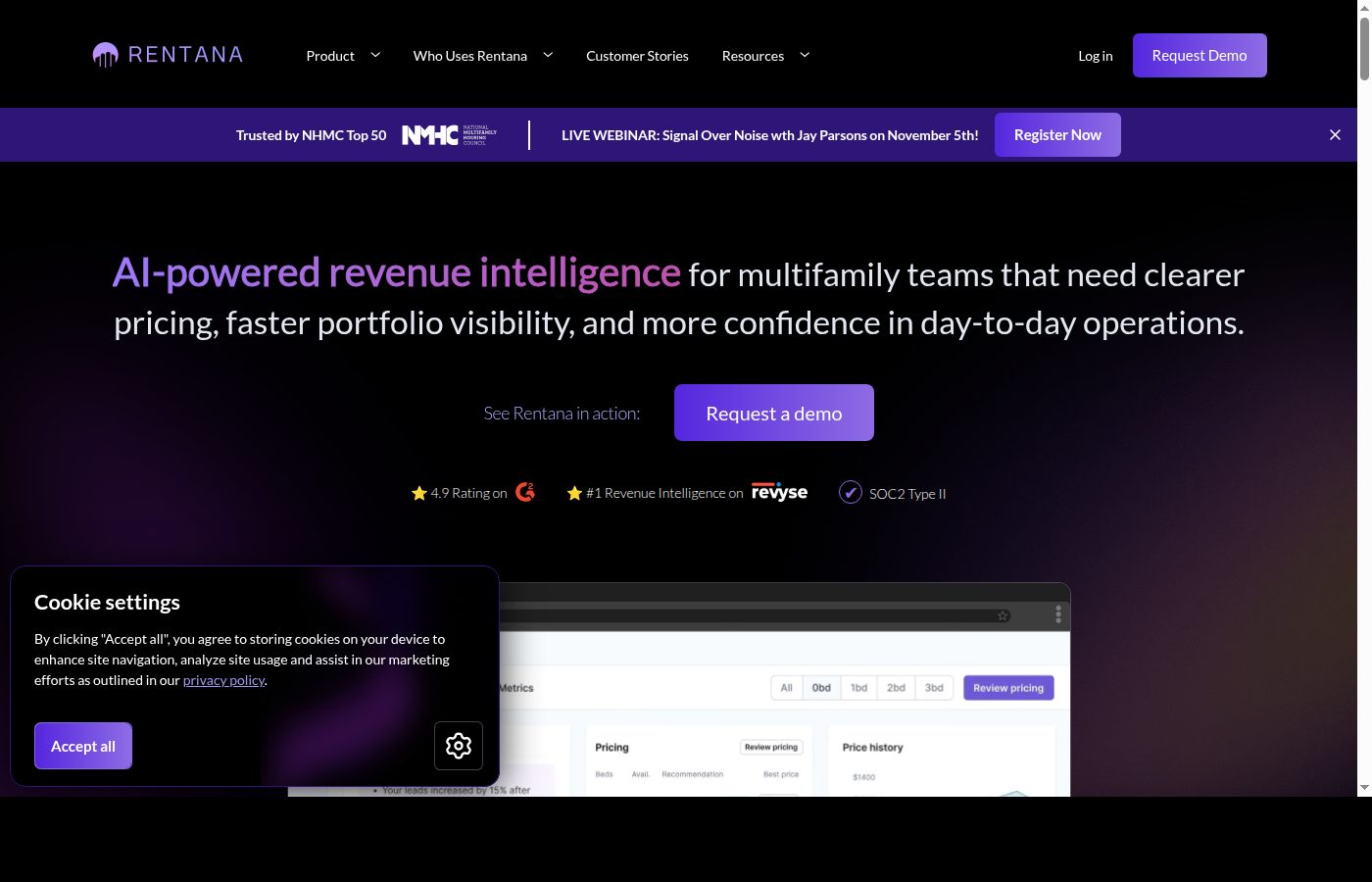
    Rentana is a CRE-native revenue intelligence platform for multifamily operators, revenue managers, asset managers, owners and third-party managers. It changes the workflow between property performance data and daily pricing decisions. Instead of assembling reports, reviewing scattered market indicators and manually updating rents property by property, teams receive pricing recommendations and portfolio-level visibility in one system. The product also addresses renewals, concessions, amenity pricing and lease expirations, placing several recurring revenue decisions within the same operating environment.

    The strongest fit is an operator that has outgrown spreadsheet pricing but finds established revenue management systems cumbersome or difficult to explain to property teams. Rentana emphasizes rapid onboarding, accessible analysis and explanations behind its recommendations. Those qualities matter because pricing software succeeds only when revenue leaders trust the model and site teams understand the resulting actions. The company says properties can begin receiving recommendations quickly, although buyers should validate implementation timing against their particular property management system, data history and approval structure.

    Rentana’s distinguishing claim concerns lease-up demand forecasting. New developments present a different problem from stabilized assets because limited historical performance, changing unit availability and absorption targets can make conventional pricing signals less reliable. A system designed to anticipate demand during lease-up could improve the timing of rent changes and concessions. Analysis: this is a meaningful product direction, but the claim should be tested through a controlled portfolio pilot because Rentana does not publish enough methodological detail to establish forecast performance independently.

    The overall proposition is credible and focused, but public evidence remains thinner than it is for mature competitors. Rentana publishes customer testimonials, a case study claim, a high G2 rating and SOC 2 Type II status. It does not publish standard pricing, detailed model validation, broad integration documentation or enough customer scale information to remove procurement uncertainty. BestCRE therefore views Rentana as a serious challenger for multifamily pricing, particularly for buyers prioritizing usability and explainability, but not yet an automatic choice for every institutional portfolio.

    What Rentana Does and How It Works

    Rentana ingests property and portfolio information to produce rent recommendations and identify changes in demand, availability and operating performance. Revenue managers can review pricing across multiple assets rather than compiling individual property reports. Predictive analytics are intended to surface emerging opportunities before they become obvious in trailing reports. The system then converts those signals into recommended actions. Public information does not fully disclose the underlying models, training data, weighting of market observations or confidence intervals, so buyers should ask how recommendations respond to sparse data, unusual concessions and rapidly changing competitive supply.

    The platform extends beyond new-lease rent. It supports renewal optimization, unit amenity pricing, special management and lease expiration controls. These functions let an operator consider effective rent and exposure instead of evaluating asking rent alone. Renewal recommendations can be applied at scale, while expiration controls help teams avoid excessive lease concentration in undesirable months. Custom recurring reports provide executives, asset managers and onsite staff with different views of the same portfolio. Ask Rentana adds a conversational interface for posing portfolio questions, although buyers should confirm which datasets it can query and how responses are documented.

    Operationally, Rentana presents recommendations with an explanation intended to show why a change is proposed. This is more useful than a black-box number when regional managers must review exceptions or property staff must execute approved decisions. The vendor also positions onboarding and administration as faster than legacy systems. Analysis: workflow simplicity may be Rentana’s most immediately verifiable advantage, while forecast quality requires longer observation. A sound evaluation should compare recommendations against the operator’s existing process, record overrides and reasons, examine realized leasing outcomes, and test whether reporting reduces analyst effort without weakening pricing governance.

    9AI Framework: Dimension by Dimension Analysis

    CRE Relevance: 10/10

    Rentana earns a 10 for CRE relevance because the entire product is designed around multifamily revenue management rather than adapted from a general analytics platform. Its core objects and decisions include units, rents, renewals, concessions, amenities, lease expirations, absorption and portfolio performance. The intended users are recognizable CRE roles, including revenue managers, asset managers, owners and third-party operators. Its workflows connect directly to daily property operations and asset-level revenue strategy. Lease-up demand forecasting further addresses a specialized problem that generic business intelligence software would require substantial configuration to model. Analysis: the product’s narrow sector focus is a strength for multifamily buyers, although it also means the rating should not be interpreted as evidence of relevance to office, industrial, retail or other property types.

    Data Quality and Sources: 8/10

    Rentana earns an 8 for data quality. The platform appears to combine operator data with public market information and applies portfolio analytics across pricing, renewals, availability and related factors. Its ability to generate recommendations quickly suggests an ingestion and normalization process designed for operational use. However, the vendor does not publish sufficient technical detail about source coverage, refresh schedules, error handling, comparable-property selection or model inputs to support a higher score. Buyers should determine whether advertised rents, concessions and availability are observed consistently in each market they operate in. Analysis: internal property data may be the most dependable input, while external competitive data deserves market-by-market testing. A pilot should reconcile source records, identify missing fields and measure how data corrections change recommendations before the system influences live pricing.

    Ease of Adoption: 9/10

    Rentana earns a 9 for ease of adoption because usability, quick property onboarding and straightforward explanations are central to the product. Customer commentary consistently emphasizes navigation, training, responsiveness and the clarity of recommendation rationales. The system also consolidates pricing, renewals, amenities, specials, expirations and reporting, which can reduce switching among separate tools. Those advantages are especially relevant for decentralized operators whose onsite teams have varying analytical experience. The vendor claims setup can occur rapidly, but implementation speed will depend on integration readiness, portfolio data quality, user permissions and approval rules. Analysis: Rentana appears easier to introduce than many established enterprise revenue systems, but buyers should verify this through a representative pilot that includes both revenue specialists and property staff, not solely a vendor-led demonstration using prepared data.

    Output Accuracy: 7/10

    Rentana earns a 7 for output accuracy. The product supplies recommendations tied to operational explanations, which improves auditability and helps users identify advice that conflicts with local knowledge. Its coverage of renewals, lease expirations, amenities and specials also provides context beyond a single asking-rent prediction. Nevertheless, public materials do not provide independent forecast error measures, recommendation acceptance rates, benchmark methodology or performance across different market conditions. A customer outcome claim is useful evidence but cannot establish general accuracy across portfolios. Analysis: the outputs appear decision-ready, but their predictive validity remains insufficiently documented. Buyers should test forecast error by horizon, compare proposed and realized effective rents, track vacancy and exposure, and review performance separately for stabilized communities, lease-ups and stressed assets. Human approval should remain in place until results are demonstrated.

    Integration and Workflow Fit: 7/10

    Rentana earns a 7 for integration. The product is designed to sit close to property management and portfolio workflows, and the vendor refers to integrations as part of reducing administrative friction. Fast onboarding claims also imply that common multifamily data can be connected or imported efficiently. However, the vendor does not publish a complete integration catalog, detailed API documentation or clear descriptions of whether each connection is read-only, bidirectional or file-based. That limits a buyer’s ability to evaluate technical fit before entering the sales process. Analysis: Rentana may integrate adequately with common systems, but portfolios with custom data warehouses, uncommon property management software or strict write-back controls face unanswered questions. Procurement should request named connectors, field mappings, update frequency, failure monitoring, historical backfill rules and data ownership terms.

    Pricing Transparency: 3/10

    Rentana earns a 3 for pricing transparency because the vendor does not publish subscription prices, implementation charges, contract minimums or optional module fees. Prospective customers must request a demonstration and commercial proposal. This approach is common in enterprise CRE software, but it makes early comparison difficult for smaller operators and prevents buyers from estimating cost before disclosing portfolio information. Buyers should ask whether pricing is based on units, properties, users or modules, and whether implementation, integrations, support, data feeds and renewal increases are included. Analysis: an economic case can still be built from analyst hours saved, reduced vacancy and improved effective rent, but it must use a buyer’s own baseline and a complete vendor quote. No reliable public price is available for an independent cost comparison.

    Support and Reliability: 8/10

    Rentana earns an 8 for support. Published customer commentary repeatedly identifies training, responsiveness and direct access to the team as strengths. This matters in revenue management because implementation is only the beginning. Operators need help investigating unusual recommendations, adjusting strategy and training staff as market conditions change. Rentana also describes enterprise-level support and ongoing feature access, though it does not publish service-level commitments, support hours, escalation procedures or standard response times. Analysis: available evidence indicates a high-touch service model typical of a focused young vendor, but buyers should establish whether that experience scales to their portfolio. Contracts should define implementation ownership, data issue escalation, model review procedures, training allowances and support coverage. Reference calls should include customers with similar unit counts, geographic dispersion and staffing structures.

    Innovation and Roadmap: 9/10

    Rentana earns a 9 for innovation. The platform combines predictive rent recommendations with renewals, lease expirations, specials, amenity pricing, recurring reports and conversational portfolio analysis. Its stated focus on forecasting lease-up demand is particularly notable because new developments lack the stable historical patterns that support conventional revenue management. Explaining the reasoning behind recommendations is also a valuable design choice for operator trust and governance. Still, innovation should not be confused with proven economic performance. The vendor does not publish enough technical or comparative evidence to verify that its forecasting method consistently exceeds mature alternatives. Analysis: Rentana is advancing the product category through a more accessible interface and broader revenue intelligence workflow. The remaining test is whether those ideas deliver repeatable gains across cycles, asset classes within multifamily and markets with uneven data coverage.

    Market Reputation: 6/10

    Rentana earns a 6 for market reputation, the maximum appropriate under BestCRE rules for a young company with limited public customer scale. The vendor displays testimonials from multifamily executives, operators, analysts and consultants, including named representatives of several organizations. It also reports strong ratings on third-party software marketplaces and states that it is trusted by large multifamily managers. Those signals support credibility, but the vendor does not publish total customer count, total units managed, retention, renewal rates or a broad set of independently verified performance studies. Analysis: Rentana has promising advocacy among visible users, yet its market record is still developing relative to RealPage, Yardi and other established providers. Buyers should request comparable references, implementation histories and evidence of continued service quality as adoption expands.

    9AI Score Card Rentana
    74
    74 / 100
    Solid Platform
    Revenue Management
    Rentana
    Rentana combines daily rent recommendations, renewal pricing, lease expiration controls and portfolio reporting in a purpose-built multifamily revenue management system.
    9 Dimensions, Scored 1 to 10
    1. CRE Relevance
    10/10
    2. Data Quality & Sources
    8/10
    3. Ease of Adoption
    9/10
    4. Output Accuracy
    7/10
    5. Integration & Workflow Fit
    7/10
    6. Pricing Transparency
    3/10
    7. Support & Reliability
    8/10
    8. Innovation & Roadmap
    9/10
    9. Market Reputation
    6/10
    BestCRE.com, 9AI Framework v2 Reviewed October 2026

    Who Should Use Rentana

    Rentana is best suited to multifamily operators that manage enough pricing complexity to justify a dedicated revenue system but want a more accessible alternative to long-established platforms. Revenue managers overseeing multiple communities can use portfolio views, recommendations and recurring reports to focus attention on exceptions. Regional and onsite teams may benefit from explanations attached to pricing decisions, especially where central strategy depends on local execution. Owners and asset managers seeking clearer visibility into rents, renewals, concessions and expiration exposure are also plausible buyers, provided their property management data can be connected reliably.

    The product is particularly relevant to developers and operators managing lease-ups, where absorption targets, changing availability and limited property history complicate pricing. Third-party managers could also use its reporting and controls to standardize revenue practices across clients, although data separation and permissioning should be tested. Analysis: the ideal buyer values rapid adoption, analyst efficiency and explainable recommendations, while retaining disciplined human oversight. Organizations considering Rentana should have a defined pricing owner, measurable baseline performance and enough transaction volume to evaluate recommendations over a meaningful pilot.

    Who Should Not Use Rentana

    Rentana is not the natural choice for office, industrial, retail, hospitality or mixed commercial portfolios because its product model is centered on multifamily leasing. Very small owners with a few properties and limited pricing activity may struggle to justify specialized revenue software unless the subscription is inexpensive, which cannot be assessed from public pricing. Buyers that require a fully published integration catalog, open technical documentation or independently validated forecast benchmarks before engaging sales will also find the available information insufficient.

    Large operators deeply standardized on RealPage or Yardi should not switch merely for a cleaner interface. Migration risk, data governance, staff retraining and write-back behavior require a documented economic advantage. Organizations seeking unattended automated pricing should also be cautious. Analysis: Rentana is better treated as a decision system with human review until portfolio-specific accuracy is established. If an operator lacks clean unit, lease, availability and concession data, fixing those foundations may create more value than immediately adding another analytical layer.

    Pricing and ROI Analysis

    Rentana does not publish pricing, plan tiers, minimum contract size, implementation fees or standard contract length. Buyers must contact the company for a proposal. A useful quote should separate the recurring platform charge from onboarding, integrations, data services, training and optional functionality. It should also specify whether pricing changes with unit count, property count, user count or feature access. Operators should request renewal terms and limits on annual increases because a low initial quote can become less attractive after implementation costs create switching friction.

    Analysis: simple ROI math should begin with labor savings, not an assumed rent increase. If a five-person revenue team saves three hours each week and fully loaded labor costs $60 per hour, annual gross time value is $46,800, calculated as five people multiplied by three hours, $60 and 52 weeks. Add only documented improvements in effective rent, vacancy or concessions, then subtract subscription, implementation and internal change-management costs. This example is illustrative, not a Rentana performance claim. Buyers should replace every assumption with their own payroll, workflow and pilot results before approving a purchase.

    Integration and CRE Tech Stack Fit

    Rentana’s natural position is between the property management system, market data sources and the operator’s reporting environment. It needs dependable unit, lease, availability, renewal, concession and amenity data to make useful recommendations. Outputs may then inform property teams, revenue managers and executive reporting. The vendor discusses streamlined integrations and fast onboarding, but it does not publish a definitive connector directory or detailed public API documentation. Buyers should not assume compatibility with a particular system without written confirmation.

    Technical diligence should establish the system of record, synchronization frequency, historical backfill, identity matching and handling of corrected transactions. Buyers should also determine whether approved rents can be written back automatically or must be entered elsewhere, and how integration failures are surfaced. For institutional portfolios, access controls, audit logs, data export and warehouse delivery matter as much as initial connectivity. Rentana states that it has SOC 2 Type II compliance, a positive control signal, but security documentation and integration architecture still require normal procurement review.

    Competitive Landscape

    RealPage AI Revenue Management is the most direct institutional alternative. It offers the benefit of a mature multifamily ecosystem and broad market adoption, but may carry greater implementation and administrative complexity. Yardi Virtuoso is relevant for operators already committed to Yardi’s platform and seeking AI capabilities within that environment. Rentana’s case against these incumbents rests on quicker adoption, clearer recommendation explanations and a more modern user experience. Analysis: those workflow benefits are plausible, but a buyer should demand a parallel test before accepting claims of superior pricing outcomes.

    HelloData approaches the problem through multifamily market surveys, rent and concession intelligence, and related underwriting or reporting workflows. It may appeal to teams that need market visibility without replacing their central pricing process. Enodo, associated with multifamily predictive analytics, is another conceptual comparison, although buyers should confirm current product availability and scope directly. Rentana is broader as an operating revenue platform, covering renewals, expirations, amenities and specials alongside pricing.

    BestCRE would shortlist Rentana when usability and lease-up forecasting are priorities, then compare it with the incumbent tied most closely to the buyer’s property management stack. The decision should be based on integration effort, forecast performance, user adoption and total contract cost. Feature demonstrations alone are insufficient because the important differences emerge from live portfolio data and exception handling.

    The Bottom Line

    Rentana deserves a serious pilot from multifamily operators seeking explainable pricing recommendations and faster portfolio analysis. Its focused workflow, renewal tools, expiration controls and lease-up forecasting position it above a simple rent survey or dashboard. The strongest evidence concerns usability and service. The weakest areas are public pricing, technical integration detail and independent validation of forecast accuracy.

    BestCRE’s decision is conditional: shortlist Rentana, but do not approve a portfolio-wide rollout from a demonstration alone. Run it on a representative group of stabilized and lease-up assets, retain a control group, document overrides and compare realized effective rent, occupancy, concessions and staff time. Proceed if the system produces consistent operational value after all costs and data requirements are included. Buyers that cannot run this evaluation should favor the option already integrated into their core property management environment.

    About BestCRE

    BestCRE.com is the definitive authority on commercial real estate AI, analysis, and investment intelligence. Every article advances the platform’s mission to help CRE professionals identify, evaluate, and adopt the best tools and strategies in the industry. We benchmark platforms using the 9AI Framework so CRE leaders can compare tools with clear evidence. Explore the category map at 20 CRE sectors for deeper coverage across the CRE stack.

    Frequently Asked Questions

    What is Rentana?

    Rentana is an AI-powered revenue intelligence and rent optimization platform built for multifamily real estate. It is used by revenue managers, asset managers, owners, third-party managers and property teams to review portfolio performance and make pricing decisions. The platform covers new-lease rent recommendations, renewals, concessions, unit amenities, lease expirations and recurring reporting. Rentana also promotes predictive analytics for identifying changes in demand, including lease-up demand forecasting. Unlike a general business intelligence tool, its data model and workflows are specific to multifamily operations. Analysis: Rentana is best understood as a daily decision system for apartment revenue, not merely a reporting dashboard. Its value depends on the quality of connected property data and whether its recommendations improve outcomes relative to the operator’s existing process.

    How does Rentana compare with RealPage and Yardi?

    Rentana competes with RealPage AI Revenue Management and Yardi Virtuoso for multifamily pricing and revenue workflows. RealPage and Yardi have mature ecosystems, large installed bases and close connections to established property management processes. Rentana differentiates through an interface designed for rapid adoption, explanations behind recommendations, broad portfolio visibility and a stated focus on lease-up demand forecasting. It also combines renewal pricing, expiration management, amenities, specials and reports in one operating workflow. Analysis: Rentana may be easier for property teams to understand and administer, but public information does not prove that its forecasts consistently outperform either incumbent. Buyers should compare the products using identical property data, integration requirements, approval workflows and realized leasing results rather than relying on demonstrations or feature inventories.

    How much does Rentana cost?

    Rentana does not publish standard prices, plan tiers, implementation fees or contract minimums. A prospective buyer must request a demonstration and obtain a proposal. The commercial review should identify whether fees are based on units, properties, users or selected modules. Buyers should also ask whether onboarding, data migration, integrations, training, support, market data and future feature access are included. Analysis: the purchase is financially justified only when measured benefits exceed the complete annual cost. Build the case from documented staff time saved, improved effective rent, reduced vacancy or better concession control, then deduct subscription and implementation expenses. Avoid treating the vendor’s general efficiency claims as a portfolio-specific forecast. A time-limited pilot with predetermined success measures is the most reliable basis for evaluating value.

    Who should use Rentana?

    Rentana is designed for multifamily operators, owners, revenue managers, asset managers and third-party managers that need consistent pricing decisions across multiple communities. It is especially relevant when analysts spend substantial time assembling reports, when onsite teams need clearer explanations for rent changes, or when a portfolio wants central oversight of renewals, concessions and lease expiration exposure. Developers and managers of lease-up properties may find the demand forecasting focus particularly useful. Analysis: the strongest buyer has clean operating data, a named owner for pricing strategy and enough leasing volume to evaluate results objectively. Small landlords with limited pricing activity may not need a specialized platform. Operators outside multifamily should look elsewhere because Rentana’s workflows and data model are built around apartment revenue management.

    Can Rentana become the central AI layer for multifamily operations?

    Rentana could develop into a broader analytical layer for multifamily teams because it already connects pricing, renewals, lease expirations, amenities, specials, portfolio reporting and conversational analysis. That combination creates a foundation for answering operational questions across properties. Whether it becomes a central layer will depend on integration breadth, data governance, model transparency and the reliability of answers outside core revenue workflows. The vendor does not publish enough technical detail to confirm that it can replace a data warehouse, business intelligence platform or property management system. Analysis: the more credible near-term role is a specialized revenue intelligence system that distributes analysis to executives and property teams. Buyers should preserve access to source data and insist on export capability so future adoption does not create unnecessary dependency.

    Related Reviews

    Compare Rentana with other Property Management & Operations tools BestCRE has scored: DoorLoop (73/100), Entrata (72/100), Viabot (62/100) and GemHaus (59/100). Browse every review in CRE Property Management & Operations, the full Best CRE AI Tools directory, or the 20 CRE Sectors hub.
  • ApartmentIQ Review: Daily multifamily intelligence for pricing and market decisions

    ApartmentIQ Review: Daily multifamily intelligence for pricing and market decisions

    BestCRE 9AI Score

    71/100 · Contender

    ApartmentIQ ranks #152 of 584 commercial real estate AI tools scored on the 9AI Framework. Nine dimensions, each scored out of 10: CRE relevance, data quality, ease of adoption, output accuracy, integration fit, pricing transparency, support, innovation and market reputation.

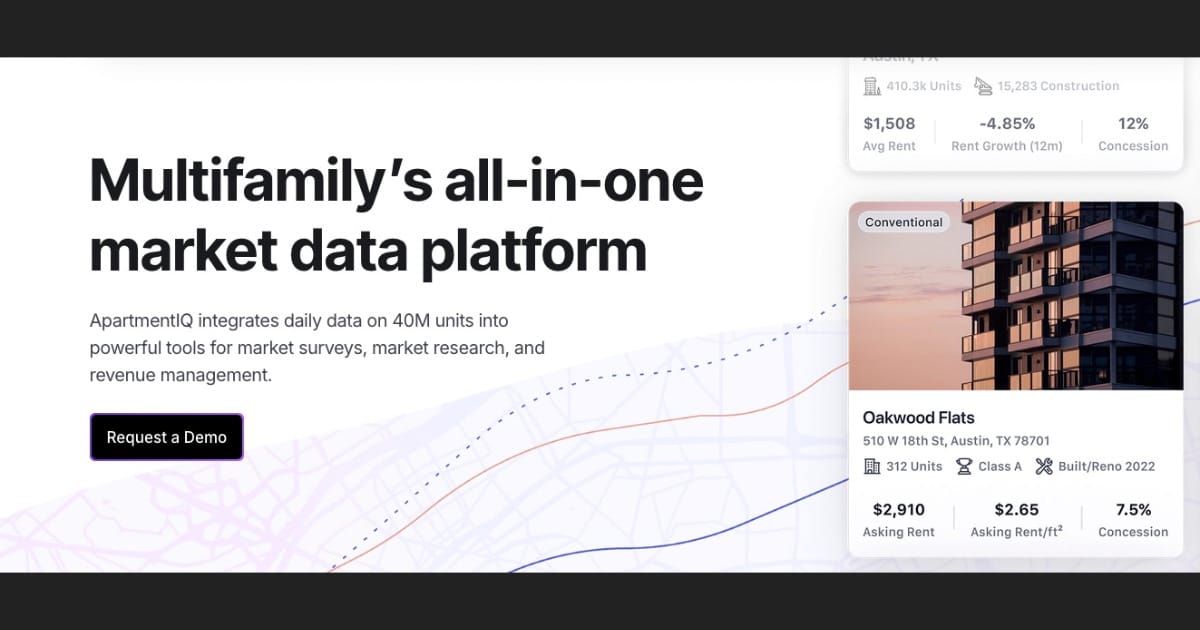
    ApartmentIQ is a CRE native market data platform built for multifamily operators, revenue managers, asset managers and investors. It changes a workflow that has traditionally depended on property teams visiting competitor websites, calling leasing offices and assembling rent surveys in spreadsheets. ApartmentIQ collects market information daily and organizes it into tools for market surveys, portfolio research and revenue management. The practical proposition is straightforward: give operating and investment teams fresher evidence about rents, availability and concessions, while reducing repetitive collection work.

    The platform is unusually focused on the connection between competitive intelligence and pricing action. Its market survey product tracks comparable properties, Explore Pro supports wider market research, and Daylight applies the underlying information to revenue management. That combination matters because the same rent observation can inform an onsite pricing discussion, an asset management review and an acquisition model. ApartmentIQ publicly describes data coverage spanning 40 million units, although buyers should distinguish broad monitored coverage from properties actively managed by customers.

    ApartmentIQ reports adoption across more than 1,500 property management companies and a customer footprint exceeding 8 million units. It also says its products are trusted by organizations representing many of the largest U.S. multifamily operators. Those claims signal substantial multifamily penetration, but they do not by themselves establish accuracy in every submarket. Coverage depth, matching quality and observation consistency should be tested against a buyer’s actual competitive sets before a portfolio commitment.

    BestCRE analysis: ApartmentIQ belongs on the shortlist for operators whose pricing process is constrained by stale surveys or inconsistent property level research. Its advantage is not simply another analytics dashboard. It is the attempt to maintain a daily data layer that supports several recurring decisions. The principal cautions are commercial and operational: pricing is not public, integration detail is limited in public product information, and automated observations still require governance when unit labels, concessions or availability change. The product looks strongest as a specialized multifamily system, not as a universal CRE database.

    What ApartmentIQ Does and How It Works

    ApartmentIQ’s market survey workflow monitors competing apartment properties and captures information such as asking rents, availability, unit attributes and advertised concessions. Users can replace manually assembled surveys with a recurring view of their selected comparables. Daily collection is particularly useful in markets where availability and specials change faster than a weekly operating meeting. The system’s value depends on normalization: differently named floor plans, effective rent structures and concession terms must be made comparable enough to support a pricing discussion. Buyers should request examples from their own markets and inspect how the platform handles incomplete listings, duplicated units and changes in source pages.

    Explore Pro expands the workflow from a property’s immediate competitive set to market research. It is designed for questions involving supply, construction pipelines, rents and comparable assets, making it relevant to acquisitions, development, asset management and business development. Historical information can help users separate a current asking rent from a trend, although the vendor does not publish enough methodological detail to treat every displayed series as transaction evidence. BestCRE analysis: the research product is most credible when used for screening, comp discovery and directional analysis, followed by verification of consequential assumptions through primary documents, broker evidence or property contacts.

    Daylight is ApartmentIQ’s AI revenue management product. It uses the company’s multifamily data foundation to support pricing recommendations rather than requiring teams to move market observations into a separate model manually. This closes the distance between competitor intelligence and operating action, but it also raises the standard for controls. Revenue managers should understand which observations influence a recommendation, how frequently property data updates, how overrides work and whether anomalous concessions are excluded. The vendor also presents MavenAI within its product family, but public descriptions do not fully establish its scope, model architecture or contractual treatment of customer data. A serious evaluation should therefore cover permissions, audit trails, recommendation explanations, exception handling and the process for correcting source information.

    9AI Framework: Dimension by Dimension Analysis

    CRE Relevance: 10/10

    ApartmentIQ earns a 10 for CRE relevance because every principal workflow is designed around multifamily property decisions. Competitive rent surveys, concession monitoring, construction pipeline research and revenue management are not generic business intelligence functions with apartment terminology added later. They correspond directly to work performed by onsite teams, regional managers, revenue managers, asset managers and investment professionals. The platform also connects market observations to pricing recommendations, which makes it operationally relevant rather than merely informational. Its specialization is a limitation for buyers working across office, retail, industrial or hospitality assets, but that does not reduce its relevance within the stated category. BestCRE analysis: few platforms align this closely with the daily operating cadence of institutional and middle market multifamily portfolios.

    Data Quality and Sources: 7/10

    ApartmentIQ earns a 7 for data quality because daily unit level monitoring can provide substantially fresher evidence than manually maintained surveys, and its stated scale suggests a broad observation network. The score stops at 7 because public marketing does not fully disclose source coverage by market, error rates, normalization methodology, missing data policy or independent validation results. Apartment listings are inherently messy. Floor plan names change, units reappear, specials contain conditions and advertised rents may exclude mandatory fees. Buyers should test representative urban, suburban and secondary market assets, then compare displayed records with source websites and leasing confirmations. BestCRE analysis: the data foundation appears differentiated, but decision quality depends on local completeness and the platform’s treatment of ambiguous listing information.

    Ease of Adoption: 7/10

    ApartmentIQ earns a 7 for ease of adoption, held there because the vendor offers only a demo request rather than a trial or self-serve sign-up. Automated surveys address a familiar process, so users can understand the initial value without redesigning the entire operating model. A team can begin with defined properties and competitor sets, compare results with its existing survey, and expand after confidence develops. Adoption becomes more demanding when the organization moves from viewing intelligence to allowing pricing recommendations to influence daily rates. Comparable selection, user permissions, exception rules and ownership of data corrections must then be formalized. Public information does not establish typical implementation duration, training requirements or administrator workload. BestCRE analysis: the survey product should be relatively approachable, while revenue management requires disciplined change management and clear accountability.

    Output Accuracy: 7/10

    ApartmentIQ earns a 7 for output accuracy, the ceiling when no accuracy metrics are published. Frequent collection should improve timeliness, and automated normalization can reduce transcription mistakes that occur in spreadsheet surveys. Accuracy is nevertheless different from freshness. An advertised special may not apply to every lease term, a unit may remain visible after being rented, and a quoted asking rent may not equal effective or achieved rent. Revenue recommendations add another layer of model judgment. The vendor does not publish independently audited accuracy measures, recommendation hit rates or detailed confidence intervals. Buyers should conduct a controlled validation using known inventory, executed leases and manually verified competitors. BestCRE analysis: outputs appear suitable for informed decisions when reviewed by experienced operators, but they should not be treated as unquestionable transaction records.

    Integration and Workflow Fit: 6/10

    ApartmentIQ earns a 6 for integration, because no production integration with Yardi, MRI or other systems is publicly documented. Its product family connects survey data, market research and revenue management internally, which reduces handoffs among separate tools. That is meaningful for organizations trying to align onsite pricing with asset management and investment research. However, public product information does not provide a complete, current catalog of property management systems, data warehouses, business intelligence tools and revenue platforms supported through production integrations. It also does not publish enough detail about APIs, field mappings, refresh behavior or implementation responsibilities. Buyers should ask for a written architecture showing each inbound and outbound data flow. BestCRE analysis: the platform can occupy an important position in a multifamily stack, but integration readiness must be verified against the buyer’s exact systems.

    Pricing Transparency: 4/10

    ApartmentIQ earns a 4 for pricing transparency because the vendor does not publish subscription prices, implementation charges, minimum commitments or standard contract terms. Prospects are directed to request a demonstration, leaving buyers unable to estimate cost before entering a sales process. Portfolio pricing may reasonably vary by unit count, modules, markets and data requirements, but configurable enterprise software can still publish representative bands or a clear pricing basis. Buyers should request separate pricing for market surveys, Explore Pro and Daylight, along with setup, integration, training, support, renewal and data export terms. BestCRE analysis: the lack of public economics does not indicate poor value, but it increases procurement effort and makes comparable total cost analysis harder.

    Support and Reliability: 7/10

    ApartmentIQ earns a 7 for support. The company serves workflows where data questions can affect live pricing, so responsive operational assistance is important. Public customer testimonials describe improved efficiency and confidence in information, which is a useful signal, but the vendor does not publish comprehensive service levels, response targets, escalation procedures, support hours or customer satisfaction measures. Prospective customers should determine whether data disputes are handled by a general support queue or a specialized research team, and whether revenue management clients receive dedicated implementation and ongoing advisory resources. References should include customers of similar portfolio size and operating complexity. BestCRE analysis: available evidence supports a positive score, although contractual support commitments require direct verification.

    Innovation and Roadmap: 8/10

    ApartmentIQ earns an 8 for innovation because it combines automated daily market observation with research and AI assisted revenue management in a single multifamily focused platform. The important innovation is the workflow connection: market data does not stop at a comp report but can inform pricing actions and wider investment analysis. This approach has more practical value than adding a conversational interface to static reports. The score remains at 8 because public information does not disclose enough about Daylight’s model design, explainability, testing or performance to establish a category defining technical advantage. Competitors also automate multifamily data collection and pricing. BestCRE analysis: ApartmentIQ is advancing the category through an integrated data and decision loop, subject to buyer validation of controls and measurable outcomes.

    Market Reputation: 8/10

    ApartmentIQ earns an 8 for market reputation. Its publicly stated customer reach, penetration among major multifamily managers and named testimonials from recognizable operators provide stronger evidence than the limited references common among newer CRE software companies. A growth investment of $25 million from Susquehanna Growth Equity also indicates institutional confidence, although financing is not evidence of product performance. The score does not reach 9 because broad adoption claims are vendor reported, contract depth is not visible, and public information does not establish renewal rates or independently measured customer satisfaction. Prospects should speak with current users operating similar assets, including one that implemented revenue management rather than surveys alone. BestCRE analysis: ApartmentIQ has a credible market position and is no longer an unproven entrant.

    9AI Score Card ApartmentIQ
    79
    71 / 100
    Solid Platform
    Multifamily Market Analytics
    ApartmentIQ
    ApartmentIQ automates daily competitor surveys and connects market research with revenue management, giving multifamily teams one data foundation for pricing and investment work.
    9 Dimensions, Scored 1 to 10
    1. CRE Relevance
    10/10
    2. Data Quality & Sources
    7/10
    3. Ease of Adoption
    7/10
    4. Output Accuracy
    7/10
    5. Integration & Workflow Fit
    6/10
    6. Pricing Transparency
    4/10
    7. Support & Reliability
    7/10
    8. Innovation & Roadmap
    8/10
    9. Market Reputation
    8/10
    BestCRE.com, 9AI Framework v2 Reviewed October 2026

    Who Should Use ApartmentIQ

    ApartmentIQ is best suited to multifamily operators with enough properties that manual comp surveys create material labor, consistency or timeliness problems. Revenue managers overseeing several markets can use daily observations to identify changing availability, rents and concessions without waiting for onsite teams to submit spreadsheets. Regional managers and asset managers may also benefit when they need a shared view of competitive conditions during pricing calls. The strongest buyer has defined competitive sets, clear responsibility for reviewing exceptions and sufficient operating data to evaluate whether recommendations improve outcomes.

    Investors, developers and business development teams should consider Explore Pro when they repeatedly screen submarkets, assess pipelines or build rent comp sets. The platform is particularly relevant when research and operations need to work from the same market evidence. BestCRE analysis: buyers should favor ApartmentIQ when multifamily specialization and update frequency matter more than having one database cover every property type. A phased purchase is sensible. Validate market surveys first in several representative markets, measure time saved and discrepancy rates, then evaluate revenue management with a controlled group and explicit approval rules.

    Who Should Not Use ApartmentIQ

    ApartmentIQ is not the natural choice for firms focused primarily on office, retail, industrial, self storage or hospitality properties. It is also likely excessive for a small owner with a few stable assets, limited competitive movement and no centralized revenue function. Such teams may obtain adequate evidence through broker relationships, property management reports and periodic manual checks. Buyers seeking verified closed transactions, ownership records, debt information or broad cross sector prospecting should evaluate a wider commercial property database instead.

    Organizations should defer Daylight if they lack reliable property data, documented pricing authority or staff able to investigate exceptions. Automation cannot repair unclear operating governance. Teams requiring public list pricing, a self service purchase or fully documented integrations before speaking with sales may also find the evaluation process frustrating. BestCRE analysis: ApartmentIQ should not be purchased merely to modernize reporting. The economics are strongest when frequent market changes create decisions that can be acted upon, measured and reviewed.

    Pricing and ROI Analysis

    ApartmentIQ does not publish subscription prices, module fees, implementation costs or minimum contract commitments. Buyers should expect a quote based on the portfolio and products under consideration, but the vendor does not publicly specify its pricing formula. Procurement should request an itemized proposal covering the market survey product, Explore Pro, Daylight, implementation, data connections, training, support, renewal increases and termination assistance. The contract should also define data retention, export rights and charges associated with adding properties or users. Without those terms, a headline subscription figure is not a reliable total cost.

    BestCRE analysis: simple ROI math should begin with avoidable labor and measurable pricing impact, using the buyer’s own assumptions. If 50 properties each spend two staff hours per week assembling and checking surveys, automation addresses 100 hours weekly. Multiply those hours by the fully loaded labor rate and by the number of operating weeks, then subtract annual software, implementation and internal administration costs. Treat any claimed revenue improvement separately, using a controlled comparison and conservative attribution. A purchase is economically credible when verified labor savings plus measured operating benefit exceed total cost by the buyer’s required hurdle, not when the case depends entirely on an untested rent uplift.

    Integration and CRE Tech Stack Fit

    ApartmentIQ can fit between public market sources, a property’s operating systems and the teams responsible for pricing and asset strategy. Market surveys and research can serve as a shared intelligence layer, while Daylight moves the platform closer to the system where pricing decisions are made. The desired architecture depends on whether users only consume reports or also send property inventory, availability and performance information into a recommendation workflow.

    The vendor does not publish a complete integration matrix or sufficient API documentation for buyers to assume compatibility. During diligence, request exact support for the property management system, data warehouse, identity provider and reporting tools in use. Confirm refresh frequency, historical backfills, unit and floor plan identifiers, error alerts, permissions and export formats. BestCRE analysis: integration should be treated as a scored implementation workstream, particularly when recommendations could reach live pricing, rather than as a feature confirmed by a logo on a sales slide.

    Competitive Landscape

    HelloData is the closest alternative for buyers prioritizing automated multifamily rent comps, market surveys and underwriting data. It may appeal to teams seeking an accessible research workflow or data services that fit acquisition analysis. ApartmentIQ presents a broader connected story across surveys, research and revenue management. A fair comparison should use identical properties and measure coverage, unit matching, concessions, effective rent treatment, history and export quality. Interface preferences matter less than discrepancies in the markets where the buyer actually operates.

    Radix is another direct multifamily intelligence alternative, particularly for market surveys, benchmarking and operational visibility. RealPage AI Revenue Management deserves consideration when pricing optimization and connection to an established multifamily operating ecosystem are the main priorities. CoStar remains relevant for broad commercial property research, ownership context and cross sector market coverage, but it is not a direct substitute for daily unit level multifamily pricing workflows.

    BestCRE analysis: ApartmentIQ is most differentiated when a buyer wants one specialist to connect recurring competitor collection with research and pricing decisions. HelloData and Radix should be tested for data accuracy and workflow fit, RealPage for revenue management depth, and CoStar for wider research needs. Do not select from demonstrations alone. Run a parallel test using known properties, document errors and omissions, then compare total contract cost, implementation burden and rights to retrieve data at termination.

    The Bottom Line

    ApartmentIQ is a high priority evaluation for multifamily operators that still depend on inconsistent manual surveys or disconnected market research. Its focused data engine and linked product set can shorten the path from a competitor’s listing change to an informed pricing discussion. BestCRE analysis: proceed to a paid pilot when the vendor demonstrates strong coverage in the buyer’s markets, explains normalization and correction procedures, and provides a workable integration design.

    Do not approve a portfolio rollout until the pilot establishes local accuracy, user adoption and clear economics. Keep human review over unusual concessions and material pricing changes, and negotiate data access, service expectations and renewal terms in writing. For buyers meeting those conditions, ApartmentIQ is one of the stronger specialized choices in multifamily market analytics. For mixed asset firms or teams wanting a broad transaction database, it should complement rather than replace a wider CRE information platform.

    About BestCRE

    BestCRE.com is the definitive authority on commercial real estate AI, analysis, and investment intelligence. Every article advances the platform’s mission to help CRE professionals identify, evaluate, and adopt the best tools and strategies in the industry. We benchmark platforms using the 9AI Framework so CRE leaders can compare tools with clear evidence. Explore the category map at 20 CRE sectors for deeper coverage across the CRE stack.

    Frequently Asked Questions

    What is ApartmentIQ?

    ApartmentIQ is a multifamily market data platform for automated market surveys, market research and revenue management. It is used by property managers, revenue managers, asset managers, developers and investors to monitor rents, unit availability, concessions, comparable properties and market supply. Its core purpose is to replace or improve manual competitive surveys with information collected on a daily cadence. Explore Pro supports broader market analysis, while Daylight applies the company’s data foundation to pricing recommendations. BestCRE analysis: ApartmentIQ is best understood as a specialized operating intelligence system for apartments, not a general commercial property database. Buyers should test its observations in their own submarkets because national scale does not guarantee equal coverage or accuracy for every competitive set.

    How does ApartmentIQ compare with HelloData?

    ApartmentIQ and HelloData both address multifamily market intelligence, including automated rent comps and research workflows. ApartmentIQ places particular emphasis on connecting daily market surveys, Explore Pro research and Daylight revenue management within one product family. HelloData is a credible alternative for automated multifamily data and underwriting oriented analysis. The right choice depends on local source coverage, concession interpretation, floor plan matching, history, exports and system fit. BestCRE analysis: buyers should create the same comp set in both platforms, compare results with manually verified property data, and record missing or incorrectly normalized observations. They should also compare contract scope and implementation requirements. A polished demonstration is less useful than a controlled test involving the buyer’s actual markets and known properties.

    How much does ApartmentIQ cost?

    ApartmentIQ does not publish standard subscription pricing, implementation fees or minimum commitments. Prospective buyers must request a demonstration and obtain a tailored proposal. The quote should separate the cost of market surveys, Explore Pro and Daylight, while identifying charges for setup, integrations, training, additional properties, users and support. Buyers should also request renewal limits and data export terms. BestCRE analysis: evaluate value by multiplying the weekly hours currently spent collecting and checking competitor data by the fully loaded labor rate, then add any operating benefit demonstrated in a controlled pilot. Subtract all vendor and internal implementation costs. Avoid supporting the purchase with assumed rent gains that have not been measured against a credible baseline.

    Who should use ApartmentIQ?

    ApartmentIQ suits multifamily operators managing enough assets that frequent manual market surveys have become costly, slow or inconsistent. Revenue managers, regional operators and asset managers are natural users because they regularly compare rents, availability and concessions before making pricing decisions. Investors and developers can use its research capabilities for comp discovery, submarket review and supply analysis. The best customer has clearly defined competitive sets, reliable internal property data and staff accountable for reviewing exceptions. BestCRE analysis: the platform is less compelling for very small landlords, infrequent researchers or companies focused on nonmultifamily property types. It should be evaluated as an operating system for recurring decisions, with success measured through data accuracy, time saved, adoption and controlled pricing outcomes.

    Will ApartmentIQ replace manual market surveys?

    ApartmentIQ can replace much of the repetitive collection and spreadsheet assembly involved in manual multifamily market surveys, but it should not eliminate professional review. Automated monitoring is well suited to capturing recurring changes in advertised rents, availability and concessions. Humans remain necessary when promotions contain conditions, listings conflict, competitor sets change or a source does not reflect the terms actually available to a prospect. BestCRE analysis for Q4 2026: the likely direction is greater automation, with market observations feeding pricing systems more directly and exceptions receiving human attention. Buyers should prepare by defining data quality thresholds, approval limits and audit procedures. The strongest future workflow is not fully unattended pricing. It is faster collection paired with accountable review of consequential recommendations.

    Related Reviews

    Compare ApartmentIQ with other Market Analytics & Data tools BestCRE has scored: CompStak (76/100), Placer.ai (74/100), DeepSeek (67/100) and LlamaIndex (67/100). Browse every review in CRE Market Analytics & Data, the full Best CRE AI Tools directory, or the 20 CRE Sectors hub.

  • Deepki Review: Portfolio sustainability data and decarbonization planning

    Deepki Review: Portfolio sustainability data and decarbonization planning

    BestCRE 9AI Score

    73/100 · Contender

    Deepki ranks #50 of 584 commercial real estate AI tools scored on the 9AI Framework. Nine dimensions, each scored out of 10: CRE relevance, data quality, ease of adoption, output accuracy, integration fit, pricing transparency, support, innovation and market reputation.

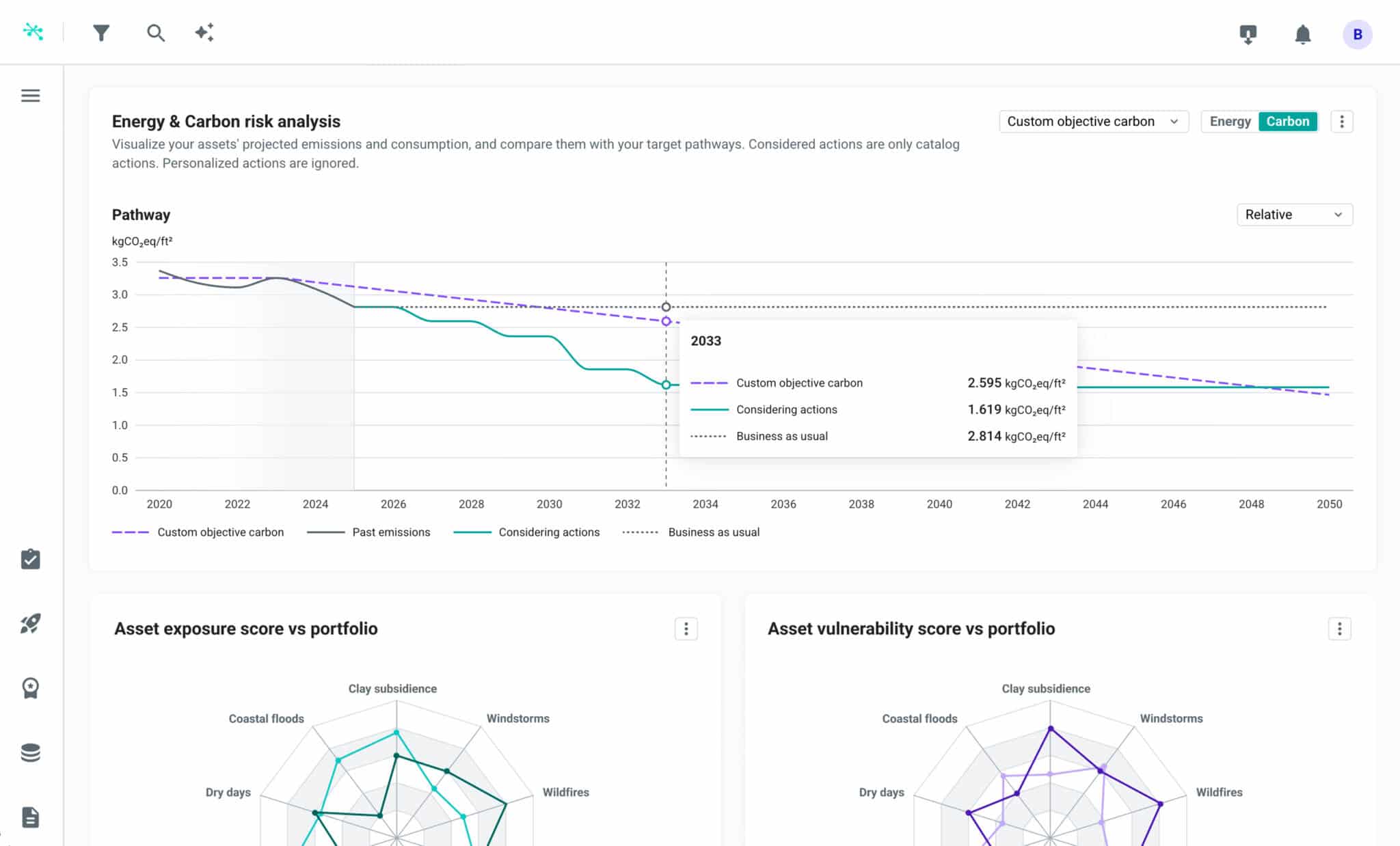
    Deepki is a CRE specific sustainability data and decarbonization platform for institutional property owners, investors, asset managers and large occupiers. It changes a workflow that often depends on utility portals, spreadsheets, consultants and repeated requests to property managers. The platform collects building and meter information, checks it, calculates sustainability indicators and presents performance from individual meters through entire portfolios. Buyers can then use the same governed dataset for reporting, climate risk analysis, energy management and capital planning.

    The practical proposition is consolidation. Deepki says its platform covers utility and property data, operational energy, carbon emissions, physical climate risk, regulatory reporting, due diligence, embodied carbon and retrofit planning. Its capital planning tools can model potential interventions against CRREM pathways or custom targets. That scope matters because many landlords still treat disclosure, engineering and investment planning as separate exercises, creating conflicting asset records and expensive reconciliation work.

    Deepki is headquartered in Paris and has established a credible enterprise presence. The company reports more than $4 trillion of real estate assets under monitoring, operations across more than 100 countries and use by major investment and property organizations. It also reports more than 600 customers and 85,000 platform users. Its acquisitions of EVORA Global and Metry broaden the proposition through sustainability advisory expertise and meter data infrastructure. Deepki previously raised a €150 million Series C round.

    BestCRE analysis: Deepki belongs near the top of a specialist CRE sustainability shortlist, particularly for multinational portfolios facing complicated data collection and disclosure obligations. It is not conventional property management software and will not replace accounting, leasing, work order or tenant systems. Its value depends on the quality of source access, ownership of remediation tasks and whether investment teams actually use the resulting analysis. Buyers should test data coverage, calculation governance, local reporting requirements and export rights using a representative group of difficult assets before committing portfolio wide.

    What Deepki Does and How It Works

    Deepki starts by assembling sustainability information that is normally scattered across utility companies, property managers, invoices, meters and internal systems. The company advertises more than 7,300 automated connectors, alongside integrations with data partners and workflows for collecting property attributes and financial information. The platform checks and versions incoming records, preserves audit trails and flags incomplete or questionable data. Where readings are unavailable, AI based estimates can fill gaps across more than 60 asset types. Estimated values still require governance because modeled consumption is not equivalent to a verified bill or meter reading.

    Once data is organized, users can examine energy, emissions and other sustainability indicators at meter, building, fund and portfolio levels. Benchmarking helps identify unusually intensive assets, while physical climate risk and carbon assessments add a longer term risk view. Teams can coordinate reporting campaigns, reuse collected indicators and monitor completion against deadlines. Deepki positions the resulting records as audit ready, but that does not remove the buyer’s responsibility to define boundaries, review estimation methods, reconcile ownership periods and approve final disclosures.

    The action layer connects measurement with investment planning. Users can create virtual retrofit scenarios, compare measures, estimate their effects and monitor implementation against carbon pathways or internal targets. Energy management views can support operational investigation, while due diligence tools can bring sustainability factors into acquisition or financing decisions. BestCRE analysis: the most valuable mechanic is not another emissions dashboard. It is the ability to carry a consistent asset record from collection through compliance and into capital allocation. The main implementation risk is organizational. A platform can expose gaps and recommend priorities, but engineering teams, asset managers and finance committees must validate assumptions, fund projects and document realized results.

    9AI Framework: Dimension by Dimension Analysis

    CRE Relevance: 9/10

    Deepki earns 9 for CRE relevance, held below 10 by its sustainability only scope, because its data model, workflows and outputs are designed around buildings, meters, assets, funds and property portfolios. The product addresses tasks performed by sustainability teams, asset managers, property managers, investment committees and real estate lenders. Its coverage of CRREM alignment, retrofit scenarios, utility consumption, climate exposure, due diligence and real estate reporting is materially different from a general carbon accounting platform. BestCRE analysis: the strongest evidence is the connection between environmental measurements and asset level decisions. Users can move from a questionable utility record to portfolio comparison and then to a proposed capital intervention without translating everything into an unrelated corporate accounting structure. The qualification is category scope. Deepki is deeply relevant to property sustainability and operations, but it is not a full property management system for leasing, rent collection, maintenance and general ledger functions.

    Data Quality and Sources: 8/10

    Deepki earns 8 for data quality. Its proposition rests on centralized utility, building, financial and climate information, supported by automated connectors, partner feeds, validation processes, audit trails and data versioning. Meter specialist Metry should strengthen collection capabilities, while the platform’s estimation models can help make incomplete portfolios usable. BestCRE analysis: those controls are appropriate for institutional reporting, but no vendor can manufacture verified source data when utilities, managers or tenants do not provide it. Estimated readings may improve continuity while also creating false confidence if they are not visibly separated from observed values. Buyers should inspect lineage at the individual meter level, rules for weather and occupancy adjustments, treatment of acquisitions and disposals, duplicate detection, and procedures for correcting closed reporting periods. A score above 8 would require more publicly accessible technical evidence about validation performance, error rates and independent testing across jurisdictions.

    Ease of Adoption: 7/10

    Deepki earns 7 for ease of adoption. The interface consolidates several sustainability workflows, and automated collection can reduce recurring requests once connections are established. Centralized campaigns, role based workflows and reusable indicators should be easier than maintaining parallel spreadsheets for every disclosure. Deepki also combines software with a substantial sustainability expert team, which can help buyers define processes and interpret requirements. BestCRE analysis: implementation will still be demanding for a large owner. Utility authorizations, meter hierarchies, landlord and tenant boundaries, joint venture permissions, historical gaps and inconsistent asset identifiers take real work. Users outside the sustainability function may also need training before they trust modeled scenarios or enter data consistently. Prospective customers should request a phased plan that identifies responsibilities, acceptance tests and remediation queues. Adoption should be judged by time to a reconciled portfolio, not by the speed of an initial dashboard demonstration.

    Output Accuracy: 7/10

    Deepki earns 7 for output accuracy. Audit trails, version control, structured checks and consistent calculation workflows can produce more defensible reporting than uncontrolled spreadsheets. The platform can also compare assets, calculate carbon indicators and simulate retrofit effects using a shared dataset. BestCRE analysis: accuracy remains conditional on source completeness, organizational boundaries, emissions factors, estimation choices and the assumptions placed inside investment scenarios. A decarbonization model is decision support, not a guaranteed forecast of energy savings, project cost or valuation impact. Physical climate outputs similarly depend on external hazard models, asset coordinates and the interpretation of exposure. Deepki does not publish enough standardized accuracy evidence to justify a higher score across all modules. Buyers should require sample calculations, factor libraries, methodology documentation, change controls and exports that allow an adviser or auditor to reproduce important figures independently before relying on the platform for formal disclosures or underwriting.

    Integration and Workflow Fit: 7/10

    Deepki earns 7 for integration, capped because no native Yardi, MRI, CoStar or Argus connector is documented, although data connectivity is central to the product rather than an optional accessory. It supports thousands of automated utility connections and presents integrated partner data alongside property, meter and financial records. The acquisition of Metry adds specialization in energy data collection, while enterprise positioning suggests that identity, governance and portfolio scale are core design concerns. BestCRE analysis: this is a strong fit for owners that need to connect many providers and jurisdictions into a common sustainability layer. The remaining diligence is specific to each buyer. A large connector count does not prove that the exact utility, property manager, accounting system or data field required by a portfolio is supported in the needed country. Buyers should obtain a source by source coverage matrix, clarify API and bulk export terms, test asset identifier mapping, and document how failed connections are monitored. Integration quality should be measured through sustained data delivery, not connector availability alone.

    Pricing Transparency: 4/10

    Deepki earns 4 for pricing transparency because the vendor does not publish subscription prices, package rates, implementation fees or standard contract terms. Prospective customers are directed to request a demonstration and enter a sales process. That approach is common in enterprise CRE software, where portfolio size, geography, modules, data sources and advisory requirements can materially affect scope. It still prevents buyers from estimating total cost before engaging the vendor. BestCRE analysis: procurement teams should ask for separate prices for platform access, implementation, connector setup, historical data work, advisory services, additional modules, support tiers and future portfolio growth. They should also clarify minimum terms, annual increases, user limits, data export rights and exit assistance. The score is at the low end of the usual range for unpublished pricing because opacity adds time and makes comparisons harder, even when a configured enterprise quote may ultimately be reasonable.

    Support and Reliability: 8/10

    Deepki earns 8 for support. The company positions software, sustainability expertise and process assistance as a combined offering, and reports a team of more than 150 sustainability experts. Its purchase of EVORA Global adds an established real estate sustainability advisory capability, which is particularly relevant for buyers that need methodology, reporting and portfolio strategy help alongside technology. BestCRE analysis: this structure can reduce the gap between software configuration and CRE decision making. It may be especially useful during onboarding, regulatory changes and capital planning exercises. Buyers should not assume every expert service is included in the software fee or available equally in every market. Contract diligence should identify the named support model, service hours, escalation path, response commitments, training allocation and boundaries between customer success and billable consulting. References should be matched by geography and portfolio complexity, since enterprise support performance can vary substantially by team and implementation scope.

    Innovation and Roadmap: 8/10

    Deepki earns 8 for innovation. The platform connects sustainability data management with climate risk, regulatory reporting, energy operations, due diligence and capital expenditure planning. AI is used for data estimation and retrofit support, while virtual scenarios can compare investments against recognized or custom decarbonization targets. The broader combination of software, advisory capability and energy data infrastructure gives Deepki more operational depth than a narrow disclosure tool. BestCRE analysis: the innovation is useful because it attempts to join measurement with investment decisions, not because the product applies an AI label. The restraint is evidence. Automated estimates and suggested interventions must be explainable, reviewable and tied to known inputs before an investment committee should rely on them. Buyers should test whether AI functions materially improve data remediation or option analysis, and whether users can see assumptions and override results. Public information does not establish independently measured gains for every module, asset class or geography.

    Market Reputation: 8/10

    Deepki earns 8 for market reputation. The company has an established profile in European real estate sustainability and publicly identifies recognized investment managers, property companies and service firms in customer stories. Reported portfolio scale, international coverage and enterprise adoption indicate that the platform has progressed well beyond an early market trial. The acquisitions of EVORA Global and Metry also signal an effort to broaden delivery and data capabilities around the core product. BestCRE analysis: this reputation should earn Deepki a place in serious institutional evaluations, but brand scale is not a substitute for reference checks. Buyers should speak with customers that share their asset types, utility markets, ownership structures and reporting obligations. They should ask about implementation delays, data exceptions, renewal economics and actual use by investment teams. A higher score would require dominant incumbent status and broader independently verifiable performance evidence and consistently detailed public documentation of customer outcomes, rather than primarily vendor selected case studies.

    9AI Score Card Deepki
    77
    73 / 100
    Solid Platform
    Sustainability Management
    Deepki
    Deepki brings utility data, carbon targets, compliance reporting, climate risk and capital planning into one CRE platform built for institutional portfolios.
    9 Dimensions, Scored 1 to 10
    1. CRE Relevance
    9/10
    2. Data Quality & Sources
    8/10
    3. Ease of Adoption
    7/10
    4. Output Accuracy
    7/10
    5. Integration & Workflow Fit
    7/10
    6. Pricing Transparency
    4/10
    7. Support & Reliability
    8/10
    8. Innovation & Roadmap
    8/10
    9. Market Reputation
    8/10
    BestCRE.com, 9AI Framework v2 Reviewed October 2026

    Who Should Use Deepki

    Deepki is best suited to institutional owners, investment managers, listed property companies, large occupiers and real estate finance organizations with portfolios spread across managers, utilities or countries. The ideal buyer already has material sustainability reporting duties and needs one governed record for asset performance, emissions, climate exposure and planned interventions. It is particularly relevant when sustainability staff spend too much time chasing bills, reconciling spreadsheets and rebuilding the same indicators for investors, regulators and internal committees.

    It also suits organizations trying to connect sustainability targets with capital planning. An asset management team can use portfolio comparisons to prioritize investigations, then evaluate retrofit scenarios with engineers and finance colleagues. BestCRE analysis: the economic case is strongest where data collection repeats frequently, reporting carries meaningful risk and capital committees need comparable asset level evidence. Buyers should have an executive sponsor, named data owners and a process for resolving exceptions. Without those elements, Deepki may become an expensive reporting repository rather than an operating system for portfolio improvement.

    Who Should Not Use Deepki

    Deepki is unlikely to suit a small landlord with a limited local portfolio, simple utility access and no complex disclosure burden. Such an owner may obtain adequate results from utility portals, an energy consultant and a controlled workbook. Companies seeking rent collection, lease administration, maintenance dispatch or tenant communications should buy property management software instead. Deepki may complement those systems, but it does not replace their core transactional functions.

    The platform is also a poor fit for buyers unwilling to fund data cleanup or assign accountability across sustainability, property management, engineering and finance. BestCRE analysis: organizations looking for automatic, unquestionable savings forecasts should be cautious. Estimated data, climate models and retrofit scenarios all require review. Teams that only need corporate emissions accounting outside real estate should compare broader carbon platforms, while buyers that need advisory work without an enterprise data platform may be better served by a specialist consultant.

    Pricing and ROI Analysis

    Deepki does not publish subscription prices, implementation charges or standard packages. Pricing is therefore likely configured through a sales process, but the vendor does not publicly specify its formula. Buyers should request a written total cost model covering platform modules, assets, meters, users, countries, data connectors, onboarding, historical imports, advisory work and premium support. They should also ask how acquisitions, disposals and portfolio growth affect fees, and whether access to raw data and calculation histories continues after termination.

    BestCRE analysis: a simple ROI test should start with avoidable labor and credible operating improvement, then subtract all recurring and one time costs. If a portfolio spends 4,000 staff and consultant hours each year collecting, checking and reporting sustainability data, and Deepki removes 1,000 hours, multiply those saved hours by the buyer’s fully loaded hourly cost. Add only energy savings that have a documented baseline, approved measure and accountable owner. Do not count modeled savings as cash until they appear in verified consumption or invoices. Compare the resulting annual benefit with subscription, implementation, internal administration and integration costs over the proposed contract term.

    Integration and CRE Tech Stack Fit

    Deepki should sit beside the property management, accounting, data warehouse and investment systems in an institutional CRE stack. It can act as the sustainability system of record while source applications continue handling leases, invoices, work orders and financial books. Utility connectors and partner feeds reduce manual collection, and structured exports or interfaces can pass approved indicators into reporting and analytics environments. The platform’s asset identifiers must be mapped carefully to the owner’s existing property hierarchy.

    BestCRE analysis: buyers should build an integration inventory before procurement. For every material source, document the system owner, geography, refresh frequency, authorization method, required history and fallback when automated collection fails. Test API access and bulk exports rather than relying on presentation slides. Confirm whether financial and property attributes are synchronized or manually uploaded, and determine how corrections flow back into downstream reports. A pilot should include tenant controlled meters, missing bills, ownership changes and at least one difficult utility market, because straightforward assets reveal little about integration resilience.

    Competitive Landscape

    Measurabl is the most direct enterprise alternative. It also focuses on real estate sustainability data, reporting and portfolio performance, with substantial visibility among institutional owners. A buyer should compare source coverage in its actual markets, treatment of estimates, disclosure workflows, calculation traceability and the usability of asset level action planning. Measurabl Navigate may be relevant where climate and transition risk analysis is central to the decision. Deepki’s case is strongest when the buyer values an integrated combination of platform, advisory expertise and energy data connections.

    Cambio is another credible option, particularly for teams comparing carbon intelligence, data automation and decarbonization planning. It may appeal to buyers seeking a focused product experience or a different approach to AI assisted data work. The correct comparison depends less on the feature checklist than on successful ingestion of the buyer’s own portfolio data. Each finalist should process the same sample, expose assumptions and reproduce selected calculations.

    BestCRE analysis: Deepki competes on institutional scope rather than general property management breadth. DoorLoop, Entrata and AppFolio address core property operations and accounting, so they are complements or alternatives only when the buying problem has been defined incorrectly. Conduit, Banner, Venn, Moved and Relevance AI likewise solve different workflow categories. A sustainability platform should be evaluated against specialist products first, then tested for fit with the existing operational stack.

    The Bottom Line

    Deepki should make the shortlist for a large owner, investor or occupier that needs defensible sustainability data across a complicated property portfolio. Its CRE specific model, wide connector strategy, capital planning functions and combined software and advisory capabilities form a credible enterprise proposition. BestCRE analysis: the platform appears strongest when one governed dataset must support reporting, risk review and investment planning across multiple markets.

    Proceed only after a paid or contractually defined pilot proves source coverage, lineage, calculation reproducibility and user adoption on difficult assets. Require a complete cost schedule and clear separation between measured, estimated and modeled results. Smaller portfolios and buyers seeking ordinary property management functions should look elsewhere. For the right institutional buyer, Deepki is a serious operating platform, but the purchase case should rest on verified data improvement and decisions changed, not the breadth of the product presentation.

    About BestCRE

    BestCRE.com is the definitive authority on commercial real estate AI, analysis, and investment intelligence. Every article advances the platform’s mission to help CRE professionals identify, evaluate, and adopt the best tools and strategies in the industry. We benchmark platforms using the 9AI Framework so CRE leaders can compare tools with clear evidence. Explore the category map at 20 CRE sectors for deeper coverage across the CRE stack.

    Frequently Asked Questions

    What is Deepki?

    Deepki is a sustainability data intelligence and decarbonization platform built for commercial real estate. Institutional owners, investment managers, occupiers and finance organizations use it to collect utility and building data, calculate environmental indicators, manage reporting campaigns, assess climate and transition risks, and plan property improvements. It organizes information from meters, bills, property teams and connected systems into asset and portfolio views. The product also supports energy management, due diligence, embodied carbon work and capital expenditure scenarios. Deepki is not a general property management platform. It does not replace rent accounting, lease administration, maintenance dispatch or tenant management systems. BestCRE analysis: its primary value is giving sustainability, asset management and investment teams a common dataset for disclosure and property decisions.

    How does Deepki compare with Measurabl?

    Deepki and Measurabl are direct competitors for institutional real estate sustainability management. Both centralize property data, support disclosure workflows and help teams examine portfolio performance. Deepki emphasizes broad utility connectivity, decarbonization planning, energy operations and access to sustainability advisers following its expansion through EVORA Global and Metry. Measurabl has its own established real estate data platform, while Measurabl Navigate extends its climate and transition risk proposition. BestCRE analysis: neither should win from a generic feature demonstration. Ask both vendors to ingest the same sample of difficult assets, identify missing data, show the lineage of calculated indicators and export a reproducible report. The better choice is the one that covers the buyer’s utilities and jurisdictions with fewer manual exceptions and clearer methodology.

    How much does Deepki cost?

    Deepki does not publish standard subscription prices or implementation fees. Buyers need to request a proposal based on their portfolio and selected scope. A useful quotation should separate software modules, asset or meter charges, connector work, initial data cleanup, historical imports, advisory services, training and premium support. It should also state user limits, contract length, annual price changes and charges for adding properties or countries. BestCRE analysis: compare vendors using total cost over the full contract term, including internal staff time and integration work. Treat estimated energy reductions as potential benefits rather than guaranteed returns. A credible business case should identify current reporting labor, consultant spending, compliance exposure and specific operating measures that the organization can actually implement and verify.

    Who should use Deepki?

    Deepki is most appropriate for institutional property owners, investment managers, listed real estate companies, large occupiers and lenders with complex portfolios. It fits organizations collecting data from many utilities, property managers, joint ventures or jurisdictions, especially when the same information must support regulation, investor reporting, asset plans and investment committees. Teams should already have an executive sponsor and named owners for data quality, engineering review and project delivery. BestCRE analysis: the platform is less compelling for a small landlord with a few buildings and straightforward reporting, or for a company mainly seeking rent collection and maintenance software. It also will not fix weak governance by itself. Buyers need staff who can investigate exceptions, approve assumptions and turn portfolio findings into funded property actions.

    Will Deepki become an AI platform for real estate investment decisions?

    Deepki is moving toward a broader real estate intelligence role by applying AI to data estimation and capital planning while connecting sustainability records with risk and financial decisions. That direction is plausible because the platform already spans collection, benchmarking, climate analysis and retrofit scenarios. BestCRE analysis: buyers should expect AI to improve exception detection, data completion and option comparison before it can independently support high consequence investment decisions. The important future test is explainability. Users need to see source records, assumptions, confidence levels and model changes, then override results when property evidence disagrees. Deepki could become more influential in underwriting and capital allocation, but adoption will depend on reproducible calculations, integration with financial systems and proof that recommendations translate into verified property outcomes.

    Related Reviews

    Compare Deepki with other Property Management & Operations tools BestCRE has scored: DoorLoop (73/100), Entrata (72/100), Assembly HOA (62/100) and Viabot (62/100). Browse every review in CRE Property Management & Operations, the full Best CRE AI Tools directory, or the 20 CRE Sectors hub.

  • Snappt Review: Rental application fraud and income verification

    Snappt Review: Rental application fraud and income verification

    BestCRE 9AI Score

    73/100 · Contender

    Snappt ranks #50 of 584 commercial real estate AI tools scored on the 9AI Framework. Nine dimensions, each scored out of 10: CRE relevance, data quality, ease of adoption, output accuracy, integration fit, pricing transparency, support, innovation and market reputation.

    Snappt is an applicant verification platform built primarily for multifamily owners, operators and leasing teams. It changes the rental application workflow by inserting a specialized fraud review between document submission and an approval decision. Rather than asking onsite staff to inspect pay stubs, bank statements and identification manually, Snappt analyzes the applicant’s evidence and returns findings that the property team can apply within its screening policy. The platform now covers document fraud, income, identity, rental history and employment, making it broader than a single purpose document checker.

    The problem is operationally important. A manipulated income document can lead to an unqualified resident, delinquency, legal expense and avoidable bad debt. Manual inspection also creates inconsistency because leasing agents have different experience levels and limited time. Snappt centralizes that work through automated checks, connected data sources and analyst review. Its CRE specificity is unusually high because the product, workflow and risk vocabulary are designed around residential leasing rather than generic identity verification.

    Snappt claims its technology catches 99.8% of edited documents and returns documentation rulings in ten minutes or less. Those are vendor claims, not guarantees for every property, document type or fraud pattern. Buyers should ask for the definitions, test population, false positive rate and treatment of inconclusive files behind the accuracy figure. They should also separate document alteration detection from the broader question of whether an applicant will pay rent. Authentic documents can still support a weak application, while suspicious documents require a documented review process rather than an automatic adverse decision.

    BestCRE analysis: Snappt is one of the strongest specialized options for multifamily application fraud, particularly for operators that process enough applications to justify a formal verification layer. Its breadth, CRE focus and property technology partnerships support a serious evaluation. The principal weaknesses are unpublished pricing and limited public detail about model validation, exception rates and contract structure. A buyer should run a measured pilot, compare results with existing screening outcomes and have counsel review the applicant dispute and adverse action workflow before portfolio deployment.

    What Snappt Does and How It Works

    Snappt’s document fraud detection examines uploaded financial documents for signs of manipulation. The company says the system analyzes thousands of metadata elements and applies visual and metadata checks, a proprietary threat list, real time applicant monitoring and analyst review. In practice, the platform is intended to move document inspection away from the leasing desk and into a standardized process. The output helps staff distinguish documents that appear authentic from those that warrant rejection, escalation or additional evidence under the operator’s written policy. Snappt also calculates income automatically, reducing the need for staff to transcribe figures from applicant files.

    VerifyMyWay expands the workflow beyond uploaded documents. Snappt describes income verification across traditional and nontraditional sources, including real time validation through connected payroll systems. Identity verification adds biometric technology and more than 30 checks on an identification document. Verification of Rent is designed to confirm rental payment history, while Verification of Employment addresses another common underwriting input. Fraud Forensics supports the product by researching emerging manipulation methods and adapting detection processes. The combined platform therefore evaluates several distinct questions: whether evidence has been altered, whether claimed income can be substantiated, whether the identity belongs to the applicant and whether relevant rental or employment history can be confirmed.

    The product does not replace a property’s resident screening policy, credit criteria or legal obligations. It supplies evidence and rulings that sit inside those processes. BestCRE analysis: operators should configure clear outcomes for passed, failed and inconclusive reviews, then specify who can override a result and what documentation is retained. They should also test accessibility, applicant consent, dispute handling and alternative submission routes. Snappt says its applicant agnostic approach helps mitigate Fair Housing risk and reports SOC 2 Type II compliance. Those are useful controls, but buyers still remain responsible for consistent criteria, vendor oversight, data retention and compliance with applicable screening and consumer reporting requirements.

    9AI Framework: Dimension by Dimension Analysis

    CRE Relevance: 9/10

    Score: 9. Snappt is CRE native and addresses a specific, costly point in the multifamily leasing cycle. Its product language, checks and outputs are built around rental applicants, onsite teams, property managers and portfolio operators. Document authenticity, qualifying income, identity, employment and prior rent performance are all directly relevant to apartment underwriting. The platform is therefore more closely aligned with CRE operations than a general identity or financial data service adapted for landlords. BestCRE analysis: the fit is strongest in conventional multifamily portfolios with centralized screening policies and meaningful application volume. It is less universal across the broader CRE market because office, industrial, retail and hospitality owners have little use for resident application screening. That limitation keeps the score at 9 rather than 10, although relevance is exceptionally direct within its intended multifamily workflow.

    Data Quality and Sources: 7/10

    Score: 7. Snappt combines uploaded applicant documents, metadata, connected payroll information, identity evidence and rental or employment verification inputs. This mixture is stronger than relying on images alone because direct source connections can corroborate claims that a document presents. Its Fraud Forensics function also indicates an organized effort to track changing manipulation patterns. Public information does not disclose enough about data coverage, missing source rates, geographic limitations, training data composition or the frequency of inconclusive results to support a higher score. BestCRE analysis: buyers should measure how often each verification path produces usable evidence for their actual applicant population. Particular attention should go to self employed applicants, cash income, gig work, international identification and thin rental histories, since those cases can expose coverage gaps even when the underlying detection technology performs well.

    Ease of Adoption: 7/10

    Score: 7. Snappt is designed to remove investigative work from onsite personnel and return a usable verification result within the leasing process. Automated income calculation and a consolidated applicant trust platform should reduce switching among tools. Published customer comments consistently describe faster reviews and less manual detective work, although testimonials are selected by the vendor and should not substitute for a controlled implementation test. Adoption still requires policy design, training and applicant communication. BestCRE analysis: the software should be straightforward for leasing teams once workflows are configured, but enterprise rollout is not merely a technical installation. Operators must determine which applications enter Snappt, how exceptions are handled, when applicants may resubmit evidence and how decisions are documented. A pilot across properties with different applicant profiles is the best way to identify friction before a portfolio deployment.

    Output Accuracy: 7/10

    Score: 7. Snappt publishes a claim that it catches 99.8% of edited documents. That is a compelling figure, but the vendor’s public materials do not provide enough methodological detail to treat it as an independently verified portfolio outcome. Accuracy also has several meanings in this context. Detecting an altered file is different from verifying income, confirming identity or predicting resident performance. False positives matter because legitimate applicants may use unusual file formats, scanning tools or income sources. BestCRE analysis: buyers should request validation documentation and calculate precision, recall, false positive rates and inconclusive rates from pilot results. They should compare Snappt findings against known fraud cases and manually reviewed legitimate applications. The score reflects a credible specialist product with layered automated and human review, while reserving room for greater public transparency about testing methods and real world error rates.

    Integration and Workflow Fit: 8/10

    Score: 8. Snappt presents integrations and partnerships as a core part of its offering. Publicly identified ecosystem relationships include AppFolio, Entrata, RealPage, Inhabit, ResMan, Yardi and Yardi Breeze, with HappinestAI also identified as a partner. That footprint fits the systems commonly used by multifamily operators and can reduce duplicate entry when the relevant connection supports the buyer’s specific workflow. Public pages do not fully describe field mappings, writeback behavior, implementation fees or feature parity across every integration. BestCRE analysis: the practical score depends on whether a property can initiate verification, track status and retain results without leaving its property management system. Buyers should request a demonstration using their exact platform edition and workflow. They should also confirm API availability, authentication controls, error handling, audit logs and responsibility for support when an integration fails.

    Pricing Transparency: 5/10

    Score: 5. Snappt does not publish standard prices, package minimums or implementation charges on its public site. Prospective customers are directed to contact the company, so a buyer cannot establish total cost or compare unit economics without entering a sales process. The absence of public pricing does not mean the product is expensive, but it creates procurement friction and makes competitor comparison harder. BestCRE analysis: request pricing in a format that separates platform fees, per applicant charges, individual verification modules, property or unit minimums, integrations, onboarding and support. Buyers should also ask whether failed submissions, repeat attempts or inconclusive reviews are billable. A multiyear proposal needs clear renewal caps and treatment of portfolio changes. The score reaches the framework ceiling for a vendor without published pricing, while recognizing that tailored enterprise pricing is common in multifamily software.

    Support and Reliability: 7/10

    Score: 7. Snappt combines software with human expertise, including fraud analyst review and a dedicated Fraud Forensics function. That structure matters because manipulated documents evolve and ambiguous applications sometimes require interpretation rather than a purely automated response. The company also provides a support contact and educational resources. Public information does not specify standard service levels, support hours, escalation times, customer success staffing or whether premium support costs extra. BestCRE analysis: support quality should be tested during procurement with realistic exception cases, not judged solely from references. Ask who handles applicant questions, how urgent leasing deadlines are prioritized and what happens when an integrated property management system is unavailable. Operators should also confirm whether Snappt assists with policy configuration and postlaunch performance reviews. The product’s human review component supports an above average score, with contractual service detail needed to justify more.

    Innovation and Roadmap: 8/10

    Score: 8. Snappt has expanded from document fraud detection into a broader applicant verification platform that covers income, identity, rent and employment. The combination of metadata inspection, direct source validation, biometrics, threat intelligence, real time monitoring and human fraud analysis is differentiated within multifamily leasing. Innovation here is practical rather than ornamental because each additional verification path can reduce reliance on a single applicant supplied file. BestCRE analysis: the most valuable design choice is treating fraud as an adaptive operating problem, not a fixed checklist. The remaining question is how quickly new threats translate into measurable detection improvements and how transparently those changes are communicated to customers. Buyers should ask for release documentation and examples of emerging fraud patterns addressed by the platform. A top score would require deeper public evidence about technical validation and sustained performance across applicant segments.

    Market Reputation: 8/10

    Score: 8. Snappt has established a prominent position in multifamily application fraud detection and displays references from recognized property managers and operators, including Greystar, Lincoln Property Company and Asset Living. It also identifies major property technology companies in its partnership and integration ecosystem. The business is venture backed, and Insight Partners announced a $100 million investment. These signals indicate meaningful market validation, although they do not prove product performance at every portfolio. BestCRE analysis: Snappt is credible enough for an enterprise shortlist without requiring a buyer to validate an unknown vendor from scratch. Reference calls should still focus on false positives, applicant complaints, implementation effort, support responsiveness and measurable bad debt outcomes. The company’s reputation is strongest in multifamily, not across all CRE sectors. That concentration is appropriate for its product and supports a high score within this category.

    9AI Score Card Snappt
    81
    73 / 100
    Solid Platform
    Applicant Fraud Detection
    Snappt
    Snappt evaluates applicant documents, income, identity and rental history, giving multifamily leasing teams a specialized fraud checkpoint before approval.
    9 Dimensions, Scored 1 to 10
    1. CRE Relevance
    9/10
    2. Data Quality & Sources
    7/10
    3. Ease of Adoption
    7/10
    4. Output Accuracy
    7/10
    5. Integration & Workflow Fit
    8/10
    6. Pricing Transparency
    5/10
    7. Support & Reliability
    7/10
    8. Innovation & Roadmap
    8/10
    9. Market Reputation
    8/10
    BestCRE.com, 9AI Framework v2 Reviewed October 2026

    Who Should Use Snappt

    Snappt best suits multifamily owners and third party managers with enough application volume to make manual fraud inspection inconsistent or expensive. Regional and national operators with centralized screening standards are particularly strong candidates because they can apply one verification policy across many communities, compare exceptions and monitor outcomes at portfolio level. It also fits operators experiencing repeated document manipulation, synthetic identity concerns or avoidable bad debt that begins during applicant qualification. Teams already using a supported property management platform should investigate whether the integration covers their exact process.

    The operational buyer is likely to include property management leadership, leasing operations, risk, compliance and information security. Onsite teams benefit from less document investigation, but legal and compliance leaders should define how results affect applicant decisions. BestCRE analysis: Snappt is most defensible when the operator can establish a baseline, run a representative pilot and connect verification findings to later outcomes such as delinquency, skips and eviction filings. A portfolio that wants one vendor for document, income, identity and rental history verification may find the combined platform more manageable than assembling several point products.

    Who Should Not Use Snappt

    Snappt is not a natural fit for office, retail, industrial or hospitality owners that do not process residential rental applications. Small landlords with very low application volume may also struggle to justify enterprise software, particularly because public pricing is unavailable. Operators seeking only credit reports or criminal background checks should not assume Snappt replaces their existing resident screening provider. Its central purpose is applicant verification and fraud detection, not a complete underwriting policy.

    It may also be unsuitable for organizations unwilling to build a formal exception and dispute process. A fraud signal should not become an undocumented automatic rejection. Properties serving many applicants with irregular, cash based or difficult to verify income should test coverage before signing broadly. BestCRE analysis: buyers that cannot measure false positives, train onsite staff or coordinate legal review should postpone deployment. Those needs do not make the product weak, but they determine whether a sophisticated detection system improves decisions or merely adds another opaque checkpoint.

    Pricing and ROI Analysis

    Snappt does not publish standard pricing, per applicant charges, contract minimums or implementation fees. Buyers must request a quote. Procurement should ask for a complete cost schedule covering each verification module, integrations, onboarding, training, resubmissions and analyst review. The proposal should state whether charges are based on units, properties, applications or completed checks, and whether minimum volumes apply. Renewal terms, annual increases and termination assistance also belong in the commercial comparison. Without these details, a public estimate would be speculation.

    BestCRE analysis: use simple portfolio specific ROI math. Calculate annual Snappt cost, then divide it by the operator’s fully loaded cost per fraud related bad tenancy, including unpaid rent, legal expense, staff time, repairs and vacancy. If the platform costs $60,000 annually and the documented avoidable loss averages $10,000 per case, it must prevent six such cases to break even. Those figures are examples, not Snappt prices or expected results. A stronger model uses the property’s own historical losses, verified fraud incidence, pilot detection rate and false positive handling cost. Do not use the vendor’s aggregate savings claims as a substitute for property level evidence.

    Integration and CRE Tech Stack Fit

    Snappt fits best as a verification layer connected to the property management and leasing stack. Its public ecosystem includes AppFolio, Entrata, RealPage, Inhabit, ResMan, Yardi and Yardi Breeze, while HappinestAI is also identified as a partner. Buyers should confirm whether their connection supports application initiation, applicant invitations, status updates, result writeback and document retention. A logo on an integration page does not establish that every workflow or product edition is supported.

    BestCRE analysis: the preferred configuration keeps leasing staff inside their primary system while Snappt performs checks in the background and returns an auditable outcome. During technical diligence, request data flow diagrams, supported fields, security documentation, role controls and failure procedures. Confirm where applicant data is stored, how long it is retained and how deletion requests move across systems. Operators using custom leasing portals should ask about API access and implementation responsibility. Integration quality should be validated in a sandbox with realistic exceptions before deployment.

    Competitive Landscape

    Findigs is a credible alternative for operators seeking a broader rental application and underwriting experience, including applicant screening and income verification. Burnt is another specialist buyers may encounter when evaluating rental application fraud controls. ApproveShield also competes around income and employment verification for rental housing. The meaningful comparison is not simply which vendor flags more files. Buyers should compare source coverage, applicant completion rates, false positives, analyst review, dispute handling, property management integrations and the clarity of returned decisions.

    Snappt’s competitive advantage is its strong identification with document fraud and its expansion into a wider applicant trust workflow. That specialization can be attractive to operators that already have screening policies but need a stronger verification checkpoint. Findigs may deserve preference when the buyer wants a more consolidated application and underwriting journey. ApproveShield may suit teams focused on qualification evidence, while Burnt should be assessed on detection approach and operational fit. BestCRE analysis: run the same anonymized test set through finalists where legally and contractually permitted, then compare confirmed findings, inconclusive cases, staff effort and applicant friction. DocumentCrunch, Jones, UpCodes, InvestNext and Imprima are recognized CRE technology products in the broader legal, compliance and due diligence category, but they solve materially different workflows and are not direct substitutes for Snappt.

    The Bottom Line

    Snappt belongs on the shortlist for multifamily operators facing material application fraud or inconsistent manual document review. Its CRE native design, broad verification coverage and property technology relationships distinguish it from generic identity tools. BestCRE analysis: the product merits a controlled pilot, particularly where management can compare findings against known screening outcomes and quantify avoided losses.

    Do not purchase on the headline accuracy claim or customer testimonials alone. Require pricing detail, validation methodology, false positive data, integration proof and a documented process for inconclusive or disputed results. If Snappt improves detection without creating unacceptable applicant friction, the operational case can be strong. If the portfolio has limited volume, irregular applicant income or no capacity to govern exceptions, the buyer should narrow the deployment or choose a simpler verification service.

    About BestCRE

    BestCRE.com is the definitive authority on commercial real estate AI, analysis, and investment intelligence. Every article advances the platform’s mission to help CRE professionals identify, evaluate, and adopt the best tools and strategies in the industry. We benchmark platforms using the 9AI Framework so CRE leaders can compare tools with clear evidence. Explore the category map at 20 CRE sectors for deeper coverage across the CRE stack.

    Frequently Asked Questions

    What is Snappt?

    Snappt is a fraud detection and applicant verification platform for multifamily rental housing. Property managers use it during leasing to examine applicant supplied documents, verify income, confirm identity and check rental or employment information. Its purpose is to identify manipulated evidence and standardize work that leasing teams might otherwise perform manually. Snappt is not a complete replacement for credit, criminal background or resident screening policies. It supplies verification findings that an owner or manager incorporates into its own approval process. BestCRE analysis: the platform is most relevant to apartment operators with substantial application volume, recurring fraud exposure and a need for consistent decisions across properties. Legal and compliance teams should define how findings, exceptions and applicant disputes are handled before deployment.

    How does Snappt detect rental application fraud?

    Snappt examines submitted documents using visual checks, metadata analysis, automated income calculations, a proprietary threat list and applicant monitoring. It can supplement document review with connected payroll information, identity checks, biometrics, rental history and employment verification. Fraud analysts and the company’s Fraud Forensics function address suspicious or emerging patterns. Compared with a manual review, the system is designed to apply more consistent checks and examine signals that may not be visible to a leasing agent. Compared with broader application platforms such as Findigs, Snappt is more explicitly centered on fraud detection and verification. Buyers should still test false positives and inconclusive outcomes because document authenticity does not by itself determine whether an applicant satisfies the property’s screening criteria.

    How much does Snappt cost?

    Snappt does not publish standard prices, per applicant fees, implementation costs or contract minimums on its public site. A property owner or manager must request a tailored quote. The buyer should obtain separate prices for document fraud detection, income verification, identity verification, rental history, employment checks, integrations, onboarding and analyst services. Ask whether repeat submissions or inconclusive cases create additional charges. BestCRE analysis: calculate break even by dividing the complete annual contract cost by the verified average loss from one fraud related bad tenancy. Use the operator’s own unpaid rent, vacancy, legal, repair and labor history rather than a vendor supplied industry average. Contract comparisons should also account for application volume commitments, annual increases, renewal terms and implementation labor.

    Who should use Snappt?

    Snappt is best suited to multifamily owners, managers and leasing teams that process enough rental applications to make manual document review slow, inconsistent or unreliable. It is especially relevant for regional and national portfolios with centralized screening rules, recurring manipulated income documents or measurable bad debt tied to applicant fraud. Risk, compliance, operations and information security leaders should participate in selection because the system affects applicant data and approval workflows. Small landlords with few applications may not obtain enough value to justify an enterprise platform, while commercial property types without resident leasing have little direct use for it. BestCRE analysis: the strongest buyer can run a representative pilot, measure confirmed fraud and false positives, train onsite teams and maintain a clear exception and dispute process.

    Will Snappt keep up with AI generated rental fraud?

    Snappt is positioned to address changing fraud methods through metadata checks, threat monitoring, automated analysis and a dedicated Fraud Forensics function. That structure is relevant as generative tools make convincing documents easier to create. No vendor can credibly promise permanent detection of every new technique, however, and public information does not establish future performance against all synthetic documents or identities. BestCRE analysis: buyers should treat adaptability as an ongoing vendor management question. Ask how new threats are identified, how quickly detection logic is updated, whether customers receive change notices and how performance is retested. Renewal reviews should examine recent confirmed misses, false positives, inconclusive rates and applicant behavior. Direct source validation of payroll or identity data may become increasingly important as visual document inspection alone becomes less dependable.

    Related Reviews

    Compare Snappt with other Legal, Compliance & Due Diligence tools BestCRE has scored: Harvey (74/100), InvestNext (73/100), DocumentCrunch (70/100) and SchemeFlow (62/100). Browse every review in CRE Legal, Compliance & Due Diligence, the full Best CRE AI Tools directory, or the 20 CRE Sectors hub.

  • ServiceChannel Review: Facilities maintenance control for distributed property portfolios

    ServiceChannel Review: Facilities maintenance control for distributed property portfolios

    BestCRE 9AI Score

    71/100 · Contender

    ServiceChannel ranks #214 of 450 commercial real estate AI tools scored on the 9AI Framework. Nine dimensions, each scored out of 10: CRE relevance, data quality, ease of adoption, output accuracy, integration fit, pricing transparency, support, innovation and market reputation.

    ServiceChannel is a facilities management platform built primarily for multi site retailers, restaurants, grocers, hotels, healthcare operators, financial institutions, and other organizations with distributed physical locations. It changes the workflow between a facility issue and its resolution. Store teams can report problems, facilities managers can route work, contractors can respond, and corporate operators can review cost and performance data within one system. For CRE owners and operators, its value is operational rather than transactional. It does not originate acquisitions, underwrite investments, manage leasing, or replace property accounting.

    The product combines work order management, asset records, preventive maintenance, contractor sourcing, compliance controls, inventory functions, capital planning, and analytics. Its Service Provider Marketplace is a meaningful distinction for buyers that need coverage across many trades and geographies. ServiceChannel also offers managed services for organizations that want outside assistance operating the program. The vendor positions its AI layer as an operating system for facilities management, although buyers should examine which capabilities are generally available, which require separate configuration, and which decisions remain dependent on human review.

    ServiceChannel is strongest when facilities work is frequent, geographically dispersed, and difficult to standardize. A national restaurant chain, for example, may need consistent dispatch rules, approval limits, service level tracking, invoice review, and contractor performance measurement across hundreds of sites. The platform creates a common operating record for those activities. That can reduce fragmented communication and give finance, procurement, operations, and facilities teams a shared view of maintenance spending and asset condition.

    BestCRE analysis: ServiceChannel is a mature, credible choice for enterprise facilities operations, particularly where contractor coordination is as important as software. Its limits are equally clear. Pricing is not publicly disclosed, implementation requires disciplined data and process design, and the platform is CRE adjacent rather than a complete property management system. Buyers should treat the purchase as an operational transformation project, not a lightweight work order application. The strongest business case comes from better vendor control, faster issue resolution, reduced avoidable spending, and more defensible repair versus replacement decisions.

    What ServiceChannel Does and How It Works

    ServiceChannel begins with service requests and work orders. An employee or facilities user records an issue at a location, selects the relevant trade or asset, and supplies operational details. Configured rules can route the request to an approved provider, apply spending limits, set priorities, and escalate exceptions. Facilities teams can then monitor status, proposals, scheduled visits, completion records, and invoices. This structured process replaces phone calls, email chains, and disconnected spreadsheets with a traceable history. Preventive maintenance schedules can also generate recurring work, helping operators move beyond reactive repairs when asset data and schedules are maintained properly.

    The asset and provider layers make the product more than a ticketing system. Asset records can connect service history, location, condition, and maintenance activity, giving operators evidence for repair, replacement, and capital planning discussions. The marketplace helps organizations identify service providers across trades and regions, while performance data supports comparison of cost, responsiveness, and work quality. Compliance and risk functions can help track provider requirements and operational obligations. Inventory capabilities address parts and supplies, while analytics consolidate spending, asset, location, and provider information for portfolio review.

    ServiceChannel AI applies automation and analysis to facilities workflows, but buyers should separate practical functions from broad positioning. The useful questions concern how accurately the system categorizes requests, identifies anomalies, recommends actions, and explains its conclusions. Output quality will depend on asset records, invoice detail, work order discipline, provider updates, and configuration. The platform can serve as a central facilities record, yet it is not automatically authoritative merely because information is centralized. BestCRE analysis: its operating model is most effective when the buyer establishes consistent taxonomies, approval policies, provider expectations, and data ownership before deployment. Weak inputs will still produce unreliable benchmarks and recommendations.

    9AI Framework: Dimension by Dimension Analysis

    CRE Relevance: 8/10

    ServiceChannel earns an 8 for CRE relevance because facilities maintenance is a core operating function for occupied real estate, even though the product is not a full property management or investment platform. It is particularly relevant to operators responsible for distributed retail, restaurant, grocery, hospitality, healthcare, and financial service locations. Work orders, asset histories, preventive maintenance, contractor oversight, compliance, and capital planning all affect property performance and customer experience. The deduction reflects its CRE adjacent position. It does not appear designed to replace lease administration, tenant accounting, investment underwriting, brokerage, or owner reporting systems. BestCRE analysis: buyers should view it as a specialized facilities layer within a broader real estate technology stack, not as the system responsible for every property record.

    Data Quality and Sources: 8/10

    ServiceChannel earns an 8 for data quality because its workflow can collect detailed operational records across work orders, assets, locations, providers, proposals, invoices, and preventive maintenance programs. Its marketplace and provider performance functions can add comparative context that a basic maintenance ticketing product may lack. However, the quality of the resulting dataset depends on consistent classification, complete asset registers, accurate technician updates, and disciplined invoice coding. Legacy information may require substantial cleanup before useful comparisons become possible. Provider entered data also needs controls because timeliness and completeness can vary. BestCRE analysis: the platform offers a strong structure for facilities data, but buyers must govern that structure. Centralization improves access and consistency; it does not independently verify every field or correct weak operating practices.

    Ease of Adoption: 7/10

    ServiceChannel earns a 7 for ease of adoption. Location employees can work through a relatively direct request and status workflow, while facilities teams gain a consolidated operating queue. That basic model should be understandable to organizations already using formal work order processes. Enterprise adoption is more demanding. Buyers must define locations, assets, trades, priorities, approval thresholds, providers, service levels, invoice rules, and user permissions. They may also need to change how store teams and contractors document work. The breadth of the platform increases its usefulness but adds configuration and training requirements. BestCRE analysis: adoption should be manageable for a well staffed facilities organization with executive support. A small team seeking immediate deployment with minimal process design may find the implementation heavier than expected.

    Output Accuracy: 7/10

    ServiceChannel earns a 7 for output accuracy. Work order status, cost reports, asset histories, provider comparisons, and AI assisted findings can support sound decisions when underlying records are complete and consistently coded. Accuracy is less certain when technicians omit details, invoices use inconsistent descriptions, duplicate assets exist, or location teams choose the wrong problem category. Automated recommendations should therefore be treated as decision support rather than unquestioned conclusions. Buyers should test classifications, cost calculations, exception detection, and repair versus replacement logic using their own historical cases. BestCRE analysis: ServiceChannel can improve operational visibility, but the platform cannot fully eliminate errors originating with requesters, service providers, integrations, or configuration. Governance and periodic sampling remain necessary, especially when outputs affect capital allocation or contractor performance decisions.

    Integration and Workflow Fit: 7/10

    ServiceChannel earns a 7 for integration. Facilities operations rarely stand alone, so practical value depends on connections with finance, procurement, property, identity, asset, and provider systems. Accruent is identified as an integration partner, which may help organizations already using that ecosystem. The vendor also offers integration services, suggesting support for more involved enterprise deployments. Still, public marketing does not establish that every buyer’s accounting, lease, building control, or business intelligence platform will connect without custom work. Buyers should request current documentation for available interfaces, supported objects, authentication, update frequency, error handling, and implementation ownership. BestCRE analysis: the platform appears capable of occupying a central facilities role, but integration quality should be proven against the buyer’s actual architecture before contract execution.

    Pricing Transparency: 3/10

    ServiceChannel earns a 3 for pricing transparency because the vendor does not publish standard subscription prices, implementation fees, marketplace economics, managed service charges, or typical contract terms. Prospects are directed to request a demonstration and speak with sales. Customized pricing is understandable for an enterprise platform whose cost may vary by locations, modules, users, transaction volume, services, and integrations. It nevertheless makes early comparison difficult and prevents buyers from estimating total ownership cost without entering a sales process. Procurement teams should ask for a complete schedule covering licenses, deployment, data migration, integrations, training, premium support, managed services, annual increases, and termination assistance. BestCRE analysis: opaque pricing does not imply poor value, but it materially increases the diligence required to compare ServiceChannel with narrower alternatives.

    Support and Reliability: 7/10

    ServiceChannel earns a 7 for support. The company publicly identifies separate customer support and provider support resources, along with ServiceChannel University offerings for both groups. That separation is useful because a facilities platform must serve corporate users, location employees, and outside contractors with different needs. Managed services may provide additional operational help for buyers that do not want to administer every part of the program internally. Public information does not establish universal response times, resolution commitments, implementation staffing, or satisfaction measures across service tiers. Buyers should negotiate escalation paths and support obligations rather than relying on general assurances. BestCRE analysis: the support structure appears suitable for enterprise facilities programs, but the actual experience will depend on the purchased package, deployment complexity, and clarity of responsibility between ServiceChannel, the customer, and service providers.

    Innovation and Roadmap: 8/10

    ServiceChannel earns an 8 for innovation because it combines facilities workflow, asset information, provider sourcing, performance analysis, and AI within a single operating environment. The marketplace is especially important. It connects software activity with the practical challenge of finding and managing contractors across distributed portfolios. The AI direction is credible because facilities programs generate repetitive requests, invoices, asset histories, and exceptions that can benefit from classification and pattern analysis. Buyers should still demand precise descriptions of each AI capability, its data sources, safeguards, explainability, and measurable effect. BestCRE analysis: ServiceChannel is advancing beyond basic computerized maintenance management, but innovation should be judged through production results rather than product labels. The strongest capabilities will be those that shorten resolution time or improve spending decisions without weakening human oversight.

    Market Reputation: 9/10

    ServiceChannel earns a 9 for market reputation. It is an established facilities management name focused on multi location enterprises and is owned by Fortive. The company says its platform is trusted by more than 600 leading brands globally, and it publicly presents customer examples across retail, restaurants, grocery, luxury, and convenience operations. Those references align closely with the product’s stated use case. Its focus on both operators and service providers also indicates an established position within the facilities ecosystem. The deduction reflects the need for buyer specific validation. Published testimonials and brand claims do not substitute for reference calls with comparable portfolios, regions, trades, and integration requirements. BestCRE analysis: ServiceChannel has stronger market credibility than a young facilities software entrant, but reputation should not override functional testing or commercial diligence.

    9AI Score Card ServiceChannel
    71
    71 / 100
    Solid Platform
    Facilities Operations
    ServiceChannel
    ServiceChannel centralizes work orders, asset records, contractor sourcing, compliance, and spend analysis for operators managing large portfolios of customer facing locations.
    9 Dimensions, Scored 1 to 10
    1. CRE Relevance
    8/10
    2. Data Quality & Sources
    8/10
    3. Ease of Adoption
    7/10
    4. Output Accuracy
    7/10
    5. Integration & Workflow Fit
    7/10
    6. Pricing Transparency
    3/10
    7. Support & Reliability
    7/10
    8. Innovation & Roadmap
    8/10
    9. Market Reputation
    9/10
    BestCRE.com, 9AI Framework v2 Reviewed October 2026

    Who Should Use ServiceChannel

    ServiceChannel should make the shortlist for enterprise facilities leaders managing many customer facing locations and a broad contractor base. The ideal buyer has recurring repair volume, multiple trades, formal approval policies, and a need to compare performance across sites and providers. Restaurant, grocery, retail, convenience, hotel, healthcare, fitness, and financial service operators are natural fits. Procurement and finance teams can also benefit when maintenance spending is difficult to classify or challenge. The platform is especially relevant when inconsistent local practices prevent corporate teams from seeing which assets, locations, and providers are driving cost.

    It also suits organizations that want a facilities system supported by contractor sourcing and optional managed services. A company entering new markets may value the ability to identify providers beyond its existing network. An operator with aging equipment may use service histories to support capital planning and replacement decisions. BestCRE analysis: the best buyer has enough scale and process maturity to benefit from standardization, but still has visible inefficiency in dispatch, approvals, invoices, compliance, or provider management. Executive sponsorship matters because the deployment reaches store employees, facilities staff, finance teams, procurement users, and outside contractors.

    Who Should Not Use ServiceChannel

    ServiceChannel is unlikely to be the best primary system for a traditional landlord seeking rent collection, lease administration, tenant ledgers, investor reporting, or property accounting. Those buyers should start with software designed around ownership and tenancy, then consider a facilities layer if maintenance complexity justifies it. A small portfolio with limited work order volume and a stable group of local contractors may also struggle to justify an enterprise implementation. Simpler maintenance products could cover the core need with less configuration.

    Organizations without clean location, asset, provider, and cost data should not expect AI or analytics to repair the problem automatically. They may still adopt the platform, but should budget for data preparation and operating change. Buyers that require public pricing, short monthly commitments, or immediate self service setup are also poor fits. BestCRE analysis: ServiceChannel should be avoided when the buying team wants software alone but lacks ownership of process design, provider participation, user training, and ongoing data governance.

    Pricing and ROI Analysis

    ServiceChannel does not publish standard pricing. Public information does not disclose license rates, implementation charges, integration fees, managed service pricing, or marketplace related economics. Enterprise quotes may reasonably vary by portfolio size, selected modules, user model, service volume, data migration, integrations, and support requirements. Buyers should request a multiyear total cost schedule that separates recurring software from implementation and optional services. The contract review should also address annual increases, minimum commitments, data export, configuration changes, training, support tiers, and costs associated with adding locations or business units.

    BestCRE analysis: simple ROI math should begin with verified maintenance spending, not a vendor savings assumption. If an operator processes 20,000 work orders per year and better routing, invoice control, or preventive maintenance saves an average of $15 per order, the annual gross benefit would be $300,000. Add documented labor savings and avoided downtime, then subtract subscription, implementation, integration, internal administration, and change management costs. The example is illustrative, not a ServiceChannel claim. Buyers should calculate conservative, expected, and high benefit cases, then require a payback period that fits their capital policy. A pilot or phased deployment can test the assumptions before a portfolio wide commitment.

    Integration and CRE Tech Stack Fit

    ServiceChannel can function as the facilities operations layer between location users, contractors, procurement, finance, and asset management. Accruent is a named integration partner, which may be relevant for enterprises already using Accruent products. Buyers should map which system owns each record before implementation. Locations and assets may originate elsewhere, ServiceChannel may own work order activity, and approved invoice data may need to pass into accounting or procurement systems.

    The diligence should cover APIs, standard connectors, batch transfers, identity management, data latency, field mapping, retry behavior, and audit logs. It should also establish who monitors failures and who pays for changes when an upstream system is modified. BestCRE analysis: ServiceChannel fits best in a governed enterprise architecture where the facilities workflow has clear boundaries. It should not become an accidental duplicate of the property, lease, finance, or enterprise asset record. A controlled integration test using real work orders and invoices is more informative than a generic demonstration.

    Competitive Landscape

    Facilio is a relevant alternative for operators emphasizing connected building operations, asset performance, maintenance, and portfolio wide operational intelligence. Building Engines is a closer comparison for commercial property operations, particularly office oriented workflows, tenant engagement, work orders, and building services. Visitt offers property operations and maintenance functionality that may appeal to teams seeking a more focused operating experience. HappyCo is worth considering when inspections, condition visibility, and multifamily operations are central requirements.

    ServiceChannel differentiates itself through the combination of enterprise work order control and a substantial service provider marketplace, particularly for distributed retail and restaurant portfolios. That makes the comparison less about feature counts and more about operating model. Buyers with numerous locations and fragmented contractor coverage may place greater value on ServiceChannel. Owners centered on tenant relationships or conventional commercial building management may find Building Engines more aligned. Teams prioritizing modern building operations should examine Facilio, while inspection intensive portfolios should compare HappyCo.

    BestCRE analysis: run the selection with identical scenarios. Ask each vendor to process an urgent repair, enforce an approval threshold, source a provider, validate compliance, reconcile an invoice, expose an integration failure, and report asset history across locations. Score the effort required from store staff, facilities managers, contractors, finance users, and administrators. ServiceChannel should win only if its broader provider and operational infrastructure creates enough measurable value to offset its pricing opacity and implementation demands.

    The Bottom Line

    ServiceChannel is a strong buy candidate for large multi site operators that need disciplined maintenance execution and contractor management across a distributed portfolio. Its combination of work orders, asset records, preventive maintenance, provider sourcing, compliance, analytics, and managed services addresses a real operational gap. The clearest fit is a retailer, restaurant group, grocer, or similar operator whose facilities program has outgrown email, spreadsheets, and disconnected local processes.

    Do not approve the purchase on reputation or AI positioning alone. Require a transparent total cost proposal, workflow demonstrations using company data, comparable customer references, documented integration scope, and agreed success measures. BestCRE analysis: advance ServiceChannel to a structured pilot when contractor coverage, spending control, and portfolio visibility are material problems. Choose a narrower competitor when the organization has modest service volume, limited implementation capacity, or needs conventional property management functions more than enterprise facilities orchestration.

    About BestCRE

    BestCRE.com is the definitive authority on commercial real estate AI, analysis, and investment intelligence. Every article advances the platform’s mission to help CRE professionals identify, evaluate, and adopt the best tools and strategies in the industry. We benchmark platforms using the 9AI Framework so CRE leaders can compare tools with clear evidence. Explore the category map at 20 CRE sectors for deeper coverage across the CRE stack.

    Frequently Asked Questions

    What is ServiceChannel facilities management software?

    ServiceChannel is a facilities management platform for organizations operating many physical locations. It centralizes service requests, work orders, preventive maintenance, asset records, contractor coordination, compliance information, invoices, inventory, capital planning, and operational analytics. Its primary audience includes retailers, restaurants, grocers, hotels, healthcare operators, financial institutions, and other businesses with distributed sites. The Service Provider Marketplace helps users source and evaluate contractors across trades and regions, while ServiceChannel Managed offers additional operational assistance. It is not a complete replacement for property accounting, lease administration, investment management, or brokerage software. BestCRE analysis: ServiceChannel is best understood as an enterprise facilities operations layer that connects location employees, facilities teams, service providers, procurement, and finance.

    How does ServiceChannel compare with other facilities platforms?

    ServiceChannel stands out for combining work order management with contractor sourcing and provider performance information for distributed portfolios. Facilio is a relevant comparison for connected building operations and asset performance. Building Engines is often more closely aligned with conventional commercial building operations and tenant facing workflows. Visitt provides focused property operations capabilities, while HappyCo is particularly relevant to inspection and multifamily use cases. The right choice depends on the operating model. ServiceChannel is most persuasive when a buyer must coordinate many locations, trades, and outside providers under common approval and reporting rules. BestCRE analysis: compare products with real scenarios involving dispatch, compliance, invoice review, integrations, and asset history, rather than relying on broad feature matrices.

    How much does ServiceChannel cost?

    ServiceChannel does not publish standard pricing, implementation fees, managed service charges, or typical contract values. Prospective customers must contact the company for a tailored proposal. Pricing may depend on factors such as portfolio size, modules, service volume, integrations, migration work, support, and operational services, but the vendor does not publicly provide a complete pricing formula. Buyers should request a multiyear total cost schedule covering licenses, deployment, data migration, integrations, training, support tiers, annual increases, additional locations, and data extraction at termination. BestCRE analysis: evaluate the quote against verified savings from administrative labor, invoice control, provider performance, avoided downtime, and better maintenance planning. Do not accept percentage savings assumptions without a documented baseline.

    Who should use ServiceChannel?

    ServiceChannel best suits facilities organizations managing a large, distributed portfolio of customer facing locations. Strong buyer profiles include restaurant groups, retailers, grocers, convenience chains, hotels, healthcare networks, fitness operators, and financial institutions with recurring maintenance demand across many trades. It is particularly useful when local teams follow inconsistent request processes, corporate managers lack visibility into service spending, or procurement needs better contractor performance information. The buyer should have enough internal capacity to define workflows, clean asset and location data, manage integrations, train users, and enforce provider participation. BestCRE analysis: small portfolios with low work order volume may find the platform heavier than necessary, while traditional landlords seeking accounting, leasing, and tenant ledger functions should consider property management software first.

    Will ServiceChannel AI change facilities management?

    ServiceChannel AI could improve facilities management by classifying requests, identifying exceptions, highlighting patterns, and helping teams act on work order, asset, provider, and spending data. The practical impact will depend on the accuracy of source records and the degree to which recommendations fit each operator’s policies. Buyers should ask which functions are currently available, what data they use, how conclusions are explained, what human approvals remain, and how performance is measured. They should also test the system against known historical cases and monitor results after deployment. BestCRE analysis: the near term opportunity is better prioritization and administrative efficiency, not autonomous facilities management. Reliable asset records, consistent coding, provider participation, and accountable human review will remain essential.

    Related Reviews

    Compare ServiceChannel with other Property Management & Operations tools BestCRE has scored: DoorLoop (73/100), Entrata (72/100), MagicDoor (66/100) and 1VALET (63/100). Browse every review in CRE Property Management & Operations, the full Best CRE AI Tools directory, or the 20 CRE Sectors hub.
  • Funnel Review: Renter focused CRM and AI for multifamily leasing

    Funnel Review: Renter focused CRM and AI for multifamily leasing

    BestCRE 9AI Score

    70/100 · Contender

    Funnel ranks #214 of 584 commercial real estate AI tools scored on the 9AI Framework. Nine dimensions, each scored out of 10: CRE relevance, data quality, ease of adoption, output accuracy, integration fit, pricing transparency, support, innovation and market reputation.

    Funnel is a CRE native leasing CRM and automation platform for multifamily owners and operators. It changes the workflow between an initial rental inquiry and an eventual renewal by organizing activity around the renter rather than separate property records. Leasing teams can manage prospects, communications, tours, applications, onboarding, resident requests, payments, and renewals within a connected operating environment. Its strongest fit is a portfolio pursuing centralized leasing, specialized staff roles, or a shared contact center across multiple communities.

    The strategic distinction is that Funnel is not merely an AI leasing assistant attached to another CRM. Its CRM sits at the center, while Fenix agents handle prospect and resident interactions across email, phone, text, and chat. Funnel also offers contact center functions, applications, screening and fraud controls, listing syndication, resident services, reporting, workflow orchestration, and integrations with property management systems. This breadth makes the buying decision closer to an operating model change than a narrow software purchase.

    For a multifamily principal, Funnel presents a credible route to consolidating fragmented leasing tools and applying automation across the renter lifecycle. The vendor says its platform powers 2 million units, indicating meaningful enterprise deployment. However, buyers should separate platform potential from portfolio specific results. Conversion, staffing, and retention improvements will depend on configuration, data quality, call handling rules, property management system connectivity, and whether onsite teams consistently work inside the prescribed process.

    BestCRE analysis: Funnel belongs on the shortlist for scaled operators that want one renter record, centralized communications, and AI agents working from the same workflow foundation. Its weaknesses are commercial opacity and implementation exposure. The vendor does not publish standard pricing, package economics, contractual minimums, or typical deployment timelines. A buyer should therefore require a property level pilot, documented integration scope, channel specific accuracy testing, and clear ownership of data and workflow configuration before committing across a portfolio.

    What Funnel Does and How It Works

    Funnel creates a unified record for each prospect and resident, then connects that record to communications and leasing actions. Teams can capture inquiries, schedule tours, produce quotes, manage appointments, and follow conversations across phone, email, SMS, and chat. This renter centered structure matters in multifamily because one household may consider several units or properties, interact with a centralized agent, and later become a resident. Conventional property centered systems can fragment that history. Funnel is designed to preserve context as the person moves from prospect management into applications, onboarding, resident service, and renewal.

    Fenix supplies the AI layer. Funnel describes prospect and resident agents that respond continuously across digital and voice channels, complete follow up, support tours and reminders, and assist staff with operating procedures. Contact center capabilities include centralized calling, recording, transcription, and call scoring. Scoring and sentiment features can help supervisors identify conversations needing attention, while reporting dashboards expose activity across the portfolio. Buyers should test generated responses, escalation behavior, fair housing controls, consent practices, and transcription performance under realistic call conditions. The vendor does not publish universal accuracy rates for these functions.

    The broader platform extends into mobile applications, screening, fraud prevention, income verification, listing syndication, move in and move out checklists, payments, maintenance requests, and self service renewals. Funnel Fabric acts as the orchestration and data layer connecting staff, AI agents, external vendors, property management systems, listing services, and supported language model tooling. A self service workflow builder is intended to let operators configure processes and guardrails. In practice, the value comes from reducing handoffs between disconnected products. The corresponding risk is configuration complexity: weak source data or poorly designed routing rules can spread errors across more of the renter journey.

    9AI Framework: Dimension by Dimension Analysis

    CRE Relevance: 9/10

    Funnel earns a 9 for CRE relevance, held below 10 by its multifamily only scope, because its data model, workflows, terminology, and channels are built specifically for multifamily leasing and resident operations. The product addresses inquiries, tours, quotes, applications, screening, move ins, payments, maintenance, renewals, and portfolio reporting rather than adapting a general sales CRM to real estate. Its renter centered record also addresses a recognizable operating problem: prospects and residents often interact across properties, channels, and specialized teams. The platform is less relevant outside multifamily, particularly for office, industrial, retail, hospitality, or investment management workflows. That narrowness is a strength within this category. BestCRE analysis: buyers should treat Funnel as a purpose built multifamily operating platform, not as a broad commercial property management system or an asset management solution.

    Data Quality and Sources: 7/10

    Funnel scores 7 for data quality because the platform can combine renter identity, communications, leasing activity, applications, property availability, resident interactions, and workflow events in one operating record. Unit level listing syndication and integrations with property management systems can reduce duplicate entry and improve the timeliness of availability data. Recorded calls, transcripts, attribution, and interaction histories add useful evidence for managers reviewing leasing performance. However, platform quality still depends on upstream property data, identity matching, integration frequency, and staff discipline. The vendor does not publish comprehensive benchmarks for record matching, transcription error, duplicate prevention, or synchronization latency. BestCRE analysis: Funnel has the architecture to create a strong multifamily data layer, but buyers must validate field ownership, refresh behavior, exception handling, and reconciliation against their actual systems.

    Ease of Adoption: 7/10

    Funnel scores 7 for ease of adoption. A unified interface and centralized workflows can simplify daily work after deployment, particularly for leasing agents who would otherwise move among separate communication, scheduling, CRM, and application tools. Mobile first resident functions and automation may also reduce routine staff handling. The adoption challenge is organizational rather than purely technical. Funnel is closely associated with centralization and role specialization, which can change responsibilities for onsite teams, contact center staff, regional managers, and third party operators. Configuring routing, brand voice, permissions, escalation rules, reporting, and property management system connections requires deliberate implementation. The vendor does not publish a standard deployment duration. BestCRE analysis: an operator with clear process ownership should adopt Funnel successfully, while a decentralized portfolio with inconsistent procedures may struggle to realize the platform’s intended benefits.

    Output Accuracy: 7/10

    Funnel scores 7 for output accuracy. Its AI agents operate within a purpose built leasing environment and can draw on renter records, unit information, configured procedures, and workflow guardrails. That context should produce more relevant responses than an isolated general chatbot. Call recording, transcription, scoring, and escalation tools also give managers ways to inspect performance. Still, the vendor does not publish broad, independently validated accuracy measures for AI responses, voice transcription, sentiment classification, lead attribution, or automated workflow completion. Leasing conversations carry fair housing, pricing, availability, and privacy consequences, so plausible language is not enough. BestCRE analysis: accuracy should be measured separately by channel and task. Buyers should assemble a test set covering policy questions, unavailable units, accommodations, pricing changes, hostile callers, ambiguous requests, and required human escalation before approving autonomous activity.

    Integration and Workflow Fit: 7/10

    Funnel scores 7 for integration, capped because no native Yardi, MRI, CoStar or Argus connector is documented, although connectivity is central to its product design rather than an incidental feature. Funnel Fabric is positioned as an orchestration layer for property management systems, listing services, vendors, data exports, language models, and external tools. The platform can therefore sit above an existing property system while coordinating communications and renter workflows across the portfolio. That approach is particularly useful for operators with multiple channels and specialized teams. Integration breadth on a sales page does not guarantee equivalent depth for every connector, however. The vendor does not publish complete technical specifications, supported objects, synchronization intervals, or implementation charges for every integration. BestCRE analysis: buyers should obtain a system specific data map showing the source of truth, supported writeback actions, failure alerts, historical migration, and responsibility for maintaining each connection.

    Pricing Transparency: 4/10

    Funnel scores 4 for pricing transparency because the vendor does not publish standard subscription prices, implementation fees, usage charges, contract minimums, or package level limits. Prospects are directed toward a demo and commercial discussion. That model is common for enterprise multifamily software, especially when pricing may vary by units, properties, modules, channels, or implementation requirements. It nevertheless makes early comparison difficult and prevents smaller operators from estimating affordability without entering a sales process. Voice activity, messaging volume, integrations, data migration, training, and premium modules could materially affect total cost, but their treatment is not publicly specified. BestCRE analysis: buyers should request a complete multiyear cost schedule that separates recurring software, consumption charges, implementation, integrations, support, training, data services, renewal increases, and exit costs. Verbal estimates are insufficient for platform comparison.

    Support and Reliability: 7/10

    Funnel scores 7 for support. The breadth of the platform implies a need for onboarding, integration assistance, workflow configuration, training, and continuing account management. Funnel provides sales and support contact paths, educational resources, case studies, a customer advisory board, and an annual user event. These signals suggest an established customer engagement structure, but they do not establish service quality. The vendor does not publish standard response times, support tiers, uptime commitments, escalation procedures, implementation staffing ratios, or customer satisfaction measures applicable to every contract. BestCRE analysis: the support score is positive but conditional because an operator adopting centralized leasing cannot tolerate prolonged communication or routing failures. Procurement teams should negotiate severity definitions, response and restoration targets, named escalation contacts, release communication, training commitments, and support coverage for integrations and AI configuration.

    Innovation and Roadmap: 8/10

    Funnel scores 8 for innovation, held below 9 because competitors offer comparable AI leasing agents, though it combines a renter centered CRM, omnichannel AI agents, contact center functions, resident services, and workflow orchestration within a single multifamily architecture. The important idea is not simply adding a conversational bot. Funnel places people and AI agents inside shared workflows that can continue from inquiry through resident service and renewal. Voice support, sentiment analysis, configurable guardrails, attribution, and a workflow builder further distinguish the platform from basic lead nurturing products. Innovation does not automatically produce dependable operations, and broad capability can increase implementation complexity. BestCRE analysis: Funnel’s approach is strategically advanced for multifamily front office operations, particularly where centralized teams manage multiple properties. The remaining question is how consistently individual customers can configure, govern, and measure those capabilities at scale.

    Market Reputation: 7/10

    Funnel scores 7 for market reputation, held there because no customers are named in the fetched evidence. It is an established name in multifamily leasing technology, is visible among large operators, and publishes customer case studies involving recognized industry organizations. Its positioning in the contest over whether the CRM or an independent AI layer should control leasing workflows has also made it strategically important. Public customer evidence is stronger than that of an early stage vendor, although individual case studies remain selected vendor evidence rather than independent portfolio wide validation. The vendor does not publish every customer, retention rate, contract renewal rate, or independently audited measure of product performance. BestCRE analysis: Funnel has sufficient market presence to reduce category and continuity concerns, but reference checks remain essential. Buyers should speak with comparable operators using the same property management system, modules, portfolio structure, and centralization model.

    9AI Score Card Funnel
    77
    70 / 100
    Solid Platform
    Multifamily Leasing CRM
    Funnel
    Funnel combines renter records, communications, applications, resident services, and AI agents around a centralized multifamily leasing operation.
    9 Dimensions, Scored 1 to 10
    1. CRE Relevance
    9/10
    2. Data Quality & Sources
    7/10
    3. Ease of Adoption
    7/10
    4. Output Accuracy
    7/10
    5. Integration & Workflow Fit
    7/10
    6. Pricing Transparency
    4/10
    7. Support & Reliability
    7/10
    8. Innovation & Roadmap
    8/10
    9. Market Reputation
    7/10
    BestCRE.com, 9AI Framework v2 Reviewed October 2026

    Who Should Use Funnel

    Funnel best suits mid sized and large multifamily owners, managers, and third party operators that want to centralize prospect handling across multiple communities. It is particularly relevant when a shared contact center, specialized leasing roles, or portfolio wide operating standards are part of the strategy. Buyers experiencing fragmented renter histories, missed follow up, inconsistent channel coverage, or duplicated work across CRM, phone, messaging, and application products should consider it. The strongest internal sponsor will usually control both leasing operations and technology, with regional leaders involved in workflow design.

    The platform also fits operators seeking AI agents without surrendering the underlying customer record to a separate point solution. Funnel can be attractive when the buyer wants automation connected to tours, applications, resident interactions, and renewals rather than limited to top of funnel lead response. BestCRE analysis: the ideal customer has clean property data, documented procedures, an accountable implementation team, and enough portfolio scale to justify integration and change management. It should also have compliance staff prepared to approve AI responses, escalation policies, recording practices, and fair housing controls before broad deployment.

    Who Should Not Use Funnel

    Small operators seeking inexpensive software with immediate self service signup may find Funnel difficult to evaluate because prices and standardized package limits are not public. Owners needing only basic rent collection, accounting, or maintenance tracking should avoid paying for a broad leasing and renter engagement layer. Funnel is also not the natural choice for office, industrial, retail, or hospitality portfolios, since its workflows are designed around multifamily renters and residents.

    Operators unwilling to standardize leasing procedures should be cautious. Centralized routing and AI automation magnify inconsistent property data, unclear responsibilities, and weak escalation rules. A portfolio committed to keeping its current property management system as the sole interface may not gain enough value from an additional CRM and orchestration layer. BestCRE analysis: buyers without resources for integration testing, workflow governance, staff training, and ongoing quality review should select a narrower product or postpone adoption until those operating foundations exist.

    Pricing and ROI Analysis

    Funnel does not publish standard prices on its website. Public information does not establish a per unit rate, base platform fee, implementation charge, contractual minimum, or included allowance for voice and messaging. Pricing likely depends on portfolio scope, selected products, integrations, and service requirements, but the exact structure must be confirmed with the vendor. Buyers should request separate pricing for the CRM, Fenix capabilities, contact center, applications, screening and fraud functions, resident portal, workflow orchestration, data migration, training, and ongoing support. They should also identify any usage based charges and renewal caps.

    BestCRE analysis: use simple ROI math before negotiating. If a portfolio expects the platform to remove 600 staff hours per month, multiply those hours by the fully loaded hourly labor cost, then add any expected improvement in net leasing contribution and resident retention. Subtract the complete monthly software, usage, implementation amortization, and internal administration cost. The remainder is estimated monthly benefit. Run conservative, expected, and upside cases, then require the pilot to validate the assumptions. Do not count automated contacts as savings unless staffing, overtime, vacancy loss, or another measurable cost actually changes.

    Integration and CRE Tech Stack Fit

    Funnel is designed to coexist with a property’s core management system rather than requiring that system to be replaced. Its integration and orchestration layer can connect the CRM, listing services, renter communications, applications, resident workflows, external vendors, data exports, and supported AI tooling. This architecture is useful when the property management system remains the accounting and unit ledger source while Funnel becomes the operating interface for leasing and renter engagement.

    The procurement team should evaluate each required connection individually. Ask which records move in each direction, how quickly changes synchronize, whether Funnel can write completed actions back to the source system, and what happens when an interface fails. Confirm support for household matching, unit availability, pricing, concessions, applications, leases, payments, work orders, renewals, and communication consent where relevant. BestCRE analysis: Funnel’s integration proposition is strong, but value depends on connector depth and governance, not the number of logos shown during a demonstration.

    Competitive Landscape

    Entrata is the clearest alternative for operators that prefer leasing, resident, accounting, and property management functions within a broader suite. BestCRE scored Entrata 88 in this category. AppFolio, scored 86, is another integrated option, especially for buyers prioritizing a wide property management system rather than a renter centered CRM layer. DoorLoop, scored 93, may appeal to buyers seeking accessible property management breadth, although its operating model and target customer profile differ from Funnel’s enterprise centralization focus.

    EliseAI is Funnel’s most important comparison for AI led leasing and resident communication. The strategic question is where the system of engagement should live. Funnel argues for CRM centered automation spanning the renter lifecycle, while buyers may consider EliseAI when evaluating a specialized AI layer across their existing systems. Nurture Boss is a relevant alternative for multifamily lead nurturing and automated follow up, while Domos should be considered where its specific leasing automation capabilities align with the portfolio’s stack.

    BestCRE analysis: choose Funnel when a unified renter record, centralized workflows, contact center operations, and AI agents must function as one platform. Choose a broader property management suite when accounting and back office consolidation take priority. Choose a narrower AI or nurturing product when the existing CRM is satisfactory and replacement risk outweighs the benefit of deeper orchestration. Every comparison should use the same properties, channels, integration requirements, and outcome definitions.

    The Bottom Line

    Funnel is a serious contender for multifamily operators redesigning leasing around centralized teams and AI assisted workflows. Its renter centered CRM gives the automation layer meaningful context, while its contact center, application, resident, and orchestration capabilities extend the value beyond lead response. BestCRE analysis: the platform’s product direction is stronger than that of a standalone chatbot, particularly for portfolios seeking one operating record from inquiry through renewal.

    The purchase decision should depend on a controlled proof, not presentation breadth. Require Funnel to demonstrate accurate property data, compliant responses, reliable escalation, writeback to core systems, and measurable labor or conversion impact at representative communities. Pricing opacity also warrants a detailed multiyear cost schedule. Buy if the pilot confirms that Funnel can replace several fragmented workflows and support the intended centralized model. Wait if process ownership, integration readiness, or AI governance is still unresolved.

    About BestCRE

    BestCRE.com is the definitive authority on commercial real estate AI, analysis, and investment intelligence. Every article advances the platform’s mission to help CRE professionals identify, evaluate, and adopt the best tools and strategies in the industry. We benchmark platforms using the 9AI Framework so CRE leaders can compare tools with clear evidence. Explore the category map at 20 CRE sectors for deeper coverage across the CRE stack.

    Frequently Asked Questions

    What is Funnel leasing software?

    Funnel is a multifamily leasing CRM and renter engagement platform for owners and property managers. It organizes information around the renter and connects prospect management, communications, tours, quoting, applications, onboarding, resident services, payments, maintenance requests, and renewals. Fenix, its AI layer, supports prospect and resident interactions across email, phone, text, and chat. The platform also includes contact center tools, reporting, listing syndication, screening and fraud functions, and workflow orchestration through Funnel Fabric. It is designed primarily for multifamily portfolios, especially operators centralizing leasing or dividing work among specialized teams. It is not a general commercial real estate investment platform, and it does not replace every accounting or property management function.

    How does Funnel compare with EliseAI and Entrata?

    Funnel differs mainly in where it places operational control. Its renter centered CRM is the foundation, with AI agents, communications, applications, resident services, and workflows connected to the same record. EliseAI is a key alternative for buyers focused on an AI engagement layer working with an existing technology stack. Entrata offers a broader property management suite that can combine leasing with accounting and resident operations. BestCRE analysis: Funnel is more compelling when the buyer wants centralized leasing and AI inside one renter workflow. EliseAI merits consideration when preserving the current CRM is a priority. Entrata is stronger when consolidating core property management and back office functions matters more than adopting a specialized renter CRM.

    How much does Funnel cost?

    Funnel does not publish standard subscription prices, implementation fees, usage charges, or contractual minimums. A buyer must request a proposal based on portfolio size, selected modules, integrations, communications volume, and service requirements. The quote should separate recurring platform fees from implementation, migration, voice, messaging, training, premium support, and third party costs. Buyers should also request renewal terms and pricing for adding properties or modules. BestCRE analysis: compare total multiyear cost against measurable reductions in staff time, missed leads, vacancy loss, duplicated software, and resident turnover. A pilot should establish baseline performance before automation begins, since activity volume alone does not prove financial return.

    Who should use Funnel property management software?

    Funnel is best suited to multifamily owners, managers, and third party operators with multiple communities, meaningful inquiry volume, and a plan to centralize leasing or create specialized teams. It fits portfolios that need a shared renter history across properties and channels, want AI agents connected to leasing actions, or intend to consolidate separate CRM, communications, contact center, and application workflows. The buyer should have documented procedures, reliable property data, integration resources, and clear ownership of compliance and automation rules. Small landlords seeking basic accounting or maintenance software may find the platform broader than necessary. Operators outside multifamily should generally select software designed for their property type and lease structure.

    Will Funnel become the main AI operating layer for multifamily leasing?

    Funnel has a credible path to becoming a major front office layer because it combines the renter record, communications, AI agents, contact center activity, and workflow orchestration. That architecture can be more defensible than a single channel assistant if operators increasingly centralize leasing. The outcome is not predetermined. Property management suites can expand their own AI capabilities, while independent AI vendors can deepen integrations and preserve the systems customers already use. BestCRE analysis: Funnel’s future position will depend on connector depth, AI reliability, workflow governance, commercial value, and its ability to keep customers from duplicating functions elsewhere. Buyers should judge current contracted capabilities and tested results, not assume that every announced agent or integration will become essential.

    Related Reviews

    Compare Funnel with other Property Management & Operations tools BestCRE has scored: DoorLoop (73/100), Entrata (72/100), Domos (66/100) and Leni AI (66/100). Browse every review in CRE Property Management & Operations, the full Best CRE AI Tools directory, or the 20 CRE Sectors hub.

  • Eptura Review: Unified workplace planning and facility operations

    Eptura Review: Unified workplace planning and facility operations

    BestCRE 9AI Score

    69/100 · Niche

    Eptura ranks #271 of 450 commercial real estate AI tools scored on the 9AI Framework. Nine dimensions, each scored out of 10: CRE relevance, data quality, ease of adoption, output accuracy, integration fit, pricing transparency, support, innovation and market reputation.

    Eptura is an enterprise worktech platform used by corporate real estate, workplace, facilities, security and asset management teams. It changes the CRE workflow by bringing space planning, workplace reservations, visitor processes, maintenance and asset records into a connected product family. That breadth makes it relevant to occupiers trying to understand how offices are used while coordinating the operational work behind them. It is less directly relevant to developers, brokers and investment teams because its center of gravity is occupied space and building operations, not transactions, underwriting or architectural design.

    The platform spans workplace experience, space optimization, facility management, enterprise asset management, visitor management and integrated workplace management systems. Eptura also maintains specialized offerings such as Archibus and Serraview, giving buyers options for complex portfolios, configurable processes and established IWMS requirements. The practical attraction is consolidation. A large occupier may otherwise use separate applications for reservations, floor plans, work orders, visitors and portfolio reporting, with inconsistent records and fragmented ownership.

    Eptura presents AI as an intelligence layer across workplace, facility, visitor and asset data. Its stated aim is to surface issues, automate routine work and support faster decisions. BestCRE analysis: the potential value depends less on the AI label than on whether an organization can establish dependable space, asset and occupancy data. When foundational records are incomplete, differently defined across regions or poorly governed, analytical recommendations will inherit those weaknesses.

    This is therefore a serious enterprise operations platform, not a quick architecture application. It competes most convincingly where workplace planning and facility execution must share information across a substantial portfolio. Buyers should examine the exact product configuration, migration plan, data model, implementation partner and reporting requirements before committing. Eptura does not publish sufficient standardized pricing to make an economical comparison without a sales process. The strongest fit is an occupier seeking broad operational coverage and willing to fund governance, integration and change management.

    What Eptura Does and How It Works

    Eptura connects the employee facing workplace layer with the systems used to operate physical facilities. Employees can reserve desks, rooms and other resources, while workplace teams can administer availability, neighborhoods, policies and space information. Visitor workflows support registration and arrival processes, with security and front desk teams participating in the same broader operational environment. Space planners can use workplace and utilization information to evaluate demand, identify underused areas and inform consolidation or reconfiguration decisions. The platform is designed to connect these activities rather than leave reservations, floor plans and operational records in separate applications.

    On the facilities side, Eptura supports work orders, preventive maintenance, technician workflows and physical asset records. Teams can track equipment, schedule recurring tasks, record service activity and examine operational performance. Its IWMS products extend the scope into portfolio and real estate administration for organizations with more complex requirements. Archibus offers configurable deployment options, including an offering positioned for government requirements, while Serraview addresses portfolio and real estate management. Buyers need to establish which application supplies each function because Eptura is a platform and product family, not necessarily one uniform interface or implementation path.

    Eptura AI is positioned across the shared workplace, facility, visitor and asset environment. The useful mechanics are issue identification, routine workflow automation and contextual analysis based on operational records. BestCRE analysis: this could help a facilities leader prioritize maintenance, a workplace team interpret demand or a portfolio team connect utilization with real estate decisions. However, public product language does not establish that every module has identical AI capabilities or that recommendations operate without configuration and human review. Buyers should request demonstrations using their own scenarios, clarify which models and data sources power each feature, test permissions and auditability, and confirm how recommendations are validated before they affect space or maintenance decisions.

    9AI Framework: Dimension by Dimension Analysis

    CRE Relevance: 8/10

    Eptura earns an 8 for CRE relevance because its products address occupied real estate, space utilization, portfolio administration, workplace operations and facility performance. These are material workflows for corporate occupiers and the consultants supporting them. The platform can connect decisions about how much space is needed with the operational processes required to keep that space functioning. It is especially pertinent to workplace and facilities leaders managing offices across multiple locations. The score stops short of the top tier because Eptura is CRE adjacent rather than a complete solution for the property industry. It does not center on acquisitions, development underwriting, leasing brokerage, construction design or investment management. Within the architecture and space planning category, it is strongest after strategic workplace requirements meet live building operations, rather than during generative design or early feasibility.

    Data Quality and Sources: 7/10

    Eptura earns a 7 for data quality. Its broad product scope can assemble records from reservations, spaces, visitors, assets, maintenance and real estate processes, giving enterprise occupiers a potentially valuable operational dataset. Longstanding IWMS products also suggest support for detailed hierarchies and established facilities records. BestCRE analysis: breadth does not guarantee consistency. Portfolio data commonly arrives with mismatched room names, outdated floor plans, duplicate assets and different regional definitions. Eptura can provide the system and governance structure, but customers remain responsible for migration quality, sensor reliability, ownership and ongoing maintenance. Buyers should test how the platform reconciles sources, timestamps utilization information, handles missing values and preserves historical changes. The vendor does not publish an independent, universal accuracy rate for customer data, which would be difficult given that source quality varies by implementation.

    Ease of Adoption: 6/10

    Eptura earns a 6 for ease of adoption. Employee activities such as reserving a desk, finding a room or registering a visitor can be relatively familiar, particularly when exposed through existing workplace workflows. Adoption becomes harder at the administrative level. A broad platform spanning workplace, facilities, assets and IWMS requires decisions about taxonomies, permissions, processes, integrations and product boundaries. Organizations migrating from several legacy tools may also need substantial cleansing and change management. BestCRE analysis: implementation effort will vary sharply between a focused workplace deployment and a multinational IWMS program. Buyers should not assume that platform breadth translates into a single short deployment. Eptura provides a knowledge center and customer support channels, but it does not publish a universal implementation timetable. A phased rollout with named data owners is the safer procurement assumption.

    Output Accuracy: 7/10

    Eptura earns a 7 for output accuracy. Operational outputs such as availability, work order status, planned maintenance and space reports can be dependable when source records, integrations and user activity are current. Its connected model can also reduce the reconciliation errors created when workplace and facilities teams maintain separate copies of the same information. AI generated insights deserve a more cautious standard. Eptura describes intelligence that surfaces issues and supports decisions, but it does not publish a general accuracy benchmark covering all products, customers and use cases. BestCRE analysis: decision quality should be evaluated at the workflow level. Buyers should compare reservation data with access or sensor evidence, inspect maintenance recommendations against technician judgment, and confirm that portfolio reports follow approved definitions. Human review remains appropriate for consequential space closures, capital decisions and maintenance prioritization.

    Integration and Workflow Fit: 8/10

    Eptura earns an 8 for integration because interoperability is central to its enterprise proposition. The company promotes APIs, numerous integrations, Microsoft workflows and an Autodesk alliance, all relevant to workplace and facilities environments. These connections can place reservations within employee tools, relate operational processes to building information and move data between Eptura and surrounding enterprise systems. The advantage is particularly meaningful for occupiers that cannot replace every existing application at once. BestCRE analysis: buyers still need to distinguish a packaged connector from a configurable API project. They should document direction of data flow, synchronization frequency, identity management, error handling, ownership and additional fees for every required connection. Eptura states that its complex IWMS offering supports more than 50 integrations, but availability can differ by product and deployment. Integration quality therefore needs to be verified against the selected configuration.

    Pricing Transparency: 3/10

    Eptura earns a 3 for pricing transparency. The vendor provides a pricing pathway but does not publish standardized subscription prices, module rates, implementation fees or a public total cost calculator. That is common for configurable enterprise software, yet it makes early comparison difficult and gives buyers little basis for estimating the cost of adding sites, users, modules or integrations. A proposal may also depend on which Eptura products are included and whether the deployment is focused on workplace experience, asset management or a broader IWMS scope. BestCRE analysis: procurement teams should request a detailed multiyear price schedule covering licenses, implementation, migration, integrations, training, support, environments, usage limits and renewal terms. They should also require pricing for likely expansion scenarios. Until those details are supplied in writing, Eptura cannot be treated as a predictably priced platform.

    Support and Reliability: 7/10

    Eptura earns a 7 for support. It provides a knowledge center, customer support channels, technical and billing assistance, and a reseller ecosystem. Those resources matter for an operational platform that may support daily employee access, visitor processing and maintenance activity. Its range of products and deployment patterns also creates a need for experienced implementation and administrative guidance. BestCRE analysis: the public presence of support resources does not establish response quality for a particular contract, region or module. The vendor does not publish one universal service level agreement applicable to every customer. Buyers should negotiate severity definitions, response and restoration targets, escalation contacts, coverage hours, release procedures and responsibility boundaries between Eptura and implementation partners. Reference checks should focus on the exact product combination under consideration because support experiences across a broad portfolio may not be interchangeable.

    Innovation and Roadmap: 7/10

    Eptura earns a 7 for innovation. Its important idea is not a standalone AI feature, but the application of intelligence across connected workplace, visitor, facility and asset processes. That scope can produce more useful context than a narrow reservation or maintenance tool, particularly when occupancy signals influence planning and operational decisions. The platform also connects established IWMS capabilities with newer workplace experience requirements. BestCRE analysis: the current public positioning is ahead of the evidence available for measurable AI performance. Claims about surfacing issues, automating work and improving decisions are plausible, but buyers need demonstrations that expose the actual inputs, recommendations, controls and audit trail. The score reflects a credible product direction without assuming that every advertised AI capability is mature, autonomous or consistently available across the product family. Innovation should be judged through workflow results, not terminology.

    Market Reputation: 9/10

    Eptura earns a 9 for market reputation. It operates at enterprise scale, maintains established product brands and serves workplace, facility and asset management functions across many industries. The company states that its technology is used by more than half of the Fortune 500, reaches more than 25 million users and operates across more than 115 countries. It also cites recognition as a leader in analyst categories that include workplace experience, enterprise asset management, computerized maintenance management and IWMS. These signals make Eptura materially more established than young architecture technology vendors. BestCRE analysis: reputation reduces vendor maturity risk, but it does not prove that every module is equally strong or that every customer receives the same outcome. Buyers should still request current references matching their geography, portfolio scale, deployment model and required integrations.

    9AI Score Card Eptura
    69
    69 / 100
    Emerging Tool
    Workplace Space Planning
    Eptura
    Eptura connects space planning, workplace reservations, visitor workflows, maintenance, assets and portfolio management for corporate occupiers with complex operating requirements.
    9 Dimensions, Scored 1 to 10
    1. CRE Relevance
    8/10
    2. Data Quality & Sources
    7/10
    3. Ease of Adoption
    6/10
    4. Output Accuracy
    7/10
    5. Integration & Workflow Fit
    8/10
    6. Pricing Transparency
    3/10
    7. Support & Reliability
    7/10
    8. Innovation & Roadmap
    7/10
    9. Market Reputation
    9/10
    BestCRE.com, 9AI Framework v2 Reviewed October 2026

    Who Should Use Eptura

    Eptura should be shortlisted by corporate occupiers with a sizable or operationally complex portfolio, especially when workplace, facilities, asset and security teams currently work across disconnected applications. The most natural buyer is a head of corporate real estate, workplace or facilities who needs to connect space demand with reservations, visitor activity, maintenance and portfolio records. It also suits organizations pursuing technology consolidation, provided they have executive sponsorship and clear ownership of space and asset data. Government and highly configurable IWMS buyers may find the Archibus options relevant, subject to a detailed requirements review.

    The platform also fits enterprises that want employee workplace tools connected to operational execution. A reservation program is more useful when administrators can relate demand to floor plans and portfolio decisions, while a maintenance program gains context when assets, locations and occupancy are governed consistently. BestCRE analysis: the strongest candidates will have an internal program manager, regional process owners, integration resources and a disciplined data plan. Buyers should enter procurement with prioritized use cases rather than purchasing the broadest platform configuration by default. A defined first phase, measurable operating baseline and agreed adoption plan will make the value easier to verify.

    Who Should Not Use Eptura

    Eptura is unlikely to be the best fit for a small landlord, brokerage team or investment shop seeking a lightweight tool for deal management, underwriting or tenant relationship tracking. Those workflows sit outside its principal strength. Small occupiers that need only basic desk booking may also find the platform broader than necessary, particularly when implementation capacity is limited. A focused reservation product could offer a simpler buying and administration experience.

    Architecture and development teams seeking generative site planning, rapid test fits or concept design should look elsewhere. Autodesk Forma, TestFit, qbiq, Snaptrude and ArchiLabs address design stage needs more directly. Eptura becomes relevant when planned environments must be governed and operated, not when a team primarily needs to create early layouts. It is also a weak choice for buyers requiring public, self service pricing or immediate deployment without data preparation. BestCRE analysis: organizations unwilling to standardize space, asset and workflow records will struggle to capture the value of an integrated operational platform.

    Pricing and ROI Analysis

    Eptura does not publish standardized product prices. Public information does not disclose a universal rate per user, site, square foot, module or asset, nor does it provide a complete schedule for implementation and integration services. Buyers must contact the vendor for a proposal. Because the portfolio covers workplace experience, visitor management, facilities, assets and specialized IWMS products, pricing is likely to depend on the selected applications and deployment scope, but the vendor does not publish the exact commercial formula. A useful request for proposal should separate subscription, implementation, migration, connector, training, support and renewal costs.

    BestCRE analysis: use simple ROI math before accepting a consolidation case. Suppose an occupier can avoid 20,000 square feet after validating sustained underuse, and its fully loaded occupancy cost is $50 per square foot annually. The indicated gross annual benefit is $1 million. From that amount, subtract software, implementation, integration, internal labor, change management and any capital cost required to exit or reconfigure space. This illustration is not an Eptura customer result or price quote. Buyers should replace every assumption with their own lease, utilization and cost data, then test conservative scenarios. Maintenance savings should be calculated separately to avoid counting the same operational benefit twice.

    Integration and CRE Tech Stack Fit

    Eptura can occupy a central position in an occupier technology stack, connecting workplace reservations, visitor workflows, facility maintenance, asset information and IWMS records. Publicly identified integration themes include APIs, Microsoft workflows and Autodesk. Identity, calendars, building access, sensors, finance, human resources and building information may also be relevant to a deployment, but buyers must confirm the supported systems and connector details for their chosen products.

    BestCRE analysis: integration architecture should begin with authoritative sources. The team must decide which system owns employees, locations, floor plans, leases, assets and work orders, then document what Eptura reads and writes. Procurement should test authentication, field mapping, latency, failure alerts, data retention and export access. The key risk is assuming that every product inherited within the Eptura portfolio shares identical connectors or APIs. Require an integration matrix tied to the final order form, along with responsibility and pricing for maintaining each connection after upgrades.

    Competitive Landscape

    Eptura competes differently from design centered products in this BestCRE category. Autodesk Forma and TestFit are stronger for early site studies, feasibility and rapid planning. qbiq emphasizes automated workplace layout creation, while Snaptrude supports collaborative building design. Motif, LightTable and ArchiLabs also sit closer to architectural production or design workflows. Eptura is the better comparison when the buyer needs to operate occupied space, coordinate reservations and connect space information with facilities and asset processes. It should not be selected as a substitute for a dedicated design authoring platform.

    Among operational alternatives, OfficeSpace Software is a direct option for workplace management and space planning. Building Engines is more oriented toward property operations, particularly for owners and managers. Occupier is relevant when lease administration and transaction management are central, while Visitt concentrates on property operations and maintenance workflows. Each may offer a narrower scope that is easier to evaluate for a defined problem. Eptura’s differentiator is its combination of workplace experience, IWMS and asset management capabilities within one vendor portfolio.

    BestCRE analysis: the shortlist should follow the operating model. An occupier consolidating several global workplace and facilities systems should give Eptura serious consideration. A design practice should prioritize the architecture products. An owner focused on tenant service and building operations should compare Building Engines and Visitt. Buyers should run identical scenarios across finalists, including a floor plan update, reservation policy change, work order escalation and portfolio report, then compare administrative effort, data consistency and total cost.

    The Bottom Line

    Eptura belongs on the shortlist for large occupiers that want workplace planning, employee experience, facility maintenance and asset information connected across a common vendor platform. Its established market position, broad operational coverage and integration direction support enterprise consideration. The purchase case is strongest when consolidation solves a documented process or data problem, not when the organization is merely seeking an AI label.

    Proceed only after confirming the exact modules, interfaces, implementation plan and multiyear commercial terms. Require demonstrations built around real workflows and sample data, then validate reporting definitions and AI outputs against known results. Smaller teams, design practices and buyers seeking transparent self service pricing should choose a more focused alternative. BestCRE analysis: Eptura is a capable operations platform with meaningful CRE relevance, but its breadth creates implementation obligations that must be included in the decision.

    About BestCRE

    BestCRE.com is the definitive authority on commercial real estate AI, analysis, and investment intelligence. Every article advances the platform’s mission to help CRE professionals identify, evaluate, and adopt the best tools and strategies in the industry. We benchmark platforms using the 9AI Framework so CRE leaders can compare tools with clear evidence. Explore the category map at 20 CRE sectors for deeper coverage across the CRE stack.

    Frequently Asked Questions

    What is Eptura?

    Eptura is an enterprise worktech platform for corporate real estate, workplace, facilities, security and asset management teams. Its products cover workplace reservations, space management, visitor processes, work orders, preventive maintenance, physical assets and broader IWMS requirements. The platform is intended to connect employee interactions with the operational systems behind occupied buildings. Eptura also includes specialized products such as Archibus and Serraview. BestCRE analysis: it is best understood as a portfolio of connected enterprise applications rather than a simple architecture or floor planning tool. Its core value is operational coordination across workplaces and facilities. It is not primarily designed for brokerage, development underwriting, generative site planning or architectural authoring.

    How does Eptura compare with other space planning tools?

    Eptura places space planning inside a broader workplace and facilities environment. It can connect floor and space information with reservations, visitor activity, maintenance, assets and portfolio processes. Autodesk Forma, TestFit and qbiq focus more directly on feasibility, test fitting or layout generation, while Snaptrude and ArchiLabs are closer to building design workflows. OfficeSpace Software is a more direct workplace management comparison. Building Engines and Visitt are relevant for property operations, while Occupier is stronger where lease administration and transaction management lead the requirement. BestCRE analysis: choose Eptura when operating occupied space across departments is the central problem. Choose a design centered alternative when creating or evaluating layouts is the primary job.

    How much does Eptura cost?

    Eptura does not publish standardized subscription prices, implementation fees or a universal pricing formula. Buyers must contact the vendor for a proposal based on the selected products and deployment scope. The commercial review should separate software subscriptions from implementation, data migration, integrations, training, support and future expansion. It should also specify renewal terms and any limits tied to users, sites, assets or transactions. BestCRE analysis: compare proposals over several years rather than using the initial subscription alone. A broad platform may replace existing tools, but consolidation value should be reduced by migration cost, internal administration and any remaining systems that cannot be retired. Ask Eptura to price both the first phase and a realistic expanded deployment.

    Who is Eptura best suited for?

    Eptura is best suited for medium to large corporate occupiers with dedicated workplace, facilities, real estate, security or asset management teams. It is especially relevant when several departments need common space and location information, or when an organization wants to connect employee reservations with facility operations and portfolio decisions. Complex portfolios, multiple regions and established IWMS requirements strengthen the fit. BestCRE analysis: successful buyers will have clear process owners, dependable implementation resources and authority to standardize data across business units. Eptura is less suitable for small companies needing only simple desk booking, property investors focused on underwriting, brokers managing transactions or architecture teams seeking generative design. Those buyers can usually obtain a better fit from a narrower specialist.

    Will Eptura AI materially improve CRE decisions?

    Eptura AI could improve decisions when it works across accurate workplace, facility, visitor and asset data. Potential uses include identifying operational issues, automating routine work and helping teams interpret space or maintenance patterns. The vendor does not publish a universal independent accuracy rate or guaranteed financial outcome for these capabilities. BestCRE analysis: future value will depend on data governance, workflow integration, explainability and user trust more than on the AI designation itself. Buyers should ask which features are currently available in their selected products, what data each feature uses, how recommendations are audited and where human approval remains required. A controlled pilot should compare recommendations with established operating results before the organization relies on them for portfolio or maintenance decisions.

    Related Reviews

    Compare Eptura with other Architecture & Space Planning tools BestCRE has scored: TestFit (76/100), Autodesk Forma (74/100), Hypar (68/100) and Loveart (52/100). Browse every review in CRE Architecture & Space Planning, the full Best CRE AI Tools directory, or the 20 CRE Sectors hub.

  • Lucernex Review: Enterprise lease administration for multi-site real estate teams

    Lucernex Review: Enterprise lease administration for multi-site real estate teams

    BestCRE 9AI Score

    67/100 · Niche

    Lucernex ranks #311 of 450 commercial real estate AI tools scored on the 9AI Framework. Nine dimensions, each scored out of 10: CRE relevance, data quality, ease of adoption, output accuracy, integration fit, pricing transparency, support, innovation and market reputation.

    Lucernex is Accruent’s real estate management platform for retailers, restaurant chains and corporate occupiers managing large portfolios of leased locations. It sits deeper in the operating workflow than a narrow abstraction tool. Teams can use it to centralize lease records, administer obligations, support lease accounting, plan sites and track construction activity. That breadth matters when a lease is not merely a document to summarize, but the operating record behind payments, options, store openings and portfolio decisions.

    The strongest fit is a multi-site operator whose real estate department has outgrown spreadsheets and disconnected point solutions. Lucernex can provide a common system for lease administrators, accountants, development teams and portfolio leaders. Accruent positions the product around real estate management complexity, and its Regal Entertainment case study supports the platform’s relevance to operators with hundreds of locations. BestCRE considers that enterprise operating context more important than a generic claim of automated document processing.

    Lucernex is CRE-adjacent rather than a document intelligence specialist. Lease information feeds broader administrative and accounting processes, but Accruent does not publicly explain enough about extraction models, confidence scoring, human review controls or benchmarked abstraction accuracy to treat the product as a category leader in AI. Buyers should separate the value of the established workflow platform from the narrower question of how much manual abstraction work its current technology can reliably remove.

    BestCRE’s analysis: Lucernex is a credible enterprise shortlist candidate when lease administration, accounting and development coordination must live within one operational environment. It is less compelling for buyers seeking a fast, transparent and AI-first abstraction service. The evaluation should therefore begin with workflow coverage and data governance, followed by a controlled test using the buyer’s own amendments, options, expense clauses and irregular lease forms. A polished platform demonstration is not evidence of dependable extraction under production conditions.

    What Lucernex Does and How It Works

    Lucernex organizes lease and property information into structured records that can support administration across a distributed portfolio. Core workflows include lease administration, lease accounting, site selection and market planning, and construction project management. In practice, that means users can connect contractual terms with dates, obligations, locations and project activity instead of maintaining separate spreadsheets for each function. The product is designed around the continuing lifecycle of a location, from planning and development through occupancy and ongoing lease management.

    For lease teams, the practical value comes from turning contractual information into operational tasks. Critical dates, renewal options, payment terms and other obligations can be maintained in a central system and used by the people responsible for action. Accounting capabilities extend the record into financial reporting workflows. Site and construction functions broaden the platform beyond abstraction, which can reduce handoffs for organizations where development decisions, project delivery and lease commencement are closely connected. The tradeoff is scope: implementation involves more process design than adopting a document extraction utility.

    Accruent describes connected workflows and data-backed insights across facilities and real estate products, but it does not publish sufficient technical detail to establish how Lucernex extracts lease terms, which document formats receive automated treatment, or how exceptions are routed for review. It also does not publish field-level accuracy rates for lease abstraction. BestCRE’s analysis: buyers should require a test set containing original leases, amendments, renewals and nonstandard clauses. The test should measure correct field capture, missed obligations, amendment precedence and the time required for human validation. Lucernex should be judged on the completed business record and downstream workflow, not on how quickly a sample document appears to process.

    9AI Framework: Dimension by Dimension Analysis

    CRE Relevance: 9/10

    Lucernex earns a 9 for CRE relevance because its workflows are built around the realities of managing leased locations, rather than adapting a general document tool to real estate. Lease administration, lease accounting, site selection, market planning and construction management all address recurring work performed by corporate occupiers and multi-site operators. The platform is particularly aligned with retail and restaurant portfolios, where opening schedules, options, payments and location decisions intersect. Its relevance is broader than abstraction alone because structured lease data can remain useful throughout the location lifecycle. BestCRE withholds the top score because Lucernex is primarily an enterprise real estate management system, not a pure specialist in AI document intelligence. Buyers whose only objective is rapid lease extraction may find more concentrated products elsewhere, while operators seeking a durable system of record should view its CRE depth as a material advantage.

    Data Quality and Sources: 7/10

    Lucernex scores 7 for data quality. Its enterprise lease administration role implies structured records, governed fields and continuity between lease, accounting and location workflows. Those characteristics can produce better operational data than isolated summaries stored in documents or spreadsheets. The weakness is public evidence. Accruent does not publish enough detail about extraction provenance, field confidence, document version handling, amendment logic or quality assurance procedures to support a higher rating for document intelligence. BestCRE’s analysis: data quality will depend heavily on implementation design, migration discipline and the review process established by the customer. A buyer should inspect how the system distinguishes source text from interpreted values and how it preserves changes across amendments. The platform’s breadth creates a strong foundation for controlled data, but it also raises the cost of weak configuration. Reliable portfolio reporting requires a clear data dictionary and accountable ownership after launch.

    Ease of Adoption: 6/10

    Lucernex earns 6 for ease of adoption. The product addresses several connected functions, which can reduce long-term fragmentation but makes initial deployment more demanding than installing a focused abstraction application. Lease administrators, accountants, development personnel and technology teams may all need to agree on fields, approvals, roles and reporting requirements. Existing lease data must also be cleaned and mapped before the platform can become a dependable system of record. Accruent offers professional services, training and customer support, which should help enterprise buyers manage that process. However, public self-service pricing and implementation detail are limited, so buyers cannot easily estimate effort before engaging sales. BestCRE’s analysis: organizations with an executive sponsor, documented processes and internal system ownership are positioned to adopt Lucernex successfully. Smaller teams seeking immediate document processing with little configuration may experience the platform as heavier than necessary.

    Output Accuracy: 6/10

    Lucernex scores 6 for output accuracy because Accruent does not publish independently verified abstraction benchmarks or detailed field-level performance results. That absence does not mean the system is inaccurate, but it prevents a buyer from treating accuracy as established. Lease records supporting payments, renewal decisions and accounting entries demand more than plausible summaries. They require correct interpretation of amendments, dates, escalation language, options and exceptions. BestCRE’s analysis: Lucernex can support accurate outcomes when structured workflows and human controls are configured well, but the buyer must validate any automated extraction separately from the surrounding administration platform. Testing should compare populated fields against attorney or administrator approved records and should track omissions as well as incorrect values. A score above 6 would require clearer public evidence about extraction methods, review controls and measured results across varied commercial lease documents. Until then, accuracy remains a diligence item rather than a proven differentiator.

    Integration and Workflow Fit: 7/10

    Lucernex receives 7 for integration. It belongs to Accruent’s broader portfolio of workplace, facility, asset and real estate software, giving enterprise customers a plausible path toward connected operational workflows. Accruent also identifies a partnership with ServiceChannel, a relevant connection for multi-site operators coordinating facilities activity alongside real estate administration. This context is useful for retailers and restaurant companies that need lease records to coexist with property operations. Still, the vendor does not publish enough accessible detail about standard connectors, API scope, data models or implementation requirements to justify an assumption of simple interoperability. BestCRE’s analysis: buyers should map every required exchange, including accounting, payment, identity, document storage, market data and facilities systems. They should also distinguish a supported product connection from a custom integration delivered through services. Lucernex has credible enterprise stack potential, but fit must be confirmed at the field and workflow level.

    Pricing Transparency: 3/10

    Lucernex scores 3 for pricing transparency. Accruent does not publish standard Lucernex subscription prices, implementation fees or a clear packaging structure for prospective buyers. The website directs buyers toward sales and demonstration conversations, which is common for enterprise software but makes early comparison difficult. Portfolio size, selected modules, integrations, migration requirements and service scope are likely relevant commercial variables, although the vendor must confirm the actual basis of any quote. Buyers should request a multiyear cost schedule that separates software, implementation, data conversion, training, integration work, support and future expansion. BestCRE’s analysis: the lack of published pricing increases procurement effort and makes it harder to determine whether Lucernex is proportionate for a smaller portfolio. It also places greater importance on contract protections covering renewal increases, added users, additional records, test environments and data export. Price should be evaluated against eliminated work and avoided errors, not platform breadth alone.

    Support and Reliability: 8/10

    Lucernex earns 8 for support. Accruent publicly offers customer support, professional services, technical support, training resources and managed services across its product portfolio. That service structure is valuable for a system touching lease administration, accounting and site development because configuration decisions can affect several departments. Enterprise buyers generally need more than a help desk during migration, testing and process redesign. The available service categories suggest that Accruent can support those stages, although Lucernex-specific response times and service entitlements are not publicly detailed. BestCRE’s analysis: buyers should negotiate named escalation paths, severity definitions, response commitments and post-launch ownership before signing. References should come from customers with comparable portfolio complexity and modules, not merely other Accruent users. The score reflects the depth of the vendor’s visible support organization and professional service options, while stopping short of a higher rating because service performance data and standard Lucernex support terms are not published.

    Innovation and Roadmap: 6/10

    Lucernex scores 6 for innovation. Its most meaningful product idea is not a novel AI interface, but the connection of lease administration and accounting with site planning and construction workflows. That operating model can be valuable for multi-site companies because location decisions continue after a document has been abstracted. Accruent also presents AI-powered capabilities elsewhere in its portfolio, but it does not publicly provide enough Lucernex-specific technical detail to establish advanced document intelligence as a defining advantage. BestCRE’s analysis: the platform currently appears stronger as an established enterprise workflow system than as a visible leader in modern lease extraction. Buyers should ask for a product roadmap, live demonstrations using complex documents and a precise explanation of which capabilities are generally available. Innovation deserves credit only when it reduces review time, improves decisions or controls risk in production. Broad references to AI should not substitute for observable mechanics and accountable results.

    Market Reputation: 8/10

    Lucernex earns 8 for market reputation. It is an established product within Accruent and is positioned for enterprise real estate operations rather than as an early stage experiment. Accruent publicly states that its broader software portfolio is trusted by more than 5,000 organizations worldwide, although that figure should not be interpreted as the Lucernex customer count. The Regal Entertainment case study provides relevant evidence of use by a large, location-intensive operator. Accruent does not publish a current Lucernex customer total, retention rate or independently measured satisfaction score. BestCRE’s analysis: vendor scale and recognizable enterprise use reduce continuity risk, but reputation should still be verified at the product level. Prospective customers should request references using similar modules, accounting requirements and portfolio structures. Lucernex’s standing is stronger than that of a young abstraction vendor, while limited public product-specific metrics keep the score below the highest tier.

    9AI Score Card Lucernex
    67
    67 / 100
    Emerging Tool
    Lease Administration
    Lucernex
    Lucernex combines lease administration, accounting, site planning and construction workflows for retailers, restaurants and corporations managing large, distributed property portfolios.
    9 Dimensions, Scored 1 to 10
    1. CRE Relevance
    9/10
    2. Data Quality & Sources
    7/10
    3. Ease of Adoption
    6/10
    4. Output Accuracy
    6/10
    5. Integration & Workflow Fit
    7/10
    6. Pricing Transparency
    3/10
    7. Support & Reliability
    8/10
    8. Innovation & Roadmap
    6/10
    9. Market Reputation
    8/10
    BestCRE.com, 9AI Framework v2 Reviewed October 2026

    Who Should Use Lucernex

    Lucernex best suits retailers, restaurant groups, entertainment operators and corporate occupiers managing a large number of leased sites. The ideal buyer needs a system of record that joins lease administration with accounting, site planning or construction activity. A centralized real estate team with defined administrators, finance participation and formal approval processes is more likely to obtain value than an individual analyst seeking occasional abstractions. Organizations replacing spreadsheets or several disconnected systems should consider Lucernex when the goal is consistent data and repeatable portfolio controls.

    It also suits enterprises willing to treat implementation as an operating model project. The buyer should have an executive sponsor, knowledgeable lease owners and technical resources for migration and integration. BestCRE’s analysis: Lucernex becomes more defensible when critical dates, payment obligations and development milestones must be shared across departments, especially when errors can affect many locations. Procurement teams should favor it when vendor maturity, professional services and broader facilities context matter. They should still require a production-like pilot, reference calls and a documented ownership model for data quality.

    Who Should Not Use Lucernex

    Lucernex is unlikely to be the best choice for a small landlord, brokerage team or owner with a modest portfolio that only needs occasional lease summaries. Its multi-function scope may introduce more configuration, governance and expense than those buyers can justify. A specialist abstraction provider or a lighter lease management product may deliver a faster result when site development, construction and enterprise accounting workflows are outside the requirement.

    It is also a weaker fit for buyers prioritizing transparent online pricing, rapid self-service activation or publicly documented AI performance. Accruent does not publish Lucernex prices or field-level extraction benchmarks. BestCRE’s analysis: teams evaluating primarily on automated clause capture should compare Lucernex directly with document intelligence specialists and score the same test leases in each system. Buyers should not select it merely because the surrounding platform is broad. The relevant question is whether that breadth replaces actual systems and work in their organization.

    Pricing and ROI Analysis

    Accruent does not publish standard Lucernex pricing. Public information does not establish a base subscription, per-user charge, per-lease rate, implementation fee or minimum contract value. Buyers should expect a sales-led quotation and request that each cost component be separated. The proposal should identify licensed modules, permitted users or records, implementation services, data migration, integrations, training, support level and renewal terms. Any optional document processing or managed service should be priced independently so its economics can be compared with specialist providers.

    BestCRE analysis: assume a team spends 160 hours each month maintaining records, checking dates and reconciling lease information. If Lucernex removes 40 hours and the fully loaded labor cost is $60 per hour, the gross labor benefit is $2,400 per month, or $28,800 per year. These are illustrative assumptions, not Lucernex claims or published customer results. The buyer should replace them with observed time from a pilot, then subtract annual software, implementation amortization and internal administration costs. Avoided penalties, duplicate payments or missed options may add value, but they should enter the model only when supported by the buyer’s own incident history.

    Integration and CRE Tech Stack Fit

    Lucernex fits most naturally as a central real estate application connected to finance, identity, document repositories and facilities operations. Its location, lease and project data may serve multiple departments, making integration design central to the purchase. Accruent’s relationship with ServiceChannel is relevant for multi-site operators that coordinate facilities management with real estate workflows. Buyers should confirm exactly which records and events pass between products and whether the connection is standard, partner-delivered or custom.

    Accruent does not publish enough implementation detail to assume that every desired connection is available out of the box. BestCRE’s analysis: create a field-level integration map before contracting. Identify the authoritative system for vendors, locations, payments, documents and accounting dimensions, then test error handling and reconciliation. Ask about APIs, authentication, rate limits, export formats and access to historical data. A successful Lucernex deployment should reduce duplicate entry without creating another isolated master record.

    Competitive Landscape

    Prophia is the stronger alternative when the buying priority is lease abstraction and document intelligence rather than a broad real estate operating platform. Its BestCRE score of 94 reflects a more concentrated category position. MRI Contract Intelligence is another enterprise-oriented option for organizations already invested in MRI’s ecosystem, although its BestCRE score of 76 indicates tradeoffs. Buyers should compare clause coverage, amendment handling, validation workflow and downstream data access using identical lease sets.

    Occupier, which scored 78, is a direct consideration for corporate real estate teams seeking lease administration and accounting with a more focused occupier experience. Visual Lease also merits evaluation for lease accounting and administration, particularly where finance requirements lead the project. Leasecake, also scored 78, may appeal to smaller operators wanting a more approachable lease and location management product without Lucernex’s enterprise breadth.

    BestCRE’s analysis: Lucernex wins when a large multi-site operator values the connection among lease administration, accounting, site planning and construction. It loses ground when extraction performance, implementation speed or transparent economics dominate the decision. Findable, RETS AI and Wilson AI occupy more document-centered territory, but their workflow fit varies. A buyer should first decide whether it needs a portfolio operating system or an intelligence layer. Comparing both as though they solve the same scope will distort the selection.

    The Bottom Line

    Put Lucernex on the shortlist if the organization manages a complex, distributed occupier portfolio and wants lease, accounting, site and construction workflows in one enterprise environment. Its CRE specificity, established vendor backing and service structure justify serious diligence. The purchase case should rest on systems replaced, administrative work reduced and decisions improved across the location lifecycle.

    Do not buy Lucernex solely for an AI abstraction claim. Accruent does not publish enough pricing, extraction methodology or accuracy evidence to support that decision without testing. BestCRE’s analysis: require a paid or controlled pilot using difficult leases and amendments, document the human review time, and obtain a complete multiyear cost proposal. Choose Lucernex if the broader workflow produces measurable value after those checks. Choose a specialist if document processing is the actual problem.

    About BestCRE

    BestCRE.com is the definitive authority on commercial real estate AI, analysis, and investment intelligence. Every article advances the platform’s mission to help CRE professionals identify, evaluate, and adopt the best tools and strategies in the industry. We benchmark platforms using the 9AI Framework so CRE leaders can compare tools with clear evidence. Explore the category map at 20 CRE sectors for deeper coverage across the CRE stack.

    Frequently Asked Questions

    What is Lucernex used for?

    Lucernex is Accruent’s real estate management software for organizations operating portfolios of leased locations. It supports lease administration, lease accounting, site selection and market planning, and construction project management. Retailers, restaurant groups and corporate occupiers can use it to centralize property records, track obligations and connect lease information with the work required to open and operate sites. It is broader than a standalone lease abstraction tool because the structured record continues into financial and development workflows. BestCRE’s analysis: its main value is creating a common operational environment for teams managing many locations. Buyers seeking only occasional document summaries may find the scope excessive, while enterprises replacing spreadsheets and disconnected applications may find the breadth useful.

    How does Lucernex compare with lease abstraction software?

    Lucernex covers more of the real estate lifecycle than a dedicated abstraction product. It combines lease administration and accounting with site planning and construction workflows, whereas specialists such as Prophia focus more directly on converting documents into structured lease data. Occupier and Visual Lease compete more closely around administration and accounting. BestCRE’s analysis: Lucernex is more attractive when extracted terms must drive continuing workflows across a large multi-site organization. A specialist may be preferable when speed, clause extraction and reviewer productivity are the primary requirements. Accruent does not publish sufficient field-level accuracy data to settle the comparison. Buyers should process the same leases and amendments in each finalist, then measure correct fields, omissions, review time and the usefulness of downstream outputs.

    How much does Lucernex cost?

    Accruent does not publish standard Lucernex pricing, so a buyer must request a custom proposal. Public information does not specify subscription rates, minimum contract size, implementation fees or pricing units. Ask the vendor to separate software modules, users or records, configuration, migration, integrations, training, support and optional services. The quote should also explain renewal increases, additional capacity and data export rights. BestCRE’s analysis: evaluate total cost across the intended contract period rather than comparing subscription fees alone. A broad platform may carry higher implementation costs but can still be economical if it replaces multiple systems and materially reduces administrative work. Conversely, if the requirement is limited to extracting terms from a small lease set, a narrower provider may offer better economics.

    Who is Lucernex best suited for?

    Lucernex is best suited for retailers, restaurant companies, entertainment operators and corporate real estate departments managing numerous leased locations. The strongest candidate has dedicated lease administration and finance personnel, formal reporting needs, and a reason to connect lease records with site development or construction activity. It should also have internal ownership for data standards, migration and ongoing governance. BestCRE’s analysis: the product fits organizations that view lease information as operational infrastructure, not merely content for one-time summaries. Small landlords, brokers and lean teams with simple portfolios may find the platform too broad. Before purchasing, buyers should confirm that multiple departments will use the connected workflows and that the expected savings justify configuration, integration and training.

    Will Lucernex become a stronger AI lease abstraction platform?

    Accruent may expand AI capabilities across its portfolio, but the vendor does not publish enough Lucernex-specific roadmap detail to promise a particular future feature or release. Buyers should evaluate what is generally available at the time of contracting, not what appears in a forward-looking demonstration. Ask which extraction functions are in production, how confidence and exceptions are handled, and whether models learn from customer corrections. Also request contractual clarity on additional charges, data use and availability for planned capabilities. BestCRE’s analysis: Lucernex has the workflow foundation to make improved document intelligence valuable because extracted terms can feed administration, accounting and development processes. Its future category position will depend on transparent accuracy evidence and practical reviewer controls, not the presence of an AI label.

    Related Reviews

    Compare Lucernex with other Lease Abstraction & Document Intelligence tools BestCRE has scored: Prophia (73/100), Kolena (72/100), Occupier (69/100) and Propaya (63/100). Browse every review in CRE Lease Abstraction & Document Intelligence, the full Best CRE AI Tools directory, or the 20 CRE Sectors hub.

  • HqO Review: Tenant experience and operations software for office portfolios

    HqO Review: Tenant experience and operations software for office portfolios

    BestCRE 9AI Score

    70/100 · Contender

    HqO ranks #240 of 450 commercial real estate AI tools scored on the 9AI Framework. Nine dimensions, each scored out of 10: CRE relevance, data quality, ease of adoption, output accuracy, integration fit, pricing transparency, support, innovation and market reputation.

    HqO is a Boston-based, CRE-native software company serving office landlords, asset managers, property teams, marketers and tenants. Its platform changes the workflow between leasing a space and retaining the customer occupying it. Instead of treating tenant communications, amenity reservations, access, service delivery and experience measurement as separate building tasks, HqO brings them into a portfolio-level system centered on the tenant relationship. The product is best understood as an experience and operations layer for office portfolios, not merely a branded tenant application.

    The platform is now positioned around Real Estate Experience, or REX, a purpose-built customer relationship model for commercial real estate. Its suites cover intelligence, experience, tenants, operations, leasing and vendors. That breadth matters because an owner can potentially connect prospect engagement, occupant services and operational signals rather than losing context when a prospect becomes a tenant. Analysis: this is HqO’s clearest strategic advantage, particularly for landlords managing multiple buildings under a common brand and service model.

    The tradeoff is scope. A platform spanning the tenant journey, building services and portfolio intelligence requires more organizational preparation than a single-purpose app. Buyers need clear ownership of tenant data, service workflows, content, integrations and adoption. A polished interface cannot compensate for inconsistent property processes or weak participation from tenants. HqO is therefore more convincing as an operating model supported by software than as a quick digital amenity added independently at each building.

    BestCRE’s analysis is that HqO belongs on the shortlist for institutional office owners seeking a consistent customer layer across their portfolios. Its CRE specificity, portfolio orientation and connection between experience and operations distinguish it from generic workplace applications. However, the vendor does not publish standard pricing, detailed implementation economics or enough product-level performance benchmarks to permit a purchase based on public information alone. Buyers should require a scoped demonstration, integration map, data ownership terms, adoption plan and measurable pilot objectives before committing across a portfolio.

    What HqO Does and How It Works

    HqO gives occupants a digital entry point for interacting with a building or portfolio. Depending on the selected configuration, the tenant-facing layer can support communications, events, amenities, access-related experiences, service interactions and discovery of available resources. Property teams use the administrative side to manage programs and engagement across buildings rather than operating unrelated channels for each asset. The practical value is consistency: an owner can establish common service patterns while still tailoring content and experiences to individual buildings and tenant groups.

    Its intelligence layer is intended to consolidate visibility across experience, engagement, leasing and operations. This can help asset and property teams compare activity between properties, identify weak points in the tenant journey and connect engagement information with operational decisions. The quality of those conclusions depends on deployment coverage, tenant participation and the reliability of connected systems. Analysis: HqO can organize useful first-party behavioral and service data, but buyers should not assume that dashboards automatically prove rent premiums, retention gains or asset value creation. Those outcomes require controlled definitions and financial validation outside the platform.

    HqO also describes an operations suite built around a cloud-based building management system, alongside leasing and vendor capabilities. This expands the product beyond communications and reservations into the infrastructure and service workflows behind the occupant experience. In practice, prospective buyers should distinguish native functions from partner integrations, confirm which modules are included, and document the system of record for each data domain. The central architectural idea is sound: tenant activity, property services and infrastructure should inform one another. The implementation question is whether HqO will serve as the master customer layer, an orchestration layer above existing systems, or both. That answer affects integration cost, governance and the amount of process change required from building teams.

    9AI Framework: Dimension by Dimension Analysis

    CRE Relevance: 10/10

    HqO earns a 10 for CRE relevance because its product model maps directly to office ownership and operating workflows. The platform addresses landlords, asset managers, property managers, marketers and tenants, with functions spanning leasing visibility, occupant engagement, amenities, building services and operations. This is not a general customer engagement product adapted with real estate terminology. Its portfolio structure, building context and focus on the landlord-to-tenant relationship are native to commercial property. The limitation is asset-class concentration rather than relevance. HqO is most naturally suited to offices and mixed-use environments with meaningful workplace services. A buyer operating industrial, self-storage or small retail properties should not infer equivalent fit without a tailored demonstration. Within institutional office, however, few products align more closely with the full experience workflow.

    Data Quality and Sources: 7/10

    HqO scores 7 for data quality. The platform has access to useful first-party signals generated by tenant interactions, amenity use, service activity, communications and connected building systems. Consolidating those signals across a portfolio can produce a more coherent view than separate applications and property-level spreadsheets. Data quality still depends heavily on implementation. Tenant adoption, identity matching, consistent event definitions, integration coverage and staff discipline determine whether portfolio comparisons are reliable. Public product information does not establish independent accuracy benchmarks, error rates or completeness thresholds. Buyers should ask for a field-level data dictionary, refresh schedules, lineage documentation and rules for deduplicating companies, users and spaces. Analysis: HqO offers a strong data structure for experience management, but its outputs should be treated as operational evidence whose reliability must be validated property by property.

    Ease of Adoption: 6/10

    HqO scores 6 for ease of adoption. The tenant-facing proposition is familiar enough for occupants: one digital front door for building information, services and experiences. The harder work sits behind that interface. A portfolio rollout can require identity configuration, content preparation, staff training, workflow redesign, integrations and a sustained campaign to secure tenant participation. Adoption also involves several constituencies whose incentives differ, including asset managers, property teams, marketers, security staff, vendors and tenant administrators. Public information does not provide a standard implementation timetable or a universal resource requirement. Analysis: HqO can simplify the eventual user experience, but it is not inherently a low-effort deployment. Buyers should begin with a representative pilot building, define onboarding ownership and establish adoption targets before expanding. Properties with weak operating discipline may digitize inconsistency rather than remove it.

    Output Accuracy: 7/10

    HqO scores 7 for output accuracy. Its principal outputs are engagement records, operational views, portfolio comparisons and intelligence derived from activity within HqO or connected systems. Direct records such as reservations, content interactions or submitted requests should be auditable, while higher-level conclusions depend on definitions and source completeness. The vendor describes AI-powered intelligence, but public information does not disclose sufficient model-level evaluation results, confidence measures or error benchmarks to support a higher score. Buyers should separate observed facts from inferred recommendations and verify any connection between engagement metrics and financial performance. Analysis: the platform can provide credible operational visibility when identities, properties and workflows are configured consistently. It should not be treated as an autonomous valuation or forecasting authority. Contract evaluation should include testing of exports, calculation logic, permissions and reconciliation against source systems.

    Integration and Workflow Fit: 8/10

    HqO scores 8 for integration because its platform strategy depends on connecting tenant interactions with property systems, services and portfolio processes. Access, amenities, service execution, leasing activity, vendors and building infrastructure all create logical integration points. The operating-layer approach is more useful than an isolated tenant app when those connections function as designed. However, public materials do not provide a complete, contract-specific inventory of supported connectors, implementation responsibilities or data synchronization limits. Compatibility can also vary by module, building and incumbent vendor. Buyers should request an architecture workshop covering identity, access control, work orders, building controls, leasing and analytics. Analysis: HqO appears well oriented toward a connected CRE stack, but the score reflects architectural fit rather than a guarantee that every legacy system will connect without custom effort.

    Pricing Transparency: 3/10

    HqO scores 3 for pricing transparency. The vendor does not publish standard subscription prices, module rates, implementation fees or minimum contract values on its public website. That prevents buyers from independently estimating total cost before entering a sales process. The broad product scope also makes headline pricing less informative unless a proposal distinguishes licenses, properties, users, integrations, deployment services, support and optional modules. Custom enterprise pricing is common in portfolio software, but it shifts more diligence onto the buyer. Procurement teams should request a multiyear cost schedule, renewal assumptions, integration charges, data migration costs and pricing treatment for added buildings or occupants. Analysis: HqO may price appropriately for complex institutional deployments, but the absence of public ranges creates avoidable uncertainty and makes competitive normalization essential.

    Support and Reliability: 6/10

    HqO scores 6 for support. A platform touching occupants, property staff and building systems requires implementation guidance, operational escalation and continuing customer success coverage. HqO presents resources, educational content, case studies and trust information publicly, but it does not publish sufficiently detailed standard support entitlements, guaranteed response times or service-level terms for BestCRE to award a higher score. Support quality may also vary by contract and deployment complexity. Buyers should define named responsibilities for launch, integrations, tenant onboarding, incident escalation and ongoing optimization. They should also confirm coverage hours and the boundary between HqO, implementation partners and connected technology vendors. Analysis: HqO appears structured to support enterprise CRE customers, yet the public evidence is not detailed enough to establish a consistently exceptional service model. Contract terms and reference calls remain necessary.

    Innovation and Roadmap: 8/10

    HqO scores 8 for innovation. Its most important idea is organizational rather than cosmetic: treating the tenant experience as a portfolio-wide customer system connected to operations, leasing and building infrastructure. That model is more ambitious than distributing a branded app and measuring downloads. The REX positioning also attempts to give landlords a persistent customer record across the journey from discovery through occupancy and renewal. Its intelligence and building-management direction could make experience data more actionable when deployments are sufficiently connected. The score stops below the maximum because the vendor’s AI claims lack public technical detail and independent performance evidence. Several competitors are also combining tenant experience, operations and analytics. Analysis: HqO is pushing the category toward a coherent operating layer, but buyers should evaluate delivered functions rather than purchasing the concept alone.

    Market Reputation: 8/10

    HqO scores 8 for market reputation. It is an established, venture-backed CRE technology company with visible specialization in office tenant experience and property operations. Its market presence, product breadth and recognition among institutional office stakeholders place it above an early-stage vendor with limited public evidence. The company also publishes customer stories and maintains a substantial industry education presence. BestCRE does not rely on undisclosed customer totals, retention figures or financial performance, and the vendor does not publish enough independently verifiable operating metrics to justify a top score. Buyers should conduct reference calls with owners whose portfolio scale, building systems and operating model resemble their own. Analysis: HqO is a credible category contender with a clear CRE identity, but reputation should support diligence rather than replace it, particularly for a platform that can become embedded across tenant and building workflows.

    9AI Score Card HqO
    70
    70 / 100
    Solid Platform
    Property Experience Platform
    HqO
    HqO connects tenant engagement, building services, leasing activity and portfolio intelligence, giving office landlords a common operating layer across multiple assets.
    9 Dimensions, Scored 1 to 10
    1. CRE Relevance
    10/10
    2. Data Quality & Sources
    7/10
    3. Ease of Adoption
    6/10
    4. Output Accuracy
    7/10
    5. Integration & Workflow Fit
    8/10
    6. Pricing Transparency
    3/10
    7. Support & Reliability
    6/10
    8. Innovation & Roadmap
    8/10
    9. Market Reputation
    8/10
    BestCRE.com, 9AI Framework v2 Reviewed October 2026

    Who Should Use HqO

    HqO is best suited to institutional office landlords and operators that want a common tenant and service model across multiple properties. The strongest buyer has enough portfolio scale to benefit from shared data, consistent branding and reusable operating workflows. Asset managers seeking better visibility into experience performance, property managers coordinating amenities and services, and marketers responsible for ongoing tenant engagement can all have a legitimate stake in the platform. A sophisticated owner may also use HqO to establish a customer layer above several property technologies.

    The product also suits landlords repositioning offices around hospitality, flexible services and differentiated tenant relationships. Those organizations should already have executive sponsorship, accountable property teams and a practical plan for occupant adoption. Analysis: HqO produces the most value when the buyer treats experience as a continuing operating discipline, not a launch campaign. The ideal selection team includes operations, asset management, leasing, marketing, technology, security and data governance. Buyers should have enough internal capacity to standardize workflows while preserving necessary building-level variation. A representative pilot should include real integrations and active tenant participation, since a demonstration cannot reveal the organizational work required for portfolio deployment.

    Who Should Not Use HqO

    HqO is less suitable for small landlords seeking a simple communication app with minimal configuration. Its platform breadth may exceed the needs of a single property with few amenities, limited tenant programming and no portfolio data strategy. Operators primarily managing industrial, storage or other low-touch assets should verify use-case depth before proceeding. A general property management system may deliver more immediate value when accounting, lease administration, maintenance and core back-office controls are the actual priorities.

    The platform is also a weak fit for organizations unwilling to assign operational ownership after launch. Tenant data becomes less useful when buildings follow inconsistent definitions, staff do not maintain content, or connected systems cover only a fraction of the portfolio. Buyers demanding public, self-service pricing will find the sales process insufficiently transparent. Analysis: companies should postpone HqO if they cannot define what adoption, service improvement and retention evidence will look like. Without those measures, the deployment risks becoming an expensive interface whose activity cannot be connected convincingly to operating or financial decisions.

    Pricing and ROI Analysis

    HqO does not publish standard pricing for the REX platform, individual suites, implementation services or integrations. Prospective customers should expect a custom proposal based on portfolio scope and selected functionality, although the exact pricing variables are not publicly specified. A comparable bid should separate recurring software, setup, migration, integration, training, premium support and optional services. Buyers should also confirm whether charges change with properties, spaces, tenants, users or connected systems, and how renewal increases are handled.

    Analysis: use simple break-even math before accepting broader value claims. Divide the full annualized cost, including implementation amortized over the expected contract period, by the number of participating properties. For each property, compare that cost with measurable benefits such as avoided software subscriptions, reduced manual service hours, higher amenity utilization, fewer duplicated communications tools or retention outcomes that finance can document. If a portfolio deployment costs C per year and produces verified annual savings and contribution of B, the simple annual return is (B minus C) divided by C. Do not assign speculative rent premiums to B. Run a pilot long enough to establish baseline and post-launch results, then require evidence that benefits exceed ongoing staffing and integration costs.

    Integration and CRE Tech Stack Fit

    HqO is designed to sit across the CRE technology stack, connecting tenant-facing interactions with access, amenities, service delivery, leasing activity, vendors and building infrastructure. That makes it a plausible customer and orchestration layer for an office owner retaining specialized systems underneath. The critical design decision is which platform owns tenant identity, company records, permissions and service history. Without a defined system of record, integrations can create duplicate profiles and conflicting portfolio reports.

    Buyers should map HqO against their property management system, work-order platform, access control, building management, identity provider, leasing CRM, data warehouse and communications tools. Building Engines, if already present in an evaluated environment, deserves special architectural attention because functional boundaries may overlap with operations workflows. Public information is not a substitute for connector-level validation. Analysis: require HqO to document direction of data flow, refresh frequency, failure handling, export rights and responsibility for each integration. Test at least one older building, since portfolio-wide feasibility is often determined by the least modern control or access system rather than the newest flagship asset.

    Competitive Landscape

    VTS is the most direct strategic alternative for large office owners that want tenant experience connected with leasing and asset workflows. Buyers should compare HqO’s customer and operations orientation with the breadth of VTS’s leasing ecosystem and VTS Activate experience capabilities. Building Engines is a relevant option when property operations, work orders and building services dominate the requirement. Because product relationships and packaging can evolve, buyers should ask each vendor to distinguish native modules, integrated products and the contractual support model in its current proposal.

    Visitt is another credible alternative for teams focused on property operations, maintenance and tenant service workflows. It may offer a more operations-centered evaluation path than HqO’s wider experience thesis. AppFolio and DoorLoop score highly in BestCRE’s broader property management category, but their center of gravity differs. They are more natural comparisons when accounting, leases and conventional property administration matter more than an institutional office experience layer. Entrata likewise has a different market emphasis and should not be treated as a direct substitute without use-case validation.

    Analysis: choose HqO when portfolio-wide tenant relationships, brand experience and connected operations form the buying center. Choose a more traditional property management or operations platform when financial administration, work orders or standardized back-office controls carry most of the value. The fairest evaluation uses scripted workflows, identical integration assumptions and a normalized multiyear cost model.

    The Bottom Line

    HqO merits a serious evaluation from office landlords that want to manage tenants as continuing customers across a portfolio. Its product direction connects engagement, services, leasing context and building operations more coherently than a stand-alone tenant application. The opportunity is strongest for owners with multiple service-rich assets, executive sponsorship and an existing technology stack that can supply dependable data.

    The decision should remain conditional. Require HqO to prove the selected modules in a representative building, connect the systems that matter, disclose the complete cost structure and demonstrate that property teams can sustain adoption. Set baseline measures before launch and reject vague claims that experience automatically creates financial value. Analysis: buy HqO if the pilot produces trusted portfolio data and measurable operating improvement that exceeds its full cost. If the need is only communications, reservations or work orders, select a narrower product and avoid paying for a transformation the organization is not prepared to execute.

    About BestCRE

    BestCRE.com is the definitive authority on commercial real estate AI, analysis, and investment intelligence. Every article advances the platform’s mission to help CRE professionals identify, evaluate, and adopt the best tools and strategies in the industry. We benchmark platforms using the 9AI Framework so CRE leaders can compare tools with clear evidence. Explore the category map at 20 CRE sectors for deeper coverage across the CRE stack.

    Frequently Asked Questions

    What is HqO used for in commercial real estate?

    HqO is a CRE-native experience and operations platform primarily used by office landlords, asset managers and property teams. It provides a tenant-facing digital entry point for building communications, events, amenities, services and other interactions, while giving operators portfolio-level tools to manage and assess those experiences. Its broader REX platform also covers intelligence, leasing, operations and vendor-related workflows. The aim is to maintain a connected customer relationship from initial property discovery through occupancy and renewal. Analysis: HqO is more than a tenant app when multiple modules and building integrations are deployed, but buyers should verify exactly which functions are native to their proposed package. It does not automatically replace every accounting, lease administration, work-order or building control system in an existing CRE stack.

    How does HqO compare with VTS and Building Engines?

    HqO competes most directly where office owners want tenant experience connected to portfolio operations and customer intelligence. VTS is a strong alternative when the buying requirement begins with leasing, asset strategy and an established leasing ecosystem, while its experience products can extend into occupant engagement. Building Engines is especially relevant when property operations, service requests, preventive work and building workflows are central. The products can have overlapping functions, so comparisons should use the current proposed modules rather than category labels. Analysis: HqO has the clearest fit when the landlord wants a portfolio-wide customer layer and consistent experience model. VTS may fit better when leasing data is the anchor, while an operations-led platform may be preferable when maintenance and service execution define success. Buyers should test identical workflows and integrations.

    How much does HqO cost?

    HqO does not publish standard subscription prices, implementation fees or module rates on its public website. Buyers need a custom proposal and should avoid comparing vendors using only an initial software quote. Request separate figures for recurring licenses, deployment, data migration, integrations, training, support and optional modules, plus the rules for adding properties or users. Renewal assumptions and termination-related data export should also be documented. Analysis: calculate value using the complete annualized cost and only benefits that finance can verify. Relevant benefits may include retired software subscriptions, reduced manual administration, improved service productivity or documented retention contribution. Do not treat engagement counts as financial return by themselves. A pilot should establish baseline operating measures before launch and show whether the expected benefit exceeds both vendor charges and the internal labor required to run the platform.

    Who is HqO best suited for?

    HqO is best suited to institutional office landlords and operators managing multiple assets with active amenities, tenant programming and service expectations. It is particularly relevant when asset management, property operations, marketing and leasing teams want a shared view of the tenant relationship. The strongest candidate has executive sponsorship, consistent data governance, staff available to operate content and workflows, and enough portfolio scale to reuse integrations and programs. Analysis: HqO is less compelling for a small owner that only needs announcements or basic reservations, and it may be excessive for low-touch asset classes. Buyers should also be cautious when building systems vary widely or no team owns occupant adoption after launch. The platform’s value depends on coordinated operations and reliable participation, not simply purchasing licenses and releasing a branded interface.

    Will HqO become the main operating system for office landlords?

    HqO has a credible path to becoming a central customer and experience layer for some office portfolios, but calling it the main operating system depends on architecture and governance. Most institutional owners will continue using specialized platforms for accounting, lease administration, access, work orders, controls and data warehousing. HqO can coordinate parts of that environment and provide a consistent tenant-facing layer, especially when its operations and intelligence modules are broadly deployed. Analysis: by Q4 2026, the decisive issue is not whether one vendor claims the operating-system label. It is whether the platform maintains reliable identities, exchanges data with incumbent systems and produces actions that property teams trust. Buyers should preserve data portability and clear system-of-record boundaries so that future modules, AI functions and vendor changes do not create dependency without measurable operating benefit.

    Related Reviews

    Compare HqO with other Property Management & Operations tools BestCRE has scored: DoorLoop (73/100), Entrata (72/100), Rely Estate (67/100) and Inspiren (67/100). Browse every review in CRE Property Management & Operations, the full Best CRE AI Tools directory, or the 20 CRE Sectors hub.

  • SmartRent Review: Connected building controls and operations for rental housing

    SmartRent Review: Connected building controls and operations for rental housing

    BestCRE 9AI Score

    70/100 · Contender

    SmartRent ranks #214 of 584 commercial real estate AI tools scored on the 9AI Framework. Nine dimensions, each scored out of 10: CRE relevance, data quality, ease of adoption, output accuracy, integration fit, pricing transparency, support, innovation and market reputation.

    SmartRent is a CRE native technology platform for multifamily, single family rental, build to rent and student housing operators. It changes property workflows by connecting in unit devices, community access systems and operational software to a centralized management layer. Owners can manage locks, thermostats, sensors and other equipment across multiple assets, while site teams can handle access, maintenance, inspections and leasing tasks through related applications. The product is most relevant when an operator wants both physical building technology and portfolio software from one accountable vendor.

    The company was founded in 2017 and trades publicly on the New York Stock Exchange under SMRT. Its disclosed corporate address is in Phoenix, Arizona. SmartRent reports serving more than 600 clients, with Smart Operations covering 1.2 million rental homes and Smart Communities powering 890,000 homes as of December 31, 2025. It also reports more than 3 million connected devices. Those figures indicate meaningful operating scale, although buyers should examine how much of the installed base uses the specific modules under consideration.

    The breadth is the central attraction. Smart Apartments supports device control and vacant unit management. Access Control centralizes credentials and entry administration. Self-Guided Tours automates prospect access. Other products address community WiFi, parking, package handling, inspections, audits, maintenance work and automated call handling. This range can reduce the number of narrow vendors an operator coordinates, but it also makes procurement more complex because value depends on hardware compatibility, property infrastructure, deployment quality and staff adoption.

    BestCRE analysis: SmartRent is strongest as a portfolio operations system with a connected building layer, not as a simple resident amenity purchase. Its public company status and sizable deployment footprint distinguish it from many private smart apartment vendors. The tradeoff is limited pricing visibility and a need for property level implementation planning. Serious buyers should run a controlled pilot, measure avoided incidents and labor savings, and confirm integrations before approving a portfolio rollout.

    What SmartRent Does and How It Works

    SmartRent connects compatible locks, thermostats, lighting controls, hubs, sensors, readers and intercoms to cloud software used by property staff and residents. Operators can set device policies, monitor equipment status and manage access without visiting every unit. A resident application provides controls for supported apartment functions, while staff tools support portfolio and property oversight. The architecture is intended to accommodate hardware from multiple manufacturers, which can preserve choice, but buyers must verify each proposed device, firmware version and building configuration rather than assuming universal compatibility.

    The operational mechanics extend beyond device commands. Access Control lets teams issue and revoke credentials, manage common areas and support resident or staff entry workflows. Self-Guided Tours can give qualified prospects time limited access for an unattended showing. Work Management organizes maintenance activity in a mobile workflow, while Inspection Management and Audit Management structure recurring field processes. Answer Automation handles selected inbound calls, and parking or package products address additional community operations. The practical benefit comes from joining these workflows with property context, permissions and device events instead of maintaining separate records in isolated applications.

    Data is collected from connected equipment and operating workflows, then presented through management views and analyses. SmartRent has identified Databricks as part of its data and analytics direction, suggesting an effort to make device and operations information more useful at portfolio scale. Buyers should still request specific demonstrations of data freshness, exception handling, export access and reporting definitions. A sensor alert, access event or completed inspection is useful only if the platform routes it correctly, preserves an audit trail and fits the operator’s response process. SmartRent can provide the technical foundation, but ownership of escalation rules, staffing and asset policy remains with the customer.

    9AI Framework: Dimension by Dimension Analysis

    CRE Relevance: 10/10

    SmartRent earns a 10 for CRE relevance because the product is built specifically around rental housing assets, operating teams and residents. Its functions map directly to recurring property workflows, including unit access, vacant unit control, touring, maintenance, inspections, energy management and asset protection. The platform also addresses portfolio administration, rather than stopping at consumer smart home controls. That distinction matters for owners that need permissions, standardized policies and reporting across many communities. Multifamily and single family rental operators are the clearest fit, with student housing and build to rent also addressed. BestCRE analysis: Few products combine this degree of building hardware involvement with such a broad rental operations suite. The score reflects domain alignment, not a conclusion that every module is equally mature or suitable for every property.

    Data Quality and Sources: 7/10

    SmartRent earns a 7 for data quality, held there because no accuracy metrics are published. Connected locks, thermostats, hubs and sensors can create direct operational records rather than relying entirely on manual entry. Inspection, audit and work management applications add structured workflow information, giving operators a wider view of property activity. The company’s analytics work with Databricks is promising for consolidating and analyzing information at scale. However, device data is only as dependable as connectivity, installation, battery condition, firmware and exception management. Buyers should test missing events, duplicate records, offline behavior and reconciliation with property management systems. BestCRE analysis: SmartRent has access to valuable first party building and operations data, but public information does not establish uniform completeness or accuracy across every device, integration and asset type. That keeps the score below the highest tier.

    Ease of Adoption: 6/10

    SmartRent earns a 6 for ease of adoption, held there by hardware installation and demo only access. Centralized software and mobile workflows can simplify daily use once the system is operating, and support for different hardware choices may help owners work with existing property standards. Adoption is nevertheless more demanding than installing a software only application. Device selection, network readiness, unit access, physical installation, testing, resident communication and staff training all affect the outcome. Different building vintages can create different deployment conditions within the same portfolio. The vendor offers end to end implementation and support, which should reduce coordination burden, but buyers need a property specific rollout plan. BestCRE analysis: The interface may be accessible, yet the overall adoption effort includes construction and field operations. A pilot at representative assets is a more reliable test than a headquarters demonstration.

    Output Accuracy: 7/10

    SmartRent earns a 7 for output accuracy. Many outputs are based on direct device states or recorded workflow actions, which can be more objective than staff recollection. Access records, sensor events, inspection submissions and work status can support operational decisions when systems are configured correctly. Accuracy can still fail at several points, including device connectivity, sensor placement, credential synchronization, user input and integration timing. Automated analyses may identify useful patterns, but SmartRent does not publish enough independent validation to support a higher score across its full suite. BestCRE analysis: Buyers should define which outputs trigger action and test false positives, missed events and delayed updates during a pilot. High consequence use cases, such as water alerts or building access, require documented escalation and backup procedures rather than unquestioned reliance on the dashboard.

    Integration and Workflow Fit: 7/10

    SmartRent earns a 7 for integration, the ceiling without a documented native Yardi, MRI, CoStar or Argus connector. The company positions its platform to work with a wide range of smart home hardware and with common property management and CRM tools. This is important because rental operators rarely replace their accounting, resident record and leasing systems solely to deploy building technology. Hardware choice also gives portfolio teams options across property types and capital plans. The limitation is that broad compatibility claims do not establish equal depth for every connection. Buyers should request the exact integration method, supported fields, update frequency, error monitoring and ownership of support incidents for each system. BestCRE analysis: SmartRent appears well suited to a layered CRE technology stack, particularly where it acts as the connected property system. The score stops short of 8 because detailed integration performance is configuration dependent and not comprehensively published.

    Pricing Transparency: 4/10

    SmartRent earns a 4 for pricing transparency, the normal level for a quote only vendor. The vendor does not publish standard subscription prices, hardware prices, installation charges or implementation fees. That is understandable for deployments involving different devices, unit counts and building conditions, but it prevents buyers from screening economics without entering a sales process. Public marketing cites potential revenue and savings outcomes, yet those claims are not a substitute for a complete proposal. Buyers should request separate costs for hardware, software, installation, connectivity, support, replacements and any required professional services. They should also clarify contract length, annual increases, minimum commitments and treatment of removed devices. BestCRE analysis: Enterprise customization may be appropriate, but the absence of public pricing creates material comparison work and warrants a score below the framework’s transparency ceiling.

    Support and Reliability: 7/10

    SmartRent earns a 7 for support, held there because no service levels or response targets are documented. The company presents implementation and ongoing support as part of its end to end model, an important capability when software, networks and physical devices must operate together. A single provider coordinating hardware and platform issues can reduce ambiguity for property teams. Its established deployment footprint also suggests experience with field installation and portfolio programs. Public information, however, does not provide enough detail about standard service levels, response targets, escalation procedures or which services are included in each contract. BestCRE analysis: Support should be evaluated as an operational control, not a general promise. Buyers should negotiate severity definitions, after hours coverage, replacement procedures, installer responsibilities and performance reporting. Reference calls with operators using comparable hardware and asset types remain necessary before relying on the vendor’s support model.

    Innovation and Roadmap: 7/10

    SmartRent earns a 7 for innovation, since public evidence of analytics outcomes is still thin. Its value lies in combining connected apartment equipment, access systems, leasing workflows and operating applications within one rental housing platform. Newer capabilities, including wallet based lock access and an analytics foundation involving Databricks, show continued product development beyond basic remote device control. The broad product surface also creates opportunities to connect physical events with maintenance, resident and asset workflows. Innovation carries execution risk, particularly when features depend on third party hardware, mobile platforms or evolving data models. BestCRE analysis: SmartRent is advancing a credible connected operations strategy rather than adding superficial artificial intelligence branding. The next test is whether analytics produce repeatable asset decisions and measurable operating improvements across diverse portfolios. Public evidence is not yet sufficient for a top score on that question.

    Market Reputation: 8/10

    SmartRent earns an 8 for market reputation, a leading position in smart apartments but not a dominant CRE incumbent. It is a publicly traded company with a substantial disclosed installed footprint and adoption among major multifamily operators. That provides more visibility into corporate performance and product scale than buyers receive from many private vendors. Its position in large rental portfolios also indicates that the platform has passed enterprise security, procurement and deployment reviews. Public status does not eliminate vendor risk, guarantee customer satisfaction or prove that every module performs equally well. Buyers should review current filings, customer references and implementation outcomes before making a long term commitment. BestCRE analysis: SmartRent is one of the most established names in smart apartment technology, with unusually strong market validation for this category. The score remains below 10 because reputation should not substitute for property specific diligence.

    9AI Score Card SmartRent
    76
    70 / 100
    Solid Platform
    Property Operations Technology
    SmartRent
    SmartRent combines smart apartment controls, access, touring and maintenance workflows in one CRE native platform designed for large rental housing portfolios.
    9 Dimensions, Scored 1 to 10
    1. CRE Relevance
    10/10
    2. Data Quality & Sources
    7/10
    3. Ease of Adoption
    6/10
    4. Output Accuracy
    7/10
    5. Integration & Workflow Fit
    7/10
    6. Pricing Transparency
    4/10
    7. Support & Reliability
    7/10
    8. Innovation & Roadmap
    7/10
    9. Market Reputation
    8/10
    BestCRE.com, 9AI Framework v2 Reviewed October 2026

    Who Should Use SmartRent

    SmartRent should make the shortlist for institutional multifamily and single family rental operators seeking centralized control of connected devices across a portfolio. It is particularly relevant when asset management, operations and technology leaders want common standards for locks, thermostats, sensors, access permissions and vacant units. Owners facing recurring water, energy, key management or maintenance problems may find stronger economics than those buying technology mainly as a resident amenity. Student housing and build to rent operators can also benefit where turnover, distributed access and centralized oversight create significant operational friction.

    The best buyer has a capable implementation team, defined property management system requirements and enough portfolio scale to justify integration and deployment work. It can identify target outcomes before procurement, such as shorter turn processes, fewer physical key tasks, faster alert response or lower vacant unit consumption. It should also have clear responsibility for networks, devices and incident escalation after launch. BestCRE analysis: SmartRent suits operators willing to treat connected building technology as infrastructure. Buyers that run a representative pilot and enforce measurement discipline are more likely to distinguish durable operating value from attractive demonstrations.

    Who Should Not Use SmartRent

    Small landlords seeking a low cost, self installed smart home package should probably look elsewhere. SmartRent’s portfolio orientation, physical deployment requirements and unpublished pricing can create more procurement and implementation work than a small operator needs. It is also a weak fit for owners unwilling to standardize access, connectivity and device policies across properties. A collection of highly varied buildings can still be supported, but the business case may fragment by asset.

    Operators seeking only accounting, rent collection or a full property management system should evaluate platforms such as AppFolio, Entrata or DoorLoop before adding a connected building layer. SmartRent can integrate with core systems, but it is not positioned as a replacement for every accounting and resident administration function. BestCRE analysis: Buyers should also defer deployment if they lack reliable property connectivity, field support or a documented response process for alerts. Installing devices without operational ownership can create more exceptions, support calls and resident frustration rather than better performance.

    Pricing and ROI Analysis

    SmartRent does not publish standard pricing for its software, hardware, installation or implementation services. Prospective customers must request a proposal based on asset count, unit count, selected modules, devices and property conditions. Buyers should insist on a line item quote separating recurring software, connectivity, equipment, installation, training, support and replacement costs. They should also ask whether integrations, data exports, mobile credentials and future hardware changes create additional fees. Without that detail, comparisons against narrower access, touring or maintenance products will be unreliable.

    BestCRE analysis: A simple ROI model should use property specific inputs. For a hypothetical 250 unit community, assume the selected package costs $200,000 in initial deployment and $30,000 annually, then compare those costs with documented incremental rent, avoided water losses, energy savings and labor savings. If verified annual benefit is $80,000, first year net cash impact is negative $150,000, while later annual benefit before replacement costs is $50,000. These figures are illustrative assumptions, not SmartRent pricing or promised results. Buyers should replace every input with contract terms and pilot evidence, then test conservative, expected and downside cases.

    Integration and CRE Tech Stack Fit

    SmartRent is designed to sit between property hardware and an operator’s broader technology stack. It supports multiple categories of locks, hubs, thermostats and sensors, while offering integrations with property management and CRM systems. Databricks is an identified analytics partner. This structure can help operators retain their system of record while adding connected building controls and operational data. The practical fit depends on whether resident, unit, lease, prospect and work order records move correctly between systems.

    Before contracting, buyers should map each required field and workflow. They should confirm whether integrations are direct or mediated, how frequently records update, how errors are surfaced and which vendor owns resolution. Access and touring deserve particular scrutiny because stale resident or prospect data can create security and customer service problems. BestCRE analysis: SmartRent can fit well in an enterprise CRE stack, but integration should be accepted through test cases covering move ins, move outs, unit transfers, revoked credentials, offline devices and duplicate records.

    Competitive Landscape

    SmartRent competes most directly with connected property and resident experience platforms such as 1VALET and Venn. 1VALET merits consideration when community access, entry, intercom and building connectivity are central requirements. Venn is a relevant alternative for operators prioritizing resident experience, community engagement and neighborhood services. Product boundaries differ, so buyers should compare the exact hardware, workflow and integration scope rather than treating every platform as interchangeable.

    HappyCo is a stronger comparison when the buying problem centers on inspections, maintenance, asset condition and operational performance. SmartRent has broader exposure to in unit devices and access, while HappyCo may deserve closer evaluation for teams whose main need is structured field operations. AppFolio, Entrata and DoorLoop are alternatives when the underlying requirement is a core property management platform. They may coexist with connected building vendors rather than replace them directly.

    BestCRE analysis: SmartRent’s clearest differentiator is the combination of public company scale, purpose built hardware and software, field implementation and a broad rental operations suite. That breadth can support vendor consolidation, but it can also produce unnecessary scope if a buyer needs only one function. Competitive evaluations should use the same properties, workflows and economic assumptions. A narrow vendor that solves the priority problem well may outperform a broader suite, while a portfolio standardization program may favor SmartRent.

    The Bottom Line

    SmartRent belongs on the enterprise shortlist for rental housing owners that view connected devices, access and property workflows as one operating system. Its CRE specificity, market presence and hardware flexibility are real strengths. The buying case is weaker when the objective is merely to advertise smart apartments or purchase a single lightweight workflow. BestCRE analysis: The platform should be judged on avoided loss, labor productivity, energy performance and resident outcomes at representative assets.

    Proceed with a pilot if the portfolio has defined operational pain, reliable connectivity and an internal owner for implementation. Require complete pricing, named integrations, support commitments and property level success measures before expanding. Do not approve a broad rollout based only on feature breadth or projected rent premiums. The decisive question is whether SmartRent’s combined platform produces better economics and fewer operating exceptions than a narrower stack at the buyer’s actual buildings.

    About BestCRE

    BestCRE.com is the definitive authority on commercial real estate AI, analysis, and investment intelligence. Every article advances the platform’s mission to help CRE professionals identify, evaluate, and adopt the best tools and strategies in the industry. We benchmark platforms using the 9AI Framework so CRE leaders can compare tools with clear evidence. Explore the category map at 20 CRE sectors for deeper coverage across the CRE stack.

    Frequently Asked Questions

    What is SmartRent?

    SmartRent is a technology platform for multifamily, single family rental, build to rent and student housing properties. It connects smart apartment hardware, including locks, thermostats, hubs and sensors, with cloud software used by residents and property teams. Its broader suite includes access control, self-guided tours, work management, inspections, audits, parking, package functions and automated call handling. The platform is intended to give operators centralized control and data across multiple communities rather than provide a consumer smart home product for individual households. SmartRent is publicly traded on the New York Stock Exchange under the ticker SMRT. BestCRE analysis: Its strongest identity is a connected property operations platform for larger rental portfolios.

    How does SmartRent compare with other property technology platforms?

    SmartRent combines physical device management with rental property workflows, which distinguishes it from software only operations products. Compared with 1VALET, buyers should examine access, intercom and building connectivity requirements. Compared with Venn, the decision may turn on whether connected building controls or resident engagement is the higher priority. HappyCo is relevant when inspections, maintenance and asset condition drive the purchase. AppFolio, Entrata and DoorLoop are broader core property management systems, so they may integrate with SmartRent rather than compete module for module. BestCRE analysis: SmartRent is most persuasive when one platform can replace several disconnected hardware and workflow relationships. A narrower alternative can be better when the operator has one defined problem and limited implementation capacity.

    How much does SmartRent cost?

    SmartRent does not publish standard prices for subscriptions, hardware, installation or implementation. Pricing therefore requires a direct proposal based on the communities, units, modules, devices and building conditions involved. Buyers should request separate line items for equipment, installation, recurring software, connectivity, integrations, training, support and device replacement. Contract length, renewal increases, minimum commitments and data access should also be documented. BestCRE analysis: The absence of public pricing makes a pilot especially important. Buyers should calculate value using verified changes in labor, energy use, losses, leasing performance and resident revenue, then compare those benefits with both initial and recurring costs. Vendor case studies can identify hypotheses, but they should not replace the buyer’s own baseline and measurement period.

    Who should use SmartRent?

    SmartRent is best suited to institutional or growing rental housing operators managing enough units and communities to benefit from centralized device and workflow administration. Strong candidates include multifamily, single family rental, student housing and build to rent portfolios with recurring needs around access, vacant units, energy, water monitoring, maintenance or self-guided tours. The buyer should have reliable property connectivity, an implementation owner and clear procedures for responding to device alerts and access exceptions. BestCRE analysis: Operators seeking a portfolio infrastructure standard are more likely to justify the effort than small landlords seeking a few smart devices. The fit improves when the owner can pilot representative properties, measure operating results and coordinate technology, asset management and site teams.

    What should buyers expect from SmartRent in the future?

    Buyers should expect SmartRent to continue developing analytics that connect device events with property operations. Its work with Databricks points toward more portfolio level analysis, while newer access capabilities indicate continued development around mobile credentials and resident convenience. The important question is whether future analytics move from dashboards to repeatable recommendations that operators can verify against asset outcomes. SmartRent has not published a complete future product roadmap, so buyers should not contract based on assumed features or delivery dates. BestCRE analysis: Near term diligence should focus on data access, reporting definitions and the ability to preserve historical information. Contract terms should distinguish currently available functions from planned capabilities and should not make the business case depend on an unpublished roadmap.

    Related Reviews

    Compare SmartRent with other Property Management & Operations tools BestCRE has scored: DoorLoop (73/100), Entrata (72/100), BuildScience (68/100) and Tenex (68/100). Browse every review in CRE Property Management & Operations, the full Best CRE AI Tools directory, or the 20 CRE Sectors hub.

PRIME 7.00%FED FUNDS 3.88%5-YR UST 4.64% ▲10-YR UST 4.86% ▲SOFR 30D 3.91%Updated Nov 10, 2026
Talk to a CRE Capital Advisor
Sizing a deal? | Curated capital network Tell Us About Your Deal (307) 439-0410