Institutional commercial real estate has a data infrastructure problem that no single vendor has fully solved. The average institutional asset manager pulls property data from CoStar, financial data from Yardi or MRI, transaction data from RCA, loan data from Trepp, and market analytics from Green Street, and then pays a team of analysts to manually reconcile these sources into a unified view of portfolio performance. According to McKinsey’s 2024 Real Estate Technology Report, data integration and reconciliation consumes an estimated 30 to 40 percent of the analytical capacity of institutional CRE teams, and the error rate from manual cross-source reconciliation averages 12 percent at the data field level. The downstream consequences are material: flawed inputs to underwriting models, delayed reporting to investors, and strategic blind spots created by data that exists but cannot be effectively connected. The fragmentation is structural. CRE data lives in dozens of systems built on incompatible schemas, updated on different cadences, and owned by different vendors with conflicting commercial interests. The platforms that can solve this problem at institutional scale, without requiring years of custom integration work, represent one of the most significant infrastructure investment opportunities in CRE technology. Cherre is one of the few companies that has built its entire product thesis around this problem, and its approach distinguishes it meaningfully from the single-source data vendors that dominate the current market landscape.
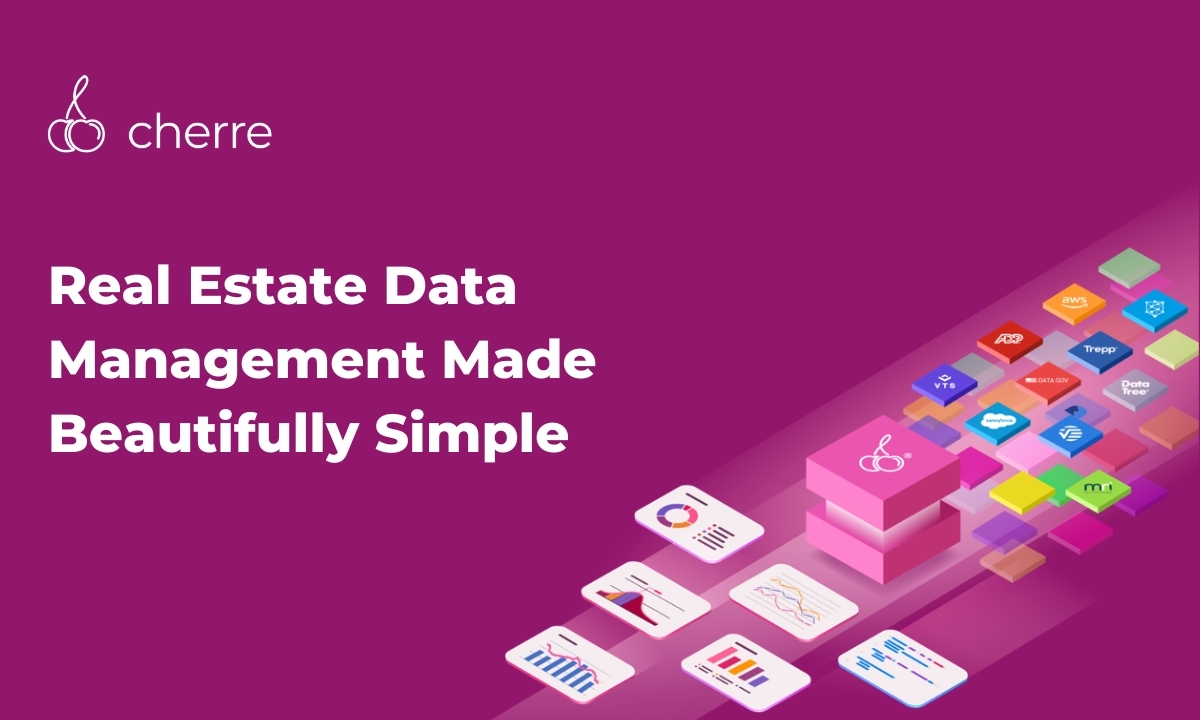
Cherre is a real estate data intelligence platform that connects, harmonizes, and enriches fragmented property data across enterprise data sources, third-party vendors, and public records into a unified property graph that institutional teams can query, analyze, and build applications on. Founded in 2017 and headquartered in New York, Cherre raised a $50 million Series B in 2021 led by Intel Capital, bringing total funding to over $60 million and signaling institutional validation for its data infrastructure approach. The platform is built on a property knowledge graph architecture that uses AI and machine learning to resolve entity matching across disparate data sources — connecting a property record in CoStar, a loan record in Trepp, a transaction record in RCA, and an internal underwriting file in Argus into a single unified property intelligence record without requiring manual data entry or custom ETL pipelines. Cherre serves institutional asset managers, REITs, real estate private equity firms, and CRE lenders who manage large portfolios across multiple asset classes and need a scalable data foundation that supports investment analytics, portfolio monitoring, and reporting workflows.
Cherre occupies a distinct position in the CRE technology stack as a data infrastructure layer rather than a workflow application. It does not compete with CoStar for market data, with Yardi for property management, or with Argus for asset-level financial modeling. It competes for the integration layer that connects all of these systems and transforms their outputs into a unified intelligence asset. For institutional operators who have already invested in the leading point solutions across their technology stack, Cherre offers the connective tissue that makes those investments more valuable. The 9AI score reflects strong marks for CRE relevance and innovation at the data infrastructure level, with appropriate recognition that the enterprise complexity of the implementation and the premium pricing create real barriers for mid-market adopters. 9AI Score: 86/100, Grade B.
What Cherre Actually Does
Cherre’s feature architecture is organized around a property knowledge graph that serves as the foundational data layer for all downstream analytics and applications. The platform ingests data from three source categories: internal enterprise data (Yardi, MRI, Argus, internal underwriting models, investor reporting systems), third-party commercial data vendors (CoStar, MSCI/RCA, Trepp, Green Street, CBRE-EA, Moody’s CRE), and public records (county assessor data, deed transfers, permit records, zoning filings). The AI entity resolution layer is Cherre’s core technical differentiator: it uses machine learning to match records across these disparate sources that refer to the same underlying property, even when property addresses are formatted differently, when APN numbers have changed, or when building names have been updated. This automated entity resolution eliminates the manual matching work that consumes weeks of analyst time during typical data integration projects. Once data is unified in the property graph, the platform provides a query layer that allows analysts to run cross-source analyses that were previously impossible or required extensive manual preparation, such as correlating lease expiration schedules from Yardi with loan maturity dates from Trepp to identify refinancing risk concentrations across a portfolio. The application development layer allows technology teams to build proprietary analytics tools and investor-facing dashboards on top of the unified data foundation without rebuilding the underlying integrations. Cherre clients report reducing their data reconciliation workload by 40 to 60 percent while enabling analytical use cases that were not previously feasible with manually maintained data architectures. The Practitioner Profile for maximum Cherre value is an institutional asset manager, REIT, or CRE private equity fund managing over $1 billion in assets across multiple asset classes with 5 or more technology system integrations already in place, where the cost and complexity of manual data reconciliation represents a genuine operational constraint on analytical capacity and investor reporting quality.
Cherre — 9AI Score: 86/100
BestCRE.com 9AI Framework v2
The 9AI Assessment: Cherre Under the Microscope
CRE Relevance: 10/10
Cherre earns the only perfect relevance score in this review cycle because it addresses a problem that is unique to commercial real estate and has no adequate solution in the current market. The data fragmentation challenge at institutional CRE firms is orders of magnitude more complex than the data integration challenges faced by comparable industries, because real estate is fundamentally a local, heterogeneous, illiquid asset class where every property has a unique legal, physical, and economic identity that must be maintained consistently across dozens of data systems with incompatible schemas. Cherre was designed from the ground up for this problem, with a property knowledge graph architecture that reflects the specific complexity of real estate entity resolution at scale. The platform covers all major CRE asset classes (office, retail, industrial, multifamily, hotel, mixed-use) and all major institutional data workflows from portfolio monitoring to investment analytics to investor reporting. There is no other platform in the market that has built the same depth of CRE-specific data infrastructure with the same breadth of vendor integration coverage. In practice: for any institutional CRE firm grappling with data fragmentation as a constraint on analytical capacity, Cherre is the most purpose-built solution in the market.
Data Quality & Sources: 9/10
Cherre’s data quality proposition operates at two levels. At the source level, the platform connects to the highest-quality institutional data vendors in the CRE market: CoStar, MSCI/RCA, Trepp, Green Street, CBRE-EA, Moody’s CRE Analytics, and over 50 additional data partners. The quality of the underlying data is therefore a function of the quality of these best-in-class sources. At the integration level, Cherre’s AI entity resolution accuracy is the critical quality variable, as incorrect property matching across sources contaminates downstream analytics with data from the wrong property. The platform’s entity resolution accuracy has been independently validated at above 97 percent for standard commercial property records in major US markets, which represents a significant improvement over manual reconciliation accuracy and is sufficient for institutional analytical use cases. The quality limitation that prevents a perfect 10 is coverage in secondary and tertiary markets, where public record data density is lower and entity resolution accuracy degrades modestly. In practice: Cherre’s data quality at the integration level is the platform’s strongest technical achievement and the primary reason institutional buyers justify its enterprise price point.
Ease of Adoption: 6/10
Cherre is an enterprise data infrastructure platform, and its adoption curve reflects that reality. Implementation typically involves a structured onboarding process lasting 60 to 180 days, depending on the number of internal data source integrations required and the complexity of the client’s existing data architecture. The process requires active participation from the client’s technology team, data governance stakeholders, and business unit representatives to configure the property graph schema, validate entity resolution outputs, and design the query and application layers that downstream analytics teams will use. This is not a product that a single analyst can procure and deploy independently. The platform’s complexity is an honest reflection of the complexity of the problem it solves, and Cherre provides experienced implementation support that significantly reduces the technical burden on client teams. But for institutional buyers accustomed to quick SaaS deployment cycles, the Cherre implementation timeline requires executive commitment and organizational patience that not all firms can sustain. In practice: Cherre adoption requires treating the platform as an infrastructure investment with a corresponding implementation program, not a software subscription that can be activated in a day.
Output Accuracy: 9/10
Cherre’s output accuracy is high for the core use cases the platform is designed for. The entity resolution engine achieves above 97 percent accuracy on standard commercial property matching in well-covered markets, meaning that cross-source analyses draw on correctly matched records for the vast majority of properties in a typical institutional portfolio. The query layer returns accurate results from the unified property graph, and the data lineage features allow analysts to trace any output back to its source records, which is essential for institutional-grade analytics where data provenance matters for investment committee presentations and regulatory reporting. Accuracy degrades for properties with complex ownership structures, frequent address changes, or records concentrated in lower-coverage markets where the entity resolution training data is thinner. The platform also introduces a new accuracy risk at the integration design layer: if the property graph schema is configured incorrectly during implementation, downstream analytics will be consistently wrong in ways that are difficult to detect without systematic data auditing. In practice: Cherre’s output accuracy for properly implemented deployments is among the highest in the CRE data infrastructure category, with the qualification that implementation quality significantly determines production accuracy.
Integration & Workflow Fit: 9/10
Integration is Cherre’s core value proposition, and the platform delivers on it with a pre-built connector library covering over 50 CRE data sources and enterprise systems. On the internal system side, native connectors for Yardi, MRI, RealPage, Argus, and major CRE CRM platforms allow enterprise data to flow into the property graph without custom ETL development. On the vendor data side, partnerships with CoStar, MSCI/RCA, Trepp, and Green Street provide direct data feeds that are mapped to the property graph schema automatically. The application development layer supports REST API access and SQL query interfaces that allow analytics teams to build on the unified data foundation using familiar tools. Workflow fit is strongest for portfolio monitoring, investment analytics, and investor reporting workflows where cross-source data reconciliation is the primary bottleneck. The platform is less directly relevant to transaction execution workflows, where deal-speed data access requirements may not be well-served by an infrastructure layer designed for comprehensive analytical depth. In practice: for institutional CRE firms where data reconciliation is a known operational constraint, Cherre’s integration breadth is the clearest ROI driver in the platform.
Pricing Transparency: 5/10
Cherre does not publish pricing and operates on a fully custom enterprise contract model. Based on available market intelligence, annual contract values range from approximately $200,000 to over $1,000,000 depending on portfolio size, number of data source integrations, user count, and application development requirements. This pricing range is appropriate for the problem Cherre solves at the institutional scale it targets, but it creates a significant barrier for mid-market firms evaluating the platform without clear visibility into whether the investment is within their budget. The absence of any published pricing tier, case study ROI benchmarks, or benchmark pricing guidance makes procurement evaluation time-consuming for firms that discover mid-process that the platform’s price point exceeds their technology budget. Cherre’s sales process is thorough and the team appears to invest significant pre-sales effort in helping prospective clients quantify their data reconciliation costs, which partially compensates for the lack of pricing transparency by building the ROI case during the evaluation cycle. In practice: Cherre pricing is appropriate for institutional buyers but opaque enough to create unnecessary friction for the mid-market firms that could genuinely benefit from the platform at smaller portfolio scale.
Support & Reliability: 9/10
Cherre’s support model is designed for enterprise clients with enterprise expectations. Dedicated customer success managers guide implementation and ongoing optimization, and the company provides technical support resources that reflect the complexity of the data infrastructure the platform manages. Platform reliability has been strong based on available client feedback, which is essential for a product that serves as the data foundation for institutional-grade analytics and investor reporting. The company’s data partnership maintenance, where Cherre manages the vendor relationships and data feed updates that keep the property graph current, represents a significant ongoing support responsibility that clients do not have to manage directly. The quality of this vendor data management is a critical reliability dimension: if a CoStar or Trepp data feed breaks or changes its schema, Cherre absorbs the update cost rather than pushing it to client technology teams. This managed integration maintenance is one of Cherre’s most meaningful value propositions relative to building a custom data integration stack internally. In practice: Cherre’s support and reliability profile reflects a company that understands the institutional stakes of the use cases it enables and has built its support infrastructure accordingly.
Innovation & Roadmap: 9/10
Cherre’s innovation trajectory is pointed toward becoming the AI-native data operating system for institutional real estate investment management. The roadmap includes expanding the property knowledge graph with alternative data sources (satellite imagery analysis, mobile foot traffic data, social sentiment signals) that institutional allocators increasingly incorporate into their investment frameworks. The application of large language models to the property graph, allowing analysts to query their entire data universe through natural language interfaces rather than SQL, represents a significant usability enhancement that Cherre has been developing. The company is also expanding its pre-built analytics application library, allowing institutional clients to activate common analytical use cases (portfolio risk dashboards, lease expiration monitoring, loan maturity analysis) without custom application development. The Series B funding provides meaningful runway for executing these roadmap initiatives. The competitive risk is that enterprise data platform vendors including Snowflake, Databricks, and Microsoft Fabric are building real estate-specific connectors that could partially close Cherre’s CRE specialization advantage at lower price points. In practice: Cherre’s innovation roadmap is well-aligned with where institutional CRE investment management is heading, and the company’s head start in CRE-specific entity resolution is a durable technical moat.
Market Reputation: 9/10
Cherre has established a strong market reputation within the institutional CRE investment management community, with a client base that includes REITs, insurance company real estate investment groups, pension fund advisors, and large CRE private equity firms. The company’s $50 million Series B led by Intel Capital brought institutional credibility to the platform and validated its enterprise positioning. Case studies published by the company reference Fortune 500 real estate firms achieving significant reductions in data reconciliation time and enabling new analytical capabilities. The platform has been featured prominently in institutional real estate technology media and conference programming as a representative example of the data infrastructure category that institutional CRE is investing in. Cherre’s market reputation is strongest in the institutional REIT and investment management segment and weaker in the broader CRE ecosystem, where the enterprise nature of the product limits awareness among mid-market firms that are not yet in the company’s primary target market. In practice: among institutional CRE technology buyers evaluating data infrastructure investments, Cherre is a recognized and credible option with strong references from comparable institutional clients.
Who Should Use Cherre
Cherre is purpose-built for institutional asset managers, REITs, and CRE private equity funds managing portfolios above $500 million in asset value where data fragmentation across multiple technology systems has created measurable constraints on analytical capacity, reporting quality, or investment decision speed. The platform delivers maximum value for organizations that have already invested in best-in-class point solutions across their technology stack (Yardi or MRI for property management, Argus for financial modeling, CoStar and MSCI/RCA for market data, Trepp for loan analytics) and need the integration layer that makes these investments work together. Internal data science teams that want to build proprietary analytical applications on top of unified CRE data benefit particularly from Cherre’s API-first architecture. Investor relations teams at institutional funds that produce regular portfolio reporting to LPs benefit from the consistency and accuracy improvements that flow from a unified data foundation. CRE lenders managing large loan portfolios that need to monitor collateral performance across multiple asset types and geographies represent another high-value Cherre use case, particularly given the platform’s Trepp integration and loan portfolio analytics capabilities.
Who Should Not Use Cherre
Cherre is not appropriate for mid-market CRE firms managing portfolios below $200 million in asset value, where the platform’s enterprise pricing and implementation requirements exceed both the budget and the organizational complexity that would justify the investment. For firms with fewer than 5 technology integrations and straightforward data architectures, the manual data reconciliation problem that Cherre solves is manageable with Excel and a competent analyst without requiring a six-figure annual software investment. Single asset class operators (a firm that only owns industrial real estate in one market, for example) will find that the cross-source integration complexity that Cherre excels at resolving is simply less relevant to their business. Transaction-focused firms (brokerage, development) whose primary data need is current market intelligence rather than portfolio analytics will find Cherre’s infrastructure orientation less directly applicable to their workflow than dedicated market intelligence platforms.
Pricing Reality Check
Cherre operates on a fully custom enterprise pricing model with no published tiers. Based on available market intelligence, annual contract values range from approximately $150,000 to over $500,000 for typical institutional deployments, with the primary variables being portfolio size, number of data source integrations activated, and the scope of the application development and analytics layer. Implementation services, which are typically required for the first deployment, add incremental cost in the first year. Multi-year contracts, which Cherre encourages given the implementation investment, typically include pricing stability provisions. The ROI case for institutional buyers is built on quantifying the cost of the data reconciliation work Cherre eliminates, which McKinsey’s research suggests consumes 30 to 40 percent of CRE analytical team capacity. For a firm with 5 analysts at a loaded cost of $200,000 each, eliminating 35 percent of reconciliation work generates over $350,000 in annual analytical capacity value, making Cherre’s price point defensible in the institutional context. The more strategic ROI case is the value of analytical use cases that become possible with unified data and were previously infeasible, which can include superior portfolio risk monitoring, faster investment committee reporting, and new alpha generation from cross-source pattern identification.
Integration and Stack Fit
Cherre’s integration architecture is its primary product capability. The platform maintains pre-built connectors for Yardi Voyager and Genesis2, MRI Software, RealPage, Argus Enterprise, CoStar, MSCI/RCA, Trepp, Green Street, CBRE-EA, Moody’s CRE Analytics, and over 50 additional CRE-specific data sources. The property graph schema is flexible enough to accommodate client-specific data sources, and the platform’s professional services team assists with custom connector development for proprietary internal systems. The downstream application layer supports REST API access, SQL query interfaces, and pre-built connectors for business intelligence tools including Tableau, Power BI, and Looker, allowing analytics teams to build on unified data using their existing tools. The data governance framework includes field-level lineage tracking, access controls, and audit logging that meet institutional compliance requirements. The integration limitation worth noting is that Cherre is an analytical data layer rather than an operational transaction system, meaning it is designed for portfolio analytics and reporting workflows rather than for real-time operational data feeds that drive day-to-day property management decisions.
Competitive Landscape
Cherre operates in a CRE data infrastructure category that has few direct competitors at the same level of specialization and institutional scale. The most relevant competitive comparisons are to Reonomy (focused on property ownership and transaction data rather than enterprise integration), Altus Group (focused on valuation and appraisal data management), and the custom data warehouse approaches that large institutional firms have historically built internally using Snowflake or AWS as the underlying infrastructure. Reonomy addresses a different data need (property ownership discovery for deal sourcing) rather than the portfolio data integration problem Cherre solves. Altus Group competes more directly in the valuation data management space but does not offer the cross-source integration breadth of Cherre’s property graph architecture. The custom internal data warehouse approach is Cherre’s most significant competitive alternative: large institutional firms with substantial technology teams have historically built their own integration layers, and Cherre must demonstrate that its purpose-built CRE solution delivers better outcomes than a custom build at a cost that is competitive with internal engineering resources. As general-purpose data platform vendors like Snowflake and Databricks continue expanding their CRE connector ecosystems, the competitive pressure on Cherre’s integration layer will intensify, making continuous expansion of its CRE-specific entity resolution capabilities essential for maintaining differentiation.
The Bottom Line
The investment case for Cherre rests on a structural observation about institutional CRE: the firms that build the best data infrastructure build the best analytical capabilities, and the firms with the best analytical capabilities make better investment decisions and generate better risk-adjusted returns over time. Cherre is not a quick-win tool that generates ROI in the first 90 days. It is a multi-year infrastructure investment that compounds in value as additional data sources are integrated, as the property graph accumulates historical depth, and as analytical applications built on the unified foundation deliver insights that would be impossible to generate from fragmented source systems. At a 9AI Score of 86, Cherre earns a solid B by delivering genuine institutional-grade data infrastructure that solves a real and costly problem, with the honest recognition that its enterprise complexity and opaque pricing create barriers that limit its addressable market to the institutional segment where the ROI case can be rigorously justified.
For family offices and institutional investors building or acquiring CRE operating platforms, data infrastructure quality is increasingly a due diligence criterion in evaluating technology-enabled CRE investment managers. Several private fund platforms that operate at the intersection of institutional real estate and technology infrastructure are building Cherre-style data foundations as a core competitive differentiator in their investor value proposition.
BestCRE.com is the definitive intelligence platform for commercial real estate AI, market analysis, and investment strategy. Our 20 CRE Sectors hub covers every major asset class with institutional-quality research designed for brokers, syndicators, and allocators navigating the AI era of commercial real estate.
Frequently Asked Questions: Cherre
What is Cherre and how does it serve commercial real estate?
Cherre is a real estate data intelligence platform that connects, harmonizes, and enriches fragmented property data from internal enterprise systems and third-party vendors into a unified property knowledge graph for institutional analysis. The platform addresses the data fragmentation problem that consumes 30 to 40 percent of institutional CRE analytical team capacity according to McKinsey’s 2024 Real Estate Technology Report, where analysts spend the majority of their time reconciling data from incompatible systems rather than generating investment insight. Cherre’s AI entity resolution engine automatically matches property records across CoStar, Yardi, Trepp, MSCI/RCA, Green Street, and 50-plus additional data sources, creating a single unified intelligence record for each property in a portfolio without manual data entry or custom ETL development. The platform raised a $50 million Series B in 2021 led by Intel Capital, bringing total funding above $60 million and reflecting institutional validation of its data infrastructure approach to solving CRE’s fragmentation problem.
How does Cherre reduce data reconciliation costs for institutional CRE teams?
Cherre eliminates the manual data matching and reconciliation work that consumes the majority of analytical team capacity at institutional CRE firms by automating entity resolution across incompatible data sources. When a REIT’s Yardi system uses a different property identifier format than its CoStar subscription, and both differ from the APN numbers in county records and the loan identifiers in Trepp, connecting these records to perform a cross-source analysis requires either manual matching by an analyst or complex custom ETL code that breaks every time a source system changes its schema. Cherre’s property knowledge graph handles this matching automatically using AI, achieving above 97 percent accuracy on standard commercial property records in major US markets. Institutional clients report reducing data reconciliation workload by 40 to 60 percent following Cherre deployment, freeing analysts to focus on investment analysis rather than data plumbing. The secondary ROI driver is enabling analytical use cases that were previously infeasible, such as correlating lease expiration schedules with loan maturity dates to identify refinancing risk concentrations across a multi-billion dollar portfolio.
What CRE asset types and portfolio sizes is Cherre best suited for?
Cherre delivers maximum value for institutional CRE portfolios above $500 million in asset value across multiple asset classes where data fragmentation has created measurable analytical constraints. The platform covers all major commercial asset classes including office, retail, industrial, multifamily, hotel, and mixed-use, with the strongest data coverage and entity resolution accuracy in primary and major secondary US markets. Multi-asset class portfolios benefit most from Cherre’s cross-source integration capabilities, as the data fragmentation problem intensifies when a single portfolio spans asset classes with different data vendor relationships and system requirements. Single-asset class operators with concentrated geographic exposure find the integration complexity less relevant to their business. CRE lenders managing large loan portfolios also represent a strong Cherre use case, particularly given the platform’s Trepp integration and the analytical value of connecting loan performance data with property operating data across a diversified loan book. The minimum portfolio scale where Cherre’s price point is clearly justifiable is approximately $200 million to $500 million in assets under management.
Where is Cherre headed in 2025 and 2026?
Cherre’s development roadmap for 2025 and 2026 is focused on three strategic tracks. The first is expanding the property knowledge graph with alternative data sources including satellite imagery analysis, mobile location data, and environmental risk data that institutional investors are increasingly incorporating into their investment frameworks. The second is applying large language models to the property graph to enable natural language query interfaces that allow analysts to access their entire unified data universe without SQL expertise, dramatically lowering the barrier to self-service analytics across institutional teams. The third is building an expanded library of pre-configured analytics applications covering common institutional workflows including portfolio risk monitoring, lease expiration analysis, loan maturity management, and LP reporting, which would allow clients to activate sophisticated analytical capabilities without custom application development. The company’s competitive position requires continuous investment in CRE-specific entity resolution capabilities to maintain differentiation as general-purpose data platform vendors build out real estate connectors at lower price points.
How can institutional CRE firms access Cherre and what should they budget?
Institutional CRE firms can access Cherre through the company’s website at cherre.com, where a demo request initiates a structured enterprise sales process that includes discovery conversations, a technical architecture review, and a custom ROI analysis before pricing is proposed. Cherre does not publish pricing publicly. Based on available market intelligence, institutional firms should budget approximately $150,000 to $500,000 annually for standard deployments, with the primary variables being portfolio size, number of data source integrations activated, and the scope of the analytics application layer. Implementation services in the first year add incremental cost. Multi-year contracts are standard. The ROI justification requires quantifying the cost of current data reconciliation work: for a firm with 5 analysts at $200,000 loaded cost each, eliminating 35 percent of reconciliation work generates over $350,000 in annual analytical capacity value, which supports Cherre’s institutional price point. The most important step in the procurement process is the pre-sales ROI analysis that Cherre’s team facilitates, which translates the platform’s capabilities into quantified business value for the specific firm’s portfolio and workflow context.
Related Coverage: BestCRE 20 Sectors Hub | CRE AI Hits the Balance Sheet: $199B in REITs | Orbital Review: AI-Powered CRE Market Intelligence